My heart breaks tonight. I have four daughters. Dear Lord, I have four daughters. What do you do? I’m going to take this to my family council this week. I have insulated myself in a world of Twinkies and DVDs. This from The Economist.
I have read few books more interesting than Temple Grandin’s Animals in Translation: Using the Mysteries of Autism to Decode AnimalBehavior.
In it she describes her world of autism and how it helped her a perspective into animals unlike any other expert in the field. She can literally see what we block out. It’s part of what helped her make a huge impact on the meat packing industry.
And it’s had an impact on her. When she was visiting her grandparents once in Arizona, she saw a squeeze chute in operation on a ranch. She saw the cattle calm, for the most part, in the chute. “Watching those cattle calm down,” she says, “I knew I needed a squeeze chute of my own.” So when she got back home she built a human-sized one with the help of her teacher. “I got through my teenage years thanks to my squeeze machine and my horses.”
Grandin is not a vegetarian activitst (she eats meat herself) or a brutal slayer. She has taken the middle ground between the fantatics that want to prevent the consumption of all meat, on one hand, or totally disregard the life of animals on the other. She writes, she says, “because I wish animals could have more than just a low-stress life and a quick, painless death. I wish animals could have a good life, too, with something useful to do. I think we owe them that.”
Temple has dozens and dozens of insights into animals, which she shares here. You’ll learn about rapist roosters and the problem of one-trait breeding, whether prediators find it “fun to kill a groundhog” (yes, she says, they do), whether animals have true cognition, and so many other things it’s impossible to list them here. I was fascinated on every page. If you have anything to do with animals, you’re going to LOVE this book.
Get the book. Read it. In the meantime, watch a 27 minute interview of Temple by Doug Fabrizio on Utah NOW. I caught this on TV flipping through the channels and couldn’t look away. This is a fascinating interview of a fascinating woman.
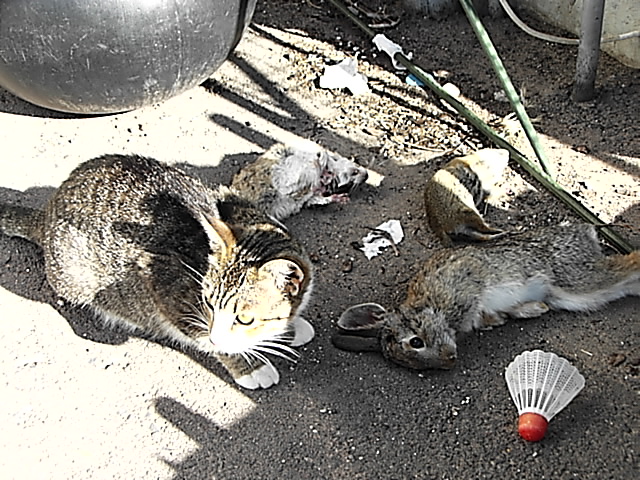
I figured regular readers would want a break from all the book release news, as fascinating as it is. And so I present to you my photograph, “Mumma, Cat of Death.” (I need a new camera. The quality of this piece of junk is so stellar.)
Mumma was a stray that showed up in our garage one day, freaked many of the long-timers, and then got pregnant. Up here in the ranch lands there are no such thing as spaying and neutering. There are a number of Toms, and, well, we were too slow with our communist population control program. So she had five cute kittens. Up until that time she was satisfied with catfood and an occasional bird or mouse. After that, she became Mumma, Cat of Death.
What you see above is only PART of the catch of ONE day: a packrat, a ground squirrel, a bird (she ate it, what you see on that piece of white paper is what she left–one leg), and a rabbit. Notice, she’s looking away from her catches. I think she was eying a visitor’s toddler at that moment, deciding if she could take him down. Every day she hunted up a few meals. And these were not for show, not nice gifts left on the doorstep for the master. No, she’d bring them up from the fields, let them ripen a bit, and then start in at the head. But she wouldn’t always eat the whole thing. Sometimes she’d leave it for the kittens. Sometimes, she’d just leave it for the next day. She turned our garage into a scene of blood and carnage.
When you live where we do, you cannot hope to landscape likes folks in a warm suburb. First of all, at 6,000 feet with a min temp of -30 Fahrenheit you can’t grow a lot of warmer climate plants. Second, the deer seem to eat everything else you do grow. So we’ve been looking and I think I’ve found a tree to add.
I actually found it earlier when I was biking around the beautiful Round Valley and had to stop and go back to revel in the delicious fragrance. But I didn’t know what it was at the time. I do now.
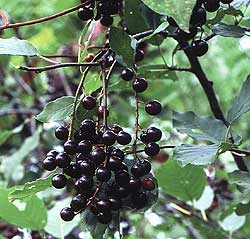
It’s the black chokecherry.
It grows naturally up here. Has beautiful fragrant blossoms in the spring. And it produces fruit that can be made into a delicious syrup. Oh, the raccoons like it as well.
Now when you eat the raw berry, unless you eat it late in the fall, you’re in for an astringent, alum after-punch. But we picked the berries up a canyon behind our town after the first frosts. In fact, many of our berries were wrinkled. They just fine raw. Even Lilia, my pickiest eater, enjoyed them.
We picked about 1.25 gallon ice cream buckets of the stuff. Then we followed this recepie and made about 4 quarts of syrup.
(I’ve heard some folks add 1/4 teaspoon almond extract for a stronger cherry taste)
Wash chokecherries, place in a large kettle, barely cover with water and cook, covered, for about 30 minutes till the cherries are soft.Mash gently and strain the chokecherry juice through a sieve or cheesecloth.
Do the same with the apples.
Pour the juice into a large kettle; stir in the sugar.
Cook on high, stirring constantly.
Boil hard for 1 minute.
Remove from heat and skim foam.
To can: Pour hot syrup into sterilized hot jars to within 1/8th inch from top.
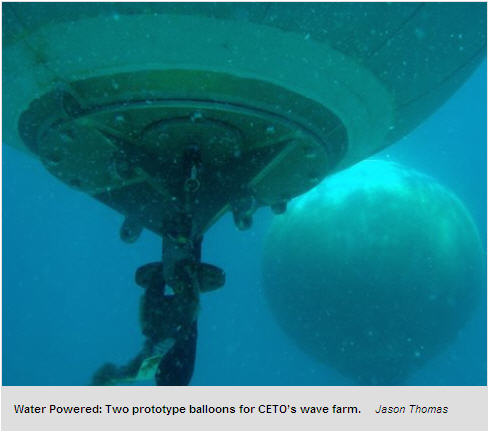
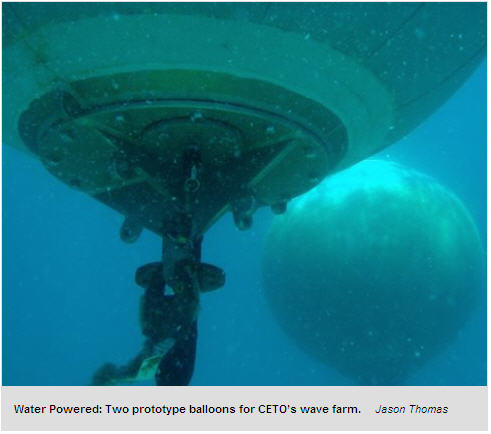
This is a fantastic article summarizing some key issues with wave energy and the solution Alan Burns, an oil bloke from Australia, has come up with. It appears he’s taking lessons from his expertise in off-shore drilling (it’s safer to work on the bottom of the sea) and applying it to wave energy. It’s a must read.
No ideas yet on how to use this in a story. If you have any, post in the comments section.
Wait, what if our hero is an inventor like Mr. Burns? Naw, what if we actually do go to the seas? It seems like a no-brainer. So we go to the seas. And our hero is the guy who is replacing parts. Humm, maybe. Of course, if our power generation is out there in the sea, then a perfect target for a terrorist is the pipe pumping the water in. Or what if they find a sea wreck while installing a huge one of these? And would the ocean floor suddenly become real estate? What kind of agent would sell it? Hummm
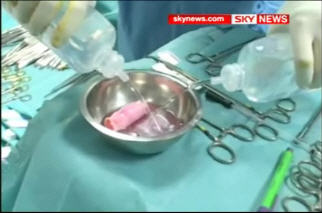
This is simply incredible. Watch the video about Claudia Castillo growing a replacement to part of her windpipe with her own stem cells. She didn’t grow the complete tube, but nevertheless…
Ms Castillo, who was born in Colombia, had suffered a tuberculosis infection that ravaged her airways, leaving her unable to do simple domestic tasks. Disease had caused her windpipe, or trachea, to collapse just at the point where it entered her lung. Without the pioneering operation in June, the lung would have been removed. Today she again has a normal life and is able to look after her two children. She can walk up stairs without getting breathless and has even been dancing.
Oh, my. Can you believe this? What the future holds for all the folks with damaged parts…
And does this mean as we age, we’ll be able to swap out the old for new? How will that affect aging? This is simply incredible.
2 Comments
That’s pretty amazing stuff. People live in such a different worlds than us. Really, we’re amazingly blessed. What are you going to do with it in family council?
I don’t know yet. I’ll present it and see what ideas we come up with to help.



That’s pretty amazing stuff. People live in such a different worlds than us. Really, we’re amazingly blessed. What are you going to do with it in family council?
I don’t know yet. I’ll present it and see what ideas we come up with to help.