|

This American Life: Superpowers

What superpower would you rather have–flight or invisibility? What do others choose? Why? What does it say about you?

Want to hear about a gal named Zora who, as a teen, made a list of everything that a superhero would have to know how to do, things like flying helicopters and diffusing bombs, and then set out to do it. Zora finished her list, btw. She’s a bounty hunter now.

You can hear this right now on  This American Life episode 178: Superpowers .

It’s a fabulous hour-long program.

Share

Similar Posts

  • If you want to work with publishers, you need this. Right now.

    thenineworstprovisionsinyourpublishingcontract-by-vandagriffWriters who want to deal with publishers need this book: The Nine Worse Provisions in Your Publishing Contract by David P. Vandagriff. And it’s currently free!

    Vandagriff is a lawyer whose business involves high-stakes intellectual property litigation. He has negotiated major contracts with a wide range of opposing parties, some of which include Apple, Hewlett-Packard, Microsoft, Intel, Morgan Stanley, Merrill Lynch, Fidelity Investments, AOL, Disney, Hallmark, plus other large publishers, agents and etailers.

    He’s also publishes The Passive Voice, a news blog on the publishing business that includes many posts from his lawyer perspective.

    Don’t fall for contract terms that turn you into a slave.

    Share
  • Masters of Chaos, Chosen Soldier, and Teenage Boys

    US Army Special Forces

    Nobody can stand up to the US Military’s conventional fighting force using conventional tactics.  Yes, Russia and China have significant militaries and a fight with them would be bloody.  But it’s not likely we’re going to go to war with them.  Instead, as we’ve seen since the 1990’s, we’re likely to fight much smaller groups—Somali warlords, genocidal brutes in the Balkans, terrorist-supporting regimes like the Taliban, unstable dictators like Saddam Hussein, or Islamic extremists who aren’t associated with any nation. 

    Those who do try to fight us conventionally get wiped out.  We saw that very clearly with Saddam Hussein.  Which is why the fight went underground.  In this type of war, when the bad guys are hiding among the good, we can’t just rush in and bomb the place to the stone age.  If we do, the local population will soon come to hate our presence and work against us.  And when that happens, we set ourselves up for defeat.

    The best way to fight against insurgents is to ally ourselves with friendly portions of the populace who can identify who the insurgents are, which doors to kick in, and can actually kick those doors in themselves, if only they get some support and training. 

    Because of this, a strong argument can be made that the US Army’s Special Forces are the most effective tool we have in winning the types of wars we’re likely to fight in the near future.

    The US military has a number of special operations forces.  Those you’re probably most familiar with are the Navy SEALs, Delta Force, Rangers, Marine Force Recon, and the Army’s Special Forces (commonly known as Green Berets).  There are other groups like the Air Force’s Combat Control Team, the Army’s 4th Psychological Operations Group, and other black op units that the military doesn’t officially recognize. There is some overlap in the types of things these forces do.  However, each has its own focus, the thing it’s best suited for. The reason why the Army’s Special Forces are so valuable in our current environment is that one of their main missions, the thing they do better than anyone else, is conducting and fighting unconventional wars.

    Along with all the other cool stuff that goes along with special operations work, Special Forces troops have to learn how to build rapport and trust because unconventional war is conducted through and by the indigenous population.  Special Forces troops not only have to know how to conduct high-risk missions, they have to be able to train others to do the same, which is why they are all required to learn a second language.  All this people work requires a more mature soldier.  And it shows: the average age of the SF operators is thirty-two, while the average age of a US Marine is nineteen.

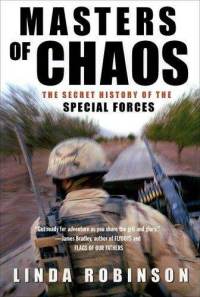
    I just read two fabulous books on the Army’s Special Forces.  The first is Masters of Chaos by Linda Robinson. Robinson was given unprecedented access.  She traveled with them to the front lines and was allowed to interview and report as no other had been allowed up to that point.  She starts with a brief history of the SF and their training; she then details missions the Special Forces carried out from 1989 – 2003, including their work in Panama, El Salvador, Kuwait, Somalia, the Balkans, Afghanistan, and the second gulf war.  My eyes were opened to the significant role they’ve played in all these conflicts.  It was absolutely fascinating.

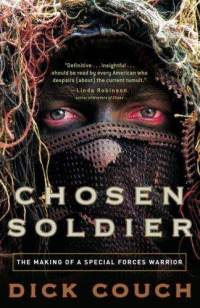
    The second book is Chosen Soldier by Dick Couch. Couch, a former Navy SEAL and CIA case officer, is the only writer ever given the privilege to attend the many months of Special Forces pre-selection, preparation, selection, and qualification training from start to finish.  He was given “full access to all training, venues, students, and training cadres.”  Couch did not merely interview.  He and his wife moved to one of the few residential structures on base at Camp Mackall in North Carolina.  Couch went out with the SF candidates to observe first hand exactly what they did, and, in a number of instances, do it with them.

    One of the things I loved about this book are the personal bios given about the backgrounds of the various candidates.  They are not at all what you’d expect—everything from bouncers to engineers to one fellow who had a degree in and a passion for Russian literature.  I also enjoyed the details he gave about the training.  There are about 1.2 million people in the US Army.  Only about 5,000 of them are in the Special Forces.  When you finish, you have a good feel for the types of things they learn and why about 80% of those who volunteer for training wash out.

    I couldn’t put either of these books down.  If you decide to read them, let me also recommend you download and read Army Field Manual 3-05.20 Army Special Forces Operations as well, which is the Army’s “keystone manual for Special Forces (SF) doctrine” that “describes SF roles, missions, capabilities, organization, command and control, employment, and sustainment operations across the operational continuum.”  You can find it here: http://tinyurl.com/3ryt3o3.  For those who just want an overview of these forces, the Army has provided a great site here: http://www.goarmy.com/special-forces.html. 

    The Boys of Laketown and Round Valley

    Every school morning my wife and two oldest girls hunt.  They eat their breakfast perched high on a hill and watch for the quarry.  When it appears, a shout is raised, and the trio races to the car.  They blast out of the garage, perform an expert three-point turn, then Monte Carlo down the winding hill road.  Next, they attempt to set a land speed record on the straight shot into town, all in an effort to catch the big yellow school bus. 

    Most days they make it.  The bus makes a few stops in town.  Sometimes they’re not so speedy and can only manage to catch the bus at its last stop.  Sometimes I join in on the hunt.  Most of the time I catch the bus at its last stop in town.  But this week I was quick enough to get them to the third stop in front of the middle school where most of the teens board the bus.  And I had the privilege to witness a class act.

    The first time I arrived with my payload, all but two teen boys had already boarded.  We raced up to the bus, my daughters flew out of the car, and the two teenage boys from Round Valley stopped.  They did not get on.  They waited for my girls to hustle the length of the bus.  My girls got on, and the boys followed them in.

    Odd.

    The next day we got there a little bit earlier.  This time I witnessed ALL of the boys from Laketown and Round Valley stand and wait for all the girls to get on first.

    What was this? 

    I asked my girls about it.  They confirmed—it wasn’t a fluke.  While first initiated by the bus driver, the boys have the class to show this courtesy every day. 

    Teenagers . . .

    Bravo, Gentlemen.  Bravo.

    Share
  • |

    American Idol Story Elements

    I don’t have time to watch, but I found myself getting sucked in this week. And here’s something I realized as I watched Simon, Paula, Randy, Ryan, & the contenstants–the show is using story principles.

    Idol

    Duh, I know: of course, it is. But it does it so well. It reminds me of a research article I read about sportscasters and audience enjoyment of sports competitions. They found that if they could inject story elements–suspense, rivalry, etc.–people enjoyed the games more. Next time you watch a college football game, notice what the color commentators say to make it a contest. It’s not just about reporting what #45 did out in the flat.

    Anyway, back to Idol. Look at these elements.

    What draws us to characters?

    Beauty, threats, quirkiness, larger-than-life situation or skills, source of viewer wish-fulfillment.

    Humm, let’s look at the cast of performers. Don’t we see all of that? How many of us wouldn’t love to be able to sing like they do? Have a shot at becoming a recording artist? Or just goggle at someone getting this chance?

    What factors generate suspense?

    Threats to characters we like or marvelous opportunities for them, turns in the situation, a prolonged resolution.

    Humm. Our sympathy is engaged because these folks are normal folks, many of them underdogs. Many viewers identify strongly with one or two because of the contestant’s various social groups and because, heck, the auditions are for people like you and me. It could be us up there in front of the world! You’ve got the threat of peformance fright, but also the overriding opportunity to make a dream real. You’ve got a wonderful career, if not millions of dollars, on the line. You’ve got Simon who is honest, but also plays his part. Isn’t that the moment of most suspense with each performance? You’ve even got a little subplot going on between Simon and Seacrest. There’s no villain here. But there are plenty of obstacles. Weekly threats.

    What does Idol give us that Survivor never could?

    It’s all REAL, even if the producers let their selection of performers be influenced by things other than vocal talent. And because it’s real, we believe it. Which means we can more easily feel sympathy and root for the various performers.

    It’s a simple but brilliant concept. And I just wasted 4 hours watching it. And I’m likely to do it again.

    Zing, Baby. Zing!

    Share
  • Why I’m gonna purchase Correia’s MONSTER HUNTER ALPHA on Monday

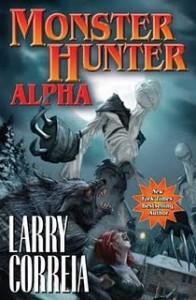
    I’m going to be purchasing MONSTER HUNTER ALPHA by Larry Correia on Monday.  Here’s why.

    Reason #1: Correia delivers the goods

    I read MONSTER HUNTER INTERNATIONAL.  I ended my review of MHI saying Correia was going to be a writer to watch.  Well, for those of you who haven’t been watching, not only did Correia  sell tons of copies of MHI, he also made the New York Times best seller list with his second book AND sold TV rights to the MHI series to a major TV producer.

    Why would his books generate such a response? Because they’re so dang fun. That’s why. And Correia isn’t just a flash in the pan one-trick pony. Far from it, as demonstrated by Reason #2 below.

    I told you in my review of INTERNATIONAL that I don’t read books that don’t suck me in. I don’t give them 70 pages to warm up and get going.  I don’t care who wrote the book. I don’t care if the author is a big lug with guns. I don’t care if he has status and money or friends who can put the hurt on me. I don’t care if the author is my girl’s godmother and brings me Walker Shortbread Rounds (which are evil cookies that exert mind control). If the book bores me, I put it down. That doesn’t mean that books which bore me aren’t wonderful. Sales and numerous reader exclamations of delight and satisfaction attest to the the fact that many are. It’s just that I’m a reader of little patience. I love it when a book starts with a bang and keeps me hooked. And Correia’s books do exactly that.   

    Reason #2: Correia’s getting better

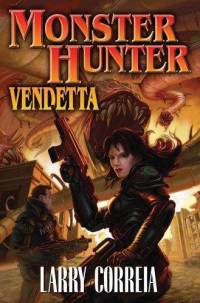
    I read MONSTER HUNTER VENDETTA recently.  I should have reviewed it, but I’ve been so freaking busy I barely have time to shave or appear in public because I’ve begun to look like the Unabomber. But here’s the deal with VENDETTA–it’s better than INTERNATIONAL.  

    Yes. Better.
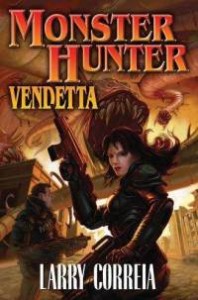
    Well, expect for maybe the opening paragraphs. The quote and first few paragraps that opened INTERNATIONAL are hard to beat. This doesn’t mean the opening of VENDETTA is weak. Heck, no. VENDETTA trounces the openings of most novels and steals their lunch. And then it continues to delight all the rest of the way through. It’s just that it didn’t quite deliver the same jolt as MHI. But 500 or 503 watts, what’s the difference?

    So with VENDETTA, are there guns? Yes.

    Monsters? Check.

    Action? There’s action galore.

    It appeals to my testosterone right off the bat (even though Larry reports that a good number of his readers are women). But there are guns, monsters, and action in a lot of stories that stink. What Correia does is not only give us great action, but he also gives us wonderful new situations.  For example, you will never see the scene set in the ghetto of Birmingham, Alabama that appears here in any other book. Never. It’s a Correia original. But even more important than great new situations, is that he gives us a first-person narrator who is delightful to be around. I’m talking about Owen Zavasta Pitt, the accountant monster hunter. His responses to the situations he gets in just make me laugh, as do a number of the responses of the other characters. My only wish is that Correia would tone down some of his language just a bit.  It is possible even when writing about military characters.  But you can’t have everything, and Owen’s such a loveable lug, I overlook it.  Hey, maybe Milo will help him out on that as the series progresses.

    Furthermore, Pitt isn’t the only character who I find delightful or interesting.  In VENDETTA there is also Holly, Agent Franks, and G-Nome, one of Correia’s best yet. Of course, there’s also the Doctors Nelson, the former hunter Carlos, Melvin the troll, and Earl Harbinger who have their own moments to shine. As do Owen’s dad and brother. And Dorcas, MHI’s secretary with the plastic leg. Heck, I even like Susan.

    So how many is that–eleven already? How many wonderful characters do most authors give you in one book? Two or three?

    And that’s one of the things that is is better with VENDETTA than INTERNATIONAL.  In INTERNATIONAL, as good as it was, some of the characters just didn’t get the stage time they needed to shine. But here Correia declutters his scenes so we’re not trying to focus on too many people. The result is that those we do focus on each have the their moments and lines. The other thing I noticed was that Correia deftly orients us to each new situation. For those of you who are writers, let me suggest you look at Correia’s technique in VENDETTA for introducing characters and settings. 

    Another good thing: he wipes out a Girls Gone Wild camera crew in the first chapter. Anyone who does that gets a few points in my book.

    VENDETTA doesn’t attempt to become bigger in scope than INTERNATIONAL (as if it could). Instead, it feels like another episode in a great tale. And I’m happy with that because it promises more to come. I’m back with characters I like and situations that make me laugh and magic crap that evokes some oohs and aahs and every now and again makes me wish I’d come up with it for my own use.

    Finally, VENDETTA leavens the humor and action with a couple of poignant moments. I’m thinking of a chapter with Carlos, another scene with Owen’s dad, and one with G-Nome.

    As you can see, VENDETTA’S packed with goodness.

    With ALPHA, I’m expecting to hook up with at least one of the gang for more exploits and laffs. Will Correia get even better? I have no doubt he will. But who cares–he’s already delivering great stuff.  

    Reason #3 Did I mention that Correia makes me laugh?

    Just didn’t want to forget that. Furthermore, I swear I read somewhere that laughter increases your health and makes you live longer. So not only am I getting a great read, I’m extending my days upon the land.

    Reason #4 Monday is a special day

    Not any old Monday. But the 25th of July.

    Why is this special?

    Because it’s the first day of the first week of the book’s release.

    Now I know I’m going to buy this book sometime. But buying it in the first week lets me do something I might not be able to do at some other time.

    Because Correia has given me hours of pleasure, I figure I can tip him for his good service by helping him make the best seller list again.  And a book has the best chance of making that list in the first week of release. (For those of you interested in how that works, Larry gives a good explaination here.) Making a best seller list does all sorts of good things for an author, and, as a result, that author’s readers.

    So Monday’s my day to leave the tip on the table and tell the owner to keep up the good work.

    The New York Times list is a good one. But I’d like to see him on the USA Today list, which measures sales so much better than any other list out there. My fingers are crossed.

    For those of you who are Correia fans or who have been putting off giving his stuff a go, now’s the time to either get MHI and begin the series or ALPHA and continue the delight.

    EDIT: After I posted, I couldn’t wait and just went ahead and processed my order. Pre-orders will count in that first week, and after writing this I couldn’t resist. Looking forward to more hours of laughter and some great characters.

    Share

3 Comments

  1. We taught that same age of kids in primary for quite a while. Loved it. It’s a wonderful age for some really interesting things to happen in church. I miss primary, now that i’m out of it.

Comments are closed.