|

This American Life: Superpowers

What superpower would you rather have–flight or invisibility? What do others choose? Why? What does it say about you?

Want to hear about a gal named Zora who, as a teen, made a list of everything that a superhero would have to know how to do, things like flying helicopters and diffusing bombs, and then set out to do it. Zora finished her list, btw. She’s a bounty hunter now.

You can hear this right now on  This American Life episode 178: Superpowers .

It’s a fabulous hour-long program.

Share

Similar Posts

  • |

    Wowser sequence in Life season 1 episode 3

    I just started watching Life, the NBC series. I’ve enjoyed the first four episodes. In fact, episode three has one of the most brilliant sequences I’ve ever seen.

    Here’s the setup. Charlie Crews is a detective who was sent to jail for a murder he didn’t commit. Being a cop in prison made him a target for many many beatings. Eleven years later they found none of the DNA at the murder site was his. So they released him, and, as settlement for damages, gave him a bunch of money, and allowed him to be a cop again. He’s been partnered up with Dani Reese. Nobody really wanted him, but she’s had problems of her own and got stuck with him. Crews had a car in the first episode, geeked out about GPS and handsoff telephone (stuff his missed in prison), but the ex-con lawyer Crews has put up in his mansion ran it over with a tractor. He’s been riding the bus. In this sequence, Crews and Reese are looking for a guy named Manny Umaga who carjacked a man and his wife then shot the wife. In this sequence they go find where he is and then go get him.

    Watch it and then read my comments below. It runs from minute 15:49 to 21:15.

    1. Surprise. You walk into a dangerous car shop. What are you expecting? You know you’re going to meet hard characters. They’re not going to want to talk to you. There’s some danger and so a bit of suspense. So we meet some hard characters. I was still surprised by the particulars of Buscando Maldito–his neck tattoos and hat. Wonderful and new (at least to me). But before we can have a confrontation–surprise–Crews sees the car of his dreams. Then we get that wonderful exchange between him and Maldito and El Repitito. Total humor. Totally unexpected. Then Maldito suggests a posse? Not only is he willing to talk, but he suggests he goes with them? When going to get Umaga, more surprises. Flash bangs? Big honking Samoan running? Busts down the door? Takes Crews by the neck? Crews pulls his own knife? Surprise after surprise after surprise.

    2. Characters. Loads of interest factors (see my post on character). Maldito and Repitito have fabulous eccentricities. Crews displays his own interesting reaction to the car. Surprising, but logical (BTW, in a later scene you see him driving the car!) Then we see his prison background coming up with the knife. Love his backstory. And did you notice how strong Reese is, taking none of Maldito’s crap?

    3. Dialogue. Did you notice how the first few times Reese says anything to Maldito he doesn’t respond to her question? Total avoidance of on-the-nose dialogue, talking cross-purpose.

    4. Soundtrack. The way they bridged the two scenes with that music was fabulous. And the music itself. Wow. BTW, that’s “No Nadie” by Edgard Jaude, Rafael Torres, & Andres Ayrado.

    5. Conflict. Between the Maldito and Crews about the car, between Maldito and Reese, between Umaga and Crews. Then Crews and Reese (with the knife).

    I think I watched this a dozen times. Loved it.

    Share
  • Good Stuff! Mr. Holmes and 13 Hours, the book

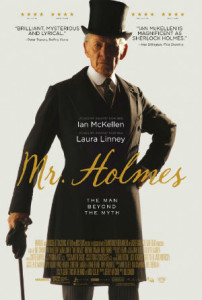
    Earlier this month I watched Mr. Holmes.

    Mr._Holmes_poster

    It left me with this fine peace. With this feeling of goodness and light, in spite of, or probably because of, a number of poignant moments. It also surprised me.

    To write a story like this, to give people this kind of gift…

    What a wonderful, powerful thing.

    Now, it was not a thriller. It’s not an episode of Sherlock or Elementary. It’s not a murder mystery. It reminds me of Saving Mr. Banks most, but also of Miss Potter, maybe even The King’s English. It has that kind of tempo.

    Basically, Sherlock Holmes is a much older man. He’s retired. And there’s a case he’s trying to solve. But, again, this isn’t a murder mystery. This story is about Sherlock himself and wisdom and the beauty of change whenever it occurs.

    The story lingered with me, and I avoided reading or watching anything else for a few days to savor it. Give yourselves a treat. Watch this wonderful story.

    *

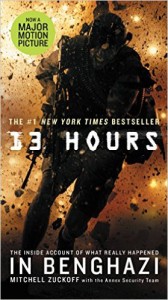
    The book 13 Hours: The Inside Account of What Really Happened in Benghazi was the answer to so many questions.

    13_Hours_ZuckhoffWant really happened in Benghazi?

    What we’re we doing there?

    Who are the brave men who tried to save the ambassador?

    It was also a thrilling read in the tradition of Marcus Luttrell’s Lone Survivor. As such, it purposely avoids the political aspect of the incident. It’s not about what the officials of the United States government did, said, or knew, or the political firestorm that ensued.

    It’s not a hit piece on Clinton and Obama, nor is it any kind of defense. Instead it simply documents the events on the ground in those last 13 hours, relying most heavily on what the five American security contractors who rushed to give aid said happened. Those men–two former Marines, two former SEALs, and a former Army Ranger—teamed up with Mitchell Zuckoff, the writer, to simply set the record straight.

    I couldn’t put the book down. Not only because the book’s well-written and the characters and situation are compelling, but also because of the insight it shared into some key dynamics within Libya itself. For example, it helps you understand why the revolt against Muammar Gaddafi centered in Benghazi, not Tripoli. It also touches on some of the currents inside these Muslim-majority countries close to the epicenter of Sunni extremism—Egypt and Saudi Arabia–so volatile. And it shares details, large and small, as only those who experience such things first hand can.

    If you want a fascinating account of really happened on the ground in Benghazi, get this book.


    Share
  • Leonard and Lady Randy (yes, that kind of randy)

    Maybe you’ve heard this one from Paul Harvey. Can you guess who it is?

    “Escape!

    Of all the positions in the field of journalism, that of war correspondent is perhaps most dangerous. Some are captured, some escape. Some die.

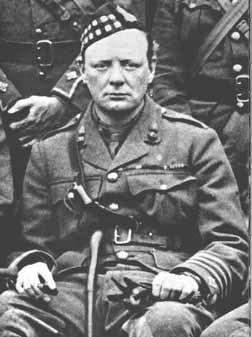
    Twenty-five-year-old Leonard Spencer was the London Morning Post’s newest correspondent. His assignment was the Boer War, in South Africa.

    Had young Leonard foreseen the peril awaiting him, he would probably have taken the assignment anyway. That’s how Leonard was.

    About twenty miles from Ladysmith, Leonard could hear the booming guns. He was aboard a British armored train that would take him as close to the front as he could get.

    The train got too close. There was a sudden crash. The train had struck a boulder on the tracks … a Boer booby trap. It was an ambush!

    Immediately, a fusillade of rifle fire followed. Surprised, British troops on the train fired back.

    And Leonard? Leonard ignored the gunshots and exploding shells. He jumped off the train, directed the British defense, helped to clear the wreckage.

    In fact, without the aid of this youthful correspondent from the Morning Post, the train might well have been lost and the British troops massacred.

    Instead, the wreckage was cleared, the train did pull out of the trap and carried a good many British soldiers with it.

    The one left behind to face the enemy…was Leonard! No, the story does not end sadly there.

    Leonard was captured, unharmed. Even though Leonard was technically a war correspondent, the Boer commander was sufficiently impressed with his bravery…to have Leonard thrown into prison at Pretoria.

    The Pretoria prison was among the world’s most carefully guarded strongholds. Still, that did not stop Leonard from plotting an escape with two other British captives.

    As darkness fell, the trio waited for their opportunity. It was now pitch black. The sentries exchanged their posts. Leonard sprang across an open area, hurdled a fence of barbed-wire mesh. When he looked back, there was no one. His comrades had missed their chance!

    Three hundred miles of hostile territory lay between Leonard and his freedom. For a while, he followed the railroad tracks to the east, stumbling alone, through the dark, dodging enemy patrols. Tired, hungry, thirsty…Leonard plodded long into the night, knowing that, each painful foot of the way, one false step could be his last.

    The night turned to day and back to night again, until the days and nights blurred.

    Finally Leonard reached a mining town. His luck wearing thin but holding, he knocked on the door of the only Britisher in the territory and was smuggled onto a train loaded with bales of wool.

    The train would carry him to the British consul. To safety.

    And that’s how Leonard Spencer, the London Morning Post’s fledgling correspondent, got his story…and his reputation for daring.

    History has all but forgotten this incident in his life in order to make room for later glory.

    The fortune that once seemed to be wearing thin had only begun…and one day rubbed off on all of England.

    For the young correspondent who once upon a time saved a British armored train and escaped the enemy under impossible circumstances…continued to do the impossible for the rest of his life.

    We knew him as Sir Winston Leonard Spencer Churchill!

    And now you know THE REST OF THE STORY.”

    Um, no, not even close. 

    When I read about the childhoods of famous historical figures I’m often surprised. For example, I’m still freaking out that Hitler was a street artist. So I ran across this article today about Winston Churchill’s childhood and his mother who was nicknamed “Lady Randy” for her promiscuity (rumored 200 lovers).

    She had no time for Winston. Other people raised him. Yet she wasn’t completely absent in his life. Apparently, she called on favors from previous lovers when Winston needed to learn French. Nevertheless, it appears Winston was raised without a father or mother, yet ends up being the kind of man who could lead a nation at war.

    This is fertile ground for drama of the best kind.

    I’m going to be seeking out some biographies. It’s going to be fascinating seeing how Winston pulled it off and who influenced and helped him along the way. 

    There’s one thing more. These facts aren’t all that drew me. What Winston wrote upon his mother’s death, well, it’s the finest poetry I’ve heard this last month.

    “I do not feel a sense of tragedy,” he said, “but only loss. Her life was a full one. The wind was in her veins.”

    That metaphoric power of that last sentence given her history and relationship with him–it’s stunning. 
     
    Read a summary of the documentary here.

    Share
  • Two Jillian Workouts & Gottman’s Seven Marriage Principles

    Jillian Michaels is, in the words of my brother-in-law, “the woman who chases the fat people around.” And indeed, as one of the main trainers on the TV series Biggest Loser, she gets those folks moving. But I didn’t know anything about her or the show earlier this year when a friend recommended her 30-Day Shred DVD workout (thank you, Mr. Dayton).

    I’m a cave dweller. I sit in my little basement office and do my thing. And I have to make sure I get some type of exercise lest I turn into a great jelly. So I’m always on the lookout for a good workout. But it’s got to meet certain standards. I don’t want anything that’s Mickey Mouse. And I don’t want any froo-froo.

    So I asked this friend if these workouts featured a bunch of women dancing around in fruity outfits, because I can tell you right now, as open to new experiences as I am, I wasn’t going to buy a leotard and tip toe through the tulips with them. My friend assured me it was froo-froo free. And boy was he right.

    Jillian shows up with two other gals, gives you a two-minute warm up, and then proceeds to bust your hiney with three circuits of strength, aerobic calisthenics, and ab exercises. The strength exercises include things like push-ups and squats with dumbbell military presses or curls. The aerobic segments have you doing jumping jacks and jump rope. The ab portions run you through all manner of crunches and lower ab exercises. The three circuits take twenty minutes to complete. And there are three different levels of workouts on the DVD.

    I walk or hike three miles a day four days a week, and so I thought I was in reasonably okay condition. Jillian disabused me of that silly notion. I couldn’t keep up. Heck, the first dozen times through the workout I think I spent half the time either catching my breath or trying not to faint.

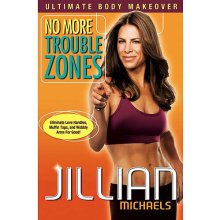
    But I kept with it and got stronger. And then I found Jillian’s No More Trouble Zones. This is a forty-minute workout. And I defy any of you he-men out there to try it and tell me you can keep up with this broad in this DVD. I still pant like a dog and have to take breaks when I do the workout. My only consolation is that Jillian and her two smiling evil pals work out with three-pound dumbbells while I work out with seven, fifteen, and twenty-five pounders.

    Like the shred workout, this forty-minute workout is comprised of circuits. But in the trouble zones workout there is no jumping about. It all double-whammy exercises that have you working both your upper and lower body at the same time or doing some killer ab maneuver. You’ll do pushups, squats, curls, a vicious plank circuit, and a dozen other exercises. You’ll work your triceps, biceps, shoulders, back, abs, and legs multiple times. This workout is no joke. 

    If you’re looking for an intense workout that doesn’t waste your time, I think you’ll enjoy either of these Jillian DVDs. All you need are a few dumbbells, a mat if you’re working on a hard surface, and prayer beads for those moments when you suspect you’re about to give up the ghost in a muscle-burning cardiac arrest.

    *

    Back in April of this year, Dr. Liz Hale, a licensed clinical psychologist, started her remarks to a local audience of more than 100 mental health professionals by saying, “Dear fellow colleagues, you are in danger of having an affair.”

    Her point was that every marriage, even those of the marriage gurus, is vulnerable to infidelity–be it sexual or emotional. Individuals have to actively curb all the subtle and often innocent beginnings that lead to unfaithfulness.

    “We make the mistake of thinking (marital) vows will keep us safe; and they don’t,” she said. She went on to say that couples cannot depend on love or similarities to keep their marriage intact. It’s not enough.

    Emotional or sexual infidelity isn’t as rare as we might think. But even if we don’t stray into some type of unfaithfulness, that doesn’t mean a marriage will stay together. Like anything worth having, a good relationship takes work.

    But what kind of work? What are the key principles for making a marriage last?

    For many years the prescriptions of marriage gurus were based on anecdotal evidence and rules of thumb—on opinion. Because the opinions weren’t tested, they led to all sorts of errors. For example, many yet believe that the road to marital bliss is through communication, specifically through successful conflict resolution. According to this idea, happy couples are those that have learned to resolve all their conflicts in a nice manner. The problem is that when conflict resolution was put to the test, the studies showed it didn’t work. Marriage therapies based on conflict resolution share a very low success rate—over the long haul they only work about 20% of the time.

    So what does work?

    John Gottman is a marriage counselor who took a different approach and started to collect rigorous scientific evidence on over 650 couples, tracking the fate of their marriages for up to fourteen years. The results of his work are startling.

    He uncovered a number of relationship myths, including the one about communication. He found that happy marriages were never perfect unions. These satisfied couples often had differences in temperament, interests, and family values. They argued over money, kids, and housekeeping, just like unhappy couples did. They had problems and faced issues. However, all these satisfied couples also practiced seven principles, even if they didn’t know it, which helped them navigate their way through all the difficulties and keep their marriages happy and stable.

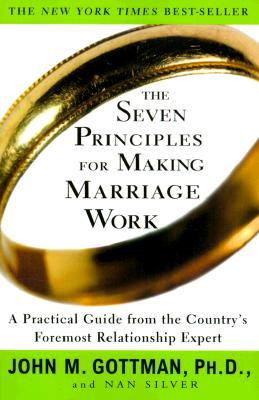
    And it’s not just opinion. The success rate for the type of marital therapy based on his research is 80%. He knows what makes marriages work and has written it up in a fabulous book called The Seven Principles For Making A Marriage Work.

    Every marriage is vulnerable to failure. It takes work to enjoy a satisfying relationship with a spouse. But it’s so much easier to improve and maintain a relationship when you’re working on the things that actually make a difference. If you want to improve your marriage, give Gottman’s book a read.

    Share
  • The Veggie from Outer Space & The Mentalist

    I’ve been trying to increase my intake of vegetables and fruits because you are what you eat, and I think I’d like to look like a broccoli—long, sturdy, and with a lot of bushiness on top. So we’ve enjoyed our weekly box of fruits and veggies from the Bountiful Baskets co-op that we pick up in Garden City each Saturday.

    And we’ve enjoyed the surprises. Because someone else orders the produce, we never know quite what we’re going to get. Of course, this also means we sometimes get things we don’t normally seek out. Take cauliflower, for instance. We received a number of heads three or four weeks in a row back in October.

    Cauliflower?

    Who eats cauliflower? You ever hear anyone say: “Cauliflower’s on—let’s make a run to Brigham City to get some,” or “LaVern, I believe I’m going to knock back another floret,” or “It’s a party! You bring the chips and soda, I’ll bring the cauliflower?”

    No. We don’t hear those things because cauliflower is just weird. It’s the stuff that nobody eats on the vegetable tray. It looks like some growth spore from the planet Xenon. In fact, I want to know who started the rumor that aliens had big eyes and spindly limbs. That’s all propaganda. The aliens are already living among us, and cauliflower is their freaky pupal metamorphosis growth stage!

    Or, at least, that’s what I thought. Then I ate a serving of creamy mashed cauliflower at Ruby Tuesday’s and gained a testimony of both Ruby Tuesday’s and the weird white cousin of cabbage.  

    So when we received our surprise veggie, did I despair or use it for target practice on the idiot orange tom cat that comes around our house? No. I went to search for that Ruby Tuesday’s recipe. And through the miracle of the internets, I found it. Or something close enough for government work.

    Here it is. Enjoy.

    CREAMY MASHED CAULIFLOWER

    • 1 head cauliflower
    • ¾ C water
    • 1 T corn starch
    • 1/3 C heavy cream
    • 1 t granulated sugar
    • ¾ t salt
    • Pepper to taste
    • 1/8 t garlic powder
    • 1/8 t onion powder
    1. Divide the head of cauliflower into florets that are all roughly the same size. Steam or microwave until cauliflower is tender (we pressure cook it). Drain and toss it into a bowl of ice water to bring the cooking process to a screeching halt.
    2. Put florets into a food processor along with ½ C water. Puree on high speed until smooth, but with some small bits for texture. Or you can simply mash it like you do potatoes.
    3. Pour all the puree into a medium sauce pan. Dissolve the corn starch in the remaining ¼ cup of water and add to the puree.
    4. Add the cream, salt, pepper, garlic powder, and onion powder to the mixture and stir. Set the saucepan over medium heat and cook, stirring often, for 5-10 minutes, or until thick.

     You can experiment and switch the water for milk if you’d like, or if you don’t have cream. Leftovers are delicious. Of course, if I end up lumpy and round, you know it’s the cauliflower’s fault, or the alien’s that has set up shop in my chest cavity, whichever’s the truth. 

    For those who haven’t tried Bountiful Baskets, go to bountifulbaskets.org for more info. For those who wonder if cauliflower has any nutritional value at all, here’s the wikipedia on its goodness:

    “Cauliflower is low in fat, high in dietary fiber, folate, water and vitamin C, possessing a very high nutritional density. As a member of the brassica family, cauliflower shares with broccoli and cabbage several phytochemicals which are beneficial to human health, including sulforaphane, an anti-cancer compound released when cauliflower is chopped or chewed. Boiling reduces the levels of anti-cancer compounds, with losses of 20–30% after five minutes, 40–50% after ten minutes, and 75% after thirty minutes. However, other preparation methods such as steaming, microwaving, and stir frying had no significant effect on the compounds.

    Along with other brassica vegetables, cauliflower is a source of indole-3-carbinol, a chemical which boosts DNA repair in cells and appears to block the growth of cancer cells. The compound also appears to work as an anti-estrogen, appearing to slow or prevent the growth of tumors of the breast and prostate. Cauliflower also contains other glucosinolates besides sulfurophane, substances which may improve the liver’s ability to detoxify carcinogenic substances. A high intake of cauliflower has been found to reduce the risk of aggressive prostate cancer. Cauliflower is also a good source of carotenoids.”

    I guess the short version of all that is blah blah blah science says it’s good.

    ***

    Nellie and I have been enjoying The Mentalist for two years now. It’s a CBS crime thriller mystery series about a “mentalist,” a guy named Patrick Jane, played wonderfully by Simon Baker, who used to be a professional mind-reader and psychic, and a very good one at that, but gave it up and came clean. All psychics, he says in the pilot episode, are either fakes or deluded.

    But he was so good at it and made so much money–why would he give it up?

    Because a serial killer named Red John murdered his wife and daughter. So Jane has dedicated his life to hunting down and killing the murderer. To do that, he becomes a consultant to the California Bureau of Investigation (CBI) and works with a team of investigators.

    Some of the episodes are about the hunt for Red John. Many more are about other cases the team has to solve.

    Patrick Jane is the main attraction of the series. His outrageous behavior, acute observation skills, and keen wit all fascinate and delight. As the series progresses, the other characters take on their own interesting personalities as well. Agent Cho, for example, provides many moments of laugh-out-loud deadpan humor.

    The series is into its third season, but with the miracle of Netflix you can start at the beginning and watch them all commercial free at your own leisure.

    Share
  • Stonefather by Orson Scott Card

    stonefather_72dpi“When Runnel was born, he was given a water name even though there had never been a wetwizard in the family.

    In the old days such names were given only to those babies as would be sacrificed to Yeggut, the water god. Later, such names were given to those whould would live to serve as priests to Yeggut. Still later, wetnames went to children of families thath pretended they once had a watermage in their ancestry.

    But now, in the village o Farzibeck, wetnames were given because the mother was fond of a nearby brooklet or because the father had a freind with such a name.”

    So begins Stonefather by Orson Scott Card. It tells the tale of Runnel who is the ninth son and fifteenth child of a farmwife who likes all her children well enough but calls them all “by each other’s names and didn’t know enough numbers to take a census and notice when one or two were missing.”  He’s also the son a man who beats him. Eventually, Runnel leaves home and seeks his fortunes in Mitherhome, the big city far to the south.

    This isn’t a full novel, but a novella of 112 pages. However, the Subterranean Press edition has a glorious cover and ink illustrations inside. More importantly, the story tells a tale that’s full of wonder, humor, and a number of delightful characters. It reminded me of the best of Card’s Hatrack books. But, of course, this world is very different. It’s strange, and I was happy to explore it with Runnel as my guide. Take an hour to read this. You won’t be disappointed. Then you can look forward, as I do, to the first of the Mithermage novels based on this world.

    Share

3 Comments

  1. We taught that same age of kids in primary for quite a while. Loved it. It’s a wonderful age for some really interesting things to happen in church. I miss primary, now that i’m out of it.

Comments are closed.