
Similar Posts
Goodies from Curse of a Dark God
Bow to the dark god, ye minions. Here’s some of what’s coming in book 2:
- The dogmen of Toth and their maulers
- The Ungar and the one they call Ruin
- The tanglewoods of the woodikin
- Firesteeds
- Gloryweaves
- Nashrud the hunter
- And last, but not least, the Orange-eyed priest of Mungo
The end is in sight on the first draft of book 2 in the Dark God series, and because this one has been a roller coaster, I had to post some of the coolness before I have to go back into frantic mode. My word count estimates for this book have been so consistently off it hasn’t been funny. Literally. It’s made me panic and stress. It should clock in around 220k. And then it’s going to be cut, cut, cut.
In the meantime…dogmen of Toth (give it the James Earl Jones).
Oh, baby.
NEWS: Finished line edit of Servant
It took me 33 hours, but I just finished reading through SERVANT and marking the manuscript up with the line edits I need to make.
Holy smokes, folks, but it’s going to be a bigger edit than I originally thought. I knew I wanted to resequence chapters 1-8 back to the way I originally intended them. I knew there were some typos. And I knew I needed to add some content surrounding Purity’s story. But as I read I found that I was making line edits on almost every page. For those unfamiliar with the term, you have basically four edits.
- Content or story edit
- Line edit
- Copy edit
- Proof edit
The story edit is just what it says: you’re looking at plot and character. In this edit, you might add or cut whole chapters or story lines.
Once the story is good, you do a line edit. In this edit you’re looking for how well the actual words on the page flow. You’re looking for parts where what you’re trying to say isn’t clear, where sentences or paragraphs are awkward, or where you haven’t been consistent. In this edit, you rewrite sentences and paragraphs.
Next, there’s the copy edit. Back in the old days, you had essentially three versions of the work. You had the original manuscript, which might go through many edits for the story and flow. Once it was good, the manuscript would be given to an editor who created a “copy” that could be used by the typesetters. Of course, before you handed that over to the folks setting the type, you wanted to make sure it was clean because making changes in type is a pain in the butt. So in this edit, you’d go over it one more time, looking for typos and grammar issues. At this level, you fix words within sentences, although many times this edit will be combined with a line edit.
Finally, there’s the proof edit. A proof was a copy of the work that had been set into type and printed. The typesetters would look at the their typesetters copy and then physically take metal sorts and mount them in a press to match it. To print it, they would ink the sorts and make an impression onto blank paper. That’s how stuff was printed.
Nowadays, you don’t need to manually set the type–you just print directly from document on your computer. So you don’t have to worry about errors introduced into the text because of the typesetting. However, as many writers will attest, you simply do not see things on the computer screen that are obvious on the printed page. And so you always want to print out a proof and then edit it one last time for any errors in formatting or for small copy or line edits.
So this last read was more or less a line edit. I did make some content-sized changes. And I did mark it up for typos and grammar stuff. But the bulk of the changes were line-level stuff, and I have to say I’m amazed at how many there are. I guess this simply means I’ve grown as a writer. But it is going to take some time to finish. I’ll then give the manuscript to my wife who is great with copy editing. And do another revision.
I have to say I enjoyed reading the stories of Talen, Sugar, Argoth, and Hunger again. Some of the events had dimmed with time, and I was delighted to read them again. Parts of this book just make me so happy. With a couple of them I was all, dang, this story is awesome!
***
Still working on the cover design for the Dark God books. Hope to finalize the basic structure this week and commission an artist. I’ll post the process and get your feedback as we go.
Hitler’s Father and Snake Venom
Hitler

I’ve just begun HITLER by Ian Kershaw. Fascinating. And full of zing. Did you know that Hitler’s father:
- Smoked like a chimney
- Went to beer table after work instead of home
- Took little interest in family and had multiple affairs with women
- Beat Adolf almost daily, his gentle mother sometimes waiting outside the door while he thrashed his son
- Had a passion for bee-keeping
See, it’s weird, unexpected, almost against-type details like the last one that always seem to stimulate the zing meters.
3 ways that snakes kill

Let’s see: digest you, hundreds of blood clots, and brain attacks. Cool visuals of how the 3 types of venom work!
And article explaining more about venom and why, for instance, sea snakes have such quick killing venom or why cobras have venom that could kill an elephant with one bite.
So after reading this, I’m thinking of Vonda McIntyre’s Dreamsnake where in the future this woman uses snakes to manufacture medicine. Not in a factory, but in the snakes themselves. And she delivers them through natures brilliantly evolved hypodermics.
But what other applications are there of this to a story? Heck, a murder mystery where you’d need to know the type of venom and the snakes nearby, a new type of dragon’s breath (instead of fire, could they breathe out a fog of one of the three toxins?), some new enzyme protein cocktail that leads to…superhero skills or is it immortality?
Sura cover reveal
Behold the cover. A big thanks to Dixon Leavitt for the art.
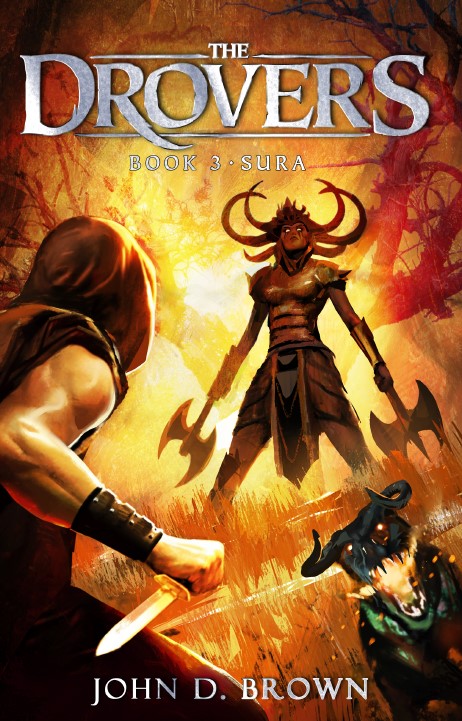
And here’s the description we’ll be using.
Nobody in their right mind travels through this place.
All Ferran wants to do is get the cattle to Broniss, get paid, and free his family from the threat of slavery. But an unexpected and terrible enemy takes most of the crew prisoner in the Blight.
Ferran, Winwallom, and Sura, the fierce Mashadian girl none of the boys trust, must free them.
But how will they when the trio is vastly outnumbered, they’re days from help, and other things lurk in the woods?
I’m so excited to get this book into your hands. I had a blast writing it.
If you don’t want to wait, Sura is now available for preorder.
John Brown will keynote at American Fork Arts Council writers conference
The city of American Fork is putting on what looks to be a great writer’s conference. I’m very pleased to announce that I’ve been asked to present the keynote speech.
Keynote: The 3 Things You Must Learn to Write Killer Stories
When: Saturday, April 25, 2009, 9:00 AM
Location:
American Fork City Arts Council
31 N. Church Street
American Fork, UT 84003
(801)763-3081This looks like a great opportunity if you’re a writer. Here’s what the organizers envision.
We have editors from Desert Book, Covenant and Cedar Fort coming to speak as well as National Book Award finalist Sara Zarr, Kristen Langdon, Ginger Churchill, Linda Bethers, Anita Stansfield and others. The goal is to provide a space for local writers to interact with local editors and local authors for inspiration, motivation and guidance in the tricky world of writing and publishing. To that end, the editors will be holding a query letter clinic using query letters from participants, which I think will be super useful. The editors are also speaking on what they want and don’t want as far as submissions, and the state of regional publishing in 2009 given the world upheaval. The authors will all be speaking on how they got an agent, how they got a book deal, what they have learned about writing.
More info: American Fork Arts Council
“From the Clay of His Heart” reprinted
 I loves me golem story. It was such a joy to write. Obviously, two editors found it a joy to read as well. So it was just reprinted in Year’s Best Fantasy 9 edited by David Hartwell and Kathryn Cramer and published by Tor.com.
The good thing is that there is a whole boatload of other great stories in this anthology including one of my favorites, Kij Johnson’s “26 Monkeys and the Abyss.”
Here’s the Amazon link.