Excellent advice from author Larry Correia

Larry just wrote a great post about Writing Gun Stuff. Down at the bottom, he says this:

I’m not one of those people who gets hung up on “rules of writing”. . .  If it is awesome, and your readers like it, write it. [emphasis added]

Amen to that. And if you’re going to write about characters with guns, read the rest of the of the post.

Share

Similar Posts

  • Binge read

    “When you are really and seriously stuck and you hate everything you’ve written, BINGE READ.”

    That’s from super author Maya Lassiter. If you recall, she did a great guest post here on her creative process. I love this technique for getting unstuck. When you binge read (or watch), not only do you see other options that you might take and adapt for your purposes, but those other options also spark whole new ideas.

    I just used this with the battle I’m writing for Curse. I wasn’t to the hate stage; I actually liked what I had. But I didn’t quite know how to get it to where I wanted it to be. So I decided to read some books by one of the masters of historical battle.

    I binge read and listened.

    And enjoyed the heck out of both the reading and the ideas I gleaned for my sequence.

    Binge read.

    It’s an awesome creative technique.

    Share
  • |

    Indie Thoughts: When an author should self-publish and how that might change

    From publishing consultant Mike Shatzkin:

    For a number of reasons, the belief here is that most of the time for most authors who can get a deal with an established and competent house, their best choice is to take it.

    Sounds reasonable, but then we get to the money quotes.

    The strength of the traditional publishers and the traditional deals is directly related to the amount of the market that is served by inventory in stores. When that proportion was “nearly all”, the power allocation was “nearly all” to the traditional publishers.

    ***

    Self-publishing and new-style digital-first publishing can grow more to the extent that the book-in-store share of the market shrinks more. But while that’s happening, the big publishers are also adding to their capabilities: building their databases and understanding of individual consumers (something that all the big houses are doing and which the upstarts seem not to believe is happening, or at least not happening effectively), distributing and marketing with increasing effectiveness in offshore markets, and controlling more and more of the global delivery in all languages of the books in which they invest.

    It will compound the pressure on the alternative players if Amazon continues to grow its global market share for ebooks. The bigger the percentage of the market that can be reached by self-publishers with one stop at Amazon, the less interest they’ll have in picking up smaller chunks of the market with additional deals and the more powerful will be any incentives Amazon cares to offer for making the title exclusive to them.

    Link to the rest at The Shatzkin Files, and thanks to Passive Guy for the original link.

    Shatzkin’s discussion of the amount of the market served by inventory in stores is right on. But his “best choice” conclusion doesn’t follow.

    Why?

    Because the question for each author has to be which stores will I be in, what kind of floor space will I have, and how long will I be there? And in many cases the answers to those questions do not compete well with indie options.

    For example, a lot of in-store sales come from the drug store, grocery store, airport, Walmart, Costco type venues. But it’s rare than an author getting an average deal will see the light of day in those places. Those are reserved for bigger sellers. And not very many of those. So unless you’re getting a big deal, you can’t count that floor space.

    Poof. Tens of thousands of venues are now no longer part of the equation.

    So you are now left with whatever number of stores the publisher can get you into at Barnes&Noble (a max of 675 stores), Books-a-Million (max of 200 stores), Hastings (max of 149 stores), non-chain stores,  etc. I think the total number of book stores in the USA is around 10,000 or so. But publishers won’t get you into all of them. Some don’t carry your type of book: they’re used books stores, or kids book stores, or Christian book stores. And even if it’s a store like Barnes&Noble, you probably won’t get into all their stores. So how many stores will you actually be in?

    Next, you have to wonder where you’ll appear in the stores you do get into. Will you be face-out somewhere prominent? Or will you have two copies spine-out in the back? If you’re spine-out, that’s just reduced the value of the floor space publishers offer you yet again.

    Finally, how long will you be there? If you sell your two copies in a store, are you done at that store? Will your books be there longer than 12 weeks? Will they be there even 8 weeks?

    James Patterson can sell millions of books because he has multiple copies in tens of thousands of stores with great display. And he’s usually there for more than just a handful of weeks. If you have two books spine-out in each of 500 stores for eight weeks, how well are you going to do?

    Here’s some math on author revenue and units sold. Is selling 1,000 books with the royalties and contract terms offered really worth it? What about 4,000 books? 7,000? Are you going to be in enough stores with a decent placement to get those numbers?

    If you’re going to be in thousands and thousands of stores with good placement, and the terms of the contract are reasonable, then, good golly, working with a publisher looks great. But if you’ve got a book that’s good enough to make an editor somewhere want to buy rights to it and the publisher is offering to put you spine-out in a little over a thousand stores with all sorts of contract crap, then Shatzkin’s “best choice” is really a poor one. In those situations my money is on going indie.

    EDIT: It seems there are about 12,700 book stores in the USA. But that includes big-box stores, which I think are the Walmarts and Costcos.

    Share
  • Indie Thoughts: Lessons from Heather Justesen

    From Heather Justesen, who writes clean romance.

    Two years ago I was working full-time for peanuts (seriously, it didn’t even cover the mortgage–and we didn’t live in a palace.) I quit to write full-time before I went completely insane. By December 2012 I had replaced my c-store income. By April 2013 I earned enough to pay ALL of our bills. Since then I’ve been the primary wage earner for our family, allowing my husband to close the business that was sucking all of the life out of him, and for us to move halfway across the country. He does bring in some money still, but even in my worst month we can pay all of the bills from my writing income. I’ve sold (real sales, not counting freebies) over 60K books in the past eighteen months. I’ve got audiobooks for most of my indie titles and I’m starting to see sales into bookstores. I would have to have one heck of an offer to even consider a traditional publisher’s contract. I’m very happy the way things are.

    * * * *

    Kevin, don’t lose hope. I have books that sell in the single digits every single month despite great reviews. And I have books in a different genre that sell really well every month (not blockbuster well, not top 100 well, but enough for us to get by on.) I didn’t do it with the first or second book, or the fourth book, I had nine books out before I started to make pay-the-bills money, and most of the money, even now that I have 18, comes from a single series. The others make very little [emphasis added]. Maybe give the genre a twist and try something a little different, but still in your general area of interest. Try a different genre that interests you, or just hang on and keep writing. Get feedback, learn more, and keep working at it. I wrote for nearly a decade before I had a book good enough to be in print (before Kindle really took off, or I had enough trust in myself to go it alone, so it was with a small press.) This is a craft, you can’t learn it overnight and success rarely comes overnight[emphasis added].

    Having three books out making six figures a month is crazy good, and definitely not the norm, and yeah those kinds of numbers can be discouraging, but a lot of the other stories here show that it can come. Most people who persevere eventually start to make decent money in indie publishing if they’re doing everything else right. Your covers are pretty good, so try changing up the descriptions and see if that helps. And keep writing.

    More on The Passive Voice.

    A series, lots of product, and an audience that has been under-served for years.

    Share
  • Larry Correia & The Monster Hunter Nation

    Gotta love this. I just got back from the dermatologist’s. Yesterday it was determined that the thing growing on the side of my nose was not an alien (darn it!) but a squamous cell carcinoma. So the Doc had his rat chew the thing off my face today. He showed me my nose in a mirror so he could explain how he couldn’t just sew up the hole because that would create a pucker. Instead, he needed to cut all the way up the bridge of my nose and then all the way down along the edge of my nostril to make an L-shaped skin flap that he could then stitch up so it would heal all nice and pretty. As he was explaining, I got a good look at the gaping bloody hole–it was the size of your pinky nail, folks. He also told me stories of his time in Russia. His medical assistant told me one of her husband’s run-in with the mafia in Milan. A good time was had all around. Then 30 or so stitches later I came home and found that Larry Correia was up to no good again: Let’s Book Bomb the Hell out of John Brown

    So the paperback of SERVANT OF A DARK GOD, which releases in two weeks on November 2nd, started off ranked #220,997 on Amazon. I just checked the rank. As of 2:22 pm we’re at #5,686. Can’t wait to see where this goes today.

    Whatever happens, I think I’m going to end up owing Larry and the Monster Hunters some ballistic tip bullets and hand grenades.

    EDIT: it’s 3:29 am on Wednesday, October 20th. Just dragged my sleepy hiney back from doing recordings with the Writing Excuses team in American Fork (they’ll publish in November). And lo, the Monster Hunter Nation did bomb the book, and it did rise in rank until it did verily hit an Amazon bestseller list.

    Amazon Bestsellers Rank: #3,068 in Books (See Top 100 in Books)

    #65 in  Books > Science Fiction & Fantasy > Fantasy > Epic

    It reached this point sometime while I was on the road. As of right now Servant is:

    Amazon Bestsellers Rank: #3,394 in Books (See Top 100 in Books)

    #88 in  Books > Science Fiction & Fantasy > Fantasy > Epic

    And so it was written that the Monster Hunter Nation was awesome to behold. It’s hand grenades for sure.

    EDIT: Here we go. Day 2 9:50 am.

    Amazon Bestsellers Rank: #3,568 in Books (See Top 100 in Books)

    #85 in  Books > Science Fiction & Fantasy > Fantasy > Epic

    EDIT: end of day 2.

    Amazon Bestsellers Rank: #4,776 in Books (See Top 100 in Books)

    Share
  • |

    American Idol Story Elements

    I don’t have time to watch, but I found myself getting sucked in this week. And here’s something I realized as I watched Simon, Paula, Randy, Ryan, & the contenstants–the show is using story principles.

    Idol

    Duh, I know: of course, it is. But it does it so well. It reminds me of a research article I read about sportscasters and audience enjoyment of sports competitions. They found that if they could inject story elements–suspense, rivalry, etc.–people enjoyed the games more. Next time you watch a college football game, notice what the color commentators say to make it a contest. It’s not just about reporting what #45 did out in the flat.

    Anyway, back to Idol. Look at these elements.

    What draws us to characters?

    Beauty, threats, quirkiness, larger-than-life situation or skills, source of viewer wish-fulfillment.

    Humm, let’s look at the cast of performers. Don’t we see all of that? How many of us wouldn’t love to be able to sing like they do? Have a shot at becoming a recording artist? Or just goggle at someone getting this chance?

    What factors generate suspense?

    Threats to characters we like or marvelous opportunities for them, turns in the situation, a prolonged resolution.

    Humm. Our sympathy is engaged because these folks are normal folks, many of them underdogs. Many viewers identify strongly with one or two because of the contestant’s various social groups and because, heck, the auditions are for people like you and me. It could be us up there in front of the world! You’ve got the threat of peformance fright, but also the overriding opportunity to make a dream real. You’ve got a wonderful career, if not millions of dollars, on the line. You’ve got Simon who is honest, but also plays his part. Isn’t that the moment of most suspense with each performance? You’ve even got a little subplot going on between Simon and Seacrest. There’s no villain here. But there are plenty of obstacles. Weekly threats.

    What does Idol give us that Survivor never could?

    It’s all REAL, even if the producers let their selection of performers be influenced by things other than vocal talent. And because it’s real, we believe it. Which means we can more easily feel sympathy and root for the various performers.

    It’s a simple but brilliant concept. And I just wasted 4 hours watching it. And I’m likely to do it again.

    Zing, Baby. Zing!

    Share
  • | |

    Teachers (and writers)! Free Class Next Monday on How to Teach Narrative for the Common Core

    If you feel a bit lost or anxious about how to teach narrative for the new core, especially stories, I think I can help.

    I’m an educator in the private sector and an award-winning novelist and short story writer. I’ve been teaching authors in various venues how to write for the last five years. I’ve been on writing podcasts with thousands of listeners, taught at a number of writers conventions, and had a series of articles published by the national Science Fiction and Fantasy Writers of America organization, an organization for professional authors. I’ve also been helping Nellie, my wonderful wife, teach her 7th and 8th grade language arts students the unit on short stories during that same period. We’ve taught it to twenty different classes and picked up a number of important insights along the way.

    This last year I couldn’t help but examine all the materials Nellie brought home during the district’s writing program adoption investigations. Some programs looked very promising; others not so much. Some got some things about writing flat out wrong. Most of the programs had gaps.

    Furthermore, because I work with so many people wanting to write, I know that it’s difficult to teach if you really don’t understand what stories really are and how they work. For lots of people, the subject matter can seem impenetrable. And yet writing stories is such a wonderful way to teach writing, especially because so many kids love it. You won’t find a kid who will spend extra hours writing a business letter or poem analysis, but you will find quite a few who will go crazy writing stories. And the whole time they’re practicing their writing skills.

    The question is how DO you write a story?

    What is a story?

    How can you tell if it’s good?

    How do you come up with ideas?

    Where do you start?

    And what the heck is this chart? Do writers really use this? (Not many that I know.)
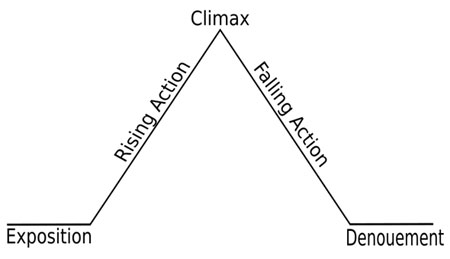
    Story Diagram plot-mountain-pic

    And does anyone think changing the diagram to look like Aspen, Colorado actually helps?
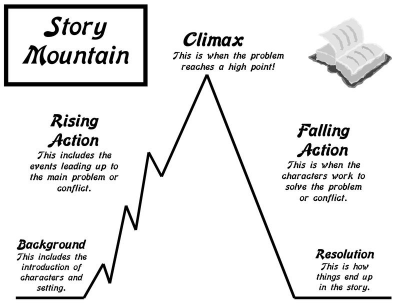
    Story Diagram Aspen 

    Hey, students—please make your story look like Aspen, Colorado!  (Yeah, that’s going to be effective.)

    And yet it’s not as difficult as it appears. Nellie and I have seen a lot of kids really get into writing stories. We’ve seen kids WILLINGLY going way beyond the assignment to write stories that are eight, twelve, twenty-five plus pages. And as they’re writing, they’re practicing grammar, spelling, structure, vocabulary, etc. without knowing it and having a great time. I know that if you enable your students, many of them will write, write, write. Especially in grade school. But also in the higher grades.

    Stories can be a blast. The assignments can connect to many students. And the results can be wonderful. I’ve laughed out loud at some of the stories coming out of Nellie’s class. Others have been enjoyable on other levels.

    But for this to work in your class, you need to know some key things. You need to understand the core of story and the story development process. You need a lesson plan that details everything step-by-step so your students don’t flounder. And you need to know some fundamental tips (secrets?) about teaching this content.

    So I’m going to hold this day-long class for you. A full eight hours. And share everything Nellie and I have learned. This class will be for teachers at ALL levels (I’ll show you some ways to scale the complexity of what you’re doing). There will be NO cost. The only thing you have to bring is a pencil, paper, whatever program materials you have, and a willingness to have a good time.

    When we finish, you will know how to write a simple story like the ones your students will write because, ta-dum, you will write one! AND you’ll have a step-by-step lesson plan that builds on whatever materials you have—an official program or one of your own. AND you’ll understand story better than 99% of the population. AND you’ll have a bundle of techniques to help your students. AND you’ll solve both world peace and maybe the lost sock conundrum.

    Truly, I think that instead of feeling stress, you’ll actually be looking forward to teaching and writing stories with your students. If not, you may bring tomatoes and huck them at me, but please be aware that I will not stand still; to find satisfaction, you will have to be able to hit a moving target.

    If you’re interested, just click the Contact John link under my photo in the left sidebar and send me an email letting me know.

    Hope to see you in class!

    GET READY FOR A FUN DAY OF LEARNING!

    Topic: Teaching writing (narrative & the common core)

    Who: Teachers (and writers at least 18 years old), seats are limited

    When: Monday, July 29th, 8:15 AM – 5:00 PM

    Where: Rich Middle School, 54 E 100 S  Laketown, UT 84038

    Materials you need to bring:

    • Pencil
    • Paper
    • The writing program you’ll be using this year
    • Kooky socks, for those who cannot resist the urge
    • A lunch or a way to get one

    AGENDA

    8:15 AM Arrive

    8:30 AM – 9:20 AM

    • Can you create a redneck crapper?
    • The 1st secret to teaching writing: Attributes & techniques
    • The 5 parts of story
    • Thieves prosper – using existing patterns
    • A car, a beggar, and an idiot — basic pattern 1

    9:30 AM – 10:20 AM

    • The 2nd secret to teaching writing: Do it with them
    • Technique: Sketch then draft
    • Workshop 1: Zombies and kisses
    • Technique: Zing hunting
    • Workshop 2: Hunt zing

    10:30 – 11:20

    • What makes a story big or small
    • Workshop 3: Select a right-sized THOM and character
    • Workshop 4: Select a Goal
    • Workshop 5: Make character sympathetic
    • Workshop 6: 3 tries
    • Workshop 7: Resolution

    LUNCH

    12:00 – 12:50

    • The 3rd secret to teaching writing: Cognitive modeling and the 6-step process
    • The 4th secret to teaching writing: Our tiny brains
    • Writing is telling: Narrative & description
    • Technique: Yes, SiR
    • Technique: Broad-brush + 1
    • Technique: The Pause

    1:00 – 1:50

    • The 5th secret to teaching writing: Have fun
    • Workshop 8: Write your story

    2:00  – 2:50

    • How the pros revise—concept, line, & copy
    • Workshop 9: Content edit
    • The 6th secret to teaching writing: Our brains are still tiny
    • Workshop 10: Line edit

    3:00 – 3:50

    • The 7th secret to teaching writing: The 3 grunts (responding to a story and grading)
    • Share stories
    • What the heck did we just do?

    4:00 – 4:50

    • How to adjust for grade level
    • Common core
    • Your program and lesson plan
    • Identify black holes
    • Wrap up & next steps
    Share