I’ve had a number of people ask me where I am with the second book. I have the progress bars on the side, but they don’t give any details. So I thought I’d start up a semi-regular post that would be something like a writer’s journal. We’ll see how it goes.
Right now I’m working on the climax of CURSE OF A DARK GOD. For the last two weeks I’ve been struggling trying to figure out the flow. I knew in general what I wanted to have happen. I had some images and the general feel–spectacle, revelation, battle at the fortress–knew I had to fulfill some expectations I’d raised with four characters. But I didn’t know the exact steps of the scene, the back and forth. I also hadn’t figured out the exact details of some of the magic that would be used.
I outlined the objectives and plans of the two opposing warlords and then the steps of the scene. I listed my objectives for the scene. I do this sketching, sometimes exploratory drafts, to help bring the scene to life in my mind. I find that until a scene is alive in my mind, it’s impossible for me to write. Anyway, over the course of two weeks I went through six takes of the scene, and it still didn’t feel right. I won’t give the details and spoil the ending, but it just wasn’t there and I was getting frustrated. I’m behind on my deadlines and a book’s ending it critical. I talked a few things over with Nellie and made some headway, but it just wasn’t there.
So I called a brainstorm meeting. I’ve never done this before for my writing work. I mean, I’ve bounced things off individuals (mostly Nellie) many times and found good resolutions, but I’ve never had a group. However, I felt I needed some extra input to get my mind going down new paths. Lenn Johnson, Amy and Alex Lamborn, and Miles and Becky Pinter came over. I borrowed a white board and easel from my church and made gingersnaps. When they arrived, I sat them around our kitchen table with Nellie and had them riff on one question while I captured their answers and ideas on the white board.
It was incredibly productive. Partly because they came up with some great ideas I’m going to use. But also because it got me thinking in a new way which allowed me to come up with an idea that resolved the main issue I was dealing with. That was last Thursday. The next day I sat down and outlined a scene that did everything I wanted it to, including giving me the “oh, baby” feeling. It feels right. I have the spectacle, the revelation, the fulfillment to the expectations for the characters. I’m excited to write it. Which means I can now move forward. This week and next I hope to finish. After that there are a few small things I need to insert and clean up. Then it’s off to my editor.
BTW, I did some calculations. For those interested, in this draft, the third, I ripped out 50% of the draft two and completely rewrote it. New problem and situation for two of my three points of view, major changes, etc. I heavily revised above 20% of the remaining 50%. I’ve put in a little over 500 hours working on this draft over the last six months.
500 hours (remember, I still have a day job).
I am a slower writer than many. But it still would have been a huge task even if I could write twice as fast as I do. I think this is a perfect illustration of three things. First, if you don’t fix some things you feel are off when you find them, you might find you have a massive amount of rework later. Second, sometimes you don’t recognize you have those issues until you’re well into it. Third, writing requires the author to make time. I think this is the most important one. And the one that probably kills most aspiring writers. The fact is that if you can’t make time, you ain’t going to write 🙂
Melissa Mead lives in Upstate NY with her husband and cat. Her stories have recently appeared in IGMS and Daily Science Fiction. She’s a member of SFWA, Codex, and the Carpe Libris Writers Group: http://carpelibris.wordpress.com/. She too had a story to tell about using questions to help her develop her published stories. I think it’s worth sharing.
Melissa
My Double Dragon novel Between Worlds (Double Dragon Publishing) came about because of a reading mistake.
You see, I’d come across the word “cantrip.” Not being a D&D player, I’d never heard it before, so I went to the OED and looked it up. The first definition said “A minor spell or incantation.” The second said “A mischievous trick,” but somehow I misread it as “A mischievous sprite.”
Oh wow- a mythological being I’d never heard of! I ransacked the library looking for any reference to those mischievous sprites. Didn’t find any, of course. Finally I decided that if I couldn’t find them, I’d make them up. So I started asking myself “What are Cantrips?” From the definition, I figured they must have some minor magical powers, and were most likely small.
So why hadn’t we heard of them before? Perhaps they were hiding.
Why were they hiding? Perhaps something awful had happened between humans and Cantrips long ago, driving the Cantrips underground. Literally.
Then why we were hearing about them now? Something must have happened that made staying hidden more risky than coming above ground. Starvation? Underground isn’t the best place to maintain a steady population. But that’s not very dramatic or personal, for story purposes. Maybe, in addition, there’s an outside threat.
Ok, so someone needs to confront this threat. One person, so we have someone to focus on. Someone more adventurous than your typical Cantrip.
And so Miska, and all the Cantrips, brought a new form of mischievous sprites to the world.
All because of the question “What the heck is a Cantrip?”
John Sez
First of all, notice she followed her zing. She stumbled upon this new creature and started to research. Her research didn’t provide much, of course. But following that impulse is key.
Next, did you notice she kept asking why? Why don’t we know about Cantrips? Why did they go underground? Why are they returning? That’s a motive or cause question.
There’s no way you’d use those exact questions in your story. But you WILL want to know WHY things are they way they are. You will want to know motives and causes, internal and external. You’ll want to know WHY your hero is facing this problem, WHY the antagonist is working against her, WHY the hero decides to tackle the problem instead of ignore it or run away. When the hero reacts and makes a decision to do X, you will want to know WHY (as well as WHAT’S THE RESULT). Same with the antagonist. When building setting, you might find it useful to ask things like WHY did they build a village here or WHY is my character a tailor? Do you see?
In addition, I’ve found that replacing “why” with “what” seems to be more productive to me. So “what led or caused my character to be a tailor” helps me more than “why.” “What’s motivating the antagonist” helps me personally more than “why is he doing this?” That might be my own weirdness, but I think “what” subtly leads me straight into nouns and situations and values and beliefs. Try it on and see if it doesn’t help you.
Finally, did you notice her use of objective. The story about overpopulation in the underground didn’t interest her much. She wanted something with an active antagonist. Something that could focus on a character. Knowing that objective, she started generating options that might fit the bill. Which lead to the cool idea of a new type of mischevious sprite.
Follow zing. Use the “what” (why) to identify cause and motive. If you can, state your objective; the clarity will give your wonderful mind a focus for its generating powers.
I was saddened today to learn that Dave Wolverton, best known by his pen name David Farland, passed away this week.
Dave was such an incredibly helpful mentor to me. It was the workshop he held at BYU back in 1993 that made me think I could actually write stories that entertained people. It was that workshop that prompted me to start submitting to the magazines.
And when I finally got my first publication, he was involved. He was the initial judge for Writers of the Future when my story won a first prize. And he was there, helping lead the writer’s workshop in Cocoa Beach, Florida and cheering all of us on.
Later, when I started writing novels, it was his thoughtful feedback that helped me improve my second novel to a publishable level. He believed in it enough to write a recommendation for me to Tor Books. When they decided to publish me, it was Dave that agreed to take me on tour with him. I enjoyed hours and hours driving with him, chatting, laughing, and signing at bookstores in Washington, Oregon, and California.
He was always interested. Always friendly. Always willing to talk and share his expertise. And always had great stories to share about his life.
As an entertainer, his stories thrilled me. In college, I was swept away by SERPENT CATCH, PATH OF THE HERO, ON MY WAY TO PARADISE, and THE GOLDEN QUEEN trilogy. My wife and I had so many delightful hours reading that trilogy to each other.
I still remember going to the bookstore in Pleasanton, California in 1998, hoping to get a copy of RUNELORDS when it was first published, being so excited when I found it on the self, opening it, and reading the first pages. They completely enthralled me. Blew me away. I felt like I was in the cinema. I loved that series and was always waiting for the final book.
I loved Dave’s stories. I appreciated so much his many kindnesses to me and his good humor.
May you rest in paradise, my friend, until the trumpet sounds.
Quesion: is it dangerous as a writer to try to improve your style?
A lot of respected authors say it’s foolishness to focus on style. Because story is what people want. Story is the thing. Put all the lipstick you want on a pig, it’s never going to be anything but a pig.
I agree with them. Why fiddle with the words when the content oinks? If you have to focus on something, focus on delivering killer stories.
However, story content is not everything. There is a feeling that comes with how the story is written. You can serve prime rib on fine china in a $100 / plate restaurant, or you can serve it in a cardboard box out on the back lawn by the shed. Same beef, but not quite the same experience.
Orson Card is one of those who cautions against thinking about trying to improve your style. I want you to read this.
Question 5:
I would like to use the discussion in Lesson One as a springboard to my own inquiry. I understand that obsessively analyzing the style in which one writes can lead to bigger problems. However, my problem is not with an overall stylistic deficiency, but a very specific one. Through dialogue, the voices of the characters speak with one another. Are there any techniques you can offer which make the process of composing dialogue any easier? (I don’t expect a wonder formula, just some methods which would help me organize my thoughts a little better.)
— Submitted by Jennifer Dittrich
OSC Replies:
Composing Dialogue
The secret is not to think about dialogue as a separate task. You aren’t writing dialogue, you’re writing an encounter between characters. Part of the encounter is what they say, but part of it is how they react to each other, what they want from each other, what has happened between them in the past, who else is watching and the impression they want to make, and so on. When the characters speak, therefore, they aren’t “speaking dialogue,” they’re using words to do something to the other person — sometimes to try to get the other person to understand some information, but more often to get the other person to do something or feel something or reveal something. That’s what you concentrate on, and then come up with words you might use to accomplish that character’s purpose. Sometimes you’ll try many different opening lines as a conversation begins, and see where they go; sometimes you’ll erase long passages because they don’t feel right to you. But the solution to dialogue problems is rarely to “write better dialogue.” It’s almost always to clarify or change what the character wants or feels or thinks.
Most often, bad dialogue is bad because it’s “clunky.” The usual cause is that you’re trying to “write well,” and your idea of writing well comes from the horrible essays you were forced to write in high school and college. Forget all that! But don’t forget it just when you’re writing dialogue — that’s bad writing even in the essays and papers produced by those very same teachers! Good writing sounds like a person talking. Your narrative sections should be written in fluid language that can easily be read aloud. In other words, your narrative should sound like dialogue spoken by a good storyteller!
So if you worry about your writing style, especially your dialogue writing, chances are that the problem you have is that you are worrying about your writing style instead of worrying about what happens and why in the story! Bad style is almost invariably the result of trying for “good style,” because “good style” is invariably defined by writing teachers and the students who believe them as “writing like someone else who writes better than you.” But you can’t write like them, because you’re not them and their voice isn’t your voice. You can only write well when you write the way you talk, only more clearly and precisely. If you are laboriously constructing your sentences, searching in the thesaurus for “just the right word,” you are almost certainly writing unreadably; and, while you might only notice it in your dialogue, chances are you are writing badly all the time.
How do you cure this destructive habit? Let me give you a parallel example. When I was a child, I had a lyric boy-soprano voice, complete with vibrato. I sang high and sweetly, and that ability to sing was an important part of who I was. But when my voice changed, the “high” was gone and so was the sweet. Grimly determined to get my voice back, I forced a vibrato using very bad technique — a strained, rapid diaphragmatic vibrato rather than one that arises from a relaxed throat. It made my voice sound eccentric and unpleasant — and the tightness that resulted severely limited my range. I went through my college career with that voice, even though I knew it didn’t sound all that good, because I didn’t know how to do it better.
Then I went to Brazil as a missionary. Nobody there knew me as a performer. No one cared how I sang. I stripped away the old pretense and sang “straight,” with clear tone, no vibrato at all. I learned to relax my throat. I sounded like nothing; and then, to my surprise, a genuine, relaxed vibrato began to enter my voice on sustained notes. And my singing range increased, both higher and lower. When I came home, my singing voice was a far more versatile and powerful instrument than it had ever been before. During my forced-vibrato years, I couldn’t “do voices” — I could only sing the one way. Now I could take my relaxed voice and shape it to sound like an old man singing, or a child, or an untrained singer, or an operatic buffoon. I could sing conversationally; I could sing formally. I had my voice at last.
But I had to stop trying to force my voice and just relax, concentrating on the song and not the singer. Before I could sing well, I had to stop trying to sing well and concentrate on singing clearly, singing to the audience.
And if you don’t understand how this applies to writing style, I’m not a good enough writer to explain it to you any better.
You can read it on his site here: http://www.hatrack.com/writingclass/lessons/1998-08-14-5.shtml
Lots of great insights there. How many ways can you say, “Please, focus on the content of the story!”
But did you notice this line: ” Your narrative sections should be written in fluid language that can easily be read aloud. In other words, your narrative should sound like dialogue spoken by a good storyteller! ”
And this one: “You can only write well when you write the way you talk, only more clearly and precisely.”
Card is talking about improving your style to make it more clear and fluid and authentic to you. Even while warning this questioner as strongly as possible to avoid trying to improve your style, Card prescribes improving your style.
So style matters, even to Card. It just doesn’t matter nearly as much, in most cases, as content does. And I agree with him on his priorities.
However, I still think Card is throwing the baby out with the bath water. Maybe because he’s seen too many wretched stories that had great style. Nevertheless, there IS a way that each of us talks. We talk that way out of habit, but also because we like some of those turns of phrases. Because certain sounds, words, and rhythms appeal to us at some level. Because they feel right.
So what if you’re reading TC Boyle and love the rhythm of his prose? What if you figure out some of what drives that rhythm? What if you begin to use it in your writing? Is that bad?
Or what if you notice how David Farland always puts movement into descriptive passages? Or that you use “really” and “very” really a lot in very many places? What if you like how Dean Koontz stops to paint his characters? His use of metaphor to evoke an image of a person? What if you notice how some of Card’s prose works poetically?
What if your editor notices something you do that jars him so much it sets his teeth to rattling, and when he points it out you agree?
What if you pick up new stylistic elements and options and try them? Are you then going to write excrement?
No. You’re not. Because it’s natural to pick up words, phrases, manners of speaking. It’s natural to try them on. In fact, trying to AVOID this is what’s unnatural.
I used to work with a guy named Rick Jendro. He looks like a young Sylvester Stallone. One thing I loved about him was that he is a wonderful water cooler story teller. Rick used his hands and voice and face when telling his water cooler stories. He wasn’t Acting with a capital A, but he was acting. He was evoking the story. He reminded me of another friend, Jeff Cuthbert, who did the same thing.
I loved listening to both of them. LOVED IT. Partly because of this acting they did.
So I noticed what Rick was doing and Jeff had been doing. The next time I told a story I let myself be a bit more free with my hand motions and actions. I didn’t study movements or anything like that. Didn’t rehearse. I found they just came when I reminded myself to let them come. I tell a better story today than I did before because of this.
Was I wrong to delight in what they did and try it? I don’t think so. There’s nothing wrong with imitation. Good gravy, that’s how we learned language in the first place.
My advice, lowly writer that I am, is to read and imitate. Notice things. Notice every thing that sings. Every thing that clunks. From character to plot to punctuation to paragraphing to dialogue to whatever. Then try things on. Try on structures and plot twists and dilemmas. Try on paragraphing and poetical devices like simile and metaphor. Try on everything that strikes your fancy. Get a whole closet of outfits that feel wonderful on your bones.
And when you write, just write. Don’t worry about the style because all these new outfits you’ve got: the ones that feel most natural for the task at hand will present themselves to you when the time is right. I promise.
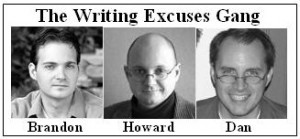
A while ago the Writing Excuses team asked me to record with them, and last Friday I got to do it and had a blast.
We recorded three episodes. In the first podcast we talk about putting and not putting ourselves in our writing and making characters who don’t all sound like the author. As usual, the guys had some great insights. Check it out: The Anti-Mary Sue Episode.
Folks. I have 2 mp3 files. One for Story Turns. One for Vivid & Clear. They are each about 48mb in size. But I don’t have the time to figure out how to make them available to you.
But I know someone out there does have the skillz to mash the slides with the audio in a short period of time and make it available. Maybe create something to upload to YouTube.
So if you have been waiting for this and would like to offer your services, I’d be happy to throw in a free copy of the ebook edition of Bad Penny and Servant for your efforts. It would in no way cover your time, but it’s better than a poke in the eye with a sharp stick. And the project will also give you all sorts of glowy goodness inside knowing that you’ve served a whole bunch of writers.
That’s my offer: glowy goodness and ebooks.
If you’re interested, click my picture in the left sidebar and and let me know 🙂
On Friday night I’m going to be part of a panel on RULES FOR WRITING MAGIC, and then I’ll be presenting VIVID & CLEAR to a bunch of SFF romancers. On Saturday I’ll be following that up with a presentation on STORY TURNS. Every time I present folks ask for the presentations. So instead of making them wait until I get home, I’ll just post them now.