“26 Monkeys, Also The Abyss” by Kij Johnson

Why is Kij smiling?

Because she knows how the blasted monkeys do it!

And she’s not telling, neither. Neener-neener.

I just read Johnson’s story and enjoyed it. I enjoyed the inexplicable trick, the narrator, the transport to this odd and wonderful traveling troupe, and dang it, even the ending. Furthermore, there are moments in the story that capture the wonderousness of these fellow animals so well that they shine like jewels.

I always wanted a monkey friend. You can read about someone who has 26 of them.

 It’s on her website, free, just waiting to be enjoyed. Kind of like a delicous mango or bananna.
.
.
.
.

Share

Similar Posts

  • |

    The average American reads 17 books per year

    Americans and Reading

    The Pew Research Center has just published their findings on reading in America. It’s called “The Rise of E-reading“. There’s a LOT of fascinating information in the report. Here’s a taste:

    1. Americans 18 and older read on average 17 books each year. 19% say they don’t read any books at all. Only 5% say they read more than 50.
    2. Fewer Americans are reading books now than in 1978.
    3. 64% of respondents said they find the books they read from recommendations from family members, friends, or co-workers.
    4. The average reader of e-books read 24 books (the mean number) in the past 12 months; the average non-e-book consumer read an average of 15.

    Building an Audience

    I also want to recommend this week’s post by Kris Rusch on Audience. She has a number of interesting things to say about the dream of being a best seller and building an audience. The money quote comes as she refers to a post by Tracy Hickman:

    “The point here is that you do not have to feel as though you are in competition with the entire world. You don’t NEED the entire world to be a successful writer. What you need is an audience—just enough of an audience, mind you—who reads your words, is changed by them and wants to come back for more.”

    An audience. More importantly, an audience that reads and “is changed by” your words. Not an audience who loves them, not even an audience who likes them. An audience who is changed by them, and because of that experience, “wants to come back for more.”

    Simple. Important. Usually forgotten.

    She talks about lots more. Read the whole thing.

    My thoughts?

    First, there’s no need for authors or readers to worry about wading through “crap.”

    According to Pew, readers only read 15 or 24 books a year on average.  That’s not a lot of books.

    More importantly, it takes about 3 seconds to get a lead for a good book.  You hear something from a friend or family member, you look at the USA Today best sellers list, you browse a few books at a store or online, you read a blog and suddenly you’ve found a book. 

    Readers fill up their book reading slots much more quickly than they can ever empty them.  That’s why we all have years of reading in our queues.

    It doesn’t matter that there are millions of other books out there, a good majority of which might have been written by monkeys. There’s no need for authors to worry that readers will have to wade through a mountain of crap to find a good book. They don’t need to because they have leads for good books coming out their ears.

    Second, people purchase books that friends, family, and co-workers love.

    Which means that when you deliver a great experience to one person, it’s going to ripple out. It’s probably not going to be linear. It’s probably going to ripple out like viruses do into different population pockets. Or seeds do into different environments. It will run through one pocket, make a jump to one or more others, or it may not jump at all. Some pockets are big, some are small.

    The way to keep a virus going is to release it in a lot of places where it’s likely to thrive or in places that a lot of people travel through. And as Kris points out, writing is all about repeat business–making sure you have a stream of good product (something I hope to rectify with my own writing this year).

    Bottom line: the best way to build your writing business is to simply write the best book you can, and keep them coming.

    Third, the market is BIG. 

    If you read Rusch’s and Hickman’s articles, you’ll see that even the mega sellers only reach a fraction of those who read. This is reinforced by the statement made by Thomas McCormack, former CEO of St. Martin’s that you can read here. So just because 100,000 people read one book doesn’t mean 100,000 others won’t read mine.  

    Moreover, e-books and online shopping are broadening distribution. Brick and mortar stores only have so many slots for books. Every 8-12 weeks they rotate the old books out (like 12 weeks is old) and replace them with the new ones, unless, of course, your book is selling very well and gets “modeled” at the store.  The point is: when you only display a few books at a time, those books will get bigger sales numbers. This happens because there isn’t anything else to purchase.

    But you don’t have that limitation with e-books and online shopping. Nothing rotates out of the store. Sure, things rotate on and off the best seller lists. But the books are always there. With an ever growing selection, there won’t be as many mega sellers.  Publishers Weekly discusses this trend in their 2011 Facts & Figures articles, which list best-seller numbers (make sure you click through to the Trade Paperback article as well). The same thing has happened with TV station viewership with the explosion of channels, DVDs, and online streaming. Same thing happened with music.

    What this means is each author has a better chance of getting his or her books to those who will love them. We’ll still have best-sellers. But we’ll also have a lot more medium sellers as well. And that’s great for authors everywhere.

    Share
  • Good Stuff! The audio production of Lockwood & Co.

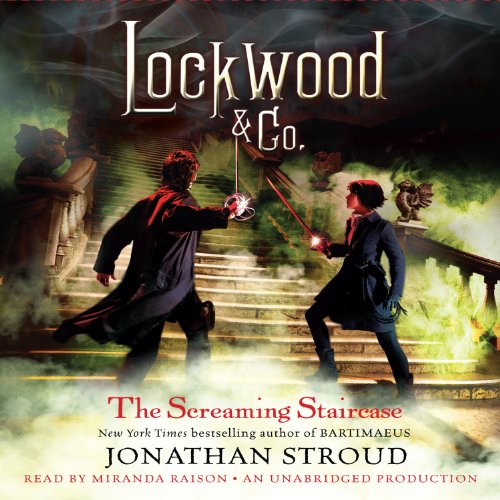
    I’m excited to share the Lockwood & Co. series by Jonathan Stroud. It’s a delightful audiobook experience for the whole family.

    Nellie introduced me to it on our road trip to Yosemite last October.

    And, oh my gosh, how we’ve enjoyed listening.

    They’re young adult paranormal thrillers with a good dose of humor and English charm.

    Yes, Netflix, launched a show based on the books, but Nellie and I tried it, and the Netflix productions don’t hold a candle to the audiobooks.

    It’s not even close.

    If you’re going to do this series, listen to the audiobooks or read them.

    The story is set in England in, I’d say, the 1980s, before cell phones and the internet became a thing. The problem is that ghosts, specters, tommy knockers, etc. are appearing all over the place and causing havoc. Because, in this world, when you’re touched by a visitor from the other side, you can easily become ghost locked, basically put in coma, or die.

    And while the ghosts can touch anyone, children and teens are the only ones who can see them. And so it’s children and teens who must fight them. Of course, large ghost protection agencies are formed, but our story is about Lucy Carlisle, who joins a tiny agency run by a daring young man named Anthony Lockwood.

    There are five books in the series, which translates to about fifty-nine hours of delightful listening. Perfect for the long road trips, cleaning, fixing dinner, walks, etc.

    Miranda Raison is the reader for the first book, Katie Lyons the second, and Emily Bevan for the final three. And they’ve all been a joy to listen to.

    I’m not normally a paranormal kind of guy, but this is making me reconsider. We loved Stroud’s Bartimaeus series. And he brings the same fast action, interesting characters, and wit to these. 

    If you enjoy delightful characters and derring-do leavened with some humor, give these a try. I think you’ll be glad you did.

    Share
  • Good Stuff! The Greatest Showman

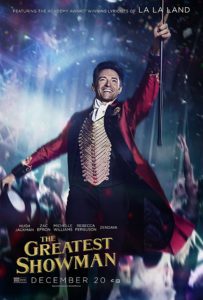
    I saw the previews of The Greatest Showman, the movie about the circus guy. I rolled my eyes. The circus? Come on.

    But my daughters, one by one, went to see it and came home raving.

    And then my wife went to see it and came home raving.

    And then my youngest was playing some music the other night, and I said, “Ooh, that’s nice. Good beat. Wow. What is that?”

    She said with much affection, “The Greatest Showman, loser.”

    I said to myself, maybe the previews simply stank. I said, I’ve seen movies where the previews were better than the full-length film. Maybe this was the reverse.

    I said, to my fine daughter and wife, “How about a movie night?”

    They were more than game to see it a second time. So we went and saw The Greatest Showman this week.

    Here’s the report.

    Oh. My. Holy. Freaking. Heck!

    This movie is one of the best movies I’ve seen in the last few years. And get this: it was released more than eleven weeks ago, back in December of last year. How many movies do you know that stay in the theaters for eleven weeks straight? When a movie keeps attracting crowds week after week, long after the release night hype has faded, they say it “has legs.”

    Let me tell you, this one has some legs. The music is awesome. The visuals are wonderful. And the story—the story is everything a story should be. I came out of the theater having wept and cheered and bitten my nails and been thrilled with a number of the scenes. I came out of the theater happy, positive, thinking about life, thinking about what really matters.

    Look, if you enjoy musicals, if you enjoy dramas, if you enjoy Hugh Jackman of Wolverine fame, you must drop everything you’re doing right now and run to see this before it leaves the theaters. You’ll be so happy you did.

    And now, I’m going to figure out how I can go see it again.

    Share
  • Earth: the biography, Planter’s Nuts at Sam’s, “The Professor of War”

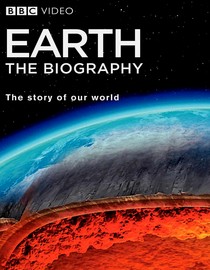
    Earth: The Biography is one of the most interesting documentary series I’ve seen in a long time. It’s produced by National Geographic and the BCC. Dr. Ian Stewart, a Scotsman, hosts the program and tells the life story of our planet, how it works, and what makes it so special.

    There are five parts: “Volcano,” “Atmosphere,” “Ice,” “Oceans,” and “Rare Earth.” And while they were all good, the last two blew me away.

    For example, I always thought the polar ice caps were a big waste of water. What do they do besides torment penguins and Eskimos?

    But the program reveals that the ice caps are critical to all life everywhere on the planet because they power the great ocean conveyer. This conveyer is a slow current that carries surface water away from the equator up to the polar caps then down to the sea floor and back—transporting oxygen, nutrients, and warmth all around the globe.

    We can see how critical the ocean conveyer is when it stops. There was a time when this happened. With no replenishment of oxygen, the water turned to poison. The poison was picked up in the clouds and rained down upon the land. And almost every living thing on the planet died a toxic death.

    Sniff, sniff–we love you, Polar Ice Caps.

    “Oceans” was fascinating, but “Rare Earth” was the kicker. How common is our cozy little situation here on earth?

    Well, for life to exist as we know it, we needed to be a certain narrow distance from the center of the galaxy, orbit a certain, less common type of star, be within a certain range of that star, have a big old fat vacuum like Jupiter hanging out in the wings sucking up asteroids and comets so they don’t hit us instead, have an orbiting moon of a certain size, an earth core with just the right amount of iron, a tilt to the earth that would allow polar ice caps, water, an atmosphere to protect us from all sorts of celestial mayhem. Heck, we even had to have that nasty mass extinction caused by the broken ocean conveyer. And there’s more.

    So many rare events had to line up just right, that it’s bound to make the atheists among us celebrate their good fortune with illegal-Wyoming-firework abandon and the believers to rise up from their chairs and shout, “Hallelujah and Amen!”

    Nellie, the girls, and I all loved this show.

    ***

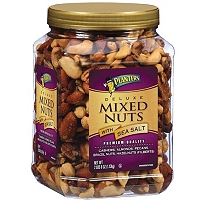
    I’m a nut man. Love nuts. Hazelnuts, walnuts, Brazil nuts, pistachio nuts, cashews, pecans. But nuts are expensive. And while peanuts are lovely, I like some variety and grow weary of the mixes where you get about five thousand peanuts and one burnt almond. So when I saw the forty ounce jars of Planter’s Deluxe Nuts (sea salt, NO peanuts) at Sam’s Club in Logan, Utah selling for a mere $10.98, I just about fainted away and died.

    Eleven bucks?!

    For comparison, please note that a little ten ounce jar of the exact same nuts costs six dollars in the grocery store. Four times the nuts for less than double the price!

    The nuts are good. More importantly, they’re a regular item at Sam’s. So with all the reports coming out about how good nuts are for you, reduce heart disease, reduce diabetes, blah, blah, blah, fight aliens, I can now afford to eat them and hopefully extend my stay as a carbon-based life form.

    ***

    General David Petraeus has revolutionized the way America wages war. It was his strategy that turned the war in Iraq around. It’s his strategy that’s being used in Afghanistan. And it will be his methods that will inform how our soldiers face enemies in years to come.

    The key to his thinking is realizing that there are two different terrains that must be won in the types of war we wage now—the geographic and the human. You know what geography is—take that hill, secure that town, remove the threats from that jungle. The human terrain, on the other hand, is made up of the hearts and minds of the people at the site of the struggle and has proven to be equally important.

    It’s important because the wars we’re most likely to engage in now are not ones where two big armies square off and blast away. Anyone who tries to stand up to the United States using that method is going to very quickly learn what it means to get stomped, shredded, and served to the dogs. So most of the battles are likely to be engagements in unconventional war, where the enemy hides, and where the local populace will make or break the effort.

    In May 2010, Vanity Fair magazine published a fascinating article called “The Professor of War” by Mark Bowden. It summarizes Petraeus’s history, the source of his thinking, and the kind of man he is. With so much at stake, I was grateful to get this well-written glimpse into the general and his approach to war.

    While you’re at the site, you might want to also read another Vanity Fair article titled “General McChrystal’s Three Biggest Strategic Errors in Dealing With Rolling Stone” by Bill Bradley, published June, 2010. McChrystal was Petraeus’s right hand man. The contrast between the two men is enlightening.

    Share
  • Best Buy, Samsung, and Sony

    I am not an early adopter. I do not rush out to buy the latest and greatest of anything. If I have something that works, then I keep using it until it absolutely won’t work anymore.

    For example, Nellie and I bought a Honda Accord when we were first married. Fourteen years later, we had put almost 300,000 miles on that car and would have tried to put on another 300,000. Unfortunately, it met an early demise when it encountered a herd of black Angus cattle on a very dark country road at one a.m. in the morning. So long, brave companion.

    We have a computer we purchased thirteen years ago which is still running Windows 98. Computers evolve about as quickly as fruit flies, which means that in human years our computer is like 450 years old. This is like going to war with first-generation muskets while everyone else is using Predator drones. And we’re okay with that, even though it appears we’re going to have to retire the old fellow this year.  Alas.

    I have these fine olive green dress pants that are fifteen years old. When the rise finally wore out, I had Nellie fix it.  She put in a bright Kermit-The-Frog green patch, which draws a lot of attention to an area that’s been down-played ever since the codpiece went out of fashion in the late 1500’s. Was this sweet revenge for eating her stash of chocolate? Or a cleverly planned source of constant enjoyment? I do not know. But as a result, I do not wear these pants to church and important business meetings. I wear them hiking. They protect me from bushes and mosquitoes, yet breathe with perfection. Why would I ever get rid of them?

    As you can see, I’m not a buy buy buy guy. Which means that when I get something it better darn well be a fine product because I know I’m likely to be using it for a very long time. And this brings me to our recent television and blu-ray player purchase. Two years ago some friends who had just purchased a big flat screen TV saw that we were still using our twenty-three year old 15″ RCA, took pity on us and gave us the 21″ TV they were replacing. It is one of those big suckers that weighs 475 pounds, but still a fine TV, and we watched it with joy.

    However, a few weeks ago our antenna converter box broke. Our church’s semi-annual worldwide conference was coming up, which is a feast we love to watch, and so we were faced with choice: buy another converter box or pay a few more dollars and move into the twenty-first century with a flat screen. Now, while it’s true I’m not a buy buy buy guy, it is also true that I have been longing for a manly TV lo these many years. This was my chance. When Nellie agreed we should look for a new TV, I went into immediate action.

    We started our search at Best Buy. The sales guys there were incredibly helpful. But we wanted to shop a bit more. So we went to a discount club, and thinking we’d save thirty bucks, purchased our TV there. We took it home, and I did not like it. I looked up the reviews on Consumer Reports and liked it even less. So I took it back. Sam’s has a great return policy, and gave us a full refund. Good bye, piece of crap.

    I went to Best Buy again. After talking with the floor guy there for some time, I purchased a 32″ Samsung LN32D Series 4. No, it’s not 60 inches of gorilla manliness, but a 32″ TV does have a bit of hair on its chest. And it was bigger than what we’d been using. And it was only a few hundred bucks. I found this TV’s picture much better. Excellent, in fact, with the TV stations. However, my DVDs didn’t play so well on it.

    I took it back to Best Buy. The folks there spent an hour testing other TVs and demonstrating that the issue was not the TV but my old Sony DVD player which could only use RCA cables. I needed a new player with the new HDMI cable, which is able to deliver much better quality. So I purchased one, a blu-ray player, brought it home, and found that the picture was indeed much better, but I hated the player’s remote controls. For example, I want to push one button to bring up the disc menu. I do not want to click options, over, down, down, down to do this each time.

    I took it back. The folks at Best Buy were as friendly and helpful as ever. There was no hassle returning it. We spent another thirty minutes test driving different players and their remotes. I finally settled on a Sony BDP-5390 which is fabulous, not only because the remote and on-screen controls were helpful and it remembers where I was with movies I don’t finish, but also because it has a number of apps that allow me to connect to my wi-fi and watch things like YouTube, listen to internet radio, and pipe music all through my house.  There are so many cool features that I’m going to be enjoying discovering them all for a number of weeks. In all of this, the folks at Best Buy were cheerful, helpful, knowledgeable, and willing to work with someone who was very particular in what he wanted. I am now a Best Buy believer. If you want excellent customer service and good prices, go to Best Buy. I’ll be going back there for my next TV . . . when this one has racked up two gajillion viewing hours and at last gives up the ghost.

    Share
  • You want your kids to succeed in school? There’s one thing you can do…

    Did you know that there is one thing that kids can do outside of school that’s been proven, over and over, to lead to them doing significantly better in all other subjects?

    And I mean all subjects. Math, history, science, criminology, psychology—you name it.

    There’s one thing, and numerous research studies have proven it, that kids do that leads to them getting better jobs later in life.

    This one thing, proven by research, leads them to grow up to make more money.

    And it doesn’t matter if they start in a rich or poor family. This one thing leads them to greater opportunity. Over and over again.

    It’s a thing that kids actually can learn to love. For some it becomes as delicious as eating ice cream.

    The kids are back in school. Parents want them to do well. They want them to succeed. How wonderful that there’s one thing that parents can focus on that will so dramatically change their child’s life.

    And it doesn’t take long. Even just twenty minutes per day of this activity can change everything.

    Twenty minutes.

    Is there a parent anywhere that can’t find twenty minutes?

    So what is this one thing?

    Reading for pleasure.

    Notice I didn’t say reading for academic purposes. I didn’t say reading to finish homework. I said reading for pleasure. For the enjoyment it brings.

    And it doesn’t matter what the subject matter is. It can be fiction—fantasy, love stories, horror, action. It can be non-fiction—like material on bugs, robots, horses, motocross. It can be fairy stories or funny anecdotes. It can be short or long. The key is that they’re reading for pleasure.

    I know some of you might be saying, “But John, my kid doesn’t like to read.”

    That’s okay. You can change that.

    If you want to find out how to help your child learn to enjoy reading, let me recommend Raising Kids Who Read: What Parents and Teachers Can Do by Daniel T. Willingham, a professor at the University of Virginia whose research has focused on the brain and learning. In the book, Willingham debunks the myths about literary instruction and provides practical, engaging, research-based tips for sharing the joy of reading with kids of all ages.

    You can get a used copy for $13 bucks on Amazon.
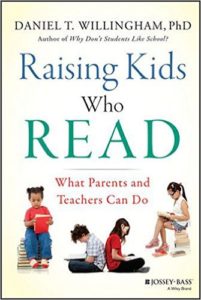
    RaisingKidsWhoReadByWillingham

    While you’re waiting for the book to come, here are some things you can do start doing right now to help your child read for pleasure.

    First, start reading something fun or interesting with or to them every day. For little kids, this can be picture books. For older kids, this can be anything–an article from a magazine, funny stories online, or books large and small. If you want to start with a joke book, that’s okay. If you want to start by listening to a book on tape, that’s great too.

    Wait a minute? A book on tape? Isn’t that cheating?

    No.

    There are four keys to helping your child read for pleasure. They need to learn to:

    1. Decode the sounds letters make.
    2. Comprehend what’s meant, which is driven by their general knowledge of the subject they’re reading about.
    3. Enjoy reading.
    4. Identify themselves as a person who likes to read books

    When you listen to a book on tape, you’re doing numbers 2-4.

    Remember: the goal is not to improve the child. It’s not to get them a better job ten years from now. It’s not to make them wealthy. It’s to simply help them enjoy reading. Because once they enjoy reading, once reading for pleasure is something they see as one of the things they do, they will begin to read more and more. And as they read, they become better at reading, which leads to more enjoyment, which leads to more reading. Which leads to all of those other awesome benefits. It’s a virtuous cycle.

    So the first thing you need to do is simply start having a good time reading with them. You can read to them at bedtime, after dinner, on weekends. You can have them read articles to you while you’re making dinner or washing the dishes. You can have them read to your or themselves while you’re on the road driving somewhere.

    You can make a rule that they have to read with you for twenty minutes before they go play with friends or watch TV or play video games.

    And above all, you need to let your child’s interests drive most of the topics you read about. If they want to read about spiders and dinosaurs, then read about spiders and dinosaurs. If they want to read horror stories, then read horror. If they’re into skiing or horses or guns, then help them find interesting stuff on the topics they’re already interested in. And if they don’t like a book, teach them they can abandon it and go find another.

    And if you yourself are not someone who reads for pleasure, well, now’s the time to start. You can make reading for pleasure something your family does, just like families make enjoying boating or hunting or riding horses or eating Mexican food part of what they do.

    It’s never too late to start.

    And seeing that this is the one thing that has such an impact on your child’s success, is there really anything else that would be a better use of those twenty minutes per day?

    Reading for pleasure—who knew that having a great time could have so many wonderful effects? Start today. Don’t wait.

    It might take a little work. You and your child might run into a few unpleasant spots. But that’s true of anything. How many times do kids fall when learning to water ski or snow ski? How many times do they experience something unpleasant when practicing football or basketball or volleyball?

    So start right now. Figure out a time with your child. And begin learning to read for pleasure.
    Share