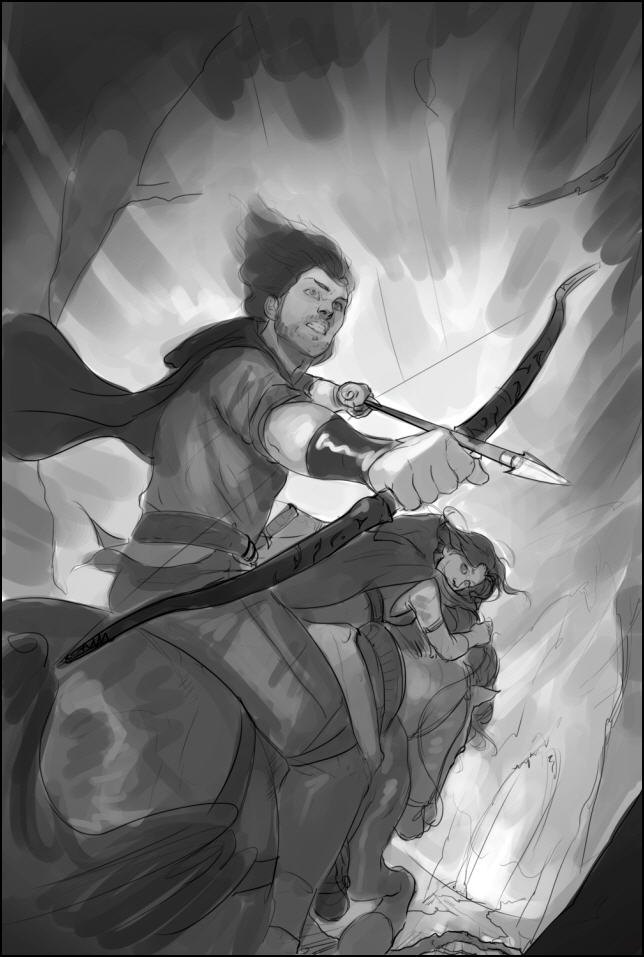
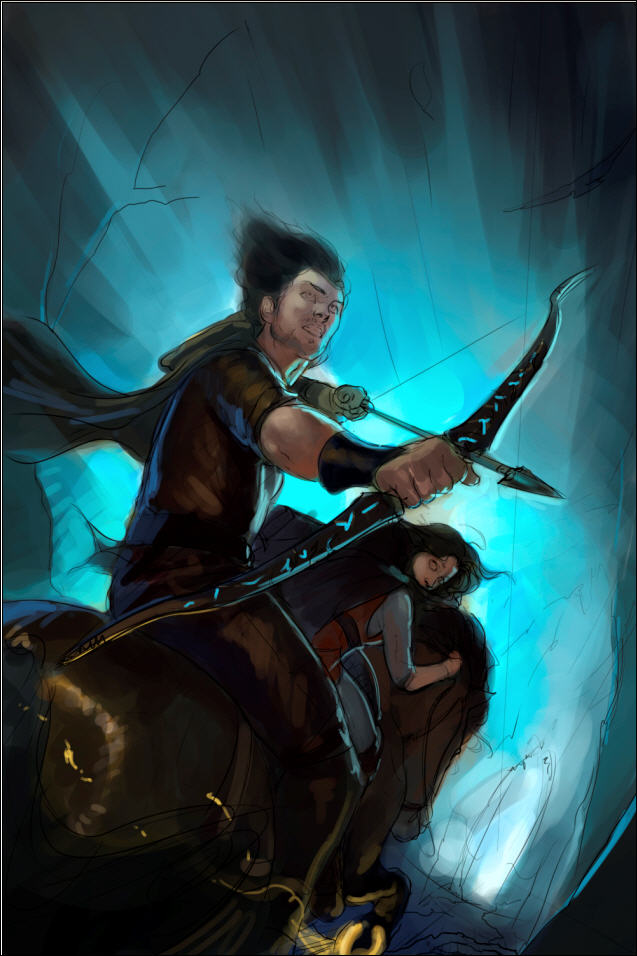
Wear the Dark God!

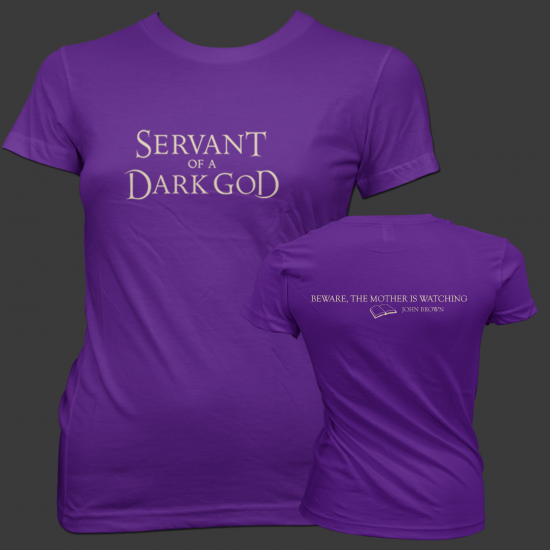
Yeah, Baby! We’ve got Dark God Tees! And all thanks to Fiction Addictions. You get to choose from two designs which you can see below. Please note: The Dark God got his fans some SPECIAL HOLIDAY PRICING! Through December 2010: $13.99 for standard style, $15.99 for the ladies fit.

ORDER NOW FROM
FictionAddictions.com

Enjoy! And welcome to the Grove.

P.S. If you desire, you can post pictures of yourself displaying your great sense of fashion (or the burnt crisp of your thunderstruck remains) on http://www.facebook.com/authorjohnbrown

Servant of a Dark God – In Yo Face

Boldly proclaim your allegiance with a simple front that states who you serve. NOTE: May attract lightning.

In Yo Face - Standard T Style

In Yo Face - Ladies T Style

Servant of a Dark God – Book Fan

For those who aren’t quite ready to commit to the dark side, we provide a more conservative front that will still raise eyebrows, but all in the good cause of literacy.

Book Fan – Standard T Style

Book Fan - Ladies T Style

Colors & Styles

Standard tee shirt style: for men or women, comes in dark brown, black, or navy with crème lettering.

The ladies tee shirt style (fitted cut and thinner fabric): comes in purple, black, or dark brown with crème lettering.

Other colors: If you simply must have the shirt in a different color, be happy, because you can, although it may take longer to process your order. Be sure to choose a color that goes well with the crème lettering.

Extra Large Sizes: If you want to get a shirt in a size not shown, you can. Just contact Fiction Addictions and let them know. It just may take a bit longer to ship your order.

Share

Similar Posts

  • |

    How to Write a Story that Rocks

    Folks, a huge thanks goes to Stephen Nelson for putting all this together. You may kiss his hand when you see him.

    This is a recording of “How to Write a Story that Rocks,” a two-hour seminar Larry Correia and I just put on at the annual BYU’s Life, The Universe, & Everything symposium. I think we had 130-140 people attend. This symposium is focused on writing fiction. And while the panels and presentations do include things specific to the science fiction, horror, and fantasy genres (both adult and young adult), a lot of time is also spent on story writing fundamentals that apply to ALL genres. So when I developed this workshop, I made sure I took the fundamental approach.

    The two-hour seminar has been broken down into 12 segments. To switch between the segments:

    • Hover your mouse pointer over the YouTube below
    • Click the forward and back arrows that appear on the right and left sides to move to the next or previous segment, OR 
    • Scroll through all 12 segments and select the one you want using the playlist control at the bottom

    If you prefer, you can watch all 12 on the How to Write a Story that Rocks YouTube playlist page.

    I’ve found whenever I develop any presentation or training that it takes a few iterations and revisions before it’s the best it can be. This is the first iteration of this seminar. And so below this video I’ve provided additional comments on each segment explaining key concepts, principles, and techniques that we might have failed to discuss or convey as clearly as we’d hoped. Enjoy!

    Handout

    How to Write a Story That Rocks – Handout

    Segment 1

    It’s documented–right-wing gun nut Larry Correia sang “Kumbaya.” What’s next? The hugging of small trees? Oh, Larry, the disilluion. The disillusion.

    The reason why I had Larry sing was not for his mellifluous performance, but to demonstrate the difference in reactions between him and our happy volunteer (“Country Road” by John Denver–this really was a love fest). The volunteer balked because he hadn’t taken any thought to know what to sing before he was commanded to do so. On the other hand, Larry and I had spoken before the seminar. So Larry had something to sing BEFORE he sang it. It’s a simple demonstration, but it illustrates a principle a lot of new writers forget. Writing is a performance. It helps to know what it is you’re going to perform before you perform it.

    It’s one thing for you to tell yourself to write. It’s much easier to tell yourself to write the scene where the rancher finds out one of his illegal ranch hands has been kidnapped.

    Now this doesn’t mean that you have to know everything. Or that you can’t write exploratory drafts to figure out what it is you want to write. But it does illustrate that whatever techniques you use, you’ll be a lot more effective in your writing when you have something to say first.

    But what do you develop? What are the things that bring the story to life? How do you go about getting those things to say? That’s precisely what I wanted to address in the seminar. In the segments that follow, I try to:

    1. Explain what I’ve found are the most important things to develop, the things that define the essence of story, that make the story come alive in the writer’s mind–the things that really matter
    2. Demonstrate techniques to develop those things so you have something to say

    Segment 2

    I think this segment went fairly well. What rocks will different from person to person, even though there will often be a huge overlap between people. So it’s important for authors to seek to develop the kinds of stories that rouse their passion. Watch this interview with best seller Debbie Macomber to see what I mean. So I can’t tell you what to write about. Or if whath you think rocks will resonate with a large number of people. However, what I can do is share the techniques I use that have been most productive in helping me develop initial ideas into something that has much more power.

    You can use the techniques to juice up any of the four parts of story. However, I will say that I find that the most productive, the most important parts, are character and problem. Plot and setting are important. I love them and work to juice them up. But when I get a good character and problem, that’s when the writing seems to flow the easiest.

    And no, I don’t list theme as a part of story. Everyone talks about theme, but when I read what they have to say or press them for examples, it seems that it always either boils down to (1) a story element or topic that’s repeated, (2) a story problem/issue stated in an abstract manner, or (3) some moral situation. Les Miserables is about the “theme” of mercy versus justice. But saying justice versus mercy is just an abstraction of the story problem and dilemmas the story deals with. So, no theme. 

    Segment 3

    Loved this bit about scenes from David Mamet: http://www.slashfilm.com/2010/03/23/a-letter-from-david-mamet-to-the-writers-of-the-unit/ 

    Segment 4

    I’ll be adding my comments to the rest of these segments over the next few days.

    Segment 5

    Segment 6

    Segment 7

    Segment 8

    Segment 9

    Segment 10

    Segment 11

    Segment 12

    Dan Wells on Story Structure

    Check it out: Dan Wells on How to Build a Story (story structure). I find Dan’s “start with the ending” technique helpful as well as thinking about a worst fears realized moment. Watch the videos and see if there isn’t something there that can help you develop your story idea.

    You can get the PowerPoint of How to Build a Story on Dan’s site.

    If you find this approach useful, you might want to check out what novelist Larry Brooks has written about the same material on StoryFix.com.

    Share
  • |

    John guests on Writing Excuses season 3 episode 18

    writing-excuses-the-guys2-300x139

    Here’s the second episode I recorded with the Writing Excuses guys.

    In the first podcast we talked about putting and not putting ourselves in our writing and making characters who don’t all sound like the author. In this one, we talked about how to not repeat ourselves in ways that make the reader feel like they’re getting the same old same old.

    As usual, the guys had some great insights. Check it out: How to Not Repeat Yourself.

    Share
  • Signing on Saturday in Eagle Mt, Utah

    BOOK SIGNING SATURDAY!

    Saturday, November 20, 2010: 5 pm – 7 pm

    It’s fantasy night at Dragons & Fairy Tales bookstore. I’ll be there with NY Times best-selling author Larry Correia, mega-popular comic strip writer Howard Tayler, ”I Am Not A Serial Killer” author Dan Wells, and others.

    3535 E Ranches Parkway Suite A
    Eagle Mountain, UT 84005
    801-789-5014
    Click here for store details

    Share
  • Gollum was in my garden

    Four days ago I was on my hands and knees in the garden, muttering, “My ring. Where is it? Where is it!” 

    I could have been Bilbo out there among the tomatoes. I could have been Gollum—though I’d have to endure a long, worm-filled diet to play that role convincingly. 

    I’ve been married thirty-six years to a good woman. You’d think a wedding ring is just a ring. 

    But it isn’t. 

    Someone memed me Boromir holding up the ring on a chain and saying, “It is a strange fate that we should suffer so much fear and doubt over so small a thing.” 

    And I thought, how true! It makes me wonder if Tolkien ever lost his wedding ring. 

    For two days I searched the ground where I’d lost it—a long hedge of tomatoes and the sagebrush hill behind where I’d tossed split fruit. For two nights I went to bed feeling the absence on my hand, as if something vital had been taken from me. 

    Then, with the help of a Garrett ACE 250 metal detector I rented from a fine establishment in Logan, Utah, I found it. 

    It was just lying there in the open in a spot I’d checked half a dozen times. The detector beeped. And there it was. 

    My precious. My precious, precious reminder of thirty-six years with my admirable wife and our four wonderful daughters. It feels so good to have it back on my finger. 

    How strange that so many memories are wrapped up in so small a thing. It almost demands a new story about a magic ring. In fact, the experience might just influence the ending of ASSASSIN. That’s how writing works sometimes—life drops the ideas right in your tomato patch. 

    Speaking of ASSASSIN, it is coming along nicely. Ferran and company just turned a major corner with the help of a spunky kid in the city. And there’s an exciting scene coming up where all heck is about to break loose. 

    On another note, many of you have asked about GLORY, the fourth book in the Dark God series. It’s next in the queue. I’ll write that climax as soon as I finish ASSASSIN. I already have an opening, a rough outline, and plenty of notes—dogmen, dreadmen, Glories—the works. It’s coming, and I think the revelation of what’s really happening will surprise you. 

    Finally, I’m not dead yet, nor am I the fount of all wisdom, but I can say this: spend time with those you love, laugh with them, go on adventures. Because one day you’ll lose your ring—or some other small token bound up with all of it—and know exactly how precious those memories are. 

    Peace out, my fellow dreadmen and fell maidens. 

    Share
  • Press Release – SF/Fantasy Key to Teen Literacy

    FOR IMMEDIATE RELEASE

    IS SF/FANTASY KEY TO TEEN LITERACY?

    Findings presented at national American Library Association conference reveal science fiction & fantasy literal gateway drugs to youth literacy

    CHICAGO, ILLINOIS |  July 11, 2009 | Utah’s newest author, John Brown, summarized statistics and research at the 2009 national American Library Association (ALA) conference held in Chicago which suggest that science fiction and fantasy are two of the main gateway drugs to literacy for youth. Data provided by Nielsen BookScan, public libraries, and recent studies published by the National Endowment for the Arts (NEA), suggest that at least 1 in 3 youths read for the effect produced by Science Fiction and Fantasy. “However,” says Brown, “given library circulation statistics, that number may well be 2 out of 3. These are incredible numbers, and have important implications for youth reading programs.”

    According to Brown, “the latest research in emotion shows that reading fiction produces a physical response, as real and physical a response as when we take aspirin, alcohol, or crack. The good thing is that while stimulating pleasure centers, it doesn’t change the brain the way hard drugs do. Furthermore, it also carries the powerful and desirable side-effect of improving reading skills. The key is in finding the type of fiction which appeals to the given age group. And for youth it appears that drug of choice is science fiction and fantasy.”

    John Brown’s epic fantasy for teens and adults, Servant of a Dark God, will be released in October 2009 by Tor Books, the largest publisher of science fiction and fantasy in the world. For more information see the links below.

    Share
  • The Cover Illustration for CURSE

    This is a story of how things went wrong and then went right. It’s also a cautionary tale for indie authors who want to direct their own art.

    Victor Minguez did the art for Servant, which I think is awesome, so I naturally wanted him to do the art for the second book as well. I started as I have before by working up a detailed creative brief which stated my goals, suggested color scheme, identified the scene I thought we should illustrate, and provided plently of reference images. The goals for this illustration were that it had to say epic fantasy, fit with Servant, have energy, and pop in thumbnail.

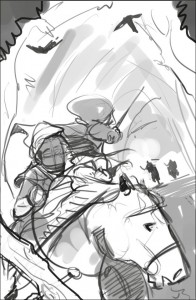
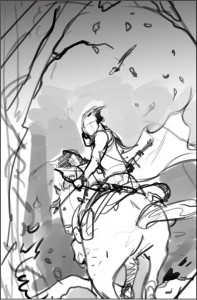
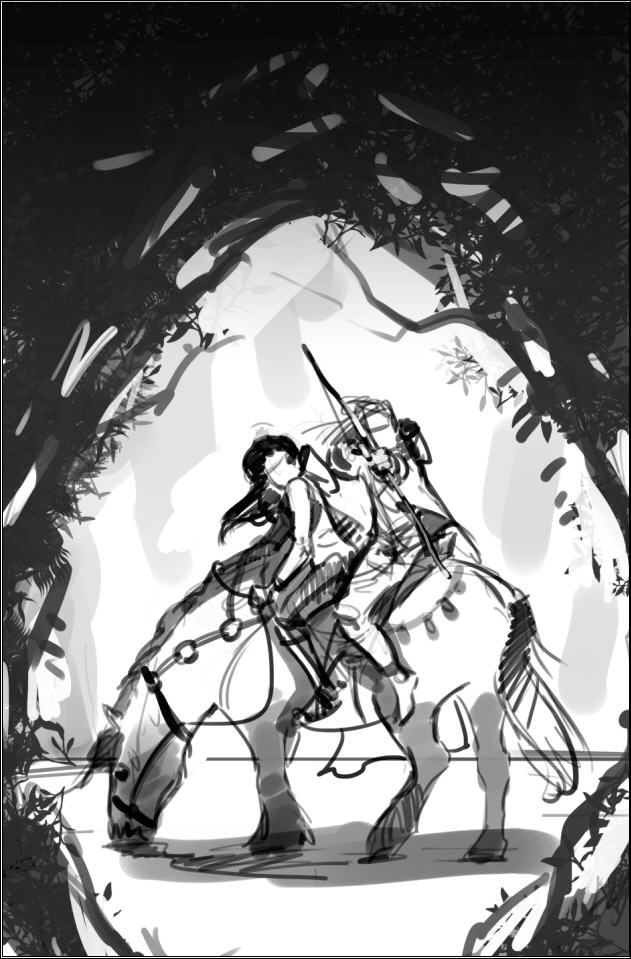
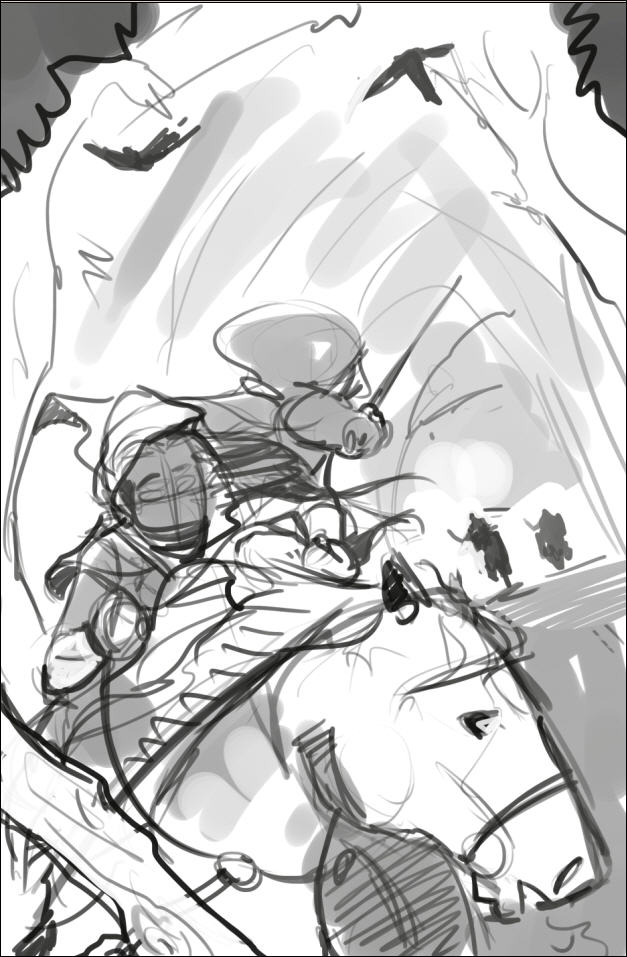
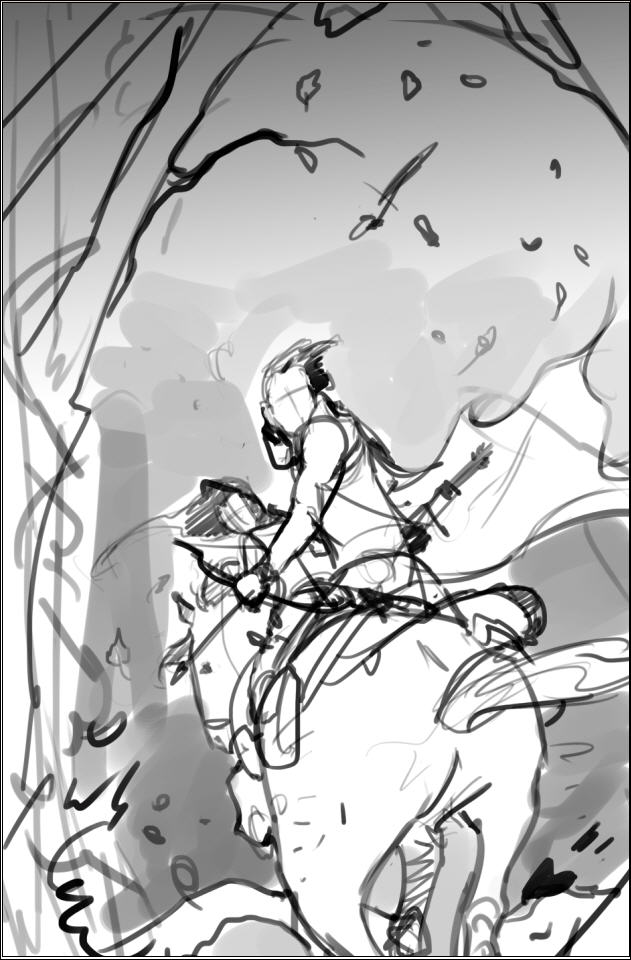
    Victor came back with these sketches. I thought all of them were great concepts. The framed and rear view depict the moment before something dramatic is about to occur, as if something dangerous is out in the woods. The front view was well into a dynamic scene. I loved the contrast of the framed sketch, but was drawn most to the dynamic rear view. (Click on any image to see it full size.)
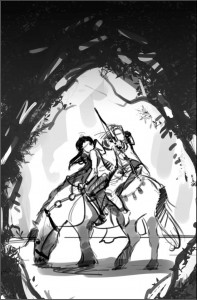
     CurseSketchFramed CurseSketchFront CurseSketchRear

    I knew from the last project that we needed to make sure that the illustration would integrate with the title and author’s name. And because we are going to brand the series, in part, by keeping the author name and title in the same position on all the books, I thought we needed to zoom in a bit. I tried various angles. Ultimately, we decided to flip it.

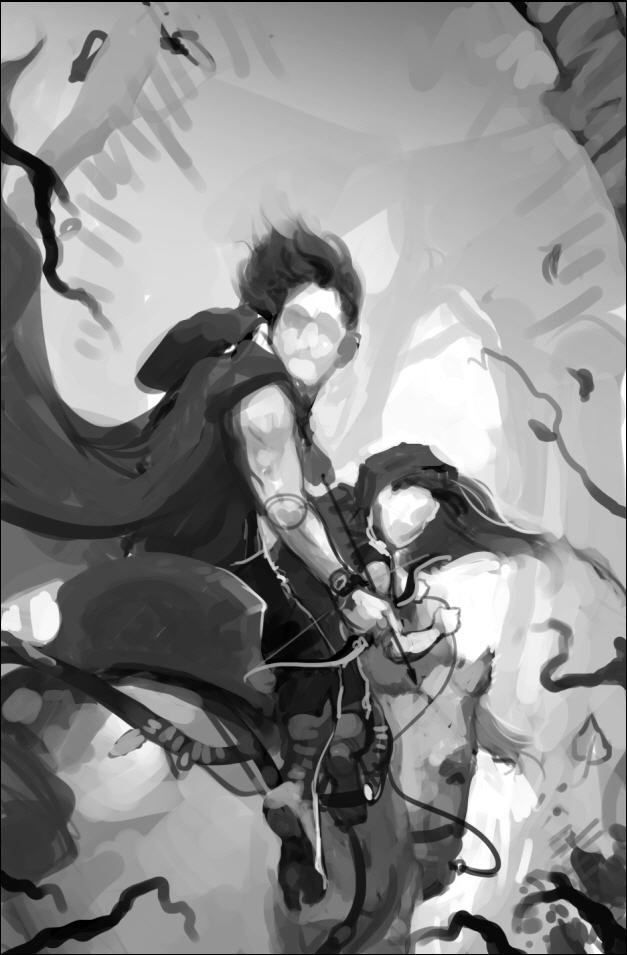
    Victor then did another sketch with values to nail it all down. I thought this sketch was awesome. There was energy. It said epic to me. I was drawn immediately to the characters. I thought we had great contrast.
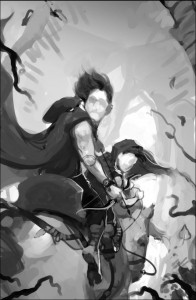
    CurseV1SketchValues

    So the next step was to start laying in some colors.
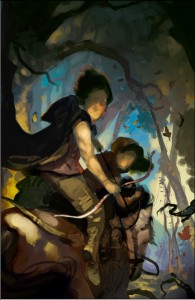
    CurseV1WIP1

    And here is where the cautionary tale begins. I think I have a good eye. I know when something is working. But I’m not a trained artist. And I’m not a trained art director. Which means that while I have a feeling of where in general I might want something to go, I don’t know exactly what will get us there. And that means that sometimes I’m going to do a lot of, let’s try this, nope that isn’t it, let’s try this instead. Naw. Maybe this. And as I begin to ask the artist to tinker, the risk of me directing us into something that doesn’t work, and forcing the artist to work way over his or her budgeted hours increases dramatically. It also sometimes increases the risk of me losing sight of the end goal.

    I keyed in on my desired color scheme. But a color scheme is a means to an end. I got trapped thinking about the means, not the end. So I asked Victor to get more gold and blue. Open it up.
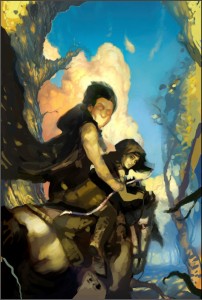
    CurseV1WIP2Brighter

    Can you see me taking us away from the original concept? Not necessarily a bad thing. Art is often iterative. But I wasn’t done. I wanted color. At least, I thought I did.

    CurseWIP3ColorBright

    Do you see where this is heading? But I had this idea and was determined to see it implemented . . .

    CurseV1WIP4

    Well, we got to this point. The artist was delivering what I’d asked. And it was shaping up to be a fine piece of art, but it was totally wrong for the book and genre. What’s more I was driving the artist nuts. For every change he’d make, I’d bring up two more. I was way too far into the details. I’d  taken us way off course. And burned up all his hours doing it.

    What do you do?

    Luckily, I know someone who IS an experienced illustrator, who has worked on many different projects, and who was willing to step in as art director. Most importantly, with me out of the picture, the artist was willing to give it one more go with this new guy at the helm.  I stepped completely away from the process. Here’s what happened in the words of the director (who wishes to remain anonymous).

    ART DIRECTOR TO THE RESCUE

    The goals for this image were to say fantasy and be eye grabbing at a very small size. I was brought on to accomplish those goals. I think we all felt that the image was too peaceful. It contradicted the feeling of danger we were going for.

    Take two: John gave me the old thumbnails that Victor had. At first I looked to see what could be salvaged from the old completed painting to use in the new, but ultimately Victor came up with a more dynamic sketch, and we decided to go for it.
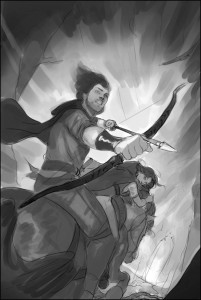
    CurseV2Sketch

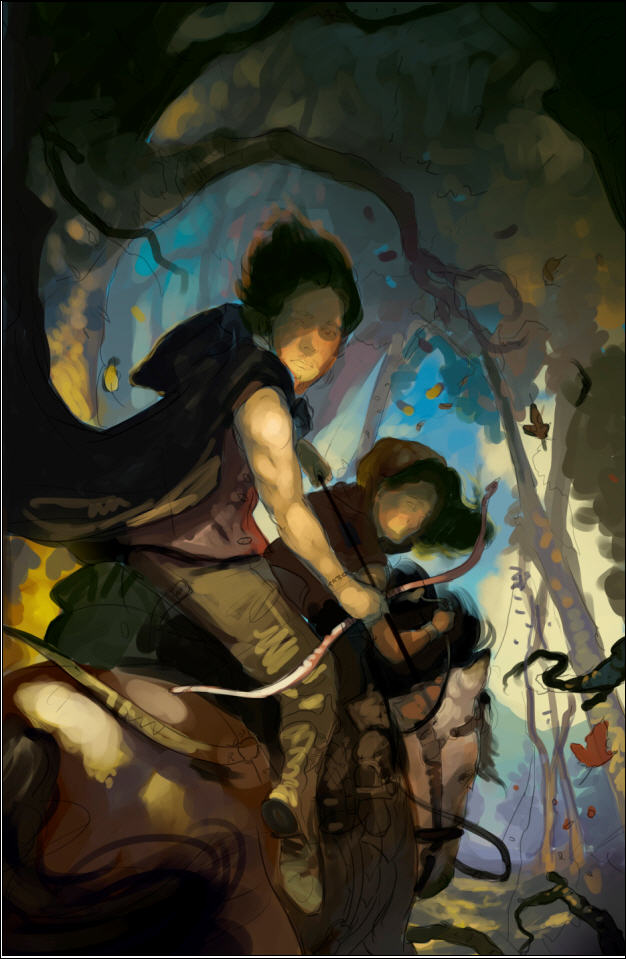
    So we started there. The processes was an iterative one. Victor blocked it in, and we nailed down the values/black and white image. Values are the underpinnings of a painting; you want that to work on an abstract level first. Meaning if you didn’t know that it was a painting of Talen and River riding away on a horse, would the value patterns still be both striking and pleasing? There is no point in proceeding with a painting if either the drawing or the values are failing. After that came the color study. 
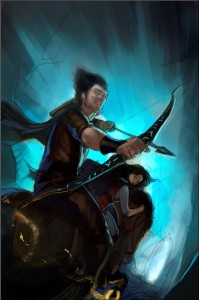
    CurseV2ColorStudy

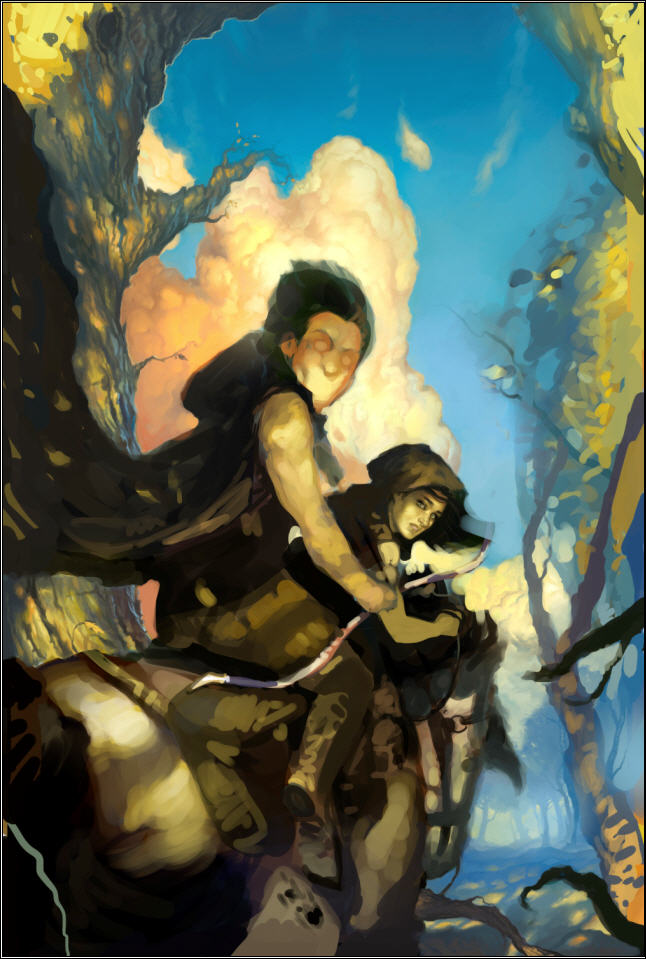
    Once nailed, we went to finish.  Victor really put his heart into this and it turned out awesome!  He’s got great talent, and is a pleasure to work with.
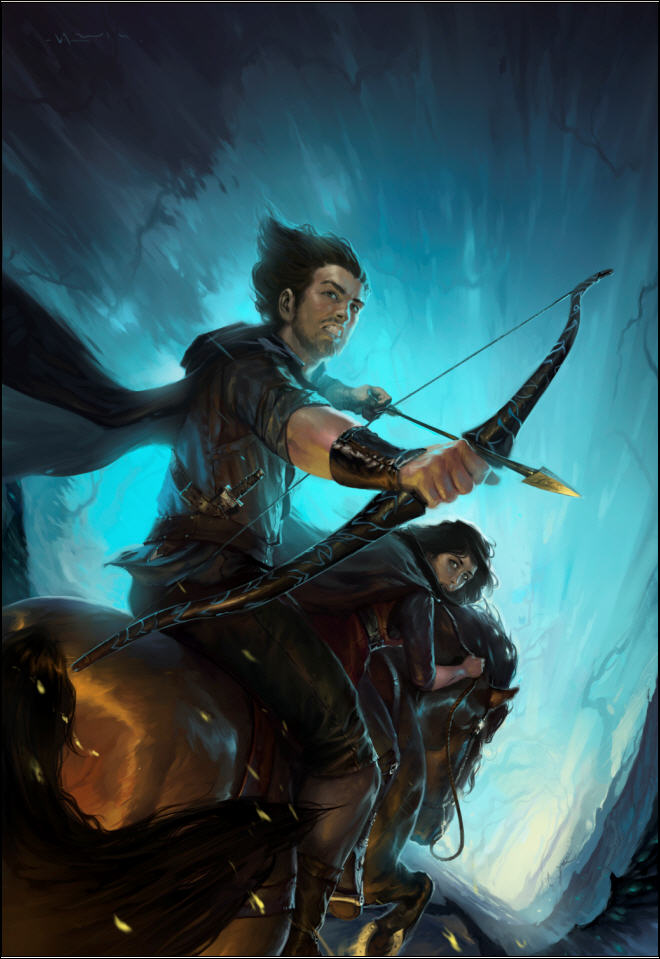
    CurseV2FinalV1 

    JOHN AGAIN

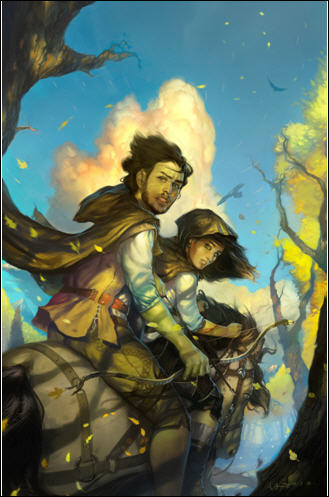
    Are Minguez and Un-named Director good or what! It says epic fantasy. It says action. It has the level of darkness and energy we need. And it looks like it belongs with the cover of Servant. It’s going to work great, and I think the cover will pop in thumbnail, especially when we add the title (white, like Servant) and author’s name (probably a bright color taken from arrow head or horse shoe).

    So lessons learned from this and the previous covers:

    1. Authors are not artists. Just because you know in general what you want doesn’t mean you have the ability to direct a project the way it should go. If you’re not careful, you will shipwreck the project.
    2. Having an experienced art director on board can do wonders.
    3. Keep the broad end in mind; try your best to let the artist focus on the means to that end. This doesn’t mean you don’t provide a lot of image reference up front, but you’re paying the artist for a reason.
    4. It’s helpful for the artist to estimate a total hours they’ll work for the project, even if you’re not paying them an hourly rate, and then keep you up-to-date on hours worked. This way you are forced to use their time wisely. You only have X hours to spend. Spend them on dumb changes, and you’re going to end up with something that’s half-baked.

    And now a mystery.

    I want you to look at the final image again. It’s not actually the final, final image. We had to ask the arist to make one more change because something was off. I will give you a hint. The change had to be made in the lower 1/4 of the image. Look at the image and see if you can find it. Do you see it?

    In the next post about this art I’ll both reveal what needed to be changed and tell you something about this artist that I think you’ll find both inspiring and amazing.

    Share

9 Comments

  1. Someone needs an editor! 🙂 Or the one you have is underpaid and understaffed. Lightning doesn’t have an “e.” Love your books. Excited about my new shirt!

  2. Doh!

    An extra “e.” Santa’s elves. I knew they were up to something. Didn’t want the Dark God muscling in on their season.

  3. I’m all for the good cause of literacy, which may attract enlightening. Thanks for the t-shirts!

  4. Thanks for the warning about the elves John.

    Btw, I finally got a copy of Servant of a Dark God now that it is out in paper back, and I love what I have read so far. I hate that so many books come out in hard cover first and I have to wait forever for the paper back. I never buy hard covers, although in truth I have to say I nearly got Jim Butcher’s 12th Dresden Files book, Changes in hard cover but I found the audio version of it on audible.com first.

    I also got a copy of Larry Correia’s Monster Hunter International today because I saw him with you on that cool 12 part video, How to Write a Story that Rocks, and he just looked like a really cool fun guy.

Comments are closed.