Sherlock Holmes, Mission Impossible, The Art of Shaving, Wages

Sherlock Holmes & Mission Impossible
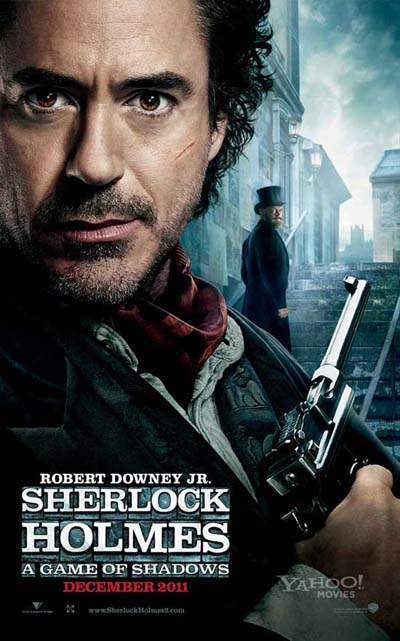
I have been looking forward to two movies this holiday season. One of them was as good as I’d hoped it would be. The other disappointed me because the story tellers forgot to make things clear. The two movies were Mission Impossible: Ghost Protocol and Sherlock Holmes: A Game of Shadows.

I loved the first Sherlock Holmes movie—the story was intriguing and plotted well, the atmosphere and music were amazing, and the characters and relationships were even better. In fact, the movie presented some of the most delightful characters I’ve enjoyed over the last few years. So it was a no-brainer to plan in a date to see this new episode.

Sherlock Holmes: A Game of Shadows provided the same great atmosphere and music as I enjoyed before. Holmes and Watson were as wonderful as they’d ever been. The film introduced a wonderful new character: Madam Simza Heron, a gutsy gypsy who you can’t help but want to know better. And it brought on Professor James Moriarty, the uber-villian. There was plenty of the wit that we enjoyed in the first one. It had all the elements to work.

However, the film fell down in its plotting. There were many times when I had no idea why the characters were doing what they were doing or how it fit into the overall threat. At other times, it appeared Sherlock could have taken out the villain but didn’t only because it would have ruined the plot.

The film makers also decided to kill off one of the characters, and therefore relationships, that had provided so much satisfaction in the first movie. And they did it without much fanfare. Who thinks it’s a good idea to kill off beloved characters like that? If you’re going to kill someone we love, you’d better make it meaningful and the core of the film. Alas, they didn’t.

In fact, it felt like there was too much stuffed into this film. Cool ideas that couldn’t be explored or have much impact including facial surgery for spies, a lost brother, European politics, resistance fighters, a henchman we hardly see. The wonderful Madam Simza Heron didn’t play the pivotal role she could have. So unlike Irene Adler in the first movie who becomes central to the story, she’s more of a bit of the setting.

If you loved the first film, you’ll have to see this. There’s a lot of good. But you must go knowing it’s a grade lower than the first film.
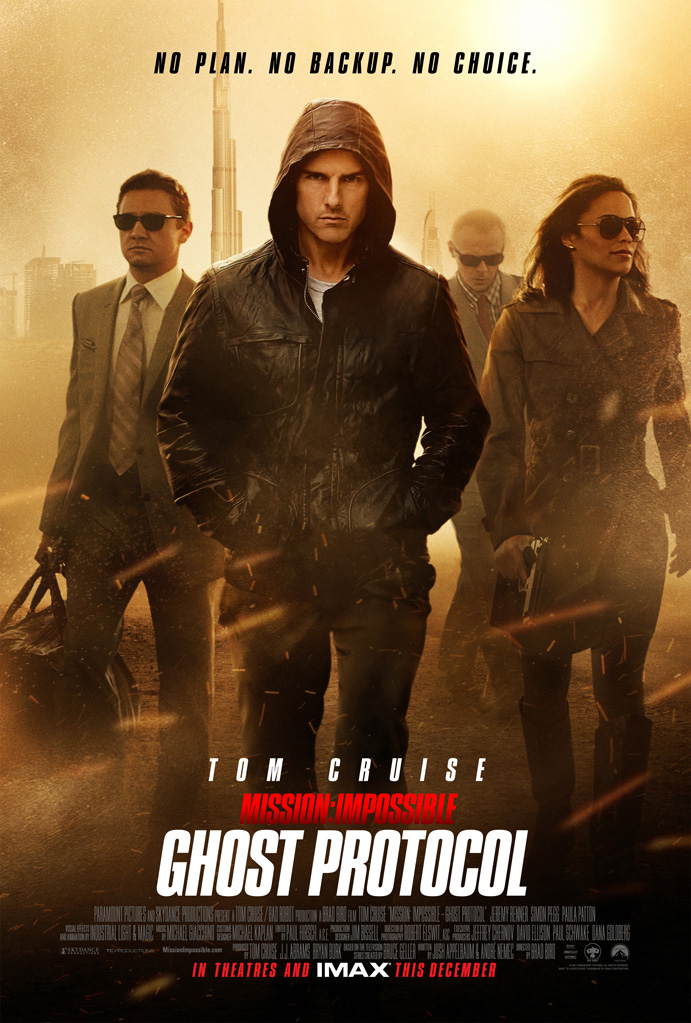
Now, I stopped liking the Mission Impossible movies about thirty minutes into the second in the series. But the previews for Mission Impossible: Ghost Protocol intrigued me. I like Tom Cruise as an actor. And so we decided to give it a try.

Mission Impossible: Ghost Protocol didn’t provide the atmosphere or super-delightful characters and relationships of Sherlock Holmes. But that’s not to say its characters were tepid. On the contrary, the cast was great with a lot of funny interplay. Furthermore, unlike some action films where everything seems to work for the hero, a lot of things go wrong for Tom Cruise’s character. These problems and his reactions are part of what make the movie.

The story also provided plenty of “action” but did it in a new way. This is the first time, for example, I’ve seen a car chase in a sandstorm. And it was a fab chase. It’s also the first time I’ve seen a final battle in an automated parking lot. The director and writers did a good job choosing new twists on common action elements.

But a story needs more than characters and new sights—the plot has to make sense. Especially when the plot takes center stage, which it does in action movies. And I’m happy to say that I never once wondered why our characters were doing something or how it affected the main threat. Furthermore, every one of the characters made a difference. The result was that I thoroughly enjoyed the film from start to finish. I can’t wait to watch it again. If you like action films, I think you’ll enjoy Ghost Protocol.

The Art of the Shaving
When I was on a mission in the Netherlands I was an idiot and did not take care of my face in the winter. I’d hop onto the bicycle with the temperature hovering around zero degrees (not counting the wind chill) and bike out with Fearless Companion to an area to meet with people or knock on doors. And I’d do it with hardly a thing covering my face and ears. As a result, I damaged my skin.

So now when I’m exposed to cold, my face flushes and stays that way for some time even when I’m in a warm house. I can’t wear cologne. And I’ve had a love/hate relationship with shaving. I can’t stand the prickle of a beard and so love to shave, but I hate the fact that when I shave, my face turns the color of a tomato for four to six hours. And this is when I use shaving cream specifically formulated for “sensitive skin.”

But then I walked into The Art of Shaving store in Fashion Place Mall and learned that those shaving creams designed for sensitive skins weren’t super gentle. They just numbed the skin so you didn’t feel the shave. The folks at The Art of Shaving suggested, of course, I use their product.

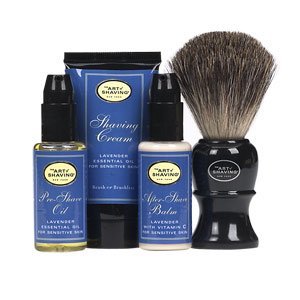
I bought a kit (I’m a sucker for good sales pitches even when I know I’m being suckered) which included: a badger hair brush (they say it is optional, but I love mine and wouldn’t do this without it), pre-shave oil, shaving cream, and after-shave balm. They had five types to choose from: unscented, lemon, sandalwood, ocean kelp, and lavender. I selected the lavender because it was formulated for sensitive skin. At first I was worried about being overpowered with the smell, but was pleasantly surprised to find the scent as light as a feather. I didn’t need a new razor; they said my Mach3 was just fine.

I came home with my bag expecting a huge dose of buyer’s remorse. Except after my first shave with their product, my face didn’t flush. Could this really be a product that worked? I wasn’t willing to make that conclusion at the time. But now, after about a month of shaving, I can honestly say that this is the best shave I’ve had in years. My face doesn’t flush. The after-shave balm does what a balm is supposed to do–soothe. There’s no alcohol burn. In fact, I use the after-shave balm on non-shave days. If your skin hates shaving, let me suggest you visit theartofshaving.com and order some product or go to one of their stores. I think you’ll also become a fan. 

Info for Choosing a Career

There are many things I wished I’d done differently when choosing a career. I wish I’d broadened my horizon on the horde of different careers possible. I wish I’d really looked at what the various careers earned on average. Luckily for those looking to select a new career today, Utah’s Department of Workforce Services compiles data on more than 700 occupational wages and shows you the average and median annual wage as well as the average for inexperienced folks in that occupation.

Not only does looking through the list help you see options you might not have considered, it also helps you get a realistic expectation for what you might earn in that profession. Now, the list, although large, doesn’t show every possible occupation (FBI agent, Marine) or every permutation of the occupations shown. For example, there’s one line for accountants and auditors, but there are tax accountants, fraud accountants, security accountants, auditing accountants, etc. Nevertheless, this is an excellent list to begin a search.

To get the list, go to this state website: http://jobs.utah.gov/jsp/wi/utalmis/default.do. Click on “Utah Occupational Wages.” That will open a page with a map of Utah. Click on the link on the right “Utah Occupational Wages” to get the Excel spreadsheet of all 700+ occupations listed.

Share

Similar Posts

  • Donald Rumsfeld, The King’s Speech, Aquatic Ancestor Apes & Talking Bacteria

    Donald Rumsfeld

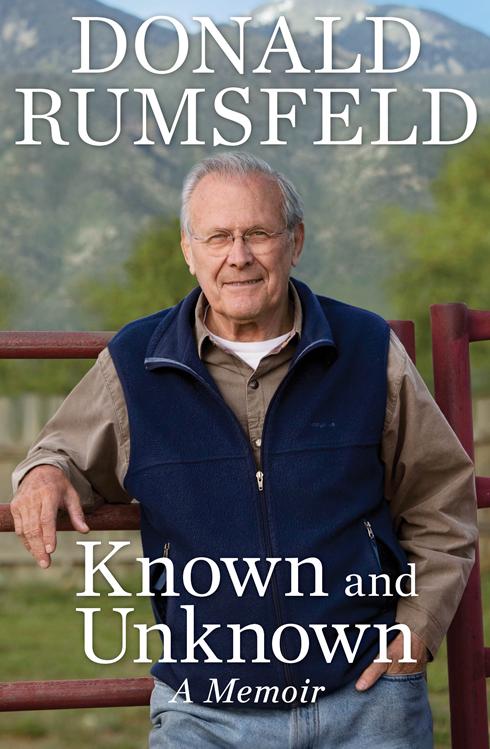
    I just finished Known and Unknown, a fat memoir by Donald Rumsfeld, and enjoyed every page.  Rumsfeld served as the Secretary of Defense under George W. Bush.  But Rumsfeld’s service didn’t start there. He was a Navy pilot, an assistant to a congressman during the Eisenhower days, and, in the early 60’s, a four-term congressman from Illinois.  He held various positions in the Nixon White House in the late 60’s and early 70’s, including ambassador to NATO.  He was Chief of Staff and Secretary of Defense when Ford took over from Nixon.  Reagan tapped him to be a special envoy to both the Middle East after the Beirut bombing and to the Law of the Sea treaty discussions.  He was the president of Searle, a pharmaceutical, as well as General Instrument, the company that pioneered HDTV.  Only after all that, did George W. Bush bring him on as Secretary of Defense.

    When writing novels, I try to create characters worth knowing, either because of their interesting personality or skills or because of the events they take part in. Donald Rumsfeld is just such a character, except he’s no fiction.

    In his memoir he shares insider information on everything from Watergate to 9/11 to the war in Iraq. What emerges is a fascinating look into many of the most important events in the last forty years.  You’ll get insight into some of the issues experienced in various White House administrations and see what really was going on with waterboarding, Guantanamo, Abu Ghraib, hurricane Katrina and many other of the hot button issues in the Bush years. There are some laugh out loud moments where his understated humor shines through. There are also parts where he reveals some of his differences with others that worked with him in the various administrations, including issues with Nelson Rockerfeller, Colin Powell and Andy Card. But in everything he writes he’s fair and restrained and attempts to present the facts accurately. This is no attempt to settle scores.  Just a wonderful read.

    If you are interested in politics at all, I think you’ll enjoy this book. Moreover, I think you’ll come out a little wiser, maybe a little better person, for having spent a few hours with Donald Rumsfeld.  

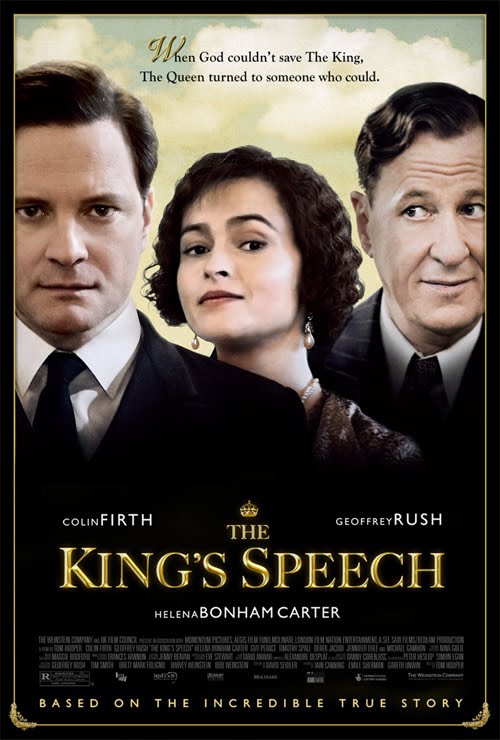
    The King’s Speech

    I do not watch many r-rated movies.  They are usually too vulgar or pornographic for my prissy tastes. However, I did my research on The King’s Speech, and having heard so many glowing reviews, Nellie and I rented it.

    It was wonderful.

    The movie tells the story of prince Albert Frederick Arthur George of Britain who did not ever expect to inherit the throne and did not want to, in part because of his stammer. Can you imagine having to be a public figure like a king and have to deal with something like that? Most of us dread the thought of public speaking. Can you imagine having to try with a stammer?

    But Albert’s lot was not to live the sheltered life. He became king when his brother abdicated the throne because of improprieties in his personal life. The day before the abdication, Albert went to London to see his mother, Queen Mary. He wrote in his diary, “When I told her what had happened, I broke down and sobbed like a child.” That is not the entry of a power-hungry man.

    He assumed the throne in 1936, when England ruled over almost a quarter of the world’s population. Three years later in 1939 WW2 broke out and Britain’s king needed to be able to address the people.

    In the movie, Colin Firth plays Price Albert. Geoffery Rush (Captain Barbossa in Pirates of the Caribbean) plays Lionel Logue, the unorthodox Australian speech therapist to whom Albert’s wife turns for help. The script is wonderful and the star-studded cast is spot on. There are moments of humor and poignancy and triumph. I was caught up in this movie as much as any I’ve seen.

    If you like English dramas, you’ll enjoy this one. And the profanity, the reason for the r-rating, is not there to depict casual vulgarity. It was part of a technique used by the therapist. In the end, you’ll overlook it and find yourself on pins and needles, rooting for this fine man.

    Aquatic Ancestor Apes & Talking Bacteria

    I’ve written about TED before. The annual TED (technology, entertainment, design) conferences, in Long Beach/Palm Springs and Edinburgh, bring together the world’s most fascinating thinkers and doers, who are challenged to give the talk of their lives (in 18 minutes or less). The folks at TED record these speeches and put them up for free on their site for the rest of us to watch. And I just watched two dandies.

    The first is by Elaine Morgan who says we evolved from aquatic apes (sigh, just when you think you’ve found grandpa Eddy hanging out in the trees, you learn he’s an imposter). Morgan is a Welsh writer for television and also the author of several books on evolutionary anthropology. In the speech she describes the reasons why it makes sense that humans had aquatic ancestors. Along the way, she illustrates key principles of science, including why science by consensus is no science at all. Her manner is so delightful and engaging I think I could listen to her for hours, preferably around the dinner table. Watch her right now. She just might convince you.

    The second speech was given by Bonnie Bassler, an American molecular biologist, who has been part of the team that discovered key insights into how bacteria talk. It appears that bacteria do not invade a host and start doing damage. No, they wait until their numbers are sufficient that they have a chance of surviving. They coordinate defense and mount attacks as a group. Who would have thought? Knowing how this works is not only interesting all by itself, but it has stunning implications for medicine and fighting infection. Bassler is a fascinating and enthusiastic presenter. Among other things, you’ll end up seeing that humans are more bacteria than you could imagine. Watch her.

    Share
  • The Rocket Science of Overspending

    In July, I blogged some spending 101 for Congress and the President, including contigency planning for alien invasions.  I thought I made some good points.  However, through the whole spending debate that occured this last spring nobody in the media or elsewhere was able to make clear what is going on with the US government. Nobody except Dave Ramsey. He explained it on Fox and then on his website. If you take the big federal numbers and translate them to a size we can understand, here’s the situation:

    – Joe and Susie (the Federal government) make $55,000 a year
    – They spend $96,000 a year
    – At the same time, they have $366,000 in credit card debt

    Look at those numbers again. Every year those clowns in Washington are adding $41,000 a year to that massive debt total. Soon enough, our overspending will kill our ability to do anything else except pay the interest on that debt.  150 years after America abolishes slavery, we decide that debt slavery really is a good idea. Yea! Give us shackles! Give us shackles!

    No wonder our credit score as a nation (our bond rating) was reduced.

    So what did the government do this last Spring? They agreed to find some way to cut spending from $96,000 to $78,000. Meaning they’re still adding $28,000 dollars a year to the government’s massive credit card debt total. Which we have to pay!

    If the US Government was a family, they would be making $55,000 a year, they spend $96,500 a year, & are $366,000 in credit card debt. What’s the first step to get out of debt? Stop overspending! But that means a family that is used to spending $96,500 a year has to learn how to live on $55,000. That’s a tough pill to swallow. It works the same way for the government. You can’t borrow your way out of debt, whether you’re a typical American family or the entire U.S. government. At some point, you’ve got to say, “Enough is enough!” and make the hard cuts necessary to win over the long haul. – Dave Ramsey

    The answer is NOT to print more money.

    If you do that, you reduce the value of each dollar. It’s called inflation. As Ron Paul rightly points out, it acts effectively as a tax. Or as I like to put it–a PAY CUT. How many of you would like to get a nice fat 10% or 20% pay cut this year? Furthermore, instead of fixing the problem, the overspending continues, which means more pay cuts in the future. More fun!

    No, the thing we have to do is STOP SPENDING MORE THAN WE MAKE.  Here’s what has to happen.

    1. We must write into law that Congress balance its budget every year–they must not be able to spend more than they take in except in rare emergencies. This means they might need to build up a rainy-day fund.
    2. We must cut our spending. Now. I linked to an idea Ron Paul has for this in my 101 post where we just go back to 2007 levels of spending.
    3. We must work to increase our revenues. Not through hiking taxes to monstrous levels, but by providing optiomal regulatory conditions for economic growth. See my 101 post. 
    4. We need to make sure the taxes are visible, so the American people can easily see what’s going on. Congress has mandated that lenders provide clients an APR so they can clearly see the rate they will pay on a mortgage. Why shouldn’t we mandate that the IRS send out an ATR–annual tax rate (or maybe Annual Grab Rate or Annual Tax Burden or you come up with the name)–which includes all Federal taxes translated into one total rate?  
    5. We need to give everyone the opportunity to pay for the soldiers that defend them and the roads they drive on, even if it’s just $50-100 a year for the very poor.
    6. We must send people to the White House and Congress who are willing to do what it takes RIGHT NOW.

    I mentioned Ron Paul a number of times above. He’s not my choice for president. But he has added a number of good things to this discussion. Here are the Ramsey links:

    EDIT: Mark Holt makes an excellent point in the comments. Inflation isn’t just a pay cut. It’s a savings cut, a retirement cut, a 401k cut, a house value cut, an everything cut. Using that backdoor method, the DC Connivers institute a tax of everything, something they’d never be able to pass out in the open.


    Share
  • Good Stuff! Mike Loades on Swords and Bows

    Mike Loades is an expert on medieval fighting. He brings energy and, not just bookish learning, but insights from hands-on use. I loved the five-part Weapons That Made Britain television series for which he was the host and chief consultant. And so I looked to see if there was anything else he’d done. I found he’d written two books, which I am so happy to have read.

    The Longbow is not just a book about the longbow. It’s about its construction and how it impacted the development of armor, and types of armor, and the wood used for the bow, and how to make arrows, and what the various points were for, and how people trained, and then cared for the bows, and how it was used in war. And, again, the insights are not just bookish ones. He’s walked the battlefields. He’s used bows for years. He’s performed tests with them. It is a 80-page book that carries a monstrous bang for the buck and one of the best purchases I’ve made for my library. I loved it.

    MikeLoades_TheLongBow

    Of course, after that experience, I had to get his Swords & Swordsmen. This book is almost 500 pages long, and I was rapt reading each page of it. Instead of focusing on one version of this weapon, Loades discusses exemplars of various types of swords through time, starting with the sword of Tutankhamun in Egypt all the way through the swords of J.E.B. Stuart and G.A. Custer in the American Civil War. There are 15 chapters all discussing different eras and swords that provide a mountain of insight. The love Loades has for and the practical experience he has with the topic shines through on every page. Just as with The Longbow, you’ll learn about use, construction, the interplay with armor, and much more. Heck, I got the ideas for at least three novels reading this book. I loved it as much as I loved the first.

    MikeLoades_SwordsAndSwordsmen

    If you enjoy military history and arms and armor, you will love these books. Guaranteed.

    While you’re waiting for them to arrive in the mail, treat yourself to five hours of fascinating video below.

    Weapons That Made Britain E01 – The Sword

    Weapons That Made Britain E02 – The Longbow

    Weapons That Made Britain E03 – The Lance

    Weapons That Made Britain E04 – The Shield

    Weapons That Made Britain E05 – Armour

    Share
  • |

    Wowser sequence in Life season 1 episode 3

    I just started watching Life, the NBC series. I’ve enjoyed the first four episodes. In fact, episode three has one of the most brilliant sequences I’ve ever seen.

    Here’s the setup. Charlie Crews is a detective who was sent to jail for a murder he didn’t commit. Being a cop in prison made him a target for many many beatings. Eleven years later they found none of the DNA at the murder site was his. So they released him, and, as settlement for damages, gave him a bunch of money, and allowed him to be a cop again. He’s been partnered up with Dani Reese. Nobody really wanted him, but she’s had problems of her own and got stuck with him. Crews had a car in the first episode, geeked out about GPS and handsoff telephone (stuff his missed in prison), but the ex-con lawyer Crews has put up in his mansion ran it over with a tractor. He’s been riding the bus. In this sequence, Crews and Reese are looking for a guy named Manny Umaga who carjacked a man and his wife then shot the wife. In this sequence they go find where he is and then go get him.

    Watch it and then read my comments below. It runs from minute 15:49 to 21:15.

    1. Surprise. You walk into a dangerous car shop. What are you expecting? You know you’re going to meet hard characters. They’re not going to want to talk to you. There’s some danger and so a bit of suspense. So we meet some hard characters. I was still surprised by the particulars of Buscando Maldito–his neck tattoos and hat. Wonderful and new (at least to me). But before we can have a confrontation–surprise–Crews sees the car of his dreams. Then we get that wonderful exchange between him and Maldito and El Repitito. Total humor. Totally unexpected. Then Maldito suggests a posse? Not only is he willing to talk, but he suggests he goes with them? When going to get Umaga, more surprises. Flash bangs? Big honking Samoan running? Busts down the door? Takes Crews by the neck? Crews pulls his own knife? Surprise after surprise after surprise.

    2. Characters. Loads of interest factors (see my post on character). Maldito and Repitito have fabulous eccentricities. Crews displays his own interesting reaction to the car. Surprising, but logical (BTW, in a later scene you see him driving the car!) Then we see his prison background coming up with the knife. Love his backstory. And did you notice how strong Reese is, taking none of Maldito’s crap?

    3. Dialogue. Did you notice how the first few times Reese says anything to Maldito he doesn’t respond to her question? Total avoidance of on-the-nose dialogue, talking cross-purpose.

    4. Soundtrack. The way they bridged the two scenes with that music was fabulous. And the music itself. Wow. BTW, that’s “No Nadie” by Edgard Jaude, Rafael Torres, & Andres Ayrado.

    5. Conflict. Between the Maldito and Crews about the car, between Maldito and Reese, between Umaga and Crews. Then Crews and Reese (with the knife).

    I think I watched this a dozen times. Loved it.

    Share
  • Good Stuff! Woman in Gold

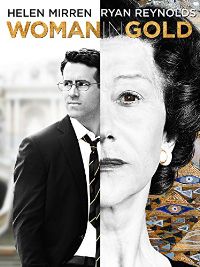
    Woman in GoldI recently watch Woman in Gold with my family, and we loved it. It has delightful characters, a suspenseful plot, and moments of both humor and deep poignancy.

    The movie is based on the true story of Maria Altmann, an elderly Jew living in Los Angeles. When she was a young woman, the Nazis took over Austria. She fled, narrowly escaping. In addition to all the horrors committed against her people and family that couldn’t get out, the Nazis stole artwork and other precious items. The problem is that after the war, many of these items were then appropriated by individuals or the countries of Europe and not returned to their original owners.

    The movie is about Maria and her young lawyer who fight the Austrian government to have a famous painting called Woman in Gold that was legally and rightfully hers returned. It’s a legal battle that went all the way to the Supreme Court of the United States in 2004. But this isn’t about someone wanting a painting. It’s about so much more.

    If you enjoyed Mr. Holmes, Saving Mr. Banks, or Bridge of Spies, I think you will love this movie. You will love the dynamic between the frank-speaking Maria and her lawyer. And you will be moved.

    Share
  • Good Stuff: Why We Get Fat

    What if everything you know about fat, cholesterol, and diet is pretty much wrong?

    What if you found out that the science behind the good old food pyramid is, well, not really there?

    We’ve been told that a healthy diet consists of lots of grains, bagels, bread, pasta, cereals, rice, etc. and very little fat. What if it’s actually the reverse?

    If it is, then it might explain why the rates of diabetes and obesity began to skyrocket as the nation started to implement a low fat high carb diet.

    I remember having gained about fifteen pounds when I was first married. I decided I would go on a diet. I read up on the low fat high carb diet and followed it strictly. Two weeks later, I had gained ten more pounds. Did I, at the time, look at the diet and think that maybe there was something wrong with it?

    No. That would have been too intelligent.

    Instead, I figured something must be wrong with me and continued to try to “eat healthy.” What’s that definition of insanity—doing the same thing over and over again and expecting different results? Call me insane. Or slow. Or too trusting of authority.

    It appears that the science of nutrition got hijacked. Government policy then ran away with it. It’s a fascinating and cautionary tale. Let me recommend three books that explain what really causes us to deposit fat and how we got off track.

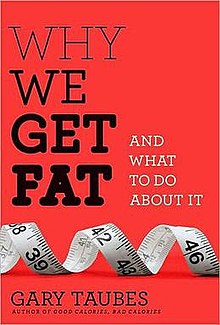
    The first is Why We Get Fat by science writer Gary Taubes. In it he reveals the bad nutritional science of the last century, why the good science was ignored, what really causes us to store fat, and what to do about it.

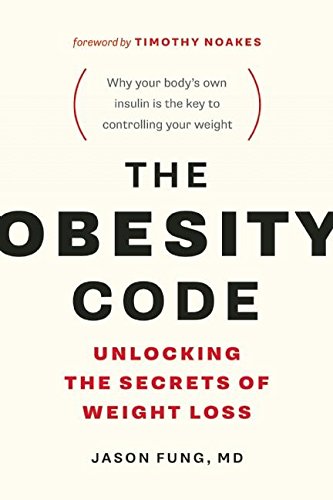
    The next is The Obesity Code by Dr. Jason Fung. Fung is a kidney specialist. Obesity and diabetes are the root of many kidney problems. And so he decided to help his patients by strop treating symptoms and get at the root cause. Fung’s gift is clarity. He explains how obesity and diabetes became an epidemic, the errors in how we think about calories and diet, and then he explains in great clarity the new model of what really causes obesity and how to reverse it.

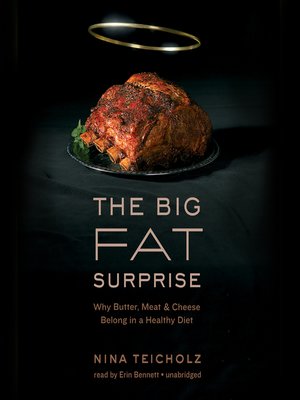
    The last is The Big Fat Surprise: Why Butter, Meat & Cheese Belong in a Healthy Diet by investigative journalist Nina Teicholz. She spent nine years investigating this, and the book reveals how the misinformation about saturated fats took hold in the scientific community, government, and the public and how recent findings overturn these beliefs. It’s a startling history, a cautionary tale showing how ego, bias, and premature institutional consensus allowed dangerous misrepresentations to become dietary dogma.

    If you’re dealing with obesity, heart disease, or diabetes, I think you’ll find these books very interesting.

    Share

4 Comments

  1. You mentioned the Art of Shaving badger hair brush was “optional.” Did you use it? If you didn’t you really should try: not only will you use less cream (so its a better value) but it will hydrate the cream more effectively and gently clean the little bits of debris from around each hair so you will get an even better shave! I have a bunch of videos (at website link) that will help you build a good lather and shave more effectively.

  2. John,
    Good review of “Game of Shadows” that I agreed with.
    Having developed a distrust of Guy Ritchie films, I was hesitant to even go see the movie.
    Friends talked me into it.
    Having read all the Sherlock Holmes stories at an early age, I believe it helped me follow the story better, understand his restraint at killing Moriarty and in general “suspend disbelief” at the cinema.
    I also have not seen the first movie.
    This made the movie work a little better for me than most but I did notice a lot of “how did we get here?” moments.
    The actress playing “Madam Simza,” Noomi Rapace, did so well that I went home and spent a few days watching the three Swedish “Girl who…” movies based on the books by Stieg Larsson.
    The digression above represents some of the experience while watching “Game of Shadows” – it goes off on tangents and the action takes viewers places with little explanation why.
    I believe I enjoyed it more than most because of my earlier time spent at 221b Baker St. with Sir Arthur Conan Doyle’s hero / anti-hero Holmes.
    Such knowledge should not be a pre-requisite for a movie, though.
    John, did you think the writers had this in mind when scripting the movie? That it would attract audiences based on Doyle’s and Downey’s fan base? Therefore, they could cut some explanation?
    Overall, it was still an entertaining movie with Downey mastering “The Art of the Close Shave.”
    -Sam

  3. Sam,

    I have no idea. But I would think they wouldn’t want to do that in this case. This is a blockbuster film, which means they want to make money, which means you want as wide an audience as possible. Why would you want to limit your audience to those who have read the stories? Everyone knows who Sherlock is, but not very many have read even one story. Now you can throw in lines and little things here and there that only devoted fans will catch. But the main story needs to be accessible and clear.

Comments are closed.