Conservative Republican Amnesia

If you ask the “conservative” talking heads–Limbaugh, Beck, Hannity, etc.–who THE best conservative president of the last 100 years was, they will say Ronald Reagan. If you ask their dogs, they will bark “Ronald Reagan.” Their gerbils will say other things, but everyone knows you can’t trust rodents. Ask the regular conservative Wanda and Mack (Jane and Joe is so cliche), and they’ll give you the same response as the dogs and people. Ronald Reagan is the guy we conservatives and Republicans have been taught to worship.

Except, when presented with a candidate as conservative as Reagan, no, probably more conservative (I’m talking Mitt Romney), many of these “conservatives” get out their inquisitional torches. Which is a big reason why the GOP primaries are as fluid as they are at this point.

As a side note, have you noticed that these talking heads and the mainstream media either have a hobby horse they ride above all else (Rush Limbaugh and his anti global warming crusade) or they seem to promote some flavor-of-the-day litmus test for each election. In one election, they’re going on and on about homosexual marriage. The next election, it’s a talking head approved stance on Taliban bombing. The next, it’s the fact that budgets must be balanced. They line the candidates up and then start whacking them based on these flavor-of-the-day tests. It’s like going to buy a car and focusing all your attention on the steering wheel.

Anyway, I think many of us have forgotten what THE so-called best conservative president of the last 100 years looked like. If Ronald Reagan were to run today as John Smith, the conservative talking heads would drop him like a hot potato.  You don’t believe me? Well, let’s see how he stacks up.

1.      ILLEGAL IMMIGRATION

  1. Reagan signed in amnesty for 3 million illegal aliens. The south-west-east-north-of-the-border kind, not the ones with green antennas.
  2. Talking Head Response: After crapping a brick, they would proclaim that John Smith, aka Ronald Reagan, is a pro illegal immigration RINO and must be thrown out!

2.      ENVIRONMENTAL REGULATION

  1. A few weeks ago Rush Limbaugh told a caller that Romney is not conservative because of his stance on man-made global warming (Romney says he doesn’t know, but there seems to be evidence men contribue; women, of course, never to contribute to such things–they’re too smart), which Limbaugh thinks will lead to big-government regulation of emissions etc.
  2. YET AS GOVERNOR, Reagan established the Air Resources Board to battle California’s worst-in-the-nation smog problem. In a 1984 radio address to the nation, Reagan took credit for the strong action he took in California to combat smog, saying: “I’m proud of having been one of the first to recognize that States and the Federal Government have a duty to protect our natural resources from the damaging effects of pollution that can accompany industrial development.”
  3. THEN AS PRESIDENT, he signed, with great pride, what many consider THE most successful environmental treaty of all time – the Montreal Protocol in 1987, which regulates emissions. Back in those days Ozone depletion was the Global Warming. Reagan believed it, despite folks questioning the science and was happy to regulate.
  4. In the 1987 State of the union he said: “We are also developing proposals that make use of market incentives to control air pollution caused by sulfur dioxide and nitrogen oxide emissions and the causes of acid rain.”
  5. What?! A cap and trade like program? Yes, putting Bush in charge. In 1990, the first Bush Administration successfully pushed through legislation establishing a cap-and-trade program to reduce acid rain—the program Reagan started!
  6. Talking Head Response: John Smith is a total pro-environmental regulation RINO, please queue Al Gore singing “Burning Ring of Fire”

3.      ABORTION

  1. Reagan signed a permissive law that allowed abortions. Since that law went into effect more than 2,000,000 abortions have happened in the Golden State.
  2. Reagan says he failed to see how it would be abused. He blamed his own inexperience, stating that had he been in office longer he would have realized that the bill was wrong.  He blamed doctors for misinterpreting the bill. President Reagan stated his prolife position by saying: “Abortion on demand now takes the lives of up to one and a half million unborn children a year. Human life legislation ending this tragedy will someday pass the Congress, and you and I must never rest until it does.”  BUT he never introduced a bill to ban abortion or amend what he’d done. Not in California, nor as president.
  3. Furthermore, today’s conservative inquisitors would point to his Supreme Court appointments. He appointed the moderate Sandra Day O’Connor.  Anti-abortion groups were livid, fearing, rightfully as it turned out, that Mrs. O’Connor would not vote to overturn Roe v Wade.  He appointed Justice Anthony Kennedy who had a long history of supporting expanded rights of privacy, gay rights, and preserving a woman’s right to choose.
  4. Talking Head Response: actions speak louder than words–John Smith is a pro-choice RINO

4.      UNIONS

  1. Reagan was a union president 8 times in a row.
  2. Reagan, aka John Smith, also had lots of troubling connections to the Teamsters, who endorsed him, and who suddenly saw less investigation of their leaders for corruption. This is during the Jimmy Hoffa organized crime years.
  3. Talking Head Response: choke, ack, sputter–Smith is a pro-union gangsta RINO!

5.      GUN CONTROL

  1. It was Governor Ronald Reagan of California who signed the Mulford Act in 1967, “prohibiting the carrying of firearms on one’s person or in a vehicle, in any public place or on any public street.” Yeah, he aimed to stop the Black Panthers et al, but affected all gun owners.
  2. Twenty-four years later, Reagan was still pushing gun control. “I support the Brady Bill,” he said in a March 28, 1991 speech, “and I urge the Congress to enact it without further delay.” He was right with Clinton on that issue.
  3. The Brady Bill, for the first time ever, instituted federal background checks on firearm purchasers in the United States.
  4. NRA spent millions fighting it, when it pass they mounted cases in a number of states wanting to have it overturned as unconstitutional.
  5. Talking Head Response: anti-gun RINO!

6.      FISCAL POLICY

  1. As Governor, Reagan signed into law the largest tax increase in the history of any state up till then. Meanwhile, state spending nearly doubled.
  2. As President he continued. While he did cut taxes his first year, he signed into law tax increases of some nature in every year from 1981 to 1987. Furthermore, the debt increased to nearly $3 trillion, roughly three times as much as the first 80 years of the century had done altogether.
  3. Talking Head Response: tax and spend RINO!

7.      RELIGION

  1. Smith, aka Reagan, let Nancy’s astrologer affect his schedule
  2. Talking Head Response: troubling devilishness (scary for evangelicals everywhere!), even if he only did it to make Nancy feel peace

Reagan the RINO? Are you kidding? And yet Reagan would be hounded out of the Republican party if he ran today. The talking heads would sound the warning long and loud, which is a shame.

On the other hand, I’m not saying we need another Reagan. Clones never pan out–hasn’t anyone seen Multiplicty with Michael Keaton?! And despite the recent zombie craze, I don’t want one in the White House, even if the world would be a better place if said zombie should eat Vladimir Putin’s brains out. I tire very quickly of Reagan worship. Or any other politician worship. As good as Reagan was, I disagree with a number of things he did. What I am saying is that those who want to get another president “as good as Reagan” had better know what such a president looks like. And it ain’t the caricature that’s being held up today by many conservatives, especially the talking heads, who seem to gloss over the facts of history.

Share

Similar Posts

  • |

    Your single biggest challenge writing novels

    I’m about to put together a brand-new novel writing boot camp, but before I do that I want to know what would be most helpful to YOU.

    So if you want to write novels, my question to you is this…

    When it comes to writing novels, what’s YOUR single biggest challenge, frustration, or concern?

    Please CLICK THE LINK to tell me.

    Click here.

    As a thank you, those that answer the question will get a seat at a virtual, 1-hour training session I’m putting on where you discover 3 key principles of keeping your readers hooked.

    I look forward to the insights.

    You’re awesome ?

    Share
  • Why I think the 10,000 hour idea is bogus

    Here’s the idea popularized by Malcolm Gladwell in Outliers and Geoff Colvin in Talent is Overrated: put in 10,000 hours of deliberate practice (as opposed to mindless practice) into the area of your choice, and you will succeed. 10,000 hours is more important than anything else.

    10,000 hours.

    The idea that deliberate practice makes perfect and leads to success seems to make a lot of sense.

    Except I don’t think the data holds up.

    First, there’s a huge survivorship bias in the 10,000 hour idea.

    Both Gladwell and Colvin based their stuff on Anders Ericsson’s research. I contacted Mr. Ericsson and asked him if there were any studies that weren’t correlational. Any that took similar groups of schlubs and showed that deliberate practice is what took them to elite levels of performance.

    He said no there weren’t, but graciously sent me some files to help. Here’s the money quote in those files:

    “The main focus of deliberate practice was to explain individual differences among those individuals who had had access to all necessary training and practice opportunities. I proposed those factors which could explain the performance differences within groups of expert musicians who had accumulated over ten years of instruction and mentoring by skilled teachers.”

    These were not studies designed to look at those who became elite and those that didn’t and figure out what made the difference. All he did was look at performance differences between experts. Which means there are huge issues using his research to make claims about what leads to expertise.

    Big issue one: he has no idea what kind of practice any of these folks had before he met with them. It’s all self-reported. There were no controls to verify the amounts of “deliberate” practice the musicians had in the long years up to the time he studied them.

    Big issue two (and just as important): he’s looking at experts. It’s all after-the-fact.

    He took a bunch of successful people and looked at their current work habits and speculated about their reports of earlier practice. Hum, they’ve put in a lot of hours. And these guys doing better seem to be doing a specific type of practice. But he did NOT look at a cohort of people who all started out at the same time, track their progress, and then identify factors that made the difference between those who became elite, those who became so-so, and those who ended up in the mud pit.

    But somehow his stuff got twisted into the idea that if you’re starting out and just put in 10,000 hours of deliberate practice, you’ll be successful just like those big guys!

    Big issue three. Ericsson did not study, and Gladwell and Colvin do not address, the factor of early success. Especially in writing and other tournament-style endeavors where rejection plays a huge role.

    So many people quit because the effort is not worth the reward. What you have left then are a bunch of people who persevered, but was it the hours they put in that led them to the top? Or did they have a lot of hours because they hung in there?

    And did they hang in because they had early success?

    And did they have early success because of luck or some natural aptitude or advantage like birthday that seems to factor so heavily in Canadian hockey (I think Gladwell talked about that in the same book–right birth date means you’re older compared to the other kids and therefore seem to have “talent” when it’s just a few months more physical development, which makes a big difference when you’re young) or some parent who had expertise and gave them a leg up against the other kids in their cohort?

    You see the effect of success in reading. My wife works as a 7th and 8th grade language arts teacher. The studies have shown that kids, in general, need to have about 94% comprehension rate to stick with reading. Below that they start to feel failure, get frustrated, and quit. In most cases, reading a super hard book will decrease motivation. Which then leads to less practice. And less skill. They’ve found that kids will work down around an 89% comprehension rate, a struggling range, if they have support. Below that the failure rate leads them to self select out of reading.

    Where in all these studies was self-selection included? Nowhere. Motivation, early success, quitting: disregarding those is a huge oversight.

    And all of these issues are compounded, especially for artists buying into the 10,000 hour idea, by the fact that even if you do get some skillz, that’s a completely separate thing from being noticed.

    Duncan Watts did a fascinating study about cumulative advantage reported in the NY Times here: http://www.nytimes.com/2007/04/15/magazine/15wwlnidealab.t.html?_r=0

    Basically he took a bunch of songs with varying quality and wanted to see how social influence (download counts) affected which songs rose to the top. He put the same set of songs in 8 discrete and separate online environments to see which songs would be most popular. His finding:

    “In all the social-influence worlds, the most popular songs were much more popular (and the least popular songs were less popular) than in the independent condition. At the same time, however, the particular songs that became hits were different in different worlds, just as cumulative-advantage theory would predict. Introducing social influence into human decision making, in other words, didn’t just make the hits bigger; it also made them more unpredictable. . .

    . . . When we added up downloads across all eight social-influence worlds, “good” songs had higher market share, on average, than “bad” ones. But the impact of a listener’s own reactions is easily overwhelmed by his or her reactions to others.”

    So even if your stuff is good, that does not mean it will be popular.

    And when you meet failure after failure after failure . . .

    You’ve got to practice well to get better, to offer more awesome gifts. But you’re not going to practice without the motivation. Motivation is the KEY to learning. And early success is a key part to motivation.

    Another piece of data that seems to belie the 10,000 hour claim is that when you do some simple math and look at surveys of writers breaking in, 10,000 hours starts to look very odd indeed.

    Let’s say you’re a poopy-slow writer and can only get 250 words in per hour. In 10,000 hours will you have written 2.5 million words or about twenty-five 100k novels.

    25 novels?

    Hey, you say, you can’t be typing the whole time.

    Okay, let’s be super conservative with these numbers. What if you spend about half that 10,000 hours writing and the other editing and doing pre-draft work? That’s still 12.5 finished novels.

    That sounds like Brandon Sanderson. Except it’s not. Remember, he sold number 5 or 6.

    Furthermore, the problem is that from all the surveys I’ve seen, writers who break into the old traditional publishing system aren’t averaging 12.5 novels. They aren’t averaging 5 or 6. They’re averaging 3-4, with a lot selling their first or second.

    Hello, Stephenie Meyer and JK Rowling. And a lot of indie authors.

    Jim Hines reports from a survey of authors he conducted:

    “I also asked how many books people had written before they sold one to a major publisher. The average was between three and four. Median was two. I was surprised, however, to see that the mode was zero. 58 authors sold the first novel they wrote.” More at: http://www.jimchines.com/2010/03/novel-survey-results-part-ii/

    10,000 hours? A million words?

    I don’t think so.

    Gladwell scoffs at this 10,000-hours-will-make-you-a-success reading of his original writings on the matter: http://www.newyorker.com/online/blogs/sportingscene/2013/08/psychology-ten-thousand-hour-rule-complexity.html.

    But this is precisely the message so many have taken from the studies. Just put in the time and you’ll become great because the practice is more important than any natural aptitude . . . or early success.

    I don’t think it is.

    John, what in the Sam Hill are you doing? Trying to depress everyone and tell them they can’t succeed?

    No.

    What I’m saying is that we must practice and improve our craft. That’s a given. But we cannot expect that alone to make us successful. Especially not as artists. We can’t expect that 10,000 alone will make our work super popular.

    Working hard WILL increase the probability of success (what’s that saying?–the harder I work, the luckier I get).  But as writers we’ve got to realize that there’s no guarantee of popularity. Or even expertise.

    So what are we left with?

    Nothing, and maybe everything. Because there is passion. There is sharing. And if you can tap into that and rejoice in the sharing that does occur, it might well be the best reward. Bricks of gold in the basement and your name on everyone’s lips must be awesome. But a memory of walking a number of afternoons with a daughter in the hills and telling (sharing) a fine tale to that audience of one might just be worth more than all the gold bricks in China.

    (Yes China, not Fort Knox. You didn’t hear?–we had to ship everything over before we could get another loan.)

    The bottom line is this: there’s no guarantee of success. Not even with 10,000 hours.

    Share
  • The Rocket Science of Overspending

    In July, I blogged some spending 101 for Congress and the President, including contigency planning for alien invasions.  I thought I made some good points.  However, through the whole spending debate that occured this last spring nobody in the media or elsewhere was able to make clear what is going on with the US government. Nobody except Dave Ramsey. He explained it on Fox and then on his website. If you take the big federal numbers and translate them to a size we can understand, here’s the situation:

    – Joe and Susie (the Federal government) make $55,000 a year
    – They spend $96,000 a year
    – At the same time, they have $366,000 in credit card debt

    Look at those numbers again. Every year those clowns in Washington are adding $41,000 a year to that massive debt total. Soon enough, our overspending will kill our ability to do anything else except pay the interest on that debt.  150 years after America abolishes slavery, we decide that debt slavery really is a good idea. Yea! Give us shackles! Give us shackles!

    No wonder our credit score as a nation (our bond rating) was reduced.

    So what did the government do this last Spring? They agreed to find some way to cut spending from $96,000 to $78,000. Meaning they’re still adding $28,000 dollars a year to the government’s massive credit card debt total. Which we have to pay!

    If the US Government was a family, they would be making $55,000 a year, they spend $96,500 a year, & are $366,000 in credit card debt. What’s the first step to get out of debt? Stop overspending! But that means a family that is used to spending $96,500 a year has to learn how to live on $55,000. That’s a tough pill to swallow. It works the same way for the government. You can’t borrow your way out of debt, whether you’re a typical American family or the entire U.S. government. At some point, you’ve got to say, “Enough is enough!” and make the hard cuts necessary to win over the long haul. – Dave Ramsey

    The answer is NOT to print more money.

    If you do that, you reduce the value of each dollar. It’s called inflation. As Ron Paul rightly points out, it acts effectively as a tax. Or as I like to put it–a PAY CUT. How many of you would like to get a nice fat 10% or 20% pay cut this year? Furthermore, instead of fixing the problem, the overspending continues, which means more pay cuts in the future. More fun!

    No, the thing we have to do is STOP SPENDING MORE THAN WE MAKE.  Here’s what has to happen.

    1. We must write into law that Congress balance its budget every year–they must not be able to spend more than they take in except in rare emergencies. This means they might need to build up a rainy-day fund.
    2. We must cut our spending. Now. I linked to an idea Ron Paul has for this in my 101 post where we just go back to 2007 levels of spending.
    3. We must work to increase our revenues. Not through hiking taxes to monstrous levels, but by providing optiomal regulatory conditions for economic growth. See my 101 post. 
    4. We need to make sure the taxes are visible, so the American people can easily see what’s going on. Congress has mandated that lenders provide clients an APR so they can clearly see the rate they will pay on a mortgage. Why shouldn’t we mandate that the IRS send out an ATR–annual tax rate (or maybe Annual Grab Rate or Annual Tax Burden or you come up with the name)–which includes all Federal taxes translated into one total rate?  
    5. We need to give everyone the opportunity to pay for the soldiers that defend them and the roads they drive on, even if it’s just $50-100 a year for the very poor.
    6. We must send people to the White House and Congress who are willing to do what it takes RIGHT NOW.

    I mentioned Ron Paul a number of times above. He’s not my choice for president. But he has added a number of good things to this discussion. Here are the Ramsey links:

    EDIT: Mark Holt makes an excellent point in the comments. Inflation isn’t just a pay cut. It’s a savings cut, a retirement cut, a 401k cut, a house value cut, an everything cut. Using that backdoor method, the DC Connivers institute a tax of everything, something they’d never be able to pass out in the open.


    Share
  • Good Stuff! Three Days in Moscow

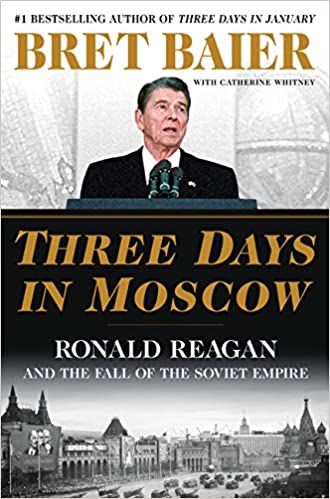
    Book cover, Three Days in Moscow

    I just finished Three Days in Moscow: Ronald Reagan and the Fall of the Soviet Empire by Bret Baier. It’s a New York Times bestseller that takes you into the world of Ronald Reagan, his rise to power in politics, and his role in ending the Cold War. And it does in a personable way with gentle humor throughout.

    I enjoyed the fascinating behind-the-scene insights about the personalities involved and the clarity about what really happened. And how the book brings Reagan to life, as if he’s almost there. Along the way you’ll also get insight into Mikhail Gorbachev, the assassination attempt on Reagan, and more.

    Baier is the chief political anchor for Fox News. In 2001, he became the station’s chief Pentagon correspondent and ended up traveling to Afghanistan 11 times and Iraq 13 times. In 2007, he became the station’s chief correspondent to the White House. More importantly, Baier seems to be one of the few journalists these days who is simply trying to get and report facts instead of spin. And that’s exactly what he’s done here.

    If you like biographies or history, if you want to know how the U.S.A. and the U.S.S.R. stepped back from decades of mutually assured destruction, if you want to get a view into how diplomacy is done, then I think you’ll love this book. And you’ll probably love it even more if you can listen to the audio book version, read by Baier himself, which also includes a recording of Reagan’s speech to the students at Moscow State University. I listened to it via the Overdrive account my public library provides. Baier’s reading was terrific.  

    Share
  • The Righteous Mind by Jonathan Haidt

    After this year’s presidential election I emailed my sister, a smart, super-competent, true-blue, bleeding-heart, save the weeds and snails liberal, who volunteered to do campaign work for Hilary Clinton in Colorado during the 2008 Democratic primaries and, of course, voted loudly for Obama in this last election.

    “Are you kidding me?” I asked. “How can anyone who doesn’t have a carrot for a brain want more of the same? I don’t get it. Obama? How can so many Americans be that gullible? I’m totally baffled.”  And that puzzlement wasn’t rhetorical. I was seriously baffled.

    “Are you kidding me?” she replied. “Mitt Romney? How could anyone vote for Mitt Romney?  Talk about baffled.”  She went on a rant listing all of Romney’s supposed deeds and positions of sooper evil and stupidity. Then she questioned how anyone could support that Hitler in his Mormon clothes.

    Okay, she didn’t say “Hitler,” but she did claim he was “evil” and “despicable.” And when I think of evil, my first thought is always of folks like Mitt Romney.

    Vicente Carrillo Fuentes, leader of the Juarez drug cartel, which is responsible for hundreds of gruesome murders each year and . . . Mitt Romney. Oh, yeah. They’re like brothers. In fact, wasn’t Romney’s dad born in Mexico? And, hey, one of Romney’s sons even knows Spanish. That boy wasn’t on a church mission there. No, he was making connections with the jefe!

    Sonia Montoya-Cadena, the one who ran a human trafficking ring in Denver exploiting young girls for sex and . . . Mitt Romney. Yeah, Romney’s just like that. If he could run slave brothels, he’d do it in a minute to make a buck. In fact, doesn’t Bain Capital own a couple of slave brothels in Greenland?

    I wanted to unload. I was prepared to destroy her with fiery analysis of the first order.

    Thundering analysis.

    Mountain crushing logic.

    She was so freaking blind.

    Except,

    She had never actually considered what I had to say in any of my previous emails. It never mattered how powerfully vast my brilliant logic was. She’d demonstrated wax ear time and again. All of my intellectual might never made a dent in her liberal force field. I brought blood and thunder, and it always seemed to bounce off her like bullets made of styrofoam.

    Nevertheless! Clinton? Obama? Save the gerbils?

    I made a comment that sent Smart Sister into DEFCON 5. Foolish me. Eventually, her liberal ire cooled and she decided to order comrade Putin to stand down and not push the big red button.

    Meanwhile, I started to think.

    I noted that if things didn’t change, the Republicans wouldn’t be winning the presidency any time soon. If they couldn’t beat Obama when the economy was in the tank, then there really was no hope. Which meant we are going to end up like Greece, with continuing inflation (which is not only an intentional, government-led annual pay cut on the disgustingly rich, filthy rich, and annoyingly rich, but also on the middle class, poor, destitute, and various and sundry hoboes everywhere), huge debt, stupid taxes, ridiculous health care, Soviet-style redistribution, blah, blah, blah.

    I asked myself, like all Republicans did, what could we conservatives do differently? Follow Obama’s example and improve our operations to get the vote out? Build up a conservative La Raza? Do the right thing with the children of illegals? Get someone willing to land more blows on the opposition (Romney could have decimated Obama in debates two and three, but he didn’t; he totally failed to define his opponent).

    Maybe it was in the messaging. Maybe what we needed to do was develop something that actually changed minds.

    At this point a faint ding sounded in the distance in my mind. A small light bulb suddenly flipped on and illuminated a dark cubby of my mind.

    Hadn’t I just read about studies showing how a soap opera in Mexico, a radio play in Tanzania, and sitcoms in America actually changed viewer attitudes and behaviors about literacy, HIV, and abortion? Didn’t I already know about the power of concrete and vivid storytelling? Not sermon-telling, but storytelling.

    Why, yes. Yes, I did.

    Had I not witnessed the use of storytelling on U.S. television for, what, fifteen years by those wanting to build sympathy for homosexuals? (A good thing, even if I disagree with some of the gay agenda.) And the cheapening of sex by others? (A bad thing.) And the clearly conscious promotion of many other attitudes and beliefs via various media programs?

    I determined there was something to this.

    If people were going to vote for fiscal responsibility in Washington, something like this was going to have to be done. It wasn’t going to happen in flame wars.

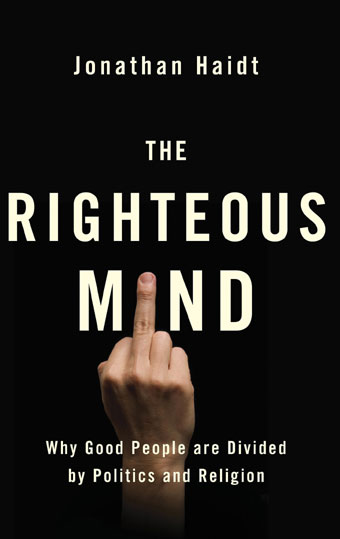
    About this same time I was browsing through the recent Radio West programs. I saw one called “The Righteous Mind.”  It was an interview of Jonathon Haidt about his new book The Righteous Mind: Why Good People Are Divided by Politics and Religion.

    Hey, wasn’t that addressing my question?

    The program blurb states: “Monday, our guest is the social psychologist Jonathan Haidt, whose latest book sets out to explain the root causes of the divisions in our society. At the heart of his argument is the idea that the human mind is designed to “do” morality. But when we separate into tribes – say political affiliations or religious denominations – we focus on different moral foundations. Haidt joins us to explain why he says we need the insights of liberals and conservatives to flourish as a nation.”

    I listened. And loved the program.

    Haidt shared a number of deliciously insightful things about how our mind works and how we choose our affiliations. He shared so many insights that I immediately requested his book at my library. The library ordered a copy for their collection. I, of course, was first in line to read it. I just finished the book.

    It’s one of the best books I’ve read all year.

    Haidt explains why my sister and I were both baffled by people who voted for the opposition candidate. He explains how human morality works. How our reason does not lead us to make the judgments we do, but instead more often acts like a lawyer to justify our positions to others.

    As soon as he explained that I saw how I had done that time and time again. For example, in this election cycle I blamed Obama for the economy. In the Bill Clinton re-election I vigorously argued that the President doesn’t have any effect on the economy and is lying if he takes credit for it. I’m not saying that Obama didn’t do things that might have hampered the recovery, but how did I know his actions exacerbated our problems? What evidence did I really have?

    Haidt explains that there are six basic moral bases then points out which ones drive liberals, conservatives, and libertarians, and how we can use that knowledge to disagree more constructively. He provides strong insights into how our reason and intuitions and judgments work, the evolutionary function of our morality, and how our wiring for group affiliation affects it.

    I didn’t agree with some of his conclusions. He sometimes takes his points too far. For example, he seems to suggest that people in cities are pre-disposed to be liberal. And that’s why they live there. Um, no. That’s not why they live there. They live in cities because that’s where the jobs are. The agricultural revolution made sure of that, remember? In his effort to explain the smaller biological basis of our beliefs, he also downplays the larger effect our families and groups have. But despite these excesses, he shares so many fresh and exciting ideas that they don’t matter. And he shares them all in such a fun and clear way that I couldn’t help but stay up late a number of nights reading this book.

    Do you know how much I wanted to trash Obama to my sister?  That Soviet-style central planner.  That drunken sailor spender.  That choom wagon pot head.

    And yet, you and I also know that will never work. I now know better why. Because of Haidt, I think I see a better way. I certainly see how I have done exactly what drives me mad about those who have drunk the opposition candidate’s Kool-aide. I see that I have my own conservative force field that deflects liberal bullets (and perhaps even blinds me to the truth sometimes). And why I need to watch my reason, that cunning lawyer part of my brain, as well as my intuition.

    Haidt, a liberal, has given me, a conservative, a great gift. I intend to use it. If you are interested in the two taboo topics of politics or religion, if you enjoyed Malcolm Gladwell’s book Blink or the Heath brother’s Made to Stick, if you want to find a better way to influence than flame wars (as fun as they can sometimes be), then I think you will enjoy the wonders Haidt shares in his fine book.

    Don’t just take my word for it. Listen to the Radio West program http://radiowest.kuer.org/post/righteous-mind for a taste of what awaits you.

    Share

4 Comments

  1. I have a staunchly conservative friend (I’m a hodgepodge of left and right views, myself, mostly aligning along social liberalism, moderate economic conservatism) who simply cannot bring himself to vote for any of this year’s candidates – with great trepidation, he *might* vote Romney, but the others terrify him.

    I tend to agree, except I include Romney in the “scares me” camp.

    Conservative intellectualism has left the building, and has been replaced with batsh*t crazy.

Comments are closed.