Why I think the 10,000 hour idea is bogus

Here’s the idea popularized by Malcolm Gladwell in Outliers and Geoff Colvin in Talent is Overrated: put in 10,000 hours of deliberate practice (as opposed to mindless practice) into the area of your choice, and you will succeed. 10,000 hours is more important than anything else.

10,000 hours.

The idea that deliberate practice makes perfect and leads to success seems to make a lot of sense.

Except I don’t think the data holds up.

First, there’s a huge survivorship bias in the 10,000 hour idea.

Both Gladwell and Colvin based their stuff on Anders Ericsson’s research. I contacted Mr. Ericsson and asked him if there were any studies that weren’t correlational. Any that took similar groups of schlubs and showed that deliberate practice is what took them to elite levels of performance.

He said no there weren’t, but graciously sent me some files to help. Here’s the money quote in those files:

“The main focus of deliberate practice was to explain individual differences among those individuals who had had access to all necessary training and practice opportunities. I proposed those factors which could explain the performance differences within groups of expert musicians who had accumulated over ten years of instruction and mentoring by skilled teachers.”

These were not studies designed to look at those who became elite and those that didn’t and figure out what made the difference. All he did was look at performance differences between experts. Which means there are huge issues using his research to make claims about what leads to expertise.

Big issue one: he has no idea what kind of practice any of these folks had before he met with them. It’s all self-reported. There were no controls to verify the amounts of “deliberate” practice the musicians had in the long years up to the time he studied them.

Big issue two (and just as important): he’s looking at experts. It’s all after-the-fact.

He took a bunch of successful people and looked at their current work habits and speculated about their reports of earlier practice. Hum, they’ve put in a lot of hours. And these guys doing better seem to be doing a specific type of practice. But he did NOT look at a cohort of people who all started out at the same time, track their progress, and then identify factors that made the difference between those who became elite, those who became so-so, and those who ended up in the mud pit.

But somehow his stuff got twisted into the idea that if you’re starting out and just put in 10,000 hours of deliberate practice, you’ll be successful just like those big guys!

Big issue three. Ericsson did not study, and Gladwell and Colvin do not address, the factor of early success. Especially in writing and other tournament-style endeavors where rejection plays a huge role.

So many people quit because the effort is not worth the reward. What you have left then are a bunch of people who persevered, but was it the hours they put in that led them to the top? Or did they have a lot of hours because they hung in there?

And did they hang in because they had early success?

And did they have early success because of luck or some natural aptitude or advantage like birthday that seems to factor so heavily in Canadian hockey (I think Gladwell talked about that in the same book–right birth date means you’re older compared to the other kids and therefore seem to have “talent” when it’s just a few months more physical development, which makes a big difference when you’re young) or some parent who had expertise and gave them a leg up against the other kids in their cohort?

You see the effect of success in reading. My wife works as a 7th and 8th grade language arts teacher. The studies have shown that kids, in general, need to have about 94% comprehension rate to stick with reading. Below that they start to feel failure, get frustrated, and quit. In most cases, reading a super hard book will decrease motivation. Which then leads to less practice. And less skill. They’ve found that kids will work down around an 89% comprehension rate, a struggling range, if they have support. Below that the failure rate leads them to self select out of reading.

Where in all these studies was self-selection included? Nowhere. Motivation, early success, quitting: disregarding those is a huge oversight.

And all of these issues are compounded, especially for artists buying into the 10,000 hour idea, by the fact that even if you do get some skillz, that’s a completely separate thing from being noticed.

Duncan Watts did a fascinating study about cumulative advantage reported in the NY Times here: http://www.nytimes.com/2007/04/15/magazine/15wwlnidealab.t.html?_r=0

Basically he took a bunch of songs with varying quality and wanted to see how social influence (download counts) affected which songs rose to the top. He put the same set of songs in 8 discrete and separate online environments to see which songs would be most popular. His finding:

“In all the social-influence worlds, the most popular songs were much more popular (and the least popular songs were less popular) than in the independent condition. At the same time, however, the particular songs that became hits were different in different worlds, just as cumulative-advantage theory would predict. Introducing social influence into human decision making, in other words, didn’t just make the hits bigger; it also made them more unpredictable. . .

. . . When we added up downloads across all eight social-influence worlds, “good” songs had higher market share, on average, than “bad” ones. But the impact of a listener’s own reactions is easily overwhelmed by his or her reactions to others.”

So even if your stuff is good, that does not mean it will be popular.

And when you meet failure after failure after failure . . .

You’ve got to practice well to get better, to offer more awesome gifts. But you’re not going to practice without the motivation. Motivation is the KEY to learning. And early success is a key part to motivation.

Another piece of data that seems to belie the 10,000 hour claim is that when you do some simple math and look at surveys of writers breaking in, 10,000 hours starts to look very odd indeed.

Let’s say you’re a poopy-slow writer and can only get 250 words in per hour. In 10,000 hours will you have written 2.5 million words or about twenty-five 100k novels.

25 novels?

Hey, you say, you can’t be typing the whole time.

Okay, let’s be super conservative with these numbers. What if you spend about half that 10,000 hours writing and the other editing and doing pre-draft work? That’s still 12.5 finished novels.

That sounds like Brandon Sanderson. Except it’s not. Remember, he sold number 5 or 6.

Furthermore, the problem is that from all the surveys I’ve seen, writers who break into the old traditional publishing system aren’t averaging 12.5 novels. They aren’t averaging 5 or 6. They’re averaging 3-4, with a lot selling their first or second.

Hello, Stephenie Meyer and JK Rowling. And a lot of indie authors.

Jim Hines reports from a survey of authors he conducted:

“I also asked how many books people had written before they sold one to a major publisher. The average was between three and four. Median was two. I was surprised, however, to see that the mode was zero. 58 authors sold the first novel they wrote.” More at: http://www.jimchines.com/2010/03/novel-survey-results-part-ii/

10,000 hours? A million words?

I don’t think so.

Gladwell scoffs at this 10,000-hours-will-make-you-a-success reading of his original writings on the matter: http://www.newyorker.com/online/blogs/sportingscene/2013/08/psychology-ten-thousand-hour-rule-complexity.html.

But this is precisely the message so many have taken from the studies. Just put in the time and you’ll become great because the practice is more important than any natural aptitude . . . or early success.

I don’t think it is.

John, what in the Sam Hill are you doing? Trying to depress everyone and tell them they can’t succeed?

No.

What I’m saying is that we must practice and improve our craft. That’s a given. But we cannot expect that alone to make us successful. Especially not as artists. We can’t expect that 10,000 alone will make our work super popular.

Working hard WILL increase the probability of success (what’s that saying?–the harder I work, the luckier I get).  But as writers we’ve got to realize that there’s no guarantee of popularity. Or even expertise.

So what are we left with?

Nothing, and maybe everything. Because there is passion. There is sharing. And if you can tap into that and rejoice in the sharing that does occur, it might well be the best reward. Bricks of gold in the basement and your name on everyone’s lips must be awesome. But a memory of walking a number of afternoons with a daughter in the hills and telling (sharing) a fine tale to that audience of one might just be worth more than all the gold bricks in China.

(Yes China, not Fort Knox. You didn’t hear?–we had to ship everything over before we could get another loan.)

The bottom line is this: there’s no guarantee of success. Not even with 10,000 hours.

Share

Similar Posts

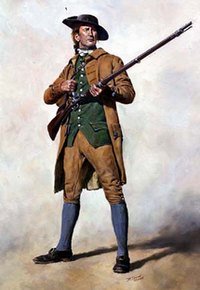
  • The Surprising Truth About Militias and the Second Amendment

    When the founding fathers spoke of “militias,” they were not referring to a bunch of yahoos running around in the woods with paint on their faces outside of state control.

    They were referring to a citizen army under state control.

    So is “militia” just the old-time word for what our army is today?

    No.

    A standing or “regular” army is one made up of professional, full-time soldiers like the US Army, the Marines, the Navy, and the Air Force. And it’s permanent, meaning you don’t disband the army when the fighting is done.

    A militia back in those days was something completely different.

    The problem of a standing army

    The founding fathers knew they needed to provide for the common defense, but they saw standing armies controlled by a central government as an immediate threat to the liberty the new union sought to preserve.

    Why would they think that?

    Easy. History was littered with case after case where standing armies had become a law unto themselves and oppressed the populace. One glaring example is what happened to the Roman empire. It suffered centuries where this faction and then that faction of the army was in control, and it brought nothing but a continual procession of civil wars and bloodshed.

    History also showed that even if the military didn’t take over, kings and queens were happy to wield standing armies to impose their will and oppress the people. Remember: the world then was ruled by monarchies. The founders had never seen a standing army wielded by any other type of power.

    So the founders didn’t want to give a president or any other central authority that power. They feared doing so would only pave the way to the ruin of the new nation they sought to form.

    So if you don’t have a standing army, how do you defend your country?

    The fyrd

    The founding fathers thought they saw a solution in a tradition of duty that went back hundreds of years in England. In the days when the Saxons ruled England, the kings and dukes would muster and deploy the fyrd to help them fight their wars.

    The fyrd was made up of all able-bodied free males between certain ages, regardless of their vocation. It was their duty to provide their own arms and defend the land when called by their leaders. So this was an army made up of farmers, tanners, smiths, tailors, etc.

    But the fyrd wasn’t a standing army. Nor was it populated with full-time soldiers. This citizen army was to be called out when needed, and when the crisis was over, it was disbanded, and the men went back to their vocations.

    The militia scheme

    The founders took this idea and tweaked it. Back in the Saxon days, the king controlled the fyrd. In this new scheme, the United States would rely on a fyrd (which they called a militia), but the powers to control it would be split between the president, Congress, and the States.

    First, Congress, not the president, was the only authority that could declare war and summon the state militias. So the president would be the commander in chief when the militia was active. But the minute Congress decided to end a war and disband the militia, that army dissolved, leaving the president as commander in chief of only the tiny number of troops that had been authorized as the regular army (less than 1,000 at the time).

    Second, while the Federal government would provide the weapons the militia would use when it mustered them for war, the state governments would be the ones to appoint the officers and train the soldiers. You can’t run an army without officers. So this would prevent the Federal government from taking control by stacking the army leadership with those loyal to a despot president or Congress.

    So the militia was supposed to be the main force that fought our wars, and it was supposed to be temporary. It’s true that Congress did authorize a standing army, but it was tiny. And with this setup, the founders figured we’d have the army we’d need, but we’d avoid the problems standing armies had posed in the past.

    So militias, as thought of by the founders in the 1700s, were not groups outside the government’s control. They were temporary citizen armies. And power over them was broken up between the president, Congress, and the States so no one group or person could wield them tyrannically.

    1791 and The Bill of Rights

    Accordingly, the founders wrote the articles and sections of the Constitution in 1787 to set all of this up. However, many anti-federalists were concerned that the Constitution didn’t go far enough to protect the rights of individuals and limit the power of the Federal government. In fact, many of the founders were so concerned about the issue that they refused to ratify the Constitution as it was.

    The only way they’d sign on is with the promise of the Bill of Rights. When they knew that bill was forthcoming, delegates from nine of the original thirteen states ratified the Constitution. The delegates of two other states waited until the document was produced. The final two (North Carolina and Rhode Island) waited until 1791 when the Bill of Rights, which includes the second amendment, was passed.

    So let’s look at the language of the Second Amendment in light of what we know about the fear the founders had of standing armies.

    “A well regulated Militia being necessary to the security of a free State, the right of the people to keep and bear Arms shall not be infringed.”

    Why did they include this? It was not because they wanted the citizens to be able to hunt or protect themselves with guns. They figured that was a given. They included this amendment because they concluded that an armed citizenry would make it impossible for tyranny to arise.

    Noah Webster, a Federalist, stated the idea this way when trying to persuade Pennsylvania to ratify the Constitution:

    “Before a standing army can rule, the people must be disarmed; as they are in almost every kingdom of Europe. The supreme power in America cannot enforce unjust laws by the sword; because the whole body of the people are armed, and constitute a force superior to any bands of regular troops that can be, on any pretense, raised in the United States. A military force, at the command of Congress, can execute no laws, but such as the people perceive to be just and constitutional; for they will possess the power, and jealousy will instantly inspire the inclination, to resist the execution of a law which appears to them unjust and oppressive”

    So the second amendment was included in the Bill of Rights because enough of the founders feared that the Constitution could be read in a way that would allow the Federal government to disarm the populace. Disarming the populace would open the way to a standing army under Federal control. And that would open the way to tyranny.

    When all was said and done, the founders separated the power of the military in this way:

    • Only Congress could declare war and muster the militia
    • Only Congress could finance it
    • There would be no standing army to speak of
    • Only the states could appoint officers to the militia
    • The government was forbidden to infringe on the rights of individuals to keep and bear arms

    So what happened?

    Militias didn’t work

    The problem is the militia didn’t work well enough to actually provide for the common defense.

    It didn’t work during the Revolutionary War. The republic had to create the Continental Army. That army was supported by the militias, but the colonists found they couldn’t rely on the militias alone. They had to have the regular army to fight the British.

    After the war, the Continental Army was disbanded, but the militias simply weren’t good enough to face the threats the new nation faced, and George Washington himself openly lamented it. The troops took a licking in 1791 at the battle of St. Claire’s and then time and again during the War of 1812.

    Heck, militias didn’t even work in the days of the fyrd. In those days, the Saxon and Norman kings relied on their house warriors (their standing army) and mercenaries for most of the work. They only supplemented with the fyrd.

    1792

    After the defeat in 1791, the early leaders concluded they needed a regular army with the training and skill it possessed. So in 1792 Congress authorized the creation of the First Legion of the United States, a standing army of 5,190 men. The legion was renamed “The United States Army” in 1796.

    In 1792 Congress also passed the Militia Acts. The acts were written to expire in two years. But Congress wrote another in 1795 to replace them. These laws authorized the president to called out the militia “whenever the United States shall be invaded, or be in imminent danger of invasion” and “whenever the laws of the United States shall be opposed or the execution thereof obstructed, in any state, by combinations too powerful to be suppressed by the ordinary course of judicial proceedings, or by the powers vested in the marshals by this act.”

    So a mere five years after the Constitution was first ratified, and a year after the Bill of Rights, Congress dramatically increased the size of the nation’s standing army and gave the President the authority to call out the militia! It’s clear that right from the beginning the militia scheme started showing some cracks.

    Today

    The First Legion was small. But it grew again in 1808, and then again during the war of 1812. And it continued to grow slowly, then ballooned in the 1900s until we now have more than a million troops in the armed forces of the US.

    The National Guard is what the militias of the 1800s transformed into in the early 1900s, but, wouldn’t you know it, the National Guard is now mostly under the control of the Federal government too.

    What does this mean?

    It means we now have the most powerful standing army the world has ever known and almost no militia. It means our military is a complete 180 of what the founders envisioned.

    I’m not saying it’s bad. I love our military.

    I’m merely pointing out that militias back then meant a certain thing and the founders wanted them for a certain reason. And that we have completely replaced that arrangement with the exact opposite.

    As for tyranny, we still have armed citizens. Maybe this is enough to deter tyranny as Webster claimed. Although the disparity between what the citizens can arm themselves with now and what the regular army has is nothing like it was in the 1700s. So maybe there are other laws and aspects of our culture that have prevented it. Maybe it’s both.

    Either way, it’s important to understand what the original militias were, why the founders wanted them, and what the second amendment was all about.

    More

    Helpful articles

    US Constitution – Provisions for the military

    Here are all of the parts of the original seven articles of the Constitution that deal with the military.

    Article 1 – The Congress
    Section 8

    This section gives Congress seventeen powers. Six of these have to with the common defense. Those military powers granted are:

    • To declare War, grant Letters of Marque and Reprisal, and make Rules concerning Captures on Land and Water;
    • To raise and support Armies, but no Appropriation of Money to that Use shall be for a longer Term than two Years;
    • To provide and maintain a Navy;
    • To make Rules for the Government and Regulation of the land and naval Forces;
    • To provide for calling forth the Militia to execute the Laws of the Union, suppress Insurrections and repel Invasions; [notice there are only three cases that warrant the calling forth of the militia]
    • To provide for organizing, arming, and disciplining, the Militia, and for governing such Part of them as may be employed in the Service of the United States, reserving to the States respectively, the Appointment of the Officers, and the Authority of training the Militia according to the discipline prescribed by Congress;
    Section 10

    This section prevents the States from doing thirteen things. Three of these have to do with the military.

    “No State shall, without the Consent of Congress, lay any Duty of Tonnage, keep Troops, or Ships of War in time of Peace, enter into any Agreement or Compact with another State, or with a foreign Power, or engage in War, unless actually invaded, or in such imminent Danger as will not admit of delay.”

    Article 2 – The President
    Section 2

    “The President shall be Commander in Chief of the Army and Navy of the United States, and of the Militia of the several States, when called into the actual Service of the United States;”

    Article 4 – The States
    Section 4

    “The United States shall guarantee to every State in this Union a Republican Form of Government, and shall protect each of them against Invasion;”

    Share
  • Billenkoek

    netherlandsSo I lived for almost two years in the Netherlands and Belgium and learned the Dutch language, which is full of delights. Today’s delight is billenkoek.


    Now koek means cake. A koekje (small cake) is a cookie. Boterkoek is butter cake, this delicious sweet, to-die-for Dutch version of shortbread.

    So what does billen mean?

    Back in the day when I’d visit various Dutchies (the people, not political territories), they’d always ask if I was thirsty. And very frequently when I’d ask for water, someone would say, “Water? The frogs wash their billen in that.”

    Billen means bum as in behind, butt, buttocks. Bil is singular, one half of the full billen, if you will.

    So what do you think a billenkoek is?

    No, not that.

    It’s a spanking.

    “Honey, you’ll clean the dishes, or you’re going to get a little bum cake. What will it be?”

    Gotta love the Dutch.

    Share
  • Gun Runner submitted!

    Gun Runner, the action-packed, science fiction novel Larry Correia and I have been working on, has been delivered to Toni Weisskopf at Baen Books.

    It was a blast to write.

    This song was played, as was appropriate, in celebration.

    The seed came from Larry’s eleven-year-old son. When we sat down to develop an idea for a sci-fi con presentation a number of years ago, Larry asked: “Joe, what’s cool?”

    The answer: “Giant robots, bandits, and murderers.”

    We looked at each other and said, “That IS cool.”

    And thus was a story born.

    The current description Baen has goes like this.

    “Once, Jackson Rook was a war hero. Raised from boyhood to pilot an exosuit mech, he’d fought gallantly for the rebellion against the Collectivists. But that was a long time ago, on a world very far away.

    Now, Jackson Rook is a criminal, a smuggler on board the Multipurpose Supply Vehicle Tar Heel. His latest mission: steal a top-of-the-line mech called the Citadel and deliver it to the far-flung planet Swindle, a world so hostile even the air will kill you. The client: a man known only as the Warlord. Rook has been in the smuggling business long enough to know that it’s best to take the money and not ask questions. But Rook cannot stand by and watch as the Warlord runs roughshod over the citizens of Swindle, the way the Collectivists did on his homeworld. For all his mercenary ways, Rook is not a pirate. And deep within the smuggler, the heart of a warrior still beats.”

    The book should be available February, 2021.

    Share
  • Good Stuff! Atomic Habits, Let Me Finish, a Political Taxonomy

    Habits are one of the most powerful forces in our lives. If we could consciously harness them, there’s no telling what we can do.

    The problem is that we keep going about it all wrong.

    We keep trying to motivate ourselves into behavior change. Sometimes motivation works, but motivation is fickle. And more often than not it leaves us hanging just when we need it the most.

    So are we doomed?

    No.

    Because motivation is just one of four parts of creating habits. And it’s not even the most important one.

    What are these other parts? How do you harness them?

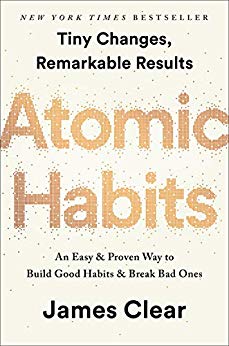
    Well, that’s the subject of Atomic Habits by James Clear.

    And one of the neat things is that Clear reveals that tiny changes can lead to remarkable results. No Herculean efforts. No getting yourself amped up. Something else that’s much easier to do and much more effective.

    The book’s been a New York Times bestseller.

    An Amazon bestseller.

    It’s been on the USA Today bestseller list for twenty-two weeks.

    If you want to build some good habits, if you want to stop some bad ones, if you want to make any behavior in yourself or others more likely, let me recommend you find out what Clear has discovered in his research and give it a try. I think you’ll be happy you did.

    *

    Chris Christie, the two-term governor of New Jersey, is an interesting figure.

    He was a federal prosecutor who cleaned up a ton of government corruption in New Jersey.

    And then he became governor. He might have come and gone like hundreds of governors, but a video went viral, showing his direct, in-your-face politics.

    Many begged him to run in the 2012 presidential election, including a whole bunch of billionaires.

    He turned them down. Said he wasn’t ready. You’ve got to admire someone who does that.

    Then he did run in the 2016 election, but failed to get the attention and votes he might have because Trump was sucking all the media out of the room. And that might have ended it. But Christie dropped out of the race and was the first to endorse Trump, who’d been a long-time friend.

    Trump almost picked him for vice president. The choice ended up being between Christie and Pence. Ultimately, he chose Pence and asked Christie to create the transition plan.

    Christie spent six months with a whole team of people creating that plan. It was a plan that would have helped Trump avoid so many disasters in appointments and policy during his first two hundred days. But when it was finished, the Trump team decided to throw it away.

    Why? What was going on?

    Christie is unlike Trump in many, many ways. Why would he support him?

    Christie reveals all and much more in Let Me Finish: Trump, the Kushners, Bannon, New Jersey, and the Power of In-Your-Face Politics.

    In the book he sets the record straight about his tenure as a corruption-fighting prosecutor and a Republican running a Democratic state, as well as what really happened on the 2016 campaign trail and inside Trump Tower. It’s a fascinating book that gives insights into the Trump team, Trump himself, and Christ Christie who I think would have made a terrific president.

    If you’re interested in politics, larger-than-life figures, and a view from the inside, I think you’ll love this book.

    *

    In less than three minutes, you can amaze your friends, cut through a lot of political blather, and clearly assess what’s being proposed over the next eighteen months as the presidential campaign heats up.

    How?

    By understanding the simple taxonomy below. 

    Every day folks in the media make accusations and claims about socialism, Sweden, Venezuela, capitalism, and the United States. Unfortunately, a lot of the time it’s clear they’re a bit muddled. So let’s cut through the confusion.  

    Whether you’re an independent, Democrat, or Republican, you’ll want to know these three terms.

    SOCIALISM

    The state owns and directs huge portions of the economy. The government in these schemes is the old-fashioned Soviet, Mao, and Nazi style dictatorships.

    These types of socialists did so much good in the 20th century. No other scheme was better at piling up dead bodies. Millions and millions of them.  

    An interesting tidbit. Did you know that “Nazi” is the abbreviation in German of “Nationalsozialistische”? That word means “National Socialist”. It comes from the name of Hitler’s political party, the “National Socialist German Workers’ Party” or “Nationalsozialistische der Deutsche Arbeiters Partei.”

    Nobody running for president today is advocating for this type of government.

    DEMOCRATIC SOCIALISM

    The state owns and directs huge portions of the economy. The government in these schemes is supposed to be democratic, which means you should be able to vote the bums out and put other bums in. Venezuela supposedly uses this model, although some wonder if it is a true democracy or a sham one.

    For those who like socialism, this is supposed to be the good way of doing it as opposed to the bad way of the old fashioned authoritarians. I will let you determine whether the “good” scheme actually leads to any better economic outcomes than the “bad” one.

    SOCIAL DEMOCRACY

    You rely on lots and lots and lots of capitalism (private ownership and direction of companies in a free market) to fund government social programs. The funding is done via high tax rates. You have elections and can vote the bums out and put other bums in. This is Sweden.

    A lot of people in the current presidential race are advocating for this type of government. Although, if they say that any system that allows billionaires to exist is immoral, you will need to scrutinize that candidate carefully because Sweden’s system allows billionaires. It may be that candidate actually wants some form of democratic socialism.

    One last point. If you think about it, the United States and Sweden are similar types of governments. They’re on the same continuum. The difference is that the United States is simply much less of a welfare state than Sweden is.

    There you have it. Three terms you are going to hear a million times over the next eighteen months.

    Amaze your friends by actually knowing what they mean.

    Be proud of your knowledge.

    And use it to carefully consider the candidates.

    Share
  • Good Stuff! The political book for our times

    I just finished the most important book on politics I’ve read in years.

    Years.

    In fact, I’ll go so far as to say it is the book for our current political times.

    I say this because America isn’t facing the threat of Communism, Nazism, poverty, illiteracy, or disease. ISIS and the terrorists are on the run. We’re beginning to figure out a better way of treating our LGBT brother and sisters. And we’re not poisoning ourselves with the broad-based racism or sexism of the past. Yes, there are lots of areas where we can improve. But these are not the main problems of our current time.

    In my opinion, the main problem of our current time is a burgeoning contempt between left and right.

    Political scientists find our nation is more polarized than at any time since the Civil War. People in positions of power and influence on both sides of the spectrum, and everywhere in between, are setting us against each other. They tell us our neighbors who are on the other side are evil, corrupt, or stupid. And must be utterly vanquished. And many of us perpetuate the message, very frequently on social media.

    By some measures the divide between right and left in America is beginning to approach the size and feeling of the one between the Israelis and Palestinians.

    Is that really where we want to go?

    I think most people will agree with me that it is not. So what do we do about it?

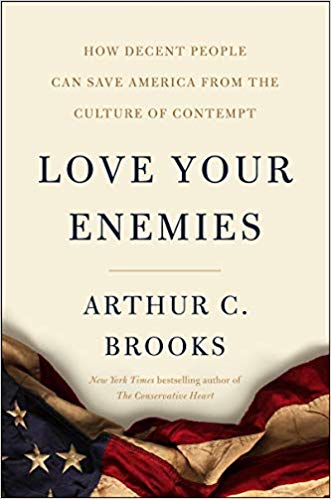
    May I suggest we start by reading this terrific book by Arthur C. Brooks called Love Your Enemies: How Decent People Can Save America from the Culture of Contempt.

    With that title you might think Brooks is suggesting that the solution to the divisions in our country is to start a national program for the singing of “Kum Ba Yah.” If so, you would be wrong.

    Brooks doesn’t claim we need less disagreement. He thinks we need more disagreement. Yes, you read that right. More. He’s calling for more, strong disagreement. It’s just that we need to disagree in a better way. A different way.

    At this point you might be wondering how it’s possible to disagree, and in greater amounts, and not run the nation off the cliff in flames.

    I was wondering that too. And Brooks provides the research, the thinking, and a number of practical methods in his book. Brooks will make you think about how we interact in a totally different way. And he does it with his trademark good humor. You’ll laugh, you’ll think, and you’ll come away seeing a better path.

    If a good portion of us disagree the way Brooks is suggesting, it will change our country. All we need is a core of us willing to try.

    If you’re interested in politics, if you are getting tired of the insults on social media and the news, if you’re tired of the way the parties are not working with each other in Washington, I think you’ll love this book.

    If you want a taste of what Brooks is talking about, watch his eleven-minute commencement speech at BYU this last April. Find it here. If you want another taste, watch his TED talk.

    Share
  • Good Stuff! Just Mercy

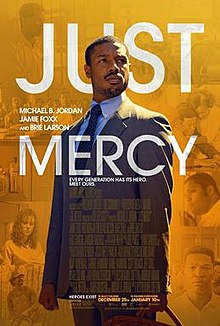
    Just Mercy movie poster

    In other countries, the government can throw you in jail for no cause. It can keep you there indefinitely awaiting trial. And it can manipulate the trial to prevent you from mounting a defense.

    In other countries, there is no trial by your peers. Instead the government is prosecutor, judge, and jury. 

    Our criminal legal system has so many wonderful protections in it. But there are times, as good as it is, when it convicts people of wrongs they didn’t do. Including murders they did not commit.

    I can’t imagine being in that position. One day I’m pursing my dreams, enjoying my family, going to the movies, walking my dog, hiking. The next I’m hauled off to jail, convicted, and put on death row.  And nobody will listen to me.

    Luckily this doesn’t happen in the vast majority of cases. But it does happen. And if it happens to you, wouldn’t it be nice to have someone show up one day and say, “I’m going to work like a dog to reveal the truth and get you out of here.”

    The movie Just Mercy tells the true story of just such a case. Walter McMillian is on death row for a murder he did not commit. And then one day a young defense attorney shows up and says he’s come to help.

    This movie will have you on the edge of your seat and make you think. There are two or three moments where some crass language is used. So check it to make sure it meets your requirements. If you end up watching, I think you’ll really enjoy this tale. We did.

    Share

2 Comments

  1. Hey.
    I concur. I also think that there are lovely freaks out there who don’t need 10k hours to be incredible. Of course, I’m not one of them, but believing in their existence gives me hope.

    I’m about to hit that 10k hour mark myself and I don’t sense any marching bands organizing in my honor. Too bad Gladwell’s theory is about as true as the time travel romances I write!

  2. I don’t know. You are succeeding very well, far above average, in both your number of readers and income, and that started well before any 10,000 hours. I also suspect a big part of your current motivation in your writing stems from that early success. Nothing motivates like success. Well, fear of being eaten by a bear might. Still, there’s nothing like having some success to motivate work.

Comments are closed.