How author Rachel Aaron wrote a novel in 12 days

Well, not quite. It was 15.

First read her essay “How I Went From Writing 2,000 Words a Day to 10,000 Words a Day”.  Now read about her 12 day triumph in “12 Days of Glory”.

Amen on the pre-writing! I’d be lost without it. LOST. Sketching out scenes beforehand makes them SO MUCH EASIER to write. I can focus on the delivery, characters, dialogue, etc. instead of the events. It frees my creativity to focus on other things. Sketching out a novel beforehand does the same for the whole book. I have a simple sketch of the scene I’m going to write today. There’s no dithering about what to write. I KNOW what I need to write. So I do another more detailed sketch, the pre-writing for the scene before I jump into the day’s work. When I get the scene in my mind, the draft comes so much more quickly.

Amen on time! I’ve found my mind is like a furnace: it takes time to get hot, and if I only dedicatetake small chunks of time, I’m forever warming it up. When I get 3-4 hours a day, I far more productive on a per hour basis than when I only get one.

Amen on enthusiasm! There’s nothing worse than trying to write something that bores me. I can’t do it. And her little method for reviewing scenes is very similar to what I do.

Great posts, Rachel! Now I just need to get back into my dedicated time groove.

Share

Similar Posts

  • Can you write for love AND money?

    Many artists think you can’t. And not simply because they envy those who are selling hundreds of thousands of copies.

    The reason they think this is for the simple fact that the creative process is fueled by following the zing. It’s ruled by passion. You have to care about AND believe in what you’re writing. You have to because if you think it’s boring or unbelivable, then it’s likely everyone else will as well. 

    For example, let’s say you are deeply bored by vampires, but see that vampire love stories are making piles of cash and decide to write about one with smoldering eyes and a bad habit of chewing tobacco even though it leads to dental problems with the fangs (hey, why would her man-toy care?), then you’re substituting passion (that which springs up from within) for graphs and plots about marektability (stuff that’s imposed from without).

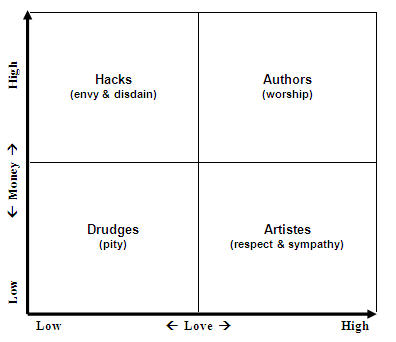
    And so many folks think that there’s a continuum. On one end is writing for passion. On the other is writing for money. And the two don’t cross. But this is a false dichotomy. The truth is that money and passion are independent factors.

    Lon Prater, a writer friend, recently expressed it this way.

    Not a dichotomy, but rather an X and Y axis, the way I see it.

    There’s:

    low love, low money (SEO writing?)

    low love, high money (For me, this would be tech writing, or media tie-in to a universe I didn’t care about)

    high love, low money (unfortunately too much of my writing!)

    high love, high money. (Loftiest of goals) 🙂

    You can find datapoints for every quadrant, and of course “love” is highly subjective and individualized, as are what counts as low and high for each writer.

    If we put labels to the quadrants, we get something like this, along with common emotions they tend to evoke in other writers. (Although I will say that envy seems to want to run amok in the author quadrant as well.) 

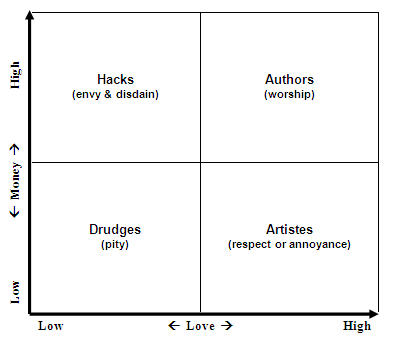
    writer-love-and-money-quadrants2

    Share
  • Generating Story 7: Creative Q&A

    Filling up your mind with wonderful things by hunting zing is a writer’s bread and butter.  But guess what?  You can’t develop a killer story by waiting to stumble across great story ideas.  So while you must deploy your drag net and hunt with a purpose, you must also learn how to develop your own zing.  And I haven’t found anything more productive for helping me do that than the process of creative question and answer.

    If you refer back to the Story Development Framework download, you’ll see that Creative Q&A is one of the key tools used to develop every part of story.  So how does it work?

    Do you remember my first and second posts where I talked about Ed Smiley and the folks at NASA who helped save Apollo 13?  They used this technique.  Here’s how it went down.

    They had a problem: the astronauts were running out of oxygen because the CO2 scrubbers weren’t working in the module they were in.

    The problem led to an objective: figure out a way to get the CO2 scrubbers working.

    The objective led to a question: what are some options for getting those CO2 scrubbers working?

    Then they began to generate possible answers.  Two days later they had one that would work.  Ed and his team saved the three astronauts aboard.

    This same thing happens over and over again in any situation that requires some new solution.  Do you remember all those redneck solutions I shared in the first post?  They were practicing creative Q&A.

    You know all those accountants generating various ways to do your taxes?  They’re practicing creative Q&A.  Mine did that this year; he figured out one legal way do our taxes that saved us some money, then figured out another legal way to do our taxes that saved us more than $1,500.  I’m so glad he looked for that second, actually third, right answer.

    You see all those mothers and fathers generating ways to make ends meet?  They’re practicing creative Q&A.

    It happens all the time.  It’s a key tool when trying to develop a story, and I’ve found a couple of guidelines when using this technique that seem to help quite a bit:

    1. Clearly identify the objective.
    2. Turn the objective into a “what” question.  For example, “I need a more interesting character” becomes “What are some things that would make my character more interesting?”  Likewise, “This scene is stupid, nobody would do that” becomes  “What would make this scene more believable?” When I’m stuck with plot, “My character isn’t facing any real problems” becomes “What are some killer troubles the character can run into?”
    3. Generate a list of good, dumb, and wacky options.  It seems the more ideas I generate, the better chance I have to come up with something really good, especially if I cherish the dumb and wacky ones by writing them down.
    4. Don’t hesitate to steal other ideas I’ve seen and modify them to make them my own.  Or to go search for how others dealt with issue.
    5. Try to generate more than one good or right answer.


    I use creative Q&A to help me develop my key objectives all the time.  I state a question and use the principles to guide me in the options I generate.  For example, in the thriller I’m writing I started with a character, an ex-con trying to go straight.  I asked myself “What are some threats to his happiness?” and “What could go wrong?”  I started to generate options.  Some were mildly interesting; some were dumb.  One was that “some old associates come back, old prison buddies, and try to drag him back into the life he’s trying to escape.”  That one tingled my zing meter, and I started to generate more information about that.  “What would they drag him back into?”  “What kinds of crimes?”  “Who are they?” (Okay, not every objective can be turned into a “what” question.)

    There are also ad hoc objectives, i.e. objectives that arise only in a particular situation that I can’t plan for.  I can use this with them as well.  For example, in Servant of a Dark God I wanted a henchman to have a cool weapon, something that I hadn’t seen before.  My question for that was “what are some cool new weapons for this henchman?”  I listed out some that were stupid and had been done before like “a big knife” and others that were wacky like “a chain.”  I generated a big old list.  As I generated options I suddenly generated the idea of “spikes.”  And then “spikes that were alive.”  That tickled my zing meter, and I followed that path and came up with the Ravelers, which I think are just awesome.

    For more information about creative Q&A, I recommend you read Creative Problem Solving: An Introduction, Fourth Edition by Donald Treffinger.  It’s one of the most practical books on creativity around.

    While you’re waiting for that to come in the mail or to get it from your library, I want you to watch something.  Dewitt Jones, a photographer for National Geographic, uses creative Q&A.  He made an incredible twenty-minute video explaining the principles of generating options.  Please watch Everyday Creativity .  It says “Preview,” but it’s the whole wonderful video.  Then go here and watch that same last bit plus some material not on the other one.  These are two versions of the same presentation.  Everyday Creativity is the commercial version used for training.  Clear Vision is the personal use one that includes some extra material.  Let me recommend you purchase the Clear Vision version. You will not regret the $45 dollars.  I promise you.

    All of what he says applies to generating answers for our writing.

    GO WATCH IT NOW.

    Note what he says about these principles about generating options:

    1. Try different perspectives for stating a problem.
    2. Follow your zing, what you care about; figure out what’s exciting you about the thing.
    3. Look for more than one right answer.  Believe there IS more than one right answer.
    4. Don’t be afraid to make mistakes—you often must make them to get the good stuff!
    5. Try breaking a pattern, do something different.
    6. Train your technique.
    7. Put yourself in the place of most potential.
    8. Be patient, persevere.
    9. Relax and goof around.

    One last thought on creative Q&A.  There are certain questions that seem to be more productive than others.  I find that those focused on the key objectives are usually very productive for me.  So give those a try, but there are others.  Furthermore, what might work for me might not work so well for you.  Don’t get stuck on using a specific question because someone else does.  The goal is not to use a specific tool, which in this case is a specific question.  The goal is to make the different parts of the story come to life in your mind.  Whatever question helps YOU do that best is the one to use.

    Because creative Q&A is such a powerful tool, I want to make sure you see plenty of examples of authors using it in their writing.  To start, read chapter 2 of Orson Card’s Characters & Viewpoint and see what questions he finds useful and an example of  how he uses them.  Then come back here.  I’ve asked some other published authors to share how they use questions to help them generate story.  I’m going to start with Ian Creasey whose short fiction has appeared in magazines such as Asimov’s, Realms of Fantasy and Weird Tales, and has been reprinted in several Year’s Best SF anthologies.  He’s written a wonderful essay that I’ll use for the next post in the series.

    For more in this series, see How to Get and Develop Story Ideas

    Share
  • Indie Thoughts: Russell Blake’s Indie Author Myths

    This is from Russell Blake, a pseudonym for Craig Osso, a 52-year-old retired home developer who has sold close to 450,000 copies of the 25 books he published in the last 30 months. The man has made over a million bucks at this.

    1) Books Sell Themselves. No, sweetie, they don’t, at all, and never did. That’s why trad pubs spend massively on promotions. Because they know that visibility sells books, not invisible cosmic forces or author brilliance. It’s a highly competitive market with millions of choices, and it’s a retail market, and in retail, visibility is key. Which means constant promotion. Which most authors hate. But it’s reality, so get used to the idea. A companion to this aphorism is the next one…

    2) Just write the next one. Sure, if you want to have two undiscovered gems instead of one. Look, writing the next one’s important, but not if it’s used to justify not promoting the last one, which is often the case. You have to both market the last one AND write the next one. Sorry. You do.

    3) It’s all about luck. Well, perhaps some of it is. Maybe even much of it is. But so’s everything. You drive to the market, and 30 seconds after you pass the intersection some dumbass crashes into the car behind you. Luck. A hundred people start restaurants in town and two do well while the rest fail. Luck. A mugger attacks you after a movie. Luck. Sometimes good, sometimes bad. The book biz is no more or less random and chaotic than life, and yet some folks seem to consistently do better than others. I believe you need to work very hard, prepare, and be persistent, thereby creating some of your own luck. As an example, it’s possible you always wear your seat belt and the other driver didn’t today. In that case, bad luck becomes disastrous due to a simple lack of preparation. Or in the case of the restaurants, perhaps the ones that prospered had owners that worked 18 hour days and were talented chefs, and further, were savvy and inventive about getting people to try their cuisine. Preparation, persistence, hard work combine in that case to drag Lady Luck in their direction. With the mugger, maybe you have pepper spray or spent years on martial arts or have a concealed carry. Your preparation is the mugger’s bad luck.

    Luck may be a factor, but in my experience it’s only one factor, and that perspective of it all being all about luck breeds apathy.

    4) Do everything right and you’ll make it. Huh. If that were so, every book put out by big pubs would do well. The vast majority don’t. But that doesn’t mean you don’t have to do everything right, unless you want to worsen your already slim odds rather than improving them.

    . . . .

    10) Your muse cannot be forced to dance. Of course it can. If you were a writer on 24 or CSI or SNL you’d be expected to perform every week or you’d be out of a job. Most who work hard enough to get those gigs don’t want to lose ‘em, so they perform. Whether they feel like it or not. Whether they’re particularly inspired or not. The notion that you need to wait for your muse to decide to infuse you with story is fine if your books sell 10 million and you can afford to wait 4 or 5 years between each one. If that’s not you, you need to develop two things: a work ethic, and a system to inspire yourself.

    One technique I use is to ask myself how I can make this book, or this chapter, the best I’ve ever written. You get completely different answers depending upon what questions you ask yourself. “How can I consistently write 5K a day and enjoy it?” will get you a different answer than “How am I ever going to do this?” If you’re stuck, ask better questions.

    . . . .

    12) I’m too busy to read. Who’s got the time? This one kills me. How in the hell do you expect to be a good writer if you don’t read a lot of good books? Intuition? Divine guidance? Magic?

    . . . .

    1[6]) Write a good book and you will make decent money. Or write a lot of good books and you will make decent money. Would that it were so. Reality is that the overwhelming majority of good books, which is to say competently written-and-edited tomes, fail to sell much.

    . . . .

    My message is simple: working very hard and very smart can improve your terrible odds, but that’s all it can do. It’s not a magic pill, nor a recipe for success.

    . . . .

    I can tell you how to operate your writing and publishing company intelligently, but you need to recognize that most well-run publishing companies fail. Just as most well-run any-kind-of-companies fail. Most start-ups don’t last. They go belly up. Even those with the smartest people and shiniest wow products. That’s just how it works. Don’t start a company if you’re uncomfortable with that idea.

    . . . .

    I’m a big proponent of choosing a genre that can support you, which means one that’s popular, and sticking to it (with the caveat that if it doesn’t meet your expectations after a massive, concentrated effort, pay attention to the result you’re getting, and switch to something with better odds). I’m also big on publishing regularly, meaning every three or four months (more often if possible) if you intend to make this your living. I’m huge on pro editing and covers and proofreading. I consider your cover and your blurb essential to success. But those are the basics. Important basics, but still, building blocks.

    They will narrow your long odds because most authors simply don’t do what they should to make themselves successful. Understanding that is an advantage. It means you already know more than 90% of those who will publish on Amazon this year. If you do everything right, that will make you the 10% that has a chance.

    But still, it’s not a lock. By any stretch of the imagination. Get clear on that. In all businesses, this included, you can do everything absolutely, spectacularly right, and go nowhere. Because God hates you. Or because the world’s unfair. Or because you’re not good enough. Or were born under a dark star. Or didn’t get breast fed enough as a child. Pick your reason. It doesn’t matter what it is, as long as you recognize that in ALL industries, most businesses do not succeed.

    . . . .

    I wish I could tell you how to avoid being that person. I wish there were a formula. What I’ve come up with I share openly: Pick a genre you love and that’s large enough to support you, stick to it, write a lot of seriously good books, focus on improving your grasp of craft each time you sit down to write, make each book your best ever (meaning respect your reader above all else), package and quality control your books like the pros do, market intelligently, and spend massive amounts of time and energy working smarter than everyone else. And above all, be extremely realistic about everything. Some might say, cynical. I’d say pragmatic.

    . . . .

    Can you do this part time and make it? Sure you can. So can someone who starts any business part time. Just recognize that your odds of making it are lower than if you did it full time. Duh. Put in 80 hours a week, you might get better results than 10. Big surprise. Can you put in 10 or 20 and still do well? Sure. Again, anything’s possible. But you have to be unable to grasp basic business concepts if you think your odds will be the same. If they were, nobody would put in the 80. They’d all put in the 10, because their odds are identical.

    . . . .

    What’s my point? That self-publishing is both exciting in its possibilities and daunting in its requirements. And that very few businesses succeed, whether it’s a new shoe shop, or a convenience store, or a restaurant, or a software start-up…or a publishing company. But it’s more possible now to succeed than at any point in the past. I’m living proof.


    Link to the rest at Russell Blake’s Author Myths-1, Author Myths-2, and Author Myths -3.

    Blake has some of the most sensible advice I’ve read. If you want more, search for him over on KindleBoards.

    Share
  • Is Amazon’s game totalitarianism?

    nazi_flagAmazatzi?

    Franklin Foer and Scott Turow recently made comments which suggest Amazon is in the process of ushering in a totalitarian book economy.

    Is Bezos, as Hitler was in the 1930s, biding his time, playing a long game, one that will lull the masses into a false sense of bookish security? Are we appeasing him, letting him take over the continent bit by bit? Is the blitzkrieg less than a decade away?

    If you listened to a recent Intelligence2 debate, you would have heard Foer-Turow claim that, yes, that’s exactly where we are headed. On the other side of the debate were Joe Konrath and Matthew Yglesais, arguing that Amazon is the reader’s friend.

    Konrath and Yglesais made some good points. But they left the central Foer-Turow argument standing like a citadel. It was left standing because much of what they had to say, as good as it was, frittered around the edges or went off into beer land.

    But the Foer-Turow argument is not a citadel. It’s a house of crackers.

    Here’s why: publishers, authors, readers, and entrepreneurs all have brains. And somehow, in their threat assessment, Foer-Turow forgot that.

    How could they forget something so fundamental?

    Well, their argument went like this.

    1. Amazon right now provides an amazing service that’s far and above anything any other bookseller currently provides. They have made more books more accessible to more readers than anyone else ever in history. Readers, of course, love this. But this is a bad thing.
    2. It’s bad because Amazon is becoming a monopoly–it already has 41% of all new book and 67% of all e-book sales, and in many divisions of those markets it has even more.
    3. If Amazon were an enlightened ruler like Aslan, okay. But Amazon is a business, and as a business it only cares about its profits. And the way to make profits is buy low and sell high. So when Amazon finishes consolidating its hold on the market, it will force publishers and authors to take less of the pie.
    4. In fact, Foer-Turow claim Amazon wants to not just reduce the share of the pie publishers get, it wants to kill off the publishers and take their share of the book pie completely. In addition to being very poor manners, this is bad for three other reasons.
    5. First, authors of non-fiction books that take a long time to research will never be able to get the money they need to do that research. Publishers are the only ones who can give them that money, which they do in the form of an advance.
    6. Second, few authors of fiction will be able to afford good editing, marketing, and book design, and so the many voices that could have been heard will be stifled, or never rise out of the crap to their true potential.
    7. Third, and this is the nefarious Nazi part, if Amazon is the only place you see books, they can control which books you see, which means they will exert enormous control over our culture because they will be able to suppress some books, and therefore the ideas in those books, and promote others. Foer-Turow claim Amazon has already done this.
    8. Finally, because it’s a business and has a goal of profit, when Amazon covers the land, it will probably eventually charge readers more. In fact, it may charge them a lot more. It can’t avoid it; it’s a business.

    So Amazon is taking over more and more book territory. When it’s taken over enough territory to be unassailable, it will then proceed to ruin our culture because its model of book selling will suppress quality non-fiction and fiction alike. And then it will gouge readers.

    Sounds depressing.

    Sounds like Orwell’s 1984 or global warming.

    The only problem is that there is a big honking flaw in all of that.

    Like BIG and HONKING.

    And I’m not talking about the issues like the idea that publisher advances are the only way non-fiction writers can be funded, or that publishers are the only way the vast majority of fiction writers can obtain quality book covers, marketing, and editing. Or that one internet site has the power to put a choke hold on ideas.

    No, it’s about something else.

    You need to know I’m not an Amazon groupie. Nor am I a hater of publishers. I am a businessman. I’m looking for good partners. And I recently wrote a post pointing out that it’s delusional for authors to think Amazon is their BFF with pinky rings. They are just, at the moment, a great indie partner. But their interests and mine are not perfectly aligned. Our love is definitely not written in the stars.

    So I’m not here to stand up for Amazon. I’m here to say that the scenario Foer-Turow paint is fantasy.

    Why?

    Because they’ve set up a chess board and assumed that Amazon is the only player.

    Monopoly

    How does a monopoly stay a monopoly?

    The government either legislates it. Or the company maintains their position by force. Or they own something that nobody else can get. Or the barriers to entering that market are so high nobody can get in to play. In all these scenarios, if people want the goods, they are forced to interact with the monopolies.

    But has the government given Amazon a legal monopoly?

    Um, nope. No charters here to be the only fur trappers in the West.

    Does Amazon have an army of thugs who are going to beat people up and make them join Amazon Prime?

    No. Well, maybe that’s what the drones are for, but they haven’t rolled them out yet.

    Do they own something nobody else can get, like a piece of land? Are they sitting on the world’s largest reserves of cheap book oil?

    Nope. They’ve got a great website and excellent logistics. But websites really aren’t that hard. And if we’re talking ebooks, you don’t need logistics.

    What about the barriers to entry?

    The big advantage Amazon has is that they usually have the lowest book prices around, the biggest selection (you can find almost any book you want there in any format it’s available in), and are incredibly convenient, providing samples, reviews, recommendations, and easy checkout. And they have the crowds.

    It’s hard to get crowds. It’s hard to get all that content. It’s hard to beat their prices. Those are some dang good barriers that keep new guys out.

    And Foer-Turow figured that’s all set. In stone.

    Human Beings

    But what happens if publishers have brains and are actually headed up by, like, real humans who aren’t just going to roll over and play dead? What would such folks do should Amazon keep killing off more and more of them and stealing their pie?

    Amazon doesn’t own the rights to their books. As soon as any contract ends, publishers could simply say, we’re done. Our books will no longer appear in your store. If you’re faced with extinction or something else, what do humans normally do?

    Amazon’s advantage is being the everything store. You can find every book imaginable there. So what happens when shoppers go there and can’t find the most popular books of our time? How long do they stick with Amazon when the shelves are empty? Anyone think about why Amazon kept selling Hachette books even when they were having contract disputes?

    What happens if indie authors have brains and are real humans who aren’t going to roll over and play dead either? What would such folks do should Amazon keep squeezing more and more profits out of them? Could such folks pull their books (like many bestselling indies have from Kindle Unlimited), form a co-op, and create their own site?

    What if everyone was talking about this awesome book that was all the rage, but it wasn’t stocked by Amazon? It was stocked on the indie site, and Apple, and all the others. How would that affect shoppers?

    What happens if there are real human entrepreneurs out there or real humans leading other businesses, and they were all wanting to make a buck, and they see Amazon charging readers a ton and swimming in easy dollars? What happens when they see those tempting profits?

    Do you think they might offer disgruntled publishers and authors better terms? Do you think they might give better deals to price-gouged readers?

    So is Amazon going to kill publishers? Only if the humans have left the building.

    Will they kill authors? Only if authors let them.

    Will they gouge readers? Not when other folks see there’s money to be made by undercutting them.

    Amazon is playing in a global market with the likes of Alibaba, Google, Apple, Walmart, etc. Amazon is playing in an internet economy where college students can come up with an idea and become billionaires. Equally important, Amazon owns nothing that somebody else can’t recreate. They have no legal monopoly. They have no army of thugs. What they have is a lot of content, a well-known URL, logistics for the hard copies, and good prices.

    But what they do not have is a marketplace where everyone else involved is absent a brain.

    Share
  • |

    LTUE schedule posted

    ltuelogoLTUE has posted its schedule for the upcoming conference Thursday – Saturady, Feb 12-14. I’m, of course, stoked to present and participate on the panels. But I’m also looking forward to attending some of the sessions.

    Look at this one: How a Military Unit Works in Real Life: Zachary Hill, Brook West, Robert J Defendi, C. R. Asay, Mike Kupari (m)

    Or this one: All about armor: Zachary Hill, J. D. Raisor, Kay Mildenhall, Charles B. Stanford (m)

    Or what about this one: Law Enforcement: James Ganiere, Zach Hill, Robin Ambrose (m), which conflicts with one of mine, dang it!

    Or this: Making Creatures Realistic to their Environment: Keliana Tayler, Brian Hailes, Jessica Douglas, Bryan Beus (m)

    This: Applied Biotechnology: Derrick William Dalton, Mikki Kells, Charlie Pulsipher, Chersti Nieveen, Ali Cross (m)

    This: How to Create a Language: Maxwell Alexander Drake, Dirk Elzinga, Valerie Mechling, Samuel Stubbs, Bryce Moore (m)

    And tons of others.

    Oh, and what about the keynote address on Saturday by Toni Weisskopf?

    It’s going to be a great conference. I’ll be giving these presentations.

    • How to Build an Action Plot. In this one, Larry Correia and I team up to share a model of plotting that should make developing your action story much easier. Attendees will be able to use the methods on a novel idea Larry, Joe (Larry’s son), and I came up with called Mech Runners. Basically, Larry turned to Joe and said, “What’s awesome?” Joe said, “Giant robots, bandits, and murderers.” We took it from there.
    • How to Build a Romance Subplot. In this one, I team up with romance author LL Muir to share a model of plotting that should make developing your romance plot or subplot much easier. Attendees will be able to use the methods on a story idea Lesli and I came up based on The Hobbit. It’s called My Precious.
    • Tapping into the Power of the Story Setup. The story setup is a fabulous tool that’s not only helped me drastically cut down the time it takes me to develop my ideas, but it has also helped me develop better ideas. In this presentation, I will explain what the story setup is and how you can use it to help you nail your novel.

    I’ll also be moderating or participating on these panels:

    • The Hero’s Journey & the Virgin’s Promise: Patterns and Archetypes for Better Characters:Michaelbrent Collings, Tracy Hickman, Blake Cassleman, Renee Collins, John D. Brown (m). Did I tell you I think the hero’s journey is stupid? This ought to be a fun one.
    • Action Sequences: John D. Brown, D. J. Butler, Peter Orullian, Adrienne Monson, M. Todd Gallowglas (m)
    • Self-Publishing Pros And Cons: Jared Abram Barneck, John D. Brown, Mikki Kells, Joe Vasicek (m)

    Hope to see you there!

    Share

4 Comments

  1. John, thanks for sharing this. I love her analytical approach to addressing the problem of productivity. This takes the whole BICHOK thing to the next level.

    As always, I’m left wondering: where do you get all these great links? Thanks again for sharing!

  2. I don’t know what led me there, actually. But I read Kris Rusch’s and Konrath’s blog regularly. Then I get mediabistro, publishers weekly, and publishers marketplace emailed to me. I review the USA Today weekly best seller list each week. And I’ll drop in on other various spots.

Comments are closed.