Sometimes it feels like there are a thousand things to remember when writing a story. New writers who make lists of these things soon begin to drown in them. But I’ve come to realize that many of these “rules” don’t matter.
They don’t matter because many ignore the function of story. This makes it impossible to know how and when to apply them, or if they’re even something you should apply in the first place. Furthermore, a good number that do tie back to function often have little impact.
In fact, the more I write, the more I believe the Pareto Principle applies to writing–a few vital factors make up most of the effect. The key is to focus on a limited number of fundamentals. To focus on these things that matter most. The things that produce the biggest bang for the buck.
So what really matters when you’re writing a story?
That all depends on what you’re trying to do. Form follows function.
So what is the function, the objective?
First of all, it’s something that happens in the reader. Readers buy stories because they provide a service, they do something to the reader, guide them into an experience. In this series, I take a look at what I think is one of the core elements of the story experience and identify the Pareto factors for delivering it to the reader.
That story core, or at least a huge part of it, is suspense.
Man goes out and turns on his sprinklers. They hiss to life. He scratches his bum, looks at the rising sun, goes back inside, and nothing more happens.
You want to pay me money for that one? Want to make it into a movie? It’s a story.
Yeah, it’s a story alright, you may say, but who cares?
Okay, so maybe while he’s scratching his bum, a guy with a gun slips in the back. The intruder points the gun at the man’s daughter who is standing by the toaster buttering her bread. She’s a teenager, dressed in cutoffs and hiking boots. The intruder says, “Your father is going to be coming back through that door any time now. You’re going to call him into the kitchen. We’re going to have a chat. You two didn’t finish the business we talked about.”
The girl only has a butter knife, but she grips it tighter, considers that only 13% of shots fired by cops in gunfights hit home. This was drilled into her by her firearms instructor. The guys who are trained only hit 13% of the time. It’s that low even though most gunfights start with the opponents standing only six feet away from each other–the distance between her and Gideon with his gun. That’s what happens when the adrenaline takes over. But Gideon doesn’t look like he’s full of adrenaline. He looks like a man going to a BBQ. So maybe he has a 40% chance with each bullet. That still gives her 60.
The front door opens. It distracts Gideon for just a moment. The barrel of his gun moves slightly to the left.
It’s not a story yet, but it’s more interesting. And it’s more interesting because that second version generated something the first one never could. What it generated, dear Reader, was a little rise of hope, fear, and curiosity–a little suspense.
After finishing draft 3 of CURSE OF A DARK GOD, I needed a break. So I reviewed my notes of DARK GOD’S GLORY, debriefed the many things I learned this last year about novels and story (and, oh boy, was it a year for learning), wrote up my “Ideal Novel” document, and then began to study structure and suspense. It’s been a wonderful and fruitful month.
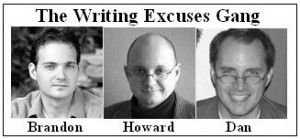
I think I’ve found some clarity and solidified a number of Pareto factors for suspense. Let me share my current thoughts on the subject. (Interestingly enough, the Writing Excuses guys just did a podcast on this subject: 5.4: Creating Suspense. You might want to check it out.)
Because form follows function, let’s start with the end in mind.
In the stories we love, the stories we stay up late at night for, the ones for which we pay $25.99 in hardback, the ones we willingly spend hours of our life on, those stories very frequently put the reader into a state of hoping and fearing for a character. This starts as curiosity and quickly moves to sympathy. Very often it builds to an edge-of-your-seat worry that continues up to the end of the novel. At that point the reader experiences a cathartic release.
When we talk about suspense, this is what I believe we’re talking about. And a key thing to remember is that the tension we’re after is not something that’s in the text. It’s something the text builds IN the reader. So you may have massive explosions, deaths, chases, escapes, villains, and all the hordes of hell combine in your story, in the text, but that does not mean the story has dramatic tension. Because dramatic tension is a READER concept. You may have a relatively quite scene where a child is doing nothing more than swinging at a park, but because the reader knows the child molester has just arrived and the park is empty, the scene creates dramatic tension. The girl feels no tension. She’s just swinging away. But the reader’s tension goes through the roof. It’s all about what happens in the READER.
So the question is what key factors of a story guide the reader into this dramatic tension?
Well, we first need to understand what’s involved with this tension. What’s it made of? I came across a lovely *discussion of this last month in David Howard’s How to Build a Great Screenplay and have adapted it to my use. In emotional terms, we HOPE and FEAR for a character. “We don’t know what WILL happen, but we know [or suspect] what MIGHT happen, and therefore feel tension about those possibilities” (p52).
Notice the key ideas:
- Hope
- Fear
- Character
- Uncertainty
So what makes us hope or fear for someone? What makes us uncertain of an outcome?
I see vital ingredients, key conditions in three of the four parts of story—problem, character, and plot. In this blog I’ll discuss the Pareto factors for suspense I see working in problem. In following posts, I’ll identify those I see in character and plot.
The Nature of the Problem
Form follows function, so what types of problems lead to us hoping and fearing for a character?
When I look back at the stories I love that produce this effect in me, I see three main types of problems. I’ve talked about these before.
Problem Type 1: Danger/Threat
In this type of problem, there’s a danger or threat to some aspect of the character’s happiness that is significant enough that the READER can sympathize.
With these problems we HOPE the character avoids or eliminates the danger, but we FEAR they may not. There are many aspects of happiness that might be threatened or in danger. I’ve listed below those that raise my FEAR and would raise my fear for someone else. I’ve stated them in first person, but you can think about them in third.
1. Life
In these situations my life is in danger or threatened. People are out to kill me (HUNGER GAMES); I’m going to starve or freeze to death (“TO BUILD A FIRE”); there’s a shark in the water who would like a taste (JAWS).
2. Security & well-being
My security and physical well-being is in danger or threatened. These include all sorts of situations where bullies threaten me with violence or where I might be maimed in some way. Or I begin to lose some vital function—sight, hearing, speech, my ability to think, etc.
3. Relationships
In these situations my inclusion in a group is threatened. My love, friendship, relationship, feeling of belonging or of being valued are endangered. For example, I’m ostracized by a group, shunned, discriminated against. Or maybe my girlfriend begins to look at other men and I fear losing her, or my son and I become estranged and I fear losing him. This can even be a physical separation like in TAKEN (daughter kidnapped for the slave trade) or NOT WITHOUT MY DAUGHTER (daughter kidnapped by husband).
4. Meaningfulness
In these situations my sense of fulfillment of doing something worthwhile is in danger. I’m threatened with a life of drudgery. You can see this at work in the beginning of THE INCREDIBLES where Bob, Mr. Incredible, has to work in a deadening insurance office. But it might be someone whose future or ability to do things that are meaningful to them is being threatened. For example, a boy who desperately wants to play the piano has his piano and is forced to do something else.
5. Freedom
Anything threatening our freedom. It might be slavery or blackmail or government control or a number of other things.
6. Ownership
In these situations my ability to retain and use my possessions is threatened. Any time something precious is stolen from me, my happiness is affected.
7. Other aspects?
These are the main aspects of happiness I’ve identified that seem significant enough to raise fears. If you think you know another, please post a comment.
Problem Type 2: Lack/Opportunity
In this type of problem, a character has a lack of and opportunity for some aspect of happiness that is significant enough that the READER can sympathize. These are often about characters in some kind of hardship. The lacks, hardships, and opportunities all have to do with the same aspects of happiness as listed above. In these situations we HOPE the character is able to fill the lack; we HOPE they will be able to grasp this opportunity for happiness. But we also FEAR they will fail.
If you think about love stories, these are all stories of lack/opportunity. She’s alone, without a lover, or a satisfying and loving relationship, and she meets someone. Suddenly, she has an opportunity for happiness. As readers we immediately began to hope she will find that relationship wonderfulness and fear she might not.
In the movie OCTOBER SKY a young boy lives in a coal mining community. But it’s not his thing. He suddenly gets an opportunity at school to do something with science. This is his ticket to doing something meaningful. We HOPE he doesn’t miss it, but we FEAR he might.
Problem Type 3: Mystery
A character encounters a mystery that is significant enough that the READER can sympathize or feel curiosity about it.
The first two types of problems center on happiness. They raise suspense and sympathy and worry in the reader. This last type of problem centers more on raising curiosity in the reader. We HOPE the character solves the mystery because we want to know the answer as well, but we FEAR they might not.
Very often these types of problem are paired with some aspect of happiness. The vast majority of murder mysteries, cop stories, and courtroom dramas do this. In fact, many happiness problems are paired with mysteries and puzzles.
Problems that are HARD to Solve
Let’s go back up to the objective. We want to HOPE and FEAR for the character. We don’t know what WILL happen but suspect or know what MIGHT and we worry and feel tension about the possibilities. We want to worry, and we want that worry to build to a pitch. We then want to experience a cathartic release.
How will we FEAR if the problem is so easy anybody could fix it? How will we WORRY if the lead has all the odds stacked in his or her favor? How will we feel UNCERTAIN if we know exactly what’s going to occur?
I can’t worry for Frodo, for example, if all he has to do is cast the naughty ring into the pit of doom that lies on the other side of his street. I can’t worry about a guy finding a girl to love and who will love him, and have that worry build to a sharp edge-of-your-seat point, if all he has to do is proclaim his feelings and the girl immediately rushes to him forever.
The facts are that we won’t feel fear, worry, or uncertainty unless the problem is HARD to solve. I’ll discuss the Pareto factors for making problems hard when I talk about plot.
Problem Intensifiers
Besides being hard, problems need to be urgent. I’ve identified four factors that seem to intensify the nature of the problem: probability, immediacy, significance, and specificity.
1. Probable
It’s one thing to face the one-in-a-gazillion chance that I might be trampled by a herd of elephants when I walk out of the door. It’s quite another to know that the last seven people who walked out of the door were killed by the madman with the AK-47 sitting at the end of the hall.
The higher the probability of the threat or loss of opportunity, the more intense the problem becomes because it’s more likely I’ll lose. No probability and I have nothing to FEAR.
2. Immediate
It’s one thing to know an asteroid will hit the earth and kill us all in 7,000 years. It’s quite another to know it will hit in three days.
The more immediate the problem, the less likely I’ll be able to solve it. The less likely my chances are, the more I’ll WORRY. Give us 2,000 years, and I’m sure we’ll figure out the asteroid thing. Give us three days, and that’s probably cutting it too close. This is why setting up a time limit, a ticking clock or ticking time-bomb, can ratchet up the audience’s tension. Of course, it has to be a short time limit. You can’t start the bomb ticking, and give the lead 45 years to disarm it.
3. Significant
We talked about this before. It’s one thing to face the kidnapping of my pet spider. It’s quite another to face the kidnapping of my child. Significance increases when more is put at risk.
The more significant the threat or opportunity, the more invested I become. The more I FEAR to lose.
4. Specific
It’s one thing to say that something bad is going to happen. It’s quite another to know that kidnappers are going to cut your finger off with a pair of wire dikes. It’s one thing to have someone say something good will happen (Chinese fortune cookie) and quite another to say your uncle just died and left you a million dollars, but you have to fight your three cousins for it.
The more specific the problem, the easier it is for us to see the specific possibilities and react to them with HOPE and FEAR. Generalities don’t trigger emotions. Striking snakes do, though. As do garbage disposals that are turned on just when you reach in to get the baby’s pacifier.
Another part of this is to make the threat specific to the hero. It’s one thing to say a lot of people in the United States or Russia or India are going to die. It’s another to say the hero will lose his own child or wife in the event. In fact, the loss of one child can make the problem more intense that the loss of thousands.
This is not to say you can’t write about threats to large groups of people. That’s one of the ways to broaden the scope of the problem and make it more significant. It’s just that problems become more intense the closer they comes to home. Things that threaten us personally, or those we love, raise more fears than those that threaten people we don’t know. A flood raging in the next county is different than the one coming down our street. So in story, the more personal you make the threat to the person we’ve invested in, the more intense the threat will be.
Uncertainty
Supporting all of this hope, fear, and worry is the fact that the reader is uncertain of the outcome. The character must have a chance to solve the problem up until the end, but for no extended period of time can it look like winning or losing is assured, because the moment the reader can predict the ending and the major turns along the way, that’s the moment they will lose interest.
Think about this. It’s the first quarter of a football game, and the score is 64 to 0. Anybody sticking around for that one to play out?
No, you can predict the ending. Why watch? Predictability kills hope, fear, and worry. It kills interest.
So how do we make sure the reader is uncertain of the outcome?
First, as stated before, we make the problem hard to solve. We’ll get into more specifics during the post on plot, but we make the problem harder to solve by giving our characters limitations, putting them into ongoing and continuing troubles, and making them face conflict with their own competing desires, other people in the story, and the setting.
But there’s another ingredient. The second thing we do is introduce surprise. Surprise is one of the vital elements in story making precisely because it makes things unpredictable. It makes hope, fear, worry, and curiosity possible.
There are two forms the surprise takes. The first is surprising or new limitations, troubles, and conflicts. New twists to the problem.
Maybe we’ve seen lots of stories about assassins who need to go behind enemy lines. But what if we add a surprising conflict. What if our character is asked to sneak in and kill his sister? Or his mother? Or his best friend? Or the teacher he loves?
What if our lead is not a highly-skilled CIA operative, but a child who has been trained for this, and not as a suicide bomber? Or a grandmother with no training at all who is forced into the situation? What if the person she is supposed to kill isn’t in enemy territory but a religious leader or someone in our own government?
Do you see? You simply twist the elements of the problem in new ways. While the situation may be similar, it’s not the exact same thing they’ve seen before, and so it prevents them from predicting how things will unfold. While they suspect what MIGHT happen, then don’t know what WILL happen.
The next type of surprise is to simply introduce a turn into the story the reader cannot foresee. Again, this relies on reader expectation. So the sidekick we’ve lead the reader to trust turns out to be a traitor. The tactic that the reader has seen work so many times in other stories fails right off the bat in your book. In fact, maybe the whole plan fails. The villain finds out about the child assassin in the beginning and when he shows up, they’re waiting.
Surprises give the story vital jolts of life. Set up a problem that has a new twist to it and give us some unexpected twists along the way during the plot.
Developing a Story Problem
Story problems are the engines that make stories go. They define where a story starts and when it ends. They do so because they generate hope, fear, worry, and curiosity. You might have great characters and a fabulous setting, but if your characters don’t face gnarly problems, readers will be unable to hope and fear for them. They will not worry. And they’ll soon tire of waiting for something to happen.
When I’m developing the central problem of my stories, I find the most exciting possibilities when I think of possible threats/dangers, lacks/opportunities, and mysteries. My ideas start to really crackle when I think of ways to make those problems harder, more urgent, and the outcome more uncertain. When I do this, I find I never have to worry about knowing what to write next. The problems beg for scenes.
It’s true that some delightful stories do not promise or deliver suspense and curiosity as their major delights. For example, in many mysteries, readers are not hoping and fearing as much as they are enjoying the character interactions or the humor. But even in those stories, hope, fear, and curiosity play a significant role. They often structure the novel.
The bottom line is that suspense over a character’s fate (hope, fear, and worry) or the answer to an involving question (curiosity) is one of the key things readers come to our stories for. And all that suspense starts with problem. However, it can’t end there because readers won’t worry for just anybody. You have to have characters they can get behind. In the next post in the series, I’ll write about a number of Pareto factors that naturally invest a reader in a character’s fate.
Notes
*These notes might expand. For right now I just want to share the full Howard quote.
“As we’ve seen, what the audience hopes for and what the characters hope for need not be the same thing. The same is true of our fears versus their fears. But how do hope and fear fit into the scheme of storytelling? Hope and fear are about the future. They derive from uncertaintly about future events in the story, future decisions the characters might make, future discoveries or revelations that might be unearthed, future outside forces and how they will influence the journey of the characters. When we discuss hope verusus fear in dramaturgical terms, this uncertainty is a function solely of the audience and its experience [my emphasis]. This is dramatic tension. We hope the man with the cobra in the shoe box won’t open the box; we fear he might and get himself or someone else bitten. We don’t know what will happen, but we know what might happen and therefore feel tension about those possibilities” (How to Build a Great Screenplay, 52).
Parts in the The Key Conditions for Reader Suspense Series
-
-
-
-
-
Scene (coming soon)
-
Development Tips




John, thanks for sharing this. I love her analytical approach to addressing the problem of productivity. This takes the whole BICHOK thing to the next level.
As always, I’m left wondering: where do you get all these great links? Thanks again for sharing!
ESP, that’s how I get them
I envy you that. 🙂 I’d love to see your full bookmark list. Have a great day.
I don’t know what led me there, actually. But I read Kris Rusch’s and Konrath’s blog regularly. Then I get mediabistro, publishers weekly, and publishers marketplace emailed to me. I review the USA Today weekly best seller list each week. And I’ll drop in on other various spots.