Last week a chart made the rounds, ranking the Presidents since Reagan on spending. Look at Reagan. That happy man is a freaking profligate. Obama, on the other hand, heck, he’s doing better than Bill Clinton.
Except there are a few problems.
First, I can’t tie this data out to the official CBO numbers.
Second, it does a bit of apples and oranges because the numbers are based on each president’s whole time in office. What does it mean when Obama increases the debt by 35% over three years, but it takes Bill Clinton almost EIGHT YEARS to increase the debt that much? A better measure would be an average per year.
Third, some have suggested this chart monkeys with the numbers, allocating the first year of each president’s first term to the previous president.
Fourth, the president isn’t the only one in Washington. Senators and Congressmen also have responsibility.
Finally, while a % increase in debt is a helpful measure, it’s not the only story. And it can be misleading if viewed on its own. For example, if we have $1 of debt, and I increase that to $10, I’ve increased our debt by 1000%. Holy Schnitzel! But if we have $500 million of debt and I increase it to $600 million, I’ve only increased it by 20%. Which is worse?
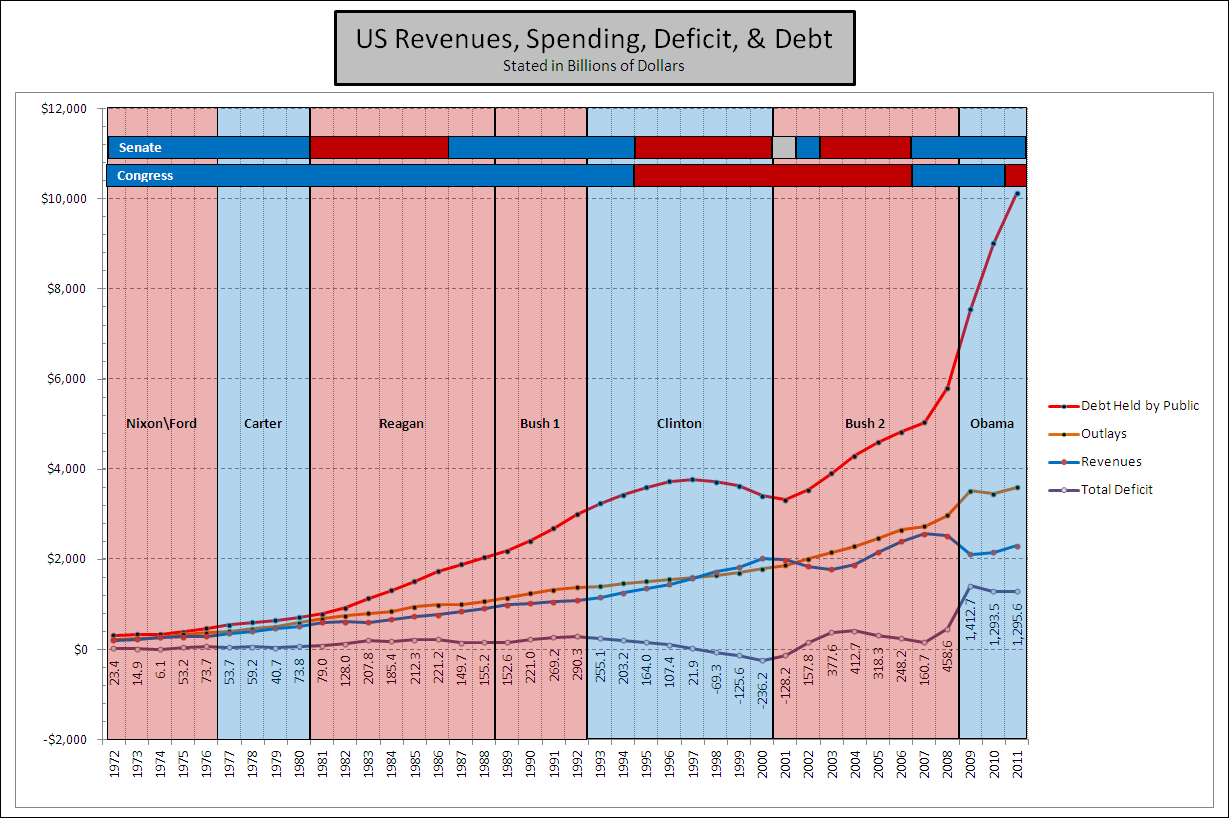
So I went out to the CBO and took their numbers from 1972 – 2011. You may get the XLS file yourself: http://www.cbo.gov/publication/42911. Then I made sure to identify who was in charge when and marked it with spiffy colors (Red is Republican, Blue is Democrat). Here are the results. Click on it to see it in its full size glory.
What does this tell us?
First, there was only ONE four-year stretch in the LAST FREAKING FORTY YEARS where the folks in Washington did not spend MORE than they took in. That was the four year period from 1998 – 2001.
What the?!?
Look at that chart again. There is a serious and systemic spending problem in Washington.
What happened in 1998 to change what had been going on for almost three decades? That was when the citizens got fed up with Washington, threw out a great number of the Senators and Congressmen, and bought into the Contract with America. This was when Newt Gingrich was Speaker of the House. This was when Clinton was getting pounded for all sorts of stuff and worked with those particular Republicans in Congress to balance the budget.
Second, the deficit, the purple line at the bottom, tripled when Obama took office. And stayed! Who put that first chart together? Oh, yeah. It was Nancy Pelosi.
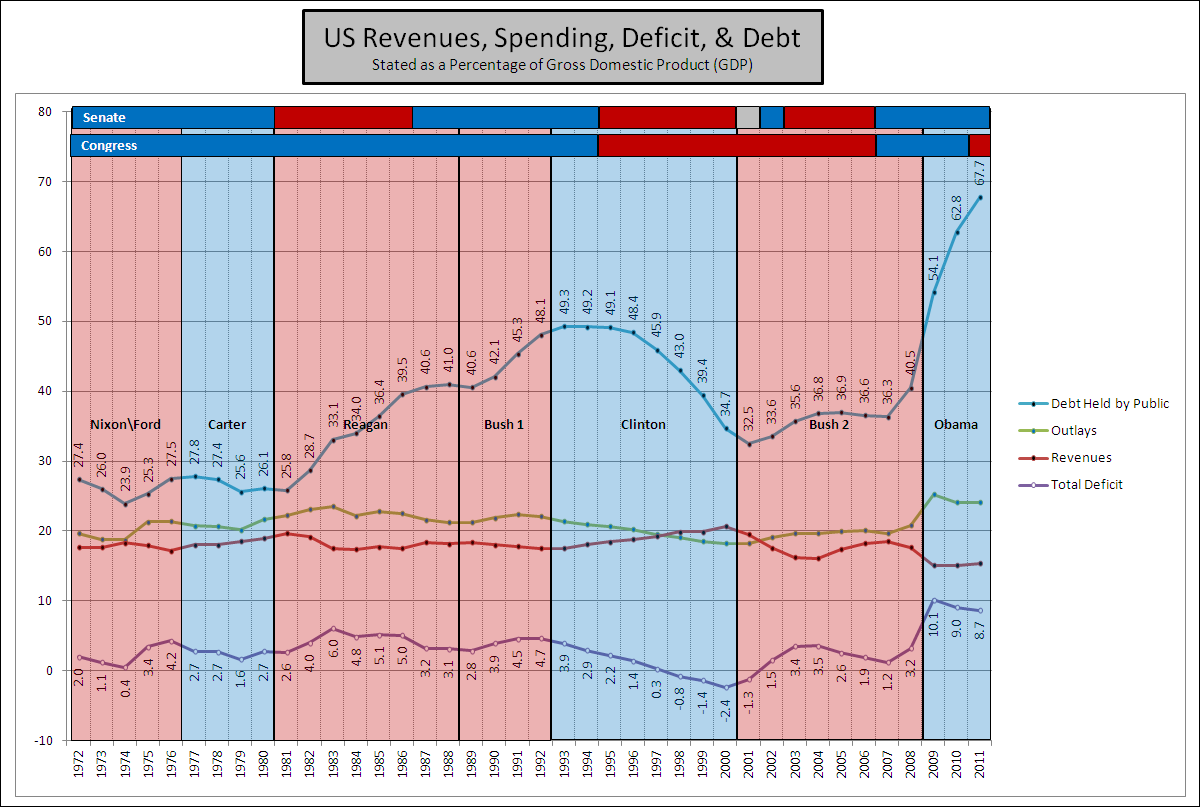
You might say, well, raw dollars is good. But what’s really important is how big a percentage that spending is of our nation’s GDP. If you’re spending 100 billion when the nation is producing 1 trillion, that sounds big, but it’s actually not as big a deal as when you’re spending 100 billion and the nation is only producing 200 billion. Okay, let’s look at these numbers as a % of GDP.
Again, 1998-2001 were good years. On a % basis, the folks in Washington during that time did better than anyone else in not spending the nation’s wealth. There’s no doubt that Reagan, Bush 1, Clinton during his fist 3 years and the Congress during those times were all happy to be big spenders. Look at the debt burden during their years. But Obama and the Democratic majorities in Congress since 2007–drunken sailors compared to those guys. And then the Republicans come in and it doesn’t change. Gridlock?
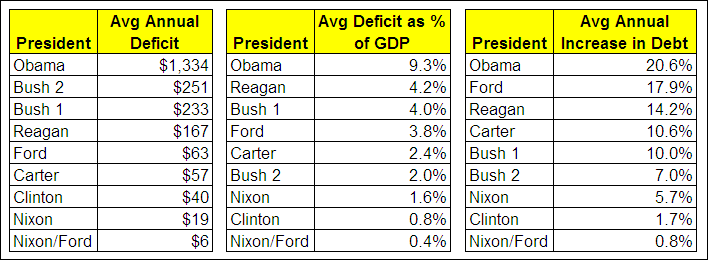
Let’s look at our presidents since 1972 and see how well they do on an annual basis. Those numbers in the first list, BTW, are stated in billions.
Seems to me the most fiscally responsible groups were those in charge during the latter part of the Clinton years, the Nixon years, and the year when Nixon resigned. It appears that during that year the folks in Washinton were so busy with the Watergate scandal they forgot to feed their spending appetites.
Bottom line: as I said before, Washington has a serious and systemic problem with over spending.
And when I say “systemic” I mean it appears the whole thing is rigged to produce over spending. We don’t just need new people out there. We need a system that prevents the overspending. We need an ammendment that requires a balanced budget and caps the size of the government in relation to GDP.
We also need to find a way to incentivize Congress to pass a budget each year. No budget, no pay is a good idea. The current House has indeed passed a budget. But the Democratic Senate has not, preventing us from having a budget at all. Obama submits budgets, but not a soul in the Senate, Democrat or Republican, will vote for them. It’s only the Republican House who seems to want to actually do their job. How can that be? Read It’s Deja Vu All Over Again with National Fiscal Policy for more info.
This November we need to get a bunch of folks like those in 1998 back in Washington. A President AND a Congress who will actually finally tame the nation’s out of control spending. Let me suggest you look at your Congressman’s and Senators’ records. How have they voted? As for President Obama, well, I’m looking at the numbers above.
I’m happy to announce the release of Create Story Ideas that Beg to be Written, a new handbook to help make novel writing easier. It’s available now on Amazon.
Last week, I was booted out of Codex Writers, a private, online writer’s group that I’d been a member of for somewhere around fifteen years. I’m not broken up about it, but the reason for said booting is interesting, unexpected, and worth a post.
Over the years, writers moved in and out of the group, but there were usually somewhere around fifty to a hundred members active on the boards. We discussed the writing craft and business. We held writing contests. We provided critiques. People shared interesting things about their lives.
The group has moderators. And the moderators got together last week and decided John Brown had to go.
Why?
What, of all the sins one may commit online, triggered this?
Was it refusing to stop posting pictures of cats?
Using too many emoticons?
Infecting everyone’s pages with Russian spam bots?
Nope. Nope. Nope.
I know what you’re thinking. Surely, John, you must have
been posting in a belligerent, arrogant, and strident way. You must have been a
jerk.
That’s what you’d think.
I assumed that’s what the problem was too. I invited those
who were angry and hurt to come to my personal thread and explain what it was
that was making them so hurt and angry. A number took me up on the offer. And,
to my great surprise, one of their criticisms was that I was too polite.
One person posted that my politeness made her think I was sealioning (a new term to me). Other’s agreed.
Another person said that my polite manner surely indicated I wasn’t sincere. Other’s agreed.
In fact, one of the moderators stated that being polite was part of the insidious problem that was John Brown. She said that my politeness had suckered folks in to letting my awful behavior go on too long.
I was offensive, and I was too dang polite about it.
So what was I doing?
Well, I was asking for evidence.
Don’t ask for evidence
My sin was suggesting that some claims being made about a
certain topic seemed to be premature. My sin was in looking at the evidence
being offered to support some of these claims and firmly stating that I
couldn’t see how it supported the conclusions.
On every topic on the forum, we could question claims and
discuss evidence in an effort to figure things out. But there was one topic, as
I learned, for which a number of the active members and the moderators decided
that was forbidden.
The topic was systemic or “institutionalized” discrimination.
On the forum, most of the discussion was how it related to publishing.
They explained to me that it was offensive for me to want to
see if the evidence actually supported the claims. It was offensive to post when
I couldn’t see that it did.
You might wonder how in the world can that be offensive.
After all, evidence is one of the first things we ask for when people make
claims.
If Billy Joe comes up to you and says, “Son, aliens done landed in my yard last night. I swear it on a stack of Bibles.” Most of us would want some additional evidence.
We’d want to see the video he took and look at the burn mark
in his lawn and the broken branches he said were made when their ship landed.
And we’d want to see the report showing that the residue collected off the
swing set was a substance unknown to mankind.
But it isn’t just claims about aliens that we do this with.
Historians do it about history.
Scientists do it about science.
Courts require it for reaching verdicts.
Heck, we even do it when we look at movie reviews—we use
those reviews as evidence that the movie is going to probably be good or bad.
Evidence.
We’re always looking for evidence to see if our guesses are
right. But on this topic, wanting evidence was offensive. I was told it was
“hurtful” and “damaging.”
The logic of micro-aggressionism
How could folks get to the point where wanting and
challenging evidence for claims was a bad thing?
Well, quite easily. And they aren’t the first to do it.
And lest you think this unfortunate logic is found only in
obscure writers groups, you need to know it has spread to many American university campuses.
That means it’s eventually coming to an organization near you. And that means
chances are good that you or someone close to you will have to face, at some
time or another, online or elsewhere, an angry mob (or moblet, as the case may
be).
So let’s examine the logic so that when you do, you’ll be
able to see the response for what it is, name it, and bring its tenets out into
the light and show them for what they are.
Here’s their logic.
ONE, each of us
has our individual prejudices, biases, and beliefs about the world.
I’m sure you agree with this. It seems pretty obvious. One guy might think soccer is for wimps, and another might think football is for lumbering meatheads. Of course, it’s not just about sports. We also hold views about people from other groups. Depending on your experience, the media you’ve been exposed to, and the statements and behavior of those around you, you might have unconsciously picked up certain beliefs about Asians, Blacks, Hispanics, Germans, Swedes, Whites, engineers, clowns, etc.
TWO, it’s likely there are others out there with the same prejudices and biases. Some of those ideas will be held in common by smaller percentages of the population. Others will be held in common by larger percentages of the populations.
I’m sure you agree with this too. A lot of Americans like football, but some don’t. A lot of Europeans like soccer, but there are some who don’t. We can see this with our beliefs about various groups. For example, ask anyone in the USA what they think about Nazis, hippies, or hockey players, and you’ll find a handful of common responses.
THREE, various prejudices
and biases can get perpetuated in the society. This is what the
micro-aggressionists call systemic discrimination.
I’m sure you’re nodding along here as well. Americans have
loved football for generations. Europeans have loved soccer too. Views are passed
on from parents to children. They’re passed on via the media. There’s a
systemic introduction to and reinforcement of those likes, dislikes, and
beliefs.
I think we’ll all together here.
However, this is the point where the micro-aggressionists diverge.
When those who have bought into the micro-aggressionist
views see any disparity between groups they focus on (ethnic minorities, women,
and minority genders), they claim, FOUR,
that the disparity between the two groups MUST be because of systemic discrimination.
Nothing else could be the cause.
I was told it wasn’t up for question. Furthermore, I was told that you can’t prove such things anyway. It’s “like ecology.” And so I shouldn’t ask. I was also told that questioning simply proved that I was lazy and ignorant, because if I’d done any amount of thinking or study, I’d agree with them.
But it didn’t stop there. They claim, FIVE, that if you question their default answer, you’re not only an ignoramus, but you are also hurting others. Literally hurting them.
The very act of asking for evidence, they say, is a micro aggression,
a micro threat, a micro attack. It’s a tiny assault. And those tiny assaults
perpetuate the discrimination. So if you disagree, you’re bullying and hurting.
If you question, challenge, or want evidence, you’re damaging people’s lives.
And this all leads them to their final conclusion—SIX, if you won’t voluntarily stop, you
must be made to stop. You must be silenced. And if you can’t be silenced, then
you must be banished.
Did you see where they went off the rails?
Multiple factors
The fact is that there are a LOT of factors that could cause differences in the situations between two people. And commonly held prejudices or biases is ONLY ONE of them. And until you’ve really dug into it, there’s no way to tell how large a factor it is, or if it’s a factor at all.
Here are just a few of the factors that have been shown to
have significant effects on a person’s success:
Birth order
Beliefs about self-efficacy
Grit
Work ethic
Whether you were born and raised in a single-parent family
How wealthy your family was
Self-control
Whether you graduated from high school
Certain pollutants in the environment
Where you lived
Your height
Your level of attractiveness (and it’s different attributes for men versus women)
Your age
Learning disabilities
Reading ability
Level of activity in a religion
General health
Notice that none of them have anything to do with ethnicity,
skin color, or gender. To ignore these as contributing factors in any given
situation is not only simplistic and wrong-headed, it can be harmful.
For example, why do Blacks have such high murder rates in
some of our biggest cities?
Micro-aggressionism would ignore all the many factors above
and assume that it must be some form of systemic racism. It would demand you
accept that explanation. And tell you you’re ultimately contributing to a
perpetuation of high murder rates if you question it.
Luckily, there are others who are looking into that issue. One strong correlation is with high out-of-wedlock birthrates. Another, with the spike in the late ’70s, is with unleaded gasoline. Or was it simply the boom in males aged 15-24? Or is it possible that murder rates are caused by different mixtures of factors at different times? Look at the graphs here.
What if a major factor is out-of-wedlock births? That has nothing to do with discrimination. It has everything to do with a life choice. And if that is indeed one of the main causes, then we can help save thousands of lives by figuring out a way to help the kids in those cities make better life choices and avoid getting pregnant outside of marriage. What if a pollutant is a compounding factor? Working on fuzzy claims of racism isn’t going to take lead out of the air.
But those under the sway of micro-aggressionism gloss over all of that. They are like doctors who diagnose every symptom as a sign of a broken leg.
Your chest hurts?
It must be a broken leg.
You’re bleeding from the head?
It must be a broken leg.
Your belly is distended?
Dang, another broken leg.
Criminalizing disagreement
The second error the micro-aggressionist philosophy makes is
in thinking disagreement is bad.
Yes, it can be uncomfortable when people disagree with you.
Yes, disagreement, even when polite, can stress you, raise
your anxiety level, or make you lose sleep.
But if you forbid disagreement, then you lose all of the
good things disagreement and the challenging of ideas brings.
Things like science and the search for truth.
Things like votes for women.
Things like civil rights.
The progress of our society has only been possible because
we’ve been able to disagree. When we begin to think disagreement is bad, we
start down a road that ultimately leads to a tragic end. One we’ve seen over
and over.
It’s the road of the Taliban and ISIS. The road of the Inquisition.
The road of the KKK. It’s one of the main roads that leads to oppression.
In the last century, Joseph Stalin, the champion of
socialism, the champion of the common man, the one who wanted to wipe out
inequity, killed an estimated 9-20 million non-combatants. Compare that to the estimated
11-12 million Hitler and his Nazi regime killed. What was Stalin’s view on
disagreement? “Ideas are far more powerful than guns,” he said. “We don’t let
our people have guns. Why should we let them have ideas?”
Indeed.
To Stalin, disagreement with his socialist ideas was
hurtful. It was damaging. It perpetuated inequality. Those that expressed even
a whiff of it were either shot or shipped off to the Gulag, the wonderful
forced-labor prison camps where people died in droves.
Mao, Pol Pot, and others all felt the same way about their
programs.
But the micro-aggressionist philosophy blindly ignores that. It ignores they all started with the righteous cause of equality.
Sure, in the beginning, it might feel like the yellow brick
road, but that path doesn’t lead to Oz. It doesn’t even lead to the witch’s
place. That road leads to Mordor.
If you go there and raise that regime, you’d better hope two
little fellows show up who have the courage to disagree.
The truth is that disagreement is like the tension and stress you feel when you workout and build muscles. It leads to a healthy, vibrant, and strong society.
Banning disagreement is like banning exercise. The result is a dramatic loss of health. A society of couch potato, Ding Dong hunchbacks.
What now
The writer’s group I got kicked out of is filled with good and interesting people. I wish them no ill will. And, again, I’m not broken up about being thrown out. Oh sure, there were good conversations and helpful insights. But, ultimately, it means one less distraction. And that’s good for me getting books out the door.
However, the ideology that some there hold is simplistic, unhelpful, and wrong. It’s not going to take them where they want to go. We know because we’ve seen how that movie ends.
And it appears it hasn’t run its course yet in our society. Which means at some point in the future, you’re probably going to meet folks who have, out of the goodness of their hearts, fallen for this logical trap.
I hope you find opportunity to speak up.
When you do, I hope you treat them politely and with good humor.
And I hope you clearly and unfailingly disagree.
Extras
If you want to know more, here are some great reads and
interviews to get you started.
How we pick up unconscious biases
“The Hidden Brain”. This is a Radio West interview of Shankar Vedantam. Nobody conducts interviews better than Doug Fabrizio. In this one Vedantam shares fascinating insights about how we pick up our unconscious biases.
Thinking,
Fast and Slow by Daniel Khaneman. A good-humored and groundbreaking
tour of the two systems in the mind that drive the way we think and the
resulting cognitive biases.
“What
exactly is a microaggression?” By Jenee Desmond-Harris. Another article
from Vox that explains what microaggressions are from the point of view of
someone who agrees with that philosophy.
The First Amendment by the Cornell Law School. An overview of what speech is currently protected and what isn’t.
An example of civic dialogue between a classical liberal and someone who disagrees.
In The Business Rusch: Generational Divide Kris Rusch points out that the new on-demand and long-tail market for books has changed the duration of the opportunity a book has to be successful, but that it seems the industry still isn’t recognizing this in how they measure success.
The problems come from the fact that those of us who run things—people in our forties, fifties, and sixties—use metrics that were developed by our parents for their world, that tightly controlled Mad Men world where everyone was expected to be the same, not just in what they wore or bought but in what they listened to or watched or read as well.
They only want new books, and then only at the time of release.
Brick and mortar bookstores?
They only have room for the latest releases, and then only the ones that are the most popular with their customers (whoever those folks might be).
Books have come late to this fight. Books have been available on demand for only about four years now, in the U.S. In other countries, there’s been even less time.
And we’re all still fighting over meaningless metrics, to use Mike Briggs’ term, because those metrics only measure things that were important around the water cooler, not things which are important now.
What’s important now?
She goes on to say:
The publishing industry isn’t even talking about new metrics. That idea hasn’t occurred to traditional publishing, and indie (or self) published writers are constantly seeking validation from the old system—trying to figure out ways to game the bestseller lists or to get a fantastic review from somewhere that has old-world prestige . . . But at some point, traditional publishers are going to have to develop new ways to figure out which products sell well and which ones don’t. All of their systems—from sales figures (which measure books shipped not books sold) to bestseller lists to critical acclaim—are based on the old models.
Kris is a very experienced with publishing, but her last point conflates internal accounting with marketing. Publishers DO know which products sell.
The primary measure of success in a financial enterprise s not new. It’s been around for 100’s of years. And on demand and long-tail markets don’t change it.
The measure is how much a product or service contributes in profit to the bottom line. You take revenues, minus expenses, and that’s the contribution that product (a book in this instance) makes to your total profit. Or to covering your fixed costs.
Booksellers have measured the success of their books with actual or estimated profits for quite some time. Publishers already know which books sell well and which don’t. No accountant in the world is going to report books shipped as the measure of success. And they don’t. The very fact that publishers have a profit and loss statement and show returns on royalty statements demonstrate that. They look very closely at actual and estimated profits. And to they do this by channel, which is reflected in a small way when they break out ebooks on royalty reports. This is all basic accounting.
Here’s an example. Until Ender’s Game the movie, Ender’s Game the book hadn’t appeared on any best seller list since it was first released. And its release was 30 years ago! Yet over the years Tom Doherty touted its sales numbers many times. Tom knew that book was gold. Of course, he did. Because he doesn’t use best seller lists to tell him what’s selling well. He knows those lists are marketing devices. He has the real data in house. Why would he need a list to tell him anything?
And Tom isn’t going to use books shipped either. Tor may report those numbers to Publishers Weekly for marketing purposes, but he will always multiply that number by an expected return rate to estimate sales. He wants to do that. Because books shipped is meaningless to the bottom line and everyone knows it, including the auditors.
Publishers are well aware of the long tail. They see it with books that have been rotated out of the brick and mortar channels but are still selling in the online ones. They report it in their annual statements. They know the online channels work differently from the brick & mortar ones.
The measure of success is still the same as it ever was—how much profit is this property contributing to our bottom line?
Marketing, however, is a whole other ball of wax.
What the long tail and on-demand allow are marketing campaigns that are impossible in the brick & mortar channel. In brick & mortar you have a limited time to advertise (roughly 8-15 weeks). After that period, most books are rotated out of the store. This means that any marketing for those brick & mortar buyers MUST coincide with the period when the books are in the stores.
But the online channels open up all sorts of other opportunities. You can market forever. And the contribution margin is always positive. The online and POD costs are easily recouped with each sale. (Publishers are well aware of this profit potential; this is why we have so many making grabs for backlists.)
And I see publishers taking advantage of these new marketing methods. This last week I saw publisher books not currently stocked by brick & mortar retailers on BookBub, BargainBooksy, and Book Sends. And the industry isn’t totally focused on new books for reviews. I just had a large newspaper agree to look at my book that was published four months ago. Still, Rusch is right when she says that the publishers haven’t adapted one of their biggest marketing tools to take advantage of the new opportunities–they haven’t done anything with the best seller lists.
Amazon has lead the way in creating new ways of marketing books to different types of readers with their best seller lists. These lists create the excitement of discovery.
But every one else is still reporting weekly sales on the big lists.
If I were a publisher, I’d be asking USA Today to provide more than just the weekly view of the top 150 books. And USA Today is THE list to watch because their numbers are not based on units shipped to a sample of stores, but actual sales. Here are some lists that readers would be interested in.
Most anticipated this week: based on pre-order totals
Most anticipated this month: based on pre-order totals
Hot new releases: based on weekly numbers
Hot new releases for the month: based on monthly numbers
Books with legs: last 3 months; I know it needs a different name (grin)
Best sellers of the last 12 months: annual total of units sold
Best sellers of the last 18 months: total units
Contenders: for each of the lists above show the next 150 books (I always want to see the next 100 books after the top 100 on Amazon’s lists; why not show readers the top 300?)
Movers: for each of the lists above show those that have the biggest rise in percentage sales and meet some unit minimum (you don’t want to feature books with 2,000% increase because they went from selling 1 unit to 20), even if they don’t break the best seller lists
Genre: allow all of this to be sliced by genre.
Let the reader select the view they want to see!
Avid readers will gravitate towards the shorter time periods. Those that read fewer books will gravitate towards the longer periods. Everyone who wants to discover something new will go to the contender and mover lists.
This is about marketing. Not publishers measuring success.
And then armed with those numbers guess what the publishers will do? They will go back to the brick & mortar venues and pitch to have some of these same books carried in the stores for the first time (some publisher books are printed digital first) or carried again.
For example, Rosling wanted to see how well we understand the scientific projections of how our population will grow. After all, a lot of people think we’re headed for an overpopulation nightmare.
In 1950 there were fewer than one billion children (aged 0-14) in the world. By 2000 there were almost two billion. How many do UN experts think there will be in 2100?
4 billion
3 billion
2 billion
What do you think the right answer is?
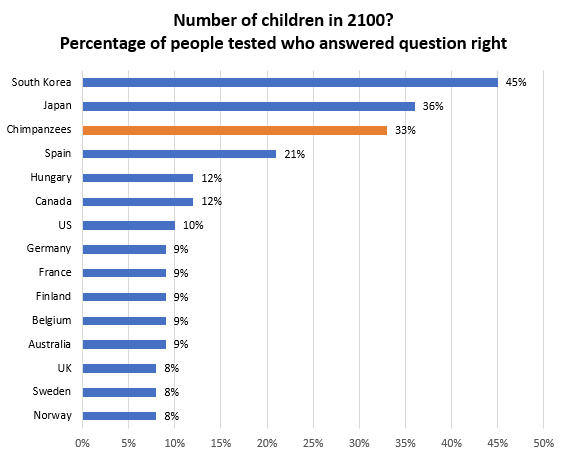
If a bunch of chimpanzees had to answer the question above, each would choose an answer randomly. And 33% of them would get it right.
But when you ask humans the question, most of them get it wrong. Most of them, in fact, do worse than the chimpanzees. It’s not even close.
Rosling asked 12,000 people in 14 countries were asked this question, among others. Here’s how many got it right in various countries.
To be clear, no chimps were tested. That bar is in there just for comparison. But if they were, that’s how they’d do.
So how is it possible that humans do so spectacularly worse than the chimpanzees?
It’s not because chimps are secretly studying world population stats and hatching schemes. It’s because we humans think we know something, but, in reality, what we think we know is wrong.
And in this case, we think they know that the population is going to keep growing and growing and growing.
But it’s not.
The right answer above is C—there are 2 billion children now, and there will be 2 billion in 2100.
The world has hit the peak number of children it will ever have at any time.
There are around 6 billion people on the earth today. As those 2 billion children get older, the UN experts project the total population to fill out and grow to 11 billion in 2100 and then level off.
That means there is no overpopulation nightmare on the horizon.
Can this be true?
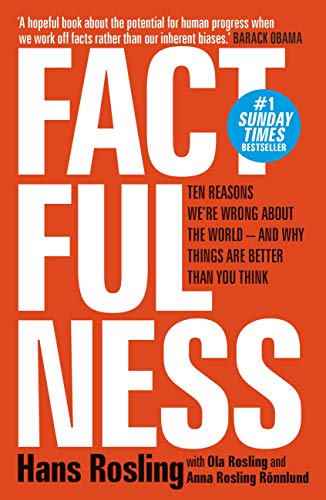
Read Rosling’s book.
Well, what about literacy levels? Poverty? Racism? Wars?
And what about the news—don’t we see the world going to pieces every night?
If you want an eye-opening experience, read Rosling’s book. He delivers all the insights with clarity, expertise, and humor.
Best of all, when you’re done, you’ll have a set of tools to help you correct the picture.
And while you’re waiting for the book, why not watch Rosling in action in this TED talk where he shows the data on population.
If you ask the “conservative” talking heads–Limbaugh, Beck, Hannity, etc.–who THE best conservative president of the last 100 years was, they will say Ronald Reagan. If you ask their dogs, they will bark “Ronald Reagan.” Their gerbils will say other things, but everyone knows you can’t trust rodents. Ask the regular conservative Wanda and Mack (Jane and Joe is so cliche), and they’ll give you the same response as the dogs and people. Ronald Reagan is the guy we conservatives and Republicans have been taught to worship.
Except, when presented with a candidate as conservative as Reagan, no, probably more conservative (I’m talking Mitt Romney), many of these “conservatives” get out their inquisitional torches. Which is a big reason why the GOP primaries are as fluid as they are at this point.
As a side note, have you noticed that these talking heads and the mainstream media either have a hobby horse they ride above all else (Rush Limbaugh and his anti global warming crusade) or they seem to promote some flavor-of-the-day litmus test for each election. In one election, they’re going on and on about homosexual marriage. The next election, it’s a talking head approved stance on Taliban bombing. The next, it’s the fact that budgets must be balanced. They line the candidates up and then start whacking them based on these flavor-of-the-day tests. It’s like going to buy a car and focusing all your attention on the steering wheel.
Anyway, I think many of us have forgotten what THE so-called best conservative president of the last 100 years looked like. If Ronald Reagan were to run today as John Smith, the conservative talking heads would drop him like a hot potato. You don’t believe me? Well, let’s see how he stacks up.
1. ILLEGAL IMMIGRATION
Reagan signed in amnesty for 3 million illegal aliens. The south-west-east-north-of-the-border kind, not the ones with green antennas.
Talking Head Response: After crapping a brick, they would proclaim that John Smith, aka Ronald Reagan, is a pro illegal immigration RINO and must be thrown out!
2. ENVIRONMENTAL REGULATION
A few weeks ago Rush Limbaugh told a caller that Romney is not conservative because of his stance on man-made global warming (Romney says he doesn’t know, but there seems to be evidence men contribue; women, of course, never to contribute to such things–they’re too smart), which Limbaugh thinks will lead to big-government regulation of emissions etc.
YET AS GOVERNOR, Reagan established the Air Resources Board to battle California’s worst-in-the-nation smog problem. In a 1984 radio address to the nation, Reagan took credit for the strong action he took in California to combat smog, saying: “I’m proud of having been one of the first to recognize that States and the Federal Government have a duty to protect our natural resources from the damaging effects of pollution that can accompany industrial development.”
THEN AS PRESIDENT, he signed, with great pride, what many consider THE most successful environmental treaty of all time – the Montreal Protocol in 1987, which regulates emissions. Back in those days Ozone depletion was the Global Warming. Reagan believed it, despite folks questioning the science and was happy to regulate.
In the 1987 State of the union he said: “We are also developing proposals that make use of market incentives to control air pollution caused by sulfur dioxide and nitrogen oxide emissions and the causes of acid rain.”
What?! A cap and trade like program? Yes, putting Bush in charge. In 1990, the first Bush Administration successfully pushed through legislation establishing a cap-and-trade program to reduce acid rain—the program Reagan started!
Talking Head Response: John Smith is a total pro-environmental regulation RINO, please queue Al Gore singing “Burning Ring of Fire”
3. ABORTION
Reagan signed a permissive law that allowed abortions. Since that law went into effect more than 2,000,000 abortions have happened in the Golden State.
Reagan says he failed to see how it would be abused. He blamed his own inexperience, stating that had he been in office longer he would have realized that the bill was wrong. He blamed doctors for misinterpreting the bill. President Reagan stated his prolife position by saying: “Abortion on demand now takes the lives of up to one and a half million unborn children a year. Human life legislation ending this tragedy will someday pass the Congress, and you and I must never rest until it does.” BUT he never introduced a bill to ban abortion or amend what he’d done. Not in California, nor as president.
Furthermore, today’s conservative inquisitors would point to his Supreme Court appointments. He appointed the moderate Sandra Day O’Connor. Anti-abortion groups were livid, fearing, rightfully as it turned out, that Mrs. O’Connor would not vote to overturn Roe v Wade. He appointed Justice Anthony Kennedy who had a long history of supporting expanded rights of privacy, gay rights, and preserving a woman’s right to choose.
Talking Head Response: actions speak louder than words–John Smith is a pro-choice RINO
4. UNIONS
Reagan was a union president 8 times in a row.
Reagan, aka John Smith, also had lots of troubling connections to the Teamsters, who endorsed him, and who suddenly saw less investigation of their leaders for corruption. This is during the Jimmy Hoffa organized crime years.
Talking Head Response: choke, ack, sputter–Smith is a pro-union gangsta RINO!
5. GUN CONTROL
It was Governor Ronald Reagan of California who signed the Mulford Act in 1967, “prohibiting the carrying of firearms on one’s person or in a vehicle, in any public place or on any public street.” Yeah, he aimed to stop the Black Panthers et al, but affected all gun owners.
Twenty-four years later, Reagan was still pushing gun control. “I support the Brady Bill,” he said in a March 28, 1991 speech, “and I urge the Congress to enact it without further delay.” He was right with Clinton on that issue.
The Brady Bill, for the first time ever, instituted federal background checks on firearm purchasers in the United States.
NRA spent millions fighting it, when it pass they mounted cases in a number of states wanting to have it overturned as unconstitutional.
Talking Head Response: anti-gun RINO!
6. FISCAL POLICY
As Governor, Reagan signed into law the largest tax increase in the history of any state up till then. Meanwhile, state spending nearly doubled.
As President he continued. While he did cut taxes his first year, he signed into law tax increases of some nature in every year from 1981 to 1987. Furthermore, the debt increased to nearly $3 trillion, roughly three times as much as the first 80 years of the century had done altogether.
Talking Head Response: tax and spend RINO!
7. RELIGION
Smith, aka Reagan, let Nancy’s astrologer affect his schedule
Talking Head Response: troubling devilishness (scary for evangelicals everywhere!), even if he only did it to make Nancy feel peace
Reagan the RINO? Are you kidding? And yet Reagan would be hounded out of the Republican party if he ran today. The talking heads would sound the warning long and loud, which is a shame.
On the other hand, I’m not saying we need another Reagan. Clones never pan out–hasn’t anyone seen Multiplicty with Michael Keaton?! And despite the recent zombie craze, I don’t want one in the White House, even if the world would be a better place if said zombie should eat Vladimir Putin’s brains out. I tire very quickly of Reagan worship. Or any other politician worship. As good as Reagan was, I disagree with a number of things he did. What I am saying is that those who want to get another president “as good as Reagan” had better know what such a president looks like. And it ain’t the caricature that’s being held up today by many conservatives, especially the talking heads, who seem to gloss over the facts of history.
Are we all wearing Coke bottle glasses with this government shut down?
First, it seems silly to me when reporters ask Americans who is causing the shut down. It’s like, duh, if either party just gave into the other party’s demands, we wouldn’t have the issue. Which means that BOTH parties are causing the shut down.
Second, it seems a lot of folks have forgotten that this is precisely what should happen.
What?
Yes, our government is designed to allow these types of things.
But, John, isn’t that just asinine?
No. It’s not an oversight. I think it’s smart. Even if it causes some pain.
Let me explain what it seems some in the media and elsewhere are forgetting.
This is not a nation that belongs to a government. It’s not a nation owned by some lord or entity. This is a nation of individuals who decided to band together because we thought that banding together would allow us to protect our lives, liberty, and pursuit of happiness better than if we stood alone individually.
This is a nation of individuals who said, you know, we think we can figure things out better together ourselves than having someone dictating to us what we’re going to do. We’ll get together and talk. We’ll argue. We’ll persuade. We’ll try to convince each other of our individual ways of thinking. And when enough of us are convinced that we should do something, we’ll act.
We’ll set up a process for talking and making decisions that ensures everyone can be heard. It would be great if we could get 100% agreement on everything, but we know that’s not realistic. At the same time, we don’t like the idea of forcing our will on others. So we’ll make a compromise; we’ll set up the rules for making decisions so it requires that a good majority of us are in agreement before we can take action, especially on matters that are important to a lot of us.
Finally, we’ll make sure no individual or group can take control and deprive us of this way of living. We did the monarch thing, and we’re done with that. We will not bow to any king ever again. We’re going to be very careful about this one item because a lot of bad things begin to happen when any one person or group gets too much power.
So we set up the rules and started working together this way. And the basic premise under all of this is that we would respect each other’s free will. We’re a land of liberty. We’re a land where we get together and agree on a course of action. Not one where we impose our will on others.
One of the main methods we used to ensure that no individual or group could take control of the rest of us and that a good majority of us must agree before taking a course of governmental action was to distribute the power to make and enforce rules. We did this in a wide variety of ways. We did this because power’s a slippery thing and easily abused. Furthermore, because we knew no system is perfect, we also set up a system of checks and balances so that if one person or group abused their power, we could stop them and force them to remember to respect the freewill that the rest of us have.
So what has caused this shutdown?
It’s very simple.
A lot of Americans do not agree with Obamacare. By most polls, it’s a majority of Americans. They were not listened to when it was being developed. They were not listened to when it was made law. They feel it was passed, not with open discussion, but a lot of chicanery. They feel it’s not some minor regulation, but a very big thing that will infringe on their rights to live how they want to live.
Now, it might be that all their fears are unfounded. It might be that Obamacare is going to usher in utopia. Many signs suggest it’s not going to do anything of the sort. But let’s just say it is the finest piece of legislation ever. Let’s say is a celestial piece of governing.
That isn’t enough.
It’s not nearly enough.
Because this is not a nation that belongs to any group. We are a nation of individuals who have banded together, agreeing that we will talk things out amongst ourselves and only act when a good majority of us agree on a course of action. This is a nation that tries to tread lightly on each other’s liberty.
But many of the folks in Washington back in 2009-2010 forgot this and forced this thing called Obamacare upon the rest of us; in doing so, they violated one of the basic agreements of our compact. If they had followed the underlying intent of our union, they would not have done what they did. They would have crafted legislation that a good majority of us could get behind.
In 2010, those of us who protested this use of power voted in new folks into the House of Representatives to deal with the matter. In fact, when given the chance, Americans (both Republican and Democrat) in the heavily Democratic state of Massachusetts voted Republican Scott Brown into office, hoping to stop this legislation in the Senate before it became law. But Harry Reid didn’t listen. He didn’t care. He and Pelosi and Obama weren’t interested in allowing a full national discussion. He and the others were more concerned with getting their way. And so he used a parliamentary trick to force it through.
This shut down is about one group of people forcing their will on the rest of us. It’s about using the checks and balances designed into the system to correct such errors. It’s about the chickens of some poor decisions coming home to roost.
I know the shut down has caused issues. It’s a partial shutdown; 13% of the government. I think 87% is still funded and running. Still, I know it’s causing some pain.
But none of that pain needs to occur. Everyone wants to fund cancer research. Everyone wants to help poor single mothers. Those things aren’t the issue. The issue is that not everyone agrees with Obamacare.
If you’re a supporter of Obamacare, let me ask you this: if the tables were turned, what would you do?
Would you not stare at the folks trying to force their will on you and say, hey, come on. We’re adults here. We all agreed that we wouldn’t do anything unless a good majority of us were convinced it was the right course of action. Let’s get together and come up with something a good majority of us can get behind.
If you’re an opponent of Obamacare, you too should recognize that a good portion of your fellow citizens are clamoring to change the way things are. They’ve been clamoring for some time. Should you force your will on them? Or should you sit down and listen and try to come up with something that addresses the points we can agree on?
I don’t know if the folks many of us voted to go to Washington will stick to their guns and correct this. I hope they do. And I hope that those on both sides who have forgotten one of the basic tenets of our social compact will wake up and remember we are banded together, not to game the system to get what we want, but to act on only what a good majority of us want.
2 Comments
Nice analysis, particularly the %GDP chart.
I have a simple set of rules for who I vote for:
1) Never vote for the incumbent
2) Of the remaining candidates, pick the one who has the best record of the smallest increases in government spending
3) If there is no useful record available, try to guess which candidate will be responsible for the least increase in government spending
I think if everyone followed similar rules, we would have a better (i.e., smaller) and more thrifty government.
I think with the Obamacare ruling this November is going to see one of the highest fiscal conservative turn outs in history.


Nice analysis, particularly the %GDP chart.
I have a simple set of rules for who I vote for:
1) Never vote for the incumbent
2) Of the remaining candidates, pick the one who has the best record of the smallest increases in government spending
3) If there is no useful record available, try to guess which candidate will be responsible for the least increase in government spending
I think if everyone followed similar rules, we would have a better (i.e., smaller) and more thrifty government.
I think with the Obamacare ruling this November is going to see one of the highest fiscal conservative turn outs in history.