Generating Story 12: Creative Q&A with Author Melissa Mead

Melissa Mead lives in Upstate NY with her husband and cat. Her stories have recently appeared in IGMS and Daily Science Fiction. She’s a member of SFWA, Codex, and the Carpe Libris Writers Group: http://carpelibris.wordpress.com/.  She too had a story to tell about using questions to help her develop her published stories.  I think it’s worth sharing.

Melissa

My Double Dragon novel Between Worlds (Double Dragon Publishing) came about because of a reading mistake.

You see, I’d come across the word “cantrip.” Not being a D&D player, I’d never heard it before, so I went to the OED and looked it up. The first definition said “A minor spell or incantation.” The second said “A mischievous trick,” but somehow I misread it as “A mischievous sprite.”

Oh wow- a mythological being I’d never heard of! I ransacked the library looking for any reference to those mischievous sprites. Didn’t find any, of course. Finally I decided that if I couldn’t find them, I’d make them up. So I started asking myself “What are Cantrips?” From the definition, I figured they must have some minor magical powers, and were most likely small.

 So why hadn’t we heard of them before? Perhaps they were hiding.

Why were they hiding? Perhaps something awful had happened between humans and Cantrips long ago, driving the Cantrips underground. Literally.

Then why we were hearing about them now? Something must have happened that made staying hidden more risky than coming above ground. Starvation? Underground isn’t the best place to maintain a steady population. But that’s not very dramatic or personal, for story purposes. Maybe, in addition, there’s an outside threat.

Ok, so someone needs to confront this threat. One person, so we have someone to focus on. Someone more adventurous than your typical Cantrip.

And so Miska, and all the Cantrips, brought a new form of mischievous sprites to the world.

All because of the question “What the heck is a Cantrip?”

John Sez

First of all, notice she followed her zing.  She stumbled upon this new creature and started to research.  Her research didn’t provide much, of course. But following that impulse is key.  

Next, did you notice she kept asking why?  Why don’t we know about Cantrips?  Why did they go underground?  Why are they returning?  That’s a motive or cause question. 

There’s no way you’d use those exact questions in your story.  But you WILL want to know WHY things are they way they are.  You will want to know motives and causes, internal and external.  You’ll want to know WHY your hero is facing this problem, WHY the antagonist is working against her, WHY the hero decides to tackle the problem instead of ignore it or run away.  When the hero reacts and makes a decision to do X, you will want to know WHY (as well as WHAT’S THE RESULT).  Same with the antagonist.  When building setting, you might find it useful to ask things like WHY did they build a village here or WHY is my character a tailor?  Do you see?

In addition, I’ve found that replacing “why” with “what” seems to be more productive to me.  So “what led or caused my character to be a tailor” helps me more than “why.”  “What’s motivating the antagonist” helps me personally more than “why is he doing this?”  That might be my own weirdness, but I think “what” subtly leads me straight into nouns and situations and values and beliefs.  Try it on and see if it doesn’t help you.

Finally, did you notice her use of objective. The story about overpopulation in the underground didn’t interest her much.  She wanted something with an active antagonist.  Something that could focus on a character.  Knowing that objective, she started generating options that might fit the bill.  Which lead to the cool idea of a new type of mischevious sprite.

Follow zing. Use the “what” (why) to identify cause and motive.  If you can, state your objective; the clarity will give your wonderful mind a focus for its generating powers.


For more in this series, see How to Get and Develop Story Ideas

Share

Similar Posts

  • What I’m looking for from SFWA

    SFWA has asked M.C.A. Hogarth to head up the new self-publishing committee. Hogarth posted about this and asks:

    So here’s my question for those of you who self-publish, either entirely or as a hybrid author: what services would you look for in a professional organization? What would make you say, “Wow, that’s worth $90 a year, sign me up?”

    I applaud SFWA’s move. And the many good things SFWA has done in the past. However, as an indie and SFWA member, here’s what would interest me: Business.

    That’s with a big B.

    That means . . .

    Distribution into brick and mortar venues. So indie authors can get on the Ingram’s catalog. Big whoop. The retailer still has to order. If SFWA was able to facilitate the sales function in some way, that alone would be worth it.

    One idea is a SFWA catalog of vetted work. I don’t know how you’d vet. Maybe some certain sales and revenue level. And revenue would have to be part of it. Brick and Mortar isn’t going to be interested in stocking the person who “sold” 50,000 units but only made $300 because 99% of them were free downloads.

    You might also consider the back lists of authors with work that was once published that has been brought back indie style. So a catalog of that includes new stuff and a section for the back list. Quality and popular indie work.

    BTW, this catalog would ALSO go to libraries.

    Education in cover design AND art direction. Maybe adding this to an awards category chosen NOT by the general membership but art pros.

    The Nebulas recognize author’s who sell. But what about recognizing those who are author-publishers, what about recognizing and celebrating quality and achievement in the key elements of publishing?

    Education in Marketing that has actually been tested and shows positive ROI. Not a bunch of articles about bookmarks and conventions. Real ROI.

    Interior formatting. Principles. Awards.

    News. What’s new on the indie front. New markets etc.

    Selling foreign rights as an indie with and without an agent.

    What about an award like RWA’s Golden Heart, but for indie books? Or make indies more inclusive in the Nebulas.

    A vendor forum where folks who provide services to indie authors (editors, artists, etc) can be listed and rated, GoodReads style, but only by SFWA members.

    And two things I have submitted to SFWA before as a trad pub author.

    Education and discussion of contracts and contract terms. What’s current. What’s alarming. I get more off of Kris Rusch’s blog than the professional organization I belong to. I should be giving my $90 bucks to Kris. What the heck?

    Education and discussion of current contract rates. Same as above. For a professional organization to not have data on current rates for novels is a real head-scratcher.

    How is it that Tobias Buckell can run a survey, but it never occurs to SFWA to survey and publish annual numbers?

    How is it that Brenda Hiatt, the romance writer who does an annual “Show Me The Money” and “Indie Earnings” report, provides more info on Tor advances than SFWA? Romance writers are better organized than any writing group on the planet, but do they need to spank us in our own house?

    These last two are no-brainers.

    This is a trade organization. These types of things would be a HUGE help.

    Share
  • The main thing about villains

    The main role of villains and antagonists in stories is to generate suspense, anxiety, and fear in the reader. They make it possible for us to worry that the hero will not be able to avoid a significant threat or remove a lack. There are other effects–mystery, poignancy (about the human situation like in Les Mis). But those are secondary.

    For the main things to happen the villain has to be a credible, significant, and immediate threat…all the way through the book until he or she is smushed or wins.

    If he’s not credible, the reader realizes there is no real threat. If the threat is not significant, who cares? If it’s not immediate, again, who cares?

    So how do we make a villain like that? We make him or her smart, powerful, a few steps ahead of the hero, and dedicated to doing something we root against (because it’s just plain wrong or because we love our hero and want the best for him and the villain is pitted against him). He has to be able to put the hero on his heels most of the way through the book, and our poor hero is scrambling to adjust.

    You can have all sorts of villains–liked by many or few, kooky or calculating, eccentric or plain, noble or sadistic–just as long as they remain significant, immediate, and credible threats. The minute they lose threat status, the game’s over because at that point fear, anxiety, and suspense in the reader vanish.

    Share
  • |

    More info on the American Fork Arts Council Gig

    Fat head alert.     

    Not to be missed – the most useful speech on writing you will ever hear! Keynote speaker John D. Brown will present ‘Three things you MUST know to write killer stories.’ John Brown is a prize-winning short story writer and novelist. His epic fantasy novel, “Servant of a Dark God” will be released in North America in September 2009. 

    “Most useful” is nice. Let’s hope I can live up to that one.  🙂 I’m looking forward to this event. A lot of other great authors will be there as well as editors from Deseret Book, Covenant, and Cedar Fort. If you’re a regional writer, you won’t want to miss this. Full information here on the American Fork Arts Council council for writers.

    Share
  • Exposition, Character Description, Curiosity vs Suspense

    Another great podcast from the writing excuses team. This time with Patrick Rothfuss (I did love his book) on writing exposition.

    http://www.writingexcuses.com/2008/09/15/writing-excuses-episodes-32-talking-exposition-with-patrick-rothfuss/

    One comment that stood out was Brandon’s conscious choice to leave some explaining to chapter 6 of Mistborn. Not only did it make the beginning more accessible, but it actually created a sense of mystery about Kelsier. I wanted to know more.

    Although, I would caution new writers that when Rothfuss talks about withholding, he’s talking about setting. He’s not talking about keeping the story from the reader. You can’t build suspense if you hide what’s going on, the dangers, etc. You can build a bit of curiosity, but that only holds the reader’s attention for a short time. Give information for suspense. Withhold for curiosity. They are two different things.

    To get a sense of proportion on exposition or broad brushing a character, I recommend Bernard Cornwell’s writing advice: http://www.bernardcornwell.net/chapters/writingadvice.htm

    Take a book you love, get a colored pencil or crayon, then begin reading. When you find a passage of descrition/setting, draw a line along the side. After 30 or so pages of doing this you’ll begin to see how much setting the author puts in and how he goes about doing it. Do this with a few stories you love and you’ll begin to see patterns.

    You can do the same thing with character. In fact, I just finished FEAR NOTHING by Dean Koontz. Loved how he did his characters. So I’ve got a used copy and a copy of VELOCITY and am marking them up. I’ve gotten a number of very interesting insights.

    Share
  • Edward Bear Shares His Proofreading Secrets

    One of the things I enjoy about being an author are the emails I receive from readers. A few months ago I received one from Mr. Edward Bear. He’d purchased Servant and, as he was reading, found an unclosed dialogue quote.

    Mr. Bear could have simply noted it and read on. But he did not. Mr. Bear is a proofreader. And so he practiced a bit of wizardry, found that I had a handful of quote goofs, and emailed them to me.

    Many of them ended up being weird smart quote issues Word introduced into the text when I broke a line of dialogue with an action like this: “You will not”–he scratched his nose angrily–“share another pair of my panty hose with that woman!”

    You’d think that would be enough for a doughty reader. But Mr. Bear didn’t just notify me of the errors. Oh, no. He also included the page from his proofreader’s grimoire that allowed him to find those quote issues in a matter of minutes in the first place.

    As soon as I had the time, I tested the spell on Bad Penny, and, voila, in a matter of a few minutes found a couple of issues in that text. I was delighted.

    But Mr. Bear wasn’t satisfied with mere delight. He then sent me another page from that grimoire to help with spelling. We luvs wizardly readers, Precious.

    Copy editing and proofreading require patience, painstaking reading, and a knowledge of what to look for. You have to know not only the mechanics of the written word (capitalization, spelling grammar, syntax, punctuation, abbreviations, usage, etc.) but also, if you’re reading for a printed edition, interior formatting (widows, orphans, word or hyphen stacks, headers, and so forth). There’s a lot to it. And anything that speeds up the process and minimizes errors is welcome.

    If you’re contracting your proofreading out, a cleaner copy can also translate into lower rates. Knowing that many of you who visit this website are writers, and because your host’s generosity knows no bounds, I asked Mr. Bear if he might be willing to share his wizardry with you. The wizard responded with a yes.

    Augmented Proofreading 1

    By Edward Bear I’m Ed Bear. I work, both professionally and otherwise, as a proofreader. I’ve gone over books for my publisher and I’ve done scan/OCR/check against paper books for republication, both electronic and back-to-treeware. When I mentioned some of the “ancillary tools” I have for aiding the work, John offered me this guest post slot in his blog. Feel free to pass this stuff around. I’ve found these techniques invaluable in getting the job done faster, and with better quality.

    First, though, I need to tell you about the tools themselves. The biggest component is the software for electronic text editing. However, I’m NOT talking Word or anything like that. I’m talking about an editing program which can a: work with plain text and b: handle Regular Expressions. (What are those, some of you ask? I’ll get to that.)

    Since I’m a windows user, I have two such programs available. My favorite is a program called TextPad (www.textpad.com).  I’ve used it for years and it’s become invaluable to my work. They currently charge $28 for a single user license, but IMO, the program’s so useful that, even though upgrades are free, I buy another license every time they bring out a new major release. The other program is free. It’s called NotePad++ (http://notepad-plus-plus.org/) I’ve tested it and it can handle the methods I use, but I haven’t used it much, since TextPad and I are long-time buddies. If anybody out there knows a program for the Macintosh which will do these jobs, please mention it in the comments.

    Regular Expressions

    You don’t have to be a wizard to use them. The tutorial over at http://www.regular-expressions.info/tutorial.html describes them elegantly:  “Basically, a regular expression is a pattern describing a certain amount of text.”  They are also called a regexp or regex, and I’ll be including the regexes I use in this post.

    I have a small library of regexes, and two of them are critical to aiding the proofreading process. One of them allows checking dialogue quotemarks, to insure that speech is properly closed off, and the other makes it possible to generate a word list of each unique word in the  book. I’ll be walking through the usage, including screenshots.

    Quote Checking

    One of the challenges of checking dialogue passages is that, with one exception, every opening quote (“) needs to have its matching closing quote (”). The exception, of course, is when the same character is speaking in the next paragraph. This can lead to a heavy false positive load if the characters are loquacious.

    The first time I tried this stunt, I found  73 paragraphs with unbalanced quotes. Only 6 of them were errors. But being able to find them quickly so they could be fixed in minutes instead of hours? That paid for the effort.

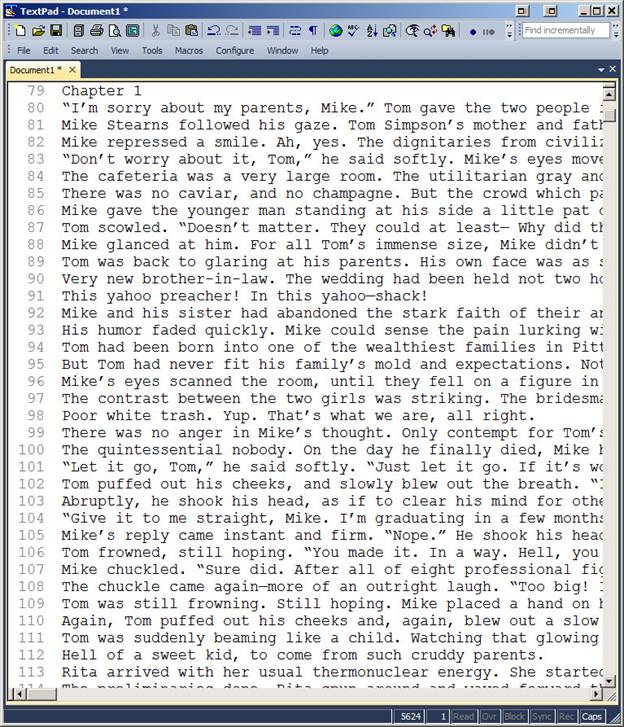
    The process itself is simple: You take the document and convert it to plain text. If it’s an RTF or Word document, you simply select ALL, hit copy, and paste it into Textpad.  The result will look something like this:

    image001

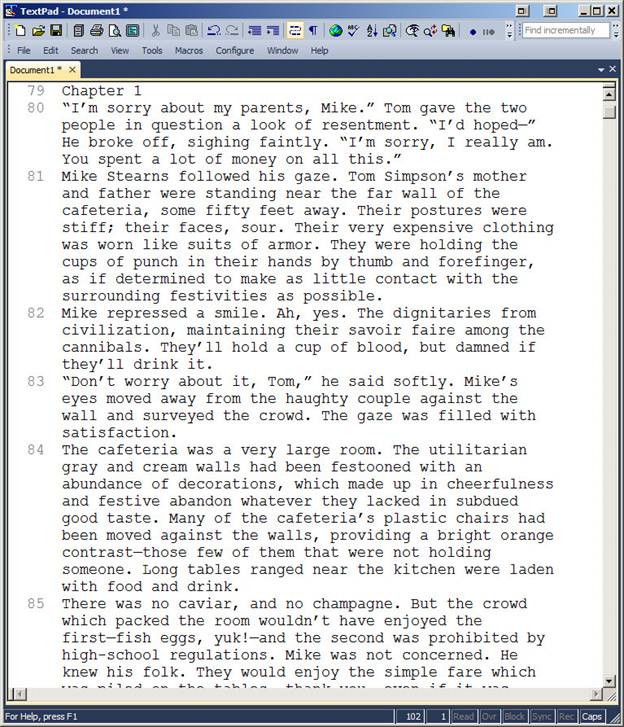
    What I normally do is turn on word wrap, so I can see the whole paragraphs as I go. So it looks like this:

    image002

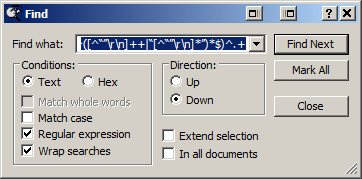
    Now, we go hunting. The next step is to set up the search pattern using a regex. The one I use for this is the following: (?!^([^“”\r\n]++|“[^“”\r\n]*”)*$)^.+ Complicated little brute, isn’t it. I didn’t write it, but I knew who to ask if he could write one, and the above is the result. FYI, there’s also one for straight quotes: (?!^([^”\r\n]++|”[^”\r\n]*”)*$)^.+ You use it the same way. So go into find, and put the regex into the “Find what:” box:

    image003

    Notice that the “Regular expression” box is checked. I also “Wrap searches” just in case I miss something and want to loop around. Click “Find Next” and:

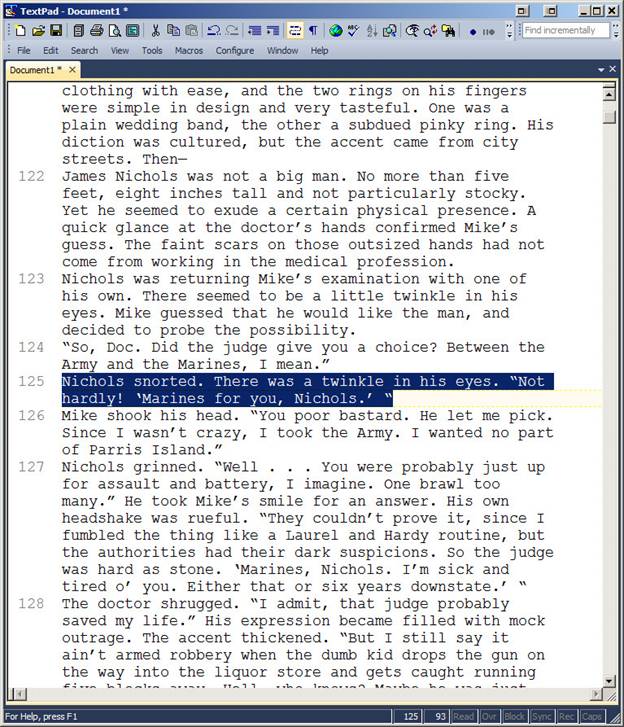
    image004

    The paragraph highlighted has two opening quotes, one at the beginning and one at the end. Word assumes that a quote preceded by a space is an opening quote, so you need to correct it in your RTF/DOC. Wash, rinse, repeat. You keep doing “find next” all the way through, checking for situations like the following:

    image005

    As I said, same speaker, next paragraph, so this one is good. This post is getting a little long for a blog entry, what with illustrations, so I’ll break off here. Stay tuned for part two: checking spelling and spelling consistency. In the meantime, here are the RegEx tool commands plus a few bonus goodies: RegExToolCommands.

    Share

2 Comments

  1. I have really been enjoying this series on creative Q&A. Your workshop on how to develop killer stories at LTUE a few years ago finally gave me the kick I needed to get moving on my story. I was highly motivated, but I remember thinking at the time that I wasn’t sure which questions to ask. This series has helped fill that gap.

Comments are closed.