No Apology: Chapter 1 – The Pursuit of the Difficult

WE MUST FACE OUR CHALLENGES OR DIMINISH

Romney starts the chapter with a quote his dad used to recite to him: “the pursuit of the difficult makes men strong.” Romney states that over the years, he’s come to believe that this idea applies to more than individuals—it applies to businesses and nations as well.

He maintains that America has always faced great challenges. He cites a few examples from America’s history and states that there really hasn’t been a time when we were free of challenges. It seemed, after Reagan and Bush had presided over the fall of the Soviet Union, many thought “peace and prosperity were here to stay—without threat, without sacrifice.” Of course, that proved untrue.

America has faced great challenges in the past and faces huge challenges now. He believes we will “remain the leading nation in the world only if we face our challenges head on.” If we do not face and overcome them, we will become “the France—still a great country, but no longer the world’s leading nation.”

The question is: what’s so bad about that?

The answer is that some other nation or nations would fill the power vacuum. Romney poses the fundamental question: “what nation or nations would rise, and what would be the consequences for our safety, freedom, and prosperity?”

FOUR GLOBAL STRATEGIES FOR WORLD POWER

Romney suggests that there are a number of nations and groups who are “intent on replacing America as the world’s political, economic, and military leader.” He states that there are, in fact, “four major strategies currently being pursued to achieve world leadership.”

The first global strategy to achieve world power is the one represented by the United States. It is a strategy based on two fundamental principles: economic freedom and political freedom. Those nations that follow this strategy have become economic powerhouses and account for more than 60% of the world’s GDP. They are also the countries who have given humankind the most freedom.

The second global strategy is the one pursued by China. Its fundamental principles are free enterprise and authoritarian rule. He spends a couple of pages discussing how well Chinese enterprise is doing. Then he believes China is intent on becoming stronger than the United States.

The third main global strategy is the one pursued by Russia. It’s fundamental principles are authoritarian rule and controlling energy. “By controlling people and energy, Russia aims to reassert itself as a global superpower.” He then explains how this could be possible.

The fourth main strategy for global power is the one pursued by the violent jihadists, who count many foreign leaders in their numbers. Their strategy is based on conquest and compulsion through a variety of tactical means.

Of these four strategies in competition today only one is founded on freedom. Romney then suggests that we can be confident that our children and grandchildren will be free ONLY IF the economic and military strength of America and the West endure. He suggests that our superpower status is not inevitable. “Three other global strategies, each pursued by at least one state or major actor, are aggressively being pursued to surpass us, and in some cases, to suppress us. The proponents of each are convinced they will succeed. And world history offers us no encouragement.”

Because of this, he believes that “our primary objective as a nation must be to keep America strong. I am convinced that every policy, every political initiative, every new law or regulation should be evaluated in large measure by whether it makes us stronger or weaker” because “our freedom, security, and prosperity are at stake.”

OBAMA’S DRAMATIC SHIFT IN FOREIGN POLICY

Romney next maintains that president Obama has introduced a foreign policy that “is a rupture with some of the key assumptions that have undergirded more than six decades of American foreign policy.”

He states that when World War 2 ended, America executed a “dramatic and profoundly meaningful shift in our relationship with the rest of the world.” Previously we had guarded our own hemisphere and attempted to stay isolated from the affairs of Europe and Asia. But we found with WW1 and WW2 that “our vital interests could not be secure in the face of threats to the cause of freedom elsewhere. At the dawn of the nuclear age, a third world war was unthinkable; it would mean the destruction of humankind.” So the president and leaders of both parties “shifted America’s foreign policy. America took on the task of anticipating, containing, and eventually defeating threats to the progress of freedom in the belief that actively protecting others was the best way to protect ourselves.”

This new order had three main pillars:

1. “Active involvement and participation in world affairs”
2. “Active promotion of American and Western values including democracy, free enterprise, and human rights”
3. “A collective security umbrella for America and her allies”

He talks about how all the presidents, Democrat and Republican, followed this new strategy. But President Obama is engineering a dramatic shift away from it based on his own underlying attitudes.

Obama envisions an America that arbitrates disputes rather than advocate ideals. This is one of the reasons why he apologized to countries around the globe for American arrogance, trying to placate our enemies. This is also why it seems he has undercut many allies, including Israel, Poland, and Columbia. To be an arbitrator, you need to be equidistant from both sides. Not advocating for one or the other.

Another one of Obama’s assumptions is that “America is in a state of inevitable decline.” He, therefore, considers it futile to fight it; instead, it’s his job to help us manage our decline. Romney suggests Obama believes maintaining a dominant America is “a bad idea even if it were possible.”

Of course, Romney fundamentally disagrees with that assessment.

GETTING BACK ON TRACK

Romney suggests several things we can do to get back on track:

• Treat our allies like allies
• Strengthen the American economy
• Increase our defense spending
• Remind ourselves that the most attractive thing about us is our ideas—so we should “encourage democracy where we can, give aid and comfort to those who want it, and not undermine those who already have it”

Undergirding all of this, Romney suggests, “must be a certain conception of the goodness and greatness of America.” This “doesn’t mean America is a perfect country. We have made mistakes and committed grave offenses over the centuries.” But we should recognize that “No nation has shed more blood for more noble causes than the United States. Its beneficence and benevolence are unmatched by any nation on earth, and by any nation in history.”

Romney concludes by saying that he believes America is “destined to remain as it has been since the birth of the Republic—the brightest hope of the world” but only IF we face our challenges head on and work to keep America strong.

MY RANDOM COMMENTS

First, I don’t know if I’m going to have the time to capture each chapter in such detail. We’ll see.

Second, I found the discussion of the four strategies insightful. Particularly because it put in explained a number of questions I had about why Putin’s Russia does what it does. It also gave me insight into China, which I thought was still mostly economically socialistic.

I found the explanation of America’s shift in foreign policy in the 20th century interesting. As well as the shift Obama has made. I think I need to understand Obama better. Does he really think this? The actions and speeches Romney cites certainly are suggestive. Has anyone seen the movie 2016? It sounds similar.

It might appear the book will continue allocating space for attacking Obama, but I believe the six pages in this thirty-page chapter form probably the biggest appearance Obama makes in the book.

It’s clear that Romney’s business experience, especially as a consultant, has influenced how he sees things. The whole talk of strategy and challenges and competition reminds me of Michael Porter.

Porter is a Harvard professor and founder of Monitor, a strategy consulting firm that has been hired by corporations and countries. He is claimed to be the most cited author in business and economics. According to Wikipedia “He is generally recognized as the father of the modern strategy field, and his ideas are taught in virtually every business school in the world. His work has also re-defined thinking about competitiveness, economic development, economically distressed urban communities, environmental policy, and the role of corporations in society. . . his main academic objectives focus on how a firm or a region can build a competitive advantage and develop competitive strategy.”

The idea that America is competing with other nations is, of course, true. But I don’t think I’ve ever heard anyone running for president claim that their central goal, the goal any president should have, is to keep America strong because of the competitive threats we face. The talk is usually all focused on this issue or that without the broader picture I found here. I found Romney’s central tenet clarifying and refreshing. The rest of the book is going to be about how to keep our competitive advantages and strength.

Comments, observations, or issues from anyone who has read the chapter?

Share

Similar Posts

  • |

    Watch The Secret to Making Plotting Easier Now

    For those that struggle with plotting your novels, you can now watch The Secret to Making Plotting Easier.

    It’s a recording of the hour-long lecture of goodness I delivered to an audience of over 140 writers at Life, The Universe and Everything last week.

    I’m happy to report that when it was over, a number of those in audience gushed quite profusely about how helpful it was.

    Enjoy!

    Share
  • Interview with John Goodwin of Writers of the Future

    During LTUE this year I sat down with John Goodwin, who manages the Writers and Illustrators of the Future contest, to chat about the contest, my win, and other writerly topics. I had a great time with John.

    If you’re a new writer or illustrator working in the science fiction or fantasy genres, I strongly recommend you submit each quarter. There is no fee and the prize is generous. Best of all, it comes with a week long workshop with pros.

    In the mean time, enjoy the interview.

    Here’s the teaser on YouTube.

    And here’s the full podcast.

    Share
  • The Surprising Truth About Militias and the Second Amendment

    When the founding fathers spoke of “militias,” they were not referring to a bunch of yahoos running around in the woods with paint on their faces outside of state control.
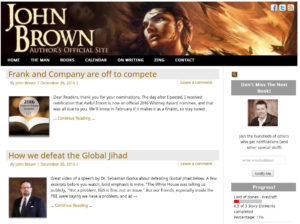

    They were referring to a citizen army under state control.

    So is “militia” just the old-time word for what our army is today?

    No.

    A standing or “regular” army is one made up of professional, full-time soldiers like the US Army, the Marines, the Navy, and the Air Force. And it’s permanent, meaning you don’t disband the army when the fighting is done.

    A militia back in those days was something completely different.

    The problem of a standing army

    The founding fathers knew they needed to provide for the common defense, but they saw standing armies controlled by a central government as an immediate threat to the liberty the new union sought to preserve.

    Why would they think that?

    Easy. History was littered with case after case where standing armies had become a law unto themselves and oppressed the populace. One glaring example is what happened to the Roman empire. It suffered centuries where this faction and then that faction of the army was in control, and it brought nothing but a continual procession of civil wars and bloodshed.

    History also showed that even if the military didn’t take over, kings and queens were happy to wield standing armies to impose their will and oppress the people. Remember: the world then was ruled by monarchies. The founders had never seen a standing army wielded by any other type of power.

    So the founders didn’t want to give a president or any other central authority that power. They feared doing so would only pave the way to the ruin of the new nation they sought to form.

    So if you don’t have a standing army, how do you defend your country?

    The fyrd

    The founding fathers thought they saw a solution in a tradition of duty that went back hundreds of years in England. In the days when the Saxons ruled England, the kings and dukes would muster and deploy the fyrd to help them fight their wars.

    The fyrd was made up of all able-bodied free males between certain ages, regardless of their vocation. It was their duty to provide their own arms and defend the land when called by their leaders. So this was an army made up of farmers, tanners, smiths, tailors, etc.

    But the fyrd wasn’t a standing army. Nor was it populated with full-time soldiers. This citizen army was to be called out when needed, and when the crisis was over, it was disbanded, and the men went back to their vocations.

    The militia scheme

    The founders took this idea and tweaked it. Back in the Saxon days, the king controlled the fyrd. In this new scheme, the United States would rely on a fyrd (which they called a militia), but the powers to control it would be split between the president, Congress, and the States.

    First, Congress, not the president, was the only authority that could declare war and summon the state militias. So the president would be the commander in chief when the militia was active. But the minute Congress decided to end a war and disband the militia, that army dissolved, leaving the president as commander in chief of only the tiny number of troops that had been authorized as the regular army (less than 1,000 at the time).

    Second, while the Federal government would provide the weapons the militia would use when it mustered them for war, the state governments would be the ones to appoint the officers and train the soldiers. You can’t run an army without officers. So this would prevent the Federal government from taking control by stacking the army leadership with those loyal to a despot president or Congress.

    So the militia was supposed to be the main force that fought our wars, and it was supposed to be temporary. It’s true that Congress did authorize a standing army, but it was tiny. And with this setup, the founders figured we’d have the army we’d need, but we’d avoid the problems standing armies had posed in the past.

    So militias, as thought of by the founders in the 1700s, were not groups outside the government’s control. They were temporary citizen armies. And power over them was broken up between the president, Congress, and the States so no one group or person could wield them tyrannically.

    1791 and The Bill of Rights

    Accordingly, the founders wrote the articles and sections of the Constitution in 1787 to set all of this up. However, many anti-federalists were concerned that the Constitution didn’t go far enough to protect the rights of individuals and limit the power of the Federal government. In fact, many of the founders were so concerned about the issue that they refused to ratify the Constitution as it was.

    The only way they’d sign on is with the promise of the Bill of Rights. When they knew that bill was forthcoming, delegates from nine of the original thirteen states ratified the Constitution. The delegates of two other states waited until the document was produced. The final two (North Carolina and Rhode Island) waited until 1791 when the Bill of Rights, which includes the second amendment, was passed.

    So let’s look at the language of the Second Amendment in light of what we know about the fear the founders had of standing armies.

    “A well regulated Militia being necessary to the security of a free State, the right of the people to keep and bear Arms shall not be infringed.”

    Why did they include this? It was not because they wanted the citizens to be able to hunt or protect themselves with guns. They figured that was a given. They included this amendment because they concluded that an armed citizenry would make it impossible for tyranny to arise.

    Noah Webster, a Federalist, stated the idea this way when trying to persuade Pennsylvania to ratify the Constitution:

    “Before a standing army can rule, the people must be disarmed; as they are in almost every kingdom of Europe. The supreme power in America cannot enforce unjust laws by the sword; because the whole body of the people are armed, and constitute a force superior to any bands of regular troops that can be, on any pretense, raised in the United States. A military force, at the command of Congress, can execute no laws, but such as the people perceive to be just and constitutional; for they will possess the power, and jealousy will instantly inspire the inclination, to resist the execution of a law which appears to them unjust and oppressive”

    So the second amendment was included in the Bill of Rights because enough of the founders feared that the Constitution could be read in a way that would allow the Federal government to disarm the populace. Disarming the populace would open the way to a standing army under Federal control. And that would open the way to tyranny.

    When all was said and done, the founders separated the power of the military in this way:

    • Only Congress could declare war and muster the militia
    • Only Congress could finance it
    • There would be no standing army to speak of
    • Only the states could appoint officers to the militia
    • The government was forbidden to infringe on the rights of individuals to keep and bear arms

    So what happened?

    Militias didn’t work

    The problem is the militia didn’t work well enough to actually provide for the common defense.

    It didn’t work during the Revolutionary War. The republic had to create the Continental Army. That army was supported by the militias, but the colonists found they couldn’t rely on the militias alone. They had to have the regular army to fight the British.

    After the war, the Continental Army was disbanded, but the militias simply weren’t good enough to face the threats the new nation faced, and George Washington himself openly lamented it. The troops took a licking in 1791 at the battle of St. Claire’s and then time and again during the War of 1812.

    Heck, militias didn’t even work in the days of the fyrd. In those days, the Saxon and Norman kings relied on their house warriors (their standing army) and mercenaries for most of the work. They only supplemented with the fyrd.

    1792

    After the defeat in 1791, the early leaders concluded they needed a regular army with the training and skill it possessed. So in 1792 Congress authorized the creation of the First Legion of the United States, a standing army of 5,190 men. The legion was renamed “The United States Army” in 1796.

    In 1792 Congress also passed the Militia Acts. The acts were written to expire in two years. But Congress wrote another in 1795 to replace them. These laws authorized the president to called out the militia “whenever the United States shall be invaded, or be in imminent danger of invasion” and “whenever the laws of the United States shall be opposed or the execution thereof obstructed, in any state, by combinations too powerful to be suppressed by the ordinary course of judicial proceedings, or by the powers vested in the marshals by this act.”

    So a mere five years after the Constitution was first ratified, and a year after the Bill of Rights, Congress dramatically increased the size of the nation’s standing army and gave the President the authority to call out the militia! It’s clear that right from the beginning the militia scheme started showing some cracks.

    Today

    The First Legion was small. But it grew again in 1808, and then again during the war of 1812. And it continued to grow slowly, then ballooned in the 1900s until we now have more than a million troops in the armed forces of the US.

    The National Guard is what the militias of the 1800s transformed into in the early 1900s, but, wouldn’t you know it, the National Guard is now mostly under the control of the Federal government too.

    What does this mean?

    It means we now have the most powerful standing army the world has ever known and almost no militia. It means our military is a complete 180 of what the founders envisioned.

    I’m not saying it’s bad. I love our military.

    I’m merely pointing out that militias back then meant a certain thing and the founders wanted them for a certain reason. And that we have completely replaced that arrangement with the exact opposite.

    As for tyranny, we still have armed citizens. Maybe this is enough to deter tyranny as Webster claimed. Although the disparity between what the citizens can arm themselves with now and what the regular army has is nothing like it was in the 1700s. So maybe there are other laws and aspects of our culture that have prevented it. Maybe it’s both.

    Either way, it’s important to understand what the original militias were, why the founders wanted them, and what the second amendment was all about.

    More

    Helpful articles

    US Constitution – Provisions for the military

    Here are all of the parts of the original seven articles of the Constitution that deal with the military.

    Article 1 – The Congress
    Section 8

    This section gives Congress seventeen powers. Six of these have to with the common defense. Those military powers granted are:

    • To declare War, grant Letters of Marque and Reprisal, and make Rules concerning Captures on Land and Water;
    • To raise and support Armies, but no Appropriation of Money to that Use shall be for a longer Term than two Years;
    • To provide and maintain a Navy;
    • To make Rules for the Government and Regulation of the land and naval Forces;
    • To provide for calling forth the Militia to execute the Laws of the Union, suppress Insurrections and repel Invasions; [notice there are only three cases that warrant the calling forth of the militia]
    • To provide for organizing, arming, and disciplining, the Militia, and for governing such Part of them as may be employed in the Service of the United States, reserving to the States respectively, the Appointment of the Officers, and the Authority of training the Militia according to the discipline prescribed by Congress;
    Section 10

    This section prevents the States from doing thirteen things. Three of these have to do with the military.

    “No State shall, without the Consent of Congress, lay any Duty of Tonnage, keep Troops, or Ships of War in time of Peace, enter into any Agreement or Compact with another State, or with a foreign Power, or engage in War, unless actually invaded, or in such imminent Danger as will not admit of delay.”

    Article 2 – The President
    Section 2

    “The President shall be Commander in Chief of the Army and Navy of the United States, and of the Militia of the several States, when called into the actual Service of the United States;”

    Article 4 – The States
    Section 4

    “The United States shall guarantee to every State in this Union a Republican Form of Government, and shall protect each of them against Invasion;”

    Share
  • You vote: excerpt or full text?

    Readers, for the last year or so I’ve set the blog to show a summary of each post which you then click into as shown below.

    For the years before that I just showed the full text like you see now.

    I personally engage more with full text displays because I read as I scroll, so even if I’m skipping, I do at least pick up the gist of the post.

    Do you have a preference? Does one view “feel easier” to you?

    Let me know.

    Share