Larry Correia is a big-booted barbarian who likes to fight in a cage. And a lot of us love to watch big-booted barbarians go at it.
We like demanding matches. We like a little blood and good sportsmanship (of course, sportsmanship in the cage is different than in other venues). And we respect both sides for showing up and giving it their best.
This last week Larry Correia battled with Alex Dally MacFarlane (and Tor, the silent partner, who thought her new column would be a great idea and has given her their big platform to talk) and Jim Hines. If you didn’t watch the match, here are the links.
I’ve enjoyed reading the give and take in this fight. For me, the barbarians seem to have landed more blows (and done so with many more funny and memorable one-liners.) But that doesn’t mean Alex Dally MacFarlane shouldn’t crusade.
And I mean crusade, as in battle.
Underneath it all MacFarlane wants to change something. She wants to change hearts and minds. A lot of us want to change hearts and minds about various things. A lot of us will show up and risk getting bloody for such things in a variety of settings. Heck, Correia the Barbarian was even willing to spend two years of his barbarian life trying to change hearts and minds in a setting where big boots are not allowed (poor Correia, more sad puppies).
But here’s the deal.
If you want to win someone like me, you’re going to do it not by scolding or brow beating me or by mandating something and then trying to back it up with sticks.
You’re going to do it by writing something so delightul that I cannot but help listen to you.
You’re not going to tell me what I can’t write.
You’re not going to tell me what I must write.
You’re going to model writing that makes me want to write that thing.
You’re going to be like Tolkien and spawn five decades of writers who want to do nothing more than imagine worlds filled with strange races and wonderous settings and weird talking tree men who have lost their wives.
You’re going to invite like-minded folks to join you in creating wonders. Or in just having a good old time. And not worry about other writers inviting folks to their creations, which might be totally different from yours.
And those wonders and good times are the things that will work the magic.
Miguel Sabido is a master of entertainment with message. Here’s a great piece in The New Yorker introducing him, his work, and methods. Notice what made his stuff so effective. The new ways of thinking he wanted to offer were never found in the A story. They were never found in the B story.
Why?
Because the number one thing the story had to do was suck people in (entertain).
And so the new thing to consider was in the C story.
MacFarlane, put it in the C story. And build a Middle-earth. Or a ring world. Or at least some vampires that sparkle.
In the meantime, I’ve got a barbarian book on the shelf that looks like a mighty good time. I think I’m going to give it a read.
Last week, I was booted out of Codex Writers, a private, online writer’s group that I’d been a member of for somewhere around fifteen years. I’m not broken up about it, but the reason for said booting is interesting, unexpected, and worth a post.
Over the years, writers moved in and out of the group, but there were usually somewhere around fifty to a hundred members active on the boards. We discussed the writing craft and business. We held writing contests. We provided critiques. People shared interesting things about their lives.
The group has moderators. And the moderators got together last week and decided John Brown had to go.
Why?
What, of all the sins one may commit online, triggered this?
Was it refusing to stop posting pictures of cats?
Using too many emoticons?
Infecting everyone’s pages with Russian spam bots?
Nope. Nope. Nope.
I know what you’re thinking. Surely, John, you must have
been posting in a belligerent, arrogant, and strident way. You must have been a
jerk.
That’s what you’d think.
I assumed that’s what the problem was too. I invited those
who were angry and hurt to come to my personal thread and explain what it was
that was making them so hurt and angry. A number took me up on the offer. And,
to my great surprise, one of their criticisms was that I was too polite.
One person posted that my politeness made her think I was sealioning (a new term to me). Other’s agreed.
Another person said that my polite manner surely indicated I wasn’t sincere. Other’s agreed.
In fact, one of the moderators stated that being polite was part of the insidious problem that was John Brown. She said that my politeness had suckered folks in to letting my awful behavior go on too long.
I was offensive, and I was too dang polite about it.
So what was I doing?
Well, I was asking for evidence.
Don’t ask for evidence
My sin was suggesting that some claims being made about a
certain topic seemed to be premature. My sin was in looking at the evidence
being offered to support some of these claims and firmly stating that I
couldn’t see how it supported the conclusions.
On every topic on the forum, we could question claims and
discuss evidence in an effort to figure things out. But there was one topic, as
I learned, for which a number of the active members and the moderators decided
that was forbidden.
The topic was systemic or “institutionalized” discrimination.
On the forum, most of the discussion was how it related to publishing.
They explained to me that it was offensive for me to want to
see if the evidence actually supported the claims. It was offensive to post when
I couldn’t see that it did.
You might wonder how in the world can that be offensive.
After all, evidence is one of the first things we ask for when people make
claims.
If Billy Joe comes up to you and says, “Son, aliens done landed in my yard last night. I swear it on a stack of Bibles.” Most of us would want some additional evidence.
We’d want to see the video he took and look at the burn mark
in his lawn and the broken branches he said were made when their ship landed.
And we’d want to see the report showing that the residue collected off the
swing set was a substance unknown to mankind.
But it isn’t just claims about aliens that we do this with.
Historians do it about history.
Scientists do it about science.
Courts require it for reaching verdicts.
Heck, we even do it when we look at movie reviews—we use
those reviews as evidence that the movie is going to probably be good or bad.
Evidence.
We’re always looking for evidence to see if our guesses are
right. But on this topic, wanting evidence was offensive. I was told it was
“hurtful” and “damaging.”
The logic of micro-aggressionism
How could folks get to the point where wanting and
challenging evidence for claims was a bad thing?
Well, quite easily. And they aren’t the first to do it.
And lest you think this unfortunate logic is found only in
obscure writers groups, you need to know it has spread to many American university campuses.
That means it’s eventually coming to an organization near you. And that means
chances are good that you or someone close to you will have to face, at some
time or another, online or elsewhere, an angry mob (or moblet, as the case may
be).
So let’s examine the logic so that when you do, you’ll be
able to see the response for what it is, name it, and bring its tenets out into
the light and show them for what they are.
Here’s their logic.
ONE, each of us
has our individual prejudices, biases, and beliefs about the world.
I’m sure you agree with this. It seems pretty obvious. One guy might think soccer is for wimps, and another might think football is for lumbering meatheads. Of course, it’s not just about sports. We also hold views about people from other groups. Depending on your experience, the media you’ve been exposed to, and the statements and behavior of those around you, you might have unconsciously picked up certain beliefs about Asians, Blacks, Hispanics, Germans, Swedes, Whites, engineers, clowns, etc.
TWO, it’s likely there are others out there with the same prejudices and biases. Some of those ideas will be held in common by smaller percentages of the population. Others will be held in common by larger percentages of the populations.
I’m sure you agree with this too. A lot of Americans like football, but some don’t. A lot of Europeans like soccer, but there are some who don’t. We can see this with our beliefs about various groups. For example, ask anyone in the USA what they think about Nazis, hippies, or hockey players, and you’ll find a handful of common responses.
THREE, various prejudices
and biases can get perpetuated in the society. This is what the
micro-aggressionists call systemic discrimination.
I’m sure you’re nodding along here as well. Americans have
loved football for generations. Europeans have loved soccer too. Views are passed
on from parents to children. They’re passed on via the media. There’s a
systemic introduction to and reinforcement of those likes, dislikes, and
beliefs.
I think we’ll all together here.
However, this is the point where the micro-aggressionists diverge.
When those who have bought into the micro-aggressionist
views see any disparity between groups they focus on (ethnic minorities, women,
and minority genders), they claim, FOUR,
that the disparity between the two groups MUST be because of systemic discrimination.
Nothing else could be the cause.
I was told it wasn’t up for question. Furthermore, I was told that you can’t prove such things anyway. It’s “like ecology.” And so I shouldn’t ask. I was also told that questioning simply proved that I was lazy and ignorant, because if I’d done any amount of thinking or study, I’d agree with them.
But it didn’t stop there. They claim, FIVE, that if you question their default answer, you’re not only an ignoramus, but you are also hurting others. Literally hurting them.
The very act of asking for evidence, they say, is a micro aggression,
a micro threat, a micro attack. It’s a tiny assault. And those tiny assaults
perpetuate the discrimination. So if you disagree, you’re bullying and hurting.
If you question, challenge, or want evidence, you’re damaging people’s lives.
And this all leads them to their final conclusion—SIX, if you won’t voluntarily stop, you
must be made to stop. You must be silenced. And if you can’t be silenced, then
you must be banished.
Did you see where they went off the rails?
Multiple factors
The fact is that there are a LOT of factors that could cause differences in the situations between two people. And commonly held prejudices or biases is ONLY ONE of them. And until you’ve really dug into it, there’s no way to tell how large a factor it is, or if it’s a factor at all.
Here are just a few of the factors that have been shown to
have significant effects on a person’s success:
Birth order
Beliefs about self-efficacy
Grit
Work ethic
Whether you were born and raised in a single-parent family
How wealthy your family was
Self-control
Whether you graduated from high school
Certain pollutants in the environment
Where you lived
Your height
Your level of attractiveness (and it’s different attributes for men versus women)
Your age
Learning disabilities
Reading ability
Level of activity in a religion
General health
Notice that none of them have anything to do with ethnicity,
skin color, or gender. To ignore these as contributing factors in any given
situation is not only simplistic and wrong-headed, it can be harmful.
For example, why do Blacks have such high murder rates in
some of our biggest cities?
Micro-aggressionism would ignore all the many factors above
and assume that it must be some form of systemic racism. It would demand you
accept that explanation. And tell you you’re ultimately contributing to a
perpetuation of high murder rates if you question it.
Luckily, there are others who are looking into that issue. One strong correlation is with high out-of-wedlock birthrates. Another, with the spike in the late ’70s, is with unleaded gasoline. Or was it simply the boom in males aged 15-24? Or is it possible that murder rates are caused by different mixtures of factors at different times? Look at the graphs here.
What if a major factor is out-of-wedlock births? That has nothing to do with discrimination. It has everything to do with a life choice. And if that is indeed one of the main causes, then we can help save thousands of lives by figuring out a way to help the kids in those cities make better life choices and avoid getting pregnant outside of marriage. What if a pollutant is a compounding factor? Working on fuzzy claims of racism isn’t going to take lead out of the air.
But those under the sway of micro-aggressionism gloss over all of that. They are like doctors who diagnose every symptom as a sign of a broken leg.
Your chest hurts?
It must be a broken leg.
You’re bleeding from the head?
It must be a broken leg.
Your belly is distended?
Dang, another broken leg.
Criminalizing disagreement
The second error the micro-aggressionist philosophy makes is
in thinking disagreement is bad.
Yes, it can be uncomfortable when people disagree with you.
Yes, disagreement, even when polite, can stress you, raise
your anxiety level, or make you lose sleep.
But if you forbid disagreement, then you lose all of the
good things disagreement and the challenging of ideas brings.
Things like science and the search for truth.
Things like votes for women.
Things like civil rights.
The progress of our society has only been possible because
we’ve been able to disagree. When we begin to think disagreement is bad, we
start down a road that ultimately leads to a tragic end. One we’ve seen over
and over.
It’s the road of the Taliban and ISIS. The road of the Inquisition.
The road of the KKK. It’s one of the main roads that leads to oppression.
In the last century, Joseph Stalin, the champion of
socialism, the champion of the common man, the one who wanted to wipe out
inequity, killed an estimated 9-20 million non-combatants. Compare that to the estimated
11-12 million Hitler and his Nazi regime killed. What was Stalin’s view on
disagreement? “Ideas are far more powerful than guns,” he said. “We don’t let
our people have guns. Why should we let them have ideas?”
Indeed.
To Stalin, disagreement with his socialist ideas was
hurtful. It was damaging. It perpetuated inequality. Those that expressed even
a whiff of it were either shot or shipped off to the Gulag, the wonderful
forced-labor prison camps where people died in droves.
Mao, Pol Pot, and others all felt the same way about their
programs.
But the micro-aggressionist philosophy blindly ignores that. It ignores they all started with the righteous cause of equality.
Sure, in the beginning, it might feel like the yellow brick
road, but that path doesn’t lead to Oz. It doesn’t even lead to the witch’s
place. That road leads to Mordor.
If you go there and raise that regime, you’d better hope two
little fellows show up who have the courage to disagree.
The truth is that disagreement is like the tension and stress you feel when you workout and build muscles. It leads to a healthy, vibrant, and strong society.
Banning disagreement is like banning exercise. The result is a dramatic loss of health. A society of couch potato, Ding Dong hunchbacks.
What now
The writer’s group I got kicked out of is filled with good and interesting people. I wish them no ill will. And, again, I’m not broken up about being thrown out. Oh sure, there were good conversations and helpful insights. But, ultimately, it means one less distraction. And that’s good for me getting books out the door.
However, the ideology that some there hold is simplistic, unhelpful, and wrong. It’s not going to take them where they want to go. We know because we’ve seen how that movie ends.
And it appears it hasn’t run its course yet in our society. Which means at some point in the future, you’re probably going to meet folks who have, out of the goodness of their hearts, fallen for this logical trap.
I hope you find opportunity to speak up.
When you do, I hope you treat them politely and with good humor.
And I hope you clearly and unfailingly disagree.
Extras
If you want to know more, here are some great reads and
interviews to get you started.
How we pick up unconscious biases
“The Hidden Brain”. This is a Radio West interview of Shankar Vedantam. Nobody conducts interviews better than Doug Fabrizio. In this one Vedantam shares fascinating insights about how we pick up our unconscious biases.
Thinking,
Fast and Slow by Daniel Khaneman. A good-humored and groundbreaking
tour of the two systems in the mind that drive the way we think and the
resulting cognitive biases.
“What
exactly is a microaggression?” By Jenee Desmond-Harris. Another article
from Vox that explains what microaggressions are from the point of view of
someone who agrees with that philosophy.
The First Amendment by the Cornell Law School. An overview of what speech is currently protected and what isn’t.
An example of civic dialogue between a classical liberal and someone who disagrees.
You can indeed learn things about the candidates from watching the ads and debates. But fifteen and thirty second snippets of information really don’t give you the full picture. And sometimes they actually hide the facts, producing nothing more than informational smog.
Recently, I decided I wanted to really know what Mitt Romney thought. What he was about. What he hopes to accomplish if he wins the presidency. If Mitt was someone in my neighborhood, I’d go visit the man, and we’d have a chat.
I’d ask him about his ideas and past. I’d ask him to give me examples. Because of the nature of the issues at stake and the number of them, I imagine our chat would probably last a few hours. It might stretch over a number of evenings.
Of course, I’d want time to consider our chat and determine where I did and didn’t agree with him. I’d want to hear what others thought. And I’d want to look into his history, his successes and failures.
But the first step would be to go to the man himself and hear him out.
I hate it when people put words in my mouth. I’m sure Romney, or anyone else running, hates that same thing. If I were running, I’d would hope folks would take the time to hear me out. They may ultimately disagree with me on many or a few things. But I’d hope, as they are gathering information, that they would take the time to actually go to the source and listen to what I myself had to say.
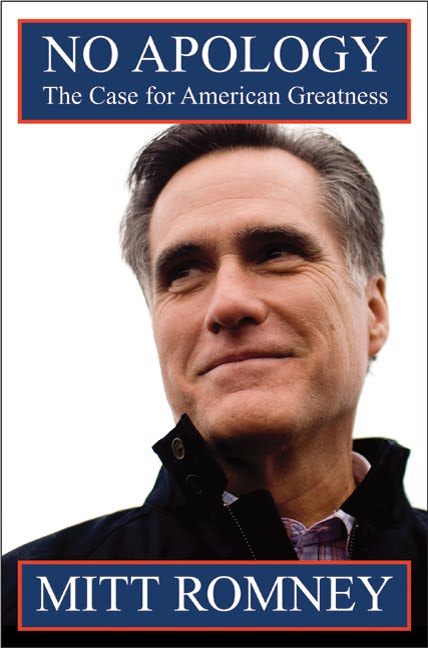
Unfortunately, I can’t walk around the corner and knock on Mitt’s door. But he did write a book that was published in 2010, and it’s probably the next best thing to talking to Romney at his kitchen table. The book is called No Apology: The Case for American Greatness.
I’ll admit I thought it was going to be a dry guide book explaining his position on every hot political issue. It’s not a guide book. In fact, he leaves a number of topics out. Nor was it dry.
I also suspected it might be a scathing attack piece on the Obama administration. It’s not that either. Not even close. He does criticize some things where he and Obama differ, but he also commends him on a few things. Either way, Obama is a very small part of the book.
So what IS this book?
Romney states its purpose in the introduction: it’s “about what I believe should be our primary national objective: to keep America strong and to preserve its place as the world’s leading nation” and “the course I believe we must take to strengthen the nation in order to remain prosperous, secure, and free” (2). It’s about his ideas on how to make sure America does not falter as so many nations have, but remains wealthy, happy, and productive.
I finished the book yesterday. I found it interesting, personable, sometimes surprising, and insightful.
I found Mitt Romney to be a man self-deprecating humor. He’s also a thinking man, one who likes to look at data to see what it shows. It’s clear he’s a man who does NOT think he knows everything or has a monopoly on every good idea, but he’s also a man who demands evidence. I also saw a man who is kind. He doesn’t talk much about his 14 years of service as a lay minister in his church in this book, but you can see how those years changed him as he discusses helping the unemployed, out-of-wedlock births, and single-parent families. Finally, I saw a man who loves, LOVES, America and is convinced she can remain the hope of the earth, but only if we do things that foster our strength.
This book outlines what he thinks those things are.
The book is written in a conversational and easy style with many examples from his personal experience, studies, and history. Romney’s record of accomplishments demonstrates his skills and hard work ethic. This book explains to what end he would apply that skill and work.
If you’re planning on voting this November for the president of the United States, I think you’ll find this book very useful. You may end up agreeing with many things he says. You may end up disagreeing with him on many points. But before you can do either, you need to understand what Romney’s position actually is. And the first step in doing so is to fully hear the man out, in his own words, from his own lips.
As a result, whether you end up deciding he’s your candidate or not, you WILL come away with important insights into the issues discussed.
What’s Next
I want you to know that I do not worship George, Ben, Tom, Adam or any of the other guys who formed our constitution and started this nation.
They put their lives and fortunes on the line for what they believed in. And I am immensely grateful for what they did. I enjoy tremendous freedoms because of their courage, determination, and sacrifice. Those guys, by-and-large, rock!
But I do NOT believe that their words are scripture nor that their ideas are sacrosanct—merely to be accepted and not to be considered and questioned and disagreed with.
Even so, these guys were gutsy and brilliant. They attempted something everyone thought would fail. Something that HAD failed every time it had been attempted in their recorded history. But they pulled it off and changed the world.
These guys believed in the common man. They believed that the educated common man was the best person to hold the reins of government. Thomas Jefferson thought up a rhyme to make the idea easy to remember. He said, “If a nation expects to be ignorant and free in a state of civilization, it expects what never was and never will be.”
I can’t argue with that.
Of course, we’re not going to become experts on every policy issue. But we certainly can become informed on the broad principles and issues. And we can certainly become informed about the candidates.
Because I found No Apology so useful, over the next few days I’m going to summarize Romney’s main points, chapter by chapter, here. I’ll also point out interesting ideas and facts he shares as well as share any questions, quibbles, or disagreements I have.
I hope you find it useful. More importantly, I hope you read the book and join in the conversation.
If you want to understand the secret to Mormonism, something 99.9% of the world does not know, even though many think they do, read on.
This last Tuesday I was at dinner with a number of wonderful coworkers. We were talking about religion and listening to the guy who helps set up our training environments talk about the interesting hunting ministry he’s involved with (it’s very cool—12,000 acres of woodland in Alabama all dedicated to hunting, outdoor survival, and God).
At one point in the conversation, a delightful fellow trainer, who shared with us the night before the definition of diplomacy as being able to tell someone to go to hell and have them look forward to the trip, asked me, “Does your church believe in Christ. Or, no, is it some other fellow?”
It’s a great question, and I realized that many people are confused. And so I wanted to take time to clear it up.
So what the heck is a Mormon?
It’s not what you think.
And for those of you who think you know, nope, it’s not about that book.
Let me explain. You’ll come away knowing more about us than anyone in any of your circles, and you can lord your superior knowledge over them at dinner parties, when playing games that require vast stores of smarts, or at random moments, just because you can.
Here’s the deal. The first part of the name of the church is “The Church of Jesus Christ.” So, yes, we believe in Christ, that he died for us, was resurrected, is our Lord and god, etc.
The last part of the name is “of latter-day saints.” We don’t use “saint” to mean super-holy people like the Catholic church does, but more as followers or disciples. So you could translate the last part of the name of our church as “of latter-day followers.”
So the whole name would be The Church of Jesus Christ of Latter-day People who Follow Him.
Okay, then what’s the deal with the name “Mormon”?
Well, here’s where we get to the nub of it and the thing that 99.9% of the world doesn’t know. The key difference between the Mormon church and other Christian churches is that we believe that Jesus has called apostles again in our day, just like he did back in the good old days. And when I say apostles, I mean guys like Peter, James, John, Paul, etc.
You might be wondering what an apostle is. What made those guys special?
It wasn’t that they had great faith in Jesus. Lots of people had great faith. It was that they were called to bear special witness of him. And that special witness was not merely that they believed, but that they knew Jesus was the Messiah because they had seen and heard him after his resurrection.
Peter himself said it best when he wrote in his letter, “For we have not followed cunningly devised fables, when we made known unto you the power and coming of our Lord Jesus Christ, but were eyewitnesses of his majesty.”
When the apostles had to choose someone to replace Judas, Peter said, “Wherefore of these men which have accompanied us all the time that the Lord Jesus went in and out among us, beginning from the baptism of John unto that same day that he was taken up from us, one must be ordained to be a witness with us of his resurrection.”
These guys didn’t simply believe. They knew. They were eyewitnesses to the fact that Jesus wasn’t just some preacher—he was the son of God and was resurrected.
So Mormons believe that Jesus has called apostles again today who bear witness of an absolute certain knowledge of the reality of Jesus the Christ. We believe their purpose is also to be the Lord’s spokesmen when He wants to make general announcements or give general instructions. Finally, we also believe they’ve received the authority to offer the covenants the Lord wants to make with all of us.
We believe the first apostle called in these latter days was a fellow by the name of Joseph Smith. We don’t worship Smith. He was just an apostle. Just like Matthew or John of old were. But we do believe the Lord called him to be an apostle and restore some truths that had gotten lost or confused over the years.
We also believe the Lord asked him to bring forth other scriptures in addition to those in the Bible. One of these new scriptures was a translation of an ancient record called The Book of Mormon. It’s called that because Mormon is the name of the guy who wrote it. And Mormon was another apostle—one called by Jesus in ancient America.
And guess what the purpose of The Book of Mormon is? It’s to testify of Jesus Christ and explain his gospel.
So the name of the Mormon church is really The Church of Jesus Christ of Latter-day Saints. Mormons believe that Jesus has called and commissioned apostles in our times, right up to today, to bear special witness of him. And in addition to that, those apostles have brought forth additional scriptures that witness of the divinity and mission of Jesus Christ.
For Mormons, it’s all about Jesus Christ.
So when someone asks, what’s a Mormon? You can say, let me tell you the real answer. It’s not about an additional book of scripture. Yes, folks gave them the nickname of Mormons because of that book, but the key difference is that Mormons believe that Jesus has called apostles like Peter and Paul again in our day to be his spokesmen, and bear a certain witness of him and his good news, and help folks receive all the blessings the Lord wants to pour out on them.
And, O, what a wonderful message we Mormons believe that is.
An avid reader friend of mine began reading through the books in a list called “100 books you must read before you die.”
She got to Jack Kerouac’s On The Road and went to Facebook and posted the following: “I don’t get the appeal. It’s about a group of boys/men who are irresponsible, drunks, whoring around taking advantage of others and being enabled by their women. Why is this a classic and why should I have wasted my time on it? Can some of my literary friends explain? I hated a brave new world and the handmaid’s tale too.”
Is the book a classic?
Should she read it before she dies?
Is it really that important?
Let me share an edited version of my response and then provide my list of 30 books you should read before you die.
*
Annette, the unfortunate truth is that these lists of “classics” are a sham because there is no objective criteria for determining literary excellence.
Or maybe I should say that measuring quality in the arts isn’t like measuring the unambiguous, objective score of a baseball game. After books exhibit a certain level of proficiency, it becomes increasingly difficult to distinguish the quality of one book from another, especially because much of this depends on a reader’s interests and subjective experience of the story.
When it becomes hard to rank performances, people rely on other measures. One of the most powerful is social networks.
So if two readers find two different books that blow them away, one of the books might get all the attention because the one book gets picked up by a news service (The New York Times) or a platform (the Oprah Book Club effect) or some other social network of influence. A lot of the so-called literary classics only appear on various lists because they tapped into the academic network, which kept them alive far longer than they would have lasted otherwise.
On The Road is simply a book that made a stir among some circles in the 1950s. That’s it.
Was it more important or of higher quality than Exodus? The Chronicles of Narnia? Lord of the Rings? A Town Like Alice? All published in the 1950s as well.
It depends.
If you’re wanting to understand the 1950s beat culture, it would be an important book.
But if you’re wanting to understand fantasy writing of the time, it wouldn’t.
If you’re wanting to read a book that’s had a huge impact on popular culture, well, LOTR beats On The Road like a dog.
Some people have the feeling that the so-called classics have some inherent medicinal value because someone put them on a list and called them classics.
Nope. They’re just stories. Some of which can shed light on the issues and interests of a part of the culture in a given period. But if you’re not interested in that specific sub-culture, who cares?
And if you’re reading to be entertained, moved, uplifted, or educated—which ones do that best for Annette is for you to decide.
So all that to say I wouldn’t devalue your reaction to the book
*
I’m now going to give you my list.
But it’s not going to be a list of titles. Nor will it focus on a book’s impact on some sub-culture of a given period.
It’s going to be a real list. One that focuses on what so many of us go to stories for.
The one that makes you weep.
The one that makes you giggle and snort.
The one that reminds you of what it’s like to fall in love.
The one that gives you hope.
The one that you begin to read more and more slowly because you don’t want it to end.
The one that scares the soup out of you.
The one that you can’t put down, even though you need to wake up early in the morning.
The one that makes you wish you lived there.
The one that’s so good that when you close it, you immediately start to read it a second time.
The one that gives you and your child hours of pleasure together.
The one that gives you a sacred, spiritual experience.
The one that makes you reread some of the lines because the turns of phrase are just so delicious.
The one that gives you courage.
The one that takes you on an awesome adventure.
The one that makes you want to be a better person.
The one that bores you to tears (just so know you how good the others are).
The one that introduces you to a different culture that delights you.
The one that makes you think.
The one that lingers with you for days.
The one that gives you lovely insights.
The one that inspires you to love your spouse more.
The one that introduces you to the sorts of people you normally don’t like and makes you actually like them.
The one that delights you with its characters.
The one that whisks you away to a different historical period.
The one that inspires you to give your children a hug.
The one that gets your adrenaline pumping.
The one that sparks all sorts of ideas in your head.
The one that makes you wonder and start imagining what it would be like to be there.
The one that blows your freaking mind.
The one that makes you stand up in your living room and cheer.
We could do more than 30, couldn’t we?
Like the one that makes you think people from a different time period are just like us. And the one that makes you think people from that same period are completely alien.
But I think we’ll stop. That there above is a list.
Those are 30 books I think everyone will want to read before they die.
I was very happy to receive news that GUN RUNNER, the novel Larry Correia and I wrote together, just won the 2021 Dragon Award for Best Military Science Fiction or Fantasy Novel.
The Dragon Awards are a set of literary and media awards presented annually by Dragon Con in Atlanta, Georgia for excellence in various categories of science fiction, fantasy, and horror novels, movies, television, and games.
And the cool thing is that these awards are voted on by fandom, meaning thousands and thousands of folks voted.
Past winners have included authors such as Terry Pratchett, Brandon Sanderson, Rick Riordan, and Stephen King.
As stated in earlier posts, the seed came from Larry’s eleven-year-old son, Joe.
When Larry and I sat down to develop an idea for a workshop we were holding for Life, the Universe and Everything, a large annual writer’s conference in Provo, a number of years ago, Joe was listening in on the stairs.
We settled on a genre, and then Correia asked, “Hey Joe, what’s cool?”
Joe immediately popped up and said, “Giant robots, bandits, and murderers.”
“We looked at each other and said, ‘Dang, that IS cool.’”
Forty minutes later we had the key elements we needed for the story we’d use in the workshop. A number of years after that workshop, Baen Books wanted a collaboration from Larry, and that story was one of the first he thought of.
Larry and I are both frequently asked to present at writers conferences. And one of the tips each of us shares to new authors is to loosen up and have fun. One of the keys to writing an entertaining story is to simply ask, “What’s cool?” And go from there.
I’m thrilled and honored that those who voted selected Gun Runner for this award.
For a number of reasons, the belief here is that most of the time for most authors who can get a deal with an established and competent house, their best choice is to take it.
Sounds reasonable, but then we get to the money quotes.
The strength of the traditional publishers and the traditional deals is directly related to the amount of the market that is served by inventory in stores. When that proportion was “nearly all”, the power allocation was “nearly all” to the traditional publishers.
***
Self-publishing and new-style digital-first publishing can grow more to the extent that the book-in-store share of the market shrinks more. But while that’s happening, the big publishers are also adding to their capabilities: building their databases and understanding of individual consumers (something that all the big houses are doing and which the upstarts seem not to believe is happening, or at least not happening effectively), distributing and marketing with increasing effectiveness in offshore markets, and controlling more and more of the global delivery in all languages of the books in which they invest.
It will compound the pressure on the alternative players if Amazon continues to grow its global market share for ebooks. The bigger the percentage of the market that can be reached by self-publishers with one stop at Amazon, the less interest they’ll have in picking up smaller chunks of the market with additional deals and the more powerful will be any incentives Amazon cares to offer for making the title exclusive to them.
Shatzkin’s discussion of the amount of the market served by inventory in stores is right on. But his “best choice” conclusion doesn’t follow.
Why?
Because the question for each author has to be which stores will I be in, what kind of floor space will I have, and how long will I be there? And in many cases the answers to those questions do not compete well with indie options.
For example, a lot of in-store sales come from the drug store, grocery store, airport, Walmart, Costco type venues. But it’s rare than an author getting an average deal will see the light of day in those places. Those are reserved for bigger sellers. And not very many of those. So unless you’re getting a big deal, you can’t count that floor space.
Poof. Tens of thousands of venues are now no longer part of the equation.
So you are now left with whatever number of stores the publisher can get you into at Barnes&Noble (a max of 675 stores), Books-a-Million (max of 200 stores), Hastings (max of 149 stores), non-chain stores, etc. I think the total number of book stores in the USA is around 10,000 or so. But publishers won’t get you into all of them. Some don’t carry your type of book: they’re used books stores, or kids book stores, or Christian book stores. And even if it’s a store like Barnes&Noble, you probably won’t get into all their stores. So how many stores will you actually be in?
Next, you have to wonder where you’ll appear in the stores you do get into. Will you be face-out somewhere prominent? Or will you have two copies spine-out in the back? If you’re spine-out, that’s just reduced the value of the floor space publishers offer you yet again.
Finally, how long will you be there? If you sell your two copies in a store, are you done at that store? Will your books be there longer than 12 weeks? Will they be there even 8 weeks?
James Patterson can sell millions of books because he has multiple copies in tens of thousands of stores with great display. And he’s usually there for more than just a handful of weeks. If you have two books spine-out in each of 500 stores for eight weeks, how well are you going to do?
Here’s some math on author revenue and units sold. Is selling 1,000 books with the royalties and contract terms offered really worth it? What about 4,000 books? 7,000? Are you going to be in enough stores with a decent placement to get those numbers?
If you’re going to be in thousands and thousands of stores with good placement, and the terms of the contract are reasonable, then, good golly, working with a publisher looks great. But if you’ve got a book that’s good enough to make an editor somewhere want to buy rights to it and the publisher is offering to put you spine-out in a little over a thousand stores with all sorts of contract crap, then Shatzkin’s “best choice” is really a poor one. In those situations my money is on going indie.
Greg, that was a great response. And I think these two statements you made capture perfectly what I object to.
Rather than a desire for what we might term inclusiveness or representation, MacFarlane’s desire seems to be to supplant what she terms a “default narrative” with what, one can only assume, will become the new default narrative.
Writers battled for centuries for a world in which the dominant ethical systems were not the immediate arbiters of aesthetic production. Their legacy to us is a world in which the aesthetic is not always and perpetually chained to power structures and dominant ideologies.
One of the fundamental principles I follow in my art is that I must have passion for the thing I’m creating. I must care about the characters and situations. I must follow my interests. I CAN’T create unless I do. Not only is there no motive, but the ideas don’t flow! My assumption is that this is the same for most practicing artists.
It seems you too read MacFarlane’s words and came away with the idea that she wants to ignore that. She wants to require artists to create art they don’t care about.
Which means her agenda is actually an attack on the very core of art itself.
What MacFarlane wants is propaganda.
Her crusade for what she thinks is right and good would ultimately suck the life blood from artists and their art. Hers is a world of the new wonder drug that will usher in utopia but turns us all into zombies instead.
Hi John,
Yes, absolutely: propaganda is exactly the right word. One of the major concepts I’ve taken from your blog is zing–the things that make me thrill when I’m writing a story. As an aesthetic principle, that’s the only one that rings true to me. Thanks for your good work and for bringing an important issue into a larger discussion.
On a totally different note, I’m looking forward to reading Curse. I love the cover.
I think that is well put. If you pie-chart and checkmark art according to race and sex you will kill it. Literal pie-charts, percentages and graphs have appeared on SFF blogs and webzines. A constant stream of recommending SFF novels according to the race and gender of the author is constant in MacFarlane’s culture. There are no SFF personages recommending SFF because a white or a man did it. This is a massive straw man reacting against nothing.
John Varley was doing what MacFarlane suggests almost 40 years ago. Why is it anyone’s problem if MacFarlane hasn’t read those or thinks the idea is still cutting edge when it’s been done to the point few even notice it anymore. It’s a question of scholarship, not whether such stories exist. They plainly do and have for a half-century.
The other problem is promoting naked identity advocacy in the same breath one forbids others to do it as a form of exclusion if not bigotry. The idea is that the straight white male is awash in wanting to see himself in media precisely because they are straight, white, and male. The problem there is that there is no sign this is actually true. As one example, the 2/3 black NFL is the No.1 sport in America, not hockey or NASCAR. There is no example of that within MacFarlane’s world, which is not diverse even while it cries for diversity. A natural demographic majority is being confused with identity supremacy, as if the reason Chinese films are Chinese or Arab films Arab is because they constitute some informal analogue to the KKK rather than an accidental and natural cultural expression. In other words MacFarlane has no Mammoth Books of White Men anthologies to push back against. An accidental demo of such an anthology is not the same as purposefully making one. A demo is not identity supremacy.
SFF is white and straight for the same reasons the NBA is 80% black and straight. There is no conspiracy. People like Jim Hines cannot accept the fact that SFF is simply an accidental cultural expression in terms of its demo that may or may not change over time. Looking at too white group photos of SFF convention chairs and hinting “racism” is as dumb as looking at too black group photos in a boxing gym and doing the same.
If you want diversity in novels, write it, but don’t accuse me of bigotry or mandate change, because there will be push back.
James,
I think you raise an interesting point. Is the SFF reading community mostly white and straight? Is the SFF author community mostly white and straight? And what are the interests of those majorities?
I ask the last question because white and straight authors might be interested in writing about folks outside the groups they identify with. They might not. They might be more interested in artificial intelligence. Who knows?
Do we have any actual data that isn’t anecdotal?
I know what I see at the conventions I go to, but I’m going to conventions in Utah. Not a statistically valid sample of total readership across the US (grin). And it would be interesting to see how all the major interests (plots, character types, settings, etc.) compare against each other, not just those focused on sexuality or ethnicity. It might be that SFF writers just don’t care about that topic. It might be that many do, but readers don’t.
Ultimately, if there’s a huge number of authors that are interested in certain types of characters and the dynamics they bring to a cast, then I don’t think anyone is holding them back from writing about those folks. Nor should anyone. Same with readership: if there are readers out there who find those dynamics interesting, then those stories will have demand and find success in the marketplace.
But as you point out, just because an author or reader finds other stuff more interesting that doesn’t mean those folks are by default bad actors. Or unwittingly holding others down.
If you write a great story, and the public loves it, nobody is going to hold you down. Not in today’s world.
I would assume that just as the NFL players have a different demographic from its viewers, so too the SFF authors have a demographic different from that of SFF readers. Wouldn’t it be a great study to see this kind of information?
BTW, the Writing Excuses folks recently announced that they felt their class wasn’t welcoming enough to folks of color.
Out of last year’s thirty attendees, we had only one writer of color, which is not even close to a realistic representation of the speculative fiction market. This was a sign to us that something was wrong. Our ratio of men and women was about half and half, which was great; that meant that both men and women deemed our retreat a safe and welcoming environment. Our ratio of white writers to writers of color was a clear sign that some writers did not necessarily feel the same welcome, and we want to change that.
I love all of the Writing Excuses folks. I think they’re great. But I wonder about their diagnosis. Who has data on the demographics of the current pool of new USA speculative fiction authors? Are they sure it’s not accurate? And what’s the demographics on the Writing Excuses podcast? This diagnosis seemed odd to me.
I do think it’s great that they want to reach out and attract authors who represent demographics that are different from the SFF majority. We’re always looking for the same but different. And folks with different backgrounds are going to bring new twists on the stories in the genres we love.
But why not just do that? Why not reach out and invite without any mention of quotas? And do these folks really need a scholarship? Or would it be more effective to use the money to broaden the podcast audience to communities they are interested in and let the interest flow naturally?
Their diagnosis doesn’t seem to be backed up by any real data. Then you have Asian folks in the comments wondering why they aren’t included. Folks from Eastern Block countries wondering the same. How inviting is that?
I think their introspection and desires are laudable. I just think that inviting broadly, working to build a broad customer base, and then judging all on their merits is a better way to go.
To me that Writing Excuses program is depraved. As for the SF community, I can vouch for the fact they are human – tell me a good story and I don’t care who’s in it. Larry Niven and John Varley commonly went outside the norm decades ago now. I accepted and even expected it because it was part and parcel of what SF does. As in music, there is no added attraction knowing the artist is gay, black or female. The attraction is artistry. Start pie-charting that and you may as well stick a fork in it. I am completely unaware of the gender and race breakdown of the 1500 song on my iPod. I know it is varied, but that was accidental. I go for the songs. In literature I go where the writing is. People like Jim Hines and Mary Robinette Kowal aren’t doing the SFF community any favors – far from it.
That community jokes about women destroying SF. Women can’t do that, and they can write SF as good as men. To me it’s not even an issue. But in the current climate, when they sarcastically use the world “destroy” on their all-female kickstarters, they’re not thinking where this all leads, so “destroy” is actually a perfect word. I’ve seen enough recommendations by race and gender to know they’ll do the same thing with awards, and if they become editors and publishers, there too. That is “destroy.”
This whole identity fracas needs to be booted out of SF and the ring leaders too. By “booted” I mean ignored, as in their fiction. I don’t care about a person’s politics but this is all just hate speech in the end and I won’t support it. When you think Harry, Bella and Katniss have taken millions of readers from core SFF, you’d think that core would get the message that readers don’t like to called racist, privileged, homophobes. By Hines’ and Kowal’s reckoning, the NHL must be KKK. So what’s the NBA: a black KKK? This is all so terribly stupid. So SFF’s white – so what? Samba is black, shadow puppetry Malay and Arab music is shockingly Arab. So what? Send Hines to the NBA to check it out. Something must be wrong.
I never knew that John Barnes was black. I didn’t care. I didn’t care that Octavia Butler was black. I don’t know what sexual orientation Jim Butcher is and don’t care.
At the same time, when you say, “there is no added attraction knowing the artist is gay, black or female,” I wonder if that’s the case for gays, blacks, or females. I don’t know if you belong to any of those groups. But I wonder.
I wonder because I know that I sometimes am more interested when someone is part of a group I strongly identify with. I think this is just normal. Not something to try to change. I don’t think you can change it. We’re built to be group’ish. So when Mitt Romney ran for president, I think my interest was piqued a bit more because he was a Mormon. I didn’t want to vote for him because of that–I’m opposed to Harry Reid and didn’t like John Huntsman or Orrin Hatch as candidates. But there was extra interest. He was skilled and one of “my people.” I don’t know if I’m explaining it clearly. And his group affiliation certainly didn’t override everything else. But it did add something.
I’m thinking about genres. I think there are some connotations, resonances, or expectations in a name. And some fit with a genre and some are a bit off. If “Veronica Michaels” or “Jenny Flowers” is writing military thrillers for men, it might “sound” wrong. If she’s awesome, it becomes an asset. But I think an initial reaction might be “too girlie.” If you have “Brad Thor” writing sweet romances, I think the resonance of that masculine name might jar with the expectations of that genre.
So I agree with what you have to say about this “pie chart” stuff. I think the NFL example is a good one.
At the same time, I do see these group effects and name expectations/connotations working on me.
I think there’s a big difference between “H.P. Lovebunny” and Con-Or-Bust, The Carl Brandon Society and Writing Excuses rewarding people because they’re not white. What I mostly resent is the idea this must be done because it is a shared racial failure on the part of whites, as if too many whites is always suspect but too many gay, Latino or black groups never is. That’s just a weird attitude to me, and a double standard even a child should see.
Just because some people want to see themselves reflected in media doesn’t mean it is a universal experience. Just because a group is 57.587% this or that doesn’t lessen its authenticity nor does it need to have a quota. Like MacFarlane, if someone wants to see themselves, write it. Why the calls for diversity? Make a movie and populate it with whomever you choose. No one is stopping you.
Diversity is one thing, using the topic as an attack platform is another. When the SFF authors most talking about diversity are saying things on Twitter like “CAN SOMEONE THINK ABOUT THE WHITE PEOPLE?!!” and “Cis peeeoooople,” those are defamatory slurs, and they are coming from the heart of the SFF community, and their colleagues are not calling them out.
I think the new politically correct SFF community has this one exactly backwards. They are basically accusing a decades old community that embraces the weird and eccentric as having an aversion to the weird and eccentric. If I wanted to see people like myself I sure as heck wouldn’t like Niven’s Beowulf Schaeffer, Poul Anderson’s Nicholas Van Rijn, Bradbury’s Uncle Einar, Spielberg’s E.T, or in other words, a pantheon of weird cultures, eccentrics and iconoclasts.
To me it’s just laughably stupid to suggest such people are startled by something as prosaic as a black or gay person. SFF fans are the last people on Earth to be xenophobes. In fact SFF almost by definition embraces diversity if not outright strangeness. The fact that whole hard genre was started in male-oriented adventure stories a hundred years ago in a country 90% white has no more meaning to me than Bollywood being majority Hindu. No one did it on purpose and neither needs to be un-did on purpose. No cultural hobby in the world does. Either call to diversify Samba, the NBA, Bollywood, hip-hop, Arab literature, middle-weight boxing, the entire thing world-wide or shut up about it.
A lot of good points.
I’m seeing it this way. It’s like food. You have a town, and all they have are hamburger joints. They like hamburgers. They’re happy with hamburgers. They eat a lot of different types of hamburgers. They’ve been eating hamburgers for decades. One day someone says, you know what, I love Thai food. I want more Thai food. I’m not so interested in hamburgers all the time anymore.
Okay, so what’s the next step?
The pie chart approach says that someone needs to regulate all the burger joints and mandate they need to start offering Thai items.
What? Why? They’re in the business of burgers.
The pie chart approach also leads some to say that if the burger people don’t include Thai items, they must be bad in some way.
What? They’re selling burgers to people who like burgers. So what? If the burger joints want to add different items to their menus, okay. But mandating they cook food they aren’t interested in cooking?
The other approach is to win customers.
Open your Thai restaurant (or invite someone in to open one), and get people to try it. If they like it, they’ll buy it. The town may go crazy for it, and a majority of people start eating Thai. Or maybe the majority continues to eat burgers, but some love some Thai now and then.
This second approach is focused on building a customer base, on try it, you’ll like it. On winning customers.
If you want, you invest in inviting great Thai restaurateurs to open shop. You invest in helping people discover them. Or you invest in training folks to become great Thai restaurateurs.
This is all independent of the burger joints.
I suspect some folks would say, yeah, well, what if there’s a planning & zoning committee in the town, and they are forever putting the kibosh on non-burger restaurants? Or telling them they can sell their stuff, but only in the warehouse out by the dump?
That’s a problem. And that’s happened in the past.
But I can’t see that happening now. I don’t see it at the major publishing houses. It’s certainly not happening in the indie world. Amazon doesn’t care about anything except that your book is formatted correctly. Wait, correction. It does filter some content. But that doesn’t prevent you from going out into cyberspace and putting up your own store to sell those types of stories.
So write something awesome. Get people to try it. Build a customer base. That’s it. There’s nobody who is stopping anyone from doing that. You might find a lot of people like your stuff; you might find only a few do. But you can’t mandate that people like your stuff.
If your goal is to get hard-core burger people to like Thai, then you might not start with a Thai restaurant. You might start, a la Sabido, with burgers, with a bit of something Thai on the side (the C story). Satay maybe.
Am I missing something?
BTW, what the heck is “H.P. Lovebunny”?
I was joking about a kind of a bait and switch you brought up with Jenny Flowers. Who knows what H.P. Lovebunny would get ya. Maybe The Spa of Ulthar.
H.P. Lovebunny. I could see that actually being a great name for a military thriller writer. It’s so against type.
“What are you reading?”
“The latest Lovebunny.”
lol
They would eat it up. I know they would.
We could make up a new sub-genre called “Special Thrill Fiction.” Let author H.P. Lovebunny be your guide to a new world of SF with military hijinx, spies, naked assassin cults and banging planets into one another by fitting them with equatorial engines. Our hero is from a civilization which is nothing more than one giant military bordello for colonizing Aardvark people from the Crab Nebula.




John,
Thank you for posting about this. I’ve written a response that addresses the issue from what I believe is a different angle, responding to some of the problems that you’ve identified in MacFarlane’s post. I’d like to know what you think: http://www.gregoryashe.com/2014/02/post-binary-gender-and-ethics-of-fiction.html
Best,
Greg
Greg, that was a great response. And I think these two statements you made capture perfectly what I object to.
One of the fundamental principles I follow in my art is that I must have passion for the thing I’m creating. I must care about the characters and situations. I must follow my interests. I CAN’T create unless I do. Not only is there no motive, but the ideas don’t flow! My assumption is that this is the same for most practicing artists.
It seems you too read MacFarlane’s words and came away with the idea that she wants to ignore that. She wants to require artists to create art they don’t care about.
Which means her agenda is actually an attack on the very core of art itself.
What MacFarlane wants is propaganda.
Her crusade for what she thinks is right and good would ultimately suck the life blood from artists and their art. Hers is a world of the new wonder drug that will usher in utopia but turns us all into zombies instead.
Hi John,
Yes, absolutely: propaganda is exactly the right word. One of the major concepts I’ve taken from your blog is zing–the things that make me thrill when I’m writing a story. As an aesthetic principle, that’s the only one that rings true to me. Thanks for your good work and for bringing an important issue into a larger discussion.
On a totally different note, I’m looking forward to reading Curse. I love the cover.
I think that is well put. If you pie-chart and checkmark art according to race and sex you will kill it. Literal pie-charts, percentages and graphs have appeared on SFF blogs and webzines. A constant stream of recommending SFF novels according to the race and gender of the author is constant in MacFarlane’s culture. There are no SFF personages recommending SFF because a white or a man did it. This is a massive straw man reacting against nothing.
John Varley was doing what MacFarlane suggests almost 40 years ago. Why is it anyone’s problem if MacFarlane hasn’t read those or thinks the idea is still cutting edge when it’s been done to the point few even notice it anymore. It’s a question of scholarship, not whether such stories exist. They plainly do and have for a half-century.
The other problem is promoting naked identity advocacy in the same breath one forbids others to do it as a form of exclusion if not bigotry. The idea is that the straight white male is awash in wanting to see himself in media precisely because they are straight, white, and male. The problem there is that there is no sign this is actually true. As one example, the 2/3 black NFL is the No.1 sport in America, not hockey or NASCAR. There is no example of that within MacFarlane’s world, which is not diverse even while it cries for diversity. A natural demographic majority is being confused with identity supremacy, as if the reason Chinese films are Chinese or Arab films Arab is because they constitute some informal analogue to the KKK rather than an accidental and natural cultural expression. In other words MacFarlane has no Mammoth Books of White Men anthologies to push back against. An accidental demo of such an anthology is not the same as purposefully making one. A demo is not identity supremacy.
SFF is white and straight for the same reasons the NBA is 80% black and straight. There is no conspiracy. People like Jim Hines cannot accept the fact that SFF is simply an accidental cultural expression in terms of its demo that may or may not change over time. Looking at too white group photos of SFF convention chairs and hinting “racism” is as dumb as looking at too black group photos in a boxing gym and doing the same.
If you want diversity in novels, write it, but don’t accuse me of bigotry or mandate change, because there will be push back.
James,
I think you raise an interesting point. Is the SFF reading community mostly white and straight? Is the SFF author community mostly white and straight? And what are the interests of those majorities?
I ask the last question because white and straight authors might be interested in writing about folks outside the groups they identify with. They might not. They might be more interested in artificial intelligence. Who knows?
Do we have any actual data that isn’t anecdotal?
I know what I see at the conventions I go to, but I’m going to conventions in Utah. Not a statistically valid sample of total readership across the US (grin). And it would be interesting to see how all the major interests (plots, character types, settings, etc.) compare against each other, not just those focused on sexuality or ethnicity. It might be that SFF writers just don’t care about that topic. It might be that many do, but readers don’t.
Ultimately, if there’s a huge number of authors that are interested in certain types of characters and the dynamics they bring to a cast, then I don’t think anyone is holding them back from writing about those folks. Nor should anyone. Same with readership: if there are readers out there who find those dynamics interesting, then those stories will have demand and find success in the marketplace.
But as you point out, just because an author or reader finds other stuff more interesting that doesn’t mean those folks are by default bad actors. Or unwittingly holding others down.
If you write a great story, and the public loves it, nobody is going to hold you down. Not in today’s world.
I would assume that just as the NFL players have a different demographic from its viewers, so too the SFF authors have a demographic different from that of SFF readers. Wouldn’t it be a great study to see this kind of information?
BTW, the Writing Excuses folks recently announced that they felt their class wasn’t welcoming enough to folks of color.
http://www.writingexcuses.com/2014/01/17/annoucing-the-writing-excusescarl-brandon-scholarship/
Here was the issue they saw and their diagnosis.
I love all of the Writing Excuses folks. I think they’re great. But I wonder about their diagnosis. Who has data on the demographics of the current pool of new USA speculative fiction authors? Are they sure it’s not accurate? And what’s the demographics on the Writing Excuses podcast? This diagnosis seemed odd to me.
I do think it’s great that they want to reach out and attract authors who represent demographics that are different from the SFF majority. We’re always looking for the same but different. And folks with different backgrounds are going to bring new twists on the stories in the genres we love.
But why not just do that? Why not reach out and invite without any mention of quotas? And do these folks really need a scholarship? Or would it be more effective to use the money to broaden the podcast audience to communities they are interested in and let the interest flow naturally?
Their diagnosis doesn’t seem to be backed up by any real data. Then you have Asian folks in the comments wondering why they aren’t included. Folks from Eastern Block countries wondering the same. How inviting is that?
I think their introspection and desires are laudable. I just think that inviting broadly, working to build a broad customer base, and then judging all on their merits is a better way to go.
To me that Writing Excuses program is depraved. As for the SF community, I can vouch for the fact they are human – tell me a good story and I don’t care who’s in it. Larry Niven and John Varley commonly went outside the norm decades ago now. I accepted and even expected it because it was part and parcel of what SF does. As in music, there is no added attraction knowing the artist is gay, black or female. The attraction is artistry. Start pie-charting that and you may as well stick a fork in it. I am completely unaware of the gender and race breakdown of the 1500 song on my iPod. I know it is varied, but that was accidental. I go for the songs. In literature I go where the writing is. People like Jim Hines and Mary Robinette Kowal aren’t doing the SFF community any favors – far from it.
That community jokes about women destroying SF. Women can’t do that, and they can write SF as good as men. To me it’s not even an issue. But in the current climate, when they sarcastically use the world “destroy” on their all-female kickstarters, they’re not thinking where this all leads, so “destroy” is actually a perfect word. I’ve seen enough recommendations by race and gender to know they’ll do the same thing with awards, and if they become editors and publishers, there too. That is “destroy.”
This whole identity fracas needs to be booted out of SF and the ring leaders too. By “booted” I mean ignored, as in their fiction. I don’t care about a person’s politics but this is all just hate speech in the end and I won’t support it. When you think Harry, Bella and Katniss have taken millions of readers from core SFF, you’d think that core would get the message that readers don’t like to called racist, privileged, homophobes. By Hines’ and Kowal’s reckoning, the NHL must be KKK. So what’s the NBA: a black KKK? This is all so terribly stupid. So SFF’s white – so what? Samba is black, shadow puppetry Malay and Arab music is shockingly Arab. So what? Send Hines to the NBA to check it out. Something must be wrong.
I never knew that John Barnes was black. I didn’t care. I didn’t care that Octavia Butler was black. I don’t know what sexual orientation Jim Butcher is and don’t care.
At the same time, when you say, “there is no added attraction knowing the artist is gay, black or female,” I wonder if that’s the case for gays, blacks, or females. I don’t know if you belong to any of those groups. But I wonder.
I wonder because I know that I sometimes am more interested when someone is part of a group I strongly identify with. I think this is just normal. Not something to try to change. I don’t think you can change it. We’re built to be group’ish. So when Mitt Romney ran for president, I think my interest was piqued a bit more because he was a Mormon. I didn’t want to vote for him because of that–I’m opposed to Harry Reid and didn’t like John Huntsman or Orrin Hatch as candidates. But there was extra interest. He was skilled and one of “my people.” I don’t know if I’m explaining it clearly. And his group affiliation certainly didn’t override everything else. But it did add something.
I’m thinking about genres. I think there are some connotations, resonances, or expectations in a name. And some fit with a genre and some are a bit off. If “Veronica Michaels” or “Jenny Flowers” is writing military thrillers for men, it might “sound” wrong. If she’s awesome, it becomes an asset. But I think an initial reaction might be “too girlie.” If you have “Brad Thor” writing sweet romances, I think the resonance of that masculine name might jar with the expectations of that genre.
So I agree with what you have to say about this “pie chart” stuff. I think the NFL example is a good one.
At the same time, I do see these group effects and name expectations/connotations working on me.
I think there’s a big difference between “H.P. Lovebunny” and Con-Or-Bust, The Carl Brandon Society and Writing Excuses rewarding people because they’re not white. What I mostly resent is the idea this must be done because it is a shared racial failure on the part of whites, as if too many whites is always suspect but too many gay, Latino or black groups never is. That’s just a weird attitude to me, and a double standard even a child should see.
Just because some people want to see themselves reflected in media doesn’t mean it is a universal experience. Just because a group is 57.587% this or that doesn’t lessen its authenticity nor does it need to have a quota. Like MacFarlane, if someone wants to see themselves, write it. Why the calls for diversity? Make a movie and populate it with whomever you choose. No one is stopping you.
Diversity is one thing, using the topic as an attack platform is another. When the SFF authors most talking about diversity are saying things on Twitter like “CAN SOMEONE THINK ABOUT THE WHITE PEOPLE?!!” and “Cis peeeoooople,” those are defamatory slurs, and they are coming from the heart of the SFF community, and their colleagues are not calling them out.
I think the new politically correct SFF community has this one exactly backwards. They are basically accusing a decades old community that embraces the weird and eccentric as having an aversion to the weird and eccentric. If I wanted to see people like myself I sure as heck wouldn’t like Niven’s Beowulf Schaeffer, Poul Anderson’s Nicholas Van Rijn, Bradbury’s Uncle Einar, Spielberg’s E.T, or in other words, a pantheon of weird cultures, eccentrics and iconoclasts.
To me it’s just laughably stupid to suggest such people are startled by something as prosaic as a black or gay person. SFF fans are the last people on Earth to be xenophobes. In fact SFF almost by definition embraces diversity if not outright strangeness. The fact that whole hard genre was started in male-oriented adventure stories a hundred years ago in a country 90% white has no more meaning to me than Bollywood being majority Hindu. No one did it on purpose and neither needs to be un-did on purpose. No cultural hobby in the world does. Either call to diversify Samba, the NBA, Bollywood, hip-hop, Arab literature, middle-weight boxing, the entire thing world-wide or shut up about it.
A lot of good points.
I’m seeing it this way. It’s like food. You have a town, and all they have are hamburger joints. They like hamburgers. They’re happy with hamburgers. They eat a lot of different types of hamburgers. They’ve been eating hamburgers for decades. One day someone says, you know what, I love Thai food. I want more Thai food. I’m not so interested in hamburgers all the time anymore.
Okay, so what’s the next step?
The pie chart approach says that someone needs to regulate all the burger joints and mandate they need to start offering Thai items.
What? Why? They’re in the business of burgers.
The pie chart approach also leads some to say that if the burger people don’t include Thai items, they must be bad in some way.
What? They’re selling burgers to people who like burgers. So what? If the burger joints want to add different items to their menus, okay. But mandating they cook food they aren’t interested in cooking?
The other approach is to win customers.
Open your Thai restaurant (or invite someone in to open one), and get people to try it. If they like it, they’ll buy it. The town may go crazy for it, and a majority of people start eating Thai. Or maybe the majority continues to eat burgers, but some love some Thai now and then.
This second approach is focused on building a customer base, on try it, you’ll like it. On winning customers.
If you want, you invest in inviting great Thai restaurateurs to open shop. You invest in helping people discover them. Or you invest in training folks to become great Thai restaurateurs.
This is all independent of the burger joints.
I suspect some folks would say, yeah, well, what if there’s a planning & zoning committee in the town, and they are forever putting the kibosh on non-burger restaurants? Or telling them they can sell their stuff, but only in the warehouse out by the dump?
That’s a problem. And that’s happened in the past.
But I can’t see that happening now. I don’t see it at the major publishing houses. It’s certainly not happening in the indie world. Amazon doesn’t care about anything except that your book is formatted correctly. Wait, correction. It does filter some content. But that doesn’t prevent you from going out into cyberspace and putting up your own store to sell those types of stories.
So write something awesome. Get people to try it. Build a customer base. That’s it. There’s nobody who is stopping anyone from doing that. You might find a lot of people like your stuff; you might find only a few do. But you can’t mandate that people like your stuff.
If your goal is to get hard-core burger people to like Thai, then you might not start with a Thai restaurant. You might start, a la Sabido, with burgers, with a bit of something Thai on the side (the C story). Satay maybe.
Am I missing something?
BTW, what the heck is “H.P. Lovebunny”?
I was joking about a kind of a bait and switch you brought up with Jenny Flowers. Who knows what H.P. Lovebunny would get ya. Maybe The Spa of Ulthar.
H.P. Lovebunny. I could see that actually being a great name for a military thriller writer. It’s so against type.
“What are you reading?”
“The latest Lovebunny.”
lol
They would eat it up. I know they would.
We could make up a new sub-genre called “Special Thrill Fiction.” Let author H.P. Lovebunny be your guide to a new world of SF with military hijinx, spies, naked assassin cults and banging planets into one another by fitting them with equatorial engines. Our hero is from a civilization which is nothing more than one giant military bordello for colonizing Aardvark people from the Crab Nebula.