Villainous Heroes

If we root against villains based on moral judgments, then how is it possible to root for heroes who are not just bad boys but down right criminal, e.g. hitmen, mobsters, thieves?

It’s a wonderful question that has a simple and revealing explanation.  We root for these bad guys because they’re really good.

What?!

When talking about bad heroes, what we often do is:

1. Take them out of their context.
2. Focus on one or two negative traits, not the person as a whole.
3. Abstract them and miss what’s happening in real time as we process the story. We only have so much working memory and usually can only think about what’s being presented versus what we think about when we’re out of the story. What’s being presented in the story is mostly the threats to these heroes, not the consequences of their evil deeds. And if the consequences are show, it’s always modified by context (#1 and #2 above).
4. Confuse fascination with rooting.

When we actually look at what’s happening with the hero in the context of the story, what we find is that rooting is still based on moral judgments of who is good/right and who is not. We root for people we think are in the right (given their context) or are getting, undeservedly, the short end of the stick; we root against people who we think are in the wrong.

Here are some examples.

DISNEY’S ALADDIN

Thief. This one’s easy, I grant it. But it’s illustrative. I never once didn’t root for the boy. But I also never saw him as a true bad boy. He was nice. He shared the bread he stole with kids less fortunate. The guards were mean brutes. Jaffar was wicked and threatened the sultan and Jasmine who were good and innocent. was in a situation that provided some leeway for his behavior (alone, penniless).

1. Context. He’s fighting a much greater evil, someone we are rooting against.
2. Whole Person. He is a thief, but he’s also kind. Given his whole person, he falls on the side of good.
3. Processing. As we process the story we’re never shown awful consequnces of his theiving. Mostly just the good and courageous things he does. And the threats to his welfare.

THE ITALIAN JOB

Thieves.

1. Context. The movie starts with a heist and then a betrayal and murders by a traitor. Yes they’re theives, but we wittness a greater evil. The people they fight against are worse than they are.
2. Whole person. Except for the thieving, he’s a likeable guy.
3. Processing. We see few negative consequences of their actions to others, but we are constantly being presented with threats to them by guys who are committing greater crimes.
4. Fascination. I was incredibly interested in the scam–the plans, tech, everything.

THE PROFESSIONAL

Mob Hit Man

1. Context. He’s protecting a girl from other hit men. He’s fighting a bigger evil. He’s also taken advantage of by his boss.
2. Whole Person. He’s a hitman, but more time is spent on his kindness.
3. Processing. We see very little of the effect his hits have on others. Instead we are presented with threats to the girl and him.

DIRTY HARRY

Murdering vigilante

1. Context. He’s stopping guys who are doing terrible things.
3. Processing. We don’t focus on negative consequences of his vigilantism, but the threats from these really bad guys.

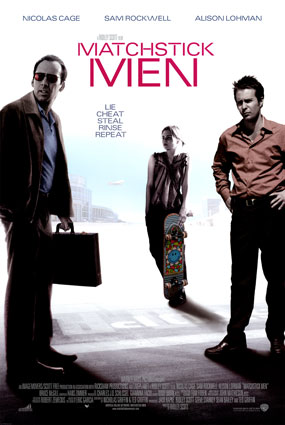
MATCHSTICK MEN

Scammers of the elderly

From IMDB “Roy’s private life, however, is not so successful. An obsessive-compulsive agoraphobe with no personal relationships to call his own, Roy is barely hanging on to his wits, and when his idiosyncrasies begin to threaten his criminal productivity he’s forced to seek the help of a psychoanalyst just to keep him in working order. While Roy is looking for a quick fix, his therapy begets more than he bargained for: the revelation that he has a teenage daughter–a child whose existence he suspected but never dared confirm. What’s more troubling, 14-year-old Angela wants to meet the father she never knew. At first, Angela’s appearance disrupts her neurotic father’s carefully ordered routine. Soon, however, with his own unique spin on parenthood, Roy begins to enjoy a relationship he never dreamed of having with his daughter.”

1. Context. Much of the time is spent his on his loneliness and issues with his estranged daughter.
2. Whole person. He steals, but we never see huge suffering from it. We see all the other issues he deals and have sympathy for him.
3. Processing. We’re focused on the threats to him, not the consequences of his one negative trait.
4. Fascination. I was fascinated by the scam and this pulled me along through the first.

CONCLUSION

What happened in all these stories as I experienced them was that the story carefully managed my view of the hero. He was always on the better side of the antagonists. He was always more good than bad, even if only by a little. And the story focused my attention most of the time on the bad/threats/consequences flowing from the antagonists, not the bad from the hero’s deeds.

What this shows is that you could write a story about a villain and make him the hero. In some instances it might be exceedingly difficult. For example, I think Hitler would be a hard sell as a hero, someone we’d root for. But the Neo-Nazis prove it’s not too hard a sell for some people. 

I don’t think recognizing the fact that we can make “bad” people sympathetic means authors are “simply being clever” or “pushing buttons.” After all, to write well you must believe and care about what you’re writing about. YOU have to believe it. Nor do I think it undercuts the notion that we root for people based on a moral stance. It just recognizes the fact that moral judgments, in fact, the vast majority of appraisals of situations, happen quickly with the facts at hand, which are the ones in our working memories. The ones the authors are controlling.

Share

Similar Posts

  • Generating Story 2: No Clue, No Solution

    I want you to think about Ed Smylie, who helped save the Apollo 13 astronauts with his duct tape contraption. What if the authorities had come to Ed, but instead of saying, “Look, we need to fit the round CO2 scrubbers into the holes for the square ones,” they’d said, “We want you to do something; it involves thinking.”

    Ed would have blinked. Waited.  “Yeah?”

    “That’s it. Something. A lot is riding on this.” And then maybe they urged him on with a significant wave of their hands.

    Can you see Ed at this point?

    “Sure.” He’d say. “I’ll get right on that.” Then he’d wonder who put these guys up to this practical joke.

    Do you see how impossible it is when you frame things that way?

    To come up with solutions, you have to have a clue about what it is you’re trying to do. Even if it’s just a rough idea. It doesn’t matter if you’re trying to fix a space ship, roast hotdogs, or write a story.

    Once we have a rough idea of what we want to accomplish, the mind automatically kicks into gear to perform its wonders. Until we do that, we’re going to be like Ed in the example above—staring at a blank wall, wondering if our superiors aren’t a bit cuckoo.

    So what are we trying to do?

    Think about your reader. Is it a woman? A teen? A crazy dude? Do you remember my book tour with Larry Correia in 2009 and the guy who, during a booksigning / doughnut party at a Phoenix Barnes & Noble, proclaimed my book to be true?  Aliens really were eating our souls and enslaving humanity. They were lizards living in the hollow portion of the earth.

    The point is: what are your readers hoping your story provides them? In fact, since you’re the first audience, what do YOU want from your stories? Why do you read?

    I want you to write down five stories you really like. Movies, TV shows, novels, short stories, plays—I don’t care the genre or type. Just write down five. Do it now. Here are five random stories I like.

    • The Incredibles
    • The Good Guy by Dean Koontz
    • Hunger Games by Suzanne Collins
    • The Sound of Music
    • Runelords by David Farland

    This is going to be a powerful exercise for you. It was for me the first time I did it in a class on interior design.

    A few years ago, Lovely Wife and I were building a house. We wanted to make our living space sing. We wanted our surroundings to make us happy, but we didn’t quite know how to go about doing that. So we took a class on interior design, hoping to learn the principles involved.

    Except when we showed up in the first session and saw the many different design styles, it overwhelmed us. Some styles were ethnic (Southwestern, Asian, French, Gothic, Pygmy), some philosophical or religious (Zen, Feng Shui), many were artistic (Modern, Arts & Craft, Minimalist, Art Deco, College Room Mate ), a lot were mixtures. Some were about making statements and creating moods, some about practicality (here’s a taste of those styles).  How in the world were we going to learn this?

    Luckily, we had a very perceptive teacher. She knew that most of us were there, not to learn all the styles, but to decorate our own houses. So in our second session, she brought dozens of home magazines. She spread them out on the tables we were sitting at and told us we would go through the magazines. When we found a picture or image we liked, we were to rip that page out and put it in our personal stack. So for about 45 minutes we looked and ripped and looked and ripped. Lovely Wife and I each ended up with a pile of a few dozen pictures.

    Then the teacher told us to spread our pictures out in front of us and look for things that the images had in common. Colors, features, design elements.

    I spread my pictures out. Lovely Wife spread out hers. And it was like magic. Boom! Right there in front of us. I loved arches and eyebrow windows. Loved dark blues and purples mixed with creams and whites. Loved the color of blond wheat and a navy blue sky. I loved wood. Loved Arts & Craft with a few tweaks.

    Lovely Wife’s pile was equally revealing.

    The teacher then said, “This is your personal style. This is what’s going to make you happy.” She told us that when designing the rooms in our house, that we should think about their function and merge them with these elements. And if any of us were to work with clients, we’d do something similar with them and find out their wants and likes.

    With our styles now beginning to be fleshed out, Lovely Wife and I went to work. Some of her elements and colors overlapped mine. Some didn’t, like her idea of sleeping bliss: a bed with sheer red drapes hanging from some lamp shade contraption in the middle.

    I told her I didn’t know if I could keep my man card and sleep in that bed. She decided I should keep my man card, but said she couldn’t sleep in a plain-walled zen room. We compromised. She got textured red on the walls. I got a bed without too many frills. We came up with designs for our spaces that did what we wanted them to do.

    But we couldn’t have done this if we hadn’t identified what we were after.

    So I’ve adapted that visual art technique used in the design class for our purposes. It’s just as powerful with literary arts. Which is why I want you to write down five stories.

    I want you to take a moment and identify what you’re after, in a big picture general way.

    I can’t do this for you.

    You and I are different. Just like Lovely Wife and I are different. While our tastes may overlap in some places, they’re going to diverge. You don’t want to write my stories. You want to write YOURS.

    So write down five stories. Then write down what you really enjoyed, over all, about each of those five stories. You might do this on five pieces of paper. What did you enjoy with each of the main story elements—character, setting, problem, plot, and text? What kind of an experience did they give you? What drew you to them in the first place?

    You don’t need to go all crazy detailed on me with this and do a twenty page report. Just hit the highlights. The stuff that will fit on one page without writing in four point font.

    When you finish that, step back and look at all five pieces of paper side by side. What common elements do you see? Circle them.

    This is your style. This is what, in general, you’re going for.

    If you found the exercise insightful, do five more stories. Ten is such a nice number.

    I’m going to predict that 99% of the things you identify have to do with what the story did to you. The stories made you laugh, smile, scream, want to fall in love again. They made you curious or jealous or feel some type of desire (be a Ninja king, strong, beautiful). Maybe they gave you insight. Maybe they affected you so profoundly that it changed, if even in a small way, how you decided to live your life.

    Stories–the ones people pay money for; the ones people stay up until four a.m. reading with a flashlight; the ones people tell their friends about–make people feel things.

    A while back I wrote about this in three parts. I believe the things you’ll read in those short posts, if you don’t know them already, will change how you think about stories. They did for me. And it all begins with lipstick.

    1. Lipstick
    2. Getting specific
    3. My big draws

    Okay, I hope at this point you are getting a general idea of why readers pay money to read the stories we create. Why YOU pay money and spend countless hours reading what others write.

    This is the first step in being able to produce on purpose, not on accident. This is the first step to becoming the Ed Smylie of fiction—understanding what you, as a writer, are trying to do.

    This week, keep your eyes open. Notice what stories do to you. Notice how you feel about different characters and plots. If you feel like taking it farther, notice the effect of different beginnings and ends of novels, chapters, or scenes. Notice the effect of different ways authors describe characters, places, and actions.

    Of course, while knowing these general objectives is critical, it’s not enough. You need to know what you’re reaching for with the current story, the current characters, the current plot. How do you translate all this general stuff to the specifics of the story in front of you? Do you have to define everything up front? And what if you don’t know what you want in the current project anyway? What if you are clueless and have nothing but a handful of random ideas that for some reason are generating electrical sparks? What do you do then?

    In the next post, I’ll talk more about those questions and where the how-to’s fit into all of this, and then we’ll get into the principles of invention.

    For more in this series, see How to Get and Develop Story Ideas

    Share
  • How to tell an author you don’t like their book

    Mette Harrison wrote a blog about how various authors respond when they read a book, don’t like it, and then the book’s author asks them directly what they thought of the book. 

    Here’s my response.

    As an author when I ask someone, especially another author, about their experience with my story, I’m looking for a data point to see how the book’s working or to get some insight. I realize others might be looking for validation. And, of course, I hope that everyone who reads my stuff finds nirvana even if I know that is not going to be the case. But I don’t ask unless I want data. And so I would hope they would report their experience accurately. I also hope they do it in friendly and helpful manner.

    So because that’s what I want, that’s what I try to do for others.  And the sandwich+ method has been one good way for me to do that.

    1. State something specific that works for me, e.g. “I love your character Bill because he’s so outrageous.”
     
    2. State the key thing that’s giving me trouble. For example, I might say, “I am having a hard time with the pacing.” But then I ALWAYS want to give the context of me as reader when it applies to my reaction, e.g. I’m a terribly impatient reader, I like to feel hope in what I read and know I don’t like as much despair as many other readers do, I can’t stand clowns (this is true: clowns are some of the scariest creatures out there, second only to crocodiles). The author should know these readerly things when they apply so the author can understand where the comments are coming from.

    If the book’s in pro shape and I think the issue is mostly my tastes, then it’s also useful to compare their work to another successful piece or author that had the same issue for me, e.g. “This reminds me of Twilight; I know people love it, but I just couldn’t get into that book either for the same reason.”

    I don’t think this is fluff. I think it’s part of being accurate. Our reality is what we focus on. And if I make a statement that leaves an author thinking I think the work is bad, then that’s not accurate because the truth is I think I’m not in the audience.

    If I think it’s a craft issue, then I highlight the main thing I think is causing the problem. A laundry list is usually useless. But thoughtful focus on the key issue can be very helpful. If I can’t tell whether it’s a taste issue or a craft issue, I admit it.

    3. State something else that’s working for me, e.g. “While I just couldn’t get past all those clowns freaking me out, I did think your chapter openers were compelling. I always wanted to read more, but then, alas, clowns.”

    4. The + is not just leaving statements hanging. Asking some sincere questions after demonstrates my genuine interest. And I am interested. If the book is unpublished, I might ask about their plans for the book, are they going to be doing another draft or shopping it, or if my reaction is common. If it’s published I might ask how it’s being received, what others are liking about it, and what’s next.  Maybe they tell me about another project they’re working on that sounds fascinating.

    This is what I’d want an author to do for me–be accurate, interested, and friendly. In such a context, someone having issues with a story is not such a big deal. It really isn’t.

    Share
  • Excellent advice from author Larry Correia

    Larry just wrote a great post about Writing Gun Stuff. Down at the bottom, he says this:

    I’m not one of those people who gets hung up on “rules of writing”. . .  If it is awesome, and your readers like it, write it. [emphasis added]

    Amen to that. And if you’re going to write about characters with guns, read the rest of the of the post.

    Share
  • Generating Story 4: The Story Setup

    Okay, I lied. I was going to get into idea generation techniques, but decided to do one more short post on development objectives. Actually, I suppose this is a technique.

    In the last post, I said one of the main objectives of your initial story development is to have the story to come to life in your mind. I explained that the best method I’ve come across up to this point for making that happen was to focus on developing the 6 core parts. Then I explained in general what I’m shooting for when developing those parts at the outset of a new project.

    You can use a number of different types of documents to capture your thoughts on those 6 core parts. You might end up with a rough two-page sketch of the story. You might write brief character bios of some sort. You might bullet the general steps of the plot. Maybe you create a map. There are a lot of types of documents you can use to capture what you’ve developed. And often the creation of those documents not only captures what you’ve developed, but helps you develop the parts in the first place.

    I want to suggest a “document” that will help you capture and develop the essence of your story setup.

    This is ONE tool.  It is not THE tool. There are many ways to capture the essence of your story. There are many tools that can help you clarify your thinking. But I think this is a good one because it forces you to get right to the core of your story and clarify it in a compact manner.

    An idea that’s core and compact has great power because it focuses the mind.

    There are so many things to juggle when writing a story that it’s easy to get lost in the weeds.  I’ve found I become so much more productive when I know the core situation that’s driving the story.

    There are a lot of things that drive reader and author interest. There might be a thematic question, fascinating characters, genre stuff (chase scenes, romantic scenes, scare the soup out of you scenes), humor. One of the main things that rivet readers to the page are the hopes and fears they have for our characters.

    A reader’s hopes and fears are driven by presenting:

    • An event that causes
    • An interesting and likeable character to
    • Face a compelling and concrete problem—a threat/danger, lack/hardship, opportunity, or mystery.
    • The character decides he must try to solve the problem (which results in the character goal the story revolves around)
    • And struggles against significant opposition.

    That’s the core of the story setup. As David Howard puts it: “there is one basic dramatic circumstance: somebody wants something badly and is having difficulty getting it.”

    Of course, stories provide a lot of delights that require you to do more than define the person and the thing they want. But the setup is at the heart of a lot of what readers go to story for. Part of the initial development of a story should focus on helping you clarify this central dramatic situation.

    So here’s a tool to help you do that. I read about it years ago in Dwight Swain’s Techniques of the Selling Writer, which was written in 1965. Swain calls it the “Starting Line-up.” I read about another version of the same thing more recently in Dan Decker’s Anatomy of a Screenplay written in 1998. He calls it the “Story Line.” The hugely published romance writer Leigh Michaels calls it a “Framework” in her On Writing Romance: how to craft a novel that sells. The agent Donald Maass calls it the “premise of a novel” in an interview published in Agents, Editors, and You by Michelle Howry.  Jim Butcher calls it a “Story Skeleton.” Let’s look at each of these variations.

    Swain’s “Starting Line-up”

    Swain asks you to include five elements:

    1. Focal character
    2. Situation
    3. Objective
    4. Opponent
    5. Threatening Disaster

     These are to be cast into two sentences.

    • Sentence 1 is a statement that establishes character, situation, and objective.
    • Sentence 2 is a question that includes the opponent and disaster and can always be answered in a clear yes or no

     Here are his examples.

     John Storm

    Sentence One

    • When humans suddenly begin to grow to twelve-foot height [situation],
    • John Storm [character]
    • tries to find out why [objective].

    Sentence Two

    • But can he defeat the traitors in high places [opposition]
    • who want to kill him [threatening disaster] in order to make the change appear to be the result of an extraterrestrial plot?

     Irene Boone

    Sentence One

    • Lonely, frustrated, and tired of living in a home where she’s treated as an unpaid servant [situation],
    • widowed Irene Boone [character]
    • wants to marry widower Frank Dawes [objective].

    Sentence Two

    • Will she lose this chance for happiness [threatening disaster]
    • because her selfish sanctimonious daughter, Connie [opponent] accuses her of immorality?

    Dale Boulton

    Sentence One

    • Sick of the conformity and hypocrisy that go with his highpaid job, and with a modest life income assured [situation],
    • Dale Boulton [character]
    • decides to retire ten years early, to go live on a shanty-boat and poke through crumbling river ghost-towns, in fulfillment of a boyhood dream [objective]. 

    Sentence Two

    • Can he make the break successfully, when his hostile wife, Sandra [opponent],
    • fights him all the way and, finally, threatens to have him declared incompetent [threatening disaster]? 

    Decker’s “Story Line”

    Decker requires three components:

    1. The main character described by an adjective
    2. The inciting event or decision that propels the character into the story
    3. The main character’s objective, stated in concrete terms

    You can add other components—other characters described by an adjective or other important events or decisions. He prefers you start with a “when.”

    Here’s an example.

    When a booksmart savings and loan bailout accountant takes over the business he is assigned, he discovers it is a bordello and teams up with the Madame using his business skills to fend off a hostile take over and save the business.

     Another.

    When a blood thirsty killer and his gang are coming to kill him, a strong-willed, decent cop must fight them over the objections of his pacifist bride who will leave him if he does.

     Another.

    When he is given a factory full of doomed Jewish workers, a greedy, opportunistic Nazi deceives his taskmasters to save them.

     Another.

    After a tornado carries her off to a strange land, a spunky teenaged girl must face a series of challenges to get home.

     More.

    When his blundering uncle throws their building and loan company into insolvency, a despairing small town banker with low self-esteem has to find a way to save the bank.

    Leigh Michael’s “Framework”

    Michaels suggests four elements in her framework, although she doesn’t stipulate a specific form.

     This definition summarizes the four crucial basics that make up a romance novel:

    1. A hero and heroine to fall in love
    2. A problem that creates conflict and tension between them and threatens to keep them apart
    3. A developing love that is so special it comes about only once in a lifetime
    4. A resolution in which the problem is solved and the couple is united

     She then lists a number of questions to help an author think about those four elements. The document that could capture this is a summary of the answers to those questions.

    Donald Maass’ “Story Premise”

    Donald Maass was asked what he looks for in a query or pitch. Like Michaels, he doesn’t specify a form, but does include some basic elements.

     I’ll tell you exactly what I need, and I can get this information after just a few questions.

    First of all: What type of novel are we dealing with here? Mystery? Mainstream? Young adult?

    Second thing: Where and when is it set? Contemporary? Historical? Magical place? A real place?

    Third: Who is the main character?

    And lastly: What is the basic problem that the character faces?

    Those things wrapped up together are the premise of a novel, and I know right away if it’s the kind of work I handle, if the idea sounds original, if the main character is sympathetic, and whether I care about the problem. That’s all i need. If all those things are a go, then I want to read the work. It’s as simple as that.

    Most authors might perceive this as additional pressure. It’s exactly the opposite. What is means is that their job is much, much easier than they think.

     If you think about a query, this is something that should be contained in a few short paragraphs.

    Jim Butcher’s “Story Skeleton”

    A reader drew my attention to a short essay Jim Butcher wrote on this subject. I thought it was excellent. Here’s Butcher:

    The story skeleton is a description of the main plot of your book, broken down into its simplest elements. . . The story skeleton (also called a story question) consists of a simple format:

    *WHEN SOMETHING HAPPENS*, *YOUR PROTAGONIST* *PURSUES A GOAL*. But will he succeed when *ANTAGONIST PROVIDES OPPOSITION*?

    For instance, look at Storm Front. (Yes, I’ll use my own books as examples, because I’m just that way. 😉 Also, I’m more familiar with them than I am with almost any other writer.) Storm Front’s story question:

    ****************************
    When a series of grisly supernatural murders tears through Chicago, wizard Harry Dresden sets out to find the killer. But will he succeed when he finds himself pitted against a dark wizard, a Warden of the White Council, a vicious gang war, and the Chicago Police Department?
    ****************************

    See! It’s oh-so-simple! Almost to the point of looking ridiculous–and I have no doubt that some of the people reading this article will think that it *is* ridiculous. They’re wrong. 🙂 This is a fundamental description of the core conflict in your tale–and stories are all about conflict.

    Go read his whole essay.

    My Version: “The Story Setup”

    Did you notice any similarities in the examples above? Character, inciting event, problem, goal, opposition. Let’s go back to the core of story I listed.

    1. An event causes
    2. An interesting and likeable character to
    3. Face a compelling and concrete problem—a threat/danger, lack/hardship, opportunity, or mystery.
    4. The character decides he must solve the problem (which results in the character goal the story revolves around)
    5. And struggles against significant opposition.

     Written even more succinctly:

    1. Character
    2. Inciting event
    3. Problem
    4. Goal
    5. Opposition

    I like the idea from Swain and Butcher of projecting us forward using a question. I like the idea from Decker and Butcher to use “when” to state the inciting incident. I also like adding in the character adjectives. I like Michael’s and Maass’ focus on problem. But I also like flexibility. My version uses key elements of the others as guidelines, keeping it simple and core by limiting the statement to 90 words.

     Here’s one for The Incredibles.

    Bob is a frustrated retired superhero, living a boring life as an insurance claim processor. When he gets an offer to do illegal superhero work on the sly, he decides to take it and pursue a double life, even though he’s forced to lie to his wife about it. But his dream job employer is actually trying to settle and old score and kill him.  Will he lose his family when he’s drawn into a showdown with a super villain that has him outmatched?

    In many longer works there are often more than one story running. Sometimes the main character has an external conflict and an internal one. Or maybe a related subplot. Sometimes other characters have related B, C, D, and E story lines. In Curse of a Dark God, for example, I have at least eight story lines that I have to braid into each other. To keep them all straight, I found it very helpful to list out the five elements for each. The goal isn’t to make these into slick marketing tools: they’re to help me focus my efforts. However, I find that when they include all the elements, they have great power to pique my interest.

     Here’s one of the “inner” conflicts of Curse.

    Talen has escaped the clutches of the Mother, but something is growing inside of him. When he begins to hunger after the Fire and soul of those around him, he realizes he’s not all human. Will he be able to resist the growing and overpowering desires, or will he become the very thing he’s fighting against?

    Here’s one of the related “outer” conflicts.

    The Mother of Mokad wants Talen—to make him into a thrall or devour him. He escapes the first attempt to capture him, but will he be able to shake the Mother’s powerful hunter and his dreadmen now that he and his sister are on their own?

     Here’s a third story line in the book, the big external plot.

    Argoth is trying to build up an army of sleth that can free mankind. But the Mother of Mokad sends her Guardian to exterminate every last one of them. Will Argoth be able to defeat Mokad’s vastly superior army, especially when the Guardian has infiltrated his ranks?

     But Argoth has another plot line for the reader to worry about.

    Argoth damaged his son. Nettle’s condition is growing worse. A foreign Divine offers to heal Nettle in exchange for Argoth’s allegiance. Will Argoth betray those around him and save Nettle? Or will he let his son die and lose him to the perils in the world of the dead?

    Here’s one of Sugar’s.

    When Sugar sneaks behind enemy lines to retrieve some items her mother left for her, she’s given the opportunity to learn a powerful lore and use it to scout for Argoth’s army in the world of the dead. But each time she uses it, she comes closer and closer to death herself. Will she be able to survive as she’s asked to serve in more and more dangerous situations?

    Here’s her inner conflict. I wanted to develop a moment of dilemma for her just as I did Argoth.

    Sugar wants to keep her brother Legs safe. But as Mokad’s army arrives, it becomes apparent Argoth doesn’t have a chance. She and her brother might not survive. Sugar’s been learning the lore with a handsome and battle-hardy loremaster who saves lore users who have become true sleth. When he asks her to sail with him and his crew before it’s too late, Sugar has to decide if she will flee and abandon her friends or stay and fight and risk losing everything in this world and the next.

    Now you see why it’s virtually impossible to write such a book with so many story lines in the normal 100,000 words. And why I question my sanity in trying to write it.

    Anyway, there’s much more to writing a fascinating and compelling story than capturing a story setup, but I’ve found that working on stating the simple core of the story clarifies many things for me and makes me much more productive. I developed a short statement of all my story setups early on in the writing.

    There are a number of ways to capture the story setup. Let me suggest you give one a try. And if you aren’t to the point where you have enough material to capture a story setup yet, that’s fine. That’s what development is for.

    One last note. If you want to read an expanded description of how one writer develops story ideas, read Write Away by New York Times Bestselling author Elizabeth George. I loved the book.

    Bonus: Miss Snark Happy Hooker Examples

    Miss Snark was the pseudonym of an agent who I believe was Janet Reid of the JetReid Literary Agency.  When she was incognito, Snark had a blog. On her blog she’d often invite people to submit their story statements used in queries to hook editors and agents to ask for more.  These entries were called “Happy Hookers.”  Snark would rate them on her crap-o-meter, sometimes giving comments and suggestions.  Let me suggest you read 50 or 100 of those hooks.

    As you’re reading, look at Mrs. Snark’s comments. But more importantly, note the hooks that excite you and the ones that don’t. Because, frankly, Snark is just one person with one person’s tastes. In this exercise, you’re not trying to figure out what she likes. You’re trying to see what story elements work for you. So don’t be dissuaded by her tastes. Identify the hooks that interest you and the ones that don’t. Ask yourself where they were unclear, unbelievable, or boring. After you’ve done a few, you’ll start to see story patterns and ways to capture your own story setup that will be useful to you. 

    For more in this series, see How to Get and Develop Story Ideas

    Share
  • Become A Story Idea Machine

    Now’s your chance

    It’s here. I finally figured out how to:

    • Hold the Novel Writers Academy courses
    • Give you one-on-one guidance (not canned videos)
    • And still accommodate my writing schedule and commitments

    The course that’s open for applications is called Create Story Ideas That Beg to Be Written. It’s purpose is to transform you into a story idea machine.

    And you can be there in six weeks. Before the end of the year.

    I will be working with only a small set of people. I can’t accommodate more and give you the one-on-one feedback you need. And so you need to apply to get in.

    The deadline for applications is midnight, October 27th. So contact me now to get the application instructions.


    A cracking good story idea requires five critical elements. Until you have all five, you’ll struggle to plot. You’ll write a few scenes and run out of gas. You’ll feel like the story just isn’t going anywhere. And that’s because it isn’t. It can’t. A story isn’t a story without all five elements.

    However, once you develop these five things, your story will suddenly roar to life. There are a few other elements that are important as well, but these five things form the core of the story setup. 

    In this course you’re not going to merely learn about all of those story elements. You’re going to go deep and learn what can only be learned by actually doing the work and developing story idea after story idea with personal one-on-one feedback from someone who knows what they’re doing.   

    When you finish, you won’t just know story theory. You will be a story idea machine. And you will be that because you have put in the work. The right work.  

    Again, this is not a course full of lectures and videos. This is a course where you’re going to work. And develop the insights and skills that only come from doing the work.

    You’re actually going to:

    • Come up with story setup after story setup after story setup
    • And improve them with one-on-one feedback. 

    It’s going to:

    • Eliminate years of you wandering about in the story wilderness trying to figure things out on your own. 
    • Put you miles ahead of other writers who have no idea what’s really at the core of story. 

    You are going to learn how to develop killer story ideas on purpose instead of on accident. Which means you’ll be able to do again and again. Reliably. Like clockwork. 

    Course details

    Here are the details. 

    • 6-week course 
    • Starts: November 2
    • Ends: December 19
    • One week off right in the middle for the US Thanksgiving holiday 

    The focus of the class is not on learning about story, although you will do that. The majority of your time will be spent on developing stories. 

    You can’t become a carpenter by watching videos and reading books about it. You have to get out on the work site, cut wood, and pound nails. You have to make the mistakes all beginning carpenters make, get feedback, and improve. The same goes for writing. And you’re going to work in this class. You develop 21 story setups. In fact, you develop more because the 21 are just the ones you turn into me. And with each one your skills, insights, and abilities grow.  

    In the beginning, your setups will be bare bones. By the end, they’ll be fully developed setups that beg to be written. Setups you can use to immediately write the first draft  of your novel, whether that’s in outline or chapter form. 

    Here’s what you do each week. 

    Week 1. November 2-7

    • Uncover the secrets of what’s really at the heart of story and how to generate ideas. 
    • Define your genre requirements
    • Create story setups 1-3

    Week 2. November 9-14

    • Uncover the secrets to compelling characters 
    • Create character sketches
    • Create story setups 4-7 

    Week 3. November 16-21

    • Uncover the secrets to formidable obstacles
    • Create story setups 8-11 

    Week 4. November 30-December 5

    • Uncover the secrets to interesting casts
    • Create story setups 12-15

    Week 5. December 7-12

    • Uncover the secrets to managing multiple storylines and series
    • Create story setups 16-19 

    Week 6. December 14-19

    • Create story setups 20-21. These are your capstone projects where you apply everything you’ve learned and take it to the next level

    As you can see, in this class you develop story idea after story idea after story idea. I didn’t detail it above, but each week you will also be lifting the hood on your favorite stories and actually seeing how they work. Story after story after story. In this class, you are marinated in the work of developing characters, THOMs, goals, obstacles, settings, casts, and more. And because of that, each week will not only bring an explosion of insights, but new skills and abilities.

    Every week you get two private, one-on-one, live sessions with me where you get encouragement and feedback on what you’ve developed. And then we’ll work as a group, applying the principles and brainstorming even MORE ideas for each other’s stories. 

    At first you might feel a bit shy and worried about your ideas and abilities. But you’ll soon get over that. By the end of the course you’ll be one of those people that can generate terrific ideas easily. And you’ll be able to do that because you will have put in the work to become a different writer.  

    Apply now!

    The normal cost of the course is $899. But because this is the first time I’ll be running through it, and we’re likely to run into a few kinks that need to be worked out, I’ve dropped the price to $599. I personally guarantee my course. You’ll be totally oh-my-gosh-I’m-so-happy-I-took-that-class satisfied, or I’ll give you your money back. No questions asked.

    Now’s your chance to stop spinning your wheels. I can’t tell you how much I wish I’d had something like this when I’d started:

    • The secrets about the true core of story.
    • The secrets about how to come up with ideas. 
    • Actual work with personal one-on-one feedback. 
    • Laser focused on what actually matters, not a bunch of ridiculous writing rules. 

    When you finish, you will be a story idea machine. 
     
    You won’t know plotting. That’s a different course and set of skills. You won’t know how to write chapters. But you’ll know how to create the engine that powers all the rest of that. You’ll know how to create the core that makes awesome plots and chapters possible. 

    If you want to take this course, click the button below and contact me. I will tell you exactly how to apply.

    I’m not going to be able to accept everyone who wants to take the class. I have a very strict limit on the number of students I can work with. So you need to get your application in before the deadline of midnight, October 27th.

    Don’t wait!

    Share
  • Generating Story 3: Develop The 6 Core Parts, Start Anywhere

    If you’re going to build a house, you need to know what type of house you want and what you want it to do. A two-man tent is a house of sorts.  So are a suburban rambler, a New York high-rise, and a medieval fort.  Each is a bit different, even if they share elements.

    Building a story is like building a house. You need to know what you’re after. You need to know how stories work in general and how the type of story you want to write works in particular.

    For example, if you love suspense, and it’s going to factor heavily in your story, you’d better learn the principles of suspense. If you love intrigue and mystery, you’d better learn how to build that in a reader. If your current project is a crime story, you need to know how crimes work and how they’re solved. If it’s a love story, you need to know how falling in love works. All of those things you identified as your personal style—you want to know how they work.

    Except sometimes, when you’re starting from scratch, you might not know exactly what kind of story you’re going to build.

    So what do you do?

    You get a list of development objectives. And you begin to work on them. Your mind needs a direction to run.

    Despite the fact that stories are different, they share some common core things. These are the things you want to focus on developing. When I start a new project, I know my task is to develop six core story elements. This gives me a direction. All I have to do is start developing these six things, and sooner or later the story comes to life.

    So what are these core elements?

    • Genre
    • Character
    • Setting
    • Problem
    • Plot
    • Text

    You need to develop all six parts. That’s your job. There’s no particular order that you develop the elements in. You just start with what you have. As you develop all six parts, the story will come to life. Your characters will begin to breathe and speak. They’ll take on a voice and attitude. You’ll see the landscape. Scenes and plot turns will come to mind. If you’re more of an auditory thinker, you might not see anything, but will start hearing the rhythms of the prose. Visual or auditory, you’ll care about and believe in the tale. You’ll have something wonderful to write and share with readers.

    Let’s look at each element to see what you’re trying to develop.

    Genre

    The genre tells you the overall effect you’re going for. It describes the salient aspects of the tale. Those aspects often focus on the emotional mix you’re delivering to the reader (horror, humor, thriller), but can also describe the setting (western, Regency romance), as well as the type of problem your characters will be facing (love story, political thriller), and the audience your writing to (young adult, middle grade, women’s fiction).

    But why do you want to know your genre? Isn’t that just a marketing thing?

    No, it’s not just some marketing thing. If I’m telling a story about a kidnapping, knowing it’s a tale of tale of horror–instead of a romantic comedy, fantasy, western, science fiction, or political thriller—makes a huge difference.

    It gives me an objective. Parameters. Remember, creativity is problem solving. If there’s no objective, there’s no solution. The moment we have an objective, our mighty brains can kick into gear and start suggesting ideas. The more specific we make the objective, the easier it is to think up ideas.

    Now, you might not know the genre when you start. You might simply have a cool bit of dialogue, an image, or newspaper clipping. That’s okay. You don’t need to start with genre, although it often helps. But you eventually want to peg that genre, even if it’s some blend of your own making, so you know the general effect you’re going for.

    Character

    You want to develop a couple of characters, usually at least a protagnoist and antagonist. They need to be interesting to you. If you want your readers to root for someone, that person had better also be sympathetic and likeable.

    What makes a character interesting? What makes them sympathetic and likeable? You might want people to dislike your antagonist. You’ll at least want them to fear him or her. What produces that? Read what I wrote about character here: http://www.sfwa.org/2010/12/key-conditions-for-suspense/. Then start noticing what makes people and characters interesting, sympathetic, and likeable to you, as well as what makes you fear and dislike others.

    There will be other characters you’ll need to develop—a mentor, lover, friend, henchmen, etc. Maybe you start with one of them. That’s fine. Just know you need to be on the lookout for your protagonist and antagonist. Almost every story has both. For the hero, you’ll usually want to develop someone that’s interesting and likeable. For the antagonist, you’ll want to develop someone who is interesting and powerful enough to make us fear for the hero.

    Setting

    Setting may play a huge role in your story as it does in epic fantasies, Westerns, historical pieces. Furthermore, a setting doesn’t have to be faraway place to play a big role. Your story may be set in a prison, rural town, or manufacturing plant, which may factor heavily into the story. Then again, setting may play less of a role. It all depends on what interests you and the type of story you’re writing.

    They key, I’ve found, is to develop the setting with the goal of having it come alive in my mind by identifying things in the setting that are interesting or will affect the hero and plot. I need to transport the reader to a place. I can’t do it, if I myself don’t know what that place is like. And it’s nice for them to find it interesting when they get there.

    Setting is also a great source of ideas for the other elements. When you develop setting, you’ll find characters, problems, and plot ideas galore.

    Problem and Plot

    I wrote a detailed explanation of problem and plot, which you can read here:  http://www.sfwa.org/2010/12/key-conditions-for-suspense/. Read it. I’m not going to rehash it now. But I will say that problem is the engine to your story. Your story is not going to go anywhere without it.

    You want to identify the main problem your character is facing. One that is going to generate enough scenes for the size of story you’re going to write. Read what I wrote about conflicts, obstacles, etc. Ultimately, you’re aiming to develop a problem that you find compelling.

    You might not develop the key aspects of the plot in the beginning. In fact, you’ll probably discover many of them only as you write. However, at this stage it does help to start looking at plot patterns for the type of problem you’re writing about because it helps generate ideas for scenes. For example, a romance about a gal who is a Minuteman or border agent and guy who is a coyote (smuggling folks across the border) will take a different course than one about a farmer trying to find his kidnapped wife.  

    In the first story, we might start by introducing the characters: the border agent interdicting a group suspected of being drug mules; the coyote is leading that group. In the next scene they might meet, and not know what the other is. They’re attracted. They meet again, maybe have dinner or dance or go hunting. The romance deepens. Then one finds out about the other.  If she finds out, does she turn him in? Maybe he inadvertantly leads the drug cartel to her and puts her in jeopardy.

    In the second story, we might start with the husband and wife in some funny situation. He leaves. Comes back. Finds her gone. Finds evidence of her kidnapping. Gets a call or a note. Is told they want him to pay them a ransom. Or maybe turn over title to something. Or maybe he works at a weapon manufacturer, and they want some piece of tech. Or maybe it’s something else.

    The point is that they develop differently. The plot patterns of love stories are different from the patterns of heists, kidnappings, shipwrecks, bullies, etc.  because they’re all different problems and require the hero to take different types of steps to solve them. When first developing a story, I’ve found it’s helpful to think about patterns for presenting, complicating, and resolving those types of problems. I’ve found it helpful to ask, what would I do in this situation?

    For more on plot patterns, see the link above. In addition to patterns, specific plot turns that really spark your interest will present themselves to you. Maybe I don’t have a pattern yet, but as I’m developing the character or setting a cool scene comes to mind. Or maybe it’s a cool plot turn–the border agent is captured by a drug cartel and the coyote goes in to save her. You want to be on the lookout for these.

    So in the beginning, you want to focus on developing a compelling problem, a general plot pattern, and be on the lookout for some cool or fun scenes or turns.

    Text

    Text is the prose on the page. It’s how you translate the story in your head to something the reader can consume. It’s the specific scenes, the dialogue, and narration, which means you don’t stop developing the text until you write “the end.”  Sometimes, the story can come alive without drafting. Sometimes, especially with those writers who are more auditory, you need a rhythm, a voice for the narrator and character before the story clicks. Often it just takes some freewrites or a drew chapters to discover this.  What I’m after is a point of view voice.

    Sum It Up

    Take some time and think about the key elements, how they work, and the core of what you need for each. Make yourself a simple checklist. Here’s one such checklist.

    • A protagonist who is interesting, fascinating maybe, someone you yourself can get behind and want to follow. 
    • An interesting antagonist who raises your anxiety for the protagonist.
    • Asetting that’s alive in your mind as well, including parts of the setting that are interesting—the things and people that are scary, cool, lovely, dangerous, funny, etc.
    • A problem that’s compelling to you. One that’s big enough for the size of story you’re writing. One that suggests a juicy plot.
    • A plot pattern or two. Maybe some scenes or plot turns that really spark your interest.
    • A voice for the main character / narrator. 

    Here’s another I recently shared with some younger writers:  

    It doesn’t matter where you start when you invent a story, but you  need to end up with a character you think is fun, cool, or  interesting, who has a problem other people will find funny or  compelling–that’s the core of your story. The problem can be a mystery the character needs to solve (there are strange green lights in the sewer), a danger or threat to some aspect of the character’s happiness or someone they care about (holy smokes, that big alien that looks like a bug wants to eat my head), or an opportunity for something that will make them happy (I live in a cupboard and get to go to magic school!) You start there. The rest of the story is about how that character goes about trying to solve the problem, the characters who help them, and those who work against them (including tiny evil mice villains). You know you’re done when the mystery is solved, the threat removed, or the opportunity is won or lost.

    Here’s another from Lou Anders that he offered on a Writing Excuses podcast that presents another way to sum up what you’re looking for with character and problem (BTW, I find no evidence that all satisfying stories need what he calls a relationship character; however I do think it’s a fantastic technique for stating theme and clarifying the internal problem in stories that revolve around a character making a change):

    [Lou] The protagonist is usually the most obvious one. He or she is the star of the film. The protagonist is someone who wants something. It has to be something concrete [emphasis added]. It can’t be “I want to be happy” or “I want to be pretty” or “I want to be rich.” It has to be a definite, achievable goal associated with that. So I want him to fall in love with me so that I will be happy. I want to win the game show that I’m going to be on so that I will be rich. I want to rob a casino of the guy who’s dating my ex-girlfriend, that will make us happy.

    [Dan] So I can be happy and rich.

    [Lou] Yes. Exactly. So it has to be a concrete, achievable goal.

    [Lou] The antagonist is the person who places obstacles to that goal in the path of the protagonist. This does not mean the bad guy. Now, we can talk about some very interesting examples. The antagonist is the one whose goals are diametrically opposed to the protagonist, and they’re the one who is blocking the protagonist’s journey.

    These aren’t twenty page design documents. They’re simple checklists. There’s power in keeping your objectives simple. Too many details and you lose your focus.

    I suggest you take some time to write a succient sumary of what you want to develop, one that gives you clear direction. It doesn’t need to be perfect. Just cobble something together. And keep it SHORT! Remember the 80/20 rule.

    Let me suggest you not get bogged down by rules: Rules vs. Objectives. And that you include at least four of the six parts: The 4 Parts. The key is have a list of core things you know you need to develop for the current project. Knowing what you need to develop gives your mind a direction to work in so you’re not just flailing about.

    You can’t know it all up front

    It’s important to know that even though you have a development checklist, you will NOT develop the whole story up front before you begin to draft. You can’t. It’s impossible. It’s a mistake to think you must.

    Even the folks who write detailed seventy-page outlines cannot imagine the exact words and turns of every scene before they actually write them. Furthermore, they are often surprised by ideas that come as they draft and find themselves adjusting their outlines.

    Your goal is NOT to develop a super detailed set of writing instructions that a monkey could follow. Your goal is to get enough ideas in the six parts for the beginnings of the story to come alive in your mind. When the story is alive in your mind, writing is almost like transcribing.

    You might develop your ideas by creating various types of sketches for the plot, problem, character, and setting before you begin to draft. This includes things like summaries, outlines, drawings, maps, character biographies, etc. On the other hand, it may take some drafting before those things begin to breathe.

    Also, it’s rarely the case that you develop the parts sequentially. What usually happens is that you develop a little bits about each part in random order. Maybe you start with the bare bones of a problem, then develop a bit about a character, then setting, which leads you to more about the character, then you see something on TV that sparks your ideas about the problem, then you write a draft of something and get some more details, then your brother says something that sparks an idea that fits. Or maybe you start with a snippet about a character and move to the setting and back to character then to problem. Or maybe you begin with setting and discover a bit about a character.

    It doesn’t matter where you start. The parts build by accretion, like a snowball—here a little, there a little. 

    Selective Attention

    Once you know what you’re trying to develop, ideas will literally jump out at you. It’s all part of the biology of selective attention (http://en.wikipedia.org/wiki/Attention).

    For example, if I tell you to develop a sexy female antagonist, I’m betting some ideas or images immediately leap to mind. If I tell you to present me with three different choices for this antagonist next week, someone who will fit into my kidnapping story, someone who’s a little surprising, and every day you think about this objective, you’ll encounter all sorts of ideas over the next seven days that you might use.

    Why? Because you’re primed to see them. You’re looking for solutions to a specific problem. You’re harnessesing your focus and working memory limitations. That’s selective attention.

    The more specific I get in my objectives, up to a point, the easier it becomes. If I tell you the kidnapping is a comedy set in rural Utah with Mormons and Peruvian sheep herders who work for 9 months and then return to Peru, that will lead you down one path. If I tell you it’s a thriller set in the deep south with Mexican drug gangs and a local police force, that starts you thinking in another.

    An Example

    Let me give you an example of all this. A few years ago, I was on a business trip, and just before checking out of my hotel, I read an interview with Deborah Vetter who used to be the editor for Cicada. She said they loved traditional fantasy stories and that many of those she liked took a common theme and gave it an unexpected twist. Cicada was open to fantasy at the time, and so I asked myself: what’s a twist on a common fantasy element?

    Boom, objective–my mind had a direction to run in.

    I got my luggage together, checked out of the hotel, and drove over to a Lowe’s around the corner to pick up something for the house. All this time I’m running various fantasy elements through my mind—witches, ghosts, dragons, etc.—asking how I might twist them. Trolls? No, boring. Witches? Meh. Vampires? Ugh. I went through a whole bunch of ideas. I got out of the car, entered the store, continued. When I was walking down the trim isle, I finally got to golems.

    Hum, that was interesting to me.

    All the golem stories I had read were about the rabbi creating the golem and what happens. Kind of like Frankenstein’s monster. So I asked: what if it wasn’t about the guy who creates the golem? What’s a twist? What if it’s about someone who finds a golem?

    I immediately saw the bank of a river, the Evanston, Wyoming river my girls and I had been playing on a few weeks earlier. I imagined the river in autumn, yellow leaves on the ground. I imagined a bald man of red clay, half exposed in the freshly shorn bank, the rune of power on his forehead and neck. The river was low, the mint growing on the exposed sand and gravel bars, the smell of leaf mold hanging low over the water.

    My cool meters went wild. Some ideas carry such a delicious energy.

    Did I have a story?

    Of course, not. I only had the first whispers of a character (the golem), setting (a river somewhere), and genre (some kind of fantasy). Maybe a bit of a problem. This was one cool idea, not anything close to a story. I knew I needed to develop character, setting, and problem. That’s what forms the premise of the story. So I got to work on those elements.

    I captured the image on a scrap of paper, and began asking questions. Who finds it? A woman, I thought. Where? I listed some options and liked the woods of North Carolina. And it was some Native American creature. What’s the problem? What’s at issue? Either the red golem has his own agenda, I thought, or it’s others forcing it on him, or he’s trapped. A trapped soul…and the woman and the golem love each other…

    Did I have a story yet?

    No. Not even close. I still didn’t have a clear problem. Or very much about the characters. No plot.

    So what could the problem be? What was the situation?

    I walked around Lowe’s, drove home, thought about it on the way, generating options. I took a few days and generated ideas about American Indians, pickups and rednecks. I researched golems. I asked myself–what would that girl do, if she found this thing?  What if she dug it out and took it home? So I had a girl who digs the golem out and transports it home in her pickup, modern day South Carolina. She takes it home, cleans it, becomes obsessed with it. Takes it into her room. One night she’s lying in the dark, the house is quiet.  And suddenly it takes in a breath. It’s trapped soul–they love one another, she has to say good-bye in the end, a bitter sweet ending.

    Whoa. Cool! Now this thing is alive. But then the more I thought about it, the more I realized I didn’t want to write a story about a woman obsessed with a golem. Golem love? So I tossed it and went back to developing more ideas.

    Here are some of my development notes so you can get a feel.

    <quote>The deep-trench men were admirable monsters. They knew the clay, the feel and pattern of it, for it had long been heavy in their minds and muscles. They were big in three dimensions and their eyes were black and barbarous…</quote>[just a scrap I ran across and put into the folder]

    Okay, this is going to be a hot writing, just letting the ideas flow to see where they take me and trying to simply let the ideas come.

    Zing: what if he leaves, she finds him, does something, and then one day she goes back and he’s gone. And what’s she going to do? He could be hiding there and malevolent. Or he could be following her.

    I like the idea of her falling in love with him.

    The red man in the bank of the river. And I’m pulled to the historical setting, a historical fantasy. Not a contemporary, but one that’s serious about the guy. One that has villagers etc.

    So she’s out there, collecting late berries (currants) or maybe mint, she’s out there and it’s a fine fall day and the water is tumbling, rushing by. And she’s in a dark blue skirt and a white blouse, and she’s got dirt on the skirt, carrying the mint, and she comes around one thicket of willow and there he is.

    He’s not all visible, but she sees the skull and the shoulder and thinks skeleton, perhaps a burial ground, some ancient thing.

    Goes to investigate. It’s not the bones of the dead. A statue? What is it? She digs a bit, dirt in its ear, digs and uncovers more of it. Sees the rune of power on his head. Steps back. He looks like someone struggling to get out of the rock, birthed from the rock. And now its very obvious to anyone coming by and she hides it. Struggling like a man from the womb.

    And so what’s the danger from here?

    She loses the cool thing.

      • He gets out and leaves–gone
      • The villagers or one guy, one big man, goes down to destroy it
        • Her fiancé
        • Her husband, she’s young, very young and he’s her husband?
      • Or she’s alone, very alone.
        • She takes the thing home, gives it a place, talks to it (like Wilson in Outcast)
        • And then one day it’s gone, he’s gone, this thing that’s taken her life, it’s gone and she realizes that it’s alive, the last image, last piece of information shows dirt, red clay dirt in the bottom of a bowl, the spoon laid to the side. Something that would signal that the thing was alive.
        • THIS IS A COOL STORY. Not a long one either. A cool one.
        • So she’s caring for it all the time. Cleaning, scrubbing
        • Does she at one time hear a gasp? Thinks, he’s coming alive. Has a place set for him, a plate etc. But that goes away, it goes long away, too long and she realizes she’s mad.
    • She digs it out? Digs it all out. Heavy as stone.

    It’s all freewheeling sketching.

    Now, I could have stuck with North Carolina and tried something else. But as you read, my interests were pulling me to a different setting. Where else might it be set?

    I listed some locations, and Croatia drew me. I’d just read and seen some cool stuff about Croatia. But I didn’t know much. Was it going to be modern or historical? I began to read about Croatia. And the 1100’s fascinated me. There was all sorts of stuff going on. I decided to set it there.

    Did I have a story?

    No. I still didn’t know what the problem was. So I outlined some options, did some character sketches. Did more research. Looked up old Croatian names and magic. I got out a map. I was wanting it to come to life in my mind. But it wasn’t there yet.

    I went searching for a problem. I didn’t really want that golem love story. I made the following entry in my pre-draft document. 

    What’s at stake? The woman finds this thing, so what? She’s obsessed. But what’s the big issue here?

    • Danger, if she wakens maybe it will kill
    • Maybe if people find out they will want to use
    • Maybe she will be declared a witch
    • Maybe it will eat her out of home
    • Eat her children
    • Maybe it will force her to feed it, force her to bring people to him so he can kill them
    • Is it a thing of danger?
    • Maybe it will force love upon her? Breed with her and create a race of goblins or trolls.
    • It is a great thief–bringing her presents, presents for the master. And one day it brings a child.
    • A goblin with long hair and not dumb, not brutish, by hungry, a predator, one who will eat you, who loves hunt and chase, but can dress and act civilized.
    • Maybe that’s the thing–it draws you, draws your dreams or your mind, feeds on these things until it has strength to go on and takes a part of you with it, you’re longing, longing, longing for it to return.

    I tried a few drafts, still focusing on it being a thing she wakens, but they all eventually lost energy. So I tried something new. Here’s what I wrote:

    What if it IS about him stealing things? “The golem was a thief, and this made her believe it might not have been such a holy thing after all.”

    Or

    She’s looking. Can’t destroy it because of its holiness. But didn’t the wizards of the devil turn rods into snakes in the Pharaoh’s court? And didn’t men always take God’s gifts, like Adam, and throw them away?

    This was a question.

    That last line brought in a voice. I’d recently watched Fiddler on the Roof; I loved the characters and voices in that movie, and it was that yiddish voice. I decided to try that voice on for size and freewrite again. Here’s what I wrote.

    The golem was a thief.

    [That felt exactly right; I love it and continued]

    Nothing in the village, nothing in the whole vale for that matter, was safe. The golem was forever stealing and bringing its thefts to Braslava’s door, laying them on her step like a cat lays down dead birds and mice.

    One day it’s the Butcher’s blue and white Turkish stockings, the next it’s cranky Petar’s new pitchfork.

    And then it would stand there, looking at her, and all she could say was, “You think you’re doing me favors? Take your inscrutable face and go sit.”

    I went maybe two pages before I ran out of steam. At the end of the freewrite, the story was alive and bucking in my hands. I was full of excitement. At this stage in the game, I had three characters I’d sketched, a problem (the thief golem), a setting, a bit of plot. I had a maybe two scenes I knew I wanted to write. I had a narrative voice for the piece. I knew, because I’d been researching the political situation, that a Hungarian lord was going to get wind of what was happening in the little village of Plavca and want to use the golem for war. I didn’t know everything, but I knew enough to start.

    You can read the story for free on my fiction page. It’s called “From The Clay of His Heart” and was the cover story for Orson Scott Card’s Intergalactic Medicine Show, Vol. 8, 2008 and reprinted in Year’s Best Fantasy #9, Ed. David G. Hartwell & Kathryn Cramer. Here’s a thumbnail of the illustration. Nice, eh?

    The key is that I knew the things I needed to develop and kept at it until everything reached a critical mass and the story came to life.  This is how you develop on purpose instead of on accident.

    Now What?

    Take some time to think about the six parts of your current project as well as some general principles about how those parts work. Write out a couple of things you want to develop in those parts. Over the next few days notice how much more productive you become.

    Of course, it helps to know how to go about developing the ideas. It helps to know some specific techniques. Because we can’t just wait for ideas to come along. Again, we want to create on purpose, not by chance.

    And that will be the topic of the next few posts.

    For more in this series, see How to Get and Develop Story Ideas

    Share