
Similar Posts
“Would I be more excited about this book if I…”
As new writers we want to do our best but because we haven’t yet internalized all the principles, we often want to create checklists of rules. We want to list out all the the aspects of a golden story and make sure we include them. And these lists can help.
Everything I’ve learned about building expertise suggests that experts have internalized guidelines, patterns, and concepts. But in the beginning we don’t have those internal constructs. And so we often are benefited by exetrnal support in the form of diagrams, lists, etc. Sooner or later we internalize. And what used to be conscious becomes automatic.
Case in point: Dean Koontz. In his book on how to write best sellers he states in so many words that you’d be in idiot not to have an outline. That was back in the late 1970’s. In an interview almost 30 years later about his Odd Thomas books, he says he never outlines. I suspect he’s so familiar with the form outlines are redundant for him now.
So lists can be good. But lists can also hinder us if we’re not careful.
For example, James Maxey, a great author, likes characters with dark secrets. He states: “One of my tricks for making my characters interesting is that the primary characters are usually motivated by a dark secret. Vendevorex in Bitterwood desperately does not want Jandra to learn that he killed her parents. Rail Blade in Nobody Gets the Girl doesn’t want anyone to know that she killed her brother with her superpowers in a moment of anger when she was still young. The key revelation for me is that the thing that the world most wants to know about a person is often the thing that a person least wants anyone to know.”
Dark secrets are kind of cool, right?
But if we then said, okay, a great story must have a character with a dark secret, and we put that on our list, that’s when we start to work against ourselves. The “must” is the problem.
Not because we don’t have tests and guidelines. Tests assume objectives. And I, for one, certainly do have objectives for my books as a whole an in their various parts. For example, I sure as heck want to make sure my opening chapter starts with a strong draw. I sure as heck want an ending that leaves me feeling some poignancy, cosolation, and a telescoping of possibilities. I most definitely want characters that intrigue me. I have some definite musts.
But any one of the techniques or elements we might list (dark secrets, 3 acts, 7 acts, the players in Campbell’s “Hero’s Journey,” characters with an internal problem, etc. and ad infinitum) are nothing more than options that might or might not serve any given objective. They’re not necessary (of course, monkeys may be necessary). And I don’t mean that in an anomaly way.
I’m not suggesting it’s counterproductive to say, well, I love characters [fill in the blank] or plots that [fill in the blank] and I want one in this novel. I’m saying if we begin to think that all (or most) good novels must have these elements, then I think we’ll end up limiting ourselves.
So when you find something that works, when you hear about a technique, or some writerly rule, put it on your list of option prompts. Not on your list of must haves. And then ask this creative question, which I got from another great author, Luc Reid: “Would I be more excited about this book if I…”
Another version might be: “Would I care about and believe in this story/character/scene/etc. more if I…”
Would I care about and believe in this story more if had a character with this [insert option]? Would I care more if this plot line had [insert option]? Would I believe the story more if there were monkeys hiding in the attic?
If the answer is yes, then add it. If the answer is no or maybe, then put it aside. That option can go back on the shelf for another time.
Will readers completely die off?
For many years people have been predicting the death of literature because the stats on the reading public show fewer and fewer books are being sold because fewer people are reading. For an author it’s a bit depressing. However, you might find this article provides some hope: http://www.newsweek.com/id/136961.
Generation R (R Is for Reader)
The book business may be flat, but there’s at least one bright spot: the booming sales of books for teens–and no, it’s not all Harry Potter… Contrary to the depressing proclamations that American teens aren’t reading, the surprising truth is they are reading novels in unprecedented numbers. Young-adult fiction (ages 12-18) is enjoying a bona fide boom with sales up more than 25 percent in the past few years, according to a Children’s Book Council sales survey…”If that trend holds, it means we’ll have a fine wave of readers to replace all of us who die off, and then some. Someone praise JK Rowling for Hogwarts and for awakening pleasure reading in the hearts of children (and adults).
And take it as a lesson. The future is in the next generation. Perhaps reading provides just as much entertainment as anything else. The kids just have to discover it.
Hopefully, Nellie will be doing her part to awaken that joy in the hearts of the marvelous youth of our small town. As I wrote before, she’s going to be following the steps of Nancie Atwell who has done amazing things for 20+ years up in Maine.
http://www.amazon.com/Middle-Understanding-Writing-Learning-Workshop/dp/0867093749
http://www.c-t-l.org/about.htmlIt’s all about reading and writing for the intrinsic joy of reading and writing. Only 15 minutes of her 65 minute class will be spent in traditional lecture. The rest is for the kids to read and write. This isn’t study hall. It’s rigorous. And again, it follows the principles I learned in my last 20 years of teaching and learning how to write.
I cannot wait to see what happens this fall!
Literary reading rates on the rise
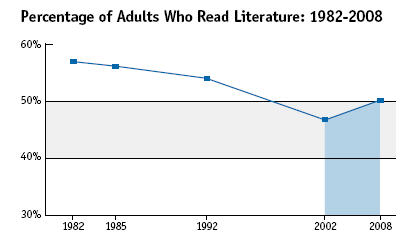
What great news!!!
Washington, D.C. — For the first time in more than 25 years, American adults are reading more literature, according to a new study by the National Endowment for the Arts. Reading on the Rise documents a definitive increase in rates and numbers of American adults who read literature, with the biggest increases among young adults, ages 18-24. This new growth reverses two decades of downward trends cited previously in NEA reports such as Reading at Risk and To Read or Not To Read.
Adults up 3.5%, young adults (ages 18-24) up by 9%. Full article here. Full report here (with nifty graphs and tables).
They attribute it to reading programs. Perhaps. I’m sure JK Rowling phenomenon had something to do with it. Whatever the reason, it’s good to hear.
Teachers (and writers)! Free Class Next Monday on How to Teach Narrative for the Common Core
If you feel a bit lost or anxious about how to teach narrative for the new core, especially stories, I think I can help.
I’m an educator in the private sector and an award-winning novelist and short story writer. I’ve been teaching authors in various venues how to write for the last five years. I’ve been on writing podcasts with thousands of listeners, taught at a number of writers conventions, and had a series of articles published by the national Science Fiction and Fantasy Writers of America organization, an organization for professional authors. I’ve also been helping Nellie, my wonderful wife, teach her 7th and 8th grade language arts students the unit on short stories during that same period. We’ve taught it to twenty different classes and picked up a number of important insights along the way.
This last year I couldn’t help but examine all the materials Nellie brought home during the district’s writing program adoption investigations. Some programs looked very promising; others not so much. Some got some things about writing flat out wrong. Most of the programs had gaps.
Furthermore, because I work with so many people wanting to write, I know that it’s difficult to teach if you really don’t understand what stories really are and how they work. For lots of people, the subject matter can seem impenetrable. And yet writing stories is such a wonderful way to teach writing, especially because so many kids love it. You won’t find a kid who will spend extra hours writing a business letter or poem analysis, but you will find quite a few who will go crazy writing stories. And the whole time they’re practicing their writing skills.
The question is how DO you write a story?
What is a story?
How can you tell if it’s good?
How do you come up with ideas?
Where do you start?
And what the heck is this chart? Do writers really use this? (Not many that I know.)
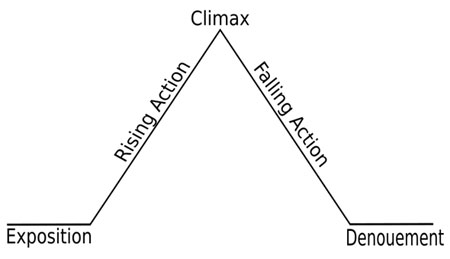
And does anyone think changing the diagram to look like Aspen, Colorado actually helps?
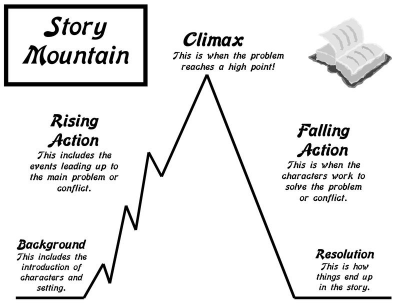
Hey, students—please make your story look like Aspen, Colorado! (Yeah, that’s going to be effective.)
And yet it’s not as difficult as it appears. Nellie and I have seen a lot of kids really get into writing stories. We’ve seen kids WILLINGLY going way beyond the assignment to write stories that are eight, twelve, twenty-five plus pages. And as they’re writing, they’re practicing grammar, spelling, structure, vocabulary, etc. without knowing it and having a great time. I know that if you enable your students, many of them will write, write, write. Especially in grade school. But also in the higher grades.
Stories can be a blast. The assignments can connect to many students. And the results can be wonderful. I’ve laughed out loud at some of the stories coming out of Nellie’s class. Others have been enjoyable on other levels.
But for this to work in your class, you need to know some key things. You need to understand the core of story and the story development process. You need a lesson plan that details everything step-by-step so your students don’t flounder. And you need to know some fundamental tips (secrets?) about teaching this content.
So I’m going to hold this day-long class for you. A full eight hours. And share everything Nellie and I have learned. This class will be for teachers at ALL levels (I’ll show you some ways to scale the complexity of what you’re doing). There will be NO cost. The only thing you have to bring is a pencil, paper, whatever program materials you have, and a willingness to have a good time.
When we finish, you will know how to write a simple story like the ones your students will write because, ta-dum, you will write one! AND you’ll have a step-by-step lesson plan that builds on whatever materials you have—an official program or one of your own. AND you’ll understand story better than 99% of the population. AND you’ll have a bundle of techniques to help your students. AND you’ll solve both world peace and maybe the lost sock conundrum.
Truly, I think that instead of feeling stress, you’ll actually be looking forward to teaching and writing stories with your students. If not, you may bring tomatoes and huck them at me, but please be aware that I will not stand still; to find satisfaction, you will have to be able to hit a moving target.
If you’re interested, just click the Contact John link under my photo in the left sidebar and send me an email letting me know.
Hope to see you in class!
GET READY FOR A FUN DAY OF LEARNING!
Topic: Teaching writing (narrative & the common core)
Who: Teachers (and writers at least 18 years old), seats are limited
When: Monday, July 29th, 8:15 AM – 5:00 PM
Where: Rich Middle School, 54 E 100 S Laketown, UT 84038
Materials you need to bring:
- Pencil
- Paper
- The writing program you’ll be using this year
- Kooky socks, for those who cannot resist the urge
- A lunch or a way to get one
AGENDA
8:15 AM Arrive
8:30 AM – 9:20 AM
- Can you create a redneck crapper?
- The 1st secret to teaching writing: Attributes & techniques
- The 5 parts of story
- Thieves prosper – using existing patterns
- A car, a beggar, and an idiot — basic pattern 1
9:30 AM – 10:20 AM
- The 2nd secret to teaching writing: Do it with them
- Technique: Sketch then draft
- Workshop 1: Zombies and kisses
- Technique: Zing hunting
- Workshop 2: Hunt zing
10:30 – 11:20
- What makes a story big or small
- Workshop 3: Select a right-sized THOM and character
- Workshop 4: Select a Goal
- Workshop 5: Make character sympathetic
- Workshop 6: 3 tries
- Workshop 7: Resolution
LUNCH
12:00 – 12:50
- The 3rd secret to teaching writing: Cognitive modeling and the 6-step process
- The 4th secret to teaching writing: Our tiny brains
- Writing is telling: Narrative & description
- Technique: Yes, SiR
- Technique: Broad-brush + 1
- Technique: The Pause
1:00 – 1:50
- The 5th secret to teaching writing: Have fun
- Workshop 8: Write your story
2:00 – 2:50
- How the pros revise—concept, line, & copy
- Workshop 9: Content edit
- The 6th secret to teaching writing: Our brains are still tiny
- Workshop 10: Line edit
3:00 – 3:50
- The 7th secret to teaching writing: The 3 grunts (responding to a story and grading)
- Share stories
- What the heck did we just do?
4:00 – 4:50
- How to adjust for grade level
- Common core
- Your program and lesson plan
- Identify black holes
- Wrap up & next steps
Who Will Play in The eBook Supply Chain?
I was reading this Konrath post by Barry Eisler on the “Attack of the self-publishing memes” in which he argues that there isn’t an inherent conflict of interest for agents to also help authors epub their books. This got me thinking about the steps (tasks) in the current supply chain, who was going to provide them, and where the biggest value lay.
Here’s the process right now as I understand it from manuscript to reader. The numbers are only task identifiers and don’t represent sequential order in every case, although I did try to sort them that way.
PAPER CHANNEL TASKS THROUGH BRICK & MORTAR OUTLETS
SELL MANUSCRIPT TO PUBLISHER
1. Promote manuscript to editor at publisher
2. Negotiate contract with publisherEDIT MANUSCRIPT
3. Story edit manuscript
4. Revise for story edits
5. Copy edit manuscript
6. Revise for copy editsPREPARE BOOK
7. Create cover design and art (a marketing/advertising function)
8. Obtain ISBN
9. Typeset book
10. Print bookMARKET BOOK TO WHOLESALERS, RETAILERS, AND LIBRARIES
11. Establish book selling hierarchy (lead book, second lead, etc.)
12. Obtain reviews from trade publications, newspapers, websites, authors, etc.
13. Create sales catalog and other sales documents
14. Contact book buyers and promote books (calls, visits, conferences, etc.)
15. Take ordersDISTRIBUTE BOOK
16. Ship to retail outlets and wholesalers
17. Warehouse book
18. Process reader purchases & returnsPROMOTE BOOK TO TARGET AUDIENCE
19. Publicity, including free copies
20. Advertising
21. Co-op display purchasesSELF-PUB EBOOK AND POD PAPER CHANNEL TASKS
EDIT MANUSCRIPT
1. Story edit manuscript
2. Revise for story edits
3. Copy edit manuscript
4. Revise for copy editsPREPARE BOOK
5. Create cover design and art (which you could lump under marketing)
6. Obtain ISBN
7. Format book for ereaders and POD services (CreateSpace etc.)DISTRIBUTE BOOK
8. Upload book to retail and library outlets
9. Warehouse the bytes
10. Process reader purchases & returnsMARKET BOOK TO LIBRARIES AND TARGET AUDIENCE
11. Obtaining reviews from trade publications, newspapers, websites, authors, etc.
12. Publicity, including free copies
13. Advertising, including website display etc.AUDIO BOOK CHANNEL TASKS
There are actually two channels here–physical audio books (CDs) and downloads (Audible, etc.).I would assume the physical audio would follow the marketing, distributing, and promoting aspects of the paper channel tasks and add in the audio production tasks. Downloadable audio would follow the marketing of the ebooks and add in the audio production tasks.
THOUGHTS
I’m sure I’m missing some key steps somewhere. Somebody please supply them if you see gaps.As for the future, here’s what I see. The paper channel tasks aren’t going to change much. Nor do I think the people performing the various tasks will either. For example, I just don’t think POD machines are going to catch on in stores and wipe out distributors. They may take out printers (#10) of trade and mass market paperbacks. But I haven’t seen a POD machine that can do hardbacks. Maybe the PODs will move to the retail outlets. But I don’t think so. Somebody disabuse me of the notion.
However, I do think there will be some interesting developments in the ebook/POD channel.
Right now a lot of authors are spending time performing tasks 6, 7, and 8. Some literary agencies are wanting to charge 15% forever for those steps with maybe a little cover design. But tasks 6-8 are the tasks that require the least amount of skill and will soon be automated.
Formatting for ebooks now is like coding html was for webpages 10 years ago–people in the code spending hours tweaking crap. Right now it takes you about a day to learn how to format a novel for the various ebook readers. Once you know how to do it, you’ll spend a day, maybe two, formatting your novel and uploading it. Or you can pay someone else to do it–any responsible teenager will do.
But within the next year I predict an application coming (if it’s not already here) that will hook into Word and other programs that will make the labor obsolete. Creating a Kindle document will be like creating a PDF document in Word today—you just click Save.
Uploading could be automated as well across various sites with some application. But it’s fairly easy now.
So for which tasks are these ebook distributors wanting to charge 15% forever? Obtaining an ISBN?
I don’t even think they even do that.
Amazon and the other ebook retailers have a lock on 9 & 10. It would be incredibly hard to dislodge those gorillas. So I think the place where literary agencies and others who want to play in the indie ebook/POD supply chain are going to flourish is in the other tasks that require the most skills–editing, cover art, and marketing, which I’ve marked in blue.
Authors interested in the indie ebook/POD channel are going to want service providers who can deliver great editing, cover art, and marketing. They’re going to want folks who can help them sell into traditional domestic and foreign paper distribution channels. They’re going to want folks who can help them sell rights to other buyers–audio, film, etc. And they’re going to want help with their contracts.
If I were an agency, graphic artist, editor, intellectual rights lawyer, or some other entrepreneur trying to serve indie ebook/POD authors, that’s where I’d spend my time.
Dystel & Goodrich literary agency recently announced they would do something like this . . . almost.
Over the past months and years we’ve come to the realization that e-publishing is yet another area in which we can be of service to our clients as literary agents. From authors who want to have their work available once the physical edition has gone out of print and the rights have reverted, to those whose books we believe in and feel passionately about but couldn’t sell—oftentimes, after approaching 20 or more houses—we realized that part of our job as agents in this new publishing milieu is to facilitate these works being made available as e-books and through POD and other editions.
Right now, you’re thinking, oh, DGLM is going to be another of those agencies that has decided to become an e-publisher and charge clients whose books they can’t sell 50% of their income for the privilege of uploading their work. Some of you may be mumbling, “Uh…that’s a conflict of interest.” We get it and we understand how that can be the perception. However, we have no intention of becoming e-publishers. As we said above, we have too much respect for the work that publishers do and too much respect for the work we ourselves do to muddy the waters in such a way.
Again, what we are going to do is to facilitate e-publishing for those of our clients who decide that they want to go this route, after consultation and strategizing about whether they should try traditional publishing first or perhaps simply set aside the current book and move on to the next. We will charge a 15% commission for our services in helping them project manage everything from choosing a cover artist to working with a copyeditor to uploading their work. We will continue to negotiate all agreements that may ensue as a result of e-publishing, try to place subsidiary rights where applicable, collect monies and review statements to make sure the author is being paid. In short, we will continue to be agents and do the myriad things that agents do.
Our intention is to keep on trying to find books we think we can sell to traditional publishing houses, to negotiate the best deal (always), and to give our authors as many options as we can. Because we will continue to be commission-based, we will not be automatically pushing authors into e-publishing. Again, we want to give our authors options and empower them to do what they set out to do all along: have their work read by the largest possible audience
However, from what I understand they’re not offering to perform the necessary tasks for 15% forever, only the project management of the tasks. Which means the author will still be paying for the editing and cover art and marketing.
15% forever for project management (a list of to-do’s in this case) and a service provider contact list? Where the author still pays for the editing, cover design and art, and marketing?
Ummmmm, no.
Others like D&G will pop up. But the ones that indie authors will eventually go to will be those that deliver on the high-skill tasks for reasonable rates. Those will be the ones playing in the ebook supply chain of the future.
Many authors will contract the tasks separately themselves. But a lot of authors won’t want to do that. They’ll want a one-stop-shop. Or one that does most of it. Some of those one-stop-shops will charge an upfront fee and will probably accept anyone who can pay. Others will make most of their money on a % of the sales to readers and libraries, footing the initial costs of the tasks, and will only work with clients they think will pay out, which if you think about it isn’t really an idie (self-pub) model at all. That’s the space traditional publishers play in right now.
But in the ebook/POD world distribution is no longer a key barrier to entry for new competitors. And so I expect to see a whole bunch of new publishers coming to play in that space. Those that select, edit, and market well will flourish.
Meanwhile, I don’t think most of us authors care which road we take and who we play with. Well, as long as they play nice and don’t poop in the sandbox. We just want to get our stories in to the hands of massive numbers of delighted readers.
LTUE 2016 presentation materials
I promised you I’d post my materials. Here they are.
Succeeding as a Storyteller 2016-02-13 HANDOUT
What Comes Next 2016-02-12 PRINT
Also, at the end of my and LL Muir’s presentation of Succeeding as a Writer, I offered some of my books, the ones I authored, for free in the back. I would like to ask whoever accidentally got caught up in the mad rush (it was like Black Friday) and took my copy of Cheree Alsop’s Daybreak: Girl from the Stars Book 1 to please mail it to me. It looks like this:
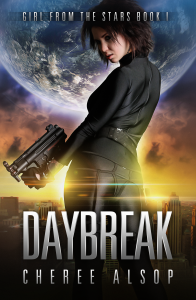
It is dedicated to “Mrs. Brown’s Class” and was a present for her. You may mail it to John D. Brown, PO Box 157, Laketown, UT 84038.