“Would I be more excited about this book if I…”

As new writers we want to do our best but because we haven’t yet internalized all the principles, we often want to create checklists of rules. We want to list out all the the aspects of a golden story and make sure we include them.  And these lists can help.

Everything I’ve learned about building expertise suggests that experts have internalized guidelines, patterns, and concepts. But in the beginning we don’t have those internal constructs. And so we often are benefited by exetrnal support in the form of diagrams, lists, etc. Sooner or later we internalize. And what used to be conscious becomes automatic.

Case in point: Dean Koontz. In his book on how to write best sellers he states in so many words that you’d be in idiot not to have an outline. That was back in the late 1970’s. In an interview almost 30 years later about his Odd Thomas books, he says he never outlines. I suspect he’s so familiar with the form outlines are redundant for him now.

So lists can be good. But lists can also hinder us if we’re not careful.

For example, James Maxey, a great author, likes characters with dark secrets. He states: “One of my tricks for making my characters interesting is that the primary characters are usually motivated by a dark secret. Vendevorex in Bitterwood desperately does not want Jandra to learn that he killed her parents. Rail Blade in Nobody Gets the Girl doesn’t want anyone to know that she killed her brother with her superpowers in a moment of anger when she was still young. The key revelation for me is that the thing that the world most wants to know about a person is often the thing that a person least wants anyone to know.”

Dark secrets are kind of cool, right?

But if we then said, okay, a great story must have a character with a dark secret, and we put that on our list, that’s when we start to work against ourselves. The “must” is the problem.

Not because we don’t have tests and guidelines. Tests assume objectives. And I, for one, certainly do have objectives for my books as a whole an in their various parts. For example, I sure as heck want to make sure my opening chapter starts with a strong draw. I sure as heck want an ending that leaves me feeling some poignancy, cosolation, and a telescoping of possibilities. I most definitely want characters that intrigue me. I have some definite musts.

But any one of the techniques or elements we might list (dark secrets, 3 acts, 7 acts, the players in Campbell’s “Hero’s Journey,” characters with an internal problem, etc. and ad infinitum) are nothing more than options that might or might not serve any given objective. They’re not necessary (of course, monkeys may be necessary). And I don’t mean that in an anomaly way.

I’m not suggesting it’s counterproductive to say, well, I love characters [fill in the blank] or plots that [fill in the blank] and I want one in this novel. I’m saying if we begin to think that all (or most) good novels must have these elements, then I think we’ll end up limiting ourselves.

So when you find something that works, when you hear about a technique, or some writerly rule, put it on your list of option prompts. Not on your list of must haves. And then ask this creative question, which I got from another great author, Luc Reid: “Would I be more excited about this book if I…”

Another version might be: “Would I care about and believe in this story/character/scene/etc. more if I…”

Would I care about and believe in this story more if had a character with this [insert option]? Would I care more if this plot line had [insert option]? Would I believe the story more if there were monkeys hiding in the attic?

If the answer is yes, then add it. If the answer is no or maybe, then put it aside. That option can go back on the shelf for another time.

Share

Similar Posts

  • How Inequity and Deservingness Propel Readers Through Story

    Inequity and deservingness are two of the main factors that keep readers reading. If we want to write killer stories, we need to know how they affect readers. A few years ago I wrote an essay on this and thought it probably too technical for most folks’ taste. But I passed it on to a recent attendee of the killer workshop and he found it helpful. In fact, when he watched Pride & Prejudice shortly after reading the essay, he saw how these factors dramatically affected his rooting interest. So I’m thinking others will find it useful as well. 

    In order to understand it you must first read George Saunders’ short story “The Bohemians.” You’ll find it here in The New Yorker, January 19, 2004. It would probably be rated PG for some profanity.

    Now if the story doesn’t pull you in, stop reading. Because the essay probably won’t make any sense to you. You’ll only be able to understand it if the story works for you. But if it does, then ask yourself what the main character’s problem was and what drew your interest? Then read my essay, “How Inequity Evokes Reader Interest.”

    Please note “The Bohemians” does present a character with a problem, and the story cycle applies, but not in the straight-forward manner it does with most stories. BTW, if you’ve ever read Patrick Rothfuss’s excellent Name of the Wind, you’ll see inequity is what shapes the story there as well. If you haven’t read it, I recommend you give it a go.

    I’ll be interested to see your responses to Saunders’ story, my essay, and/or Rothfuss’s novel.

    Share
  • |

    The average American reads 17 books per year

    Americans and Reading

    The Pew Research Center has just published their findings on reading in America. It’s called “The Rise of E-reading“. There’s a LOT of fascinating information in the report. Here’s a taste:

    1. Americans 18 and older read on average 17 books each year. 19% say they don’t read any books at all. Only 5% say they read more than 50.
    2. Fewer Americans are reading books now than in 1978.
    3. 64% of respondents said they find the books they read from recommendations from family members, friends, or co-workers.
    4. The average reader of e-books read 24 books (the mean number) in the past 12 months; the average non-e-book consumer read an average of 15.

    Building an Audience

    I also want to recommend this week’s post by Kris Rusch on Audience. She has a number of interesting things to say about the dream of being a best seller and building an audience. The money quote comes as she refers to a post by Tracy Hickman:

    “The point here is that you do not have to feel as though you are in competition with the entire world. You don’t NEED the entire world to be a successful writer. What you need is an audience—just enough of an audience, mind you—who reads your words, is changed by them and wants to come back for more.”

    An audience. More importantly, an audience that reads and “is changed by” your words. Not an audience who loves them, not even an audience who likes them. An audience who is changed by them, and because of that experience, “wants to come back for more.”

    Simple. Important. Usually forgotten.

    She talks about lots more. Read the whole thing.

    My thoughts?

    First, there’s no need for authors or readers to worry about wading through “crap.”

    According to Pew, readers only read 15 or 24 books a year on average.  That’s not a lot of books.

    More importantly, it takes about 3 seconds to get a lead for a good book.  You hear something from a friend or family member, you look at the USA Today best sellers list, you browse a few books at a store or online, you read a blog and suddenly you’ve found a book. 

    Readers fill up their book reading slots much more quickly than they can ever empty them.  That’s why we all have years of reading in our queues.

    It doesn’t matter that there are millions of other books out there, a good majority of which might have been written by monkeys. There’s no need for authors to worry that readers will have to wade through a mountain of crap to find a good book. They don’t need to because they have leads for good books coming out their ears.

    Second, people purchase books that friends, family, and co-workers love.

    Which means that when you deliver a great experience to one person, it’s going to ripple out. It’s probably not going to be linear. It’s probably going to ripple out like viruses do into different population pockets. Or seeds do into different environments. It will run through one pocket, make a jump to one or more others, or it may not jump at all. Some pockets are big, some are small.

    The way to keep a virus going is to release it in a lot of places where it’s likely to thrive or in places that a lot of people travel through. And as Kris points out, writing is all about repeat business–making sure you have a stream of good product (something I hope to rectify with my own writing this year).

    Bottom line: the best way to build your writing business is to simply write the best book you can, and keep them coming.

    Third, the market is BIG. 

    If you read Rusch’s and Hickman’s articles, you’ll see that even the mega sellers only reach a fraction of those who read. This is reinforced by the statement made by Thomas McCormack, former CEO of St. Martin’s that you can read here. So just because 100,000 people read one book doesn’t mean 100,000 others won’t read mine.  

    Moreover, e-books and online shopping are broadening distribution. Brick and mortar stores only have so many slots for books. Every 8-12 weeks they rotate the old books out (like 12 weeks is old) and replace them with the new ones, unless, of course, your book is selling very well and gets “modeled” at the store.  The point is: when you only display a few books at a time, those books will get bigger sales numbers. This happens because there isn’t anything else to purchase.

    But you don’t have that limitation with e-books and online shopping. Nothing rotates out of the store. Sure, things rotate on and off the best seller lists. But the books are always there. With an ever growing selection, there won’t be as many mega sellers.  Publishers Weekly discusses this trend in their 2011 Facts & Figures articles, which list best-seller numbers (make sure you click through to the Trade Paperback article as well). The same thing has happened with TV station viewership with the explosion of channels, DVDs, and online streaming. Same thing happened with music.

    What this means is each author has a better chance of getting his or her books to those who will love them. We’ll still have best-sellers. But we’ll also have a lot more medium sellers as well. And that’s great for authors everywhere.

    Share
  • |

    New Workshop: How to Write a Story that Rocks

    Folks, the first tentative schedule for Life, The Universe, & Everything (LTUE) has been set. For the past few years I’ve been teaching a 2-3 hour workshop called “The 3 Things You Must Learn To Write Killer Stories.” I think I must have taught it over 15 times in different venues. Hundreds have attended and said they loved it.

    However, this year I’m going to be doing something different. I’m developing a new two-hour workshop called “How to Write a Story that Rocks.”

    I’ll be teaching it Thursday evening, February 11th from 5 PM – 7 PM at LTUE at BYU. It’s FREE and open to all.

    What I found was that a lot of new aspiring authors get lost in mountains of rules. But great storytelling isn’t about rules. They try to form stories with word counts, chapters, and weird plot diagrams. But stories aren’t about those things. They have a hard time knowing what to write next because they don’t understand how story works. In fact, some don’t know how to start at all. They just flounder in their piles of zing. Finally, even if they can get a bullet outline, they have a hard time turning that into a scene.

    So what we’re going to do in this workshop is this.

    1. I’m going to bring in some ideas for character, setting, and problem. We’re not going to generate from scratch as we’ve done in the past because I want to get to the next steps.
    2. Then I’m going to teach you how to go from idea to outline–we’re going to do it together, and you’re going to learn exactly how to know what comes next 
    3. Then we’ll go from outline step to scene sketch.
    4. Then from scene sketch to draft.
    5. At every step I’ll be pointing out key story development concepts and principles

    When we finish, you should be able to:

    1. Identify the essential story objectives and story development questions–get these right and the rest doesn’t really matter. This will include the HANDFUL of key things you need to worry about and develop with character and plot.
    2. Develop more likeable and interesting characters
    3. Develop more powerful story concepts (call it premise, problem, situation, whatever). Once you get this the story writes a lot of itself.
    4. Explain the real Story Cycle. Not Campbell’s mumbo-jumbo hero’s journey. Not the three, five, seven, nine acts. Not Freytag’s diagram. Story.
    5. Explain what it means to “move a story forward,” “increase the stakes and tension,” “complicate the plot,” “complicate the motive” and how that’s done using surprise, conflict, motive, and problem. Included in this are “turns,” “rugpulls,” and “reversals.”
    6. Use the Story Cycle concepts to generate a story bullet outline and take a bullet step idea and turn it into a scene.
    7. Explain the creative principles that help you generate stories more easily.

    Larry Correia will be there as well. So I’m expecting this to be a very helpful workshop. I’m going to do all I can to make it as good or better than the first.

    Share
  • How libraries select books

    Back in May I wrote about a Gallup survey that shed some light on how US adults select books to read. That poll revealed that book reviews only play a role 7% of the time with readers. The most important things to readers are prior experience with an author and recommendations from someone they know.

    But there’s another important block of buyers that don’t buy the same way. In fact, for them reviews are KING.

    Who are these buyers?

    Public libraries.

    And the library market isn’t small. According to  a fascinating Library Journal article, “there are more than 9,000 in the US, and that’s not counting branches.” Furthermore, “library purchases account for over ten percent of the $27 billion industry (excluding print textbooks for K–12 and higher ed). In contrast to consumer buying, which relies on discretionary dollars, the library market remains a consistent sales channel for publishers.”

    When looking at how many books average authors sell and what it takes to make a living writing, it becomes very apparent that libraries can have a huge effect on a midlist writer’s career.

    Of course, we all know there’s more to it than sales. The article points out:

    Libraries are far more than a market, however. Libraries create readers. They are the test bed, the petri dish for books, a place where people can discover a passion for reading as children and indulge it as adults and where passionate readers can sample new authors. Librarians are the ultimate handsellers of books (though they call it readers’ advisory), and increasingly they put their considerable technical skills into making library web sites rich interactive social networks for book lovers.

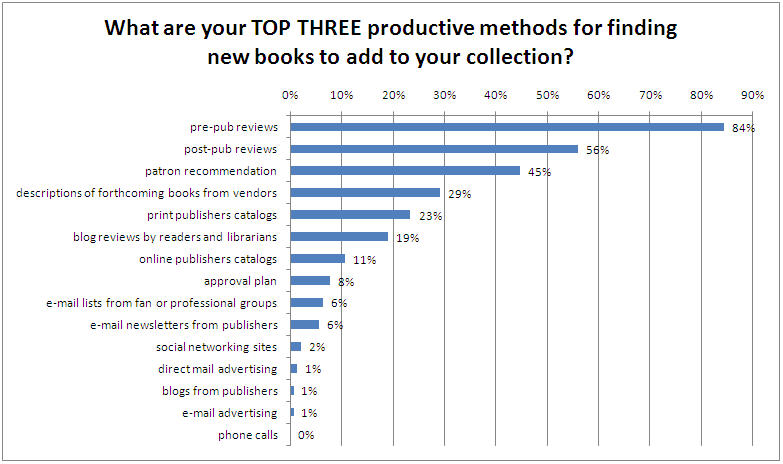
    I love libraries for this very reason. And because there’s no way I could purchase all the books I read. No way in heck. So how do they find the books for their collections? I mentioned above that they used reviews. But I didn’t know how much until I saw the data. Holy schnitzel (click on the graphic to see it full size).

    HowLibrariesSelectBooks.

    This only makes sense. Study after study has shown that buyers don’t want unlimited choice. Readers use prior experience and recommendations from people they know to manage the chaos. Libraries use reviews and then patron recommendations. Of course, this use of reviews has other implications as shown below.

    I get a lot of requests from self-published authors asking me to buy their books, and I have to explain that with limited resources and only so much space on the shelves, we have to go with books that are reviewed, that have been professionally edited. With nearly half a million books published each year—maybe half of them self-published, and most of those pretty awful—I just don’t have time to go beyond trusted sources. This usually doesn’t go over well.

    About 9 months ago I wrote about how cumulative advantage can drive product popularity–products that get early positive notice tend to get more notice. It appears that cumulative advantage is at work again. It’s just that with libraries the method isn’t a download counter. The article’s author concludes, “the best way to reach the library market is indirectly: by publishing books that people want to read and having them assessed objectively in reviews.”

    So what are the major sources for pre-publication book reviews? The article lists five big ones:

    • Booklist
    • Kirkus Reviews
    • Library Journal
    • Publishers Weekly
    • School Library Journal

    But what can an author do with this information? Authors can’t control reviews. Heck, according to the article the Library Journal itself only reviews about 10% of the books they receive.

    We all know the answer. Authors can control one thing: they can strive to write the best holy freaking heck book in their power. After all, what’s a review but a recommendation? Besides, patron recommendations were #3 on the librians’ list anyway. Nevertheless, it DOES help to have a publisher who sends your book out to the reviewers and their catalogs out to libraries. It helps to have a team that’s connected with librarians.

    The article ends by saying publishers and libraries are actually working together. I liked how the author summed it up.

    What publishers offer:

    • Discovery of talent
    • Shaping and refining books
    • Design, distribution, marketing, and promotion

     What librarians offer:

    • Discovery of books
    • Nurturing of diverse reading communities
    • Selection, distribution, marketing, and promotion

    Here’s to libraries! (And good reviews. And grandmas. And the little house trolls that give writers fabulous ideas.)

    Share
  • | |

    Speculative Fiction, Gateway Drugs, and Literacy

    You can read the transcript of my remarks at the American Librarian Association (ALA) conference in Chicago on July 11 below as well as the supporting information.

    IS SF/Fantasy Key to Teen Literacy?

    Intro

    I am so happy to be here. And I’m happy share some good news. David McCollough, the Pulitzer prize winning historian shared this fact in his commencement speech at the University of Utah this spring. “There are yet “more public libraries in America than there are McDonalds.” [Cheering]

    We have not yet been assimilated!

    Of course, this is due in a large part to you, the librarians who care for the collections and take care of the patrons. Which is why I think you deserve a big round of applause. Give yourselves a hand. [Applause]

    Fiction is a literal drug

    I want to start my remarks with two quotes.

    Ray Bradbury was recently interviewed in a NY Times article  He said, “I don’t believe in colleges and universities.” This is what he said, “I don’t believe in colleges and universities. I believe in libraries.” He said this because when he graduated from High School he didn’t have enough money to go to college. So he went to the library three days a week for ten years.

    The next quote is from the great poet Dylan Thomas–“Do not go gentle into that good night, rage, rage against the dying of the light”–that guy. He said,  “My education was the liberty I had to read indiscriminately and all the time, with my eyes hanging out.”

    If you look at Bradbury and Thomas, they read, not because there was some grade involved, not because someone went after them with a stick—they read from hunger. From thirst. They read with wild abandon because they found in reading something they couldn’t find elsewhere.

    I want to suggest one thing they found was a drug. [Laughter] I’m not speaking in metaphor. I’m talking about real physical response. As real and physical as the response you get when you or I take aspirin, brandy, or crack. Well, I hope we’re not taking crack. [Laughter] 

    When we think about drugs we think about pills, smoke, injections. But those are simply one set of delivery mechanisms for chemicals that trigger a physical response. There are other delivery mechanisms. Other triggers. One of them is fiction.

    Now I don’t have time today to detail how this works. But I will write it up on my website for those who are interested. The key thing to remember is that fiction, the kind of fiction we love, the kind that keeps us up at night sitting on the edge of the tub or locked in a closet with a light, the kind of fiction goes beyond cognition, beyond data and facts. We find it so pleasurable precisely because it triggers and guides a physical response.

    So how does all of this apply to science fiction and fantasy? Here’s the deal. And here’s where we come to our topic. Science fiction and fantasy is, for our youth, one of the most powerful gateways drugs into the fictive experience. Of course, there are ideas in science fiction and fantasy that ripple out to the society. But even if there weren’t, the happy side-effect of an addiction to this drug is improved literacy. And we all know how much that impacts.

    Numbas

    Now I know those of you who work with young adult circulation have seen this. But I thought it might be interesting to get some actual numbers so we can start to gauge the scope of the science fiction and  fantasy effect.

    My interest in this began when I saw the results of the latest NEA survey. They have this graph showing reading rates in all age groups dropping horribly since 1982. By 2002 the graph is taking a nose dive.  Then in 2008 everything turns around. And among the young adults (18-24), we see the biggest increase—9%.

    I saw they had a genre preference question in this survey. Of course, I wondered about science fiction and fantasy. So I contacted the NEA and dug into the details. It appears that 34% of the 18-24 group say they like to read science fiction and fantasy. That’s a big number. That’s 1 in 3.

    Of course, I wanted another data pont, so I went to BookScan and asked for data on book sales. Because the wonderful people there love librarians and Tor Books, they said of course. We looked at juvenile fiction sales from 2004-2008. What we saw was that science fiction and fantasy grew 144% during that period. All the other genres only grew 23%. We also saw that science fiction and fantasy currently make up almost 30% of the juvenile fiction market. So about 1/3.

    Now there are some problems with the BookScan data. Yes, it only cover 60-70% of the market. It’s not in Wal-mart, grocery stories, and a few other places. But what’s more problematic for this issue is that they don’t break up the juvenile sales by age. It includes everything for folks one month old to age eighteen. So I’ve got books like Go Dog, Go in the dataset along with Twilight and Go Dog, Go isn’t categorized as fantasy. [Laughter] My suspicion is that if we narrow it down to the middle grade and YA group, we’ll see more science fiction and fantasy.

    So I needed someone who did break it up by age. Well, who does that? You do. Libraries do. Besides, a lot of youth don’t have the $ to buy lots of books. So I went to some libraries in Utah and Ohio and got their YA fiction circulation stats. Here’s what I found: 60-80% of the YA fiction circulation is science fiction and fantasy. This does not include graphic novels or magna. It’s text fiction.

    Folks, this is a big drug. I don’t know what part science fiction and fantasy played in the rise in reading rates, that would require a larger and more rigorous study. But I can tell you this: We want to see the impact of science fiction and fantasy on our society? We’re seeing it right now.

    My Story

    This large effect makes sense because science fiction and fantasy deliver experiences that are intersting to and matter to youth. It’s chock full of and encounter with the strange, weird, and wonderful; adventure and danger; doing something meaningful; being someone special, someone desireable, someone wanted in the group. All that coming of age stuff. So no wonder it’s a huge gateway drug.

    I know that it was in my case. I wasn’t a reader. I don’t think I read more than twenty or twenty-four book from kindergater to sixth grade. I look at the little fellows in my local school today and they read that many titles in the first six months of the first grade. But I didn’t. I wasn’t a reader. I do remember loving the look and feel of these small chubby books. [Laughter]

    I would take them them up to the librarian to check them out. She’d look down at me. “Are you going to read all that?” she’d ask. “Yes,” I’d say. Of course, it was lie. [Laughter] It was a huge lie because I would take them home and put them up on my dresser and just look at them.  Just loving the look and feel. And then when it was time to check them in, I’d take them back and give them to the librarian. “Did you read all that?”

    “Yes,” I’d say. And that’s how I became an author–lying to librarians. [Laughter] 

    Now in sixth grade my sister, we were in the car, I had four sisters and we had one TV, and so you had to reserve the time for your programs. So my sister says, “I have to watch The Hobbit for school.” Now I don’t know anything about The Hobbit. It sounded like a romance. [Laughter] I protested. No, way–we’re not going to watch some dumb kissing thing.

    “No,” she said. “It’s got dragons.”

    “You’re lying,” I said.

    I was convinced I was doomed. But it didn’t matter. We watched it. It had dragons. And I loved the experience so much I wanted another hit. Shortly thereafter my mother and father went on a business trip. I went over to my buddy’s house. So the first day we come up out of the basement to go to school and I said, “Oh, I’m feeling sick.” So my buddy went off to school and I went back down into the basement and played hookie for two days and read The Hobbit.

    It was amazing. More amazing than the movie. I had to have that experience again. And so I read Ursula LeGuin, Patricia McKillip, Donaldson, Terry Brooks. I kept reading because it delivered a cognitive-physical experience I loved. Of course, I didn’t put it that way back then. It was more along the lines of, duuuude. [Laughter]

    Now I got a BA in English and a Masters in Accounting. Those degress required a lot of reading. But I didn’t develop the requisite literacy skills in school. I developed them in science fiction and fantasy.

    And so when I started to write I was naturally drawn to fantasy. Having experienced this wonderful thing, I wanted to produce that and share it with others. So this novel that’s coming out has the gosh-wow I still love. It’s set in a world were humans are ranched by beings of immense power. There’s a young man and young woman in terrible trouble. So it has monsters, magic, and mayhem. But I also found fantasy big enough to let me explore other things that have become more important to me as I’ve aged. Like family, sacrifice, and redemption. And I hope people enjoy all that. But ultimately, I hope this book does for someone else what The Hobbit did for me and opens a door to a wonderful addiction. And, of course, as a powerful side-effect, improves the literacy of some rascal or rascaless. [Laughter]

    Conclusion

    I want to end where we began with that Thomas quote.

    “My education was the liberty I had to read indiscriminately and all the time, with my eyes hanging out.”

    That kind of wild abandon will happen when the drug takes effect. And for many of our youth, probably at least one in three, that’s going to be when they ingest a few ounces of SF & Fantasy.

    Thank you.

    [Applause]

    Supporting Numbers

    How fiction is a drug

    Emotion is not a cognition, although cognition plays a part. It’s not just in your brain. It involves a physical response, which means it involves chemicals. 

    We sometimes forget that our bodies produce a staggering number of chemicals. Sometimes they produce in response to external stimuli—the sun triggers the creation of vitamin D, ingested sugar triggers the production of insulin, the sight of a ravening lion standing not five feet away with nothing between him and me produces, among other things, adrenaline.

    Lots of these reactions, we don’t notice. But there’s a whole group of these physical responses that we do. We lump them together and call them emotions.

    Jenefer Robinson in her wonderful book Deeper Than Reason, explains, “Emotions are our way of responding to events in the environment (either external or internal)” that matter to us. They are “physiological changes that register the event in a bodily way and get us ready to respond appropriately.” Fight, flight, pursue, woo, investigate. They focus our attention, get us ready to take action, and communicate all this to others.

    So while I might not feel the production of vitamin D, I do feel the fear of the lion. Fear is a wonderful thing—it keeps us alive. It raises our heart rate, pumps us full of drugs that prepare us to flee or fight. The emotion writes itself on our faces in order to, among other things, communicate the situation to those around us, warning others and calling for help. It is a physical response. Yes, there are cognitions involved, but there are also chemicals.

    The latest research on emotion shows that emotion is a process that involves three things. (1) An affective appraisal of our environment that signals something important to us—a threat or opportunity. (2) This triggers an immediate physical response (chemicals, galvanic skin response, accelerated heart rates, facial expressions, etc.). (3) At this point cognitive (conscious thought) appraisals kick in and help us monitor the situation and moderate the physical response.

    For example, I go out to the yard and step on this thing that slithers through the grass. The sensory signals immediately trigger a physical response to get me ready to flee or fight–heart rate, adrenaline, etc. Then I notice the snake is far too long. I look closer. It’s the garden hose. My physical response changes. I laugh, feel relief. Research has shown that when we read text, the same process occurs. We do indeed have the same types of physical responses. In some cases they’re more intense.

    Now here’s the thing. This physical response is triggered not just by threats and opportunities we perceive with our senses, things out there. It is also triggered by thought. Thoughts deliver a physical response just as surely as crack does. We have the research to prove it. In fact, sometimes thought delivers a more powerful physical response. Here’s but one example. Did you know that people with a phobia of snakes have a stronger reaction to reading a passage about snakes than they do to the actual critter?

    This is where fiction comes in. As I stated in my speech, fiction, the kind of fiction we love, the kind that keeps us up at night sitting on the edge of the tub or locked in a closet with a light, the kind that lingers in the fabric of our clothes and our hair long after we close the book, that kind of fiction goes beyond cognition, beyond data and facts. That kind of fiction triggers a physical response.

    It does this, and this is one difference from emotion triggered by our own thoughts or the sensory data we pick up from the world, because fiction, by its very nature, its very structure, is actually guiding our emotional response. Our physical response. This management of the response is in fact one of the things that we find so pleasurable about it.

    To find out more, please read:

    • The Science of Emotion by Randolph R. Cornelius
    • Deeper Than Reason: Emotion and its Role in Literature, Music, and Art by Jenefer Robinson

    You may then want to search out texts by Dolf Zillmann, Jennings Bryant, and Peter Vorderer.

    Share