Back in 2011 I wrote a post titled “Since when did young adult fiction become the cure for cancer?” It was a response to all the YASaves hysteria. The main point of my amazing post (grin) was that the people complaining about some YA content wanted not to ban books, but to simply have a way to more easily evaluate if they wanted to buy a particular book in the first place.
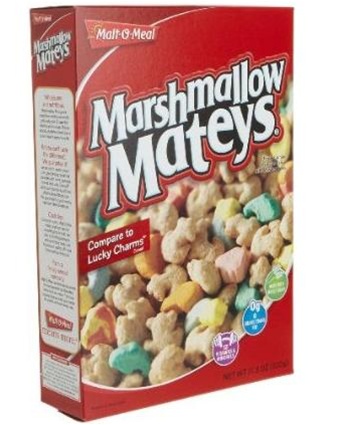
They want to avoid purchasing what they thought was a box of Marshmallow Mateys only to open it and find a bunch of bicycle sprockets.
Last year I decided to work on a solution. I have some ideas. But before I get ahead of myself and build something, I want to really understand if it’s a problem worth solving. I want to chat with others who do care about content to see what aspects of this are important to them and what they’re doing now to find this information.
So, if you wish books had ratings for sex, violence, and language, then I want to talk to you. It will take about 20 minutes. If you’re open to chatting, leave a comment, or click Contact above and fill in the form.
Because I live up in the middle of nowhere, we’ll have to chat via a web meeting. But never fear: I’ll host that. All you’ll have to do is show up and answer my questions 🙂
An avid reader friend of mine began reading through the books in a list called “100 books you must read before you die.”
She got to Jack Kerouac’s On The Road and went to Facebook and posted the following: “I don’t get the appeal. It’s about a group of boys/men who are irresponsible, drunks, whoring around taking advantage of others and being enabled by their women. Why is this a classic and why should I have wasted my time on it? Can some of my literary friends explain? I hated a brave new world and the handmaid’s tale too.”
Is the book a classic?
Should she read it before she dies?
Is it really that important?
Let me share an edited version of my response and then provide my list of 30 books you should read before you die.
*
Annette, the unfortunate truth is that these lists of “classics” are a sham because there is no objective criteria for determining literary excellence.
Or maybe I should say that measuring quality in the arts isn’t like measuring the unambiguous, objective score of a baseball game. After books exhibit a certain level of proficiency, it becomes increasingly difficult to distinguish the quality of one book from another, especially because much of this depends on a reader’s interests and subjective experience of the story.
When it becomes hard to rank performances, people rely on other measures. One of the most powerful is social networks.
So if two readers find two different books that blow them away, one of the books might get all the attention because the one book gets picked up by a news service (The New York Times) or a platform (the Oprah Book Club effect) or some other social network of influence. A lot of the so-called literary classics only appear on various lists because they tapped into the academic network, which kept them alive far longer than they would have lasted otherwise.
On The Road is simply a book that made a stir among some circles in the 1950s. That’s it.
Was it more important or of higher quality than Exodus? The Chronicles of Narnia? Lord of the Rings? A Town Like Alice? All published in the 1950s as well.
It depends.
If you’re wanting to understand the 1950s beat culture, it would be an important book.
But if you’re wanting to understand fantasy writing of the time, it wouldn’t.
If you’re wanting to read a book that’s had a huge impact on popular culture, well, LOTR beats On The Road like a dog.
Some people have the feeling that the so-called classics have some inherent medicinal value because someone put them on a list and called them classics.
Nope. They’re just stories. Some of which can shed light on the issues and interests of a part of the culture in a given period. But if you’re not interested in that specific sub-culture, who cares?
And if you’re reading to be entertained, moved, uplifted, or educated—which ones do that best for Annette is for you to decide.
So all that to say I wouldn’t devalue your reaction to the book
*
I’m now going to give you my list.
But it’s not going to be a list of titles. Nor will it focus on a book’s impact on some sub-culture of a given period.
It’s going to be a real list. One that focuses on what so many of us go to stories for.
The one that makes you weep.
The one that makes you giggle and snort.
The one that reminds you of what it’s like to fall in love.
The one that gives you hope.
The one that you begin to read more and more slowly because you don’t want it to end.
The one that scares the soup out of you.
The one that you can’t put down, even though you need to wake up early in the morning.
The one that makes you wish you lived there.
The one that’s so good that when you close it, you immediately start to read it a second time.
The one that gives you and your child hours of pleasure together.
The one that gives you a sacred, spiritual experience.
The one that makes you reread some of the lines because the turns of phrase are just so delicious.
The one that gives you courage.
The one that takes you on an awesome adventure.
The one that makes you want to be a better person.
The one that bores you to tears (just so know you how good the others are).
The one that introduces you to a different culture that delights you.
The one that makes you think.
The one that lingers with you for days.
The one that gives you lovely insights.
The one that inspires you to love your spouse more.
The one that introduces you to the sorts of people you normally don’t like and makes you actually like them.
The one that delights you with its characters.
The one that whisks you away to a different historical period.
The one that inspires you to give your children a hug.
The one that gets your adrenaline pumping.
The one that sparks all sorts of ideas in your head.
The one that makes you wonder and start imagining what it would be like to be there.
The one that blows your freaking mind.
The one that makes you stand up in your living room and cheer.
We could do more than 30, couldn’t we?
Like the one that makes you think people from a different time period are just like us. And the one that makes you think people from that same period are completely alien.
But I think we’ll stop. That there above is a list.
Those are 30 books I think everyone will want to read before they die.
Well, from what people have been posting, he seemed like the devil. But I know how the internet can be. Mitt Romney at one time was the devil. Now, I think he’s been degraded in those quarters to janitor of the hot place. Yeah, that one Romney who is out raising tons of money to help fix blindness among the poorest of the poor, that evil son-of-a-gun.
So when I saw there was a new head honcho in town, I decided to see what he was all about.
I did try reading various posts on the internet, but after a dozen or so of those, I realized it would just be easier to go to the source. And so I went to Vox Day’s website and clicked the contact link, which popped up an email.
I asked Day if he’d mind answering a few questions.
He agreed.
What you will read below is our conversation, arranged for easy reading.
Why am I doing this?
Well, who doesn’t want to scoop the devil? But beyond that, I agree with George R. R. Martin: internet conversations that are not moderated to maintain a tone of respectful disagreement are a bane upon us all. Actually, Martin said they were part of the devil’s alimentary canal, but I didn’t want to confuse the topic.
So I’d read a number of posts that Day had made and others folks had made about Day and saw all the bad juju going back and forth. And I wanted to know what this guy actually believed. Once I understood that, if I disagreed, then I could disagree in a way that I think is actually productive.
We talked about some of his views on two subjects—race and women. Are his ideas provocative? Well, you need to know what they are before you decide.
Conversation
Brown
Vox,
I’m following the conversation about the Hugos. Many of the conversations claim you are a racist and misogynist. Knowing how labels and slurs can magically become fact, I wanted to go to the source and understand what it is you truly believe. I’ve done some reading on your site. I’ve seen attack pieces such as this http://rationalwiki.org/wiki/Theodore_Beale#cite_note-real-ass-13.
But it’s all so scattershot and snippets out of context. I’m wondering if you might answer some questions. If so, my first questions are about your views on race.
Do you believe Black Africans have, in general, less genetic potential for intelligence than White Europeans?
Do you believe the same for the darker Asians like those from India or Indonesia?
Which genetic group has the highest genetic potential for intelligence at this time?
My response to those who claim I am racist or misogynist is simple: why do you reject science, history, and logic? It is not hateful to be scientifically literate, historically aware, and logically correct.
Pure Homo sapiens sapiens lack Homo neanderthalus and Homo denisova genes which appear to have modestly increased the base genetic potential for intelligence. These genetic differences may explain the observed IQ gap between various human population groups as well as various differences in average brain weights and skull sizes.
Yes, East Asians have been observed to have considerably higher IQs than Southeast Asians.
The Chinese. Their average IQ is higher than the Ashkenazi Jews, who are genetically a refined group of Semitic-Italian crosses. To be more specific, the highest average IQ is found in Singapore.
No, the genetic groups are the Homo sapiens sapiens/Homo neanderthalus crosses, the Homo sapiens sapiens/Homo neanderthalus/Homo denisova crosses, and the pure Homo sapiens sapiens. These broadly align with Europe, Asia, and Africa, but not exactly.
Let me see if I’ve captured your overall approach. You feel it’s important to examine and conduct science without regard to political correctness. For example, if Vanhanen and Lynn say IQ is genetic, you feel the most appropriate thing to do is not attack them for being racists, but simply examine their data and conclusions dispassionately. It’s important to question it. Argue with it. Try to falsify, as we do with any other scientific claim. But not dismiss it simply on the basis that it doesn’t agree with our what we feel is morally right. Correct?
Day
Yes. Science and history and logic exist regardless of whether we are happy about them or not. We have to take them into account.
Brown
It appears the Lynn & Vanhanen book suggests the genetic IQ differences were caused, not by Homo crosses, but by natural selection operating in colder climates over long periods of time. Can you provide another reference that discusses the DNA tracing and IQ correlation of the various crosses?
Day
There are many articles on the Internet about DNA and IQ, I suggest you simply search them out and read a few. The data is conclusive, the rationale explaining the data is not.
Brown
I’m not sure I understand what you mean when you said the rationale explaining the data is not conclusive. What do you mean by that?
Day
Regarding rationale, the data is beyond dispute. But we cannot explain why the data is the way that it is, we can only construct various explanatory hypotheses. Historical explanations are, for the most part, scientific fairy tales, literal science fiction.
Brown
I read your comment to Jemisin about African exposure to Greco-Roman culture. It seems you’re suggesting societies can’t make large change their culture (values and beliefs) over a few generations, or within one generation. Is that what you’re claiming? It doesn’t seem like you’re making a genetic-intelligence argument since 1,000-2,000 years seems too short for any type of significant evolution. Of course, if it’s a cultural argument, then I don’t see how it’s possible to say it’s impossible for a bunch of Jemisons to accomplish this since she was raised with the Western culture. Confused on your base point here.
Day
Yes, I am claiming that societies are incapable of moving from full primitivism to full civilization within the time frame that primitive African societies have been in contact with what we consider to be civilization. It is a genetic argument. It takes that long to kill off or otherwise suppress the breeding of the excessively violent and short-time preferenced. African-American men are 500 times more likely to possess a gene variant that is linked to violence and aggression than white American men.
Brown
Two more questions. It doesn’t sound like you’re against immigration per se. You just think that if a society wants to continue, they need to breed. Right?
Day
I am against large-scale immigration, particularly population-replacement immigration. Limited immigration, no problem.
Brown
I suspect someone is going to wonder if your ideas on race and IQ and violence mean you favor some type of eugenics program. So let me ask you: do you believe in selective breeding or sterilization? If so, would that be to promote the Homo crosses you think are better? Or just any trait from any group you think is superior?
Day
No, I am not a eugenicist. I oppose forced selective breeding and sterilization. However, I also oppose dysgenic and dyscivic social policies, which is presently what we have across most of the West.
Brown
As much as I want to ask more about what you consider dysgenic and dyscivic policies, I think it would just lead to another topic, which would lead to another. Let’s talk about your views on women. Here are my initial questions.
Do you believe a country is better off when women cannot vote?
Do you believe a country is better off when women are not afforded equal education opportunities as men?
What are the top topics of education do you think would be beneficial for women?
I’ve read this post http://voxday.blogspot.ca/2012/06/scientist-beats-up-pz.html. It sounds like you think the main objective of a country or culture with regards to women should be to reduce female promiscuity (not necessarily male promiscuity) and increase the number of children each female bears. Is that correct?
Referring to that same post, are you saying that genital mutilation and acid burnings are legitimate ways to treat women? Or are you saying that they are bad things, but that the societies that do such things have lower female promiscuity rates and higher fertility rates, and so it’s a small price to pay?
Day
Yes, in a representative democracy. However, note that I favor universal direct democracy and the jury is out there.
It depends. It increasingly appears that a society is improved by widespread female education through high school, and harmed by it beyond that level. If you look at the demographics, a society that sends its women to college stops breeding. How this is supposed to benefit a society, I do not understand.
Again, it depends. If a society is demographically dying, then yes, it had better do something to get its birth rate up or it will cease to exist. This isn’t rocket science. If a society is stable or growing demographically, it has no need to concern itself with such policies.
You appear to have misread the post. PZ Myers claimed that there was no rational case to be made for the Taliban’s activities. I responded by demonstrating that the Taliban’s behavior is entirely rational, it is merely the consequence of different objectives and ruthlessness in pursuing them. But the mere fact that I am capable of observing a logical syllogism does not mean I share the assumptions involved or advocate the conclusion. Considering that the Taliban defeated the Soviets and appear to have outlasted NATO, I think it is remarkably stupid to dismiss them as irrational simply because they are willing to defend their way of life.
Brown
Even though it appears I misread the exchange with PZ Myers, your answers to 2 and 3 suggest you prioritize fertility rates as the main goal a society should have towards women. As long as the population is stable or growing, you feel a society can examine other goals or objectives. But only if those goals or policies do not negatively impact the population rate. Correct?
Day
Yes. The NATIVE population rate. Immigration is used to cover up demographic decline, but it changes the nation.
Brown
Okay, what’s the reason you feel women shouldn’t vote in a representative democracy? And do you think only certain types of males should vote?
Day
The reason women shouldn’t vote in a representative democracy is they are significantly inclined to vote for whomever they would rather f***. Hence the studies about height and hair being relevant to US presidential politics. That’s why women’s suffrage was pushed by the Communists and why it is the first plank of the Fascist Manifesto.
In a representative system, yes, only certain types of males should vote. And before you leap to any silly conclusions, please keep in mind that I have lived most of my life in political systems where I am not allowed to vote. Voting does not equal maximizing freedom and liberty.
Brown
First, what types of males do you think should vote in a representative government and what’s the main reason why?
Second, do you believe large numbers of males will vote based on sexual attractiveness as well when females are running for office?
Day
Men who demonstrate sufficient long-term orientation and a willingness to put the national interest above self-interest.
No, men aren’t wired the same way.
Brown
How would you identify the types of men you mention? Military or law enforcement service? How would you determine who had a long-term view of things?
Day
I have never given any thought to how such men would be identified. Every method is bound to fail in time.
Personally, I’d like to see direct democracy tried. We now have the technology, and it would be MUCH harder to corrupt than representative democracy. At least we don’t know exactly HOW it would fail.
Brown
Vox,
This has been really helpful to me. I think it would be helpful to others wanting to understand you. Agreeing, of course, is a different matter. But that’s a different subject. Would you be okay with me posting this conversation on my site?
Day
Sure, do as you see fit. The usual suspects will have their own hissy fits, but that’s of no concern to me. I find it amusing when people tell me they disagree with some of these things. Do they not understand that it is not me with whom they are disagreeing, but reality? Why people can understand that if pandas don’t breed, they will go extinct, but fail to grasp the same thing is true of nations is beyond me.
Comments
You will notice I wasn’t trying to challenge his ideas. Does that mean I agree with them lock, stock, and barrel?
No. I’m very skeptical about a lot of them.
But as I stated above, before I agree or disagree with someone, I need to understand them. And the best way to understand someone is to ask questions, listen, and verify I’ve understood accurately. The worst way to understand is to start with an attack.
In this stage, the goal is not to trick someone. It’s not to convince them that they’ve contradicted themselves. It’s not to prove any point.
It’s to hear them out. And if there are things that don’t make sense, to ask questions of clarification.
But what do I think about his ideas?
Well, let’s look at them.
Scientific Inquiry
I have to agree with his idea that we should try to look at science dispassionately. I think it’s dumb to reject someone’s science simply because the results offend our sensibilities.
We reject science because there are issues with the data, or the experiments, or conclusions. We reject it because it doesn’t fit with the observations. Or because we can’t replicate the results, or because it fails to predict as it claimed it could. But we only hurt ourselves when we reject it because it doesn’t fit our current political beliefs.
Okay, fine. But what about his views on race and women?
The Rhetoric of Offense
Well, they’re bound to rile feathers. And Day sometimes seems to go out of his way to state them in a way he knows is offensive. I didn’t feel he did that with me. But if you read the links above, you can see he does employ it with others.
Here’s my take on this. The rhetoric of offense is different than the rhetoric of explication. The latter is meant to explain. The former’s goal is to cause injury. It has no interest in sharing ideas. It only has interest in injuring someone, either to try to gain relief from an attack or to beat someone into submission, or because seeing folks get all riled up provides amusement.
A good portion of Day’s posts that I’ve read, admitting it’s nowhere near exhaustive, seem to contain a lot of the rhetoric of offense. And I think this dramatically undermines his ability to get others to consider his ideas, let alone believe them.
Sure, the attacks might bring like-minded folks to his side. But, for the most part, it does not provide the ground in which insight grows. Offense closes both parties off to challenges, biases, and ideas. It closes them off to new information. And new information is such an integral part of learning.
Some people say that tone shouldn’t matter. For example, you may lace the fact that the earth revolves around the sun with expletives, or say it to me sweetly, but the fact remains that the earth revolves around the sun. So asking for a more respectful tone is an ad hominine attack, a logical fallacy. It has nothing to do with the argument.
But here’s where I believe the anti-tone folks go wrong. Offense changes the message. When you call me a jackass, you’ve selected to promote one message over another. It doesn’t matter if you’ve couched your attack in a well-reasoned point because you have decided to no longer communicate your point. You’ve decided to communicate the offense instead.
Can’t we do both?
Not really. It’s like playing a country western tune of reason softly in the background while shoving a 110 decibel speaker blasting an annoying alarm in my face.
It’s like taking the statement “the cow jumped over the moon” and saying “the the the the the the the the the the the the the the” followed by a barely audible statement of the rest. All the receiver hears is “the”. And that’s what they respond to.
This means there’s no fallacy at play because there is no argument being communicated. Instead, you’ve communicated an attack. And invited a response to precisely the same.
If the speaker wants someone to consider his ideas, then he needs to speak in a way that invites consideration. I know, you can do that, and the receiver may still go into what sometimes feels like “a hissy fit.” We see this all the time, don’t we? Communication is indeed a two-way street. However, if the guy who was trying to explain decides to switch and respond with an attack, that’s his choice. But don’t call it explication or reason or conversation.
Day was perfectly polite to me. And I know it’s incredibly difficult sometimes to not attack when being attacked. I know his ideas, even when stated reasonably, will rile some folks. But it’s also true that he sometimes loads his communications with things he knows will offend. Things meant to injure and ridicule. Things which show little regard for others. I find it counterproductive. I think it’s wrong. But I also condemn the same tactic from the other side. And, yes, there is probably a time to use the rhetoric of offense, but that’s for another post.
Okay, but what about his beliefs, John?
Votes for Women
Do you agree it would be better for our nation if women didn’t vote?
No.
I’m not convinced men aren’t affected by charisma. What? When males get in a group, all are equally popular? Or popular only because of their ideas, not their looks, money, power, physical prowess, etc? Nor am I convinced that women can’t be long-term thinkers. I haven’t seen any science that supports that idea. And my personal experience has been just the opposite. The women I know think a lot about the future. Furthermore, when I include women in councils, we usually come up with much better ideas.
Now Day might suggest there’s science to look at. That’s his prerogative. I’m incredibly skeptical. But I think the most productive thing to do in reaction to his claim is to gauge whether you think it merits serious consideration. If it does, or if you’re curious, examine the evidence and report your results. If it doesn’t, just say you haven’t seen anything to suggest its worth looking into further.
Education for Women
What about his idea that the most important thing for a society is to maintain the population, which means the most important thing for a woman is to have babies, and that education undermines this and therefore should be avoided?
In one way, he’s right. If you want to maintain a certain population, you do indeed have to breed.
But if that’s your goal, I don’t see education in general as the determining factor. Mormon women have, as a group, much more education than the average female in the United States AND they have more babies. Lots more. I don’t think it’s education per se. I think it’s the values and beliefs some education fosters.
There are some groups that are taller on average than others, some that are shorter. On the face of it, I don’t see why some groups might not have a genetic disposition to more of one kind of intelligence and other groups less. I haven’t looked into this much. I don’t know anything about Homo sapiens sapiens, Homo neanderthalus, Homo denisova, and the various crosses.
However, I do question if IQ isn’t more about nutrition and early learning. I wonder if IQ tests really measure intelligence or just one type of problem solving. And I’m skeptical that it’s really that big of a difference. Maybe it is. I admit my ignorance and curiosity on this topic openly.
Race and National Success
What about his claim that Homo sapiens sapiens, which he claims are what we find in Sub-Saharan Africa ancestry, have more genes for violence than we do up north and so can’t at the present time build as successful a society?
This one makes no sense to me. I don’t see a difference in violence levels. Like the Romans weren’t violent? Or the Germanic tribes? Hitler and all those that followed him didn’t do violence? Napoleon and his armies? I don’t see how we selected against violence and short-term thinking. I’m incredibly skeptical of these claims.
Now, it could be he needed more space to lay them out. After all, I wasn’t asking for evidence or a full treatise. Only what he believed. But as it stands right now, I’m betting the types of violence he’s looking at are driven more by culture than anything else. And I don’t believe people are genetically predisposed against democracy.
Frankly, the ideas laid out in Guns, Germs, and Steel seem more predictive to me about what makes peoples successful than Homo crosses. But of course I’m always open to new information. However, even if this claim is true, it’s a fallacy to peg each member of a group to the average. People lie along a bell curve for all sorts of things, and it might be that any one person or community or even nation might actually have less of this than another from a different group.
Bottom line
Vox Day wasn’t the devil, dang it.
He is someone who espouses a couple of ideas that I agree with and a number that seem flat out wrong to me. He appears to be someone who enjoys the rhetoric of offense. I may investigate some of his claims. I may not. I am new to the topic of genetics, and am curious. Whatever I do, I found it useful to try to see for myself what the man believes. One thing that he and I agree on is how we should react to claims made with the purpose, not to offend and injure, but to expand our knowledge.
Now, I have no idea what types of comments this post will bring. Please note that I did not ask Day for his sources, or to lay out all the evidence he feels backs up these beliefs. That’s much too big for this post. You can certainly share your ideas and the science you find compelling. But this is my site, and by golly I request that if you post and want to express disagreement, that you disagree respectfully. Name calling, high-octane expletives, etc. will not fly here. Any post that fails to avoid this will be deleted. You can certainly try again, but if any prove unwilling to abide by this rule, I’ll simply block you to save myself some time.
I am much more interested in a discussion here than attack and offense.
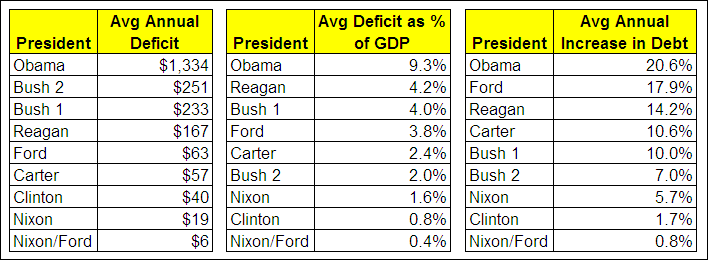
Last week a chart made the rounds, ranking the Presidents since Reagan on spending. Look at Reagan. That happy man is a freaking profligate. Obama, on the other hand, heck, he’s doing better than Bill Clinton.
Except there are a few problems.
First, I can’t tie this data out to the official CBO numbers.
Second, it does a bit of apples and oranges because the numbers are based on each president’s whole time in office. What does it mean when Obama increases the debt by 35% over three years, but it takes Bill Clinton almost EIGHT YEARS to increase the debt that much? A better measure would be an average per year.
Third, some have suggested this chart monkeys with the numbers, allocating the first year of each president’s first term to the previous president.
Fourth, the president isn’t the only one in Washington. Senators and Congressmen also have responsibility.
Finally, while a % increase in debt is a helpful measure, it’s not the only story. And it can be misleading if viewed on its own. For example, if we have $1 of debt, and I increase that to $10, I’ve increased our debt by 1000%. Holy Schnitzel! But if we have $500 million of debt and I increase it to $600 million, I’ve only increased it by 20%. Which is worse?
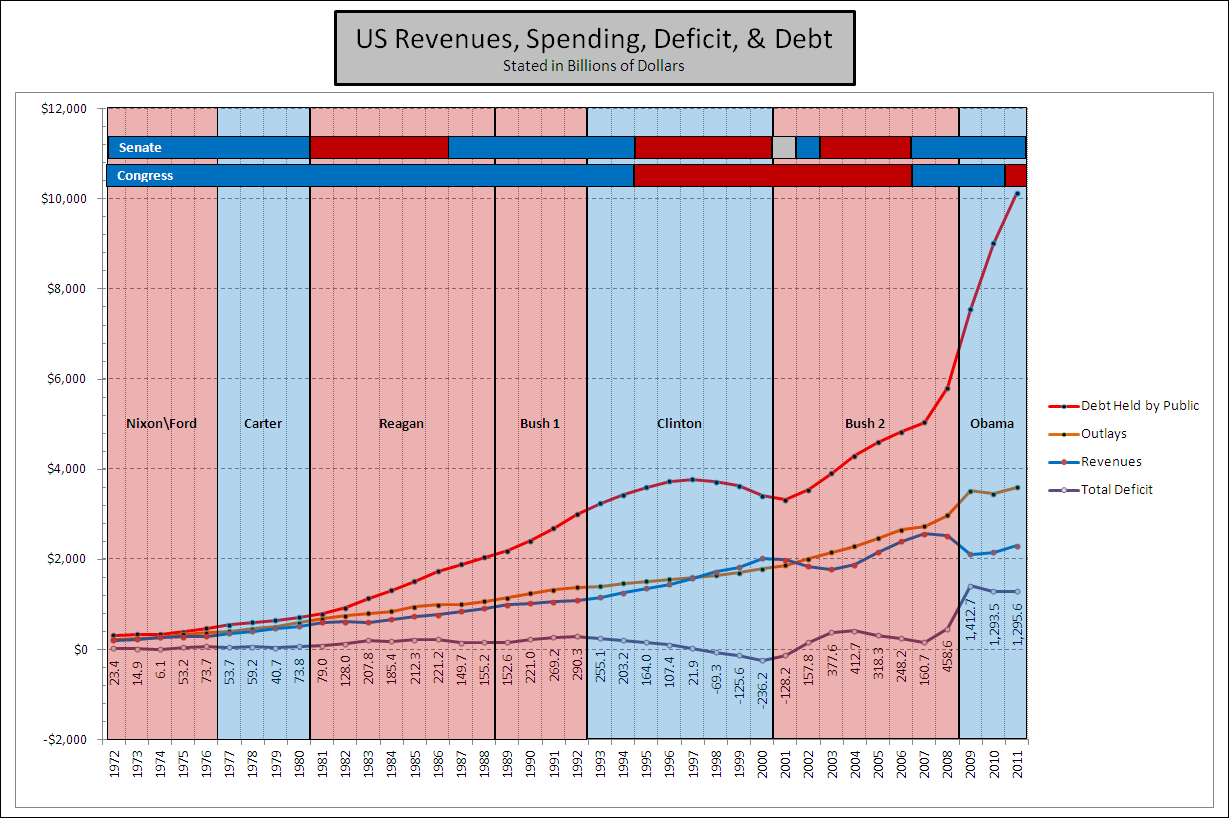
So I went out to the CBO and took their numbers from 1972 – 2011. You may get the XLS file yourself: http://www.cbo.gov/publication/42911. Then I made sure to identify who was in charge when and marked it with spiffy colors (Red is Republican, Blue is Democrat). Here are the results. Click on it to see it in its full size glory.
What does this tell us?
First, there was only ONE four-year stretch in the LAST FREAKING FORTY YEARS where the folks in Washington did not spend MORE than they took in. That was the four year period from 1998 – 2001.
What the?!?
Look at that chart again. There is a serious and systemic spending problem in Washington.
What happened in 1998 to change what had been going on for almost three decades? That was when the citizens got fed up with Washington, threw out a great number of the Senators and Congressmen, and bought into the Contract with America. This was when Newt Gingrich was Speaker of the House. This was when Clinton was getting pounded for all sorts of stuff and worked with those particular Republicans in Congress to balance the budget.
Second, the deficit, the purple line at the bottom, tripled when Obama took office. And stayed! Who put that first chart together? Oh, yeah. It was Nancy Pelosi.
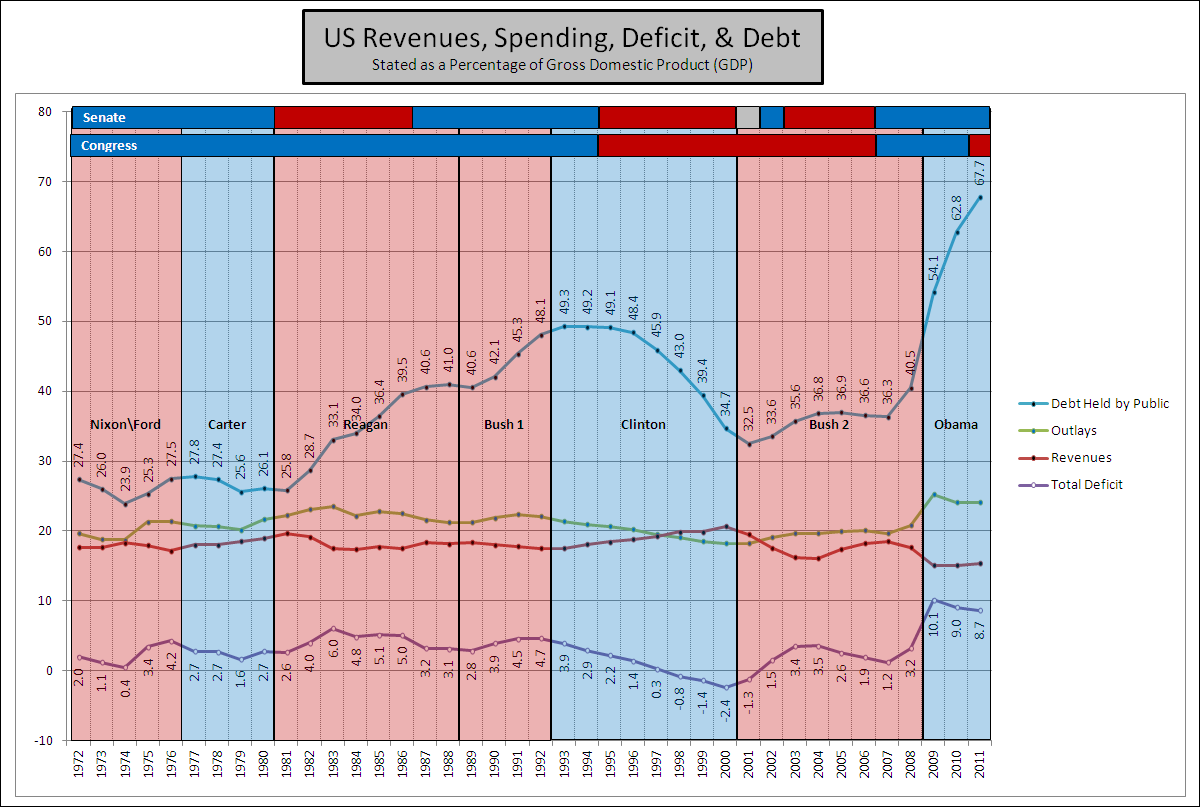
You might say, well, raw dollars is good. But what’s really important is how big a percentage that spending is of our nation’s GDP. If you’re spending 100 billion when the nation is producing 1 trillion, that sounds big, but it’s actually not as big a deal as when you’re spending 100 billion and the nation is only producing 200 billion. Okay, let’s look at these numbers as a % of GDP.
Again, 1998-2001 were good years. On a % basis, the folks in Washington during that time did better than anyone else in not spending the nation’s wealth. There’s no doubt that Reagan, Bush 1, Clinton during his fist 3 years and the Congress during those times were all happy to be big spenders. Look at the debt burden during their years. But Obama and the Democratic majorities in Congress since 2007–drunken sailors compared to those guys. And then the Republicans come in and it doesn’t change. Gridlock?
Let’s look at our presidents since 1972 and see how well they do on an annual basis. Those numbers in the first list, BTW, are stated in billions.
Seems to me the most fiscally responsible groups were those in charge during the latter part of the Clinton years, the Nixon years, and the year when Nixon resigned. It appears that during that year the folks in Washinton were so busy with the Watergate scandal they forgot to feed their spending appetites.
Bottom line: as I said before, Washington has a serious and systemic problem with over spending.
And when I say “systemic” I mean it appears the whole thing is rigged to produce over spending. We don’t just need new people out there. We need a system that prevents the overspending. We need an ammendment that requires a balanced budget and caps the size of the government in relation to GDP.
We also need to find a way to incentivize Congress to pass a budget each year. No budget, no pay is a good idea. The current House has indeed passed a budget. But the Democratic Senate has not, preventing us from having a budget at all. Obama submits budgets, but not a soul in the Senate, Democrat or Republican, will vote for them. It’s only the Republican House who seems to want to actually do their job. How can that be? Read It’s Deja Vu All Over Again with National Fiscal Policy for more info.
This November we need to get a bunch of folks like those in 1998 back in Washington. A President AND a Congress who will actually finally tame the nation’s out of control spending. Let me suggest you look at your Congressman’s and Senators’ records. How have they voted? As for President Obama, well, I’m looking at the numbers above.
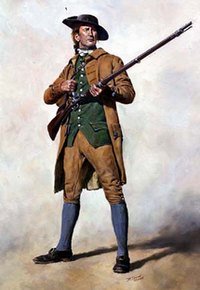
When the founding fathers spoke of “militias,” they were not referring to a bunch of yahoos running around in the woods with paint on their faces outside of state control.
They were referring to a citizen army under state control.
So is “militia” just the old-time word for what our army is today?
No.
A standing or “regular” army is one made up of professional, full-time soldiers like the US Army, the Marines, the Navy, and the Air Force. And it’s permanent, meaning you don’t disband the army when the fighting is done.
A militia back in those days was something completely different.
The problem of a standing army
The founding fathers knew they needed to provide for the common defense, but they saw standing armies controlled by a central government as an immediate threat to the liberty the new union sought to preserve.
Why would they think that?
Easy. History was littered with case after case where standing armies had become a law unto themselves and oppressed the populace. One glaring example is what happened to the Roman empire. It suffered centuries where this faction and then that faction of the army was in control, and it brought nothing but a continual procession of civil wars and bloodshed.
History also showed that even if the military didn’t take over, kings and queens were happy to wield standing armies to impose their will and oppress the people. Remember: the world then was ruled by monarchies. The founders had never seen a standing army wielded by any other type of power.
So the founders didn’t want to give a president or any other central authority that power. They feared doing so would only pave the way to the ruin of the new nation they sought to form.
So if you don’t have a standing army, how do you defend your country?
The fyrd
The founding fathers thought they saw a solution in a tradition of duty that went back hundreds of years in England. In the days when the Saxons ruled England, the kings and dukes would muster and deploy the fyrd to help them fight their wars.
The fyrd was made up of all able-bodied free males between certain ages, regardless of their vocation. It was their duty to provide their own arms and defend the land when called by their leaders. So this was an army made up of farmers, tanners, smiths, tailors, etc.
But the fyrd wasn’t a standing army. Nor was it populated with full-time soldiers. This citizen army was to be called out when needed, and when the crisis was over, it was disbanded, and the men went back to their vocations.
The militia scheme
The founders took this idea and tweaked it. Back in the Saxon days, the king controlled the fyrd. In this new scheme, the United States would rely on a fyrd (which they called a militia), but the powers to control it would be split between the president, Congress, and the States.
First, Congress, not the president, was the only authority that could declare war and summon the state militias. So the president would be the commander in chief when the militia was active. But the minute Congress decided to end a war and disband the militia, that army dissolved, leaving the president as commander in chief of only the tiny number of troops that had been authorized as the regular army (less than 1,000 at the time).
Second, while the Federal government would provide the weapons the militia would use when it mustered them for war, the state governments would be the ones to appoint the officers and train the soldiers. You can’t run an army without officers. So this would prevent the Federal government from taking control by stacking the army leadership with those loyal to a despot president or Congress.
So the militia was supposed to be the main force that fought our wars, and it was supposed to be temporary. It’s true that Congress did authorize a standing army, but it was tiny. And with this setup, the founders figured we’d have the army we’d need, but we’d avoid the problems standing armies had posed in the past.
So militias, as thought of by the founders in the 1700s, were not groups outside the government’s control. They were temporary citizen armies. And power over them was broken up between the president, Congress, and the States so no one group or person could wield them tyrannically.
1791 and The Bill of Rights
Accordingly, the founders wrote the articles and sections of the Constitution in 1787 to set all of this up. However, many anti-federalists were concerned that the Constitution didn’t go far enough to protect the rights of individuals and limit the power of the Federal government. In fact, many of the founders were so concerned about the issue that they refused to ratify the Constitution as it was.
The only way they’d sign on is with the promise of the Bill of Rights. When they knew that bill was forthcoming, delegates from nine of the original thirteen states ratified the Constitution. The delegates of two other states waited until the document was produced. The final two (North Carolina and Rhode Island) waited until 1791 when the Bill of Rights, which includes the second amendment, was passed.
So let’s look at the language of the Second Amendment in light of what we know about the fear the founders had of standing armies.
“A well regulated Militia being necessary to the security of a free State, the right of the people to keep and bear Arms shall not be infringed.”
Why did they include this? It was not because they wanted the citizens to be able to hunt or protect themselves with guns. They figured that was a given. They included this amendment because they concluded that an armed citizenry would make it impossible for tyranny to arise.
Noah Webster, a Federalist, stated the idea this way when trying to persuade Pennsylvania to ratify the Constitution:
“Before a standing army can rule, the people must be disarmed; as they are in almost every kingdom of Europe. The supreme power in America cannot enforce unjust laws by the sword; because the whole body of the people are armed, and constitute a force superior to any bands of regular troops that can be, on any pretense, raised in the United States. A military force, at the command of Congress, can execute no laws, but such as the people perceive to be just and constitutional; for they will possess the power, and jealousy will instantly inspire the inclination, to resist the execution of a law which appears to them unjust and oppressive”
So the second amendment was included in the Bill of Rights because enough of the founders feared that the Constitution could be read in a way that would allow the Federal government to disarm the populace. Disarming the populace would open the way to a standing army under Federal control. And that would open the way to tyranny.
When all was said and done, the founders separated the power of the military in this way:
Only Congress could declare war and muster the militia
Only Congress could finance it
There would be no standing army to speak of
Only the states could appoint officers to the militia
The government was forbidden to infringe on the rights of individuals to keep and bear arms
So what happened?
Militias didn’t work
The problem is the militia didn’t work well enough to actually provide for the common defense.
It didn’t work during the Revolutionary War. The republic had to create the Continental Army. That army was supported by the militias, but the colonists found they couldn’t rely on the militias alone. They had to have the regular army to fight the British.
After the war, the Continental Army was disbanded, but the militias simply weren’t good enough to face the threats the new nation faced, and George Washington himself openly lamented it. The troops took a licking in 1791 at the battle of St. Claire’s and then time and again during the War of 1812.
Heck, militias didn’t even work in the days of the fyrd. In those days, the Saxon and Norman kings relied on their house warriors (their standing army) and mercenaries for most of the work. They only supplemented with the fyrd.
1792
After the defeat in 1791, the early leaders concluded they needed a regular army with the training and skill it possessed. So in 1792 Congress authorized the creation of the First Legion of the United States, a standing army of 5,190 men. The legion was renamed “The United States Army” in 1796.
In 1792 Congress also passed the Militia Acts. The acts were written to expire in two years. But Congress wrote another in 1795 to replace them. These laws authorized the president to called out the militia “whenever the United States shall be invaded, or be in imminent danger of invasion” and “whenever the laws of the United States shall be opposed or the execution thereof obstructed, in any state, by combinations too powerful to be suppressed by the ordinary course of judicial proceedings, or by the powers vested in the marshals by this act.”
So a mere five years after the Constitution was first ratified, and a year after the Bill of Rights, Congress dramatically increased the size of the nation’s standing army and gave the President the authority to call out the militia! It’s clear that right from the beginning the militia scheme started showing some cracks.
Today
The First Legion was small. But it grew again in 1808, and then again during the war of 1812. And it continued to grow slowly, then ballooned in the 1900s until we now have more than a million troops in the armed forces of the US.
The National Guard is what the militias of the 1800s transformed into in the early 1900s, but, wouldn’t you know it, the National Guard is now mostly under the control of the Federal government too.
What does this mean?
It means we now have the most powerful standing army the world has ever known and almost no militia. It means our military is a complete 180 of what the founders envisioned.
I’m not saying it’s bad. I love our military.
I’m merely pointing out that militias back then meant a certain thing and the founders wanted them for a certain reason. And that we have completely replaced that arrangement with the exact opposite.
As for tyranny, we still have armed citizens. Maybe this is enough to deter tyranny as Webster claimed. Although the disparity between what the citizens can arm themselves with now and what the regular army has is nothing like it was in the 1700s. So maybe there are other laws and aspects of our culture that have prevented it. Maybe it’s both.
Either way, it’s important to understand what the original militias were, why the founders wanted them, and what the second amendment was all about.
Here are all of the parts of the original seven articles of the Constitution that deal with the military.
Article 1 – The Congress
Section 8
This section gives Congress seventeen powers. Six of these have to with the common defense. Those military powers granted are:
To declare War, grant Letters of Marque and Reprisal, and make Rules concerning Captures on Land and Water;
To raise and support Armies, but no Appropriation of Money to that Use shall be for a longer Term than two Years;
To provide and maintain a Navy;
To make Rules for the Government and Regulation of the land and naval Forces;
To provide for calling forth the Militia to execute the Laws of the Union, suppress Insurrections and repel Invasions; [notice there are only three cases that warrant the calling forth of the militia]
To provide for organizing, arming, and disciplining, the Militia, and for governing such Part of them as may be employed in the Service of the United States, reserving to the States respectively, the Appointment of the Officers, and the Authority of training the Militia according to the discipline prescribed by Congress;
Section 10
This section prevents the States from doing thirteen things. Three of these have to do with the military.
“No State shall, without the Consent of Congress, lay any Duty of Tonnage, keep Troops, or Ships of War in time of Peace, enter into any Agreement or Compact with another State, or with a foreign Power, or engage in War, unless actually invaded, or in such imminent Danger as will not admit of delay.”
Article 2 – The President
Section 2
“The President shall be Commander in Chief of the Army and Navy of the United States, and of the Militia of the several States, when called into the actual Service of the United States;”
Article 4 – The States
Section 4
“The United States shall guarantee to every State in this Union a Republican Form of Government, and shall protect each of them against Invasion;”
If you want to understand the secret to Mormonism, something 99.9% of the world does not know, even though many think they do, read on.
This last Tuesday I was at dinner with a number of wonderful coworkers. We were talking about religion and listening to the guy who helps set up our training environments talk about the interesting hunting ministry he’s involved with (it’s very cool—12,000 acres of woodland in Alabama all dedicated to hunting, outdoor survival, and God).
At one point in the conversation, a delightful fellow trainer, who shared with us the night before the definition of diplomacy as being able to tell someone to go to hell and have them look forward to the trip, asked me, “Does your church believe in Christ. Or, no, is it some other fellow?”
It’s a great question, and I realized that many people are confused. And so I wanted to take time to clear it up.
So what the heck is a Mormon?
It’s not what you think.
And for those of you who think you know, nope, it’s not about that book.
Let me explain. You’ll come away knowing more about us than anyone in any of your circles, and you can lord your superior knowledge over them at dinner parties, when playing games that require vast stores of smarts, or at random moments, just because you can.
Here’s the deal. The first part of the name of the church is “The Church of Jesus Christ.” So, yes, we believe in Christ, that he died for us, was resurrected, is our Lord and god, etc.
The last part of the name is “of latter-day saints.” We don’t use “saint” to mean super-holy people like the Catholic church does, but more as followers or disciples. So you could translate the last part of the name of our church as “of latter-day followers.”
So the whole name would be The Church of Jesus Christ of Latter-day People who Follow Him.
Okay, then what’s the deal with the name “Mormon”?
Well, here’s where we get to the nub of it and the thing that 99.9% of the world doesn’t know. The key difference between the Mormon church and other Christian churches is that we believe that Jesus has called apostles again in our day, just like he did back in the good old days. And when I say apostles, I mean guys like Peter, James, John, Paul, etc.
You might be wondering what an apostle is. What made those guys special?
It wasn’t that they had great faith in Jesus. Lots of people had great faith. It was that they were called to bear special witness of him. And that special witness was not merely that they believed, but that they knew Jesus was the Messiah because they had seen and heard him after his resurrection.
Peter himself said it best when he wrote in his letter, “For we have not followed cunningly devised fables, when we made known unto you the power and coming of our Lord Jesus Christ, but were eyewitnesses of his majesty.”
When the apostles had to choose someone to replace Judas, Peter said, “Wherefore of these men which have accompanied us all the time that the Lord Jesus went in and out among us, beginning from the baptism of John unto that same day that he was taken up from us, one must be ordained to be a witness with us of his resurrection.”
These guys didn’t simply believe. They knew. They were eyewitnesses to the fact that Jesus wasn’t just some preacher—he was the son of God and was resurrected.
So Mormons believe that Jesus has called apostles again today who bear witness of an absolute certain knowledge of the reality of Jesus the Christ. We believe their purpose is also to be the Lord’s spokesmen when He wants to make general announcements or give general instructions. Finally, we also believe they’ve received the authority to offer the covenants the Lord wants to make with all of us.
We believe the first apostle called in these latter days was a fellow by the name of Joseph Smith. We don’t worship Smith. He was just an apostle. Just like Matthew or John of old were. But we do believe the Lord called him to be an apostle and restore some truths that had gotten lost or confused over the years.
We also believe the Lord asked him to bring forth other scriptures in addition to those in the Bible. One of these new scriptures was a translation of an ancient record called The Book of Mormon. It’s called that because Mormon is the name of the guy who wrote it. And Mormon was another apostle—one called by Jesus in ancient America.
And guess what the purpose of The Book of Mormon is? It’s to testify of Jesus Christ and explain his gospel.
So the name of the Mormon church is really The Church of Jesus Christ of Latter-day Saints. Mormons believe that Jesus has called and commissioned apostles in our times, right up to today, to bear special witness of him. And in addition to that, those apostles have brought forth additional scriptures that witness of the divinity and mission of Jesus Christ.
For Mormons, it’s all about Jesus Christ.
So when someone asks, what’s a Mormon? You can say, let me tell you the real answer. It’s not about an additional book of scripture. Yes, folks gave them the nickname of Mormons because of that book, but the key difference is that Mormons believe that Jesus has called apostles like Peter and Paul again in our day to be his spokesmen, and bear a certain witness of him and his good news, and help folks receive all the blessings the Lord wants to pour out on them.
And, O, what a wonderful message we Mormons believe that is.
Every year the Alfred E. Smith Foundation hosts a millionaires-only fundraising dinner for Catholic charities. It’s a custom to have the two main candidates speak in election years. President Barack Obama and Governor Mitt Romney roasted themselves and each other this week, just two days after their brouhaha second debate.
Not only are both talks funny, but the fact that these two men came together for this purpose says a lot about both of them. Go Obama and Romney! It’s the perfect antidote to bitter political rancor.
Doesn’t the question of whether it is “a problem worth solving” depend critically on how many people would actually derive a benefit?
You could interview dozens of people who say that they would like book ratings, but that is just a drop in the bucket to the hundreds of millions of people who read books.
Do you have an idea of what percentage of book readers say they would like to see books with ratings?
Also, even if some people say they would like to see books with ratings, how useful are the ratings really? Sure, parents could avoid buying books for their children based on the ratings. But will that really stop children from reading certain books? Wouldn’t a large number of children actually want to read a book more if it appears to be forbidden fruit? Couldn’t such children go to the library or the bookstore themselves to read such books? Or borrow them from friends? Or download them from the Internet?
Good questions all, John. They’re all part of what customer discovery is meant to find out. I have my hypotheses; the customer discovery process helps me validate and test them.
As far as how useful ratings are to folks, my hypothesis is that they’d be as useful as they are to folks who see movies. And a heck of a lot of people use movie ratings of one kind or another.
How will interviewing a few people who self-select to say they “wish books had ratings for sex, violence, and language” help you find out what percentage of book readers want book ratings?
It seems to me the only reasonable way to answer that question is to survey a statistically significant number of book readers, in as broad and unbiased a sample as possible.
For answering the question of what percentage of book readers want a rating system, your sample would be useless since you have asked them to self-select for wanting a rating system.
I doubt your hypothesis that book ratings would be as useful as movie ratings. The difference is that movie theaters and many movie sellers will not allow underage people to view movies not rated for them. But I find it very unlikely that libraries, and unlikely that most bookstores, would be willing or able to prevent certain people from reading books based on ratings.
Also, if I understand you correctly, the book ratings would be more complicated than movie ratings. Restricted movies are basically R rated movies, or PG-13 parents strongly cautioned. The R-rating is simple for movie theaters to enforce — check ID and if under 17 then no go.
But with a book rating not just based on age of reader, it would be nearly impossible for libraries or booksellers to enforce. So children would have a much easier time getting books that there parents don’t want them to get as compared to getting into a movie theater to watch an R-rated movie.
It seems to me that book ratings could possibly have the opposite of the intended effect. If parents try to prevent their children from reading books with certain ratings, then those books will become more desirable to many children, and children will seek those books out specifically. And since such books will be easily available from the library, booksellers, friends, or the Internet, then those books rated for racy sex, extreme violence, or banned language may be read by even more children than if there were no ratings to steer the children towards the thrilling “forbidden” books.
By the way, most of my doubts are in regards to using such a rating system for “young adult” books, since I am assuming that such a rating system would be used by parents in an attempt to prevent their children from reading certain books.
However, if we are talking about people making decisions for their own reading, then it seems to me that the rating system makes more sense. I know some adults do not want to read books that use certain words they do not like, or which describe sex or sexuality in a straightforward or explicit manner. Such people could make their own reading decisions based on book ratings.
In such a case, I can see your survey providing useful information. For people deciding whether they want to read a book, what information would they like that is not currently provided by cover blurbs or amazon reviews? That would be the area that book ratings might be helpful for some people.
John,
Interviews are only one part of a larger customer discovery or development process. I’ll be doing other things to assess market size. In this part of the process I’m looking to talk to early adopters, folks who have a large problem they want to fix.
As for parents and ratings, you’re making an assumption about the goal of this that’s incorrect. I’m not seeking to provide a solution to a rating enforcement need. This isn’t a policing solution. It’s a customer information solution. What customers do with it is beyond the scope.
And it would be for all books, but YA book readers and purchasers are probably a key market segment. Also, it’s incorrect to assume that YA is read only by youths. A very large portion of YA is read by adults–30% or 60%. I can’t remember the number, but it was large. Many adults read YA because it used to be a “safe” genre. And because it moves more quickly.
A rating system may be useful, but I’ve found that by going to websites like Amazon and reading the customer reviews I can get a pretty good feel for a book’s content. Could this be a problem that is already solving itself?
I’m one of those adults that like to read YA because it is ‘safe’. My children are a little too young right now to read heavily (mt oldest is 9), but I’m already encouraging them to find out what others have said about a book before reading it.
I’m not entirely sure where you’re going with this, but I’ve got a few questions/thoughts on the matter.
1) This is the digital age. Five minutes with Amazon, Good Reads, Wikipedia, or Google is about all you need to find out every plot detail of most novels, let alone if it contains graphic content.
2) Most people pick up books upon referral, usually given by people who have similar tastes in fiction. We’ve all had people who have different tastes refer us to books that weren’t to our individual liking. With these people common sense tells you after one such experience to not read books they tell you about.
3) Presentation is more important in written fiction than in any other medium. You can present the exact same action sequence, featuring the exact same dialog and actions three different times, and depending on presentation they can all have completely different tones. One presentation you might find offensive, another you’re completely okay with. A rating system, V for violence, does little to distinguish between the two.
With all that being said, I think a rating system would be redundant. We’ve been trained for decades to check movie or even video game ratings, and if it wasn’t for that those rating systems would be just as redundant.
On a side note, I somehow doubt that most of the adults who read YA do so because it’s safe. I would be if there was a poll, most of these readers would list pace as the primary reason for reading YA, maybe even the lack of political fluff as the second reason.
Pete,
It might be. This is, in part, why I’m conducting interviews. I want to see how people for whom this is an issue are currently resolving the issue. So far, some have mentioned reading the reviews on Amazon but a surprising number are simply reading into the books and getting annoyed.
James,
My response to your points.
1) You’re making an assumption about what people do. That’s your hypothesis. The question is: is it valid? Specifically, is it valid for lots of folks who are looking to vet books for sex, violence, and language? I’m making assumptions as well. And the validation for those assumptions are going to be found by talking to folks. If I talk to lots of folks who have this issue but solve it in two seconds with internet searches, then there’s no need to proceed and develop the solution. If not, then it suggests I make a wider search.
2) Sometimes. You’re making another assumption that would need to be validated. I just talked to a fellow whose friend usually recommends great stuff. He recommended a book. The fellow I talked to found nothing objectionable in the first chapters and so put the audio in the car with the kids. 1/3rd the way into the book, a character started to drop the f-bomb all over the place. In this case, the fellow I talked to was annoyed because he had just wasted time and money on a book he was going to return. But he wasn’t going to immediately discount everything his friend would recommend in the future either. And what if he does stop listening to that friend’s recommendations? That still doesn’t prevent him from having the same experience in the future.
Getting out and talking to people is helping me see if my assumptions are correct.
3) A rating as you suggest doesn’t make much distinction. But I haven’t suggested any solution yet. I’m still in problem validation mode.
As for redundancy, this is yet another hypothesis. Rating systems might be redundant for a lot of people. They might not be for a lot of people. My question at this point is whether there are enough people with this issue to warrant further investigation.
As for your side note, I didn’t say “most” 🙂 I said “many.” But that too is an assumption that needs to be validated.
When doing product development, the first thing we need to do is validate as many of the key assumptions as possible. That’s what I’m currently in the midst of. And the best way to do that is to form my hypotheses and then talk to people who have this issue, not speculate about what they might or might not do 🙂
Does it make better sense now?
I really don’t hate the idea of some sort of content label for books; especially if it was something along the lines of “Contains Mild Profanity, Violence, and Sexual Content.” As the parent of a two and a half year old, I pretty much put blind faith into the idea that her pop-up books won’t broach any topics I don’t think she is ready for. Once her books start having chapters, I’d rather not have to read them to know what’s in them.
I don’t have the delusion that I can completely prevent her from seeing content I think is too adult, but this would be a convenience for what will no doubt be an uphill battle.
John
My points weren’t criticisms but just general thoughts I had while reading your post and a few of the questions you will hear from potential customers. Also, after thinking about it for a few minutes, I’d have to retract my guess of pacing being the number one reason for adults reading YA and put nostalgia in its place followed by pacing.
James,
I didn’t take them as criticisms 🙂 But they did come across as statements of fact. What I was trying to clarify is that I think they’re actually assumptions, hypotheses. When developing a new product, the key thing is to ID key assumptions and then validate them.
As for why so many adults read YA, I think your first assumption about pacing is probably more accurate. My wife and I read a lot of YA, and we don’t do it for nostalgic reasons. But that’s my assumption. I could be wrong. When trying to develop a product, I think it’s important to label such things as assumptions until we have data that validates them.
I work in a school library (grade 7-12) and while we have a separate section for senior fiction and in a few cases some books are labeled 11-12 only. While I like to think myself as well read, there is only so much time in a day to research content on books we are ordering for the library. I think something simple as content warning regarding violence, sex and language would be useful as despite what people think not all reviews single out these items. It could be something as simple as a sticker on the book, or more information on the publisher’s website.
As for enforcement, it is easy here as we can limit what the students are allowed to read without written consent from their parents.
Depending when the round table chat is going to take place, I may or may not be available as I will be on vacation soon (all 14 days of it).
Cheers,
David
Thanks, David. I’ve sent you an email. These are all one-on-one chats.
Jennifer B. told me about your quest and asked if I’d be willing to contact you and help out with your survey. I am an avid “filter” user for both books and movies (and everything else)and would be willing to chat if it would helpful. I’m an avid reader and am mother to many readers (one of whom is a voracious reader). There are numerous blogs and sites already devoted to this issue (which I applaud) but the more the merrier. =)
I think a rating system for books would be very useful! When I browse through a selection of movies to rent I can glance at the back cover and instantly have an idea of whether it has content I’d be uncomfortable with, but when browsing through a bookstore or library I have to look up every book and read several reviews (which isn’t even possible to do on my phone–yes it’s the digital age but not everyone has a smartphone), or else read the back cover and decipher whether it hints at any mature content by using words like “raunchy.” For a long time I’ve been wishing there was something simple stamped on books so it could save me the time, especially since I’ve been in the situation more than once in which I’d already gotten the book home and put hours into it just to come across a very explicit scene I didn’t want to read.
I agree with many that we shouldn’t be trying to ban books, and I would hypothesize that a rating system may actually help steer people away from that as a solution. With the current system of books being either available or banned, and access of information being either extensive research or reading through all of it yourself, anything people find objectionable they feel must be banned so others will know it has that content before they read it unknowingly. Moving to a system that gives a clear idea of what kind of content is in books right away could give at least a framework to organize the chaos and offer a saner alternative to banning. School library staff would save countless hours of research to make sure they carried literature that was appropriate. My eighth grade science teacher probably wouldn’t have gotten away with including in his curriculum for several years his own novel, which contained an alien rape scene–perhaps school administrators with the apathy not to read through the book may have at least referred to its rating.
Although it wouldn’t be made for the purpose of censorship through laws, a rating system could mean a guideline for parents as well—as another comment said, it’s sure to be an uphill battle for parents guiding their children toward wholesome media. Yes, some kids would jump at the opportunity to seek directly after “forbidden fruit,” but don’t you think those kids find ways of doing that already? Is that reason enough to limit information on texts that are available to the public in order to hope kids don’t come across something inappropriate on their own? As well as benefiting adults in their reading selection, that prior information about a book could mean the difference for a lot of the kids who are honestly just looking for a good story. Personal responsibility needs to be adopted at some point, and making the decision not to choose a movie (or book) because it has a certain rating can be much easier than getting halfway through it and disciplining oneself not to continue.
I had no idea I had this much to say about the idea, and I’m sure I would be even less eloquent about my argument in person (that’s probly why I wrote all that down), but I would be open to an interview. =)
I was sent over to your site by Rachel on Goodreads. I have considered the idea of book ratings before, but find it pretty problematic. All the same, I would be interested in an online chat or phone call about this, if it helps you in your research.
I usually do a lot of research into books my kids will have a chance to read, and then I use that research to decide if I am going to read it to approve it for them. This represents a lot of steps and effort for each and every book, which gets tiring after awhile. Half the books I read a year are for my kids, and I read about fifty books a year. I sometimes would like a simpler method of screening for content. For me this does not represent censorship in that I don’t debate the existence of certain books, only whether or not I want to give a large amount of my time and energy to reading them. And may I say, this is one of those reasons why I look forward to my kids growing up and making their own choices. 🙂
Here are a few of my initial ideas:
pro:
Fewer surprises when finding good lit for my kids, and for myself. I have done extensive research on a certain book and risked not reading it, only for my daughter to encounter multiple adult scenes in what was supposed to be YA historical fiction.
con:
even the movie ratings that have been with us for so long can not be trusted. Their standards have shifted over the years. They are not specific enough- but then how can they be?
The same scene done differently in a classic novel as opposed to a modern novel could end up looking the same as per rating, but feel very differently to the reader.
How would a rating system offset the expansion of the definition of YA to include everyone from early 20s to the preteen?
Would it be able to be controlled to prevent the slide along the continuum of standards? In other words, looking at movie ratings, what was an R movie in the 60s is now a PG-13, or even a ‘hard’ PG.
Would a rating system be able to keep up with the many books that come out each year? There are more books than movies, by far, aren’t there?
Some of the things my very particular daughter wishes to avoid would be very difficult for a rating system to capture. The result for me would be reading everything anyway. To be honest, it comes down to this: I wish there would be a thorough and trustworthy system, but nothing will ever replace my own work. I just can’t see how a rating system could replace the running lists and perceptions I have in my head. In some cases, it could help a little. But would it really simplify things for me, or just set me up?
I would be curious to see how a rating system affects school and public libraries. There’s a political pit for you to be stepping into!
Finally, I am glad to see a discussion on this. If books for children weren’t being changed so quickly, we might not even need to discuss the issue.
I would love to see some kind of rating on books, as this can be very hard to find out without skimming the book or reading reviews which frequently give away important plot points.
An easy implementation could be something along the lines of low, medium & high for the categories of language, violence, & sexual content. It might look something like this for an age 11 book:
L:low
V:med
S:low
Or for an adult sci-fi book that I may want to avoid:
L:high
V:high
S:med
They wouldn’t have to be colored green or red to indicate “bad” or “good”, as this varies by individual, but could still give someone an idea before they get 1/4 of the way into a book and have to put it down in disappointment.
 Back in 2011 I wrote a post titled “Since when did young adult fiction become the cure for cancer?” It was a response to all the YASaves hysteria. The main point of my amazing post (grin) was that the people complaining about some YA content wanted not to ban books, but to simply have a way to more easily evaluate if they wanted to buy a particular book in the first place.



 When the founding fathers spoke of “militias,” they were not referring to a bunch of yahoos running around in the woods with paint on their faces outside of state control.
Doesn’t the question of whether it is “a problem worth solving” depend critically on how many people would actually derive a benefit?
You could interview dozens of people who say that they would like book ratings, but that is just a drop in the bucket to the hundreds of millions of people who read books.
Do you have an idea of what percentage of book readers say they would like to see books with ratings?
Also, even if some people say they would like to see books with ratings, how useful are the ratings really? Sure, parents could avoid buying books for their children based on the ratings. But will that really stop children from reading certain books? Wouldn’t a large number of children actually want to read a book more if it appears to be forbidden fruit? Couldn’t such children go to the library or the bookstore themselves to read such books? Or borrow them from friends? Or download them from the Internet?
Good questions all, John. They’re all part of what customer discovery is meant to find out. I have my hypotheses; the customer discovery process helps me validate and test them.
As far as how useful ratings are to folks, my hypothesis is that they’d be as useful as they are to folks who see movies. And a heck of a lot of people use movie ratings of one kind or another.
How will interviewing a few people who self-select to say they “wish books had ratings for sex, violence, and language” help you find out what percentage of book readers want book ratings?
It seems to me the only reasonable way to answer that question is to survey a statistically significant number of book readers, in as broad and unbiased a sample as possible.
For answering the question of what percentage of book readers want a rating system, your sample would be useless since you have asked them to self-select for wanting a rating system.
I doubt your hypothesis that book ratings would be as useful as movie ratings. The difference is that movie theaters and many movie sellers will not allow underage people to view movies not rated for them. But I find it very unlikely that libraries, and unlikely that most bookstores, would be willing or able to prevent certain people from reading books based on ratings.
Also, if I understand you correctly, the book ratings would be more complicated than movie ratings. Restricted movies are basically R rated movies, or PG-13 parents strongly cautioned. The R-rating is simple for movie theaters to enforce — check ID and if under 17 then no go.
But with a book rating not just based on age of reader, it would be nearly impossible for libraries or booksellers to enforce. So children would have a much easier time getting books that there parents don’t want them to get as compared to getting into a movie theater to watch an R-rated movie.
It seems to me that book ratings could possibly have the opposite of the intended effect. If parents try to prevent their children from reading books with certain ratings, then those books will become more desirable to many children, and children will seek those books out specifically. And since such books will be easily available from the library, booksellers, friends, or the Internet, then those books rated for racy sex, extreme violence, or banned language may be read by even more children than if there were no ratings to steer the children towards the thrilling “forbidden” books.
By the way, most of my doubts are in regards to using such a rating system for “young adult” books, since I am assuming that such a rating system would be used by parents in an attempt to prevent their children from reading certain books.
However, if we are talking about people making decisions for their own reading, then it seems to me that the rating system makes more sense. I know some adults do not want to read books that use certain words they do not like, or which describe sex or sexuality in a straightforward or explicit manner. Such people could make their own reading decisions based on book ratings.
In such a case, I can see your survey providing useful information. For people deciding whether they want to read a book, what information would they like that is not currently provided by cover blurbs or amazon reviews? That would be the area that book ratings might be helpful for some people.
John,
Interviews are only one part of a larger customer discovery or development process. I’ll be doing other things to assess market size. In this part of the process I’m looking to talk to early adopters, folks who have a large problem they want to fix.
As for parents and ratings, you’re making an assumption about the goal of this that’s incorrect. I’m not seeking to provide a solution to a rating enforcement need. This isn’t a policing solution. It’s a customer information solution. What customers do with it is beyond the scope.
And it would be for all books, but YA book readers and purchasers are probably a key market segment. Also, it’s incorrect to assume that YA is read only by youths. A very large portion of YA is read by adults–30% or 60%. I can’t remember the number, but it was large. Many adults read YA because it used to be a “safe” genre. And because it moves more quickly.
A rating system may be useful, but I’ve found that by going to websites like Amazon and reading the customer reviews I can get a pretty good feel for a book’s content. Could this be a problem that is already solving itself?
I’m one of those adults that like to read YA because it is ‘safe’. My children are a little too young right now to read heavily (mt oldest is 9), but I’m already encouraging them to find out what others have said about a book before reading it.
I’m not entirely sure where you’re going with this, but I’ve got a few questions/thoughts on the matter.
1) This is the digital age. Five minutes with Amazon, Good Reads, Wikipedia, or Google is about all you need to find out every plot detail of most novels, let alone if it contains graphic content.
2) Most people pick up books upon referral, usually given by people who have similar tastes in fiction. We’ve all had people who have different tastes refer us to books that weren’t to our individual liking. With these people common sense tells you after one such experience to not read books they tell you about.
3) Presentation is more important in written fiction than in any other medium. You can present the exact same action sequence, featuring the exact same dialog and actions three different times, and depending on presentation they can all have completely different tones. One presentation you might find offensive, another you’re completely okay with. A rating system, V for violence, does little to distinguish between the two.
With all that being said, I think a rating system would be redundant. We’ve been trained for decades to check movie or even video game ratings, and if it wasn’t for that those rating systems would be just as redundant.
On a side note, I somehow doubt that most of the adults who read YA do so because it’s safe. I would be if there was a poll, most of these readers would list pace as the primary reason for reading YA, maybe even the lack of political fluff as the second reason.
Pete,
It might be. This is, in part, why I’m conducting interviews. I want to see how people for whom this is an issue are currently resolving the issue. So far, some have mentioned reading the reviews on Amazon but a surprising number are simply reading into the books and getting annoyed.
James,
My response to your points.
1) You’re making an assumption about what people do. That’s your hypothesis. The question is: is it valid? Specifically, is it valid for lots of folks who are looking to vet books for sex, violence, and language? I’m making assumptions as well. And the validation for those assumptions are going to be found by talking to folks. If I talk to lots of folks who have this issue but solve it in two seconds with internet searches, then there’s no need to proceed and develop the solution. If not, then it suggests I make a wider search.
2) Sometimes. You’re making another assumption that would need to be validated. I just talked to a fellow whose friend usually recommends great stuff. He recommended a book. The fellow I talked to found nothing objectionable in the first chapters and so put the audio in the car with the kids. 1/3rd the way into the book, a character started to drop the f-bomb all over the place. In this case, the fellow I talked to was annoyed because he had just wasted time and money on a book he was going to return. But he wasn’t going to immediately discount everything his friend would recommend in the future either. And what if he does stop listening to that friend’s recommendations? That still doesn’t prevent him from having the same experience in the future.
Getting out and talking to people is helping me see if my assumptions are correct.
3) A rating as you suggest doesn’t make much distinction. But I haven’t suggested any solution yet. I’m still in problem validation mode.
As for redundancy, this is yet another hypothesis. Rating systems might be redundant for a lot of people. They might not be for a lot of people. My question at this point is whether there are enough people with this issue to warrant further investigation.
As for your side note, I didn’t say “most” 🙂 I said “many.” But that too is an assumption that needs to be validated.
When doing product development, the first thing we need to do is validate as many of the key assumptions as possible. That’s what I’m currently in the midst of. And the best way to do that is to form my hypotheses and then talk to people who have this issue, not speculate about what they might or might not do 🙂
Does it make better sense now?
I really don’t hate the idea of some sort of content label for books; especially if it was something along the lines of “Contains Mild Profanity, Violence, and Sexual Content.” As the parent of a two and a half year old, I pretty much put blind faith into the idea that her pop-up books won’t broach any topics I don’t think she is ready for. Once her books start having chapters, I’d rather not have to read them to know what’s in them.
I don’t have the delusion that I can completely prevent her from seeing content I think is too adult, but this would be a convenience for what will no doubt be an uphill battle.
John
My points weren’t criticisms but just general thoughts I had while reading your post and a few of the questions you will hear from potential customers. Also, after thinking about it for a few minutes, I’d have to retract my guess of pacing being the number one reason for adults reading YA and put nostalgia in its place followed by pacing.
James,
I didn’t take them as criticisms 🙂 But they did come across as statements of fact. What I was trying to clarify is that I think they’re actually assumptions, hypotheses. When developing a new product, the key thing is to ID key assumptions and then validate them.
As for why so many adults read YA, I think your first assumption about pacing is probably more accurate. My wife and I read a lot of YA, and we don’t do it for nostalgic reasons. But that’s my assumption. I could be wrong. When trying to develop a product, I think it’s important to label such things as assumptions until we have data that validates them.
I work in a school library (grade 7-12) and while we have a separate section for senior fiction and in a few cases some books are labeled 11-12 only. While I like to think myself as well read, there is only so much time in a day to research content on books we are ordering for the library. I think something simple as content warning regarding violence, sex and language would be useful as despite what people think not all reviews single out these items. It could be something as simple as a sticker on the book, or more information on the publisher’s website.
As for enforcement, it is easy here as we can limit what the students are allowed to read without written consent from their parents.
Depending when the round table chat is going to take place, I may or may not be available as I will be on vacation soon (all 14 days of it).
Cheers,
David
Thanks, David. I’ve sent you an email. These are all one-on-one chats.
Jennifer B. told me about your quest and asked if I’d be willing to contact you and help out with your survey. I am an avid “filter” user for both books and movies (and everything else)and would be willing to chat if it would helpful. I’m an avid reader and am mother to many readers (one of whom is a voracious reader). There are numerous blogs and sites already devoted to this issue (which I applaud) but the more the merrier. =)
I think a rating system for books would be very useful! When I browse through a selection of movies to rent I can glance at the back cover and instantly have an idea of whether it has content I’d be uncomfortable with, but when browsing through a bookstore or library I have to look up every book and read several reviews (which isn’t even possible to do on my phone–yes it’s the digital age but not everyone has a smartphone), or else read the back cover and decipher whether it hints at any mature content by using words like “raunchy.” For a long time I’ve been wishing there was something simple stamped on books so it could save me the time, especially since I’ve been in the situation more than once in which I’d already gotten the book home and put hours into it just to come across a very explicit scene I didn’t want to read.
I agree with many that we shouldn’t be trying to ban books, and I would hypothesize that a rating system may actually help steer people away from that as a solution. With the current system of books being either available or banned, and access of information being either extensive research or reading through all of it yourself, anything people find objectionable they feel must be banned so others will know it has that content before they read it unknowingly. Moving to a system that gives a clear idea of what kind of content is in books right away could give at least a framework to organize the chaos and offer a saner alternative to banning. School library staff would save countless hours of research to make sure they carried literature that was appropriate. My eighth grade science teacher probably wouldn’t have gotten away with including in his curriculum for several years his own novel, which contained an alien rape scene–perhaps school administrators with the apathy not to read through the book may have at least referred to its rating.
Although it wouldn’t be made for the purpose of censorship through laws, a rating system could mean a guideline for parents as well—as another comment said, it’s sure to be an uphill battle for parents guiding their children toward wholesome media. Yes, some kids would jump at the opportunity to seek directly after “forbidden fruit,” but don’t you think those kids find ways of doing that already? Is that reason enough to limit information on texts that are available to the public in order to hope kids don’t come across something inappropriate on their own? As well as benefiting adults in their reading selection, that prior information about a book could mean the difference for a lot of the kids who are honestly just looking for a good story. Personal responsibility needs to be adopted at some point, and making the decision not to choose a movie (or book) because it has a certain rating can be much easier than getting halfway through it and disciplining oneself not to continue.
I had no idea I had this much to say about the idea, and I’m sure I would be even less eloquent about my argument in person (that’s probly why I wrote all that down), but I would be open to an interview. =)
I was sent over to your site by Rachel on Goodreads. I have considered the idea of book ratings before, but find it pretty problematic. All the same, I would be interested in an online chat or phone call about this, if it helps you in your research.
I usually do a lot of research into books my kids will have a chance to read, and then I use that research to decide if I am going to read it to approve it for them. This represents a lot of steps and effort for each and every book, which gets tiring after awhile. Half the books I read a year are for my kids, and I read about fifty books a year. I sometimes would like a simpler method of screening for content. For me this does not represent censorship in that I don’t debate the existence of certain books, only whether or not I want to give a large amount of my time and energy to reading them. And may I say, this is one of those reasons why I look forward to my kids growing up and making their own choices. 🙂
Here are a few of my initial ideas:
pro:
Fewer surprises when finding good lit for my kids, and for myself. I have done extensive research on a certain book and risked not reading it, only for my daughter to encounter multiple adult scenes in what was supposed to be YA historical fiction.
con:
even the movie ratings that have been with us for so long can not be trusted. Their standards have shifted over the years. They are not specific enough- but then how can they be?
The same scene done differently in a classic novel as opposed to a modern novel could end up looking the same as per rating, but feel very differently to the reader.
How would a rating system offset the expansion of the definition of YA to include everyone from early 20s to the preteen?
Would it be able to be controlled to prevent the slide along the continuum of standards? In other words, looking at movie ratings, what was an R movie in the 60s is now a PG-13, or even a ‘hard’ PG.
Would a rating system be able to keep up with the many books that come out each year? There are more books than movies, by far, aren’t there?
Some of the things my very particular daughter wishes to avoid would be very difficult for a rating system to capture. The result for me would be reading everything anyway. To be honest, it comes down to this: I wish there would be a thorough and trustworthy system, but nothing will ever replace my own work. I just can’t see how a rating system could replace the running lists and perceptions I have in my head. In some cases, it could help a little. But would it really simplify things for me, or just set me up?
I would be curious to see how a rating system affects school and public libraries. There’s a political pit for you to be stepping into!
Finally, I am glad to see a discussion on this. If books for children weren’t being changed so quickly, we might not even need to discuss the issue.
I would love to see some kind of rating on books, as this can be very hard to find out without skimming the book or reading reviews which frequently give away important plot points.
An easy implementation could be something along the lines of low, medium & high for the categories of language, violence, & sexual content. It might look something like this for an age 11 book:
L:low
V:med
S:low
Or for an adult sci-fi book that I may want to avoid:
L:high
V:high
S:med
They wouldn’t have to be colored green or red to indicate “bad” or “good”, as this varies by individual, but could still give someone an idea before they get 1/4 of the way into a book and have to put it down in disappointment.
Thanks, Collin 🙂