Taggart’s and a Secret

taggartsgrillMost of the time when you go to hole-in-the-wall restaurant, it’s a hole-in-the-wall.

But sometimes you strike gold.

And my youngest daughter and I struck big-time gold last week two miles east of Morgan, Utah, in the canyon between Morgan and Henefer off of exit 108. I’ve driven that stretch many times and never knew anything was off that exit. Literally, if you blink, you’ll think nothing is there.

But if you do, you will miss out on Taggart’s Grill.

It’s nestled in some trees up against the northern slope. The first thing that strikes you when you get out of the car is the delicious aroma. Then you notice the peacocks running about. And then you enter the diner and see a display case of tantalizing, large desserts such as cheesecake, carrot cake, and huge pink-frosted cookies.

The diner itself has a wonderful airy feeling with a high ceiling and lots of windows that offer views of the grove and garden surrounding the diner. There are seats outside in an area with a small waterfall. But we sat inside with the walls of log-cabin wood and the stained glass panels hanging in the windows.

They serve a variety of dishes from sandwiches and soups to pizza, burgers, and fancy plates of salmon or tenderloin. And while the views and setting is awesome, the food is where they really shine.

The beef stew was thick and amazing. The battered fries perfect. The sandwiches were wrapped in thick and soft flat bread that was delicious. And speaking of bread, they asked if I wanted a roll with the stew. I said yes. They didn’t bring out a roll–they brought out a small loaf of what appeared to be freshly baked bread. We of course had to try one of the desserts and opted for the
carrot cake. It was lovely with a hint of almond in the cream cheese frosting.

The portions were huge and so we took enough home for another meal for three.

We’re going back.

I want to try one of their burgers, the halibut, and the BLT.

If you like great food at a great price and are anywhere near Morgan, don’t blink at exit 108. Just pull off and enjoy an awesome meal.

*

Parents of Rich Middle School students, what if I told you that researchers have uncovered a secret activity that teens enjoy that has the side benefit of actually raising their grades in all of their classes.

But that’s not all. This one secret thing will help them get better jobs years in the future.

It will help them make more money.

And they won’t even know that it’s doing this for them. They won’t care. Because they won’t be doing it for the grades or money. They’ll be doing it for the enjoyment it brings. They’ll be doing it just because they like to do it.

One little surprising thing.

And it’s backed up by lots and lots of research.

Do you want to know what this activity is?

Do you want to open up opportunities for your child?

If you do, come to the meeting Mrs. Brown is having at 7:00 p.m. on Wednesday, October 12 at the Rich Middle School.

We will reveal all there.

Share

Similar Posts

  • The Veggie from Outer Space & The Mentalist

    I’ve been trying to increase my intake of vegetables and fruits because you are what you eat, and I think I’d like to look like a broccoli—long, sturdy, and with a lot of bushiness on top. So we’ve enjoyed our weekly box of fruits and veggies from the Bountiful Baskets co-op that we pick up in Garden City each Saturday.

    And we’ve enjoyed the surprises. Because someone else orders the produce, we never know quite what we’re going to get. Of course, this also means we sometimes get things we don’t normally seek out. Take cauliflower, for instance. We received a number of heads three or four weeks in a row back in October.

    Cauliflower?

    Who eats cauliflower? You ever hear anyone say: “Cauliflower’s on—let’s make a run to Brigham City to get some,” or “LaVern, I believe I’m going to knock back another floret,” or “It’s a party! You bring the chips and soda, I’ll bring the cauliflower?”

    No. We don’t hear those things because cauliflower is just weird. It’s the stuff that nobody eats on the vegetable tray. It looks like some growth spore from the planet Xenon. In fact, I want to know who started the rumor that aliens had big eyes and spindly limbs. That’s all propaganda. The aliens are already living among us, and cauliflower is their freaky pupal metamorphosis growth stage!

    Or, at least, that’s what I thought. Then I ate a serving of creamy mashed cauliflower at Ruby Tuesday’s and gained a testimony of both Ruby Tuesday’s and the weird white cousin of cabbage.  

    So when we received our surprise veggie, did I despair or use it for target practice on the idiot orange tom cat that comes around our house? No. I went to search for that Ruby Tuesday’s recipe. And through the miracle of the internets, I found it. Or something close enough for government work.

    Here it is. Enjoy.

    CREAMY MASHED CAULIFLOWER

    • 1 head cauliflower
    • ¾ C water
    • 1 T corn starch
    • 1/3 C heavy cream
    • 1 t granulated sugar
    • ¾ t salt
    • Pepper to taste
    • 1/8 t garlic powder
    • 1/8 t onion powder
    1. Divide the head of cauliflower into florets that are all roughly the same size. Steam or microwave until cauliflower is tender (we pressure cook it). Drain and toss it into a bowl of ice water to bring the cooking process to a screeching halt.
    2. Put florets into a food processor along with ½ C water. Puree on high speed until smooth, but with some small bits for texture. Or you can simply mash it like you do potatoes.
    3. Pour all the puree into a medium sauce pan. Dissolve the corn starch in the remaining ¼ cup of water and add to the puree.
    4. Add the cream, salt, pepper, garlic powder, and onion powder to the mixture and stir. Set the saucepan over medium heat and cook, stirring often, for 5-10 minutes, or until thick.

     You can experiment and switch the water for milk if you’d like, or if you don’t have cream. Leftovers are delicious. Of course, if I end up lumpy and round, you know it’s the cauliflower’s fault, or the alien’s that has set up shop in my chest cavity, whichever’s the truth. 

    For those who haven’t tried Bountiful Baskets, go to bountifulbaskets.org for more info. For those who wonder if cauliflower has any nutritional value at all, here’s the wikipedia on its goodness:

    “Cauliflower is low in fat, high in dietary fiber, folate, water and vitamin C, possessing a very high nutritional density. As a member of the brassica family, cauliflower shares with broccoli and cabbage several phytochemicals which are beneficial to human health, including sulforaphane, an anti-cancer compound released when cauliflower is chopped or chewed. Boiling reduces the levels of anti-cancer compounds, with losses of 20–30% after five minutes, 40–50% after ten minutes, and 75% after thirty minutes. However, other preparation methods such as steaming, microwaving, and stir frying had no significant effect on the compounds.

    Along with other brassica vegetables, cauliflower is a source of indole-3-carbinol, a chemical which boosts DNA repair in cells and appears to block the growth of cancer cells. The compound also appears to work as an anti-estrogen, appearing to slow or prevent the growth of tumors of the breast and prostate. Cauliflower also contains other glucosinolates besides sulfurophane, substances which may improve the liver’s ability to detoxify carcinogenic substances. A high intake of cauliflower has been found to reduce the risk of aggressive prostate cancer. Cauliflower is also a good source of carotenoids.”

    I guess the short version of all that is blah blah blah science says it’s good.

    ***

    Nellie and I have been enjoying The Mentalist for two years now. It’s a CBS crime thriller mystery series about a “mentalist,” a guy named Patrick Jane, played wonderfully by Simon Baker, who used to be a professional mind-reader and psychic, and a very good one at that, but gave it up and came clean. All psychics, he says in the pilot episode, are either fakes or deluded.

    But he was so good at it and made so much money–why would he give it up?

    Because a serial killer named Red John murdered his wife and daughter. So Jane has dedicated his life to hunting down and killing the murderer. To do that, he becomes a consultant to the California Bureau of Investigation (CBI) and works with a team of investigators.

    Some of the episodes are about the hunt for Red John. Many more are about other cases the team has to solve.

    Patrick Jane is the main attraction of the series. His outrageous behavior, acute observation skills, and keen wit all fascinate and delight. As the series progresses, the other characters take on their own interesting personalities as well. Agent Cho, for example, provides many moments of laugh-out-loud deadpan humor.

    The series is into its third season, but with the miracle of Netflix you can start at the beginning and watch them all commercial free at your own leisure.

    Share
  • |

    Animals in Translation by Temple Grandin + Interview

    I have read few books more interesting than Temple Grandin’s Animals in Translation: Using the Mysteries of Autism to Decode Animal Behavior.

    In it she describes her world of autism and how it helped her a perspective into animals unlike any other expert in the field. She can literally see what we block out. It’s part of what helped her make a huge impact on the meat packing industry.

    And it’s had an impact on her. When she was visiting her grandparents once in Arizona, she saw a squeeze chute in operation on a ranch. She saw the cattle calm, for the most part, in the chute. “Watching those cattle calm down,” she says, “I knew I needed a squeeze chute of my own.” So when she got back home she built a human-sized one with the help of her teacher. “I got through my teenage years thanks to my squeeze machine and my horses.”

    Grandin is not a vegetarian activitst (she eats meat herself) or a brutal slayer. She has taken the middle ground between the fantatics that want to prevent the consumption of all meat, on one hand, or totally disregard the life of animals on the other. She writes, she says, “because I wish animals could have more than just a low-stress life and a quick, painless death. I wish animals could have a good life, too, with something useful to do. I think we owe them that.”

    Temple has dozens and dozens of insights into animals, which she shares here. You’ll learn about rapist roosters and the problem of one-trait breeding, whether prediators find it “fun to kill a groundhog” (yes, she says, they do), whether animals have true cognition, and so many other things it’s impossible to list them here. I was fascinated on every page. If you have anything to do with animals, you’re going to LOVE this book.

    Get the book. Read it. In the meantime, watch a 27 minute interview of Temple by Doug Fabrizio on Utah NOW. I caught this on TV flipping through the channels and couldn’t look away. This is a fascinating interview of a fascinating woman.

    Source:Temple Grandin on Utah NOW

    Share
  • Sherlock Holmes, Mission Impossible, The Art of Shaving, Wages

    Sherlock Holmes & Mission Impossible
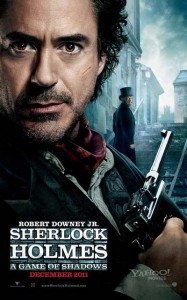
    I have been looking forward to two movies this holiday season. One of them was as good as I’d hoped it would be. The other disappointed me because the story tellers forgot to make things clear. The two movies were Mission Impossible: Ghost Protocol and Sherlock Holmes: A Game of Shadows.

    I loved the first Sherlock Holmes movie—the story was intriguing and plotted well, the atmosphere and music were amazing, and the characters and relationships were even better. In fact, the movie presented some of the most delightful characters I’ve enjoyed over the last few years. So it was a no-brainer to plan in a date to see this new episode.

    Sherlock Holmes: A Game of Shadows provided the same great atmosphere and music as I enjoyed before. Holmes and Watson were as wonderful as they’d ever been. The film introduced a wonderful new character: Madam Simza Heron, a gutsy gypsy who you can’t help but want to know better. And it brought on Professor James Moriarty, the uber-villian. There was plenty of the wit that we enjoyed in the first one. It had all the elements to work.

    However, the film fell down in its plotting. There were many times when I had no idea why the characters were doing what they were doing or how it fit into the overall threat. At other times, it appeared Sherlock could have taken out the villain but didn’t only because it would have ruined the plot.

    The film makers also decided to kill off one of the characters, and therefore relationships, that had provided so much satisfaction in the first movie. And they did it without much fanfare. Who thinks it’s a good idea to kill off beloved characters like that? If you’re going to kill someone we love, you’d better make it meaningful and the core of the film. Alas, they didn’t.

    In fact, it felt like there was too much stuffed into this film. Cool ideas that couldn’t be explored or have much impact including facial surgery for spies, a lost brother, European politics, resistance fighters, a henchman we hardly see. The wonderful Madam Simza Heron didn’t play the pivotal role she could have. So unlike Irene Adler in the first movie who becomes central to the story, she’s more of a bit of the setting.

    If you loved the first film, you’ll have to see this. There’s a lot of good. But you must go knowing it’s a grade lower than the first film.
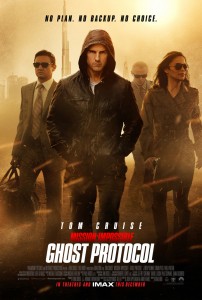
    Now, I stopped liking the Mission Impossible movies about thirty minutes into the second in the series. But the previews for Mission Impossible: Ghost Protocol intrigued me. I like Tom Cruise as an actor. And so we decided to give it a try.

    Mission Impossible: Ghost Protocol didn’t provide the atmosphere or super-delightful characters and relationships of Sherlock Holmes. But that’s not to say its characters were tepid. On the contrary, the cast was great with a lot of funny interplay. Furthermore, unlike some action films where everything seems to work for the hero, a lot of things go wrong for Tom Cruise’s character. These problems and his reactions are part of what make the movie.

    The story also provided plenty of “action” but did it in a new way. This is the first time, for example, I’ve seen a car chase in a sandstorm. And it was a fab chase. It’s also the first time I’ve seen a final battle in an automated parking lot. The director and writers did a good job choosing new twists on common action elements.

    But a story needs more than characters and new sights—the plot has to make sense. Especially when the plot takes center stage, which it does in action movies. And I’m happy to say that I never once wondered why our characters were doing something or how it affected the main threat. Furthermore, every one of the characters made a difference. The result was that I thoroughly enjoyed the film from start to finish. I can’t wait to watch it again. If you like action films, I think you’ll enjoy Ghost Protocol.

    The Art of the Shaving
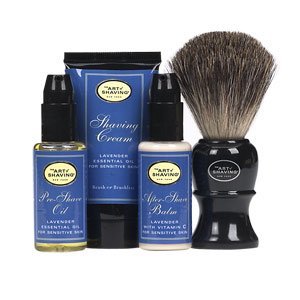
    When I was on a mission in the Netherlands I was an idiot and did not take care of my face in the winter. I’d hop onto the bicycle with the temperature hovering around zero degrees (not counting the wind chill) and bike out with Fearless Companion to an area to meet with people or knock on doors. And I’d do it with hardly a thing covering my face and ears. As a result, I damaged my skin.

    So now when I’m exposed to cold, my face flushes and stays that way for some time even when I’m in a warm house. I can’t wear cologne. And I’ve had a love/hate relationship with shaving. I can’t stand the prickle of a beard and so love to shave, but I hate the fact that when I shave, my face turns the color of a tomato for four to six hours. And this is when I use shaving cream specifically formulated for “sensitive skin.”

    But then I walked into The Art of Shaving store in Fashion Place Mall and learned that those shaving creams designed for sensitive skins weren’t super gentle. They just numbed the skin so you didn’t feel the shave. The folks at The Art of Shaving suggested, of course, I use their product.

    I bought a kit (I’m a sucker for good sales pitches even when I know I’m being suckered) which included: a badger hair brush (they say it is optional, but I love mine and wouldn’t do this without it), pre-shave oil, shaving cream, and after-shave balm. They had five types to choose from: unscented, lemon, sandalwood, ocean kelp, and lavender. I selected the lavender because it was formulated for sensitive skin. At first I was worried about being overpowered with the smell, but was pleasantly surprised to find the scent as light as a feather. I didn’t need a new razor; they said my Mach3 was just fine.

    I came home with my bag expecting a huge dose of buyer’s remorse. Except after my first shave with their product, my face didn’t flush. Could this really be a product that worked? I wasn’t willing to make that conclusion at the time. But now, after about a month of shaving, I can honestly say that this is the best shave I’ve had in years. My face doesn’t flush. The after-shave balm does what a balm is supposed to do–soothe. There’s no alcohol burn. In fact, I use the after-shave balm on non-shave days. If your skin hates shaving, let me suggest you visit theartofshaving.com and order some product or go to one of their stores. I think you’ll also become a fan. 

    Info for Choosing a Career

    There are many things I wished I’d done differently when choosing a career. I wish I’d broadened my horizon on the horde of different careers possible. I wish I’d really looked at what the various careers earned on average. Luckily for those looking to select a new career today, Utah’s Department of Workforce Services compiles data on more than 700 occupational wages and shows you the average and median annual wage as well as the average for inexperienced folks in that occupation.

    Not only does looking through the list help you see options you might not have considered, it also helps you get a realistic expectation for what you might earn in that profession. Now, the list, although large, doesn’t show every possible occupation (FBI agent, Marine) or every permutation of the occupations shown. For example, there’s one line for accountants and auditors, but there are tax accountants, fraud accountants, security accountants, auditing accountants, etc. Nevertheless, this is an excellent list to begin a search.

    To get the list, go to this state website: http://jobs.utah.gov/jsp/wi/utalmis/default.do. Click on “Utah Occupational Wages.” That will open a page with a map of Utah. Click on the link on the right “Utah Occupational Wages” to get the Excel spreadsheet of all 700+ occupations listed.


    Share
  • The Story Behind “Amazing Grace”

    John Newton writes the following about himself.

    “My father was a very sensible, and a moral man, as the world rates morality; but neither he, nor my step-mother, was under the impressions of religion: I was, therefore, much left to myself, to mingle with idle and wicked boys; and soon learnt their ways.”

    And learn them he did, and not just from wicked boys.  This is the John Newton who worked aboard a “respectable” slave ship and then became the captain of his own.  But this is also the John Newton who later wrote “Amazing Grace,” probably the most famous of all folk hymns.

    That song has been sung in countless arrangements and to different tunes. I love the version by The Five Blind Boys of Alabama sung to the music of “The House of the Rising Sun”.  Soulful.  Incredible.

    And the fabulous mash up of those two same songs performed by Jerry Lawson And The Talk Of The Town on NBC’s The Sing-Off season 2.

    And the more traditional version featured on the movie Amazing Grace sung by Chris Tomlin and titled “Amazing Grace (my chains are gone)”.

    There are simply too many wonderful versions to list.

    But what makes this song so wonderful is not only the words, but also the story behind the song.  This song isn’t a song of theology—it’s John Newton’s own heartfelt expression of gratitude to God, who helped him turn from his profane and wicked life and eventually fight against the ills he practiced.  Later in life, Newton became a supporter and inspiration to William Wilberforce who lead the fight to pass the British Slave Trade Act in 1807, which abolished the slave trade in that empire.

    Although the experience of Newton’s turning point is dramatic, and referred to in the song, his change didn’t occur over night.  In fact, it took him a number of years to fully come to himself.   It was 34 years AFTER he retired from slavery, which was years AFTER he turned toward a new life, that he published his forceful pamphlet Thoughts Upon the Slave Trade, in which he describes the horrific conditions of the slave ships and apologizes for a confession that “comes too late” and “will always be a subject of humiliating reflection to me, that I was once an active instrument in a business at which my heart now shudders.”

    My heart soars when seeing someone turn a life around (maybe because I’m in need of a turnaround).  It’s such a wonderful and instructive tale of hope.

    Recently, Asbury University Media Com students and an Asbury Art Dept student under the direction of Professor Greg Bandy produced a short 14 minute documentary called Amazing Grace: The Story Behind the Song on the fascinating story of how John Newton wrote the most famous hymn in the world . . . and helped bring about one of the most powerful social justice movements in the history of Western Civilization.  It’s a great tale.  Watch it below.

    Amazing Grace: The Story Behind the Song from Gregory Bandy on Vimeo.

    Share
  • |

    This American Life: Superpowers

    What superpower would you rather have–flight or invisibility? What do others choose? Why? What does it say about you?

    Want to hear about a gal named Zora who, as a teen, made a list of everything that a superhero would have to know how to do, things like flying helicopters and diffusing bombs, and then set out to do it. Zora finished her list, btw. She’s a bounty hunter now.

    You can hear this right now on  This American Life episode 178: Superpowers .

    It’s a fabulous hour-long program.

    Share
  • | |

    One of Orson Card’s best essays

    Scott Card recently wrote “Marriage needs lots of humor.” It’s an awful title for one of the best articles of his that I’ve ever read.

    I’m not going to spoil it for you. But I will say that I’ve found that it’s the small things that seem to make the biggest difference in relationships. And this is one of those small things that packs a HUGE punch. But not until this article did I realize it.

    And for you writers who are wanting insights on what makes characters interesting and sympathetic–there’s a little treasure trove here for you as well.

    Enjoy!

    Share