The last slot was filled just a few minutes ago, almost exactly 2 days after the announcement. Ten hardy souls have joined me for this journey. The goal is to finish 10 novels that are crackling with zing. I’ll report progress as we go. But now it’s heads down again because I’ve got my own novel to finish.
As new writers we want to do our best but because we haven’t yet internalized all the principles, we often want to create checklists of rules. We want to list out all the the aspects of a golden story and make sure we include them. And these lists can help.
Everything I’ve learned about building expertise suggests that experts have internalized guidelines, patterns, and concepts. But in the beginning we don’t have those internal constructs. And so we often are benefited by exetrnal support in the form of diagrams, lists, etc. Sooner or later we internalize. And what used to be conscious becomes automatic.
Case in point: Dean Koontz. In his book on how to write best sellers he states in so many words that you’d be in idiot not to have an outline. That was back in the late 1970’s. In an interview almost 30 years later about his Odd Thomas books, he says he never outlines. I suspect he’s so familiar with the form outlines are redundant for him now.
So lists can be good. But lists can also hinder us if we’re not careful.
For example, James Maxey, a great author, likes characters with dark secrets. He states: “One of my tricks for making my characters interesting is that the primary characters are usually motivated by a dark secret. Vendevorex in Bitterwood desperately does not want Jandra to learn that he killed her parents. Rail Blade in Nobody Gets the Girl doesn’t want anyone to know that she killed her brother with her superpowers in a moment of anger when she was still young. The key revelation for me is that the thing that the world most wants to know about a person is often the thing that a person least wants anyone to know.”
Dark secrets are kind of cool, right?
But if we then said, okay, a great story must have a character with a dark secret, and we put that on our list, that’s when we start to work against ourselves. The “must” is the problem.
Not because we don’t have tests and guidelines. Tests assume objectives. And I, for one, certainly do have objectives for my books as a whole an in their various parts. For example, I sure as heck want to make sure my opening chapter starts with a strong draw. I sure as heck want an ending that leaves me feeling some poignancy, cosolation, and a telescoping of possibilities. I most definitely want characters that intrigue me. I have some definite musts.
But any one of the techniques or elements we might list (dark secrets, 3 acts, 7 acts, the players in Campbell’s “Hero’s Journey,” characters with an internal problem, etc. and ad infinitum) are nothing more than options that might or might not serve any given objective. They’re not necessary (of course, monkeys may be necessary). And I don’t mean that in an anomaly way.
I’m not suggesting it’s counterproductive to say, well, I love characters [fill in the blank] or plots that [fill in the blank] and I want one in this novel. I’m saying if we begin to think that all (or most) good novels must have these elements, then I think we’ll end up limiting ourselves.
So when you find something that works, when you hear about a technique, or some writerly rule, put it on your list of option prompts. Not on your list of must haves. And then ask this creative question, which I got from another great author, Luc Reid: “Would I be more excited about this book if I…”
Another version might be: “Would I care about and believe in this story/character/scene/etc. more if I…”
Would I care about and believe in this story more if had a character with this [insert option]? Would I care more if this plot line had [insert option]? Would I believe the story more if there were monkeys hiding in the attic?
If the answer is yes, then add it. If the answer is no or maybe, then put it aside. That option can go back on the shelf for another time.
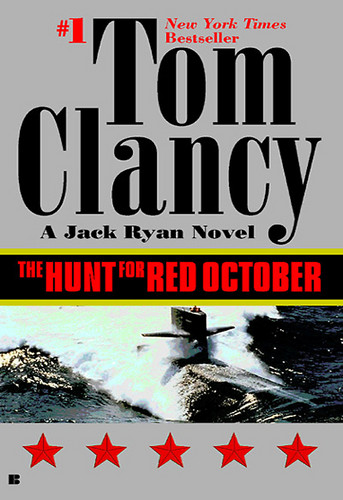
Tom Clancy is one of the biggest authors of our time. How did he break in? It’s an interesting story that Deborah Grosvenor, the editor who acquired The Hunt for Red October (Clancy’s first book), tells here.
Author Mette Harrison writes a column on writing for Orson Card’s Intergalactic Medicine Show. I think you can read them without a subscription. This month’s column had some great insights. Here’s one fab example.
I also recommend that if you want to write a book that readers will not be able to put down, focus on one really good story (more on this next month). I am not saying that you can’t have sub plots or minor characters. You can. But I urge you to make sure that your page count does not obscure which characters are the main ones or what their main goal is. If you have lots of different characters who are in different parts of your world, that is fine. But make sure that they are all working at different ends of the same thread, that they all end up being part of the same story. If you cannot figure out which character is the one you want your readers to care the most about, to root for most desperately, you may have too many characters.
James Dawson, YA author, feels it’s somehow wrong to hold back on cussing in his fiction. He wrote an article about this in the UK Guardian called “Why Teens in Books Can’t Swear.” He thinks it’s unrealistic. He thinks it’s about gate-keeper censorship. You know, parents wanting to steer their children towards certain experiences and away from others.
People.
Dawson’s approach to the whole problem is wrong-headed. This isn’t about the virtues and vices of fiction. Or about gatekeepers, especially in today’s ebook world. Or what experiences parents want to provide their children. And it’s not about art reflecting reality. Reality includes trips to the toilet, and yet we somehow fail to include realistic bum wiping in so many of our tales. Good heavens, have we betrayed our artistic integrity? No. We’ve just naturally chosen to include things that appeal to us and leave out others that don’t. Every book is an exercise in hundreds of such choices.
The fact is that Dawson’s forgetting that a fundamental aspect of the book trade is the trade. The buyer trades his or her money for a product (the book) that provides a service (the entertainment, thrills, chills, etc. of the reading experience) he or she values. A customer preferring one kind of experience over another isn’t censorship (the horror, the horror). It’s choice.
As an author, you make your offer. If folks like it, they buy it. If not, they don’t. Nobody owes you a purchase.
This means that in any business, and selling fiction is a business, the most sensible way forward is to offer your intended buyers something they are likely to value. Something they’re going to like. Something they want. If your buyer is thirsty and wants water, offer him a cold glass of water, not a waffle iron. And if you can’t bear to develop anything but waffle irons, then, by all means, develop waffle irons. Just make sure you offer them to the folks looking for . . . waffle irons.
This business of making offers also means that we package our products and services so that customers can easily tell what’s in the box. You don’t want someone to purchase your box thinking it contains breakfast cereal when in reality it’s a bunch of bolts.
Yeah, writing is an art. But offering it in trade to others is also a basic economic act.
Here, watch this book trailer for Scott Westerfield’s Leviathan.
Yeah, I know you want to–go ahead, watch it again.
Miller looks at book trailers, sees that the vast majority of them are lame, lame, lame (actually, this is the FIRST I’ve seen that’s any good). Sees that they reach no markets and then concludes that all trailers are silly. It’s true: lame trailers ARE a waste of time and money. But ANY advertisement (print, video, audio, whatever) that’s lame is a waste of time and money. Making killer trailers that nobody sees is an even bigger waste of time and money. But that’s true of ANY killer advertisement that nobody sees.
Look. I’ve never read Westerfield. Don’t know much about him or his books. But I saw that clip and now want to read that book. Hum, trailer worked for me. I AM a reptoid mutant, but I suspect there are others out there like me. I mean, come on. Good gravy, woman–“Do you oil your war machines? Or do you feed them?” Killer!
Movie trailers, book trailers–any advertisement–isn’t about delivering what the person is going to experience on the spot. If that were the case, then you’d never show a print ad of a meal at Olive Garden because it doesn’t deliver the goods right there on page 10 of Woman’s Day. Nope, all you’d do is go around giving out samples in places with Italian mood.
Miller’s error is not understanding the difference between making an offer and delivering on one. What an ad is supposed to do is make the offer. Let you know this thing is available. Because you’re not delivering the actual experience, you can make the offer via all sorts of media. Now, if you can give them a taste, that’s great. But you don’t need to deliver the full deal right there.
So what do you need in an offer? You need the offer to say, “Hey, I’ll deliver this type of experience.” It needs to call to some action, either directly or by implication–“buy this” or “be here.” You also need it to say, “You can trust this will be worth it” and make the consumer believe that’s likely to be true. It communicates this last bit by being a quality piece of work.
Making an offer is exactly what book covers do–they make the offer and give the consumer a little taste. And book covers matter. This has been proven over and over. Just like most people, when I see a cool cover, I pick up the book and check it out. When I see a lame one, or one that offers something I’m not interested in, you’re going to have to threaten me to pick that book up. Or it better dang well have some righteous word of mouth. It’s that simple. We all judge books by their covers because the cover is making an offer. And lame offers don’t get very many takers.
Book trailers are nothing more than deluxe book covers. The cool thing about them is the cool thing about movie trailers–you can make the offer by providing a little taste. You do that by giving the audience the story situation, the pitch. You do it by communicating the feel of the experience and raising curiosity. You do it by making it a pro job. The good ones make you laugh, say cool!, or raise curiosity and expectation.
And that Westerfield trailer does that.
Dang, “Do you oil your machines? Or do you feed them?”
Run that on TV. Run it on the radio. Put it up on sites where people are likely to see and click. Confirm it in print. Make the offer to real people. Get it infront of young readers. I’ll stake my eyebrows that ad can sell as many books as a good movie trailer can sell movie tickets.
Very effective advertising for the book. I think the content of the book is crap, but that trailer made me pick it up just to see what it was all about.
Do you notice that this one and the Westerfield one combine extreme professionalism AND they make the pitch in a clear and grabbing way? The pitch for both was what the book was about. For fiction it’s the concept. For non-fiction how to it’s the promise.
So many of the book trailers lack one or more of those things. For example, look at the book award finalist for THE FALLEN: http://www.youtube.com/watch?v=vsLE6bNaIrk. I don’t know what the heck the book is even about after a long 2 minutes. They’re trying to make a movie.
Something else. On both of these you have a voice over PITCHING the book to you just as someone might do it in person or to an editor. It’s a powerful method, I think.
Notice also how short the Westerfield one is. Just over a minute. Westerfield’s really is like a query pitch or cover copy–in just a few lines tell me what your story is about. We get genre, setting, character, and the story problem or concept.
The city of American Fork is putting on what looks to be a great writer’s conference. I’m very pleased to announce that I’ve been asked to present the keynote speech.
Keynote: The 3 Things You Must Learn to Write Killer Stories When: Saturday, April 25, 2009, 9:00 AM Location:
American Fork City Arts Council
31 N. Church Street
American Fork, UT 84003
(801)763-3081
This looks like a great opportunity if you’re a writer. Here’s what the organizers envision.
We have editors from Desert Book, Covenant and Cedar Fort coming to speak as well as National Book Award finalist Sara Zarr, Kristen Langdon, Ginger Churchill, Linda Bethers, Anita Stansfield and others. The goal is to provide a space for local writers to interact with local editors and local authors for inspiration, motivation and guidance in the tricky world of writing and publishing. To that end, the editors will be holding a query letter clinic using query letters from participants, which I think will be super useful. The editors are also speaking on what they want and don’t want as far as submissions, and the state of regional publishing in 2009 given the world upheaval. The authors will all be speaking on how they got an agent, how they got a book deal, what they have learned about writing.