|

You’re invited to join the novel writing workshop pilot

I am developing an online novel writing course and am looking for folks to pilot it with me and give me feedback. I’m thinking I want to limit it to 10-12 folks.

It’s free and will probably take two or three months to complete. If you join, your job will be to do the work. And there will be work. I’m thinking 10-15 hours of work per week. Please don’t ask to join if you don’t want to make this commitment. I only want folks who are serious and ready to give this a shot. In addition to the work, you’ll need to report your experience with the course as we go, sharing with me where you get stuck, what’s confusing, what’s helpful, what does and doesn’t advance your skill. In fact, if at some point the course just isn’t providing you any value, you are welcome to drop. That’s good feedback too.

It’s going to be a blended format that includes self-paced work and some type of weekly online meeting. I will be guiding the class. At the very least, we’ll meet and chat at my site. I don’t know if we’ll do a live meeting or not. Still working that out.

I struggled for many years, trying to figure this stuff out, then had a number of epiphanies during Orson Card’s boot camp and continued from there. Of course I still have lots to learn. But I want to share what I have.

I love teaching and have been teaching in one form or another for the last 20 years. I’m currently an education program manager at a large software firm. What this is all means is that I’m trying to build a course that guides folks through a process that will help them learn to WRITE novels. Not just talk about them.

So this is not a series of lectures with quizzes that test your ability to recall, although I will quiz you.

It’s not a course with an end goal of teaching you what I’ve learned about the concepts and principles of plot, character, and setting, although you will need to learn that.

This is about increasing your ability to get ideas, develop them, and then write.

It’s about doing the work. It’s about production. It’s about finishing product. And having a good time doing it.

If you already feel comfortable with your ability to finish novels, this is NOT the course for you.

You can learn more about the course here by clicking The Path in the On Writing menu.

Probably the only other thing you need to know is that the class is a PG-13’ish class. While the stories can deal with intense and adult themes, as the teacher, I’m not interested in working with stories with explicit or detailed sex or lots of language of the sort that would earn a movie rating more restrictive than PG-13.

Remember, this is a pilot. Even though I’ve taught about writing for a number of years to various audiences, there might be some rough spots. We might find we need to change the work requirements or activities or any number of things.

If you’re interested, click on the Contact link on the menu of my site, and shoot me an email.

Edit 1/30/15: I’m getting a number of excellent questions about the time commitment and schedule. Let me answer them here.

The gap I’m trying to fill

First, you have to understand that I am not interested in talking about novels and writing novels. I’m interested in helping folks finish novels. That’s a big gap I see in most writing instruction. It’s the gap I had. There was nobody to help me move from the theory to the writing, and writing all the way to the end. So this isn’t a class about novels. It’s a class where I hope to help you learn a number of techniques for developing and finishing one. And to learn those techniques, you have to actually use them. Which means you have to develop and finish a novel 🙂

So why 10 hours as a minimum?

If you’re a slower writer, it’s going to take you around 50 hours to develop and write a novel of 25,000 words. That’s the size of one of Louis L’Amour’s smaller novels (which we call sometimes call “novellas” today). It’s the size of some smaller romances. A lot of indies are writing serials around this size. If you want to write a 50k book, it’s probably 100 hours, maybe more. A 75k novel? 150-200 hours. The development and first draft of a 100k novel? 200-300 hours.

These are not exact times. Some writers are faster. But you get the picture. Writing a novel is a big project. And I’ve found that it’s just too hard to get any traction on less than 10 hours per week. When you spend much less time than that, you spend most of your time just trying to remember what the story is about. I’ve found it’s best to keep your writing engine hot, or at least warm.

So will these 10 hours be in meetings?

No. I don’t want to have a lot of meetings. That’s the beauty of online. We will have deadlines. But you should be able to complete you work during the times that suit you best.

What’s the course schedule?

I can’t give you an exact schedule. I haven’t timed everything. Figuring that out is part of what we’re doing in this course. But I do know what I want you to learn and how I hope to help you learn it. We’ll just have to see how far we get with each weekly 10-hour chunk.

Share

Similar Posts

  • |

    How to Write a Story that Rocks

    Folks, a huge thanks goes to Stephen Nelson for putting all this together. You may kiss his hand when you see him.

    This is a recording of “How to Write a Story that Rocks,” a two-hour seminar Larry Correia and I just put on at the annual BYU’s Life, The Universe, & Everything symposium. I think we had 130-140 people attend. This symposium is focused on writing fiction. And while the panels and presentations do include things specific to the science fiction, horror, and fantasy genres (both adult and young adult), a lot of time is also spent on story writing fundamentals that apply to ALL genres. So when I developed this workshop, I made sure I took the fundamental approach.

    The two-hour seminar has been broken down into 12 segments. To switch between the segments:

    • Hover your mouse pointer over the YouTube below
    • Click the forward and back arrows that appear on the right and left sides to move to the next or previous segment, OR 
    • Scroll through all 12 segments and select the one you want using the playlist control at the bottom

    If you prefer, you can watch all 12 on the How to Write a Story that Rocks YouTube playlist page.

    I’ve found whenever I develop any presentation or training that it takes a few iterations and revisions before it’s the best it can be. This is the first iteration of this seminar. And so below this video I’ve provided additional comments on each segment explaining key concepts, principles, and techniques that we might have failed to discuss or convey as clearly as we’d hoped. Enjoy!

    Handout

    How to Write a Story That Rocks – Handout

    Segment 1

    It’s documented–right-wing gun nut Larry Correia sang “Kumbaya.” What’s next? The hugging of small trees? Oh, Larry, the disilluion. The disillusion.

    The reason why I had Larry sing was not for his mellifluous performance, but to demonstrate the difference in reactions between him and our happy volunteer (“Country Road” by John Denver–this really was a love fest). The volunteer balked because he hadn’t taken any thought to know what to sing before he was commanded to do so. On the other hand, Larry and I had spoken before the seminar. So Larry had something to sing BEFORE he sang it. It’s a simple demonstration, but it illustrates a principle a lot of new writers forget. Writing is a performance. It helps to know what it is you’re going to perform before you perform it.

    It’s one thing for you to tell yourself to write. It’s much easier to tell yourself to write the scene where the rancher finds out one of his illegal ranch hands has been kidnapped.

    Now this doesn’t mean that you have to know everything. Or that you can’t write exploratory drafts to figure out what it is you want to write. But it does illustrate that whatever techniques you use, you’ll be a lot more effective in your writing when you have something to say first.

    But what do you develop? What are the things that bring the story to life? How do you go about getting those things to say? That’s precisely what I wanted to address in the seminar. In the segments that follow, I try to:

    1. Explain what I’ve found are the most important things to develop, the things that define the essence of story, that make the story come alive in the writer’s mind–the things that really matter
    2. Demonstrate techniques to develop those things so you have something to say

    Segment 2

    I think this segment went fairly well. What rocks will different from person to person, even though there will often be a huge overlap between people. So it’s important for authors to seek to develop the kinds of stories that rouse their passion. Watch this interview with best seller Debbie Macomber to see what I mean. So I can’t tell you what to write about. Or if whath you think rocks will resonate with a large number of people. However, what I can do is share the techniques I use that have been most productive in helping me develop initial ideas into something that has much more power.

    You can use the techniques to juice up any of the four parts of story. However, I will say that I find that the most productive, the most important parts, are character and problem. Plot and setting are important. I love them and work to juice them up. But when I get a good character and problem, that’s when the writing seems to flow the easiest.

    And no, I don’t list theme as a part of story. Everyone talks about theme, but when I read what they have to say or press them for examples, it seems that it always either boils down to (1) a story element or topic that’s repeated, (2) a story problem/issue stated in an abstract manner, or (3) some moral situation. Les Miserables is about the “theme” of mercy versus justice. But saying justice versus mercy is just an abstraction of the story problem and dilemmas the story deals with. So, no theme. 

    Segment 3

    Loved this bit about scenes from David Mamet: http://www.slashfilm.com/2010/03/23/a-letter-from-david-mamet-to-the-writers-of-the-unit/ 

    Segment 4

    I’ll be adding my comments to the rest of these segments over the next few days.

    Segment 5

    Segment 6

    Segment 7

    Segment 8

    Segment 9

    Segment 10

    Segment 11

    Segment 12

    Dan Wells on Story Structure

    Check it out: Dan Wells on How to Build a Story (story structure). I find Dan’s “start with the ending” technique helpful as well as thinking about a worst fears realized moment. Watch the videos and see if there isn’t something there that can help you develop your story idea.

    You can get the PowerPoint of How to Build a Story on Dan’s site.

    If you find this approach useful, you might want to check out what novelist Larry Brooks has written about the same material on StoryFix.com.

    Share
  • Life, The Universe, & Everything 2010 Schedule

    If you’re a writer, you’ll find Life, The Universe, & Everything (LTUE) an excellent convention. Yes, it’s focused on science fiction and fantasy, but the principles of writing discussed apply generally and there are a lot of authors who will be there that write in different genres–YA, romance, etc. In fact, there will be a LOT of published authors there, period–including two that have recently been on the NY Times best seller list and others who have just broken in.

    If I were an aspiring author, I’d be making sure I had arrangements to attend at least part of the convention. Follow the link above and look at the list of panel topics. And remember: it’s open to all and FREE of charge.

    Dates: Feb 11-13, 2010
    Wilkinson Center
    Brigham Young University
    Provo, UT 84602
    (801) 422-4636 (BYU information line)

    I’ll be doing the following. Hope to see you there!

    BTW, Stephen Nelson has graciously offered to film the workshop. If the recording and class pass muster, we’ll post it for your viewing enjoyment!

    Thursday, Feb 11

    5 – 7 PM: Writing workshop: “How to Write a Story That Rocks” (John Brown, Larry Correia)

    Friday, Feb 12

    9 AM: Panel: “Paths to publishing: When is traditional best and when should you try an alternative” (Stacy Whitman, John Brown, Dan Willis, Eric Swedin, Sandra Tayler)

    Noon: I will be attending Dan Well’s Pacing and Story Structure presentation.

    1 PM: Panel: “Killer Openings – How to write a gripping, engaging and interesting opening paragraph” (Dr. Steven C. Walker, John Brown, Mette Harrison, Heather Horrocks)

    Saturday, Feb 13

    9 AM: Panel: “A Guys Take on Writing Romance (Male Panelists)” (L. E. Modesitt, Jr., Clint Johnson, Aleta Clegg, Dan Willis, John Brown)

    Noon: Panel: “Building different cultures….” (L. E. Modesitt, Jr., Roger White, John Brown, Brandon Mull, Marty Brenneis)

    1 PM: Signing. (Wish very much I could go to Eric James Stone’s reading at the same time. I’ve gone to 2 or 3 of his and have never been disappointed)

    2 PM: Reading from CURSE OF A DARK GOD.

    Share
  • Awful Intent Update: Chapter 26

    I have now moved from the struggle into the resolution. It’s all down hill from here.  I expect the novel to be 70-80k words. The shortest novel I’ve written yet. But I always seem to add on most of my revisions. I hope to keep it shorter, but we’ll see.

    Now you may ask, hey, how does that compare with other thrillers? Well, here are the lengths of a few of James Patterson’s.

    Title Words
    Honeymoon 65,572
    4th of July 68,000
    Lifeguard 71,634
    Mary, Mary 72,426
    Judge and Jury 74,288
    Doublecross 70,753

    And here are some more by some other authors.

    Author Title Words
    Lee Child Gone Tomorrow 146,000
    Lee Child One Shot 124,000
    Lee Child Killing Floor 162,000
    Lee Child Persuader 164,000
    Michael Connelly The Brass Verdict 145,000
    Ridley Pearson Cut and Run 114,000
    Robert Crais The Watchman 82,000
    Robert Crais Taken 84,000
    Robert Crais The First Rule 76,000
    Robert Crais The Sentry 82,000
    Brad Thor Full Black 117,000
    Brad Thor Athena Project 102,000
    Dean Koontz The Good Guy 93,000
    Dean Koontz The Husband 94,000
    Share
  • Positive Review from James Maxey on Orson Card’s Intergalactic Medicine Show

    James Maxey is a writer I admire. For his work ethic. For the quality of his prose. For his imagination. His story “To Know All Things That Are In The Earth” is one of my favorites. So you can be sure I was pleased to find and read this today.

    I will say, in utter candor, that Servant of a Dark God is a work that truly stands out from other fantasy books on the market. What makes this book work so well is that it’s a story about family first, and a fantasy adventure second. Full review.

    Share
  • Servant cover art

    The cover illustration for SERVANT is finished!

    (and there was much rejoicing.)

    yea.

    Actually, there was DANCING. Because I think the final piece rocks. The artist is Victor Minguez. Here are two of his pieces that I really enjoy.

    The first is “Angel.” I love the bright contrast, the face, and the fact that there’s so much rich detail.

    The next is “Champagne Havoc.” Again, a wonderful face, but also an awesome idea (a robot carrying a woman in the palm of its hand), and then the lines and chopper give the whole piece a lot of energy.

    Click here to see other works in his portfolio.

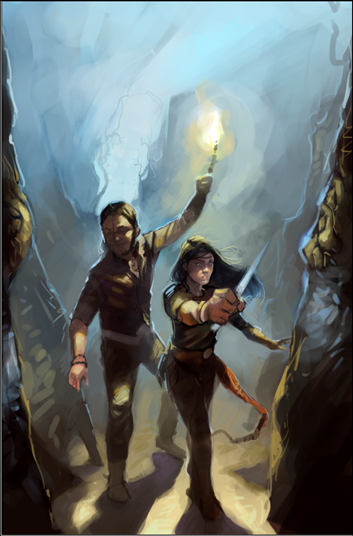
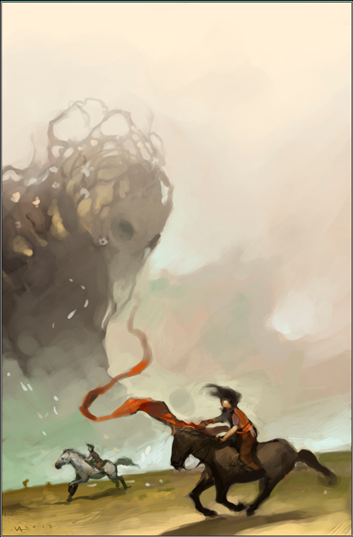
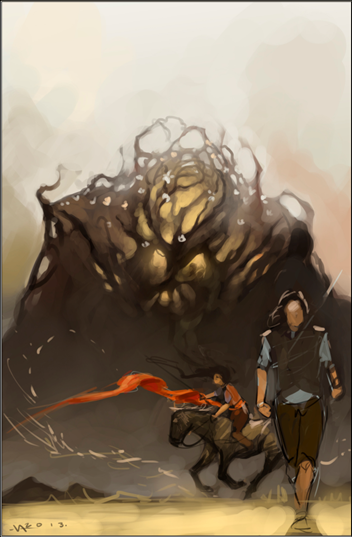
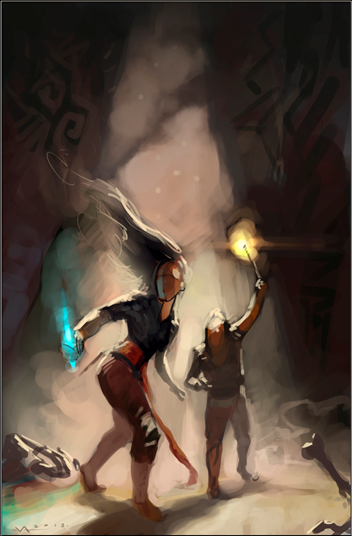
    So we kicked the project off by me sharing the goals I had for the cover and tons of reference on everything from color scheme to character costume. I asked Victor to develop some concepts for an ensemble of Hunger, Sugar, and Talen as well as some for the cave scene towards the end of the book. He came back with these sketches.

    Servant Sketch 1 cave Servant Sketch 2 horse ensemble

    Servant Sketch 3 ensemble Servant Sketch 4 cave

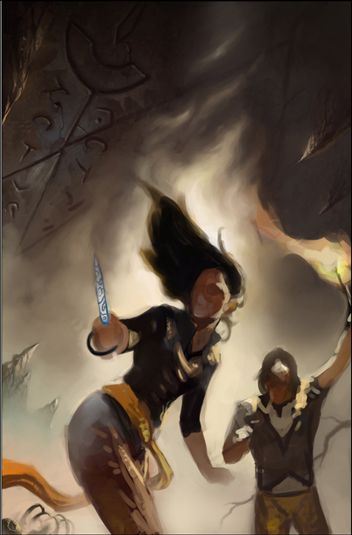
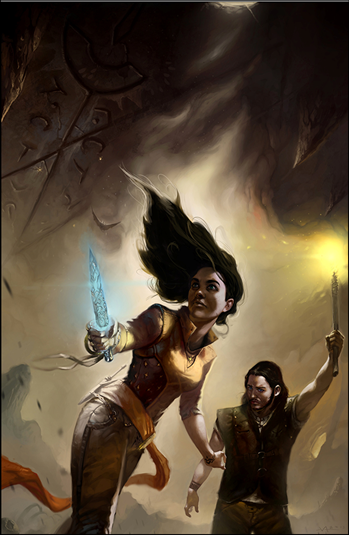
    I liked the first because it would allow us to see the figure’s faces more clearly. And there was a lot of interesting detail with the cave. Look at the roots by the entrance. I also liked the structure. I liked the third because it included Hunger, and Victor was taking Hunger in a new direction. I also thought we could do some neat things with the energy of Sugar on the horse and that long sash. The fourth one, however, just felt right. It had so much potential energy. I was immediately drawn to the body language. And so this is the one we decided to develop.  Then one of my beta art viewers suggested moving closer and putting in more strong diagonals. It was a perfect idea. Victor agreed and came back with this.


    Servant WIP 1

    I liked the lines of her stance but wondered if she needed something stronger with her legs. Victor adjusted, but my idea just wasn’t an improvement.

    Servant WIP 2

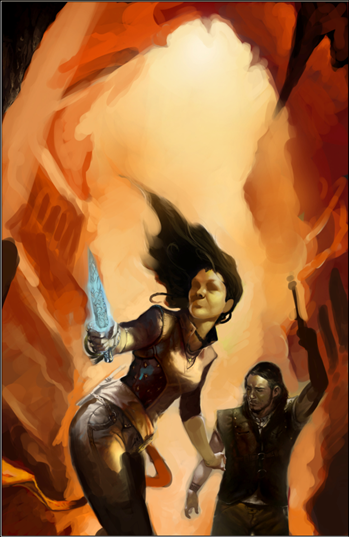
    So we decided to stick with the previous version. However, this was all too dark. Way too much gray. When looking at things in thumbnail, the cover has to pop. I shared more reference images. And Victor went back and delivered this.

    Servant WIP 3

    Boom! That was exactly what I was looking for. Bright, dynamic. However, we needed a more neutral bit at the top for the title and author’s name. And the brightest spot had to be behind Sugar to draw the eye to her. Here was the next version.

    Servant WIP 4

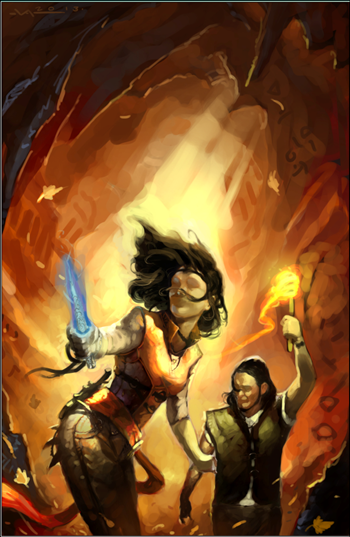
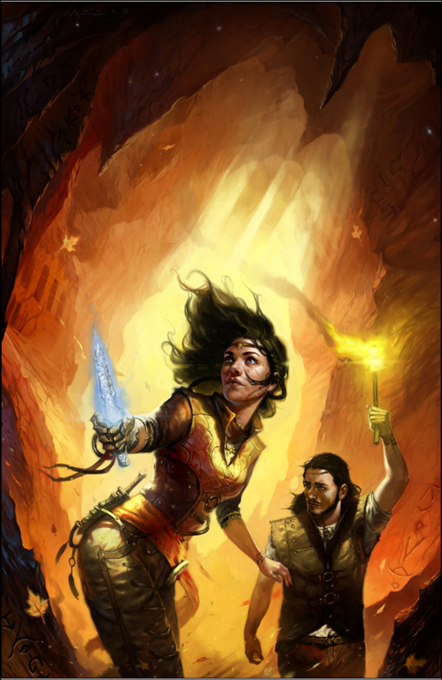
    At this point I started to dance. This was IT! There was a lot going on here. We had the high contrast I wanted. We had the energy. The wind with the hair and leaves and sash and torch all add kinetic energy. As do all the diagonals. Notice as well the cave details–we have hints at previous habitation, runes, and some interesting contrast with the dark foreground. I had shared a number of N.C. Wyeth and Tim and Greg Hildebrandt pieces as reference, and I think this captured elements of those and gave them a new twist. Note as well the sharp projections on Sugar’s behind. Victor put them in there purely for aesthetic reasons. He had no idea what they were. I loved them. He loved them. They worked. We would just have to make them make sense.

    After a few more iterations, he delivered the final.

    Servant Final

    I think it’s gorgeous. And will advertise the book perfectly. In a few days I will reveal the final cover with title etc. Shortly after that, SERVANT will be available again to please English readers worldwide.


    Share

3 Comments

Comments are closed.