Author: John Brown

  • Gladwell, Dish Cloths, and Higher Technology for Tuna

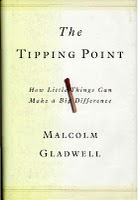
    The Tipping Point by Malcolm Gladwell

    After reading Made to Stick, I decided to read the book that inspired it—The Tipping Point: How Little Things Can Make a Big Difference by Malcolm Gladwell. I’d read Blink and Outliers by the same author and found both fascinating.  I’m happy to report The Tipping Point is just as good. In it, Gladwell examines what conditions cause ideas, behaviors, messages, and products to spread like outbreaks of infectious disease. 

    In the book he shares a number of situations and studies, including the sudden drop in crime in New York city in the 1990’s (which started by attacking graffiti in the subway), the dramatic popularity of the Blue’s Clues TV program with pre-schoolers, Paul Revere’s success in rousing the citizens along his route (versus the almost total failure of the other guy who rode that night), the resurgence of Hush Puppies shoes, syphilis in Baltimore, Columbia Record’s amazingly effective golden box ad campaign, and a dozen other outbreaks.  From all of these, he extrapolates three rules of social epidemics—The Law of the Few, The Stickiness Factor, and The Power of Context.  
    The arguments Gladwell presents are thought-provoking and powerful, but what makes him such a treat to read is how he writes.  Like the best science writers (in fact, I think he IS one of the best), he tells great stories with interesting characters.  He puts the reader on the edge of the seat with mystery, insight, and humor. He makes things that could be incredibly complex seem like first grade math. It’s as if he’s standing right there with you chatting about the subject. Moreover, he does all this from page one.

    Here’s what I mean. I left the book out on the kitchen table one night after reading a few chapters.  The next morning Super Wife came down to quickly eat breakfast and get herself to a meeting.  She made the mistake of opening the book to glance at the first page. Twenty-five minutes later she came up for air and realized she was going to be late and dashed out the door. The writing is pure mind control.  And I loved every minute of it.

    If you’re at all interested in advertising or how fads and movements start, if you want to affect the behavior of customers or local teens, if you just like to read how things work, I think you’ll love this book.

    Sunflower Dish Cloths
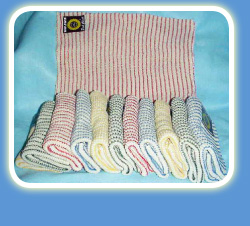
    I used to suffer along with subpar dish cloths.  There were the dish cloths with mesh on one side that were so small you had to rinse them after every wiping stroke.  There were the hand cloths made of terri that belonged in a bathroom but were repurposed and were far too big. Then were the cloths that had some slippery crap in the thread that refused to soak up water.  And there were the crocheted things that I think we should have put out of their misery when we first got them. Folks suggested we go to sponges. So we did sponges and had similar results.

    Oh, woe, woe, woe.

    Then a kind and loving friend gave us a set of mystery cloths that were incredible.  They were large enough that we didn’t need to rinse with every wipe.  They had this fantastic weave that was open, yet absorbent, and dried quickly.  And the weave had enough of a texture that you could use it to scrub.  We received those back in 1999.  They lasted us for years and gave us much kitchen cleaning joy.  But, alas, like all of mortality, those brave cloths finally began to give up the ghost. 

    My problem was that I didn’t know who had made those cloths and where I could get more.  We looked all over and couldn’t find them.  And then, at this year’s Garden City Raspberry Days craft fair, we saw them nestled amidst all the kitsch!  We bought as many as we could afford, and went our way rejoicing, fully expecting these to last us until we have grandchildren.  Maybe we’ll pass them down as priceless heirlooms.  Maybe some day they’ll be featured on Antique Roadshow.  Maybe they’ll be resurrected with us and become the official dish cloth of the Millennium when the world is renewed (it could happen).

    If you’re sick and tired of sponges and crappy dish cloths, let me suggest you pick up some Sunflower Dish Cloths made by Sangamon Mill. You can order them in bulk at http://www.sangamonmill.com/ , or in smaller quantities online from places like Amazon.

    Everiholder’s Veggie & Tuna Press & Strainer
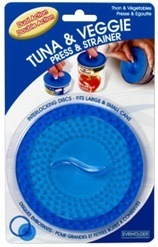
    Do you eat tuna? If so, you know the biggest pain is draining the can. But you don’t have to suffer along any longer using the lid, which doesn’t do a good job at all anyway.  There’s a better solution, which Super Wife discovered. It’s called the Tuna and Veggies Press and Strainer by Evriholder: http://www.evriholder.com/Tuna-Veggie-Press.asp.  With this little blue piece of higher technology you easily and quickly press all the juices away, and nothing slips out the sides. We love our.  You can order it online, although Super Wife found it at our local evil empire Wal-Mart store.

    That’s it for now.  In the next review, I’m going to reveal two killer recipes over which all who partake will salivate and drool—Chocolate Éclair Cake and Dill Potato Salad.
  • Sticky Ideas, Cook’s Country Magazine

    They stole his kidney . . .

    A friend of a friend of mine is a frequent business traveler.  To keep his identity safe, I’ll call him Bill.  Bill was recently in Atlantic City for an important meeting with some new clients.  Afterward, he went to a local bar to kill some time before his flight and took a seat at a table. 

    He’d just finished one drink when an attractive woman approached and asked if she could buy him another.  He was surprised, but flattered (Bill isn’t exactly a Brad Pitt).  He accepted the drink.  The woman walked to the bar and brought back two more drinks—one for her and one for him.  He thanked her and took a sip. And that was the last thing he remembered . . . before he woke up, disoriented, lying in a hotel bathtub, his body submerged in ice.

    He looked around frantically, trying to figure out where he was and how he got there.  Then he spotted the note:

    DON’T MOVE. CALL 911.

    A cell phone rested on a small table beside the bathtub. He picked it up and called 911, his fingers numb and clumsy from the ice. The operator seemed oddly familiar with his situation. She said, “Sir, I want you to reach behind you, slowly and carefully. Is there a tube protruding from your lower back?”

    Anxious, he felt around behind him. Sure enough, there was a tube.

    The operator said, “Sir, don’t panic, but one of your kidneys has been harvested. There’s a ring of organ thieves operating in this city, and they got to you. Paramedics are on their way. Don’t move until they arrive.”

    Incredible, isn’t it?

    More importantly, do you think you could remember enough of that, without review, to tell it to someone tomorrow?

    My guess is that you could. And if you did, you’d be spreading one of the most successful urban legends of the past fifteen years.  

    But I didn’t tell you the story to focus on urban legends. There are a lot of stories people tell one another that don’t go viral.  What makes this one different?  In fact, what makes any idea stick effortlessly, like this one does, in someone’s brain?

    Are you a teacher? In school, at home, or at your business? Do you give presentations?  Do you ever need to advertise something—a product, service, or yourself? If so then you’ve had this question.

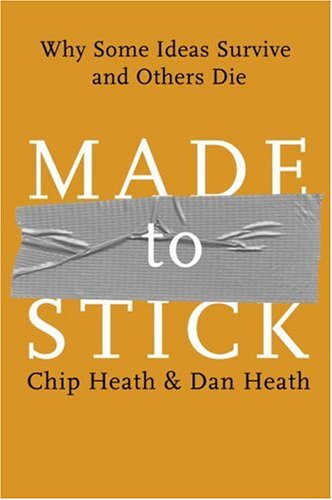
    Maybe you’ve uncovered some of the secrets. Maybe you haven’t.  But there’s no reason to despair: Chip and Dan Heath have written the book on it. It’s called Made to Stick: Why Some Ideas Survive and Others Die and is one of the most fascinating and practical reads I’ve come across in the last few years.

    The brothers Heath spent hundreds of hours researching sticky ideas: urban legends, advertising campaigns, wartime rumors, proverbs, conspiracy theories, jokes, some of the nation’s best teachers—you name it; if it was sticky, they looked at it. They asked questions like what makes some urban legends so compelling? Why do some chemistry lessons work better than others? Why do some political ideas circulate widely and others fall short? What they found was that sticky ideas exhibit six traits. And it was relatively easy for someone, once they understood those traits, to make almost any idea stickier.

    I can see the traits in some of the things that I’ve done that have been sticky. I can see other ways to improve. The cool thing is that I’m not going to be guessing as much. If you need to make your ideas stick, let me recommend you get this book.  If you want a preview, go to madetostick.com.

    Recipes that actually work?

    I was once induced, through insidious mind control, to purchase a cookbook that included all sorts of tempting dishes. I prepared a number of the recipes, and every one of them was a bust, especially the cinnamon flank steak with eggplant, which I think Nellie and I chewed for about six hours until our jaws dropped off.

    Not satisfied to learn my lesson once, I soon purchased another book on making bread the Old World way. Despite our best efforts and many valiant attempts, all we could produce were loaves that were so bitter and sour they could have been used at Guantanamo Bay to threaten captured Talibanists to talk.

    Let’s just say that after a few more of these, I finally beat back the mind control. I’ve been gun-shy of cookbooks ever since. We’ve been very selective over the years, and this has saved me some money. Unfortunately, I think all of those lessons learned are going to go out the window.

    I was recently watching the Create channel and saw an episode of Cook’s Country where they showed how to make coleslaw that wouldn’t get all watery and a grilled chicken with traditional Southern white BBQ sauce that had me slavering in my seat. During the show they talked about testing these recipes and their failures.

    I learned that the folks there had just finished an eleven-season series called America’s Test Kitchen (where was I all that time?). In the series, they tested hundreds of recipes five ways to Sunday to come up with ones that really worked.

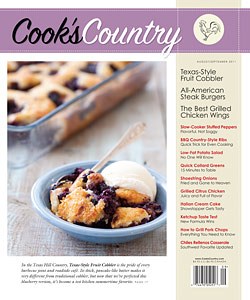
    When the episode of Cook’s Country finished, the old cookbook mind control had risen to full force. This time, though, I was able to exercise some restraint. Instead of buying fifty cookbooks, I started a 14-day trial to Cook’s Country magazine, a thirty-four page, oversized, bi-monthly that’s full of recipes that have been tested. 

    One of the neat features is that they don’t simply present the recipes, they also include the stories behind the testing so a reader can learn from their failures and successes right along with them. In fact, the stories of the tests were so interesting I made Nellie sit down while I read them to her. The magazine also includes cooking tips and product ratings. In the issue I received, I learned, for example, which egg wash proved, through testing, the most successful on pies and which graham cracker tasted best in recipes. One of the best things about the magazine is that, unlike many magazines that have three sentences of content and forty pages of advertisements, Cook’s Country has zero advertisements. Zero! It’s nothing but cooking.

    We’ve tried five recipes so far. Three of them have been clear winners for all the tasters in this family. There other two were good, but not spectacularly so. Still, there weren’t any cinnamon flank steaks! 

    In the next set of reviews, I’ll share their potato salad recipe that had us all oohing and aahing. And maybe the chocolate éclair cake we adjusted to perfection. I’m going to continue the subscription and give their family cookbook a try.  I’ll report my results. In the meantime, I suggest you look at Cook’s Country magazine online at cookscountry.com or watch the show on Create.

  • Some 101 for Congress and the President

    It’s not really rocket science.

    1. If you have loans outstanding and the payment is due, you owe the creditors a payment. Payables for Idiots 101.
    2. If you have received goods and services, then you owe your vendors a payment. Payables for Idiots 102.
    3. You pay your bills. End of story. That’s what grown ups do. If you have to float some debt for a few months, you do it. And you staple a note to your head to stop spending like a slot machine junkie. Payables for Idiots 103.

    The debts we have are for goods and services we’ve already received. So increase the debt limit and pay your damn bills. What about spending?

    1. You do not spend more than you take in year after year. If you do, that’s called running your business into the ground. In the case of the Congress (primarily Harry Reid’s Senate at this point, although many, but not all, of the Republicans were happy to go along with dumb spending earlier) and the President, it’s the country they’re running into the ground. Spending for Idiots 101.
    2. If you’ve got all sorts of cool things planned like Acorn subsidies for pimps and Antarctica Jell-O wrestling grants for scientists, but you can’t afford them—i.e. you have to go into debt to get them–you cancel those plans. Spending for Idiots 102.
    3. The problem is that Congress and the President buy all sorts of crap and expect to put it on a credit card when it comes due. And there’s nothing to prevent them from doing it.
    4. They’re like irresponsible teenagers. They need controls that won’t allow them to overspend. Kind of like putting limits on a teenager’s cell phone minutes. Or forcing them to use a debit card. When they’re out of cash, they get a card denied response from their vendors.
    5. So you set spending limits, debt limits, and force them to balance the budget each year, except in extreme emergencies like when space aliens try to wipe out humanity. Spending for Idiots 103.

    This means you pass Cut, Cap, and Balance and quit spending money you don’t have. Really difficult stuff. What about getting out of debt?

    1. You eat rice and beans until you’re debt is gone or down to a manageable level. That means you cancel crap you can’t pay for. Sorry earmarks, you’re gone. Sorry grants for nude artists in trees, you’re gone. Sorry subsidies for PBS, you’re gone.  Finances 200: How to Not Be A Money Moron.
    2. You figure out how to reduce your current cost structure. This means you figure out a way to reduce the costs of Medicare, Medicaid, Social Security, and every other service or product you provide, cutting those that aren’t essential. You hire someone like Mitt Romney who knows how to go through every line in a budget and turn a bloated ship around.  Finances 300: No, You Can’t Pay For Your Sister’s Hair Implants with My Money.
    3. You remind people this is the freaking U S of A. A place where a man or woman can make themselves. Not where the government changes your diapers and feeds you mush three times a day. Communism and socialism have failed. They were badly conceived utopias, much like multi-level soap and vitamin marketing schemes that are supposed to usher in the Second Coming.  Finances 400: The USA Buried the USSR for a Reason.
    4. You increase your revenues.
    5. However, if you raise taxes, you’re actually going to depress your revenues. Think about this. Which car company has bigger revenues–Lamborgini or Honda? Who is going to put out, if they’ve got Louie the Fingers and his buddy Jockstrap taking increasing amounts of their money in a protection racket? Don’t be a thug. Be an enabler.  Do what Wal-Mart does and go for volume.  Do what Ebay does–create the environment that entices tons of commerce, entices people to dramatically increase their transactions. Transactions go through the roof; you take only a tiny cut, and, shazam, you increase your revenues.  Finances 500: Um, Do You Want People to Work to Become Rich or Do You Want Them To Pick Up Torches and Burn the Houses of the Rich Down?

    Cut spending, reduce cost structure, and increase your revenues. That’s getting out of debt.

    Is this really that hard?

    EDIT: 8/1 Seems that “wacky” Ron Paul actually has a simple commonsense approach that doesn’t sound crazy. Why couldn’t we do this?

  • Why I’m gonna purchase Correia’s MONSTER HUNTER ALPHA on Monday

    I’m going to be purchasing MONSTER HUNTER ALPHA by Larry Correia on Monday.  Here’s why.

    Reason #1: Correia delivers the goods

    I read MONSTER HUNTER INTERNATIONAL.  I ended my review of MHI saying Correia was going to be a writer to watch.  Well, for those of you who haven’t been watching, not only did Correia  sell tons of copies of MHI, he also made the New York Times best seller list with his second book AND sold TV rights to the MHI series to a major TV producer.

    Why would his books generate such a response? Because they’re so dang fun. That’s why. And Correia isn’t just a flash in the pan one-trick pony. Far from it, as demonstrated by Reason #2 below.

    I told you in my review of INTERNATIONAL that I don’t read books that don’t suck me in. I don’t give them 70 pages to warm up and get going.  I don’t care who wrote the book. I don’t care if the author is a big lug with guns. I don’t care if he has status and money or friends who can put the hurt on me. I don’t care if the author is my girl’s godmother and brings me Walker Shortbread Rounds (which are evil cookies that exert mind control). If the book bores me, I put it down. That doesn’t mean that books which bore me aren’t wonderful. Sales and numerous reader exclamations of delight and satisfaction attest to the the fact that many are. It’s just that I’m a reader of little patience. I love it when a book starts with a bang and keeps me hooked. And Correia’s books do exactly that.   

    Reason #2: Correia’s getting better

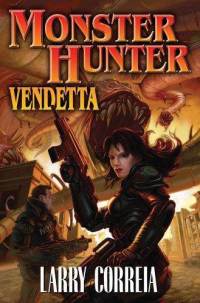
    I read MONSTER HUNTER VENDETTA recently.  I should have reviewed it, but I’ve been so freaking busy I barely have time to shave or appear in public because I’ve begun to look like the Unabomber. But here’s the deal with VENDETTA–it’s better than INTERNATIONAL.  

    Yes. Better.

    Well, expect for maybe the opening paragraphs. The quote and first few paragraps that opened INTERNATIONAL are hard to beat. This doesn’t mean the opening of VENDETTA is weak. Heck, no. VENDETTA trounces the openings of most novels and steals their lunch. And then it continues to delight all the rest of the way through. It’s just that it didn’t quite deliver the same jolt as MHI. But 500 or 503 watts, what’s the difference?

    So with VENDETTA, are there guns? Yes.

    Monsters? Check.

    Action? There’s action galore.

    It appeals to my testosterone right off the bat (even though Larry reports that a good number of his readers are women). But there are guns, monsters, and action in a lot of stories that stink. What Correia does is not only give us great action, but he also gives us wonderful new situations.  For example, you will never see the scene set in the ghetto of Birmingham, Alabama that appears here in any other book. Never. It’s a Correia original. But even more important than great new situations, is that he gives us a first-person narrator who is delightful to be around. I’m talking about Owen Zavasta Pitt, the accountant monster hunter. His responses to the situations he gets in just make me laugh, as do a number of the responses of the other characters. My only wish is that Correia would tone down some of his language just a bit.  It is possible even when writing about military characters.  But you can’t have everything, and Owen’s such a loveable lug, I overlook it.  Hey, maybe Milo will help him out on that as the series progresses.

    Furthermore, Pitt isn’t the only character who I find delightful or interesting.  In VENDETTA there is also Holly, Agent Franks, and G-Nome, one of Correia’s best yet. Of course, there’s also the Doctors Nelson, the former hunter Carlos, Melvin the troll, and Earl Harbinger who have their own moments to shine. As do Owen’s dad and brother. And Dorcas, MHI’s secretary with the plastic leg. Heck, I even like Susan.

    So how many is that–eleven already? How many wonderful characters do most authors give you in one book? Two or three?

    And that’s one of the things that is is better with VENDETTA than INTERNATIONAL.  In INTERNATIONAL, as good as it was, some of the characters just didn’t get the stage time they needed to shine. But here Correia declutters his scenes so we’re not trying to focus on too many people. The result is that those we do focus on each have the their moments and lines. The other thing I noticed was that Correia deftly orients us to each new situation. For those of you who are writers, let me suggest you look at Correia’s technique in VENDETTA for introducing characters and settings. 

    Another good thing: he wipes out a Girls Gone Wild camera crew in the first chapter. Anyone who does that gets a few points in my book.

    VENDETTA doesn’t attempt to become bigger in scope than INTERNATIONAL (as if it could). Instead, it feels like another episode in a great tale. And I’m happy with that because it promises more to come. I’m back with characters I like and situations that make me laugh and magic crap that evokes some oohs and aahs and every now and again makes me wish I’d come up with it for my own use.

    Finally, VENDETTA leavens the humor and action with a couple of poignant moments. I’m thinking of a chapter with Carlos, another scene with Owen’s dad, and one with G-Nome.

    As you can see, VENDETTA’S packed with goodness.

    With ALPHA, I’m expecting to hook up with at least one of the gang for more exploits and laffs. Will Correia get even better? I have no doubt he will. But who cares–he’s already delivering great stuff.  

    Reason #3 Did I mention that Correia makes me laugh?

    Just didn’t want to forget that. Furthermore, I swear I read somewhere that laughter increases your health and makes you live longer. So not only am I getting a great read, I’m extending my days upon the land.

    Reason #4 Monday is a special day

    Not any old Monday. But the 25th of July.

    Why is this special?

    Because it’s the first day of the first week of the book’s release.

    Now I know I’m going to buy this book sometime. But buying it in the first week lets me do something I might not be able to do at some other time.

    Because Correia has given me hours of pleasure, I figure I can tip him for his good service by helping him make the best seller list again.  And a book has the best chance of making that list in the first week of release. (For those of you interested in how that works, Larry gives a good explaination here.) Making a best seller list does all sorts of good things for an author, and, as a result, that author’s readers.

    So Monday’s my day to leave the tip on the table and tell the owner to keep up the good work.

    The New York Times list is a good one. But I’d like to see him on the USA Today list, which measures sales so much better than any other list out there. My fingers are crossed.

    For those of you who are Correia fans or who have been putting off giving his stuff a go, now’s the time to either get MHI and begin the series or ALPHA and continue the delight.

    EDIT: After I posted, I couldn’t wait and just went ahead and processed my order. Pre-orders will count in that first week, and after writing this I couldn’t resist. Looking forward to more hours of laughter and some great characters.