 Bradley P. Beaulieu just had his first novel released on April 1st. It’s called The Winds of Khalakovo and is the first of three planned books in The Lays of Anuskaya series publishehd by Night Shade Books. In addition to being an L. Ron Hubbard Writers of the Future Award winner, Brad’s stories have appeared in various other publications, including Realms of Fantasy Magazine, Orson Scott Card’s Intergalactic Medicine Show, Writers of the Future 20, and several anthologies from DAW Books. His story, “In the Eyes of the Empress’s Cat,” was voted a Notable Story of 2006 in the Million Writers Award. His agent is Russell Galen.
Brad is a software engineer by day, wrangling code into something resembling usefulness. He is also an amateur cook. He loves to cook spicy dishes, particularly Mexican and southwestern. He lives in Racine, Wisconsin with his wife and two children. As time goes on, however, Brad finds that his hobbies are slowly being whittled down to these two things: family and writing. In that order . . .
I recently had the opportunity to interview Bradley. Among other things, we talked about how he broke in and how he comes up with his ideas. He also convinced me to use his picture method, which I’m finding very handy on my current thriller project.
***
JOHN: In your novel an elemental spirit attacks an incoming windship, murdering the heir to a kingdom. The person believed to be behind this is a child, an autistic savant. This sounds like Orson Card tale (grin). Did you come up with this character first, the magic, or something else. Tell us the genesis of the tale and this character in particular.
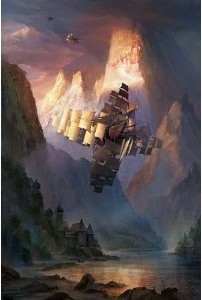
BRADLEY: The genesis of the book is actually from a series of postcards of fine art that I picked up in Edinburgh, Scotland. (I posted about it on my website if you’re curious to learn more.) I used that artwork to first generate and then crystallize my thoughts about the book. Initially, I tried not to let any one thing rule the brainstorming I would do from time to time. I didn’t even know who the main characters were at first. I was quite taken by the picture of the three sisters, though, and I knew right away, the moment I laid eyes on the original in the National Gallery, that they would play a major part in the novel.
But in the end it was the picture of the boy with the flaming brand that kept leaping out at me, calling for attention. The artist is Godfried Schalcken, and the piece is called A Boy Blowing on a Firebrand to Light a Candle. This character eventually became Nasim, the autistic savant. As I was studying the characters, I began to realize that this boy was not going to be a point-of-view character, but he was going to be a prime mover. In the end, he embodies much of what Winds is about. The story truly does revolve around him and his unique powers.
The brand that he holds in the painting also came into play. I didn’t know what the magic was going to be about. I hardly had a single preconception about the book going in. I just wanted the artwork to speak to me, to advise me as to what the story was going to be–from the characters to the world to the magic. The boy blowing on the brand got me to thinking about elemental magic, and I realized that Nasim was one who could do this without even thinking. It came as naturally to him as did breathing. That’s a difficult place to put a character, however. As a writer, you have to be careful of all-powerful things, and so I needed something to balance Nasim’s abilities. And this, of course, is where his disconnection from the world came from. Nasim, as written in the book, is often lost. He has difficulty relating to others in even the smallest of ways. This both limited his power and made him in some ways more dangerous and more scary than a calculating villain, simply because of the unpredictability.
I’d be remiss if I didn’t also mention Rehada, who started out as a somewhat minor character but grew into the most complex and perhaps the most compelling of my three main characters. Rehada came from Andrew Geddes’ Hagar. It’s another beautiful painting, filled with emotion. I was drawn to the fact that she was crying. I wondered why. I spent a lot of time answering that one question. After knowing that her people were essentially pacifists, I realized that Rehada was not. She felt she had betrayed her people and their ways because she had taken to the path of violence. It was from this, from that one single tear, that the entirety of the Maharraht–the fanatical splinter group that came to embrace violence as a means to an end–was born.
By this point, I understood that I wanted there to be an aristocracy of some kind, and I fairly quickly landed on a culture that was modeled loosely after Muscovite Russia. I don’t remember why, exactly. It might have been that the other artwork reminded me of Russian Czars a bit, but I think the biggest driver here was that I definitely didn’t want something that was centered around western Europe, because frankly that’s been done to death. I wanted something more unique, and I’d always sort of like the mystique and darkness that seemed to hover around that time period in Russia. They’ve always seemed like a hard people, a people that would do whatever it took to survive, but in the same light, they took time to live life fully when they could.
Given that I had the loose guidelines of the aristocracy, the peace-loving, indigenous Aramahn, and finally the will of the Maharraht to do whatever it took to regain the islands as their own, it created a crucible from which the story flowed fairly easily. I spend a lot of time building my worlds so that the conflicts within them come naturally, and that was definitely the case here.
JOHN: The description of the world and your process for getting into the story is fascinating. From the article on your site it sounds like using images was a new technique for you. Is that correct? And if it is, was your process previously to have some other physical object of which you’d ask questions?
 BRADLEY: Yes, using artwork as a starting point was a new technique for me. I had no idea if it was going to work or not. An interesting thing came up when I was doing it, though. One of the things I learned at a few of the workshops I’ve been to (Writers of the Future and Orson Scott Card’s Literary Bootcamp) was to create stories in very little time using a few unrelated things as starting points. One unanticipated result of having restrictions in some areas (such as the elements involved in the story) is that it opens your mind in other areas. You’re forced to become more creative in some ways because certain avenues have been closed to you. I think it was the same with the portraits I used to represent the characters.
Before that, in the previous three novels I’d written, I didn’t really have any specific brainstorming techniques. I would start with a premise and perhaps a loose idea of the characters and a mood, and I would go from there, trying to stay true to those things as the story evolved and grew. Although part of the problem with those early stories was that I was young in my craft, I also think my brainstorming wasn’t very efficient. I think, as I alluded to above, that there were too many possibilities. I had trouble narrowing the story down, and it led to stories that were ok, but nothing great. Too often they became a bit generic. Nothing really stood out.
So while the artwork I used is one of a great many possible brainstorming techniques, I like the idea of challenging yourself with restrictions in order to force the story to stretch and bend in unpredictable ways.
JOHN: Wow. That’s a striking insight. I think I’ve found the same thing occurs when I run workshops or do my own brainstorming, but I don’t know that I’ve ever crystallized it the way you have. (See folks, this is why I love these interviews.) So I see _The Winds of Khalakovo_ will be published by Night Shade books. You’ve had quite a few short stories published, but this is your first novel. How did you make the sale? Did you have an agent? Was the editor someone you knew? Gives us a bit of the story behind this.
BRADLEY: As you said, I’d been making steady progress throughout the years in short story sales. I had attended a number of workshops, and I think my name had at least some recognition by editors, either from short stories I’d published or personal connections I’d made at conventions. As an aside, some people will say that you shouldn’t go and sell yourself at conventions. If an opportunity comes up, they say, and an editor or agent asks you what you’re working on, go ahead and take advantage of it. I don’t doubt that that’s good advice for some. Just not for me. I believe that editors and agents are at cons not just to meet with their authors and speak with agents, but to see who’s coming up in the field. They’ll get to know a certain percentage of the newcomers from their short sales, or even novel sales, but they can’t read everything. They can’t even read a small percentage of the fiction that comes out each year. So, frankly, it’s up to me to make them aware of who I am.
Now, that doesn’t mean you should be pushy. You should be friendly and businesslike. Keep things short and sweet and as casual as you possibly can. And that’s exactly what I tried to do. I approached Jeremy at World Fantasy in San Jose (2009) and told him I had an epic fantasy that he might like. I pitched it as “The Song of Ice and Fire meets Earthsea.” He asked me if I had an agent. I said no. Night Shade doesn’t normally take unagented mss (and I should probably ask Jeremy some day if he gets annoyed that I tell this story), but he said he liked the cool pitch and said to send it his way. Roughly five months later, I got an email from Jeremy, offering to publish the book.
At that point, I moved quickly to find an agent, and believe me, agents will move quickly as well if you tell them you have an offer on the table. That doesn’t mean they’ll be clamoring to sign you up. It just means you have their attention. I was lucky enough to be picked up by Russell Galen of the Scovil Galen Ghosh Literary Agency. Russ and I are simpatico on a number of levels, and to be frank, as an agent he kicks serious ass, so I feel honored and blessed to be under his wing.
JOHN: What a great breaking in story. And you’re right, Galen is tops. So to give my readers perspective, did you approach a lot of editors this way? Or was Jeremy at Night Shade one of a select few? And did you encounter any annoyance? I know my editor, David Hartwell at Tor, doesn’t much like to be approached at cons. But obviously, that’s not the case with all editors.
BRADLEY: Well, I had not approached anyone else for Winds. However, I had previous novels, and I’d approached a variety of agents and editors over the years. Not scads of them, mind you, but a number of them, and there were more agents I spoke to than editors because the general rule of thumb is that you can approach and/or query multiple agents at the same time, whereas editors you typically ask for exclusives, even at the partial stage. I was also careful about who I approached, and when. I went to the Pikes Peak Writers Conference for several years. They had pitch sessions there, where you can sit down with an acquiring agent or editor and talk to them about your novel. I certainly took advantage of this, but I also wasn’t afraid to approach them outside of those sessions. At conferences in particular, I think the invited guests are open to being approached at the bar, at the dinners, and at the parties. Again, though, I tried to keep things as casual as I could, and I kept the pitch short and sweet so that they could determine quickly whether it was a project that interested them. Most often I got a “Sure, send me 50 pages” type of answer, but I got a few requests for fulls by doing this as well.
Conventions are another beast. It’s a looser environment than a conference, so I was much more choosy about when I approached agents and editors. I’ve never encountered annoyance, but I’ve certainly felt stiffness from those who perhaps would rather not be approached. I learned from this early on and adjusted my approach. I would try to meet them first and strike up a conversation and see where it went. Often, if you can just be humans with one another, the subject of what you write and what projects you might have ready will come up. Try to take that approach, because there’s nothing to put off an editor that already keeps unknown writers at arm’s length than the smell of desperation. In the words of Monica Geller, keep it breezy.
JOHN: Well, I’m excited for you. Night Shade is a great publisher. So I have one more question: what’s next?
BRADLEY: I’m contracted for two more books, so that’ll occupying my time for a little while yet. But I’ve started brainstorming the next project. (I like to let things germinate for quite a while, so it’s important for me to get my hindbrain working on these as early as possible.) I have two possibilities that I’m mulling over. The first is a science-fantasy called The Days of Dust and Ash. Think Nausicaä of the Valley of the Wind meets The Coldfire Trilogy. I’m excited about this story, because it’s a departure from what I’ve written in the past, though it will still be fantastic and wide in scope. The story focuses on a young girl who is summoned from the dust, a global consciousness that was created as the last great age of technology fell under a nanite plague.
The other is called From the Spices of Sanandira. I sold a novella with the same title to Beneath Ceaseless Skies last year, and it will be appearing sometime this spring. It’s a story that springs from Sanandira, a large desert oasis known for its caravan trade and spice bazaars. It’s got a strong Thousand and One Nights feel to it. The novel is not so much an expansion of the novella as it is a re-imagining of it. It will probably focus on a pair of twins: one boy, one girl. The sister is sold to one of Sanandira’s famed assassin rings at a young age. The boy (the protagonist) finds his sister by happenstance years later, and because of this chance meeting is drawn into the world of intrigue his sister walks every day.
***
JOHN SEZ: I just love hearing how other authors work. As I said before, after this interview I decided to use the image technique myself on my current thriller project. Images of people and places and thing. I’m finding it helpful to help the story come to life. I also think Bradley’s breaking in story illustrates one key thing: work. And that’s exactly what I need to do right now 🙂
 After reading Made to Stick, I decided to read the book that inspired it—The Tipping Point: How Little Things Can Make a Big Difference by Malcolm Gladwell. I’d read Blink and Outliers by the same author and found both fascinating. I’m happy to report The Tipping Point is just as good. In it, Gladwell examines what conditions cause ideas, behaviors, messages, and products to spread like outbreaks of infectious disease.
 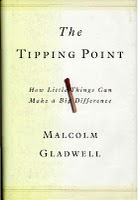 The arguments Gladwell presents are thought-provoking and powerful, but what makes him such a treat to read is how he writes. Like the best science writers (in fact, I think he IS one of the best), he tells great stories with interesting characters. He puts the reader on the edge of the seat with mystery, insight, and humor. He makes things that could be incredibly complex seem like first grade math. It’s as if he’s standing right there with you chatting about the subject. Moreover, he does all this from page one.
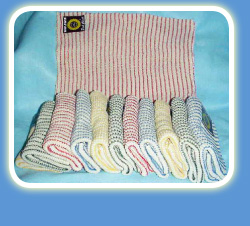 I used to suffer along with subpar dish cloths. There were the dish cloths with mesh on one side that were so small you had to rinse them after every wiping stroke. There were the hand cloths made of terri that belonged in a bathroom but were repurposed and were far too big. Then were the cloths that had some slippery crap in the thread that refused to soak up water. And there were the crocheted things that I think we should have put out of their misery when we first got them. Folks suggested we go to sponges. So we did sponges and had similar results.
 Do you eat tuna? If so, you know the biggest pain is draining the can. But you don’t have to suffer along any longer using the lid, which doesn’t do a good job at all anyway. There’s a better solution, which Super Wife discovered. It’s called the Tuna and Veggies Press and Strainer by Evriholder: http://www.evriholder.com/Tuna-Veggie-Press.asp. With this little blue piece of higher technology you easily and quickly press all the juices away, and nothing slips out the sides. We love our. You can order it online, although Super Wife found it at our local evil empire Wal-Mart store.