On Writing

  • Washington Irving, Family, & Writing

    How do writers juggle writing and family?

    One of my heroes is Mary Higgins Clark who, as a single mom, started a career. She got up very early, wrote for 1-2 hours in the morning, and became a mega-seller.

    I have four girls. And a full-time job. When the first two were little my wife was working and I was Mr. Mom going to school. Then we switched.

    Here’s my experience. While I love writing, my stories do not run to me and give me wonderful strangling hugs after school like my youngest. While I laugh at the humor I come up with in my stories and enjoy it, it cannot replace the uncontrollable giggling I experience when I go on dates with my second. While writing lifts me, it does not fill my office with notes and wallpapers of love like my oldest. And writing never drags me out to play ghosts in the graveyard or hide and seek–daughter #3. Nor will my stories and novels be there for me when I’m old.

    While writing is incredibly fulfilling, my wife, kids, and other relationships are a joy it cannot replace.

    What all this means is that I try to recognize that I can’t let family and writing compete. They can’t be equal priorities. Family comes first. But this doesn’t mean I don’t write. I block out times to write. These are my writing times. I get up early to make time for this. I don’t watch a lot of TV. I don’t read a million blogs, nor, alas, can I read fiction at the level I used to. I make time. But I also make blocks when I just forget writing (even though it can be hard).

    Specifically, here’s my average work week.

    5:00 AM rise, wake and get centered for the day
    6:00 AM work (“work” is my day job and writing)
    6:30 AM family and breakfast
    7:30 AM go to work (at home). Try to get in 7-8 hours at day job and 2 hours writing. When I did commute I wrote for 1 hour during lunch and 1 hour in the morning before I went to work. Then I’d take a 2 hour block on Thursdays.
    5:30 PM family etc.
    9:30 PM bed

    On Saturdays I get a few more hours writing. Sunday I forget everything but family.

    With the new book contract I have to become a bit more creative. But if it ever comes down to sacrifice the last 2 years of my oldest being at home and writing, well, the books will go.

    When my writing plans meet reality, I try to adjust and find other slots for writing. It wasn’t easy in the beginning, but it’s become much easier. And I don’t worry about what I might have accomplished in writing if I’d just had the extra time. Such what-if’s, I’ve found, are almost always poisonous. And who the heck cares? Because while I want to write wonderful stories, I think the greatest loss I think I might experience at the end of my life (believing in an after life or not) is looking back and seeing that I traded the opportunity for wonderful relationships for a rapidly mouldering spot on the shelves.

    Washington Irving wrote a funny and wonderful piece on this mouldering in his “The Mutability of Literature” in THE SKETCHBOOK OF GEOFFERY CRAYON. I recommend every writer read this to put life and writing into perspective.

  • Some Key Concepts for Love Stories

    My first four professionally published short stories were all love stories of one kind or another. I love good love stories. And so when the Writing Excuses team podcasted about this topic with Dave Wolverton, I was excited to hear what they had to say. Of course, they didn’t dissappoint. However, I would like to add a few things here.

    1. A love story or romance is a happiness story. The problem is one of danger to, lack of, or opportunity for the happiness that comes with having a close bond with someone else. To be loved and included, to be valued by someone.

    2. Love stories don’t have to be between two characters who are romantically interested in each other. They can be between two people who become friends or a person who is on the outs with a particular group as with RAINMAN, or between a father (or father figure) and son as in TREASURE PLANET, or a mother and daughter.

    3. It seems to me that these social story problems can be broken down into four elements.

    1. Raising the idea
    2. Making the characters attractive
    3. Raising obstacles and conflict
    4. Showing signs of progression

    RAISING THE IDEA

    Just as with any story problem, we have to know there’s an issue. The idea of possibility or lack has to be presented to us. And the specific person who we hope the character bonds with has to be identified. How is this done?

    Lots of ways. But I can see two big ones right off the bat. The first has to do with what a character notices about the other person. In a romantic love story, it might be some thoughts about another’s attractiveness, either looks or character. This could happen when the character sees the other person, touches them, hears them speak. And it doesn’t have to be a stranger. Perhaps they had a crush on that person when they were younger. There are all sorts of cues we use to signal romantic potential. All we have to do is raise a few of those for the reader and the idea is planted.

    The second way the idea is raised is by having some other character raise it. Someone else notices the person and thinks them attractive. Or they make a suggestion that our character getting together with them is a possibility.

    So when Jack sees Mary he can think about when the blankety blank she’s going to get off the commando team because all she does is distract the men. Not him, of course. Or Bill can tell Jack that Mary has been watching him. And Jack can say, she can look all she wants because she’s never going to get a piece of this.

    MAKING THE CHARACTERS ATTRACTIVE

    The second thing I see that’s necessary is that the other person is attractive to the reader. Or, at least, the reader could see how the character could be attracted to this person. This doesn’t always have to be physical beauty. Nor does it have to be sexual attraction. A buddy story would be about something else–about someone who we think is admirable in some way. But it has to happen for the reader to believe the story.

    Of course, our hero may be duped. Jack might be falling for Cindy when she’s really just after his money. The readers know both sides and can see how Jack’s choices make sense, even while we feel great anxiety of the trouble coming down the line. 

    RAISING OBSTACLES AND CONFLICT

    These are key, of course. No obstacles or conflicts and there is no story. Jack sees Jill. Says I love you. They marry. The end. So we have to have obstacles. They can start immediately with the character recognizing a possiblity. For example, Jack is simply oblivious to Jill’s interest in him. And when he decides to trust his friend’s advice to pursue her, he sees her with another man. She’s not an option for him afterall.

    If we think about yes-buts and no-furthermores and that usually the hero has to fail at the end of act 2 for us to feel triumph at the end of act 3, we’ll see that obstacles and conflicts progress just as they do in any other story.

    There are many obstacles or points of conflict. Distance (CASTAWAY), social status, fears of rejection, a stuttering problem, another person who Jack is interested in or who Jill is interested in, something Jill does that Jack doesn’t agree with, jobs that are demanding and keep them apart or make them keep secrets (TRUE LIES). Are too closely related. It’s against your vows or values (you’re a nun or he’s a client) Etc.  Many are internal and have to do with trust, fear, competing desires, and commitment.

    The key to the obstacles, I’ve found, is in making it hard to choose or fulfill commitment. It isn’t about sex or kissing. Because you can have a story where two people have sex and it doesn’t resolve any tension in the love story (what if the guy is seen that night with another woman?). It’s about two people being able to say I love or value you and meaning it.

    And so anything that would keep them from commiting works. And after they’ve committed, anything that would make one recant. Or be unable to enjoy that love going forward.

    SHOWING SIGNS OF PROGRESSION

    The last thing is that the audience needs to know that things are moving forward. In plotting, we need a few yesses along the way or the story’s over. How do we do this? What are the signs? I can think of a few.

    1. The character’s thoughts are more and more about the other person, noticing all sorts of things, dealing more and more with inner dilemmas.
    2. The character’s actions become more and more open. The lingering looks, or glances she tries to  hide, the touching. The character’s words become more and more direct. Usually oblique at first and then more clear later.
    3. There is more validation from other characters.

    Why do so many stories have the characters in a romance dance? Not because dancing is some mystical thing. No, it’s a romantic cue. We associate romance with dancing. And being in such close proximity raises the pulse. But you can put people in close proximity in many other ways–in a crate as they’re being smuggled into the country, standing smashed together in a subway, retracting a bullet from the leg, cutting and washing hair (John Travolta in PHENOMENON), etc.  The reason why we do this; however, is so that we can get a yes, a sign of progression. Of course, we could also use it to raise a devestating conflict as when Maria dances with Captain Von Trapp in THE SOUND OF MUSIC. But that’s only devestating because during the dance they had declared in subtle ways that they were interested in one another.

    So we raise obstacles and show signs of progression, back and forth, the obstacles pointing more and more toward disaster until at the end of act 2 Jack loses…and we get the no-but plot turn. No, he’s failed completely. But then a desperate glimmer of hope…

    In the end we need final confirmation. One thing that says, yes, they’re committed. Often in romantic love stories writers use sex as a blunt confirmation. I think it’s often the lazy way out. Here, show Jack and Jill having sex. Okay, next plot point. It’s lost most of its power for me. And such a thing should be anything but cliche. My advice is to think of many other ways that show commitment and value. A few examples off the top of my head are what Dean Koontz in his ODD THOMAS series did this for Odd and Stormy, FAR AND AWAY with Joseph and Shannon, WHAT ABOUT BOB, and SABRINA. In fact, having sex was turned on its head in this one. Lovely.

    At least think about other options because romantic love stories are not about sex. Sexual tension stories are. But that’s a different problem. A different type of story. And it seems writers sometimes confuse these two. Romantic love stories are about two people finally saying, yes, I love you, I value you, and I mean it, and always will. And as an audience, we believe.

    And if that doesn’t move you, then remember that one of the things we go to stories for is surprise. Something new. How wonderful would it be if something as simple and Jackbiking into Jill’s work place with a parrot on his shoulder is the ultimate moment of the story, and says everything that needs to be said? And when Jill looks up at the commotion, her heart to this point hardened or desolate, and sees the bird, the audience weeps or cheers…
  • |

    Is Product Popularity Random?

    In Why Publishing is Making You Crazy—and What You Can Do About It: The Tao of Publishing, Steven Axelrod and Julie Anne Long write an interesting post that takes some findings made by Duncan Watts and attempts to explain why writers should only focus on the quality of their work because they cannot reliably affect popularity in any other way.

    I agree with them that social-influence seems like a good explanation for the sometimes unexplicable successes we see in publishing and the difficulty publishers have in both predicting and producing a steady stream of hits. However, I do not find support for their main conclusion that writers can do nothing but write.  In fact, I suggest that Watts’ findings show quite the opposite.

    Axelrod and Long base much of their argument on an experiment conducted by Duncan Watts that tested the power of social-influence on music selection in some controlled music websites. Watts summarizes his findings in the excellent Is Justin Timberlake a Product of Cumulative Advantage?.

    In his part of the post, Axelrod points out that the Watts findings indicate “50% of the factors affecting your career could be totally outside of your control—totally random” and that “unless we can separate out those random factors which contributed to an author’s past success [and we can’t, Axelrod suggests], anything we can say or predict about why she succeeded will invariably be way off-the-mark.” And therefore “what’s interesting—and chilling, as well—is that there’s evidence that the harder a person works to make sense of a random event, the farther they’ll end up from the truth.”

    In other words, the only thing an author can reliably do to improve the popularity of his stories is focus on their instrinsic quality. And get more stories out so he has more shots in the fickle social-influence game.

    I agree that having more product in the market increases your odds. I also agree that focusing on the intrinsic quality of the writing can do the same. I even agree that this is where authors should spend most of their time. However, Watts’ studies do not indicate other efforts are wasted. In fact, they suggest the opposite.

    Watts does not controvert anything we now know about marketing. What he does is clarify the power of social-influence in our decision making and the dynamics of ONE type of endorsement system. What Watts shows is:

    1. A perceived non-bias endorsement of your product can have a huge effect in the product’s popularity.
    2. The intrinsic quality of the product has an effect on popularity, but social-influence plays as large or larger role.
    3. Popularity in the system set up in the test websites depended on the decisions of a few early-arriving potential endorsers, i.e. good early reviews (downloads in this case) are amplified and lead to an effect he calls “the richer getting richer.”
    4. In this one endorsement system, neither a future endorsement nor the identity of the early endorser can be predicted.

    These findings, however, need to be put in context. From cars, to camcorders, to recipes, the popularity of a product depends on three main factors. These aren’t new ideas and publishing is no different than any other industry. The factors come from long-standing marketing practice:

    1. Visibility (people know about it)
    2. Endorsement (recommendation from an attractive person, trusted authority or friend, or trusted system like the perceived unbiased reviews on Amazon or “most downloads” stats)
    3. Attractiveness (intrinsic to the product, the perceived value offered the target market, and the social effect as pointed out by Watts)

    Each of these three affects the other two. Visibility makes endorsements and initial attractiveness possible. Endorsements make a product more attractive and more likely to be visible. Attractiveness makes something more visible and more likely to be endorsed. And round and round we go.

    It’s true that Watts shows 50% of the effect is due to endorsement. But nowhere does Watts suggest an author cannot increase the probability of visibility and endorsement.

    In the study, the endorsement method used was a counter showing the number of times the song had been downloaded. It was random, anonymous, and perceived as unbiased. That was a controlled environment. However, what if a singer had been able to ask all those he knew who loved his song to download it from the site? Or what if someone organized such a campaign independent of the singer? Both actions would immediately affect the probability of the song increasing in visiblity and endorsement and, hence, popularity.

    It’s too bad Watts didn’t test this in one of his sites to see if he could make a winner. As it was, all Watts was doing was seeing if he could predict a success by quality alone. He was passively observing, not actively taking measures to increase visibility and endorsement.

    Furthermore, the counter is just one type of endorsement system. There are a number of others. We’ve all seen how an Oprah endorsement can move the market. The identity of that endorser is NOT random and has great predictive value. Her decision to endorse is still random. But what if you have a way to make your book visible to her? Would it be a waste of time to do so?

    Robert Sawyer loves to tell of one action he took with someone with much less endorsement power than Oprah and the effect it had on his sales. Was Sawyer guaranteed visibility and endorsement from that action? No. However, he DID increase the probability, and it resulted in sales. Here’s his account.

    Watts confirms that endorsements have a mighty effect on popularity. Even something as simple as a “most downloads” counter can easily overwhelm a listener’s own reactions. But the logical conclusion is not to do nothing. The logical conclusion is that if authors want to increase their popularity, they must not rely only on the intrinsic value of their product, but they must also search for ways to increase visibility and endorsement.

    Axelrod is correct that it’s sometimes difficult to see the effect of any given marketing campaign or tactic. This is because marketing efforts are probabilistic, not deterministic. However, probabilistic does not mean random. Furthermore, it does not indicate you cannot increase the probability of success. While publishers may not be able to produce best sellers every time, I’m confident if they decided to stop marketing altogether, sales would drop.

    Will all efforts succeed? No. Any marketing progam needs to consider the effect of diminishing returns. The effectiveness of some actions may be difficult to test. Furthermore, authors may not have the budget to run a campaign large enough to increase their probabilities, although there are strategies to become a big fish in a small pond (see Geoffery Moore’s Crossing the Chasm).

    Despite all these issues, we know, in general, getting endorsements helps. In general, the right placement in book stores increases visibility. Author visits to schools, if done right for middle age readers, can also increase visibility. Radio interviews, if done right, do the same. There are many things that DO improve an author’s odds. We can increase the probability of visibility and endorsement by taking intelligence, consistent action.

    And that’s good news. We might not be able to guarantee a hit, but one thing IS certain—we’ll have no direct influence on visibility and endorsement if we do nothing.

    (BTW, for those interested, here’s a great presentation on a related idea:Six Degrees: The Science of the Connected Age a presentation by Duncan J. Watts.)

  • Plot Basics

    In the comments to this week’s writing excuses on the 3 act structure, a writer asked if the try/fail cycle would really work with her chase story because her folks do not “fail to solve the problem” every time so much as “escape by the skin of their teeth”.

    I thought this was a great question because we ARE often led to believe that the characters need to fail in each attempt. But if we look at a number of stories we’ll see that this isn’t the case. The hero is NOT always failing in his scene or sequence goal. In fact, much of the time he succeeds. So how does plot really work? Here’s my post.

    [edited for clarity]

    Jen, fwiw:

    A few things finally opened up acts and plot to me. Maybe they’ll be helpful to you. I say this because a chase would work the same as anything else. I’ll just start at the beginning, although I’m sure you know a lot of this.

    1) Story is about someone solving a problem. The problem is one of happiness (danger or lack on some level–physical, social, freedom, etc.) or mystery.

    2) The reason why we tell stories about problems is because the solving of problems, if done a certain way, evokes suspense, surprise, and curiosity in the reader, and then a release of emotional tension. Why we humans like that ride, I don’t know. But we must keep this in mind when dealing with #1 because these effects are the main effects the bulk of people go to story for.

    3) Plot is simply the actions the characters take, the results of their action, and what they decide to do next. Except this can’t be any old action and result. It has to be action and result that builds the anxiety of suspense, surprise, and the mystery or puzzle.

    4) There are four possible answers to the question of “did the hero’s action solve the problem?”: yes, no, yes but, no furthermore.

    For example. Yes, you killed the monster. No, you didn’t. Yes, you killed the monster, but it bit you and now you have the virus that’s going to turn YOU into a monster. No, you didn’t kill the monster furthermore you woke up its mumma.

    Of those four possiblities, only the last two build suspense and curiosity. The first removes it totally. So it’s out. And a no answer leaves suspense unchanged. All you’re doing is delaying things with that. What you want to do is ratchet it up.

    So if you want to build suspense then when a character takes an action, that action has to make things worse. They may escape by the skin of their teeth, but now the federal police know where they are (yes-but). Or not only did they not escape the police, but now the mafia, the real bad guys, know where they are (no-furthermore). These escalations and complications to the plot/problem continue until the hero’s plan is in total shambles and it appears he really is done for. That’s when they get one last shot at it.

    If someone is trying to escape you don’t need a different plot structure. Their actions simply need to make it harder and harder and harder. Their plan needs to start to come apart. Things go wrong. Things they didn’t plan for make it worse. Someone double-crosses them or goes AWOL. We need to see them walking into dangers they didn’t plan for. If you go back and look at Prison Break season 1, you’ll see this all over the place in the last two episodes.

    5) Acts are just a nifty way of breaking up the problem solving process into parts. In act 1 (the beginning), as stated, you introduce the problem and show that the character won’t or can’t walk away. Often a big reversal or reveal (a big yes-but or no-furthermore) marks the end of that act. But the key thing is that the hero MUST act. The stakes or too high or they simply can’t get away.

    Now in act 2 (the middle) the hero says, aha, this is the real problem. Let’s try to solve it. Act 2 is a breeze to write IF you think about escalations and complications and nasty surprises–yes-buts and no-furthermores. He takes an intelligent action. BAM. It gets worse. And as these complications pile up we see that the hero comes to a point where his plans are in a shambles and the problem looks almost certain to squash him for good. In Star Wars, sure they saved the princess, but they led the empire to the secret base and the death star is going to blow them away (a grand yes-but).

    In the last act, the hero straps on his guns and trys one more thing. Sometimes it helps to think of acts 1 and 2 as the hero reacting and act 3 as the hero finally getting the inititative, although it appears to be almost too late, and strapping on his guns. In Star Wars they do this. They’re running, running, running, and then they attack the death star. But the odds are slim. And they only have one little chance.

    Remember: the odds are slim at this point and things get worse not because this is how problems are solved. Many get solved on the first try in real life. But because solving a problem in this way produces maximum suspense, surprise, and curiosity–the chief effects readers go to stories for. Any time you see a new plot structure or theory, you need to ask yourself what effect it has on the reader. If you can’t see any, junk it.

    So you might have three acts, four, five, seven (all variations I’ve seen). It doesn’t matter. An act usually ends with a huge change in the nature of the problem. See Robert McKee’s STORY. But the number of acts isn’t the issue. It’s the effect on the reader. The acts are just means to an end. If we don’t keep the end in mind we’re likely to misuse the techniques. 

    6) The key for moving through the acts is to ask myself about actions, obstacles, and results. Here are some questions I’ve found productive.

    Action. What are some intelligent actions the hero might take in this situation? What would I do? What are some logical steps that the reader might not think of?

    Obstacles. What happens? What are some compelling obstacles the hero will face in this attempt? Are there points of conflict with himself, someone else on his side, the antagonist or his henchmen, someone in the background, with the setting? What does the antagonist do to foil the hero? What is a logical but maybe an unexpected and surprising obstacle to both the reader and hero? How does the hero’s plan begin to come apart?

    Results. What happens? What are some possible results that pose a yes-but or no-furthermore? What would be unexpected, surprising to both the hero and the reader? How does the character’s action make it worse? How does the result reveal the problem is much worse than the hero and reader first thought?  I’m thinking of complications and escalations–things that make the problem harder to solve or more important because more’s at stake.

    In all of these, I choose the options that gives me the most zing and run with them. If they peter out, I try another (take 2, take 3, take 4), until I have one that works. Then I repeat it all over again and again until the hero is looking the gun in the face.

    7) The “hero’s journey” is nothing more than a bunch of mystical names for common elements in this specific type of problem solving structure. Why does the hero have to leave home? Not because of some mystical archetype mumbo jumbo. No, because this forces them out into unfamiliar territory–adventure, risk. Things go wrong. The hero has to face the problem.

    Why does the hero go to “the cave”? Again, not because of some mystical archetype mumbo jumbo. No, because turning and facing the monster, going onto ITS turf, poses the MOST RISK and hence most danger and hence most suspense for the reader.

    Always keep the purpose of the story in mind. Suspense and curiosity DRIVE the structure of most stories. Yes, there are other effects we go to story for. But the reason stories are structured the way they are is because of those two reader effects. And all the rest of those Joseph Campbell terms are useless to writers unless they make the connection and see how they play into suspense and curiosity.

    And even then I’ve found it’s wrong-headed to bind yourself to to a form just because. Or to think you need to slavishly follow it. The decision has to feel right for the story. It has to build anxiety and curiosity. And whatever does that well is right, regardless of whether it follows some formula. Although, I will say that certain story structures are used again and again because they deliver the goods to the reader better than other structures. Like biological evolution, they survive because of natural selection by readers.

    So that ended up longer than I intended. Hopefully the ideas were as helpful to you as they were to me.

    This writer’s question arises because of the common way of explaining the try/fail cycle sets us up to think there is only a no or no-furthermore option to each attempt by the hero. However, if we just look at a handful of stories, we’ll see the yes-but option is used all the time. What we want to avoid is the yes option, because that just stops the story. It stops the story because story is about solving a problem. And once the problem is solved, the story is over.  

    Other writers talk of formulas, however “pattern” has always been a more helpful way of looking at it than “formula.” I know, that’s semantic quibbling. But “formula” suggests to me THE way while “pattern” suggests to me something not so strict, something with some give to it and perhaps a great number of variations. Either way, pattern or formula, I found that unless I can understand the why of a part of the pattern, the effect it has on the reader’s experience, it’s not much use to me. It all comes down to plunging our hero into trouble or mystery, and then making the trouble or mystery worse SO THAT the reader feels increasing anxiety, curiosity, and surprise.

    BTW, here’s a good explanation of the 3 act structure with some tips from Stephen J. Cannell, an old pro. I really like his tips on act 2 issues and complications. Because if we make the antagonist an active force, he or she will provide many wonderful yes-but and no-furthermore options.

    You’ll find other excellent explanations of plot in TECHNIQUES OF THE SELLING WRITER by Dwight V. Swain, HOW TO WRITE BEST SELLING FICTION by Dean Koontz, and THE SECRETS OF ACTION SCREENWRITING by William C. Martell.

  • |

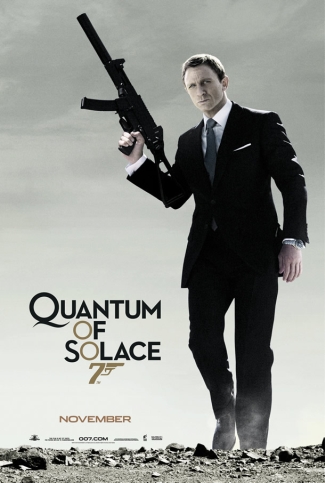
    Diagnosing Quantum of Solace

    ***SPOILERS***

    Last night I went out with my wife and some friends to watch QUANTUM OF SOLACE. I was so excited. But when the movie ended, I was totally unsatisfied. There was no release. Nothing. It just ended.

    There was lots of great stuff in it. Love the character and style of this new bond. Loved CASINO ROYALE, but this just didn’t work for me. My diagnosis has two parts.

    MINOR ISSUE: clarity in story. The chase scenes were so choppy I couldn’t get a feel for what was going on so I could worry for Bond. All I did was get sick to my stomach. Part of the way through I told my wife I was going to write death threats to the freaking director. Who in the world thought that was a good idea? It doesn’t mimic battle etc. In battle you are HYPER alert and focused. Your world doesn’t turn into chaos.

    But it was more than the chase scenes. There were times when I did not know what was going on. Why was Bond going to his friend from movie 1, why was he watching that guy pick up a bag at the play, why was he going to the party, etc.?

    If he’d shared any of his plans, I could have gotten worried when antagonistic forces thwarted him. As it was, I was just watching him do stuff and only realizing at the end what the goal was.

    The basic principle of suspense is to let me know what they need to do and why they need to do it, then let me worry as I see the operation fall apart. Or let me know the danger and see them walking into it. But time and again they didn’t provider the viewer with the necessary information in this movie. 

    MAJOR ISSUE: ineffective story structure. I think for a film to build to a huge climax and release, the hero has to find himself in more and more desperate circumstances. His situation has to become darker and darker until we see no way out for him. By the end of act 2 his plans etc. should all be in shambles. He’s out of options.

    In this Bond I rarely felt he was in danger. Yes, there were some fight sequences which were tense, but he never ended up in worse shape afterwards. We got messages that he was being framed for murders, but I never really felt the screws tightening on him. So it never got darker and darker for him.

    His plans seemed to only be delayed, not destroyed. In Casino Royale, his car is wrecked and he’s taken captive and is going to die. He loses. In this one, nothing. Even when his plane is shot down going out to the desert, it’s just a delay. They walk to the bustop and are soon back on track.

    There might be another point about something being at stake. The water grab is a great idea, but we’re talking a 50 year plot. It’s not THAT urgent.

    A FIX?

    I think they could have done more by playing up the revenge/mystery of the last one. Yes, have the water grab, but make this personal to him. He’s searching for the answers to who was behind his lover’s death. Why not?

    Then get the villain, the US CIA, and the British hunting him down with real resources. He evaded everyone fairly easily in this one. He’s running FROM all these forces, barely one step ahead, until he gets caught by them. And it’s one of Green’s guys in the CIA or something like that who captures him. So he’s totally screwed. Then have the Black CIA officer do something to spring him. He’d probably have to die for it.

    I’m sure there are more and better options. But do something so that Bond is running for his life, FAILS, then pulls it out. Not chasing down the bad guys one by one with relative ease.

    Just one option. Thoughts?