John’s Reviews – books, movies, whatever

  • The Blind Side, Blink, Tandoori Oven, Bischoff Cookies
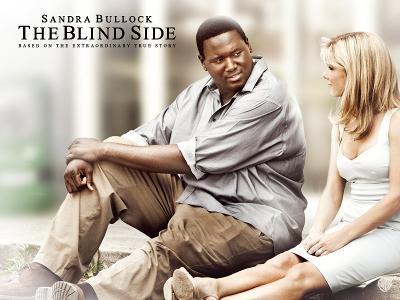
    The Blind Side

    Every time I see a sports movie advertised, I groan. Gee, what could this be–yet another story about an individual who, through pluck and determination, overcomes great odds to yadda, yadda, yadda win the game, yea, go team?

    Yawn.

    I enjoy sports, but only those where the outcome really is in question. Only those where I don’t already know the story. If I want a scripted win, I can watch some long-hairs and freaks on WWF.  

    So you’ll understand why I didn’t rush out last year to see The Blind Side. What? A monstrously huge kid plays high school football as a lineman? Wow, he must have really worked hard at that. Is the paint still drying at the Zeyer’s house? Maybe I’ll go watch that instead.

    And this was my response even though Sandra Bullock plays the leading role. I usually enjoy the movies Bullock stars in. Well, except for the last two–The Proposal and All About Steve–which I couldn’t bring myself to watch more than ten minutes of combined. But besides those, she’s probably been one of the most enjoyable actresses since Katherine Hepburn. This is because she actually plays real women, interesting characters, people with personality.

    This is opposed to some actresses who don’t really play people at all, but are put in movies by directors who must think that if they can make the eyes bong out of male heads, those very males won’t notice that the story is dumber than a bag of rocks. These gals have lips that are so puffed up they look painful (e.g. Angelina Jolie, ouch, ouch, OUCH, somebody help her) or have seemingly nothing else to bring to the table besides their looks (e.g. Megan Fox, oooh, look at her shirt ride up over her belly, oooh, another shot of her eyes, oooh, white teeth), and so all their roles end up including very little besides posing for the camera so that we can see that, yes, Timmy, these women really were born with some mathematics, i.e. symmetry and facial proportions conforming to the golden ratio. Are your eyes bonging out yet, Timmy? See, that’s why you should study algebra and geometry. Math lets you do things like that.   

    Anyway, so it was a Bullock film, yet I still didn’t want to see it. But my real-man brother-in-law suggested it for a date night, and so I reluctantly went to watch. (Date night as in double date with the wives, not him and me. Sheesh, you people.)

    I’m so glad I went. The movie was excellent. Probably because it was not about the plucky athlete winning the game, but about something far more important and enjoyable. It’s based on the true story of a rich southern white couple–Leigh Anne and Sean Tuohy–who try to take a homeless teenage African-American, Michael Oher (“Big Mike”), into their family. Michael’s mother is a crack head. His father is unknown. Michael himself is not doing very well. He’s failing school. He doesn’t even have a place to sleep sometimes. And he’s got the good old boys of his neighborhood wanting to hook him up with their gang and drug scene. But Leigh Anne soon takes charge.

    And, boy, does she take charge. She’s one of the most delightful characters I’ve seen in a long time. I laughed again and again at her lines and personality. She also made me think about what I’m doing with my life. This woman and her family did something significant. I won’t tell you what happened with Michael–blah, blah, blah, yea, go team. You can find out for yourself. That wasn’t the important story here. The important story, the one that touched my heart and funny bone, was the one about a delightful family who went way out of its way to try to give a complete stranger a chance at a happy life.

    Go see this show. No, it’s not in the theater, but you can buy or rent it. Me, I get all my films via Netflix. If you haven’t subscribed, consider it. Then you too can feel the excitement of seeing the happy little red Netflix envelopes waiting for you in your mailbox.

    By the way, I have enjoyed a number of other great sports films over the years. If you like The Blind Side, I think you’ll enjoy Coach Carter, Miracle, Invincible, and Cool Runnings (a Brown family favorite).

    Blink by Malcolm Gladwell

    We are told to make decisions based on logic, not emotion. Reason must prevail. The closer we are to Spock, the better. At least in our decision-making, right?

    Well, no. That’s actually wrong.

    Over the last two decades researchers have found that the vast majority of our decisions are made by our gut, in the blink of an eye. And even those we make consciously, we make with a large input from our emotions. In fact, people who have the emotion centers in their brains damaged seem almost unable to make good decisions. Give them seven types of apples to choose from, and they can’t seem to pick one. Ask them to schedule an appointment, and they’ll go round and round listing the pros and cons of different dates and times. Let them know one deck of cards is stacked against them, and they still choose to play with it. They have logic, but lack judgment.

    The rapid, emotional part of our brain is critical for good decision making. Of course, out guts can often be spectacularly wrong. In Blink, Malcolm Gladwell explores both sides of the choices we make in the blink of an eye.

    But this is no tome of dry erudition. Gladwell writes with fantastic simplicity, clarity, and power. He explains what we now know about human decision-making by letting us meet the psychologist who has learned to predict whether a marriage will last, based on just a few minutes of observing the couple; the tennis coach who knows a player will double-fault before the racket even makes contact with the ball; and the art experts who can spot a fake at a glance. He helps us see why New Coke failed, how we pick presidents, and how it was possible that the police shot down Amadou Diallo, who was simply coming home one night. He shares the story of Paul Van Ripper who beat the Pentagon war-gamers in a massive defeat and why.

    Blink reveals that great decisions makers aren’t those who have the biggest brains and highest IQ, but those who have perfected the art of “thin-slicing”—focusing in on the factors that make the biggest difference.

    The book was fascinating. Read it. You’ll start seeing the world differently.

    The Tandoori Oven

    While living in Orem, UT, Nellie and I got our first taste of Indian food. When we moved to the San Francisco area, we found a few Indian restaurants and really learned to love the cuisine. So you can imagine how excited we were when we moved up to boonieville Laketown and were told that just an hour away in Logan was a great Indian restaurant. So we followed the directions to the address we were given and ended up at the gas station just south of the USU football stadium on 720 East and 1000 North. And there above the gas station was the sign for the restaurant.

    We both looked at each other and rolled our eyes. Were the people who told us about this kidding?

    But I decided to just go look. Sometimes the little holes-in-the-walls can surprise you. Maybe in the back by the Hostess rack and chips we’d find some great food. I entered the gas station and found it run by a pleasant Indian fellow. I thought, dang, we’ve got our very own Apu’s Quiki-Mart (Apu being one of my favorite characters on the The Simpsons). However, there was no restaurant. I looked around and saw nothing but racks of normal gas station snacks. I was confused. “I was told there was an Indian restaurant here?” I said.

    “Right over here,” he said in his Indian accent and pointed me to an entryway in the far wall hung with strings of beads. “Through there.”

    Intrigued, I passed through the beads and did indeed find a small restaurant. They’d simply sectioned off a part of the original gas station. I also found that there was a separate door to the outside which I’d missed. I examined the buffet, which looked pretty good, went outside and waved Nellie in. We were going to give it a shot. We let them seat us, and proceeded to enjoy a fabulous meal.

    The restaurant is called The Tandoori Oven: http://TandooriOvenLogan.com. Nellie and I go there regularly. It’s been updated since the first time we went and dished up our soup into treacherous styrofoam bowls. Now they use real cutlery, but the good food and friendly service hasn’t changed.

    If you know Indian food, you can go in the evenings and order a number of dishes to share. But if you want the best deal, go for lunch. They put on an all-you-can-eat buffet which will let you sample a number of dishes. We love the kurmas, saags, vindaloos, curries, naans, and, dude, the spinach soup! Heck, it’s all good. Especially when we can sweeten it a bit with their tamarind or mango chutney. And make sure you leave room for their saffron helwa (spiced cubes of farina) smothered with cardamom rice pudding for dessert.

    Bischoff Lotus Cookies

    I recently performed a taste test. I got a package of Oreos and a package of Bischoff Lotus cookies, and I am here to state that the Bischoff Lotus cookies spanked the Oreos and sent them back to kindergarten for some schooling.

    After the taste test, I had to force myself not to eat the rest of the Bischoff Lotuses in one sitting. I succeeded in lasting for two sittings. Yes, they’re that good—crisp, caramelized, sweet. They have none of the bitterness of gingersnaps, yet have enough spice to delight the tongue.

    But these aren’t new cookies. The Dutch and Belgians have been enjoying them for years. Over there these types of cookies are called speculaas and are probably the most popular cookie around. I can testify they’re great with milk, hot chocolate, and Pero (hey, this is Mormon country). I understand they go great with coffee, even though I have not imbibed in that Aztec concoction and, therefore, cannot vouch for it personally. And for two years I enjoyed them, along with picturesque scenes of cobblestone streets, bicycles, and windmills.

    When I came home, alas, I couldn’t find these delights anywhere except at specialty Dutch stores. And when we moved away from Utah, I never found them again. Then Delta Airlines started serving them on their flights. Oh, joy. But I don’t fly that often. So I’m excited to report that recently I was walking in Macey’s grocery store just across from the Stadium 8 movie theaters in Logan, scanning the packages along the cookie aisle and finding nothing appetizing, when the heavens parted, and a beam of light illuminated a white package with red lettering. I believe I heard a choir.

    Bischoff Lotus cookies.

    Could it be?

    It was.

    I heard reports they were also in Wal-Mart, but I didn’t see them there. So for the sure bet, go to Macey’s, buy, enjoy. And consider yourself Dutchified.

  • Toy Story 3, How to Train Your Dragon, Rumbi Island Grill

    Toy Story 3

    It’s interesting that two of the most enjoyable films this year are both animated. The first is Toy Story 3. We all know how awful sequels can be, and, in fact, I didn’t like Toy Story 2 all that much. But Pixar defied the sequel slump with this one.

    Andy has grown up and is going to college. From a toy’s point of view, that’s tantamount to death because Andy has to clean out his room, and what is he going to do with all that junk anyway? The last few remaining toys barely miss the garbage truck and get sent, by accident, to the local day care instead. Sounds great for a toy, right? They’ll get played with every day forever. But things are not as they seem at the day care, and our crew of toys is put on the fast track to an early death. Will they be able to escape when the other toys there are ruled mob-style by a big pink teddy bear that smells of strawberries?

    I laughed and cried and cheered in this movie. There are hilarious scenes featuring Barbie and a Ken who’s gone over to the dark side. More gut busters with Buzz Lightyear when he’s put into Spanish mode and Mr. Potato Head who has powers we never would have suspected.

    But the movie goes beyond toys and action. It’s not just a cartoon. It’s about loyalty and friendship and heroics and love and family. Because my oldest will be leaving the nest next year, the final scenes carried extra power for me. But I think they will be effective for almost anyone because Pixar does in this movie what all great art does—it reaches into themes we all share. And in that moment, we identify so strongly with the characters that their situation becomes our own.

    How to Train Your Dragon

    Dreamworks’ How to Train Your Dragon, based on the novel by Cressida Cowell, is the movie I should have seen for my birthday. Instead, we went to the mind-numbing Clash of Titans. I still cringe at some of the massive plot holes in that one, even though Medusa rocked. Which only proves, once again, that cool effects can’t save a bad story. How to Train Your Dragon, on the other hand, delivers cool monsters, but never once did the writers make the mistake of thinking that cool monsters is what the story was about.

    The movie is about a young Viking named Hiccup who wants to be accepted, wants to become one of the burly defenders of his city, like his dad, Stoik the Vast. But Hiccup isn’t brawny. However, he is resourceful. And during a dragon attack, he brings down a mysterious Night Fury dragon with his invention. However, when he finds the dragon, he can’t bring himself to kill it. Instead, Hiccup and the dragon begin a friendship. But will Hiccup be able to save the dragon that everyone wants to kill? Will the Vikings be able to see the truth about the dragons before they’re destroyed? Most importantly, will Stoik be able to accept his son?

    I enjoyed the superb animation in this story as well as the dragons. But it was the characters and humor that made this movie so good. There’s Stoik who just can’t relate to his son, but tries to bond with a very interesting use of his dead wife’s brassier, Hiccup, the son, with his dry wit, and Gobber, a peg-leg family friend who has some of the best lines in the movie.

    Go see this show. You’ll laugh, and then you’ll wish you had a dragon of your own.

    Rumbi Island Grill

    The Rumbi Island Grill is a restaurant chain that started in Salt Lake City in 2000. They serve fast, casual tropical food at incredibly good prices. My favorite is their rice bowl. It comes with your choice of sauce, rice, and meat with sautéed vegetables. In the Netherlands I learned to love Indonesian food and the spicy-sweet peanut sauce that often accompanied it, which is why I can’t get enough of the Bali Island bowl with brown rice and shrimp. You might find you love the sauce so much you ask for two servings to pour over your bowl (oh, and add a dash of the hot sauce). The food’s great, but they’ve paid attention to the Hawaiian atmosphere as well. So even though it’s fast food (you order and they bring it out to you), you feel like you’re sitting in a casual dining restaurant.

    I always look for a Rumbi when I travel down to Salt Lake City or Provo. Now I don’t have to go so far–a restaurant has opened up in Logan right across from the Wal-Mart on the south end of town! I took Nellie there recently. The staff was friendly and the food was delicious–just what I’d come to expect.

    Now all we need is a Cheesecake Factory!

  • |

    Superstars Writing Seminar DVDs

    Aspiring authors, I wasn’t able to attend, but heard from a few who were that the Superstars Writing Seminar in Pasadena with Eric Flint, Brandon Sanderson, Dave Wolverton, Rebecca Moesta, and Kevin J. Andersen was EXCELLENT. 

    See clips of parts of the videos here (still a lot of good info): http://www.youtube.com/view_play_list?p=2F211054CBD822A8

    Purchase the full recordings on DVD or MP3 here: www.writerscanon.com

    Topics include:

    • Econ 201 for Writers: Economics of Commercial Publishing
    • Inside Editors: How editors look at manuscripts, novels & short fiction
    • Dirty Secrets: What you need to know about being a Professional Author
    • From Slushpile to #1 New York Times Bestseller in 4 Years
    • Intellectual Property: How to Exploit Yours
    • Balancing Acts: Writing World & Real World
    • Agents: the A Word
    • Networking for Writers
    • Self-Promotion for Authors
    • Novel Contracts
    • Self-Publishing: Realities & Pitfalls
    • Pitching the Big Proposal
    • Two Heads Are Better than One: Collaborative Writing
    • New Media: Using It to Get an Edge
    • E-Publishing
    • Movies, TV and Authors
    • Anatomy of a Major Book Release
    • Myths of Publishing
    • Eleven Tips to Increase Your Writing Productivity
  • |

    Writing Update: Curse, trebuchets, CONduit, book industry, & Robinson Wells

    As of 5 PM this last Saturday I have finished 15,000 words of the climax of Curse of a Dark God. I think I have another 10,000 to go and the book will be done. I’m so close to the end of this draft! So don’t let the progress bars fool you. The ending is coming together fabulously–lots of spectacle, big reveals, and major heroics. At least, I think so.

    While working on this, I had to spend a number of hours finding out how strong a wind must be to pick up humans and stones. I also needed to know the destructive forces of various classes of tornados and hurricanes. Why would I need to know such things? I write fantasy, for Leroy’s sake!

    (Yes, that’s good English; I’m a writer, and one of my prerogatives is to make up silly versions of common expletives using the names of friends and enemies.)

    Here’s why: I just can’t write if I don’t believe in what I’m writing. And when I’ve got monsters (skir) that can generate winds that will be used in a siege, well, I had to know the terminal velocities of what these creatures could throw, and what that might mean for fortress defense. I had to know the limitations and ramifications.

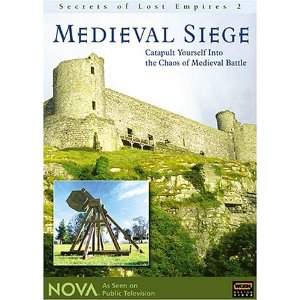
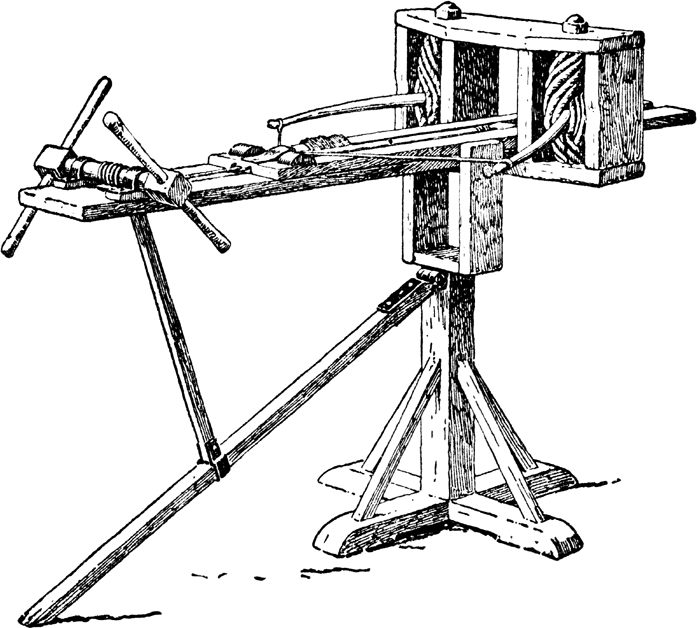
    I won’t rehearse all the fascinating details (and it WAS fascinating), but all that research did lead me to a wonderful documentary. It’s called Secrets of Lost Empires 2: Medieval Siege and was produced by Nova in 2000. You can get it on Netflix or Amazon.  In the film, fifty carpenters worked day and night to create and test what they dubbed “the fourteenth century version of the atom bomb”–the trebuchet (tre-byou-SHAY). The trebuchet as the most popular throwing machine in Europe during the middle ages. If you love the history of medieval war, you’ll love this film. You might want to add to it a reading of the excellent Ancient and Medieval Siege Weapons by Konstantin Nossov, which you can get via the inter-library loan program.

    I’ll share two cool factoids for you history fans. “Catapult” means “shield-breaker,” “cata” meaning break or penetrate and “pelta” being the name of the shield used by the Greek light infantry. The original catapults were NOT big spoons–they sped arrows and balls along a track like a crossbow. However, instead of using the spring force of a bow, they used torsion-springs, which is what you get when you twist fibers that want to be straight. In the case of catapults the fibers were ropes made out of animal sinews or hair (horse or human, a woman’s hair being considered the best) and soaked in oil. Click on the image to see a larger picture. 

    A modern example of a torsion-spring are those balsa wood airplanes with propellers attached to a rubber band that’s hooked to the belly of the plane. To fly them, you rotate the propeller round and round, twisting the rubber band. Then you let the propeller go. Because the rubber wants to be straight, it reverses the twist, spinning the propeller the opposite way you twisted it. 

    You might think these torsion-spring engines were weak. But one catapult was reported as being powerful enough that an arrow shot from it broke through a shield, and the armored warrior standing behind it, at a distance of 400 yards! Hence, the name.

    The other factoid is that “trebuchet” comes from the French term meaning to overthrow. If you saw Return of the King, you’ll recognize them as the engines used on the towers of Minas Tirith. Trebuchets are simply an evolution of the staff sling. When it came to breaking castle walls, there was nothing more effective until the cannon appeared. Of course, in my book I use them a bit differently. You’ll see.

    One funny thing. I watched the movie with my oldest who was just as fascinated with the engines as I was. When she was telling my wife about the film, she kept referring to trech-uh-butts. Which, I guess, is as fair an attempt at “trebuchet” as any. However, my wife kept picturing buttocks and couldn’t figure out what the heck my daughter was talking about–“You were watching what with your father?!”

    The French make things so hard . . .

    ***

    The Monday after CONduit I left for work in Mexico and then Vegas. I didn’t get back until this week. So I just wanted to say I had a great time at the con. Loved chatting with all the folks there.

    It was great to see the Larry Correia, Paul Genesse, Jessica Day George, Isaac Stewart (and his brother Dan), Mette Harrison, Eric James Stone, Darren Egget, Julie Frost, Sandra Tayler, LE Modesitt, Josh Perkey, Nicole (whose husband is an Orem cop and I lost his number), Daniel Who-I-Sacrificed-to-My-Editor, and the Dungeon Crawlers Radio guys.

    It was also nice to speak with Julie Wright who was one of the initial judges for the Whitney Awards. She’s always nice to chat with, but this time it was especially nice since she said reading Servant of a Dark God was like eating chocolate. I’ll take chocolate praise any day.

    I also met new author Janci Patterson who just sold a YA with a great premise. It’s called SKIP and is about a young girl whose parents are divorced. The girl has to go stay with her dad who lives in a trailer and is a bounty hunter. I’m a sucker for bounty hunter stories. Especially this one, because she goes out with him and falls in love with one of the guys her dad has to haul in. I’ve slaughtered the pitch, but I got that good old writer’s envy when she told me about it. Can’t wait to read it.

    I also got to see Barbara Hambly. I was at LTUE when she was there like 20 years ago. We loved her stuff. She suddenly dropped out of the writing scene in the early 90’s and now I know why–it appears Del Rey dropped all their midlist authors except for Anne McCaffery and someone else. Hambly was one of the causalities.

    ***

    After Hambly’s main address, I sat with a few authors and had a brief discussion about the book industry where it was suggested the industry was shrinking–fewer readers, fewer sales, doom, doom, doom. But that is exactly opposite all the data I’ve seen.

    1. Book sales have an annual average growth over the last seven years of 1.1%, adult paperbacks are growing 2.9% http://www.publishers.org/main/IndustryStats/indStats_02.htm or http://www.publishers.org/main/IndustryStats/documents/S12009Final.pdf . Now, this doesn’t show units sold. So it could be that they sold fewer units for more money per unit. Still, it shows at the very least that $$$ aren’t shrinking.
    2. The New Book Titles report here shows an increase in the number of titles: http://www.bowker.com/index.php/book-industry-statistics — 80% increase from 2002 to 2009.
    3. Reading rates are actually on the rise: http://johndbrown.com/2009/03/literary-reading-rates-on-the-rise/
    4. Finally, I contacted Bookscan for their numbers for an ALA conference I did last summer. This is just juvenile fiction, but the numbers are in units. Now, I don’t know if they added more sources to their database and so that caused a rise, but I explained to them what I was trying to do—see trends over time—and this is the data they provided. According to their numbers, more juvenile books are being sold now than in 2004. Click on the graphic below. This means we have more and more readers rising up through the ranks! One author asked how much of that was Rowling and Meyer. During that period books by those authors accounted for an average of 7-10% of all juvenile fiction. Bookscan categorizes “juvenile” as everything for kids. That means from Go, Dog Go up through what we consider Young Adult. R&M accounted for an average of 33-36% of what Bookscan categorizes as science fiction, fantasy, or magic within the juvenile mega-category. What all that means is the growth is across the whole category, not just with their books.

    So I’m very sanguine about the book industry’s prospects. Today’s youth seem to be able to play computer games AND read in great quantities.

    ***

    Finally, one last bit of news. Robinson Wells was the one of the main ones to start the Whitney Academy and the Whitney Awards. Well, he just got some fabulous news. Here’s the announcement from Publishers Marketplace: “Robison Wells’ YA debut dystopian thriller VARIANT, a modern-day LORD OF THE FLIES, set at a boarding school where not everything is as it seems and every day is a fight for survival, in a significant deal, in a three-book deal, to Erica Sussman at Harper Children’s.”

    For those of you who don’t know, here are the PM deal categories.

    • “nice deal” $1 – $49,000
    • “very nice deal” $50,000 – $99,000
    • “good deal” $100,000 – $250,000
    • “significant deal” $251,000 – $499,000
    • “major deal” $500,000 and up

    Oh, baby. Someday. Someday. Of course, I’m nothing but happy for Mr. Wells!

    Links

  • The Young Victoria

    Being a crass American I have always considered the current British royalty as nothing more than very expensive mascots. What function do they really serve besides acting as some kind of high-society-reality-show soap opera? 

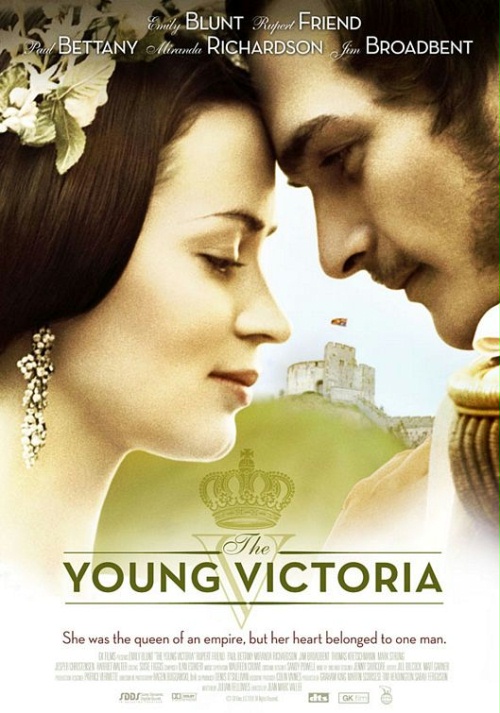
    Not that this is bad. If the British want to spend their money on queens, princes, and princesses, who am I to oppose them? After all, we Americans have kept the stellar Survivor series going for ten seasons. And when it finally ends, we’ll probably replace it with something else of supreme value like World’s Biggest Belchers or Kids Who Eat Boogers. At least the Royal Family has some modicum of class. Still, the point is that I’m not disposed to feel much sympathy for state-supported rich folk. So when I tell you I just watched and loved The Young Victoria, it should tell you something.

    The movie was sublime. A large part of it was because the story left me edified, left me wanting to be a husband–a friend to my wife–as good as the Albert portrayed in that film. Compare this to Killers which could have been so good, but devolved into dumb sex jokes and dumber action, which then only got worse. When that one ended, I staggered out of the theater having lost half my brain.  The Young Victoria, on the other hand, enlarged my soul.

    The movie is a romantic dramatization of some of the events preceding and following the coronation of  Alexandrina Victoria (Queen Victoria), focusing on her early reign and romance with Price Albert in the 1830s. She was only 18 when her uncle, the King, died and the crown fell to her. Some suggested she was too young and should sign her powers over to a regent. Others wanted to use her as a puppet. The question was: would she fall prey to the political aspirations of others? I will let you watch the movie to find out.

    Emily Blunt does a wonderful job as Victoria. I loved her in the Jane Austen Book Club as well. She’s supported by a great cast, including Rupert Friend as Prince Albert, Mark Strong (the villain in the recent Sherlock Holmes and Robin Hood) as the domineering Sir John Conroy, and Paul Bettany as the dubious Lord Melbourne.

    When recently compiling my list of favorite movies of the decade, I lamented the dearth of good love stories. Well, I just found one. This movie was golden.  If you love Jane Austen, you’re going to love this show.

    (BTW, the Royals actually do perform a number of worthwhile tasks. Read this wiki on the British Royal Family. You may also want to read this on Victoria after you watch the movie.)