Florida education results – wow!

Jeb Bush oversaw what appears to be an amazing transformation in education results in Florida from 1999 to 2007. He came to Utah to talk to legislators to share those results and what Florida did to achieve them. The Deseret News summarized some of it. However, anyone interested in education needs to learn more. Luckily, you don’t have to be among the special 300 who got to attend.

Bush started a non-profit as soon as he finished his time as governor. It’s called Foundation for Excellence in Education. On its website you can watch The Florida Formula Student Achievement which gives you the overview. Yeah, it’s 80 minutes long. So what? The education of our children is one of the most important things we can spend our time on. It’s worth two episodes of Seinfeld reruns or The Office. When you’re finished, you then might want to watch any number of the other videos out there or explore their material on excellence in teaching.

There is one key thing that has to be gotten right, however, for the whole thing to work. And that’s the test. All of this is based on performance on Florida’s FCAT. Right now I’m not too confident of Utah’s core tests. First, no teacher knows what’s on them. If you don’t know what you’re being measured on, it’s kind of hard to live up to the measurement. A lot of people go all Chicken Little about teaching to the test–“don’t teach toward the test! oh, no we’re teaching to the test!” But if the test is structured correctly, then that’s EXACTLY what we should be teaching to. The second issue is the very objectives we’re testing. I have not been impressed with Utah’s state objectives. Bad objectives and a bad test sink the whole operation. I’ve written more on these two issues here.

Still, I think Florida is on to something. Watch the video and then tell me what you think. I would be thrilled to have what I’ve seen so far implemented in Utah.

Share

Similar Posts

  • |

    The Myth of Being More Productive by Multitasking

    One of my personal flaws is my monkey fascination. I am interested in too many things. For example, when I was at the university I wanted to major in English, History, Dutch, Art, and graduate with Honors.

    Um, no. That didn’t work. They finally wrote me a letter and said 220 credits was more than enough. And I would graduate the next semester with whatever degree I could cobble together.

    Of course, then I started my Masters of Accountancy and Information Systems program. (Some people never learn.)

    When I was in my Masters program I started an investment club, wrote fiction, and wanted to start a FSBO home business as well as a write a non-fiction book with 4 collaborators. Oh yeah, and I was supposed to be Mr. Mom with two kids at the time while my wife put me through school.

    All this did was stress my marriage to the point that my wife was considering giving me the pink slip. Of course, being so involved in so many projects I had no idea I was in danger of being layed off.

    No, over the years I’ve learned that simplicity and focus is divine. It’s good to say no to the million things that vie for my attention, even the many noble causes. It’s smart to put a lot of effort into a few things. Become an expert in one area.

    In business, I’ve watched some friends focus, focus, focus. They’ve put in their time and have become very successful at what they do. They’ve worked hard. . . at one thing. On the other hand, you have those of us who haven’t yet been able to give up that danged monkey brain. (Although I will give myself credit–for the last five years I’ve been trying to reduce. Trying to focus. I’m failing spectacularly. But I figure sooner or later my efforts will pay off.)

    The multitasking myth shows up not only in the general activities we engage in, but also in learning. I heard this NPR story on myth of multitasking and thought I’d share.

    Maybe less really is more.

    Share
  • |

    Literary reading rates on the rise

    What great news!!!

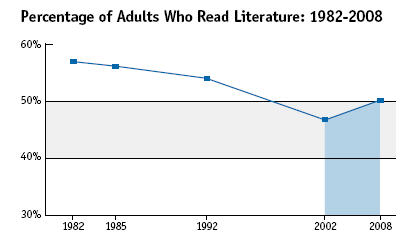
    Washington, D.C. — For the first time in more than 25 years, American adults are reading more literature, according to a new study by the National Endowment for the Arts. Reading on the Rise documents a definitive increase in rates and numbers of American adults who read literature, with the biggest increases among young adults, ages 18-24. This new growth reverses two decades of downward trends cited previously in NEA reports such as Reading at Risk and To Read or Not To Read.

    Adults up 3.5%, young adults (ages 18-24) up by 9%. Full article here. Full report here (with nifty graphs and tables).

    They attribute it to reading programs. Perhaps. I’m sure JK Rowling phenomenon had something to do with it. Whatever the reason, it’s good to hear.

    Share
  • |

    Why you can’t popularize literary fiction, part 2

    I voiced my opinions on the TC Boyle message board. Needless to say, I’m probably too aggressive in my stance. But a guy over there said: “(easy,chewable,harmless pages) shouldn’t be the goal of any writer with even the tiniest self-respect.”

    Here’s my response.

    —-

    I don’t know any of these successful authors who don’t have self-respect because I don’t know any of them who try to write based on what they think will sell. Everyone of them that I know writes from passion. And I know some NY Times Bestsellers. They might look at 10 projects they have passion for and choose one that might be more marketable. But the passion comes first.

    I don’t know how anyone could spend the amazing number of hours it takes to finish a novel unless they have passion for the project. In fact, I wonder if it’s possible to create something that’s actually sellable without it. Everyone’s always talking about these hacks out there with metal brains writing for money. But after all the writers I’ve met, I’ve yet to find one. In my experience they’re as scarce as the yeti.

    So my intent wasn’t to say you can write for love or money, but not both. My intent was to say that I believe most MFA programs have made themselves irrelevant to the greater stream of literacy in the country. The teachers have passion for fringe genre and teach their students how to entertain that fringe reader. And if they DO have passion for the types of fiction most readers want, such enjoyment is always talked about as some form of slumming. There’s an apology or at least a statement making it clear they know such fiction is not something you bring to the table where serious writers work.

    But this isn’t true. Serious writers, passionate writers work in those genres. And they deliver excellent work. By that I do NOT mean they deliver the tropes of literary fiction in drag. What they deliver doesn’t appeal to the fringe markets. But it’s excellent, nevertheless, because it delivers exactly what the people go to those stories for.

    Share
  • Ack! It’s English class

    Lorrie McNeill gives her middle school students a wide choice of reading in Jonesboro, Ga.

    Junior High and High School English = grammar, spelling, and reading Cliff Notes.

    Wrong.

    It all depends on the goal. The NY Times recently published an article about a whole other approach to language arts. Nellie is one of those who is trying this new approach with her 7th and 8th graders.

    She’s had experienced similar fears, similar results, and similar comments from parents as the teacher featured in the article. Most importantly Nellie has kids reading more than they’ve ever read in their lives, writing more than they ever imagined they could. And it all derives from a change in the goal—make lifelong joyous readers and writers versus teaching the students to be able to recite facts about a given set of works.

    Of course, the students still learn literary concepts and grammar, but only as it supports and relates to their writing for publication, whatever form that publication may take (family newsletter, review in local or school paper, letter to favorite author, pro, etc.)

    She’s loving this program and has been amazed at some of the stuff these kids produce and the progress they make when natural motivation kicks in.

    NEW YORK TIMES
    BOOKS | August 30, 2009
    The Future of Reading: A New Assignment: Pick Books You Like
    By MOTOKO RICH
    The experimental approach is part of a movement to revolutionize the way literature is taught in U.S. schools.

    http://www.nytimes.com/2009/08/30/books/30reading.html?emc=eta1

    And for you who might think society might fall if we let them choose their books, consider this…

    WALL STREET JOURNAL
    LIFE & STYLE, AUGUST 29, 2009, 5:04 A.M. ET
    Good Books Don’t Have to Be Hard: A novelist on the pleasure of reading stories that don’t bore; rising up from the supermarket racks
    By Lev Grossman

    http://online.wsj.com/article/SB10001424052970203706604574377163804387216.html

    Share
  • |

    What Separates the Gifted from the Schlubs and How Praise Can Backfire

    What makes someone gifted?

    Raw talent?

    Sure. An apptitutde for something always helps. But it appears it’s not enough. True expertise takes work. And those trying to help (i.e. parents, teachers, coaches) can hinder if they give the wrong kind of praise.

    I wanted to share three articles reporting the results of a number of interesing studies on expertise which often appears as a skill level that seems unobtainable by normal, motivated individuals.

    The Meadow Mount School of Music

    This music school in the Adirondacks has “trained such luminaries as Pinchas Zukerman, Itzhak Perlman, Joshua Bell, Lynn Harrell, and Yo-Yo Ma.” A number of researchers wanted to see what the difference was between the students who seemed most skilled and those who weren’t. They divided students “into three skill levels, including one the faculty had identified as having the best chance of becoming world-class soloists.” Then they looked at the differences.

    According to the report, “the results were clear-cut, with little room for any sort of inscrutable God-given talent. The elite musicians had simply practiced far more than the others…Psychologists found a second attribute in elite players that is less obvious than sheer hours of practice. While most of us think of practice as the repetition of tough spots (and this is how many young people do practice), elite musicians, they found, took a different approach.”  Read full article.

    The majority of childhood prodigies never fulfill their early promise

    Why? According to these researchers it’s because so many early-bloomers get warped by their experience and fail to develop perseverance. More here.

    Praise that Undermines Achievement

    It appears that how we praise achievement affects performance. Sometimes in large and startling ways.

    You may think that it’s good to praise your child for being “smart” or “good” in some subject. But there’s growing evidence that giving kids such labels doesn’t improve or motivate performance, but actually reduces it.

    Psychologist Carol Dweck and her team have studied the effect of praise on students in a variety of settings. “Repeating her experiments, Dweck found this effect of praise on performance held true for students of every socioeconomic class. It hit both boys and girls—the very brightest girls especially (they collapsed the most following failure). Even preschoolers weren’t immune to the inverse power of praise.” So what type of praise actually works? Read here.

    When does genius bloom?

    We often think genius must be tied to being precocity. After all, Motzart was doing musical flips when he was still a kid.  For writers, however, it appears this isn’t the case. More here.

    Share
  • |

    Nancie Atwell and Real Learning

    If you’ve read my article on the Teachers section, you know I think a good portion of what we do in our public schools is a waste of time because it’s not driven by any natural motivation. The result is that  students are bored more than they need to be. They develop a distaste for many subjects that could provide them great joy. Finally, when they do learn, it’s for a test, not life. And so when the test is over the promptly forget what they’ve learned. 

    This is not to say that I’m against testing or teaching to a test. Far from it. A good test demonstrates that you’ve learned what you’re supposed to have learned. A good test focuses on the main things you want to learn. Good tests (and there are many types of tests) are critical.  The problem is the objectives the tests are built on. If the objectives are idiotic then teaching to the test becomes idiotic.

    Now Nellie just got a job (we’re so happy!) teaching 7th and 8th grade English. For some of you that will elicit groans. The memories of supreme boredom produced by endless grammar lessons and assigned readings with worksheets are still that strong. And Nellie and I had the same feelings. If her job was to teach grammar et al for nine months, she was going to shrivel and die.

    Because grammar is bad? No, for heaven’s sake. Because grammar isn’t the point. Nor are assigned readings. Or iambic pentameter, rising action, theme, character, plot, induction, deduction, the six traits and all the rest of the usual suspects. The point is to enjoy writing and reading for the things writing and reading do.

    So we’ve been working and disussin how she might still meet all the state requirements yet teach the practical joy. Becasue if she teaches the joy, then the students will become better readers and writers than they ever could be otherwise. Which means they’ll be able to do and enjoy the things that can be enjoyed and done when you know how to write and read.  Case in point: our girls. Nellie’s done such a good job teaching the joy of reading that we have to ground them from books every once in a while.

    So anyway, I came up with some ideas, a first draft of a curriculum. Of course, starting from scratch is a huge project. There were issues with it. More importantly, would it work? You don’t want to risk your first year on the job. Luckily, Nellie is smarter than I am and found someone who already discovered this wheel. Nellie handed me Nancie Atwell’s In the Middle.

    I began to read, and I didn’t stop until almost 1 AM. Everything I’ve learned about teaching in the last 20 years, everything I’ve learned about learning how to write in the last 20 years–it’s all there. The key principles are all there. And the implementation of those principles is simple and proven (they actually test results).

    What are the principles? What is the program?

    Read the book. Heck, just read the first chapter.

    I cannot tell you how excited I am for Nellie. We ordered these books and can’t wait to devour them.

    • In the Middle: New Understanding About Writing, Reading, and Learning
    • The Reading Zone: How to Help Kids Become Skilled, Passionate, Habitual, Critical Readers
    • Lessons That Change Writers
    • Naming the World: A Year of Poems and Lessons
    • Side by Side: Essays on Teaching to Learn

    Nellie is also going to apply for a four-day intership at the Center for Teaching and Learning in Edgecomb, Maine. I hope she gets in. She’s also going to do a week-long writer’s workshop at BYU.

    Stay tuned. I’m going to twist her arm and see if she won’t blog about her experience this first year.

    Share