Good Stuff! 4 Delightful Movies

If you’ve been looking for some good movies to watch, I have four here that I think you’ll enjoy.

Wives And Daughters CoverThe first is for fans of Downtown Abbey and Pride and Prejudice. It’s a four-episode, BBC TV miniseries called Wives and Daughters, and is based on the novel by Elizabeth Gaskell, who was a popular English novelist in the mid-1800s. Gaskell is the one who also brought us the delightful Cranford and North and South, which all my daughters love.

Wives and Daughters is about Molly Gibson, the daughter of a country doctor, who suddenly has to deal with a new stepmother and a stepsister who becomes Molly’s good friend but brings a lot of baggage with her, mostly concerning men. It’s also about a man whom Molly falls in love with, but who only thinks of her as a sister.

But it’s about even more than that. It’s about the enjoyable relationship Molly has with her father and the local Squire and his family, and the issues the Squire has with his own sons. It’s also about how the women in the town and the local gentry deal with Molly.

Gaskell has a knack for showing both the good and bad about people and still making you love them. She also writes a fabulous ending. I don’t want to spoil anything, but the ending, for me, was just brilliant in so many ways. If you enjoy period romances, you’re going to love this.

*

The-Hundred-Foot-JourneyThe next movie is called The Hundred Foot Journey and is a humorous story about a contemporary Indian family down on its luck. The father leads them to England, but things don’t work out. So he takes them on a trip through France looking for the place to set up their restaurant. Except it’s a bit of a hare-brained idea because France doesn’t do Indian food.

The family’s vehicle breaks down outside a little town, and the father decides this is the place where they will try to build their life again. The problem is the spot he’s chosen is right across the street, the titular hundred feet, from a posh French restaurant. And the battle between the two restaurant owners begins.

You’ll laugh and fall in love with the characters in this story. And when it’s over, you’ll immediately want to go out and get some Indian food. It’s a great film.

*

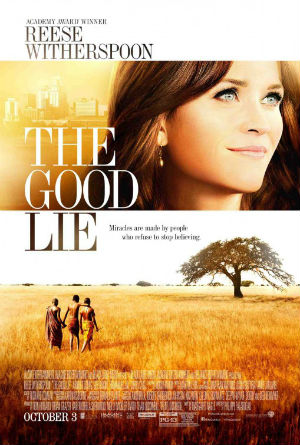
The_Good_Lie_posterAnother wonderful fish-out-of-water story is The Good Lie, which is about three of The Lost Boys of Sudan, refugees who are resettled in America.

In 1983-2005 there was a civil war in Sudan, which lies on the southern border of Egypt. During the war, government troops and rebels of the south systematically attacked villages in southern Sudan, killing 2.5 million and displacing a million others. The Lost Boys and The Lost Girls were children who escaped the attacks and traveled by foot in search of safe refuge. For many that was over 1,000 miles across three countries to refugee camps in Ethiopia and Kenya. Over half died along their epic journey, due to starvation, dehydration, sickness and disease and attack by wild animals and enemy soldiers.

In 2001, as part of a program established by the United States Government and the United Nations, approximately 3,800 Lost Boys were given the chance to leave the camps and resettle in the United States. This film is inspired by their experience. In fact, a few of the actors are actually some of those who were resettled.

The beginning of the film is about their journey. The rest is about what happens when they come to America. There are many poignant moments in this film, but there is also a good dose of humor and goodness. It’s a wonderful film to watch with the family.

*

McFarland,_USA_posterMy last, but certainly not least, recommendation is McFarland, USA, made by Disney and starring Kevin Costner. My family and I simply loved this movie. We loved it so much some of us ended up watching it three times because we couldn’t coordinate our schedules and so watched it again with the family members who weren’t there the first time.

It’s based, with a little literary license, on a true story about Jim White, a teacher who re-starts a cross country running program in 1980 in McFarland, a small agricultural town at the south end of California’s Central Valley. It’s another fish-out-of-water film with this White coach being introduced to Hispanic culture.

Now I know what you’re thinking—oh, jeez, another sports film. And, yes, it has many of the same story beats that you find in many sports stories. But this one seemed to make them all fresh again. All I can say is that we loved it. In fact, immediately after the third viewing, two of my daughters were so juiced about running, they went out on a run of their own.

If you like sports at all, you’ll like this one. But even if you don’t love sports, you’ll like it because it’s not really about sports. It’s about the human spirit and seeing value in the things everyone else overlooks.

Share

Similar Posts

  • Gladwell, Dish Cloths, and Higher Technology for Tuna

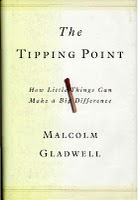
    The Tipping Point by Malcolm Gladwell

    After reading Made to Stick, I decided to read the book that inspired it—The Tipping Point: How Little Things Can Make a Big Difference by Malcolm Gladwell. I’d read Blink and Outliers by the same author and found both fascinating.  I’m happy to report The Tipping Point is just as good. In it, Gladwell examines what conditions cause ideas, behaviors, messages, and products to spread like outbreaks of infectious disease. 

    In the book he shares a number of situations and studies, including the sudden drop in crime in New York city in the 1990’s (which started by attacking graffiti in the subway), the dramatic popularity of the Blue’s Clues TV program with pre-schoolers, Paul Revere’s success in rousing the citizens along his route (versus the almost total failure of the other guy who rode that night), the resurgence of Hush Puppies shoes, syphilis in Baltimore, Columbia Record’s amazingly effective golden box ad campaign, and a dozen other outbreaks.  From all of these, he extrapolates three rules of social epidemics—The Law of the Few, The Stickiness Factor, and The Power of Context.  

    The arguments Gladwell presents are thought-provoking and powerful, but what makes him such a treat to read is how he writes.  Like the best science writers (in fact, I think he IS one of the best), he tells great stories with interesting characters.  He puts the reader on the edge of the seat with mystery, insight, and humor. He makes things that could be incredibly complex seem like first grade math. It’s as if he’s standing right there with you chatting about the subject. Moreover, he does all this from page one.

    Here’s what I mean. I left the book out on the kitchen table one night after reading a few chapters.  The next morning Super Wife came down to quickly eat breakfast and get herself to a meeting.  She made the mistake of opening the book to glance at the first page. Twenty-five minutes later she came up for air and realized she was going to be late and dashed out the door. The writing is pure mind control.  And I loved every minute of it.

    If you’re at all interested in advertising or how fads and movements start, if you want to affect the behavior of customers or local teens, if you just like to read how things work, I think you’ll love this book.

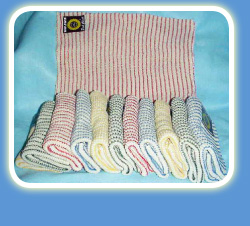
    Sunflower Dish Cloths

    I used to suffer along with subpar dish cloths.  There were the dish cloths with mesh on one side that were so small you had to rinse them after every wiping stroke.  There were the hand cloths made of terri that belonged in a bathroom but were repurposed and were far too big. Then were the cloths that had some slippery crap in the thread that refused to soak up water.  And there were the crocheted things that I think we should have put out of their misery when we first got them. Folks suggested we go to sponges. So we did sponges and had similar results.

    Oh, woe, woe, woe.

    Then a kind and loving friend gave us a set of mystery cloths that were incredible.  They were large enough that we didn’t need to rinse with every wipe.  They had this fantastic weave that was open, yet absorbent, and dried quickly.  And the weave had enough of a texture that you could use it to scrub.  We received those back in 1999.  They lasted us for years and gave us much kitchen cleaning joy.  But, alas, like all of mortality, those brave cloths finally began to give up the ghost. 

    My problem was that I didn’t know who had made those cloths and where I could get more.  We looked all over and couldn’t find them.  And then, at this year’s Garden City Raspberry Days craft fair, we saw them nestled amidst all the kitsch!  We bought as many as we could afford, and went our way rejoicing, fully expecting these to last us until we have grandchildren.  Maybe we’ll pass them down as priceless heirlooms.  Maybe some day they’ll be featured on Antique Roadshow.  Maybe they’ll be resurrected with us and become the official dish cloth of the Millennium when the world is renewed (it could happen).

    If you’re sick and tired of sponges and crappy dish cloths, let me suggest you pick up some Sunflower Dish Cloths made by Sangamon Mill. You can order them in bulk at http://www.sangamonmill.com/ , or in smaller quantities online from places like Amazon.

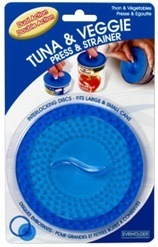
    Everiholder’s Veggie & Tuna Press & Strainer

    Do you eat tuna? If so, you know the biggest pain is draining the can. But you don’t have to suffer along any longer using the lid, which doesn’t do a good job at all anyway.  There’s a better solution, which Super Wife discovered. It’s called the Tuna and Veggies Press and Strainer by Evriholder: http://www.evriholder.com/Tuna-Veggie-Press.asp.  With this little blue piece of higher technology you easily and quickly press all the juices away, and nothing slips out the sides. We love our.  You can order it online, although Super Wife found it at our local evil empire Wal-Mart store.

    That’s it for now.  In the next review, I’m going to reveal two killer recipes over which all who partake will salivate and drool—Chocolate Éclair Cake and Dill Potato Salad.

    Share
  • |

    “How It All Came Crashing Down” by Peter B. Gardner

    Everybody knows that we got into this recession because banks began lending money to people who had terrible credit ratings, right? People who didn’t have to prove they even had a job. I mean, how long are you going to stay in business when you keep handing out dough to people you never hear from again?
    But is that all there is to it? And was it really just the fault of congress because they told Freddie Mac and Fannie May (the organizations that purchased loans) that they had to start purchasing these highly risky things? Or was it all those greedy Wall Streeters?

    In this must-read article, “How it All Came Crashing Down,” BYU econ professors explain how we got into this mess—and what we can learn from it.

    But that’s not the end of the story. Ira Glass and the folks at This American Life uncover deeper causes of the problem in their must-listen show “The Watchmen” (no, not the movie). I mean, come on, we were told these high-risk loans were as dangerous as milkshakes. Shouldn’t SOMEBODY have seen it?

    President Obama keeps saying that the root of the problem was that there wasn’t enough government oversight. Sounds good, doesn’t it?  We’ll get disinterested Uncle Sam to protect us from all these investment bullies. But if we dig a bit deeper, it appears that Uncle Sam was one of the major players at the root of the mess.

    Ouch.

    Read. Listen. They are two fabulous pieces.

    Share
  • Good Stuff! Some Calm on the Climate

    Is the sky falling?

    When we politicize science it sure seems that way.

    For example, a while back I reviewed The Big Fat Surprise by Nina Teicholz. What she found in her research about fat and sugar was that we followed the exact wrong diet path over the last 40 years by (1) rushing to judgment on the science in a field that was tricky and (2) politicizing it. This, in turn, affected the science. And not in a good way. Here’s a quote from the book.

    “Once ideas about fat and cholesterol became adopted by official institutions, even prominent experts in the field found it nearly impossible to challenge them. One of the twentieth century’s most revered nutrition scientists, the organic chemist David Krivtchesky, discovered this thirty years ago when on a panel of the National Academy of Sciences, he suggested loosening the restriction on dietary fat. “We were jumped on!” he told me. “People would spit on us!…they were so angry that we were going against the suggestions of the American Heart Association and the National Institutes of Health”

    “This kind of reaction met all experts who criticized the prevailing view on dietary fat, effectively silencing any opposition. Researchers who persisted in their challenges found themselves cut off from grants, unable to rise in their professional societies, without invitations to serve on expert panels, and at a loss to find scientific journals that would publish their papers. As a result, for many years the public has been presented with the appearance of a uniform scientific consensus on the subject of fat, especially saturated fat, but this outward unanimity was only made possible because opposing views were pushed aside.”

    For the rest of us, the result has been the highest obesity and diabetes rates we’ve ever seen. And it seems to me that we’ve been doing this same thing with climate science.

    Instead of vigorous and spirited debate and research, we’re rushing to judgment and politicizing it. The media, non-climate scientists, activists, politicians, and others have turned it into a religious eco frenzy. And so we end up with people like Bill Nye the science guy (who was a mechanical engineer and then TV host for a children’s science program, not a climate scientist) suggesting that “climate deniers” go to prison.

    Prison?

    I think Bill had a bad dream about Nazi Germany, socialist Russia, or ISIS.

    We all want clean air and water. We all want awesome rivers and lakes. We all want good science. Is it possible to remove the politics and frenzy so we don’t go off into the weeds again? I don’t know. But I did find these short videos helpful. If you’re interested in the climate, I think you’ll enjoy them.

    In the first one, Richard Lindzen, an MIT atmospheric physicist, addresses the politicization.

    In the one, Will Happer, emeritus professor of physics at Princeton University,  addresses whether we can actually accurately predict the climate.

    This one by Patrick Moore, an ecologist and one of the founders of Greenpeace who subsequently left the organization because of its anti-science activism, explains why CO2 is actually awesome.

    In this one Moore gives more details and argues that maybe we need more CO2.

    In this one, Bjorn Lomborg argues against climate alarmism. Of course, Lomborg isn’t a climate scientist. However, if his facts are correct, then he asks an important question.

    The other thing to ask is so what? So let’s say the seas rise a bit and it gets a bit warmer. We might lose some beach front properties over a number of years. That’s not new. It might accelerate and reach farther inland. Okay. But nobody is going to die. They’ll just rebuilt somewhere else.

    So let’s avoid prison and climate pogroms and disastrous dashes off into public policy like we did with fat and sugar. Let’s simply support our scientists in doing what they do best. Let’s promote a vigorous search for more insight.

    Notes

    Share
  • The Rocket Science of Overspending

    In July, I blogged some spending 101 for Congress and the President, including contigency planning for alien invasions.  I thought I made some good points.  However, through the whole spending debate that occured this last spring nobody in the media or elsewhere was able to make clear what is going on with the US government. Nobody except Dave Ramsey. He explained it on Fox and then on his website. If you take the big federal numbers and translate them to a size we can understand, here’s the situation:

    – Joe and Susie (the Federal government) make $55,000 a year
    – They spend $96,000 a year
    – At the same time, they have $366,000 in credit card debt

    Look at those numbers again. Every year those clowns in Washington are adding $41,000 a year to that massive debt total. Soon enough, our overspending will kill our ability to do anything else except pay the interest on that debt.  150 years after America abolishes slavery, we decide that debt slavery really is a good idea. Yea! Give us shackles! Give us shackles!

    No wonder our credit score as a nation (our bond rating) was reduced.

    So what did the government do this last Spring? They agreed to find some way to cut spending from $96,000 to $78,000. Meaning they’re still adding $28,000 dollars a year to the government’s massive credit card debt total. Which we have to pay!

    If the US Government was a family, they would be making $55,000 a year, they spend $96,500 a year, & are $366,000 in credit card debt. What’s the first step to get out of debt? Stop overspending! But that means a family that is used to spending $96,500 a year has to learn how to live on $55,000. That’s a tough pill to swallow. It works the same way for the government. You can’t borrow your way out of debt, whether you’re a typical American family or the entire U.S. government. At some point, you’ve got to say, “Enough is enough!” and make the hard cuts necessary to win over the long haul. – Dave Ramsey

    The answer is NOT to print more money.

    If you do that, you reduce the value of each dollar. It’s called inflation. As Ron Paul rightly points out, it acts effectively as a tax. Or as I like to put it–a PAY CUT. How many of you would like to get a nice fat 10% or 20% pay cut this year? Furthermore, instead of fixing the problem, the overspending continues, which means more pay cuts in the future. More fun!

    No, the thing we have to do is STOP SPENDING MORE THAN WE MAKE.  Here’s what has to happen.

    1. We must write into law that Congress balance its budget every year–they must not be able to spend more than they take in except in rare emergencies. This means they might need to build up a rainy-day fund.
    2. We must cut our spending. Now. I linked to an idea Ron Paul has for this in my 101 post where we just go back to 2007 levels of spending.
    3. We must work to increase our revenues. Not through hiking taxes to monstrous levels, but by providing optiomal regulatory conditions for economic growth. See my 101 post. 
    4. We need to make sure the taxes are visible, so the American people can easily see what’s going on. Congress has mandated that lenders provide clients an APR so they can clearly see the rate they will pay on a mortgage. Why shouldn’t we mandate that the IRS send out an ATR–annual tax rate (or maybe Annual Grab Rate or Annual Tax Burden or you come up with the name)–which includes all Federal taxes translated into one total rate?  
    5. We need to give everyone the opportunity to pay for the soldiers that defend them and the roads they drive on, even if it’s just $50-100 a year for the very poor.
    6. We must send people to the White House and Congress who are willing to do what it takes RIGHT NOW.

    I mentioned Ron Paul a number of times above. He’s not my choice for president. But he has added a number of good things to this discussion. Here are the Ramsey links:

    EDIT: Mark Holt makes an excellent point in the comments. Inflation isn’t just a pay cut. It’s a savings cut, a retirement cut, a 401k cut, a house value cut, an everything cut. Using that backdoor method, the DC Connivers institute a tax of everything, something they’d never be able to pass out in the open.


    Share
  • The Avengers & The Paris Grill

    Edit: I wrote this like a month ago and thought I posted it. But there is was in my drafts. Somebody give me some Ginko extract.

    The Avengers

    The Avengers is Marvel’s latest installment of the films in the Avenger world—Iron Man (2008), The Incredible Hulk (2008), Iron Man 2 (2010), Thor (2011), and Captain America: The First Avenger (2011). 

    Iron Man is, by far, the BEST of all of them.  I thought Captain America might be just as good, but the movie lost its way about half way through.  The others are okay, not anything to jump up and down on the couch about. So while I was looking forward to seeing The Avengers, I wasn’t expecting anything special. I’m happy to tell you that The Avengers is good. Not as good as Iron Man, but much better than all the others.  And certainly well-worth the price of admission.

    The earth is in possession of an artifact of immense power called the Tesseract, which isn’t a made-up name. In geometry a tesseract is a cubic prism—some four-dimensional thing which boggles the mind. But in this movie and Captain America, the tesseract is a blue cube that can open portals to different parts of the universe or run Nazi war machines.  The problem is that there are other beings in the universe.  Some of these would like to be able to run their own Nazi machines and subjugate all species on every planet.  So they get Loki, Thor’s adopted brother, to lead an army to raze the earth and retrieve the artifact.   

    Of course, earth’s forces aren’t strong enough to repel this alien force. That is, unless you call upon the Avengers—Iron Man, Thor, Hulk, and Captain America. As well as Avengers who haven’t had their own movies yet like Black Widow, Hawk, and Nick Fury.

    It all sounds a bit much, and in the hands of a lesser writer it might have been. But Joss Whedon (Serenity, Firefly, Buffy the Vampire Slayer) wrote the script and directed the movie. And he did a fantastic job. Instead of thinking we came for a barrage of special effects, he takes time to build the characters and relationships so we care about the action when it arrives. He does use the idiot chaos cinema technique for some of the action, but not nearly as much as was in Hunger Games. More importantly, he makes up for the error of his ways with a number of laugh-out-loud moments. Hilarious moments.  In fact, the humor is one of the main reasons why this movie was so good.

    If you like super hero movies, you’ll love The Avengers. Maybe not as much as you like Iron Man or Spider Man 2 or the Nolan Batman series. But close enough to have a great night out.

    The Paris Grill

    The Paris (Idaho) Grill has opened another restaurant in what used to be the Bear Lake Motor Lodge Cafe.  The cafe was okay. Nothing to write home about.  So I didn’t know what to expect with the new grill.  However, I took two of my daughters out last night for dinner.

    The Paris Grill has four menus. I don’t know why they keep them separate, but they do. One for breakfast, lunch, dinner, and another for their pizzas.  We opted for the “Burgers n Pastas n Salads” menu which I guess is the lunch menu, but was what we ordered our dinner off of.

    Confused yet?

    Luckily, the food’s good enough that the menu business doesn’t matter. The lunch menu features a number of regular sandwiches—BLT, chicken cordon bleu, French dip.  But it also offers some signature sandwiches like a kielbasa and pepper sandwich, something called the Hobo Deli (which is tasty sounding combo of sour dough bread with pepper cheese, roasted turkey, bacon, grilled tomatoes, and cilantro dressing), as well as the Monster Grill—roast beef topped with caramelized onions and peppers, mushrooms, and provolone cheese.  I opted for the Monster Grill. My girls skipped the salads and ordered a hamburger and the chicken cordon bleu with mashed potatoes.

    The first words out of my daughters’ mouth when eating the mashed potatoes were “ooh” and “yum.”  That was followed by another “ooh” and “yum.”  The potatoes were good.  And they were made from scratch.  The sandwiches were tasty as well.  Good enough that I’m going to go back to the grill to try their dinner menu with my wife.  

    We topped the dinner off by splitting one of the grill’s big, hot cinnamon rolls.  The prices for the lunch items were reasonable—around seven or eight bucks—and they were big enough that the girls took half their meal home.  

    If you’re in Garden City, Utah and looking for something besides burgers and shakes, try the grill.  I think you’ll be quite satisfied when you walk out the door.

    Share
  • Good Stuff: The Free State of Jones

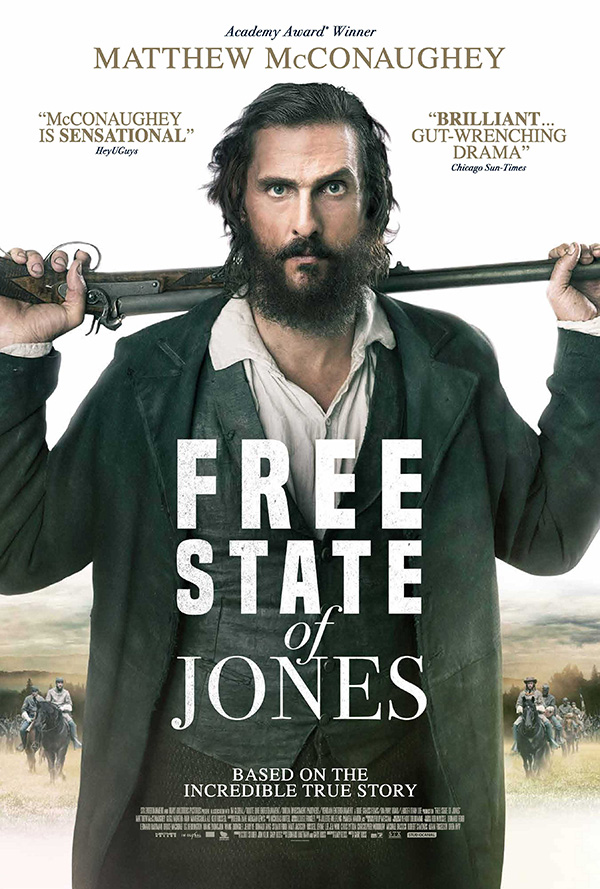
    I recently watched a moving and surprising film called The Free State of Jones, starring Matthew McConaughey. It’s about Newton Knight and how he led three counties in Mississippi to break away from the Confederacy during the Civil War.

    Think of that. On January 9, 1861, Mississippi declared it’s independence from the United States over the issue of slavery. They were the second state to do so. South Carolina was the first. On reflection, it makes sense these two states seceded first because they had the highest portion of the population as slaves. South Carolina’s population was 57% slave. Mississippi’s was 55%.

    Mississippi’s declaration of independence from the Unites States starts with this paragraph.

    “Our position is thoroughly identified with the institution of slavery—the greatest material interest of the world. Its labor supplies the product which constitutes by far the largest and most important portions of commerce of the earth. These products are peculiar to the climate verging on the tropical regions, and by an imperious law of nature, none but the black race can bear exposure to the tropical sun. These products have become necessities of the world, and a blow at slavery is a blow at commerce and civilization. That blow has been long aimed at the institution, and was at the point of reaching its consummation. There was no choice left us but submission to the mandates of abolition, or a dissolution of the Union, whose principles had been subverted to work out our ruin.”

    The rest of the declaration simply elaborates on that theme. However, not everyone in Mississippi agreed. The folks in Jones County, way down in the southeastern part, were mostly non-slave holders and cattle herders and had little use for a war over a state’s right to maintain the institution of slavery.

    Led by Knight, on October 13, 1863, with the war still raging, folks in Jones County and adjacent counties formed a separate government known as the “Free State of Jones”. They fought at least fourteen skirmishes with Confederate forces and went so far as to raise an American flag over the courthouse in Ellisville and send a letter to Union General William T. Sherman declaring Jones County’s independence from the Confederacy and asking for support.

    This movie is based on those events and, importantly, some that occurred after the war ended.

    The film is rated R for a scene with some Civil War battle injuries. And perhaps because of the use of the n-word. What it delivers is a powerful depiction of the issues of the time and the courage of one man who’d had enough. If you like history and action, I think you’ll enjoy this movie.

    Share