Interview by Davis Ashura
Davis Ashura, author of The Castes and OutCastes, recently interviewed me. Check it out. It was a fun interview.

Davis Ashura, author of The Castes and OutCastes, recently interviewed me. Check it out. It was a fun interview.
Mrs. Brown, my wife, teaches language arts for the 7th and 8th grades as well as reading comprehension. She’s big on reading. She wants to provide every opportunity for kids to not only get good at it, but also learn to love it.
And so her walls are lined with bookshelves full of awesome books teens love. She reads the first chapters of books to her classes to let them sample various stories. She features their book reports. She has them paste the covers of the books they’ve read on pages displayed around the classroom. And the school’s awesome librarian supports with her own programs.
The 7th and 8th grade students at Rich Middle School are marinated in a big celebration of reading.
In Mrs. Brown’s class, it’s fairly straight forward to get an A on reading, which is a huge part of your grade—all you’ve got to do is read.
But how much reading do they need to do? How do you track it? And what books should they read?
Check this out.
First, she tests each student to see what his or her reading speed is.
Next, she takes the number of hours they’re supposed to be reading each week for homework (I think it’s 2 or 2.5), then does the math to get a feasible reading word count for the trimester for each student. She may adjust it a bit, depending on the student’s ability.
Third, she presents that number to the student, and the two of them set a word count goal for the trimester. Talk about an individualized goal.
If you want to get an A in reading, all you have to do is reach that word count goal.
How do you know how many words a book has?
The Accelerated Reader program provides that information.
But how does she know that they’ve read the books?
She uses the Accelerated Reader tests. And if there isn’t one, the student can write a report.
And what books do the students read?
Any dang book they like.
I love this. The kids get to select their own books and just read, read, read.
Another part of this is that she pings each student once a week to ask them what book they’re reading, what page they’re on, and what they think of the book. This weekly check-in provides the more frequent accountability students of that age need.
Yesterday, she received this report from one of her 8th grade boys who is reading Prey, the first book in The Drovers series.
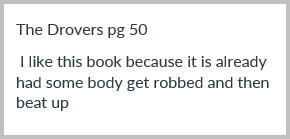
Oh, yeah.
I’ll take that any day (grin).
Rock on, budding reader.
Folks, a huge thanks goes to Stephen Nelson for putting all this together. You may kiss his hand when you see him.
This is a recording of “How to Write a Story that Rocks,” a two-hour seminar Larry Correia and I just put on at the annual BYU’s Life, The Universe, & Everything symposium. I think we had 130-140 people attend. This symposium is focused on writing fiction. And while the panels and presentations do include things specific to the science fiction, horror, and fantasy genres (both adult and young adult), a lot of time is also spent on story writing fundamentals that apply to ALL genres. So when I developed this workshop, I made sure I took the fundamental approach.
The two-hour seminar has been broken down into 12 segments. To switch between the segments:
If you prefer, you can watch all 12 on the How to Write a Story that Rocks YouTube playlist page.
I’ve found whenever I develop any presentation or training that it takes a few iterations and revisions before it’s the best it can be. This is the first iteration of this seminar. And so below this video I’ve provided additional comments on each segment explaining key concepts, principles, and techniques that we might have failed to discuss or convey as clearly as we’d hoped. Enjoy!
How to Write a Story That Rocks – Handout
It’s documented–right-wing gun nut Larry Correia sang “Kumbaya.” What’s next? The hugging of small trees? Oh, Larry, the disilluion. The disillusion.
The reason why I had Larry sing was not for his mellifluous performance, but to demonstrate the difference in reactions between him and our happy volunteer (“Country Road” by John Denver–this really was a love fest). The volunteer balked because he hadn’t taken any thought to know what to sing before he was commanded to do so. On the other hand, Larry and I had spoken before the seminar. So Larry had something to sing BEFORE he sang it. It’s a simple demonstration, but it illustrates a principle a lot of new writers forget. Writing is a performance. It helps to know what it is you’re going to perform before you perform it.
It’s one thing for you to tell yourself to write. It’s much easier to tell yourself to write the scene where the rancher finds out one of his illegal ranch hands has been kidnapped.
Now this doesn’t mean that you have to know everything. Or that you can’t write exploratory drafts to figure out what it is you want to write. But it does illustrate that whatever techniques you use, you’ll be a lot more effective in your writing when you have something to say first.
But what do you develop? What are the things that bring the story to life? How do you go about getting those things to say? That’s precisely what I wanted to address in the seminar. In the segments that follow, I try to:
I think this segment went fairly well. What rocks will different from person to person, even though there will often be a huge overlap between people. So it’s important for authors to seek to develop the kinds of stories that rouse their passion. Watch this interview with best seller Debbie Macomber to see what I mean. So I can’t tell you what to write about. Or if whath you think rocks will resonate with a large number of people. However, what I can do is share the techniques I use that have been most productive in helping me develop initial ideas into something that has much more power.
You can use the techniques to juice up any of the four parts of story. However, I will say that I find that the most productive, the most important parts, are character and problem. Plot and setting are important. I love them and work to juice them up. But when I get a good character and problem, that’s when the writing seems to flow the easiest.
And no, I don’t list theme as a part of story. Everyone talks about theme, but when I read what they have to say or press them for examples, it seems that it always either boils down to (1) a story element or topic that’s repeated, (2) a story problem/issue stated in an abstract manner, or (3) some moral situation. Les Miserables is about the “theme” of mercy versus justice. But saying justice versus mercy is just an abstraction of the story problem and dilemmas the story deals with. So, no theme.
Loved this bit about scenes from David Mamet: http://www.slashfilm.com/2010/03/23/a-letter-from-david-mamet-to-the-writers-of-the-unit/
I’ll be adding my comments to the rest of these segments over the next few days.
Check it out: Dan Wells on How to Build a Story (story structure). I find Dan’s “start with the ending” technique helpful as well as thinking about a worst fears realized moment. Watch the videos and see if there isn’t something there that can help you develop your story idea.
You can get the PowerPoint of How to Build a Story on Dan’s site.
If you find this approach useful, you might want to check out what novelist Larry Brooks has written about the same material on StoryFix.com.
One of the things I love about writing is that there’s always something new to learn. There’s always new content and, therefore, lots of cool research, but there’s also a lot to learn about the craft. I have no illusion that because I now have a contract I’ve suddenly arrived as a master craftsman. This art is just too big.
So you can imagine my delight when I saw that David Morrell is going to be giving a day-long workshop in my own backyard (out West, 5-8 hours is still in your backyard). I’ve signed up for Morrell’s workshop on June 6, 2008.
He’s the guy who wrote Rambo and started Thrillers Inc. He was also a professor for many years.
More on the Conference
http://www.murderinthegrove.com/index.htm
More on Morrell.
http://www.shotsmag.co.uk/shots21/intvus_21/dmorrell1.html
http://www.davidmorrell.net/
http://www.writerswrite.com/journal/oct02/morrell.htm
This was interesting.
David : I have a Ph.D. in American literature and taught academic courses: the American Novel of the 19th Century, the American Novel of the 20th Century, American Realism, Hemingway and Faulkner, Hawthorne and Melville, that sort of thing. The University of Iowa has the famous Writers Workshop, but I had nothing to do with it. In fact, they hated the sort of books I wrote and hated even more that I earned money as a novelist. That was the official line. But in secret, students snuck to my office and asked me technical questions about craft or asked me to read contracts they’d been offered (to see if the contracts were reasonable). Sometimes they showed me their manuscripts. The most productive association of that sort was with Jon Jackson who later published a series of police novels about Detroit. My most gifted student was T. C. Boyle. He writes humorous literary novels and short stories that critics love. His latest is DROP CITY. I taught him nothing about writing – he was a genius. But he did ask me to direct an individual reading course that he needed in order to graduate. We had a lot of interesting discussions, and I’m thrilled by his distinguished career.
Interestingly enough, T.C. Boyle was one of the writers that made life bearable for me while I was getting my BA in English. His novels, well, I never finished one of them. But his short work sings. Heck, his long work sings, but there’s not enough plot for my tastes.
Tia Nevitt writes the Fantasy Debut blog where she reviews “All Debut Fantasy . . . (almost) All the Time.” She’s posted a review of Servant of a Dark God that points out some interesting differences between this epic fantasy and others. She is also one for whom the family aspect of the story resonated. In fact, she’s the first that’s really highlighted it. She has an interview with me coming out later this week where I discuss that aspect of the novel. Finally, I really like how she captured one of the core issues of the story below. I wish she’d been there when I was sending my queries off to agents and editors 🙂
Servant of a Dark God by John Brown is one of those novels that I pick up with some reluctance, not really thinking it’s for me, but then I end up enjoying it thoroughly.
Mr. Brown has taken a very different approach with Servant of a Dark God. This is an epic fantasy that does not involve epic journeys, recent calamities or long-term character arcs. It does involve long-term lies; the kind of lies that are told over such a long period of time that they are thought of as truths. Full review of Servant of a Dark God.
Dixon Leavitt is an amazing artist. He recently emailed me saying: “Sometimes I just start sketching with no plan in mind. This just popped out. Thought you’d like to see it.” It’s Hunger from Servant of a Dark God.

Duuuuuuuuuuuude!
Dixon explains the step by step of the creation of this painting at dixondoodles.blogspot.com. You’ll want to noodle around that blog to see the other artwork he’s done.
Rejoice! Sing! The draft is done!
Hallelujah.
Based on my records I spent:
If I’d been working full time on this that would be roughly 17 weeks. That’s about 4 months. I don’t think that’s so bad, considering this book clocks in at 230,000 words. Not bad at all. But no wonder just finishing a novel is the thing that filters most would-be writers out. That’s a freaking huge amount of time. I hope as things progress I get faster.
Here’s what I focused on in this draft.
So I’m very pleased with this draft. Here are the first three chapters for your enjoyment: CODG draft 2 beginning for readers. Remember: feedback from my wife, agent, editors, and other early readers will change it. You’re welcome to contact me with any comments you might have about it.
