Good Stuff! Savory Thai, Planters Medley, Everest, The Arrival

I love finding little, non-chain restaurants with excellent, reasonably priced food. And I just found another one this week. It’s called Savory Thai, and it’s on 182 W Center Street in Orem, UT.

Oh, baby. If you decide to go, you are in for a treat. We ate there in celebration of my third daughter’s call to do missionary work in the middle and western Pennsylvania area (go Steelers, Amish, and “yous all”).

I learned to love Thai food because it’s so close to Indonesian food. And I learned to love that because I lived in the city of Nijmegen in the Netherlands for five months and in Amersfoort, which is maybe an hour away, for seven. In Nijmegen, I lived in the attic of a row house with a series of missionary companions. In Amersfoort, I lived in a spare bedroom with another series of companions. Both homes were owned by Indonesian grandmothers who cooked one or two Indonesian meals a day for us. Think about that—home cooked Indonesian food every day. It was marvelous. When I came back to the States, Indonesian restaurants were few and far between, but to my delight I found that the Thai cuisine is very close, and so that became my stand in.

If you’ve never had Thai food, it’s kind of like Chinese, but it’s got curries, so it’s a little like Indian as well, but that doesn’t describe it either because it has its own separate taste that’s entirely wonderful.

This place is in a little strip of stores. It’s small enough that you could drive right past and never know it existed. But when you walk in, you’ll see that they know how to make a good first impression. It’s clean, smells good, and the host is friendly, but these guys go farther than that. You’ll notice, of all things, the menu cover. Instead of handing out some flimsy paper or laminated thing, they hand out these thick menus covered in what looks like some kind of leather. It gives a feel of permanence, of solidity, as if the restaurant has been there for years (it’s two months old). But of course we weren’t there for menus or friendly servers. We were there for the food. And we were not disappointed.

I can happily report that their green curry (spicy), pineapple curry, massaman curry (a lovely peanuty sauce), orange chicken, chicken cashew, fried rice, and pad Thai were all excellent. They use no MSG, cook it fresh, and keep it reasonably priced, $8-$10 per dish. I can promise you that we’ll be back.

If you’re in the area and want some great food, stop at Savory Thai.

*

I love almonds and have been for many years a big fan of the W?nderful brand bags of roasted and salted almonds you can find in Sam’s Club. However, this last week, I came across something new from Planters called their Almond Lover’s Medley, which is a blend of four different varieties of almonds, dry roasted and unsalted. It includes the Marcona, Nonpareil, Fritz, and Butte-padres, which is the variety used in the W?nderful bags. I can report that this mix from Planters is delicious. The differences in taste and texture between the varieties is subtle, but real. And I was surprised at how much I enjoyed them unsalted. If you love nuts, you’ll want to give this blend a try.

*

I did not want to watch a movie about climbing Mt. Everest. Everest? Were you kidding me? I couldn’t think of anything more boring, but this is what my daughters wanted, and it was Thanksgiving weekend, and so we watched Everest, the 2015 movie.

I am happy to report that it ended up being a great, disaster thriller, based on a true story, which was captured in the book Into Thin Air by Jon Krakauer. I cared about the characters, was on pins and needles during great portions, and exclaimed out loud during a number of tense parts. And after all that sweating, the story made me think about the things we do and how to prioritize when life is on the line.

If you like stories about survival, you’ll love this. If you don’t, I still think there’s a good shot you’ll really enjoy it.

*

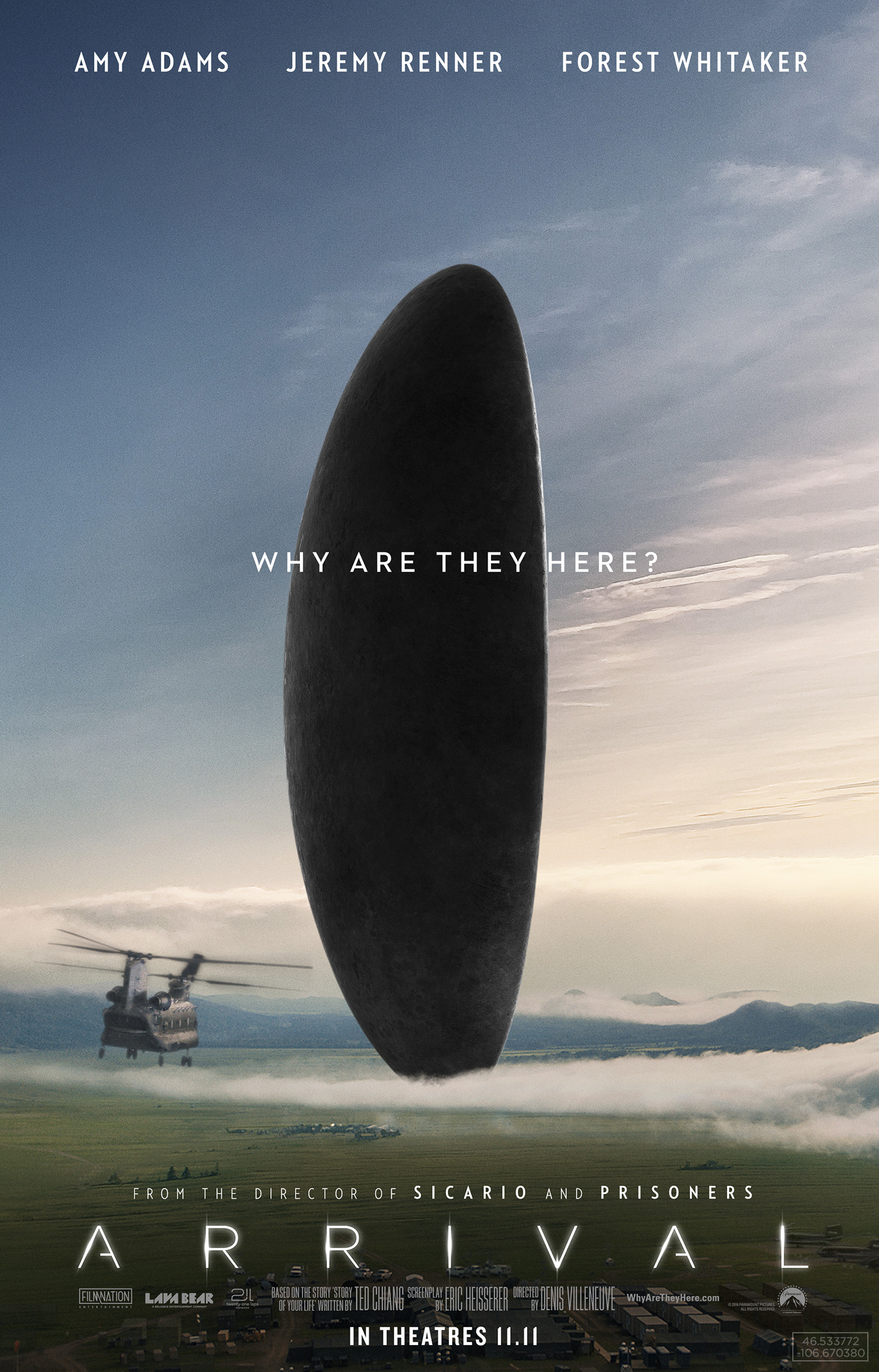
My wife is a sport. We were in the big city to watch a movie with our youngest daughter who is in high school. Our daughter, with her teenage brain, had the wild idea of a double-feature. My original man brain thought that sounded capital—how long had it been since we’d squandered five or six hours watching movies! The wise man brain didn’t think it was a very practical idea, and suggested it would be much better to do a double-feature next week we we could start at three in the afternoon. But the wise man brain was outnumbered and soon succumbed. And then all of the crazy brains ganged up on my wife, who graciously relented, and so we watch The Arrival and Fantastic Beasts and Where to Find Them and got home at like 1:30 am.

As for Fantastic Beasts, if you like Harry Potter stuff, you’ll love it. If you’re not mad for Harry Potter, it’s not going to rock your world (although you still might have a good time). Enough said.

What about The Arrival?

This is a movie about the arrival of aliens, but it’s not a shoot-em-up like Independence Day or War of the Worlds. It’s more like Contact, the one with Jodie Foster. It’s a film that makes you think and is for those who are willing to be a little patient. If you can slow down and just enjoy the film, I think you’ll end up loving it because it’s about far more than meeting mysterious creatures. It ends up being about the choices a woman makes about her family. If you go and give it the space it needs, I guarantee you’ll chat about it and savor it afterwards.

I won’t tell you anything more because you’ll only understand what’s going on in the woman’s life when you get to the last fourth of the movie, and I don’t want to spoil the delicious revelation for you. So just know that the alien tech and the alien themselves are strange and mysterious and cool, but that this movie is about so much more.

If you liked Contact or even Inception (sans the frustrating non-ending), you’ll love this.

Share

Similar Posts

  • Tales From Earthsea

    Tales from Earthsea (The Earthsea Cycle, Book 5) 

    When I was in 7th grade I read Tolkien’s The Lord of the Rings trilogy. Of course, I wasn’t the sharpest literary tack back then, and so great sections of The Two Towers and The Return of the King went over my head and, therefore, bored me. But, with the help of the Hildenbrant calendars, enough came through to thrill. I wept at the events in the mines of Moria with Gandalf, geeked out over the elves, orcs, and Nazgul, was fascinated with the Ents and wizards, and generally wanted to stay in that world forever.

    When I finished the trilogy, I mourned–the dream was over. I read Smith of Wootton Major and Farmer Giles of Ham. Both were delightful, but neither was the same as LOTR. Then I saw The Silmarillion. It had a cool cover, a map.

    Oh, joy! I bought it and took it home.

    Alas, that book was about as much fun as reading a ten-pounder on the history of baroque cornices. I tried mightily to push through, but I don’t think I was able to finish more than 15 pages total from all the sections. So I mourned again, and then, still feeling the loss, went looking for something else that might whisk me away.

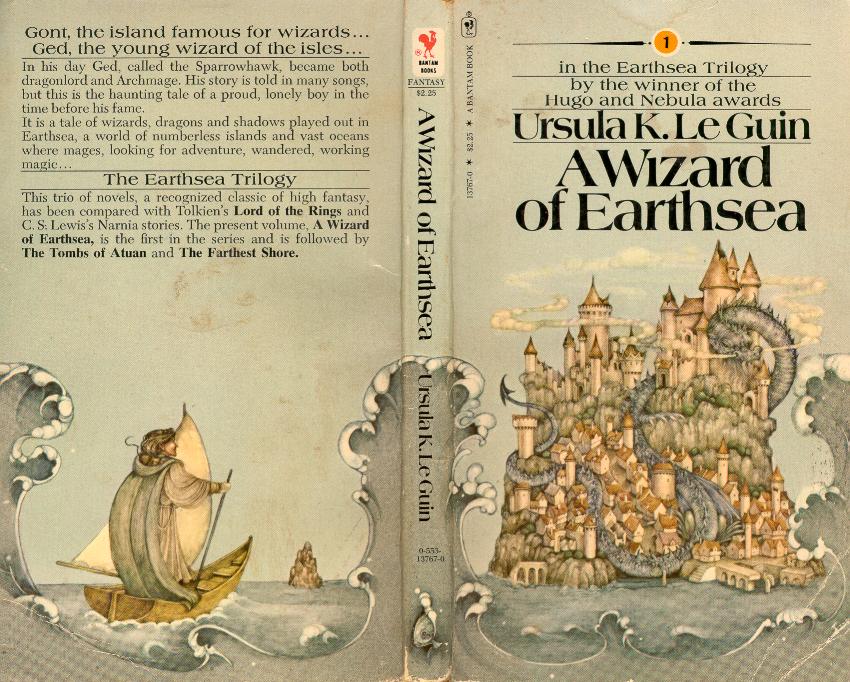
    One of those whisking stories was Ursula LeGuin’s A Wizard of Earthsea. Of course, the fact that there was a wizard in it was important, but as equally delightful to my then puny literary prowess, was that the story was a slim thing. As were its two companions The Tombs of Atuan and The Farthest Shore.

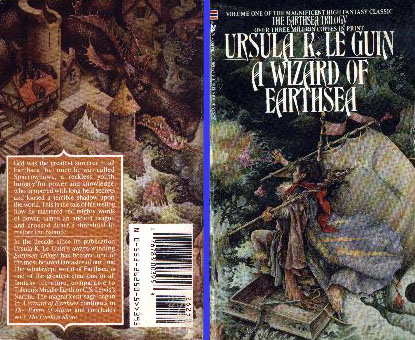
    Here’s the cover the drew me in so long ago.

    I relished all three and moved on to other stories.

    Time passed and I forgot about LeGuin. Almost 10 years later I was newly married. My wonderful new wife started reading to me as we’d drive. And on one of the three-hour drives to her parents, she pulled out this little book and began to read.

    It was A Wizard of Earthsea! And it was just as marvelous the second time with a bigger brain as it was the first time with a smaller one. In fact, Nellie’s reading to me was so enjoyable I slowed down to 40 mph so I could extend the 3-hour drive. Of course, she quickly caught on to my scheme, shut the book, and told me she wouldn’t read another word unless I drove 65 mph, at the very least.

    What can a guy do? I kept it at 65 (well, 60) and joyed in the wonderfulness of a new wife who would read aloud to me (you mean this model reads, too?!), the night and the stars spread above those lonely Utah and Wyoming roads, and the amazing story unfolding before me.

    And this is the cover of the one my wife read to me.

    We read all three to each other and moved onto other stories.

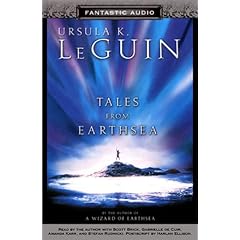
    More than 15 years passed and I’d mostly forgotten LeGuin (I really never could get into her Hainish stuff). I was in the library looking for some good audio. And there on the shelf stood Tales from Earthsea by Ursual LeGuin.

    Just a little slim container of cassettes. Why not? I thought.

    Holy heroes, Batman—it was gold. LeGuin’s a master of building that feel: the wonder of fantasy, the mystery of things long forgotten or rumored to exist, the pull of learning arcane powers. I loved every minute of it (well, except for the slogging first four pages of backstory, but get through that, which isn’t too bad with Karr’s reading, and you’re into the kingdom). The first story, “The Finder,” read by Amanda Karr was incredible. It takes us back to how Roke became was it was in the first trilogy. But the delights do not end there. Four more stories follow.

    I liked them all so much, I just checked the audiobook out again so I could listen a second time. And, it appears, LeGuin was busy in my absence because she has more Earthsea than this.

    • A Wizard of Earthsea, 1968
    • The Tombs of Atuan, 1971
    • The Farthest Shore, 1972 (Winner of the National Book Award)
    • Tehanu: The Last Book of Earthsea, 1990 (Winner of the Nebula Award)
    • Tales From Eathersea, 2001 (a collection of short stories)
    • The Other Wind, 2001

    I just got the last two from Amazon. I can’t wait to enter into LeGuin’s magic spell yet again.

    More cool Earthsea stuff.

    Share
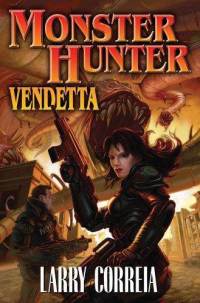
  • Monster Hunter International by Larry Correia

    MonsterHunterInternational_LarryCorreiaThere’s a joke that all horror movies would be over in two minutes if you just made the hero smart and gave him a gun.

    Well, Correia gives his likeable hero a gun, but not just any old thing. If you’re going to kill a vampire, why not use a rocket propelled grenade or a flame thrower? In fact, if there were enough monster outbreaks, you might have a government agency. You might also find that agency was willing to outsource some of the monster hunting to private contractors (ala Blackwater). And you can bet they won’t be hunting with pea shooters. They’ll be doing it right, with brains and firepower. Correia, someone who loves guns (used to own a gun shop and shoot competitively in rifle, shotgun, and pistol) and monsters, wrote a story that does just that.

    The idea of Larry Correia’s Monster Hunter International might remind you a bit of X-Files or Men in Black, but it’s neither. However, it is as  good as or better than both. Correia tells the story of Owen Pitt, a big lug of an accountant, who, as he was working late one evening, gets called into the office of his boss. No big deal, right? Except the fat man is naked, transforming into a werewolf, and vows to eat Pitt’s heart. It’s not quite how you want to end your day tallying debits and credits. Pitt almost dies in the encounter, but manages to “live the American dream” and throw his incompetent jerk of a boss from the fourteenth-story window and splatter him on a double-parked Lincoln Navigator below.

    Good work for a bean counter. When Pitt finally recovers, he gets an offer he can’t refuse (mostly because of the alluring agent that comes to recruit him), and he joins Monster Hunter International (MHI), the private contractor who sends out special force teams to use any means at their disposal to kill monsters. Unlucikly for Pitt, one of the baddest monsters around is just about to ruin the world forever, and Pitt finds himself in the middle of the fight.

    Correia fills the book with enough action for any red-blooded male, a variety of bad mamba jamba monsters, and wonderful characters. There’s romance and heroism (I got a lump in my throat at one part toward the end), but his signature is his humor. I laughed again and again.

    Part of that humor stems from the fact that Correia has an ear for good lines. Part stems from his delight in taking common tropes and stereotypes and twisting them. And this is another one of the things that I enjoyed immensely about the book. For example, the team of newbie hunters that Pitt joins is not made up of square-jawed males and females with Navy SEAL backgrounds, although some in the company do have that. Nope, Correia puts together an accountant, librarian, school teacher, and stripper (all people who faced some kind of monster and are ready for payback), and he makes them believable hunters. 

    This tongue-in-cheek tweaking is everywhere. There are elves in this book unlike any you have ever seen. But he also makes it personal. Owen is not your typical accountant. Even a number of the minor characters get this treatment. For example, one of the people on the team is a Black guy with Rasta hair. But Correia doesn’t choose from what Correia calls one of the four Hollywood stereotypes. Nope, this guy plays against those types. He isn’t the comic relief, the gangsta, the sports dude, or scary male. He’s his own man, a shy virgin with a good heart. Correia also gives his characters interesting backstories. And one of the delights is discovering them.

    I encountered a few minor flaws in the presentation, but these are easily overlooked. Easily. There’s also quite a bit of profanity (and so those who wish to avoid it are forewarned). However, when I turned the last page Friday night, I looked up at Larry who was lying on his bed in our La Quinta hotel room in Denver, his concealed .45 and 9mm guns on the floor beside him, and said, “Wow. WOW.” And then I think I said, “Dude, what a marvelous read” or maybe it was “Oh, great lord of zombie destruction tales do not smite me,” but I’m not sure because I was still thinking about the perfect last line of the perfect last scene of the last chapter.

    Now, those exclamations of satisfaction and delight had nothing to do with the guns on the floor, that Larry’s a deadly shot, or that he’s a big 6’3″ Portugese. It has nothing to do with the fact that he and I were on a book tour together. I don’t read books that don’t grab me. End of story. I stopped doing that long ago. I don’t care who wrote them. And I don’t give false praise. False praise irks me to no end and does nobody any good, especially not the receiver. The truth is that Larry’s book was simply too good to put down. It pulled me in with the opening quote and kept delivering the goods until the end. And if you don’t believe me, you read the quote that both inspiried and opens the book and tell me you don’t want to turn the next page.

    “You know what the difference between me and you really is? You look out there and see a horde of evil, brain-eating zombines. I look out there and see a target-rich environment.” ~Dillis D. Freeman Jr.

    Yeah, it got ya, didn’t it. The ride is waiting folks. Just go on over to Amazon. Correia is going to be a writer to watch.

    Share
  • Believe In Me, Cyber War

    A Man and a Team of Girls

    Back in 1964, Jim Keith took a job at an Oklahoma high school to coach boy’s basketball.  But when he arrived, the administrators changed their minds and gave his job to someone else.  Keith’s contract didn’t specify which gender he’d coach, just that he’d coach.  So they switched him to the girls.  Keith was extremely disappointed.  Who wanted to coach girls when it was the boys who played real ball?  Especially when Keith was supposed to be head coach.  Keith tried to get the promised position back, except the girls he coached had other things in store for him.  Harold Keith, Jim’s brother, wrote a novel based on what happened.  That novel was made into a movie in 2006 called Believe In Me.  

    Now, we all know the plot line of sports movies: a losing underdog of a team rises up to win.  It’s predictable, right?  But we could say that of all crime shows as well—in this episode investigators discover a crime and figure out who did it!  Wow, what a shocker.  We could say it of all romantic comedies as well—in this movie a couple at odds gets together.  No way!  We could say it of lots of stories.  And yet we love these stories anyway.  Why?  

    Because the characters suck us in.  Because the story tellers do such a good job with the particular details we forget we’re watching a movie or reading a book.  We forget to think about the ending.  Furthermore, the stories are often about more than just winning games.  And so we worry about these people who have become real to us and focus on their immediate situation.  At least, that’s what happens when the story tellers do a good job.

    And Robert Collector, who both wrote and directed the film, did a great job with Believe In Me.  Now, I don’t know how accurate the film’s depiction of five-on-five play is; I believe the girl basketball teams of that era played six-on-six.  But that’s a niggling technical detail.  Besides, the movie isn’t about technique anyway.  It’s about a man and a group of country girls who have to face difficult obstacles, not so much on the court, but off it.  If you have girls or like sports at all, I think you’ll love this movie. 

    Cyber War

    I recently reviewed America The Vulnerable which explained how exposed we are as individuals, corporations, and a country to cyber crime, cyber espionage (both state and corporate), and cyber attacks.  Of all the cyber threats we face as individuals and a nation, the least likely is an all out cyber war.  But just because it’s less likely that doesn’t mean the threat isn’t real.  Especially since cyber warfare has been in use since the 1990’s.  We used cyber weapons openly in the gulf war in 2003, knocking out Iraqi air defenses.  Israel used them to own Syria’s air defenses when bombing their clandestine nuclear site in 2007.  Russia used them against Estonia in 2008 and Georgia in 2009 on a variety of targets, bringing many critical systems to a halt.  In 2010, somebody, most likely the US or Israel, developed the Stuxnet worm to sabotage the uranium enrichment facility at Natanz in Iran.  China has already conducted trial runs of cyber attacks on the US and has planted logic bombs and trap doors to activate in the future.

    In Cyber War, Richard Clarke shares his insights into what cyber war is, how cyber weapons work, and how vulnerable we are as a nation.  He discusses the cyber warriors (hackers) we now employ in the US military, and how a cyber war is like and unlike other wars.  In the second half of the book, he discusses the factors that have created our current vulnerability, how to set up a defense, and what we need to think about when conducting a cyber war. 

    And Clarke knows his stuff.  He worked for the State Department during the presidency of Ronald Reagan.  In 1992, President George H.W. Bush appointed him to chair the Counter-terrorism Security Group and to a seat on the United States National Security Council.  President Bill Clinton retained Clarke and in 1998 promoted him to be the national coordinator for security, infrastructure protection, and counterterrorism, the chief counterterrorism adviser on the National Security Council.  President George W. Bush kept him in the same position and later made him special adviser to the president on cyber security.    

    The thing I liked most about the book is that in addition to describing cool cyber war weapons, threats, and incidents, Clarke examines answers to many critical questions.  For example, how can we set up a defense without the government becoming a 1984 nightmare?  Would arms agreements work in cyber space?  (No.)  How do you prevent a cyber war from turning into a kinetic (guns and troops) war?  How do you attack your enemy when it’s sometimes hard to know who launched the attack in the first place?  He discusses these and many more questions.

    The book does have one fault.  Clarke has an obvious axe to grind with the Bush administration, and can’t help but make snide and irritating comments whenever he brings them up.  The good news is that those spots are few and far between.  If you want an excellent introduction into how cyber weapons are used and will likely be used in the future, you’ll want to read this book.

    Share
  • |

    Orson Card’s Literary Boot Camp

    Just apply already!

    Orson Card has just announced the dates and location for this year’s literary boot camp. This one is in North Carolina. Card usually usually holds a session in the west every other year. But here’s the deal: east or west, if you are a new writer, this is THE workshop to attend. It is hands-down THE best workshop I have ever attended.

    If you want to learn how to write fiction from one of the masters, you will apply (the boot camp is limited to 12 people) and then do whatever it takes to attend if you’re selected.  The two day writing class is also great. I don’t know that I would spend hundreds of dollars to fly in for that, but I would and did spend hundreds to attend the boot camp (way back in ye year 2002).

    For more information, go here: http://www.hatrack.com/misc/bootcamp2014/

    Share
  • Good Stuff! Two fun family and party games

    There’s nothing quite like the laughter and fun a good family or party game creates. And we discovered two games this summer that have brought hours of pleasure.

    The first is Just One. It’s for 3 to 7 players and takes about 20 minutes to finish.

    Now, I was skeptical of this game at first because it’s a cooperative party game.

    I mean, come on. Cooperation?

    No teams?

    No competition?

    What were we going to do—hold hands and sing Kumbaya?

    I was fully expecting to be bored out of my mind. Boy, was I wrong. There was suspense, laughter, and loads of fun.

    There are 13 rounds in each game. In each round, one player blindly selects the number of a word on one of the game cards. The other players each write a one word clue to help that player guess the word. However, if two or more players write down the same word, they have to remove that clue.

    So you’re trying to come up with one-word clues the others won’t that still help the guessing player. Some clues lead the guessing player off onto funny tangents. Others are just funny. And then there’s the suspense of whether someone else wrote your word and whether the player will be able to guess it from the clues that are left.

    Your goal is to guess all 13 words selected. And there’s a little score card that ranks what it means if you get 13, 12, 11, etc.

    As an aside, it’s crazy to me that the score card provided motivation. But it did. It was a delightful little brain hack.

    One Word is a quick, fun game. We’ve played it with a few as 3 and as many 8 players and had a ball each time. We are so happy to have it in the family game closet.

    The next is Fish Bowl. It’s for 4+ players. What this game does is take favorites like Taboo, One Word, and charades and mixes them together in a competitive game between two teams.

    Here’s how you play it. Each person writes up 5 to 7 different words or phrases on separate slips of paper, folds the papers, and puts them in a bowl. Then you do 3 rounds.

    Round 1 is like Taboo, where you can describe, but can’t say or act out the word or phrase on the paper. You select a team to go first. One person on the team selects the papers from the bowl and then tries to describe the word or phrase. The team has 30-45 seconds (you decide) to guess as many of the words as possible. When the time is up, it’s the other team’s turn. Back and forth you go, selecting a new team member each turn to give the clues, until there are no more slips of paper in the bowl. Then you count the number of slips each team got and move to round 2.

    In round two, you put all of the slips of paper back into the bowl. The team that went second in the first round starts this one. This time the person giving clues gets to share one word. That’s it. And the team has to guess it. Again, the team has 30-45 seconds to guess as many as they can.  Then it goes to the next team. And you switch back and forth just like you did in round 1, and when the slips of paper are gone, each team counts up their score.

    In round 3, you put all of the slips of paper back into the bowl. The time the person giving the clues has to act them out. No words allowed. You run this round just like you did the first two with  30-45  second turns, switching back and forth between the teams until all the papers are gone. At that point, the teams  total their scores for this round and then for all 3 rounds together to see which team won.

    If you don’t want to use paper, you can play a version online.

    Either way, it’s another fast, fun game. In fact, we played it last night. And laughed and laughed when one daughter was trying to get the other to guess “sling” and nailed her teammate in the head trying to act out a rock hitting Goliath.   Movies are great. But sometimes what you need is some delightful game fun. And I’m betting you’ll love these.

    Share
  • “Scatter and Return, the Eyes of the Princess” by Willow Fagan

    I wasn’t meaning to read this story. I drifted over from Codex (an online writers group I belong to) and thought I’d check the opening, nothing more. But the voice and the story were so compelling that the next thing I knew I was halfway through and had to finish.

    There are a few things in this story I don’t know if I like. But I’m not going to mention them here and prejudice you because the narration was fabulous. The story situations compelling. The dry understatement, the mixture of the mundane and fantastic, the oddness of the tale—all lovely and delicious. But that’s not all. There was something else with the cadence of the writing that drew me. And the solution the golem finds in the end, oh my gosh, it was wonderful.

    It’s free, dang it, so follow this link and enjoy.

    Share

One Comment

  1. The Arrival was great. The ending was everything. Where Interstellar left me feeling hollow and unfulfilled, The Arrival pulled fulfilled it’s promises perfectly.

Comments are closed.