Of the 1.4 million people in the armed forces, only 2,800 of them are Navy SEALS (acronym for “sea, air, and land”). That’s 1/5th of one percent. They are one of the most elite fighting forces in the world. However, less than 20% of those who attempt to become a SEAL ever succeed. To even try you must pass a physical screening test which requires you to swim 500 yards in ten minutes or less, perform seventy-nine push-ups in two minutes or less, and eleven pull-ups. You have to be able to run 1.5 miles in at least 10:20 minutes, and that’s while wearing boots and trousers.
 Some may think: well, that’s not too difficult. I could work up to that. However, the reality is that this level of physical fitness will not be enough. Because once you get into the initial training, you’re going to be doing far more than this every day.
Can you knock out 500 push-ups in a day, along with a four mile run, hours of paddling out in a six-man raft into a ten foot wave that tumbles you again and again into chilling waters, hefting your share of a 160 pound log over your head until you can barely lift your arms, and running an obstacle course with obstacles three-stories high. You’ll do a lot of this while covered with sand, your thighs and armpits chafing. On some days you’ll have to swim a few miles in a cold sea. And then you’ve got to get up and do it all again the next day. No wimpy hour-long workouts on Monday, Wednesday, and Friday with rest days in between. Heck, on the third week, you’ll get only about four hours of sleep over four days.
Can you do it?
Maybe you can. But before you try, or assure yourself that you could have if you’d only had the chance, let me suggest you watch Discovery Channel’s Navy SEALS BUDS Class 234 to witness what it takes to become the best of the best. It’s a fascinating three-DVD set, just over five hours of programming, that follows class 234 through the initial six-month SEAL training called BUDS (basic underwater demolition/SEALS). You’ll see 114 men start the six-month course and only 17 finish it. In fact, less than thirty make it past the first three weeks, which include the most grueling and punishing training I’ve ever seen. Those initial weeks are designed specifically to weed out all but the most committed and able.
The Discovery Channel does a great job with this six-part series. And it’s not just for guys. It only took about three minutes for each of my daughters to get hooked as well. And why wouldn’t they? It’s as fascinating as any American Idol or So You Think You Can Dance. In fact, in many ways it’s far more interesting. Heck, it was so good I think I’m going to watch it again. You can get it on Amazon, rent if from Netflix, or check it out from the Logan library.
For more info on the SEALS, let me recommend you start with these two sites: http://www.seal.navy.mil/seal/ and http://en.wikipedia.org/wiki/United_States_Navy_SEALs
***
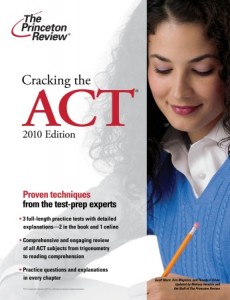 My high school age daughters took the ACT last year and got good scores. But we wanted to make sure that they had excellent scores. High enough to put them in the upper levels of those applying to their desired universities. But how would we prepare them?
Back in the olden days when I was preparing to get my Masters of accounting degree, I knew I’d need some help to get a score on the GMAT that would be competitive. I looked at a number of study guides and ended up choosing the Princeton Review guide for the GMAT. I studied hard, got a great score, and became a believer. The guide made everything so easy. More importantly, everything the guide prepared me for was on the test. This is why, when I wanted to get a Masters of fine arts in creative writing, I used the Princeton Review for the GRE. Again, the study guide was easy to follow, and I got an equally good score on that test. Having had two great experiences, it’s no surprise I turned to Princeton Review again to help my two girls with their test. (BTW, some may see an attempt to get more than one graduate degree as smart, others as masochistic, and yet others as simple ivory tower bone-headery—I’ll let you decide which it might be in this case.)
The Princeton Review guide for the ACT is called Cracking the ACT. A new edition is published every year and includes general ACT test-taking tips, everything you need to know in the specific content areas, and practice tests. It also includes access to the Princeton Review’s online resources which include another practice test. It’s a big guide (this year’s edition was 619 pages), but the size is deceptive. There’s plenty of white space for taking notes, and the text is written so clearly, and everything broken down in such an easy manner to follow, that you’ll start only to suddenly realize you’ve just read thirty pages. Besides, you don’t have to study it all. You can focus on specific content areas, if that’s all you want to do.
This spring, both daughters worked through the book. We looked at their previous scores, identified areas for improvement, and set up a six-week schedule that required them to study about an hour per day, sometimes with help from Mom or Dad, but mostly on their own. One daughter studied hard, took the test in June, and improved her score by five points. The other daughter studied a little less diligently, took the same test, and improved her score by four points.
When 36 is the highest possible score, such jumps become significant. However, they’re not the result of special DNA. While I tend to think my girls are everything and a bag of chips (especially when they give me back scratches), the truth is the ACT doesn’t test some mumbo-jumbo innate intelligence. It tests skills. Skills anyone can learn. What my girls supplied was consistent effort. All they needed was expert guidance in how to apply the effort. And Cracking the ACT provides boatloads of that.
If you’re looking to improve your own score or help your children improve theirs, get this book. I have no doubt that anyone who supplies a bit of effort will be able see some nice results.
***

Imagine emerald pools, steep red canyons, and a gentle breeze. Imagine water so clear you can see the plants and rocks sixteen feet down on the bottom. Imagine trout swimming only feet away. Imagine swimming with those trout and then getting back into your raft to ride some rapids. Imagine picnicking a the water’s edge or atop a flat, shaded rock forty feet up that gives you a grand view of the river. If you’re lucky, maybe you’ll see an osprey dive for a fish or watch a pair of river otters swim by. Imagine doing this with family or friends, all in a short twenty-four hour period.
This experience is only about three hours away from Laketown, Utah. Well, everything except the swimming with the trout bit. The fish don’t really swim with you. They mostly just flee, but you get the idea. To enjoy it, all you need to do is raft the seven mile stretch of the Green River from the Flaming Gorge dam down to the Little Hole campground.
My family and I just did this with some friends and had a grand time. Because the river is relatively slow and the rapids are relatively moderate and short, parents don’t have to worry every second that someone is going to fall in and drown in a man-eating surge. In fact, along many of the calm areas we actively helped the children into the sparkling cold water (grin), including one rafter who was only three years old. One of the most enjoyable moments was when we pulled the rafts up into the gentle backwash of a large rock in the middle of the river, climbed the rock, and took turns jumping into the current and letting it carry us downstream.
The sun was shining, the weather warm. It was a wonderful trip. A total memory-maker. We put in just before noon and hauled the raft out just before 6 PM. But we could have taken much longer to play along the way.
The experience was fairly cheap. It cost about $70 to rent an eight-man raft. Perfect for six people. But there are other smaller and larger raft sizes. You’ll need to arrange a way to get the raft to the river and back again. We simply tied our raft to the top of our minivan. You can pay the rental people to drive your car to the exit ramp at Little Hole after you put into the river, or bring two cars (or a bike) and drop one at the exit. Or you can pay for a shuttle service where they drive you to the River and pick you up.
You’ll want to bring a small cooler with drinks, snacks, and sunscreen. You’ll also want to have good footwear. The river bed is rocky, and when you pull into shore, you don’t want to be ouching it the whole way in. I don’t recommend flip flops. They’re no better than bare feet. Old sneakers are fine, but they don’t dry quickly. And they waterlog and get heavy, which makes them less than ideal for swimming. Your best bet is to get real water shoes that are made to be light and drain quickly and yet still have a decent sole–a sandal or mesh covered shoe that uses Velcro to strap up. You can be fancy and spend a lot, or do what I did and get yours at Wal-Mart for less than ten bucks.
You could make it a long trip and drive to and from the gorge and run the river all in one day, but why push it? Just find a place to stay overnight. There are some motels in the area, but we elected to camp. The spots at the Firefighters Memorial campground were $27 per night. The campground was beautiful and tidy with restrooms and running water. One of the most surprising things about this particular campground was that I didn’t see one mosquito while I was there.
I’m one of these types that attracts the villains. If there’s only one mosquito within a mile radius, it will smell me, pass up many other suitable victims (including my wife), and risk its life and limbs to sink its #@!* proboscis into my flesh. I think my blood must be some kind of mosquito crack. There’s probably some mosquito black market out there for it, run by some nasty mosquito cartel, which is led by a murderous, malaria-ridden mosquito boss making piles of evil mosquito money and spending it on opulent mosquito yachts and guns!
Anyway, not one bite. We watched the sun set and then fell to sleep with the stars overhead and the wind gently soughing through the boughs of the pine trees.
To make campsite reservations, go to www.utah.com to get a good map view of possible camping sites. Then go to www.recreation,gov to make the reservations online. Make sure your specific camping spot has everything you need. Our campground was very rocky and not all of the sites had tent pads. If you want to scope the lay of the land, the recreation.gov site will give you GPS coordinates of the campground. Enter those into Google maps then switch to satellite view and zoom in. You see exactly what you get. This way you can avoid accidently booking the site right next to the bathrooms or road or the one that features no trees.
Finally, when you’re done, you might want to top it all off by stopping at the The Flaming Gorge Lodge restaurant, just a few miles south of the dam, and enjoying a monster-sized cup of hot chocolate with whipped cream and one of their fabulous desserts. The blackberry cobbler and ice cream was delicious.
 Karl Marx was not a scientist. Nor was Adam Smith before him. They were philosophers. Theorists. Idea men. That’s what all economists in those days were. They had little tested knowledge, and so which economic system was best was all a matter of opinion.
 Do you want some fun family entertainment that includes laughs, wonder, and moments of poignancy? Something you can watch and enjoy with the kids? Then let me recommend the animated TV series Avatar: The Last Airbender. This is NOT the movie Avatar by James Cameron with all the big blue people Nor is it the movie The Last Airbender, based on the TV series, which many fans disliked. This is the original. The one that millions love.
 The Guardian just published




First off, Love the work in progress bar you have on your site! Even though it doesn’t really give me any specific details I still feel completely up to date. And its leagues above a Meandering guesstimation date.
Economics and Politics; not the best combination for keeping people listening unless they already agree.
As for Avater: the last airbender I totally agree. It won all of the awards for a reason. To bad for the horrible movie though.
-Rehcra
The aftermath of the subprime lenders debacle or BP’s mismanagement have been felt worldwide. The problem isn’t that these companies are putting profits ahead of everything else, it’s that they’re being dishonest to themselves and in their reporting to shareholders by cutting corners for short term benefit. Ultimately, that works well for the current management who can hope to walk away before the proverbial hits the fan; it works badly for everyone else left to pick up the pieces. Business needs unbiased oversight as much as nuclear weapons – they both stand to ruin lives.
As an American who lives abroad I am often infuriated by the right wing rhetoric back home that obstinately refuses to allow progress. Labelling anyone who disagrees with the status quo as a communist may get one side of politics all fired up, but to the rest of the world we just end up looking churlish. Stepping beyond the propoganda and rhetoric is easy – but it takes stepping outside the US with our eyes open, living in other progressive countries, and seeing for ourselves.
But then, it’s easier to buy the party line and believe the rest of the world has fallen behind us, that change is bad, or that the American way of life is the best in the world. After all, if we didn’t, what would it make us?
Thanks for the recommendations! I always look forward to these posts. What age group is Avatar: The Last Airbender aimed at? My oldest is 5, and he’s easily scared. But I’d love to have a fantasy themed show I can watch with him.
He’ll be fine. It’s not scary. It’s aimed at middle-grade. I have an 8 year old watching it and she loves it.
One of the things I loved about Avatar: The Last Airbender (asides from the characters) is their choreography. The styles of kung fu they chose really fit the elements they represent.
http://en.wikipedia.org/wiki/Avatar:_The_Last_Airbender#Series_overview
How far along are you in the series?
We just started book 3.
If folks are turned off by my thoughts on politics then I suppose they’ll have to be turned off. If they have information to share, I’m happy to hear it.
Not sure how to respond to this or what specific thing your post is taking issue with. I lived in a progressive European country for a few years. Does that mean my views suddenly have clout? The review of the book highlights that economics is not about philosophy anymore. If you have economic studies to share that shed light on something in the post you take issue with, then please share them. If your issue is that I said the President made a statement in good Marxist fashion, please show me how he’s not suggesting that the government allocate goods and services instead of letting prices take care of that coordinating.
I don’t think any of your remarks are inappropriate, John. But they will offend plenty of people. Plan on it. Any time you venture a personal opinion, there is bound to be somebody who gets annoyed. At this point, the kind of people who get offended at the idea of fiscal responsibility deserve to be offended.
Firstly John, I’d like to say I’m a fan. Servant of a Dark God is on the same shelf as my books by Brandon Sanderson, Kate Forsyth and Raymond E. Feist.
Secondly, I’d like to apologise for the length of this post. This is the shortened version, honest.
My science major taught me that even in empirical studies, interpretation plays a major role.
At a recent lecture I heard ~2% of climate scientists say the jury is out on climate change (although if you think about it, if 2% or even 4% of a jury said ‘not guilty’, that jury would be telling the judge ‘throw the book at him/her/them’).
Unless these scientists are researching on different planets, the difference must be how they interpret their data, and which data they choose to analyse. [Yes, analyse with an ‘s’. I’m Australian. No promises about the rest of my spelling 😉 ]
Let me put it this way. I think of economics as applied sociology: http://xkcd.com/435/
Before anyone points out the obvious, I am of course at least as guilty as anyone else.
I have not read Thomas Sowell’s book, only drawn on some undergraduate classes and some quick research. I note Sowell considers welfare as promoting poverty. For an example of alternate economic views, Wikipedia links to academic studies which contradict this position (for example http://www.u.arizona.edu/~lkenwor/sf1999%28poverty%29.pdf). But as you did not make note of this in your summary, it may not be relevant.
As for whether it is good economics to let money pool in the hands of the rich, we must consider marginal propensity to consume (MPC) (1). MPC is the portion of new income that an individual will spend when their disposable income increases. People with low income tend to have a higher MPC than those with a high income (2). If you have lots of money, you are less inclined to spend any extra you receive. So if you want lots of cashflow in your economy, you want to give it to those with little money.
Therefore, in an economic sense, President Obama would be correct in stating that allowing the rich to hoard profits is harmful.
This isn’t about government allocation of goods, this is about the government regulating anti-competitive practices and helping people lead happy lives.
I agreed wholeheartedly with your summary when you pointed out that governments seem not to do their research when trying to make their policies a reality. I wonder if my government, also struggling with the health care system, is working to emulate France (3), or whoever has the best system now…
What is all this telling us? Well, I am with your recommendation 100%. We need to educate ourselves and use the limited information we possess to make the best decisions we can.
As for economics having no room for philosophy, whatever happened to ethics?
Thank you for providing a forum to express this. I hope I have not bruised anyone’s psyche too deeply. I also hope no one is planning to bruise (or puncture, maim, poison, etc.) me too deeply. An opinion was invited and mine was given,
Like you stated earlier, if someone can’t sit with my political views, they are free to stand up and find a chair they like better. Unfortunately, I doubt I have time to discuss this further myself. I guess it’s a good thing I’m posting where I am. This discussion can continue without any contribution from or to me. The same cannot be said for my next essay.
Respectful Regards
(1) Bernanke, Olekalns and Frank, Principles of Economics (2006) [textbook]
(2) Cervantes-Godoy, D. and J. Dewbre (2010), “Economic
Importance of Agriculture for Poverty Reduction” in OECD
Food, Agriculture and Fisheries Working Papers no. 23 [journal]
(3) http://www.who.int/whr/2000/media_centre/press_release/en/
Heath,
These are precisely the kinds of comments I love. Thanks for taking the time to post.
I think your comments on MPC makes a lot of sense. However, forcing those that make profits to share all those profits with others eliminates the incentive to make the profit in the first place. Which then removes some or all of those profits. Which then dries up the cash stream or keeps it artificially low. People want that service, which is why they were willing to pay the prices stated to begin with. But now they can’t get it because it’s not worth the time of producers to provide it. Furthermore, because the opportunity attracts fewer entitites, prices stay higher.
If instead, you let the companies keep the cash they’ve earned, what happens? If they get to keep the cash, then they usually do not distribute it all to their owners. Most of it is kept in the company. Because there’s even more profit to be made they will try to increase production which requires them to purchase more equipment and/or increase labor. It also attracts other companies to move or expand operations to get some of the profits. Jobs are preserved and created. So the cash still flows through the system, but in this case it creates jobs. Futhermore, it creates incentives to continue generating the profit. As more companies compete, prices usually drop. This makes the product or service cheaper for the consumer. Finally, it gives incentives to allocate resources to delivering this product or service that people want.
The intent of helping those poorer than ourselves I think is a good one. But using a method that removes the incentives of production seem to actually work against that. I think it’s stunning how many people rose out of poverty when India and China made the reforms they did.
I think a better approach in many cases is for the individual to seek out ways to help and places to send money and time. And the help will be sent to the causes people place the most value on because each individual will be prioritizing their causes.
This is not to say that I think that a government can never do a better job, given all the pros and cons. For example, I think it’s probably best for the government to maintain a military and fire department etc.
But the thread of Obama’s comments on this matter from his campaign until now haven’t been about weighing each case. He talks about forcing an allocation of wealth from those who have more to those who has less as a general principle. And it is this general principle that has been shown in the last century to not allocate resources as effectively and raise the standards of living of a nation as an economy that uses prices and individual choice to allocate the resources.
Also, I know some people think the rich just sit on piles of money. But actually they put that money into investments. Some of those savings or investments are in the banking system, which lends money to small and large businesses and individuals wanting homes etc. Some of those investments are in companies. Some in bonds (so the US government, companies, and local municipalities can get the cash they need to do things for the public good). The cash doesn’t sit in a pile somewhere. And even if it is in a bank account, it’s being lent out.
So the cash flows through the system either way. It flows through when government does the spending. But when individuals and individual companies are allowed to make the decisions on where it goes, and let prices self-regulate so they can provide accurate information to consumers and producers, the funds are allocated more efficiently, although not perfectly, to the products and services valued most. The incentives to produce remain, increasing the overall cash flow and getting the resources to where they’re wanted.
Dannyboy, true. Civil disagreement is always welcome on my site. I don’t expect everyone to agree with me. Therefore I see no reason not to post something just because someone may disagree. If someone gets torqued about something, then they can be torqued as well on my site. Just as long as they keep it within bounds. 🙂