So I lived for almost two years in the Netherlands and Belgium and learned the Dutch language, which is full of delights. Today’s delight is billenkoek.
Now koek means cake. A koekje (small cake) is a cookie. Boterkoek is butter cake, this delicious sweet, to-die-for Dutch version of shortbread.
So what does billen mean?
Back in the day when I’d visit various Dutchies (the people, not political territories), they’d always ask if I was thirsty. And very frequently when I’d ask for water, someone would say, “Water? The frogs wash their billen in that.”
Billen means bum as in behind, butt, buttocks. Bil is singular, one half of the full billen, if you will.
So what do you think a billenkoek is?
No, not that.
It’s a spanking.
“Honey, you’ll clean the dishes, or you’re going to get a little bum cake. What will it be?”
When it comes to politics, we frequently talk twice as much
as we should and listen half as much as is deserved. With our mouths open so
much of the time, we fail to get the facts. And this often leads us to paint things
in hyperbolic black or white.
One area where we seem to do this regularly is with the
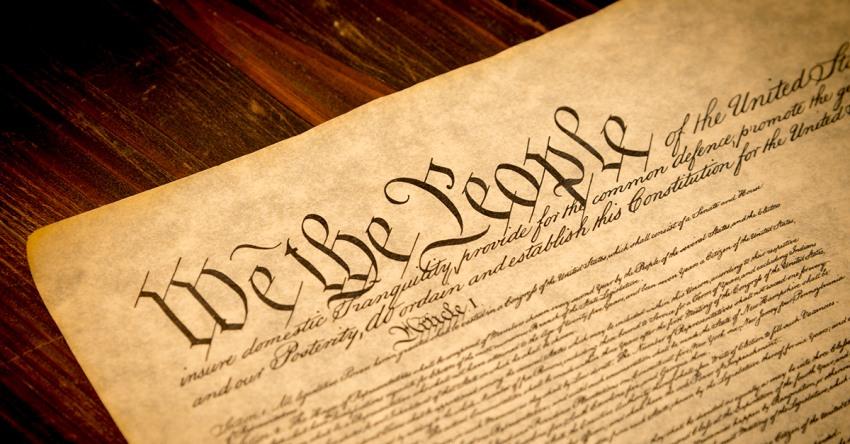
Founding Fathers. Depending on our side, we label the Founders as devils or
demigods and the constitution as a wicked document or holy writ.
Is it possible both sides are distorting the truth?
Joseph Ellis, one of the nation’s foremost scholars
of American history, suggests that we are. He has written an excellent article for
the online Encyclopedia Britannica called “Founding Fathers” that points
out both the amazing things the Founders achieved with the birth of this nation
and some of their most egregious failures.
I don’t know about you, but I find clarity a good thing. I
think it helps us have more productive conversations. If you agree with me, I
think you’ll enjoy the clarity Ellis brings to the Founders and the nation they
set up. Read his
article here.
For my part, I think the Founders set up an awesome system. Not because it was perfect at birth, but because it was a system that got enough right to allow us to get where we are today. Look at how far we’ve come on so many fronts! And it got enough right to allow us as a nation to get even better in the future.
Just consider what the Founders implemented that was in no
government at that time. The ideals of individual liberty, the separation of
powers, the ability for a huge swath of citizens to elect their leaders, the ability
to change the constitution itself, the separation of church and state, and the
engine of democratic capitalism that has lifted more people out of poverty than
anything else the world has seen.
The Framers didn’t create the Constitution in a vacuum, but
nowhere in the world had anyone set anything up that went so far. There was
nothing like it, no real examples to follow. And many thought it would fail,
just as France’s attempt in their revolution failed just a few years later.
As for things they got wrong. Well, they themselves soon recognized the way we elect the president and vice president didn’t work and adjusted it. Their idea that political parties wouldn’t form was wrong. Their idea of a militia for common defense didn’t work (see my writeup here). Their compromise on slavery was a festering sore that came to a head before the Union was 100 years old. Their treatment of the Indians was awful. Their reasons for excluding women and those not owning land was bone-headed.
So, yes, they got some things wrong. Some of them held some
beliefs that we find appalling today. And the nation has not implemented their
stated ideals as well as we might have hoped. However, the Founders got so many
things right. And what’s more, they did it as men living in the times they lived,
having grown up with the beliefs and values of that time, not those of 2019!
While we as a nation have progressed from some of their
failures (thank heavens), in other ways the Founders may be are our betters.
There are a great many lessons to learn from them, both from their successes
and failures. One is their humility—they knew what they’d created wasn’t
perfect. Let’s not imagine that we or our ideas are perfect either.
If you’re at all interested in politics, I recommend Ellis’s
article and its view of the Founders. Read it article here.
I always enjoy presenting at the Life, the Universe and Everything writers conference. This year they asked me to present the following.
The 3 Little Secrets that Make Plotting So Much Easier
No, the secrets don’t have anything to do with the hero’s journey; 3, 7, 8, or 9 acts; Lester Dent; or cat-saving beats. An average novel has around 40 to 70 scenes. If you’re like me, those abstract plot structures spark an idea or three, then dump you in front of a blank wall. So where in the heck do all the other scenes come from? Well, a whole heap of them stand up and present themselves when you use these 3 little secrets. If you struggle with plotting, this is your chance to put that behind you for good and start generating fun and exciting plots with ease. Come learn the 3 little secrets that make plotting so much easier.
Despite the oft-repeated 11th commandment for writers—show, don’t tell—writers never show. They can’t. It’s all tell, tell, tell. The trick is to tell in a way that helps your readers imagine with such vividness and clarity that your story triggers an emotional response. In this session learn the five critical prose techniques that help you do just that.
“More than 50% of all traditionally-published book sales of any format in the US now happen on Amazon.com.”
That’s just amazing. But I found something even more amazing this week.
Author Earnings released a report this week of their analysis of a million titles on Amazon. Data Guy, the tech guy behind the software gathering the information and crunching it, posted this graph in the comments.
Do you see the amazing thing?
Well of course you do, I gave it away in the title of the blog. Science fiction and fantasy sell MORE units than thrillers.
More.
What?!
For, like, ever I thought SFF was a tiny portion of the market. Not so, my friends.
Some may say, well, but this only represents Amazon. What about the channels traditional publishers sell through? Author Earnings explains a way to account for that in their report. Basically just double the size of the purple and red bars. If you do that I think thrillers might just edge SFF out. But it doesn’t dwarf it by any means.
Furthermore, for an indie author, I don’t worry about those other channels because they’re not really a viable option for me. My world is selling online. And the online market for SFF is the SECOND BIGGEST MARKET after Queen Romance.
Oh, BTW, next book in the queue is volume 1 of Lord of Bones. It’s going to start with something like this.
The four men did not leave. Instead, they spread out just a bit in shallow semi-circle in front of Blaze.
Four of them. One of him. There was definitely going to be blood.
“You don’t want to do this,” Blaze said.
The big one drew his sword and swung it a bit to loosen his shoulders. “Oh, but we do. Because you’re not handing over the blackmeal. And we’re not leaving without it.”
No, he was not going to hand that over. Couldn’t. Not if he valued the lives of his wife and boy.
Two of the others drew their swords. The fourth brought his staff up and laid it on his shoulder in a two-handed grip.
The big one would be the obvious target to take first. But Blaze knew that would be a mistake. The big one was there just to focus his attention. To fix Blaze in place. And then the silent one would slice him up the side.
The man with the skinny face said, “Old man, the vultures will be picking your eyes out before lunch.”
Blaze said, “Well, if you’re so determined, let’s not keep them waiting.” And then he rocked forward.
I’ve not forgotten the Dark God series. I will finish it, but I need to get this smaller volume of Lord of Bones out.
I’ll be presenting this Saturday, June 8, at the league’s summer writer symposium at USU. Here’s the description of my presentation.
Make ‘Em Beg For More! How do you keep your readers begging for one more page? The answer is probably not what you think. Come to this session to learn the surprising secret—along with plenty of examples and how-tos. When you’re done, you’ll know exactly what you need to do to write stories that are devilishly hard for readers to put down.
Check out the schedule below. Looks like there will be some great presentations. If you attend, please come and say hello.
I posted my review of No Apology on a few sites the other day. I can understand how some folks might be skeptical that the book is nothing more than a PR puff job. But I’m surprised at how many refuse to even test their assumptions with ten or fifteen minutes of reading (or listening to a few minutes of the book on audio).
Too bad for them. They’re missing out.
For those who think they know Romney from what’s being reported in the press, I want to suggest you listen to or read Pat Caddell’s recent comments on 9/21/12 at the Accuracy in Media conference. Caddell is a Democrat, BTW. He is the founder of Cambridge Survey Research, a public opinion pollster, and an expert in analyzing public opinion. He’s been working for democratic campaigns for a long, long time. He started with the McGovern campaign. Then worked for the Jimmy Carter campaign, for Gary Hart, for Joe Biden, and Jerry Brown. His speech is titled “The Audacity of Corruption”. Find it here: http://www.aim.org/video/pat-caddell-the-audacity-of-corruption/
Back in college I took this class on epistemology (how we know what we know). It was fascinating. One of the best classes I took. One of the things the professor taught us was that the first step in examining someone’s ideas was to capture them. So he’d have us research all sorts of stuff and then write a short paper in which we restated the ideas in summary form.
A few years later I read Steven Covey’s 7 Habits of Highly Successful people. An amazing book. One of the habits was to seek first to understand, then to be understood. He pointed out that probably the best measure of whether you have actually understood someone is that you can restate their point in your own words to their satisfaction.
First seek to understand, then to be understood. Capture.
I’m going to try to do that here.
I’ll start by outlining the structure of the book.
CHAPTERS 1-3
Romney shares some interesting insights about the four main current geopolitical strategies being employed by major players around the world and the threats they pose to us. He also considers lessons from great nations in the past that have fallen—what were their mistakes and how can we avoid them.
CHAPTER 4
Romney discusses key ways we can grow American “soft power” and maintain our “hard power” abroad.
CHAPTERS 5-9
Romney discusses domestically what we need to do to remain internally powerful, and, therefore, prosperous and free. Topics include the economy and jobs (chapter 5), the entitlement programs social security, medicare, and medicaid (chapter 6), health care (chapter 7), education (chapter 8), and energy (chapter 9).
CHAPTER 10
Romney suggests that culture is a huge factor in the success of nations. He summarizes key values and practices he feels will promote a strong culture.
CHAPTER 11 – EPILOGUE
Romney provides a method for gauging how we’ll we’re doing—a set of national indicators—as well as a summary of all the things he discussed in the preceding chapters that he believes will make and keep America strong.
The central overarching theme of the book is that America will only remain strong if we follow certain principles. We’re at a point where many feel America is starting its demise. Romney rejects that must be the case.
In the next post, I’ll capture chapter 1 and make my few comments. I hope you join me 🙂
There’s nothing quite like the laughter and fun a good family or party game creates. And we discovered two games this summer that have brought hours of pleasure.
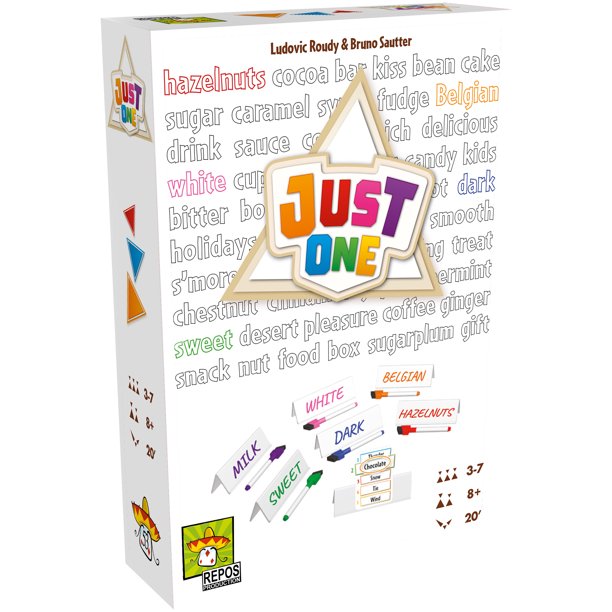
The first is Just One. It’s for 3 to 7 players and takes about 20 minutes to finish.
Now, I was skeptical of this game at first because it’s a cooperative party game.
I mean, come on. Cooperation?
No teams?
No competition?
What were we going to do—hold hands and sing Kumbaya?
I was fully expecting to be bored out of my mind. Boy, was I wrong. There was suspense, laughter, and loads of fun.
There are 13 rounds in each game. In each round, one player blindly selects the number of a word on one of the game cards. The other players each write a one word clue to help that player guess the word. However, if two or more players write down the same word, they have to remove that clue.
So you’re trying to come up with one-word clues the others won’t that still help the guessing player. Some clues lead the guessing player off onto funny tangents. Others are just funny. And then there’s the suspense of whether someone else wrote your word and whether the player will be able to guess it from the clues that are left.
Your goal is to guess all 13 words selected. And there’s a little score card that ranks what it means if you get 13, 12, 11, etc.
As an aside, it’s crazy to me that the score card provided motivation. But it did. It was a delightful little brain hack.
One Word is a quick, fun game. We’ve played it with a few as 3 and as many 8 players and had a ball each time. We are so happy to have it in the family game closet.
The next is Fish Bowl. It’s for 4+ players. What this game does is take favorites like Taboo, One Word, and charades and mixes them together in a competitive game between two teams.
Here’s how you play it. Each person writes up 5 to 7 different words or phrases on separate slips of paper, folds the papers, and puts them in a bowl. Then you do 3 rounds.
Round 1 is like Taboo, where you can describe, but can’t say or act out the word or phrase on the paper. You select a team to go first. One person on the team selects the papers from the bowl and then tries to describe the word or phrase. The team has 30-45 seconds (you decide) to guess as many of the words as possible. When the time is up, it’s the other team’s turn. Back and forth you go, selecting a new team member each turn to give the clues, until there are no more slips of paper in the bowl. Then you count the number of slips each team got and move to round 2.
In round two, you put all of the slips of paper back into the bowl. The team that went second in the first round starts this one. This time the person giving clues gets to share one word. That’s it. And the team has to guess it. Again, the team has 30-45 seconds to guess as many as they can. Then it goes to the next team. And you switch back and forth just like you did in round 1, and when the slips of paper are gone, each team counts up their score.
In round 3, you put all of the slips of paper back into the bowl. The time the person giving the clues has to act them out. No words allowed. You run this round just like you did the first two with 30-45 second turns, switching back and forth between the teams until all the papers are gone. At that point, the teams total their scores for this round and then for all 3 rounds together to see which team won.
If you don’t want to use paper, you can play a version online.
Either way, it’s another fast, fun game. In fact, we played it last night. And laughed and laughed when one daughter was trying to get the other to guess “sling” and nailed her teammate in the head trying to act out a rock hitting Goliath. Movies are great. But sometimes what you need is some delightful game fun. And I’m betting you’ll love these.
2 Comments
lieve John…..
Billenkoek…Haaaaaaaaaaaaaa…
Ja …als je billenkoek krijgt omdat je iets stouts hebt gedaan…dan ben je echt de ,,sigaar,,!!
Nederlands is een vreemde taal…vind ikzelf.
Al die gezegdes en spreekwoorden….word er helemaal gek van….help!
liefs…..Hazel.

 So I lived for almost two years in the Netherlands and Belgium and learned the Dutch language, which is full of delights. Today’s delight is billenkoek.


lieve John…..
Billenkoek…Haaaaaaaaaaaaaa…
Ja …als je billenkoek krijgt omdat je iets stouts hebt gedaan…dan ben je echt de ,,sigaar,,!!
Nederlands is een vreemde taal…vind ikzelf.
Al die gezegdes en spreekwoorden….word er helemaal gek van….help!
liefs…..Hazel.
Ach! Nooit ‘billenkoek’ gehad.