Good Stuff: The Free State of Jones

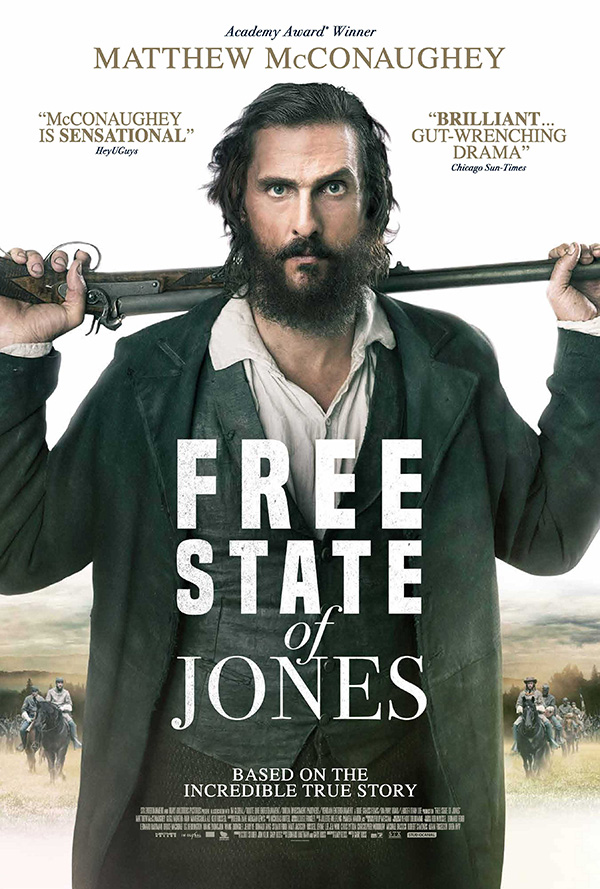
I recently watched a moving and surprising film called The Free State of Jones, starring Matthew McConaughey. It’s about Newton Knight and how he led three counties in Mississippi to break away from the Confederacy during the Civil War.

Think of that. On January 9, 1861, Mississippi declared it’s independence from the United States over the issue of slavery. They were the second state to do so. South Carolina was the first. On reflection, it makes sense these two states seceded first because they had the highest portion of the population as slaves. South Carolina’s population was 57% slave. Mississippi’s was 55%.

Mississippi’s declaration of independence from the Unites States starts with this paragraph.

“Our position is thoroughly identified with the institution of slavery—the greatest material interest of the world. Its labor supplies the product which constitutes by far the largest and most important portions of commerce of the earth. These products are peculiar to the climate verging on the tropical regions, and by an imperious law of nature, none but the black race can bear exposure to the tropical sun. These products have become necessities of the world, and a blow at slavery is a blow at commerce and civilization. That blow has been long aimed at the institution, and was at the point of reaching its consummation. There was no choice left us but submission to the mandates of abolition, or a dissolution of the Union, whose principles had been subverted to work out our ruin.”

The rest of the declaration simply elaborates on that theme. However, not everyone in Mississippi agreed. The folks in Jones County, way down in the southeastern part, were mostly non-slave holders and cattle herders and had little use for a war over a state’s right to maintain the institution of slavery.

Led by Knight, on October 13, 1863, with the war still raging, folks in Jones County and adjacent counties formed a separate government known as the “Free State of Jones”. They fought at least fourteen skirmishes with Confederate forces and went so far as to raise an American flag over the courthouse in Ellisville and send a letter to Union General William T. Sherman declaring Jones County’s independence from the Confederacy and asking for support.

This movie is based on those events and, importantly, some that occurred after the war ended.

The film is rated R for a scene with some Civil War battle injuries. And perhaps because of the use of the n-word. What it delivers is a powerful depiction of the issues of the time and the courage of one man who’d had enough. If you like history and action, I think you’ll enjoy this movie.

Share

Similar Posts

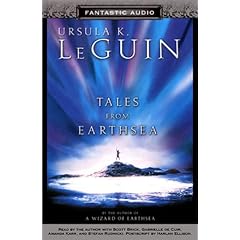
  • Tales From Earthsea

    Tales from Earthsea (The Earthsea Cycle, Book 5) 

    When I was in 7th grade I read Tolkien’s The Lord of the Rings trilogy. Of course, I wasn’t the sharpest literary tack back then, and so great sections of The Two Towers and The Return of the King went over my head and, therefore, bored me. But, with the help of the Hildenbrant calendars, enough came through to thrill. I wept at the events in the mines of Moria with Gandalf, geeked out over the elves, orcs, and Nazgul, was fascinated with the Ents and wizards, and generally wanted to stay in that world forever.

    When I finished the trilogy, I mourned–the dream was over. I read Smith of Wootton Major and Farmer Giles of Ham. Both were delightful, but neither was the same as LOTR. Then I saw The Silmarillion. It had a cool cover, a map.

    Oh, joy! I bought it and took it home.

    Alas, that book was about as much fun as reading a ten-pounder on the history of baroque cornices. I tried mightily to push through, but I don’t think I was able to finish more than 15 pages total from all the sections. So I mourned again, and then, still feeling the loss, went looking for something else that might whisk me away.

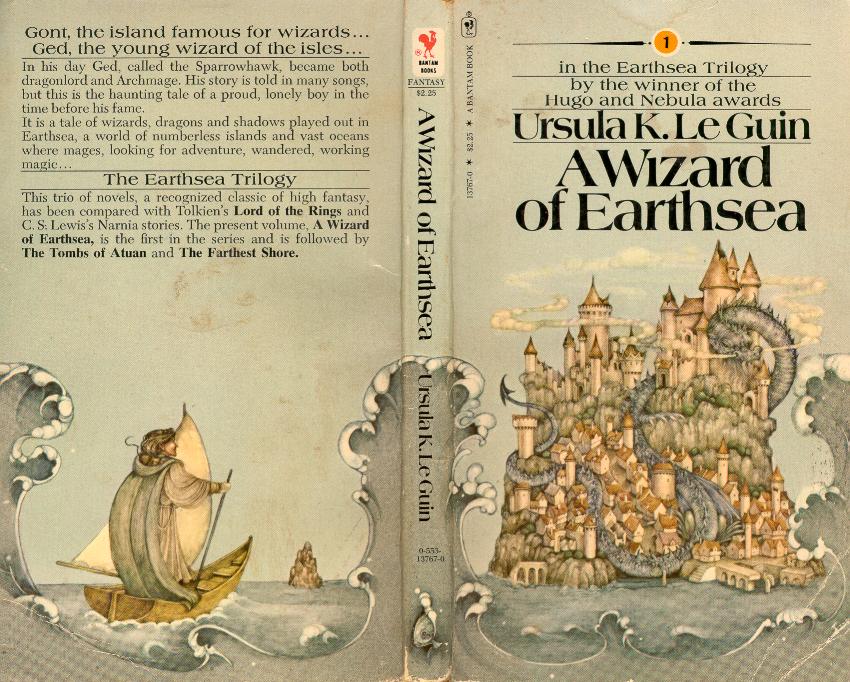
    One of those whisking stories was Ursula LeGuin’s A Wizard of Earthsea. Of course, the fact that there was a wizard in it was important, but as equally delightful to my then puny literary prowess, was that the story was a slim thing. As were its two companions The Tombs of Atuan and The Farthest Shore.

    Here’s the cover the drew me in so long ago.

    I relished all three and moved on to other stories.

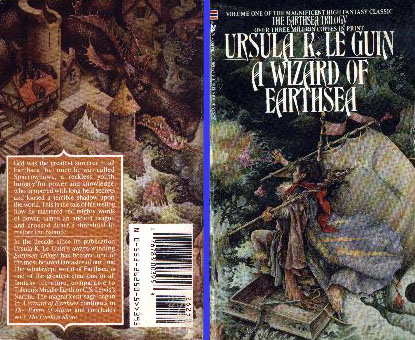
    Time passed and I forgot about LeGuin. Almost 10 years later I was newly married. My wonderful new wife started reading to me as we’d drive. And on one of the three-hour drives to her parents, she pulled out this little book and began to read.

    It was A Wizard of Earthsea! And it was just as marvelous the second time with a bigger brain as it was the first time with a smaller one. In fact, Nellie’s reading to me was so enjoyable I slowed down to 40 mph so I could extend the 3-hour drive. Of course, she quickly caught on to my scheme, shut the book, and told me she wouldn’t read another word unless I drove 65 mph, at the very least.

    What can a guy do? I kept it at 65 (well, 60) and joyed in the wonderfulness of a new wife who would read aloud to me (you mean this model reads, too?!), the night and the stars spread above those lonely Utah and Wyoming roads, and the amazing story unfolding before me.

    And this is the cover of the one my wife read to me.

    We read all three to each other and moved onto other stories.

    More than 15 years passed and I’d mostly forgotten LeGuin (I really never could get into her Hainish stuff). I was in the library looking for some good audio. And there on the shelf stood Tales from Earthsea by Ursual LeGuin.

    Just a little slim container of cassettes. Why not? I thought.

    Holy heroes, Batman—it was gold. LeGuin’s a master of building that feel: the wonder of fantasy, the mystery of things long forgotten or rumored to exist, the pull of learning arcane powers. I loved every minute of it (well, except for the slogging first four pages of backstory, but get through that, which isn’t too bad with Karr’s reading, and you’re into the kingdom). The first story, “The Finder,” read by Amanda Karr was incredible. It takes us back to how Roke became was it was in the first trilogy. But the delights do not end there. Four more stories follow.

    I liked them all so much, I just checked the audiobook out again so I could listen a second time. And, it appears, LeGuin was busy in my absence because she has more Earthsea than this.

    • A Wizard of Earthsea, 1968
    • The Tombs of Atuan, 1971
    • The Farthest Shore, 1972 (Winner of the National Book Award)
    • Tehanu: The Last Book of Earthsea, 1990 (Winner of the Nebula Award)
    • Tales From Eathersea, 2001 (a collection of short stories)
    • The Other Wind, 2001

    I just got the last two from Amazon. I can’t wait to enter into LeGuin’s magic spell yet again.

    More cool Earthsea stuff.

    Share
  • Interview with Author Bradley Beaulieu

    Bradley P. Beaulieu just had his first novel released on April 1st. It’s called The Winds of Khalakovo and is the first of three planned books in The Lays of Anuskaya series publishehd by Night Shade Books. In addition to being an L. Ron Hubbard Writers of the Future Award winner, Brad’s stories have appeared in various other publications, including Realms of Fantasy Magazine, Orson Scott Card’s Intergalactic Medicine Show, Writers of the Future 20, and several anthologies from DAW Books. His story, “In the Eyes of the Empress’s Cat,” was voted a Notable Story of 2006 in the Million Writers Award. His agent is Russell Galen.

    Brad is a software engineer by day, wrangling code into something resembling usefulness. He is also an amateur cook. He loves to cook spicy dishes, particularly Mexican and southwestern. He lives in Racine, Wisconsin with his wife and two children. As time goes on, however, Brad finds that his hobbies are slowly being whittled down to these two things: family and writing. In that order . . .

    I recently had the opportunity to interview Bradley. Among other things, we talked about how he broke in and how he comes up with his ideas. He also convinced me to use his picture method, which I’m finding very handy on my current thriller project.

    ***

    JOHN: In your novel an elemental spirit attacks an incoming windship, murdering the heir to a kingdom. The person believed to be behind this is a child, an autistic savant. This sounds like Orson Card tale (grin). Did you come up with this character first, the magic, or something else. Tell us the genesis of the tale and this character in particular.

    BRADLEY: The genesis of the book is actually from a series of postcards of fine art that I picked up in Edinburgh, Scotland. (I posted about it on my website if you’re curious to learn more.) I used that artwork to first generate and then crystallize my thoughts about the book. Initially, I tried not to let any one thing rule the brainstorming I would do from time to time. I didn’t even know who the main characters were at first. I was quite taken by the picture of the three sisters, though, and I knew right away, the moment I laid eyes on the original in the National Gallery, that they would play a major part in the novel.

    But in the end it was the picture of the boy with the flaming brand that kept leaping out at me, calling for attention. The artist is Godfried Schalcken, and the piece is called A Boy Blowing on a Firebrand to Light a Candle. This character eventually became Nasim, the autistic savant. As I was studying the characters, I began to realize that this boy was not going to be a point-of-view character, but he was going to be a prime mover. In the end, he embodies much of what Winds is about. The story truly does revolve around him and his unique powers.

    The brand that he holds in the painting also came into play. I didn’t know what the magic was going to be about. I hardly had a single preconception about the book going in. I just wanted the artwork to speak to me, to advise me as to what the story was going to be–from the characters to the world to the magic. The boy blowing on the brand got me to thinking about elemental magic, and I realized that Nasim was one who could do this without even thinking. It came as naturally to him as did breathing. That’s a difficult place to put a character, however. As a writer, you have to be careful of all-powerful things, and so I needed something to balance Nasim’s abilities. And this, of course, is where his disconnection from the world came from. Nasim, as written in the book, is often lost. He has difficulty relating to others in even the smallest of ways. This both limited his power and made him in some ways more dangerous and more scary than a calculating villain, simply because of the unpredictability.

    I’d be remiss if I didn’t also mention Rehada, who started out as a somewhat minor character but grew into the most complex and perhaps the most compelling of my three main characters. Rehada came from Andrew Geddes’ Hagar. It’s another beautiful painting, filled with emotion. I was drawn to the fact that she was crying. I wondered why. I spent a lot of time answering that one question. After knowing that her people were essentially pacifists, I realized that Rehada was not. She felt she had betrayed her people and their ways because she had taken to the path of violence. It was from this, from that one single tear, that the entirety of the Maharraht–the fanatical splinter group that came to embrace violence as a means to an end–was born.

    By this point, I understood that I wanted there to be an aristocracy of some kind, and I fairly quickly landed on a culture that was modeled loosely after Muscovite Russia. I don’t remember why, exactly. It might have been that the other artwork reminded me of Russian Czars a bit, but I think the biggest driver here was that I definitely didn’t want something that was centered around western Europe, because frankly that’s been done to death. I wanted something more unique, and I’d always sort of like the mystique and darkness that seemed to hover around that time period in Russia. They’ve always seemed like a hard people, a people that would do whatever it took to survive, but in the same light, they took time to live life fully when they could.

    Given that I had the loose guidelines of the aristocracy, the peace-loving, indigenous Aramahn, and finally the will of the Maharraht to do whatever it took to regain the islands as their own, it created a crucible from which the story flowed fairly easily. I spend a lot of time building my worlds so that the conflicts within them come naturally, and that was definitely the case here.

    JOHN: The description of the world and your process for getting into the story is fascinating. From the article on your site it sounds like using images was a new technique for you. Is that correct? And if it is, was your process previously to have some other physical object of which you’d ask questions?

    BRADLEY: Yes, using artwork as a starting point was a new technique for me. I had no idea if it was going to work or not. An interesting thing came up when I was doing it, though. One of the things I learned at a few of the workshops I’ve been to (Writers of the Future and Orson Scott Card’s Literary Bootcamp) was to create stories in very little time using a few unrelated things as starting points. One unanticipated result of having restrictions in some areas (such as the elements involved in the story) is that it opens your mind in other areas. You’re forced to become more creative in some ways because certain avenues have been closed to you. I think it was the same with the portraits I used to represent the characters.

    Before that, in the previous three novels I’d written, I didn’t really have any specific brainstorming techniques. I would start with a premise and perhaps a loose idea of the characters and a mood, and I would go from there, trying to stay true to those things as the story evolved and grew. Although part of the problem with those early stories was that I was young in my craft, I also think my brainstorming wasn’t very efficient. I think, as I alluded to above, that there were too many possibilities. I had trouble narrowing the story down, and it led to stories that were ok, but nothing great. Too often they became a bit generic. Nothing really stood out.

    So while the artwork I used is one of a great many possible brainstorming techniques, I like the idea of challenging yourself with restrictions in order to force the story to stretch and bend in unpredictable ways.

    JOHN: Wow. That’s a striking insight. I think I’ve found the same thing occurs when I run workshops or do my own brainstorming, but I don’t know that I’ve ever crystallized it the way you have. (See folks, this is why I love these interviews.) So I see _The Winds of Khalakovo_ will be published by Night Shade books. You’ve had quite a few short stories published, but this is your first novel. How did you make the sale? Did you have an agent? Was the editor someone you knew? Gives us a bit of the story behind this.

    BRADLEY: As you said, I’d been making steady progress throughout the years in short story sales. I had attended a number of workshops, and I think my name had at least some recognition by editors, either from short stories I’d published or personal connections I’d made at conventions. As an aside, some people will say that you shouldn’t go and sell yourself at conventions. If an opportunity comes up, they say, and an editor or agent asks you what you’re working on, go ahead and take advantage of it. I don’t doubt that that’s good advice for some. Just not for me. I believe that editors and agents are at cons not just to meet with their authors and speak with agents, but to see who’s coming up in the field. They’ll get to know a certain percentage of the newcomers from their short sales, or even novel sales, but they can’t read everything. They can’t even read a small percentage of the fiction that comes out each year. So, frankly, it’s up to me to make them aware of who I am.

    Now, that doesn’t mean you should be pushy. You should be friendly and businesslike. Keep things short and sweet and as casual as you possibly can. And that’s exactly what I tried to do. I approached Jeremy at World Fantasy in San Jose (2009) and told him I had an epic fantasy that he might like. I pitched it as “The Song of Ice and Fire meets Earthsea.” He asked me if I had an agent. I said no. Night Shade doesn’t normally take unagented mss (and I should probably ask Jeremy some day if he gets annoyed that I tell this story), but he said he liked the cool pitch and said to send it his way. Roughly five months later, I got an email from Jeremy, offering to publish the book. 

    At that point, I moved quickly to find an agent, and believe me, agents will move quickly as well if you tell them you have an offer on the table. That doesn’t mean they’ll be clamoring to sign you up. It just means you have their attention. I was lucky enough to be picked up by Russell Galen of the Scovil Galen Ghosh Literary Agency. Russ and I are simpatico on a number of levels, and to be frank, as an agent he kicks serious ass, so I feel honored and blessed to be under his wing.

    JOHN: What a great breaking in story. And you’re right, Galen is tops. So to give my readers perspective, did you approach a lot of editors this way? Or was Jeremy at Night Shade one of a select few? And did you encounter any annoyance? I know my editor, David Hartwell at Tor, doesn’t much like to be approached at cons. But obviously, that’s not the case with all editors.

    BRADLEY: Well, I had not approached anyone else for Winds. However, I had previous novels, and I’d approached a variety of agents and editors over the years. Not scads of them, mind you, but a number of them, and there were more agents I spoke to than editors because the general rule of thumb is that you can approach and/or query multiple agents at the same time, whereas editors you typically ask for exclusives, even at the partial stage. I was also careful about who I approached, and when. I went to the Pikes Peak Writers Conference for several years. They had pitch sessions there, where you can sit down with an acquiring agent or editor and talk to them about your novel. I certainly took advantage of this, but I also wasn’t afraid to approach them outside of those sessions. At conferences in particular, I think the invited guests are open to being approached at the bar, at the dinners, and at the parties. Again, though, I tried to keep things as casual as I could, and I kept the pitch short and sweet so that they could determine quickly whether it was a project that interested them. Most often I got a “Sure, send me 50 pages” type of answer, but I got a few requests for fulls by doing this as well.

    Conventions are another beast. It’s a looser environment than a conference, so I was much more choosy about when I approached agents and editors. I’ve never encountered annoyance, but I’ve certainly felt stiffness from those who perhaps would rather not be approached. I learned from this early on and adjusted my approach. I would try to meet them first and strike up a conversation and see where it went. Often, if you can just be humans with one another, the subject of what you write and what projects you might have ready will come up. Try to take that approach, because there’s nothing to put off an editor that already keeps unknown writers at arm’s length than the smell of desperation. In the words of Monica Geller, keep it breezy.

    JOHN: Well, I’m excited for you. Night Shade is a great publisher. So I have one more question: what’s next?

    BRADLEY: I’m contracted for two more books, so that’ll occupying my time for a little while yet. But I’ve started brainstorming the next project. (I like to let things germinate for quite a while, so it’s important for me to get my hindbrain working on these as early as possible.) I have two possibilities that I’m mulling over. The first is a science-fantasy called The Days of Dust and Ash. Think Nausicaä of the Valley of the Wind meets The Coldfire Trilogy. I’m excited about this story, because it’s a departure from what I’ve written in the past, though it will still be fantastic and wide in scope. The story focuses on a young girl who is summoned from the dust, a global consciousness that was created as the last great age of technology fell under a nanite plague.

    The other is called From the Spices of Sanandira. I sold a novella with the same title to Beneath Ceaseless Skies last year, and it will be appearing sometime this spring. It’s a story that springs from Sanandira, a large desert oasis known for its caravan trade and spice bazaars. It’s got a strong Thousand and One Nights feel to it. The novel is not so much an expansion of the novella as it is a re-imagining of it. It will probably focus on a pair of twins: one boy, one girl. The sister is sold to one of Sanandira’s famed assassin rings at a young age. The boy (the protagonist) finds his sister by happenstance years later, and because of this chance meeting is drawn into the world of intrigue his sister walks every day.

    ***

     JOHN SEZ: I just love hearing how other authors work. As I said before, after this interview I decided to use the image technique myself on my current thriller project. Images of people and places and thing. I’m finding it helpful to help the story come to life. I also think Bradley’s breaking in story illustrates one key thing: work. And that’s exactly what I need to do right now 🙂
    Share
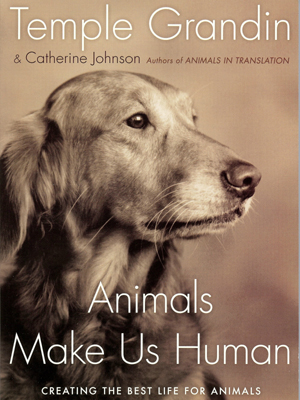
  • Animals Make Us Human by Temple Grandin

    Which animals do you think have a better life: family dogs or cattle on ranches?

    Think about it. Cattle get branded and tagged and slaughtered. Some live only a year or two. Meanwhile, Fido gets the run of the house, a spot in front of the couch, and chew toys.

    You might be surprised to know that many cattle have it better than pampered family pets. That’s the claim Temple Grandin makes in her fascinating and practical book Animals Make Us Human: Creating the Best Life for Animals.

    Grandin is not a beef industry lobbyist working smoke and mirrors PR to make ranchers look good. She’s a practical, down-to-earth, get-your-hands-dirty animal scientist who has revolutionized the beef industry and had an impact on many others. She isn’t a vegetarian, and has no intention to become one. But she does love animals. And her insight and research has made the lives of millions of animals better.

    When people ask her how she can work in the beef industry instead of being an activist against it, she says that all things die. It’s the cycle of life. She has no problem eating animals. In fact, she believes that our relationship with the animals we use for food is symbiotic–mutually beneficial. But she also believes that if we’re going to raise them, or keep them as pets, we need to give these animals a quality life.

    So what do animals need for a quality life? Should we give our cattle rubdowns? Let our dogs roam through city streets? What do our cats and pigs and horses need? Is it freedom?

    Her answer, surprisingly, is that focusing on freedom really isn’t a good guide for trying to give animals a good life. Not because freedom is a bad thing, but because it’s too confusing. Instead, she believes that we should be basing animal welfare on the core, or what she calls the “blue ribbon,” emotion systems in the brain. The key systems are SEEKING, RAGE, FEAR, PANIC, and PLAY.

    The rule is simple: avoid stimulating the negative emotions; do stimulate the positive ones. In the book she shares what she knows about how to do that for dogs, cats, horses, cows, pigs, chickens and other poultry, wildlife, and animals in zoos.

    Grandin is always fascinating, and with her trademark style of stories and practical insights, she shares what the research and her more than 30 years of practical hands-on experience working with animals has taught her. You’ll learn why your chickens need a place to hide, even if you’ve fenced out every fox and skunk with thirty feet of concrete; what makes pigs happy; why clicker training is so successful with horses; why you might want to consider the color of your cat’s fur; why leaving your dog locked in the house with food and plenty of toys may actually be very stressing. You’ll even learn to look at zoo habitats differently. Each chapter focuses on a different animal and how to avoid the negative and stimulate the positive blue ribbon emotions. This is not touchy-feely fluff. It’s not the ranting and raging of someone who thinks the planet would be better of without humans. It’s the insights of someone who is rigorously scientific, down-to-earth practical, and passionate about animals.  

    In her own words: “Everyone who is responsible for animals needs a set of simple, reliable guidelines for creating good mental welfare that can be applied to any animal in any situation.” Read her book to find out what she suggests these should be. If you own pets or raise animals, I think you’ll love this read. If you’d like to sample the first chapter, you can at Grandin’s website:  http://www.grandin.com/

    Share
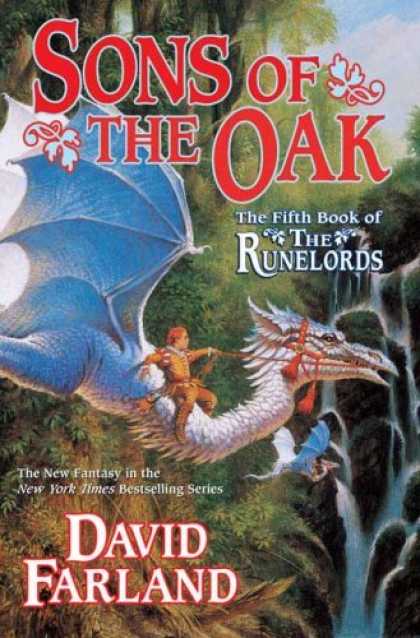
  • Check out Dave Farland’s new cover

    Isaac Stewart pointed this out to me. Wow. And what a change. Farland’s got a whole new look and feel. I don’t know much about cover art/marketing and how well various colors and styles do in the book store (will buyers gloss over this because of its dark color?–I hope not). But however this performs on the shelf, it’s a great illustration.

    See more images on Irene Gallo’s blog about it. Compare with the old style.

    david-farlands-sons-of-the-oak

    Share
  • My Most Favorite Movies of the Decade: 2000 – 2009

    I was bummed after seeing Clash of the Titans because the movie just didn’t work for me (although Medusa was cool). It was a total thumbs down. After expressing my disappointment, my wife said it seemed I never liked any movie we saw in a theater. To defend myself against this heinous accusation I shall list all my favorite movies of the last decade.  My only question is: where are all the love stories? I haven’t seen a great love story since Sabrina and Far and Away.

    Of course, I haven’t had time to see all the movies made in the last ten years. So if you have some favorites not listed here, post them.

    Top 10 Movies: 2000 – 2009

    10. A Beautiful Mind (2001, PG-13)

    John Forbes Nash, a mathematician, thinks he’s broken the code for a terrible Soviet conspiracy plot, but the real truth turns his world upside down. It’s full of mystery, suspense, and love.  Russell Crowe gives a brilliant performance as Nash. Furthermore, the film is based on the the true story of John Forbes Nash, Jr., a Nobel Laureate in Economics.

    9. Pirates of the Caribbean: The Curse of the Black Pearl (2003, PG-13)

    Swashbuckling adventure, a curse, and lots of humor. Probably the best pirate movie ever made. The next two movies fell flat for me, but this one was simply amazing.

    8. Gladiator (2000, R)

    Another Russell Crowe film. A corrupt prince betrays a Roman general and murders his family. They general is captured and made a slave to fight as a Gladiator. I was so drawn into the story that at one point in the movie theater I had to restrain myself from shouting out at a suspenseful moment.

    7. The Last Samurai (2003, R)

    Nathan Algren, a former US soldier in America’s west, drowns his regrets in alcohol. He becomes a military advisor in Japan, but is captured by the enemy. He learns from the enemy samurai, but does he become a new, better man? This one has Tom Cruise in it. I enjoyed it immensely.

    6. We Were Soldiers (2002, R)

    From the IMDB: “In a place soon to be known as The Valley of Death, in a small clearing called landing zone X-Ray, Lt. Colonel Hal Moore and 400 young fathers, husbands, brothers, and sons, all troopers from an elite American combat division, were surrounded by 2,000 North Vietnamese soldiers. The ensuing battle was one of the most savage in U.S. history. We Were Soldiers Once And Young is a tribute to the nobility of those men under fire, their common acts of uncommon valor, and their loyalty to and love for one another. The story of the first major battle of the American phase of the Vietnam War and the soldiers on both sides that fought it.” This is an incredible story. Mel Gibson and the others give an outstanding performance. I wept at their courage.

    5. Spiderman-2 (2004, PG-13)

    The first Spiderman stank. Sorry. It stank because the villain was too cartoonish. The third one stank as well. This one, however, oh baby. Peter Parker’s personal life is falling apart, he’s losing the one thing in life that would make him happy (yes, a girl). Furthermore, he begins to lose his powers just as he has to battle a brilliant scientist named Doctor Otto Octavius, who becomes Doctor Octopus (aka Doc Ock), after an accident causes him to bond psychically with mechanical tentacles that do his bidding. Loved this. Drama, gosh wow super-heroism, and a heart.

    4. Ice Age (2002, G)

    Another hilarious animated tale with heart. Set during the Ice Age, a saber tooth tiger, a sloth, and a wooly mammoth find a lost human infant and try to return him to his tribe. Of course, the saber tooth tiger was sent to lead the others into a trap. Sid the sloth is one of the best characters to come along in a long time. You’ll love this show. Again, another show I can watch over and over again.

    3. The Emperor’s New Groove (2000, G)

    I saw the previews to this and thought D-U-M-B. But it is one of the best films ever. Animated. Hilarious. Emperor Kuzco’s ex-administrator Yzma wants to kill him and rule. She turns him into a llama instead, and her not too bright side-kick doesn’t quite finish him off. Now the selfish emperor is on the run and needs to regain his throne. But the only person who can help him is the guy whose home he’s going to bulldoze. But that doesn’t capture the half of it. The characters are wonderful. Me and the kids watch this three or four times a year and still don’t tire of it.

    2. The Incredibles (2004, PG)

    A family of undercover superheroes tries to live a normal suburban life but is forced into action to save the world. This is Pixar’s best film. Every one of these characters is interesting. The family dynamics are real and often hilarious. There’s suspense, drama, and gosh-wow. Imagine James Bond as a family man. I LOVE this movie.

    1. The Lord of the Rings trilogy: Lord of the Rings (2001, PG-13), The Two Towers (2002, PG-13), The Return of the King (2003, PG-13)

    For those readers who aren’t familiar with this, J.R.R. Tolkien’s Lord of the Rings is one of the most popular series written in the last 50 years. His three books spawned a whole new genre. It is, in fact, the genre I currently write in. Peter Jackson and Fran Walsh did an amazing job bringing the beloved epic fantasy to the screen. There’s heroism, suspense, and wonder galore. These movies transport you to another world, immerse you in it, and leave you wanting more.

    Runners Up

    Casino Royale (2006, PG-13)

    I gave up on James Bond years ago. This is Bond like you’ve never seen him. Loved this. The next Bond, The Quantum of Solace, fell totally on its face. But Casino Royale is the real deal–action, spy, and poignant love story all wrapped up in one.

    Luther (2003, PG-13)

    The story of the early 16th century German monk Martin Luther who, sick of Church materialism, begins the Protestant Reformation. I knew very little about Luther. This movie was an eye-opener.

    Matchstick Men (2003, PG-13)

    Nicolas Cage is a phobic con man who learns he has a teenage daughter. He plans another con, but things start to fall apart. In the end, well, let’s just say it was a heart-breaking, then absolutely satisfying.

    Seabiscuit (2003, PG-13)

    Based on the true story of the undersized Depression-era racehorse whose victories lifted the spirits of the nation. This story is full of heartbreak and redemption. About not giving up on broken things. Loved it.

    Slumdog Millionaire (2008, R)

    A Mumbai teen who grew up in the slums, becomes a contestant on the Indian version of “Who Wants To Be A Millionaire?” He is arrested under suspicion of cheating, and while being interrogated, events from his life history are shown which explain why he knows the answers.

    Walk the Line (2005, PG-13)

    This tells the story of country music legend Johnny Cash. It starts from his early days on an Arkansas cotton farm to his rise to fame with Sun Records in Memphis. It shows how he fell to drugs, and how he climbed back out again. Marvelous performances and story.

    A Better Way to Rate Movies

    Life is too short to waste it on movies that offend instead of uplift.

    I have found over the years that the MPAA movie ratings are lousy at helping me avoid dreck. They’re okay as a rough guide, but they don’t give me enough information to make a good choice. Furthermore, the MPAA often rates a movie mature for elements I don’t find offensive and not for others I do. Luckily, there are other places that rate movies. The one that I’ve found most helpful is KidsInMind.com.

    The folks there give movies separate ratings on three things: sex/nudity, violence/gore, and profanity. But they don’t just present some mysterious number. They also list exactly what’s in the movie. What this does is give you the information you need to make a wise decision. By looking at movies that made me uncomfortable in each of those three areas and comparing scores, I soon pegged my acceptable KidsInMind levels.

    KidsInMind doesn’t tell me anything about the quality of the story or movie-making. But I can look at other reviews for that kind of stuff. What it does well is help me avoid movies with content I know I will find objectionable. Of course, I still look at the MPAA rating, but before I go see a movie or order it on Netflix, I check the KidsInMind ratings. It’s not perfect, but in almost every case it works like a charm. The only downside to the site is its five gazillion popup ads. But it’s a small price to pay for good information.

    Share
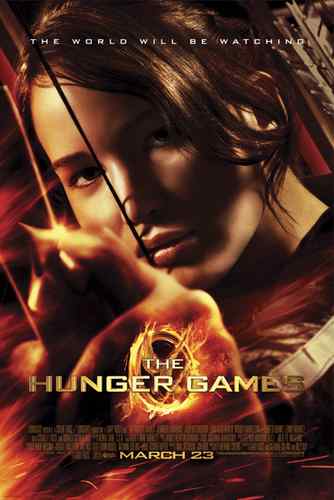
  • Hunger Games the Movie – Excellent, but marred . . .

    So is the movie as good as so many are saying?

    I liked the book a lot. You can see my review here: http://johndbrown.com/2010/09/amano-jasons-deli-and-the-hunger-games/

    Yes, but is the movie as good as the book?

    Let’s start with the beginning of the movie. During the first 10 or 15 minutes I was so annoyed and angry that I almost rose up out of my seat to shout “Stop it! Stop it! Stop it!” at the screen.

    Was this because the movie wasn’t faithful to the book?

    Because the actors sucked?

    Because the popcorn triggered a terrible case of restless leg syndrome?

    No, no, and no. 

    Then, why, John? Why?

    Because the director, Gary Ross, who wrote the wonderful Seabiscuit and Big, just couldn’t trust the material, the story, to work its magic. No, he thought that it would be a really good idea to MAKE ME SICK by overexaggerating and overusing HANDHELD CAMERA MOVEMENT. You know, the idea that if you confuse the viewer and make them uncomfortable, that will help them FEEL the wrongness, the stress, and the fear of the situation.

    A common technique for doing this is the tilted shot. Tilt the shot just a little and viewers subconsciously get the idea that something is wrong. You don’t notice it. The movie plays on, but you do feel that something is wrong, that trouble is brewing somewhere or someone is lying. A similar technique is used in action scenes. To help the viewer feel the “speed” of the action, they give us quick cuts. But the traditional tilted shot and quick cuts preserve understanding. They’re more of an unconscious effect. You still see the movie unfold and understand it. 

    However, some directors in the last few years, maybe with Spielberg’s use of this in the beginning of Saving Private Ryan (is there a movie history buff out there who can confirm?), decided that if a little was good, good golly, ten times that would be a LOT better.  So instead of realizing that action sequences like the one in the beginning of Casino Royale or the fights in Inception, ones you can easily follow, are the kinds audiences want, they figure they need to push the shots and cuts until audiences can’t make heads or tails of what’s happening.

    Instead of giving the audience tremendous thrills and suspense, they give them confusion.

    Wow, that’s a good trade off.

    And now, Gary Ross, who seems to have inexplicably bought into this, decides that what he needs to do is not only deliver confusion but nausea and annoyance as well.

    Stop, people. Stop. PLEASE! A little spice enhances a dish and takes it to the next level. But when you dump a cupful of thyme on my plate, all you do is make me want to gag.

    I’m not the only one who noticed. My 14 year old and my 19 year old noticed it as well and were bugged by it. It got so bad I told myself if it didn’t stop, I was going to walk out and ask for my money back.  Luckily, Ross toned his nonsense down and finally let the actors and story take center stage. 

    Which is what he should have done from the beginning because the acting was great. I loved Jennifer Lawrence (Winter’s Bone) as Katniss. Loved Willow Shields as Primrose and Josh Hutcherson as Peeta. Stanley Tucci playing Ceasar Flickerman, the blue-haired talk show host, was perfect. And the story was indeed a faithful translation of the book. I’m sure a huge part of that is due to the fact that Suzanne Collins, the author of the novel, helped write the screen play.  The other writers were Gary Ross and Billy Ray. 

    They did change a few minor things like Buttercup the cat is now black and white (I’m so utterly devastated I won’t be right for years), and Primrose gives the mockingjay pin to Katniss instead of Madge. They added scenes with the President of Panem.  They cut some scenes with minor characters and some twists in the plot. For those who read the book, even though the lost and changed parts added texture to the story, I think you’ll still be very pleased. For those who haven’t read the book, I think you’ll be wowed and sobered by the end. You’ll think about the Romans and their gladiators. You’ll wonder how we can we humans can do things like this. And I think you’ll feel a great indignation take root in your breast against the villains who control the world of the story.

    So, the move is a great experience that would have been over-the-top excellent if the director hadn’t marred it with way too much of something that should be used as spice instead of the main course.  Nevertheless, I recommend it. If you like action and drama, I think you’ll love the movie and the book. And hopefully my comments above will innoculate you to the opening scenes because you know to expect them going in.

    EDIT: Matthais Stork writes about “Chaos Cinema: The Decline and Fall of Action Filmmaking“. And his response to his critics. Anne Billson of The Guardian agrees that “Action sequences should stir, not just shake“.  But here’s a fellow trying to defend chaos cinema in a way that reminds me way too much of those I met in my English degree who assumed that the highest reading was one that focused on meaning, one that assumed the story was really not a story about people to be experienced, but a clever puzzle that needed to be decoded.

    EDIT: The issue with chaos cinema is that it replaces showing with telling.

    It presents “big fight” and “exciting chase” instead of showing the big fight and exciting chase. It’s similar to voice over narration: using the soundtrack to tell us about what’s happening instead of showing it to us. But it goes beyond even that because at least the narration told us what was happening. Chaos cinema at its most extreme doesn’t do even that. It replaces clarity with confusion. And this is its biggest downfall.

    For someone to react with emotion to a situation, they must (1) understand what’s going on AND (2)believe that the situation is real. The moment you deliver confusion, you take away one of the two necessary antecedents, and prevent the audience from responding emotionally. They now can only respond intellectually, e.g. Ah, I congnitively see that we are having a fight; I have no idea what’s happening and how that affects the guy I’m rooting for, but I see we’ve inserted the “fight” concept. (For those interested in the excellent discussion of emotion and stories, you’ll want to read Jenefer Robinson’s DEEPER THAN REASON: Emotions and it’s role in literature, music, and art.)

    Take it too far and you remove the second antecedent as well because now, instead of reacting to the story, you’re thinking about the camera man. Which is what happened with me when I just about came out of my chair to shout at the screen at the beginning of HUNGER GAMES. And what happened to half a dozen others I know who couldn’t look up because it would make them dizzy, and another half dozen who did look up and got sick.

    Chaos cinema trades in the super powers of cinematic storytelling for a bunch of rocks.

    Share

3 Comments

  1. Thanks for the review!! I’m a big Matthew McConaughey fan. I saw a trailer for thus a while back, it looked like a great film!

  2. I echo Dave’s comment from the 18th in all regards.

    John, your through review helps satisfy what a short trailer does not begin to explain. And stirred more interest thereby. (explaining the R rating helps our family as well 🙂 )

    Again, thank you – and I’ll take this opportunity to wish you and yours a very, Merry Christmas and hopes for a happy 2018 for the Browns.

Comments are closed.