How people actually break into writing novels
Aspiring writers, Jim C. Hines is starting to release the results of his how did you break in survey. Go read it!!
Aspiring writers, Jim C. Hines is starting to release the results of his how did you break in survey. Go read it!!
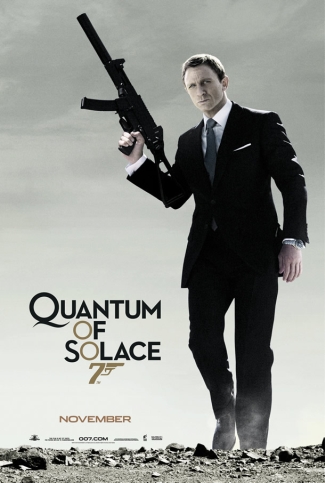
***SPOILERS***
Last night I went out with my wife and some friends to watch QUANTUM OF SOLACE. I was so excited. But when the movie ended, I was totally unsatisfied. There was no release. Nothing. It just ended.
There was lots of great stuff in it. Love the character and style of this new bond. Loved CASINO ROYALE, but this just didn’t work for me. My diagnosis has two parts.
MINOR ISSUE: clarity in story. The chase scenes were so choppy I couldn’t get a feel for what was going on so I could worry for Bond. All I did was get sick to my stomach. Part of the way through I told my wife I was going to write death threats to the freaking director. Who in the world thought that was a good idea? It doesn’t mimic battle etc. In battle you are HYPER alert and focused. Your world doesn’t turn into chaos.
But it was more than the chase scenes. There were times when I did not know what was going on. Why was Bond going to his friend from movie 1, why was he watching that guy pick up a bag at the play, why was he going to the party, etc.?
If he’d shared any of his plans, I could have gotten worried when antagonistic forces thwarted him. As it was, I was just watching him do stuff and only realizing at the end what the goal was.
The basic principle of suspense is to let me know what they need to do and why they need to do it, then let me worry as I see the operation fall apart. Or let me know the danger and see them walking into it. But time and again they didn’t provider the viewer with the necessary information in this movie.
MAJOR ISSUE: ineffective story structure. I think for a film to build to a huge climax and release, the hero has to find himself in more and more desperate circumstances. His situation has to become darker and darker until we see no way out for him. By the end of act 2 his plans etc. should all be in shambles. He’s out of options.
In this Bond I rarely felt he was in danger. Yes, there were some fight sequences which were tense, but he never ended up in worse shape afterwards. We got messages that he was being framed for murders, but I never really felt the screws tightening on him. So it never got darker and darker for him.
His plans seemed to only be delayed, not destroyed. In Casino Royale, his car is wrecked and he’s taken captive and is going to die. He loses. In this one, nothing. Even when his plane is shot down going out to the desert, it’s just a delay. They walk to the bustop and are soon back on track.
There might be another point about something being at stake. The water grab is a great idea, but we’re talking a 50 year plot. It’s not THAT urgent.
A FIX?
I think they could have done more by playing up the revenge/mystery of the last one. Yes, have the water grab, but make this personal to him. He’s searching for the answers to who was behind his lover’s death. Why not?
Then get the villain, the US CIA, and the British hunting him down with real resources. He evaded everyone fairly easily in this one. He’s running FROM all these forces, barely one step ahead, until he gets caught by them. And it’s one of Green’s guys in the CIA or something like that who captures him. So he’s totally screwed. Then have the Black CIA officer do something to spring him. He’d probably have to die for it.
I’m sure there are more and better options. But do something so that Bond is running for his life, FAILS, then pulls it out. Not chasing down the bad guys one by one with relative ease.
Just one option. Thoughts?
Author Jim C. Hines recently posted a thoughtful blog about connections between Writers of the Future and Scientology. There are a number of folks who have issues with Hubbard’s metaphysical claims and the church he started. Some folks claim that supporting Writers of the Future (WOTF) in any way supports the Church of Scientology (CoS) and the abuse of the young, the innocent, those who are vulnerable, and the stupid.
I won a first prize in the Writers of the Future. I received $2,000 cash for the prize and subsequent publication. I also recieved a paid trip to Cocoa Beach, Florida to workshop with the other winners and pro writers. I tell new writers to submit to the contest all the time. I do not feel I’m supporting any wickedness. Let me walk you through this. You tell me if I’m killing any puppies.
A. What underlies the continued operation of WOTF?
B. What are the effects of the contest?
I was a first place winner. I had a marvelous time. This was the one held in Cocoa Beach, Florida. One night I needed to go to a convenience store to get something (tooth paste?). One of the WOTF folks drove me there. A nice woman. It was raining. It was just the two of us in the SUV.
I’m a VERY CURIOUS guy. I’ve read most of DIANETICS. I stopped by a Scientology place in Seattle to chat. I like hearing people talk about their faiths, about their lives, about whatever. If you spend any amount of time with me, you will tell me your life story. You will. It just happens.
I tried my dangest to get something out of that woman, but she was as tight as a clam sealed in four feet of concrete.
Nobody talked Scientology. Everyone involved went out of their way to avoid it. End of story. I’ve talked to many other winners. They report the same.
On the other hand, they did have a PR guy there.
Mr. PR intereviewed us about the contest and Hubbard’s works and took footage. Our one-on-one interviews were on camera. We took still photos. He asked us in our acceptance speeches to thank Hubbard by name.
He was a PR guy.
It was very clear his job was to generate PR content for WOTF and Hubbard. How do I KNOW this? Because his questions all centered around WOTF and/or Hubbard. But never CoS.
Some of the winners did not like his solicitation for a mention of Hubbard’s name. There was some reality show behind the scenes grumbling and scheming, and they did not mention Hubbard in their thanks at the awards event.
That’s fine, although it didn’t make much sense to me. Maybe they felt gratitude needs to be spontaneous, not asked for. And I can agree with them on that. At the same time, why would I take $2,000 cash for the prize and publication, and the paid hotel, and workshop, and airfare and then slap the folks who gave it to me? I was indeed grateful. So I mentioned Hubbard in my thanks (oh, look at how noble I am; somebody should saint me).
What did the contest do for me?
So the contest, as far as I’m concerned, is a GREAT contest for new writers.
But am I supporting CoS? And is that a bad thing?
Every time I purchase a Kraft Foods or Nabisco product, I directly fund Phillip Morris tobacco company and their efforts to hook children on smoking abroad. Some of the tomatoes I purchase in Walmart and other grocery stores are tainted by slavery that occurs today in Florida and California’s central valley with migrant workers. Some of those tomatoes end up in various restaurants like Pizza Hut or Papa Murphy’s. Every bite of chocolate you eat funds slavery in the Ivory Coast, where the vast majority of cocoa beans come from. Not a few slavers here and there, but widespread slavery and abuse. There are many situations like this.
What do you do when you like a product or service, but don’t necessarily want to lend aid to an affiliated cause?
In many situations, I don’t do much.
Alas, there goes my sainthood.
I admit that I should and should probably think more about this. At the same time, with regards to CoS, I don’t know that it is a wicked and exploitative organization.
I’ve seen nothing that suggests they’re into crime. Or systemic abuse. Or fraud. Or that they have a vendetta against dumb people. I don’t share one iota of their faith in Hubbard or his metaphysical teachings. But I do share other values and beliefs with them. Just as I do with Catholics, Muslims, Pagans, Athiests, Communists, and Realtors.
Besides, I never did PR for them. I’ve always said I DISAGREED with their theology, which is negative PR, if you think about it. Furthermore, I’m fairly confident the contest DOES NOT funnel large amounts of money to CoS.
What can they be making after taking out the expenses of the award week for all those authors, illustrators, judges, “luminaries,” etc. that they fly in and house, all in addition to the prize and publication monies? I’m confident they make nothing at all, but actually lose money each year.
So the net net is that they get some PR for WOTF in the SFF community and some for Hubbard’s name. That’s it. That’s what I’m giving them.
But I don’t see any documented stories of that leading to any donations or conversions to CoS. Or positive PR for CoS. Which, again, I’m still not convinced is a systemically exploitative and wicked organization.
But even if it were, am I really supporting CoS when I promote WOTF?
I don’t think so. I’m not giving them cash. I’m not giving them any positive PR. It seems to me purchasing one bag of Oreos or a Lindt chocolate bar does more harm than this ever could.
I feel so much better now. I am saving the puppies.
Of course, if you disagree, please post a comment. If you have reliable documentation, not hearsay and tabloid clamor, that can add to the discussion, feel free to share it. I’m all for good data. And if you see issues with my logic, share that as well. But no wild-eyed, Chicken Little, my mother was eaten by CoS aliens rants please.
As for that Twix I just ate. . .
(sigh)
EDIT 1: I just learned the Phillip Morris spun Nabisco and Kraft off in 2007. So that frees up my Oreo conscience, but the principle remains.
EDIT 2: Okay, so I just learned that the CoS planned and authorized crimes in Operation Snow White. What to make of that? Comments? Talk about your corporate espionage. I know there are governments and organizations around the world and in the US that engage in that all the time. But this is the first I’ve seen from a “church.”
EDIT 3: Read through the links on this post by Deirdre Saoirse Moen where she explains why she no longer supports the WOTF contest. Primarily, she just can’t stand some of the CoS practices.
Of note is the link to the court report by the Village Voice at the Debbie Cook hearing. One question I have is why all those leaders were in the Hole to begin with? Was it some routine church program? Yeah, it sounds awful, but the military puts the SEALs and Special Forces through awful things. So I’m not clear on all of that. And why haven’t more come out to complain? The unlawful detainment aspect of these allegations is disturbing. But are they really doing this? Are these isolated experiences, or SOP? I don’t know.
There’s another one farther down that lists alleged harassment of folks posting some CoS theology documents on the internet. I sampled the documents linked to there. Most of those are just copyright violation letters. SOP for anyone trying to protect copyright.
Looking at Operation Snow White, the Debbie Cook hearing, and the copyright violation stuff, it’s becoming fairly clear that the CoS has taken an extremely aggressive approach against some of those who speak out against them (maybe it’s over the top) and a similar approach with protecting their materials. Although I think they’ve lost the battle about their materials on the internet.
Instead of trying to win public opinion with the truth, it seems in some cases they’ve instead attempted through various methods to try to silence detractors.
Anyone have any more links to substantive material?
EDIT 4: Here’s a letter from Joni Labaqui, a Scientologist and the person who runs the whole WOTF shooting match, to Frank Wu, who was an illustrator winner, and had posted some stuff about WOTF and CoS here: http://www.frankwu.com/illo.html (I found the letter at the bottom).
Dear Frank,
Hi! It’s Joni Labaqui here. Haven’t seen you since you blew me off at LA Con a few years ago and now I know why. I didn’t understand why you didn’t want to talk to me for very long. I loved your write-up on your site about the contest until you got into talking about Scientology. I know what you mean about feeling hurt when people put down your church. I happen to think you are NOT stupid because you are a Christian. I have many Christian friends and I respect their beliefs and even fight for them. But then you get into my religion on your site and putting out falsehoods, then I realized you didn’t have all of the info. We don’t sue people for bad mouthing our religion. The Church sues when there is slander and liable of considerable magnitude involved. Lets use an analogy here – lets say someone accused you of raping the girl next door, but you didn’t do it. Would you be upset? Lets say the parents then sued you or had you put in jail or both. Would you be upset? Would you hire an attorney? Gee, you’d be involved in a legal suit wouldn’t you? What if the father of the girl made sure you were lied about in the newspapers and on TV and he tried or succeeded in ruining your reputation? How would you feel? On top of that, lets say what really happened is you simply talked to the girl and were trying to help her and she turned around and accused you. How would you feel? And how about all those people who love to gossip? (I personally hate people who gossip as all they are doing is hurting others and they are basically low-life losers – lots of people fit into this category, I’m afraid). How would you feel?
You were actually wrong in that Scientology pays for the writers and illustrators awards. The Hubbard estate (which is not the church) makes so much money on royalties from his hundreds of published fiction it would make your head spin. You were right about the fact that every one of us who works at Author Services is a Scientologist, but the judges of the contest are not. They share the same goal that Mr. Hubbard did in starting and paying for this contest – to help the new guy, just like yourself back then when you won. So I don’t understand, a nice person like you has to even bring up the subject in your write-up. You think we are interested in “converting” any of you winners just because we have you tour the Life Exhibition? The answer from the horses mouth is NO. We are simply showing you more about his life and works so that you have the facts about the other part of his life, not the bullshit and lies that has been put out by vested interests of multi-billion dollar drug companies and the psychs that can’t stand us. Have you received tons of unwanted, unsolicited mail? The answer is no. Trust me, if we wanted to convert you, you would sure know it. Believe it or not, Mr. Hubbard in founding this contest just wanted you guys to be seen and heard because he knew how hard it is to get started. Period. Its not about Scientology. That is the simplicity of this contest. Anyone reading anything else into it has their own issues and I feel sorry for them. I guess maybe you ran into someone bad mouthing us and you listened to them. If someone badmouthed you – to this day – I wouldn’t buy it. I’d tell them to take a hike. Do you know why? Because I know you are a good person. I met you, I shared some of that joy you experienced when you won, and I was truely happy for you because I like people being happy, winning in life and doing well and winning this contest. I still like you, but I’m a bit disappointed that you felt compeled to write what you did. I don’t get it. I personally put in hundreds of hours of work to help give you the event that you won your award at, so how do you think I feel?
I hope to hear from you. Best, Joni
I’ve experienced yet again the miracle of manure, of starting from scratch, and following the zing.
This last week I’ve been rewriting a beginning to a novel. It’s a bit tricky because I can’t just rewrite it without constraint. Such a rewrite would cause massive changes to everything else in the book. In fact, a complete, unfettered rewrite of a beginning might end up requiring a totally different book. But Tor bought the book in hand. Besides, I don’t have time for a total rewrite even if they did want one. So the new beginning had to fit into the rest of the current story.
At three different spots where this beginning needed significant changes I have had to write a pile of cow crap because it’s all I had in me at the time. I knew I couldn’t use those plops when I finished them. But there they were.
The problem was compounded by my reading the recent Time article about Stephenie Meyer and starting to listen to Empire by Card. I have a weakness for comparing myself to others, and this time the comparison yeilded some depressing results.
Then I asked myself what wasn’t working and how I might meet the goals of those scenes a bit better. I followed my heart. But in all three cases I had to stop trying to use the brilliant words I had written originally. Not the cow crap revision, but the original stuff.
I’m not talking about the general prescription that we writers need to “murder our darlings” because the darlings are usually bad writing. I find general prescriptions to be wrong much of the time and that one in particular to make no sense at all.
In this case one of the things I had to jettison was a beginning segment that had compelled 90% of the readers who glanced at it to read more. A beginning page that snagged agents and editors. A beginning page I still loved, even after reading it as many times as I had.
But it just wouldn’t fit, couldn’t fit with the new structure. When I tried to hang onto it, I wrote crap. Which was fine. There was some good stuff in the crap. But I eventually had to trust myself and come up with something else completely.
And while I don’t know if it’s going to suck readers in like the original, I think it’s pretty dang good. Back before Card’s boot camp I would have never made it to this point. I would have given up. But this is just the process for me now. It took some time to learn and trust it. But now I know that while sometimes I can write hot. There’s no reason to despair if I don’t. Sometimes it takes a few tries before I get to the good stuff.
As for Meyer and Card, well, it’s not my goal to be a one-trick pony, now, is it. 🙂
Folks, a huge thanks goes to Stephen Nelson for putting all this together. You may kiss his hand when you see him.
This is a recording of “How to Write a Story that Rocks,” a two-hour seminar Larry Correia and I just put on at the annual BYU’s Life, The Universe, & Everything symposium. I think we had 130-140 people attend. This symposium is focused on writing fiction. And while the panels and presentations do include things specific to the science fiction, horror, and fantasy genres (both adult and young adult), a lot of time is also spent on story writing fundamentals that apply to ALL genres. So when I developed this workshop, I made sure I took the fundamental approach.
The two-hour seminar has been broken down into 12 segments. To switch between the segments:
If you prefer, you can watch all 12 on the How to Write a Story that Rocks YouTube playlist page.
I’ve found whenever I develop any presentation or training that it takes a few iterations and revisions before it’s the best it can be. This is the first iteration of this seminar. And so below this video I’ve provided additional comments on each segment explaining key concepts, principles, and techniques that we might have failed to discuss or convey as clearly as we’d hoped. Enjoy!
How to Write a Story That Rocks – Handout
It’s documented–right-wing gun nut Larry Correia sang “Kumbaya.” What’s next? The hugging of small trees? Oh, Larry, the disilluion. The disillusion.
The reason why I had Larry sing was not for his mellifluous performance, but to demonstrate the difference in reactions between him and our happy volunteer (“Country Road” by John Denver–this really was a love fest). The volunteer balked because he hadn’t taken any thought to know what to sing before he was commanded to do so. On the other hand, Larry and I had spoken before the seminar. So Larry had something to sing BEFORE he sang it. It’s a simple demonstration, but it illustrates a principle a lot of new writers forget. Writing is a performance. It helps to know what it is you’re going to perform before you perform it.
It’s one thing for you to tell yourself to write. It’s much easier to tell yourself to write the scene where the rancher finds out one of his illegal ranch hands has been kidnapped.
Now this doesn’t mean that you have to know everything. Or that you can’t write exploratory drafts to figure out what it is you want to write. But it does illustrate that whatever techniques you use, you’ll be a lot more effective in your writing when you have something to say first.
But what do you develop? What are the things that bring the story to life? How do you go about getting those things to say? That’s precisely what I wanted to address in the seminar. In the segments that follow, I try to:
I think this segment went fairly well. What rocks will different from person to person, even though there will often be a huge overlap between people. So it’s important for authors to seek to develop the kinds of stories that rouse their passion. Watch this interview with best seller Debbie Macomber to see what I mean. So I can’t tell you what to write about. Or if whath you think rocks will resonate with a large number of people. However, what I can do is share the techniques I use that have been most productive in helping me develop initial ideas into something that has much more power.
You can use the techniques to juice up any of the four parts of story. However, I will say that I find that the most productive, the most important parts, are character and problem. Plot and setting are important. I love them and work to juice them up. But when I get a good character and problem, that’s when the writing seems to flow the easiest.
And no, I don’t list theme as a part of story. Everyone talks about theme, but when I read what they have to say or press them for examples, it seems that it always either boils down to (1) a story element or topic that’s repeated, (2) a story problem/issue stated in an abstract manner, or (3) some moral situation. Les Miserables is about the “theme” of mercy versus justice. But saying justice versus mercy is just an abstraction of the story problem and dilemmas the story deals with. So, no theme.
Loved this bit about scenes from David Mamet: http://www.slashfilm.com/2010/03/23/a-letter-from-david-mamet-to-the-writers-of-the-unit/
I’ll be adding my comments to the rest of these segments over the next few days.
Check it out: Dan Wells on How to Build a Story (story structure). I find Dan’s “start with the ending” technique helpful as well as thinking about a worst fears realized moment. Watch the videos and see if there isn’t something there that can help you develop your story idea.
You can get the PowerPoint of How to Build a Story on Dan’s site.
If you find this approach useful, you might want to check out what novelist Larry Brooks has written about the same material on StoryFix.com.
Complaining is not a business strategy ~ Jeff Bezos
I love that quote.
That doesn’t mean folks should never express dismay, fear, or frustration. It can sometimes be very helpful to voice it.
Name it.
Pin it to the wall.
And then move forward.
So Amazon changed how they approach paying authors with Kindle Unlimited (KU). I think the move is fantastic. It rewards value provided to the reader. If you’re in the business of selling value to the reader, that’s a no-brainer.
I also think this whole KU 2.0 thing illustrates why Author Earnings is so important.
It reminds us that we are NOT Amazon.
It reminds us that we are NOT the publishers.
It reminds us that we are NOT the agents.
We are a totally different group.
Amazon is simply a partner. A great partner right now, but they are NOT us.
Which means we’re responsible to make our own way. How do you do that? The only way I can imagine is to own the idea that you’re a business. And then think like a business.
How?
I haven’t run any better way than the lean startup approach. I’ll be sharing some posts over the next few weeks that explains just what that means.
Happy 4th of July! May God bless America and the disruptive freedom-loving form of government she introduced.
If you’re going to build a house, you need to know what type of house you want and what you want it to do. A two-man tent is a house of sorts. So are a suburban rambler, a New York high-rise, and a medieval fort. Each is a bit different, even if they share elements.
Building a story is like building a house. You need to know what you’re after. You need to know how stories work in general and how the type of story you want to write works in particular.
For example, if you love suspense, and it’s going to factor heavily in your story, you’d better learn the principles of suspense. If you love intrigue and mystery, you’d better learn how to build that in a reader. If your current project is a crime story, you need to know how crimes work and how they’re solved. If it’s a love story, you need to know how falling in love works. All of those things you identified as your personal style—you want to know how they work.
Except sometimes, when you’re starting from scratch, you might not know exactly what kind of story you’re going to build.
So what do you do?
You get a list of development objectives. And you begin to work on them. Your mind needs a direction to run.
Despite the fact that stories are different, they share some common core things. These are the things you want to focus on developing. When I start a new project, I know my task is to develop six core story elements. This gives me a direction. All I have to do is start developing these six things, and sooner or later the story comes to life.
So what are these core elements?
You need to develop all six parts. That’s your job. There’s no particular order that you develop the elements in. You just start with what you have. As you develop all six parts, the story will come to life. Your characters will begin to breathe and speak. They’ll take on a voice and attitude. You’ll see the landscape. Scenes and plot turns will come to mind. If you’re more of an auditory thinker, you might not see anything, but will start hearing the rhythms of the prose. Visual or auditory, you’ll care about and believe in the tale. You’ll have something wonderful to write and share with readers.
Let’s look at each element to see what you’re trying to develop.
The genre tells you the overall effect you’re going for. It describes the salient aspects of the tale. Those aspects often focus on the emotional mix you’re delivering to the reader (horror, humor, thriller), but can also describe the setting (western, Regency romance), as well as the type of problem your characters will be facing (love story, political thriller), and the audience your writing to (young adult, middle grade, women’s fiction).
But why do you want to know your genre? Isn’t that just a marketing thing?
No, it’s not just some marketing thing. If I’m telling a story about a kidnapping, knowing it’s a tale of tale of horror–instead of a romantic comedy, fantasy, western, science fiction, or political thriller—makes a huge difference.
It gives me an objective. Parameters. Remember, creativity is problem solving. If there’s no objective, there’s no solution. The moment we have an objective, our mighty brains can kick into gear and start suggesting ideas. The more specific we make the objective, the easier it is to think up ideas.
Now, you might not know the genre when you start. You might simply have a cool bit of dialogue, an image, or newspaper clipping. That’s okay. You don’t need to start with genre, although it often helps. But you eventually want to peg that genre, even if it’s some blend of your own making, so you know the general effect you’re going for.
You want to develop a couple of characters, usually at least a protagnoist and antagonist. They need to be interesting to you. If you want your readers to root for someone, that person had better also be sympathetic and likeable.
What makes a character interesting? What makes them sympathetic and likeable? You might want people to dislike your antagonist. You’ll at least want them to fear him or her. What produces that? Read what I wrote about character here: http://www.sfwa.org/2010/12/key-conditions-for-suspense/. Then start noticing what makes people and characters interesting, sympathetic, and likeable to you, as well as what makes you fear and dislike others.
There will be other characters you’ll need to develop—a mentor, lover, friend, henchmen, etc. Maybe you start with one of them. That’s fine. Just know you need to be on the lookout for your protagonist and antagonist. Almost every story has both. For the hero, you’ll usually want to develop someone that’s interesting and likeable. For the antagonist, you’ll want to develop someone who is interesting and powerful enough to make us fear for the hero.
Setting may play a huge role in your story as it does in epic fantasies, Westerns, historical pieces. Furthermore, a setting doesn’t have to be faraway place to play a big role. Your story may be set in a prison, rural town, or manufacturing plant, which may factor heavily into the story. Then again, setting may play less of a role. It all depends on what interests you and the type of story you’re writing.
They key, I’ve found, is to develop the setting with the goal of having it come alive in my mind by identifying things in the setting that are interesting or will affect the hero and plot. I need to transport the reader to a place. I can’t do it, if I myself don’t know what that place is like. And it’s nice for them to find it interesting when they get there.
Setting is also a great source of ideas for the other elements. When you develop setting, you’ll find characters, problems, and plot ideas galore.
I wrote a detailed explanation of problem and plot, which you can read here: http://www.sfwa.org/2010/12/key-conditions-for-suspense/. Read it. I’m not going to rehash it now. But I will say that problem is the engine to your story. Your story is not going to go anywhere without it.
You want to identify the main problem your character is facing. One that is going to generate enough scenes for the size of story you’re going to write. Read what I wrote about conflicts, obstacles, etc. Ultimately, you’re aiming to develop a problem that you find compelling.
You might not develop the key aspects of the plot in the beginning. In fact, you’ll probably discover many of them only as you write. However, at this stage it does help to start looking at plot patterns for the type of problem you’re writing about because it helps generate ideas for scenes. For example, a romance about a gal who is a Minuteman or border agent and guy who is a coyote (smuggling folks across the border) will take a different course than one about a farmer trying to find his kidnapped wife.
In the first story, we might start by introducing the characters: the border agent interdicting a group suspected of being drug mules; the coyote is leading that group. In the next scene they might meet, and not know what the other is. They’re attracted. They meet again, maybe have dinner or dance or go hunting. The romance deepens. Then one finds out about the other. If she finds out, does she turn him in? Maybe he inadvertantly leads the drug cartel to her and puts her in jeopardy.
In the second story, we might start with the husband and wife in some funny situation. He leaves. Comes back. Finds her gone. Finds evidence of her kidnapping. Gets a call or a note. Is told they want him to pay them a ransom. Or maybe turn over title to something. Or maybe he works at a weapon manufacturer, and they want some piece of tech. Or maybe it’s something else.
The point is that they develop differently. The plot patterns of love stories are different from the patterns of heists, kidnappings, shipwrecks, bullies, etc. because they’re all different problems and require the hero to take different types of steps to solve them. When first developing a story, I’ve found it’s helpful to think about patterns for presenting, complicating, and resolving those types of problems. I’ve found it helpful to ask, what would I do in this situation?
For more on plot patterns, see the link above. In addition to patterns, specific plot turns that really spark your interest will present themselves to you. Maybe I don’t have a pattern yet, but as I’m developing the character or setting a cool scene comes to mind. Or maybe it’s a cool plot turn–the border agent is captured by a drug cartel and the coyote goes in to save her. You want to be on the lookout for these.
So in the beginning, you want to focus on developing a compelling problem, a general plot pattern, and be on the lookout for some cool or fun scenes or turns.
Text is the prose on the page. It’s how you translate the story in your head to something the reader can consume. It’s the specific scenes, the dialogue, and narration, which means you don’t stop developing the text until you write “the end.” Sometimes, the story can come alive without drafting. Sometimes, especially with those writers who are more auditory, you need a rhythm, a voice for the narrator and character before the story clicks. Often it just takes some freewrites or a drew chapters to discover this. What I’m after is a point of view voice.
Take some time and think about the key elements, how they work, and the core of what you need for each. Make yourself a simple checklist. Here’s one such checklist.
Here’s another I recently shared with some younger writers:
It doesn’t matter where you start when you invent a story, but you need to end up with a character you think is fun, cool, or interesting, who has a problem other people will find funny or compelling–that’s the core of your story. The problem can be a mystery the character needs to solve (there are strange green lights in the sewer), a danger or threat to some aspect of the character’s happiness or someone they care about (holy smokes, that big alien that looks like a bug wants to eat my head), or an opportunity for something that will make them happy (I live in a cupboard and get to go to magic school!) You start there. The rest of the story is about how that character goes about trying to solve the problem, the characters who help them, and those who work against them (including tiny evil mice villains). You know you’re done when the mystery is solved, the threat removed, or the opportunity is won or lost.
Here’s another from Lou Anders that he offered on a Writing Excuses podcast that presents another way to sum up what you’re looking for with character and problem (BTW, I find no evidence that all satisfying stories need what he calls a relationship character; however I do think it’s a fantastic technique for stating theme and clarifying the internal problem in stories that revolve around a character making a change):
[Lou] The protagonist is usually the most obvious one. He or she is the star of the film. The protagonist is someone who wants something. It has to be something concrete [emphasis added]. It can’t be “I want to be happy” or “I want to be pretty” or “I want to be rich.” It has to be a definite, achievable goal associated with that. So I want him to fall in love with me so that I will be happy. I want to win the game show that I’m going to be on so that I will be rich. I want to rob a casino of the guy who’s dating my ex-girlfriend, that will make us happy.
[Dan] So I can be happy and rich.
[Lou] Yes. Exactly. So it has to be a concrete, achievable goal.
[Lou] The antagonist is the person who places obstacles to that goal in the path of the protagonist. This does not mean the bad guy. Now, we can talk about some very interesting examples. The antagonist is the one whose goals are diametrically opposed to the protagonist, and they’re the one who is blocking the protagonist’s journey.
These aren’t twenty page design documents. They’re simple checklists. There’s power in keeping your objectives simple. Too many details and you lose your focus.
I suggest you take some time to write a succient sumary of what you want to develop, one that gives you clear direction. It doesn’t need to be perfect. Just cobble something together. And keep it SHORT! Remember the 80/20 rule.
Let me suggest you not get bogged down by rules: Rules vs. Objectives. And that you include at least four of the six parts: The 4 Parts. The key is have a list of core things you know you need to develop for the current project. Knowing what you need to develop gives your mind a direction to work in so you’re not just flailing about.
It’s important to know that even though you have a development checklist, you will NOT develop the whole story up front before you begin to draft. You can’t. It’s impossible. It’s a mistake to think you must.
Even the folks who write detailed seventy-page outlines cannot imagine the exact words and turns of every scene before they actually write them. Furthermore, they are often surprised by ideas that come as they draft and find themselves adjusting their outlines.
Your goal is NOT to develop a super detailed set of writing instructions that a monkey could follow. Your goal is to get enough ideas in the six parts for the beginnings of the story to come alive in your mind. When the story is alive in your mind, writing is almost like transcribing.
You might develop your ideas by creating various types of sketches for the plot, problem, character, and setting before you begin to draft. This includes things like summaries, outlines, drawings, maps, character biographies, etc. On the other hand, it may take some drafting before those things begin to breathe.
Also, it’s rarely the case that you develop the parts sequentially. What usually happens is that you develop a little bits about each part in random order. Maybe you start with the bare bones of a problem, then develop a bit about a character, then setting, which leads you to more about the character, then you see something on TV that sparks your ideas about the problem, then you write a draft of something and get some more details, then your brother says something that sparks an idea that fits. Or maybe you start with a snippet about a character and move to the setting and back to character then to problem. Or maybe you begin with setting and discover a bit about a character.
It doesn’t matter where you start. The parts build by accretion, like a snowball—here a little, there a little.
Once you know what you’re trying to develop, ideas will literally jump out at you. It’s all part of the biology of selective attention (http://en.wikipedia.org/wiki/Attention).
For example, if I tell you to develop a sexy female antagonist, I’m betting some ideas or images immediately leap to mind. If I tell you to present me with three different choices for this antagonist next week, someone who will fit into my kidnapping story, someone who’s a little surprising, and every day you think about this objective, you’ll encounter all sorts of ideas over the next seven days that you might use.
Why? Because you’re primed to see them. You’re looking for solutions to a specific problem. You’re harnessesing your focus and working memory limitations. That’s selective attention.
The more specific I get in my objectives, up to a point, the easier it becomes. If I tell you the kidnapping is a comedy set in rural Utah with Mormons and Peruvian sheep herders who work for 9 months and then return to Peru, that will lead you down one path. If I tell you it’s a thriller set in the deep south with Mexican drug gangs and a local police force, that starts you thinking in another.
Let me give you an example of all this. A few years ago, I was on a business trip, and just before checking out of my hotel, I read an interview with Deborah Vetter who used to be the editor for Cicada. She said they loved traditional fantasy stories and that many of those she liked took a common theme and gave it an unexpected twist. Cicada was open to fantasy at the time, and so I asked myself: what’s a twist on a common fantasy element?
Boom, objective–my mind had a direction to run in.
I got my luggage together, checked out of the hotel, and drove over to a Lowe’s around the corner to pick up something for the house. All this time I’m running various fantasy elements through my mind—witches, ghosts, dragons, etc.—asking how I might twist them. Trolls? No, boring. Witches? Meh. Vampires? Ugh. I went through a whole bunch of ideas. I got out of the car, entered the store, continued. When I was walking down the trim isle, I finally got to golems.
Hum, that was interesting to me.
All the golem stories I had read were about the rabbi creating the golem and what happens. Kind of like Frankenstein’s monster. So I asked: what if it wasn’t about the guy who creates the golem? What’s a twist? What if it’s about someone who finds a golem?
I immediately saw the bank of a river, the Evanston, Wyoming river my girls and I had been playing on a few weeks earlier. I imagined the river in autumn, yellow leaves on the ground. I imagined a bald man of red clay, half exposed in the freshly shorn bank, the rune of power on his forehead and neck. The river was low, the mint growing on the exposed sand and gravel bars, the smell of leaf mold hanging low over the water.
My cool meters went wild. Some ideas carry such a delicious energy.
Did I have a story?
Of course, not. I only had the first whispers of a character (the golem), setting (a river somewhere), and genre (some kind of fantasy). Maybe a bit of a problem. This was one cool idea, not anything close to a story. I knew I needed to develop character, setting, and problem. That’s what forms the premise of the story. So I got to work on those elements.
I captured the image on a scrap of paper, and began asking questions. Who finds it? A woman, I thought. Where? I listed some options and liked the woods of North Carolina. And it was some Native American creature. What’s the problem? What’s at issue? Either the red golem has his own agenda, I thought, or it’s others forcing it on him, or he’s trapped. A trapped soul…and the woman and the golem love each other…
Did I have a story yet?
No. Not even close. I still didn’t have a clear problem. Or very much about the characters. No plot.
So what could the problem be? What was the situation?
I walked around Lowe’s, drove home, thought about it on the way, generating options. I took a few days and generated ideas about American Indians, pickups and rednecks. I researched golems. I asked myself–what would that girl do, if she found this thing? What if she dug it out and took it home? So I had a girl who digs the golem out and transports it home in her pickup, modern day South Carolina. She takes it home, cleans it, becomes obsessed with it. Takes it into her room. One night she’s lying in the dark, the house is quiet. And suddenly it takes in a breath. It’s trapped soul–they love one another, she has to say good-bye in the end, a bitter sweet ending.
Whoa. Cool! Now this thing is alive. But then the more I thought about it, the more I realized I didn’t want to write a story about a woman obsessed with a golem. Golem love? So I tossed it and went back to developing more ideas.
Here are some of my development notes so you can get a feel.
<quote>The deep-trench men were admirable monsters. They knew the clay, the feel and pattern of it, for it had long been heavy in their minds and muscles. They were big in three dimensions and their eyes were black and barbarous…</quote>[just a scrap I ran across and put into the folder]
Okay, this is going to be a hot writing, just letting the ideas flow to see where they take me and trying to simply let the ideas come.
Zing: what if he leaves, she finds him, does something, and then one day she goes back and he’s gone. And what’s she going to do? He could be hiding there and malevolent. Or he could be following her.
I like the idea of her falling in love with him.
The red man in the bank of the river. And I’m pulled to the historical setting, a historical fantasy. Not a contemporary, but one that’s serious about the guy. One that has villagers etc.
So she’s out there, collecting late berries (currants) or maybe mint, she’s out there and it’s a fine fall day and the water is tumbling, rushing by. And she’s in a dark blue skirt and a white blouse, and she’s got dirt on the skirt, carrying the mint, and she comes around one thicket of willow and there he is.
He’s not all visible, but she sees the skull and the shoulder and thinks skeleton, perhaps a burial ground, some ancient thing.
Goes to investigate. It’s not the bones of the dead. A statue? What is it? She digs a bit, dirt in its ear, digs and uncovers more of it. Sees the rune of power on his head. Steps back. He looks like someone struggling to get out of the rock, birthed from the rock. And now its very obvious to anyone coming by and she hides it. Struggling like a man from the womb.
And so what’s the danger from here?
She loses the cool thing.
- He gets out and leaves–gone
- The villagers or one guy, one big man, goes down to destroy it
- Her fiancé
- Her husband, she’s young, very young and he’s her husband?
- Or she’s alone, very alone.
- She takes the thing home, gives it a place, talks to it (like Wilson in Outcast)
- And then one day it’s gone, he’s gone, this thing that’s taken her life, it’s gone and she realizes that it’s alive, the last image, last piece of information shows dirt, red clay dirt in the bottom of a bowl, the spoon laid to the side. Something that would signal that the thing was alive.
- THIS IS A COOL STORY. Not a long one either. A cool one.
- So she’s caring for it all the time. Cleaning, scrubbing
- Does she at one time hear a gasp? Thinks, he’s coming alive. Has a place set for him, a plate etc. But that goes away, it goes long away, too long and she realizes she’s mad.
- She digs it out? Digs it all out. Heavy as stone.
It’s all freewheeling sketching.
Now, I could have stuck with North Carolina and tried something else. But as you read, my interests were pulling me to a different setting. Where else might it be set?
I listed some locations, and Croatia drew me. I’d just read and seen some cool stuff about Croatia. But I didn’t know much. Was it going to be modern or historical? I began to read about Croatia. And the 1100’s fascinated me. There was all sorts of stuff going on. I decided to set it there.
Did I have a story?
No. I still didn’t know what the problem was. So I outlined some options, did some character sketches. Did more research. Looked up old Croatian names and magic. I got out a map. I was wanting it to come to life in my mind. But it wasn’t there yet.
I went searching for a problem. I didn’t really want that golem love story. I made the following entry in my pre-draft document.
What’s at stake? The woman finds this thing, so what? She’s obsessed. But what’s the big issue here?
- Danger, if she wakens maybe it will kill
- Maybe if people find out they will want to use
- Maybe she will be declared a witch
- Maybe it will eat her out of home
- Eat her children
- Maybe it will force her to feed it, force her to bring people to him so he can kill them
- Is it a thing of danger?
- Maybe it will force love upon her? Breed with her and create a race of goblins or trolls.
- It is a great thief–bringing her presents, presents for the master. And one day it brings a child.
- A goblin with long hair and not dumb, not brutish, by hungry, a predator, one who will eat you, who loves hunt and chase, but can dress and act civilized.
- Maybe that’s the thing–it draws you, draws your dreams or your mind, feeds on these things until it has strength to go on and takes a part of you with it, you’re longing, longing, longing for it to return.
I tried a few drafts, still focusing on it being a thing she wakens, but they all eventually lost energy. So I tried something new. Here’s what I wrote:
What if it IS about him stealing things? “The golem was a thief, and this made her believe it might not have been such a holy thing after all.”
Or
She’s looking. Can’t destroy it because of its holiness. But didn’t the wizards of the devil turn rods into snakes in the Pharaoh’s court? And didn’t men always take God’s gifts, like Adam, and throw them away?
This was a question.
That last line brought in a voice. I’d recently watched Fiddler on the Roof; I loved the characters and voices in that movie, and it was that yiddish voice. I decided to try that voice on for size and freewrite again. Here’s what I wrote.
The golem was a thief.
[That felt exactly right; I love it and continued]
Nothing in the village, nothing in the whole vale for that matter, was safe. The golem was forever stealing and bringing its thefts to Braslava’s door, laying them on her step like a cat lays down dead birds and mice.
One day it’s the Butcher’s blue and white Turkish stockings, the next it’s cranky Petar’s new pitchfork.
And then it would stand there, looking at her, and all she could say was, “You think you’re doing me favors? Take your inscrutable face and go sit.”
I went maybe two pages before I ran out of steam. At the end of the freewrite, the story was alive and bucking in my hands. I was full of excitement. At this stage in the game, I had three characters I’d sketched, a problem (the thief golem), a setting, a bit of plot. I had a maybe two scenes I knew I wanted to write. I had a narrative voice for the piece. I knew, because I’d been researching the political situation, that a Hungarian lord was going to get wind of what was happening in the little village of Plavca and want to use the golem for war. I didn’t know everything, but I knew enough to start.
You can read the story for free on my fiction page. It’s called “From The Clay of His Heart” and was the cover story for Orson Scott Card’s Intergalactic Medicine Show, Vol. 8, 2008 and reprinted in Year’s Best Fantasy #9, Ed. David G. Hartwell & Kathryn Cramer. Here’s a thumbnail of the illustration. Nice, eh?

The key is that I knew the things I needed to develop and kept at it until everything reached a critical mass and the story came to life. This is how you develop on purpose instead of on accident.
Take some time to think about the six parts of your current project as well as some general principles about how those parts work. Write out a couple of things you want to develop in those parts. Over the next few days notice how much more productive you become.
Of course, it helps to know how to go about developing the ideas. It helps to know some specific techniques. Because we can’t just wait for ideas to come along. Again, we want to create on purpose, not by chance.
And that will be the topic of the next few posts.
For more in this series, see How to Get and Develop Story Ideas
