Indie Thoughts: It’s a business

Complaining is not a business strategy ~ Jeff Bezos

I love that quote.

That doesn’t mean folks should never express dismay, fear, or frustration. It can sometimes be very helpful to voice it.

Name it.

Pin it to the wall.

And then move forward.

So Amazon changed how they approach paying authors with Kindle Unlimited (KU). I think the move is fantastic. It rewards value provided to the reader. If you’re in the business of selling value to the reader, that’s a no-brainer.

I also think this whole KU 2.0 thing illustrates why Author Earnings is so important.

It reminds us that we are NOT Amazon.

It reminds us that we are NOT the publishers.

It reminds us that we are NOT the agents.

We are a totally different group.

Amazon is simply a partner. A great partner right now, but they are NOT us.

Which means we’re responsible to make our own way. How do you do that? The only way I can imagine is to own the idea that you’re a business. And then think like a business.

How?

I haven’t run any better way than the lean startup approach.  I’ll be sharing some posts over the next few weeks that explains just what that means.

Happy 4th of July! May God bless America and the disruptive freedom-loving form of government she introduced.

Share

Similar Posts

  • Edward Bear Shares More Proofreading Secrets

    Mr. Edward Bear (pseudonym) shared an awesome secret for sussing out quote issues in a previous post. He’s back with a nifty way to help spot spelling issues.  It helped me spot a number of inconsistencies in Bad Penny, which I recently fixed. Take it away, Mr. Bear.

    * * * *

    Augmented Proofreading 2

    Last time, I mentioned checking spelling and spelling consistency, and this note is to fulfill my promise.

    To begin with, I’ll admit freely I do not recommend just running a spieling chucker over the text. And yes, I’m using the phrase deliberately. The spelling checker in the program I’m using to write this just waltzed right past it, despite the fact that neither word makes sense in this context. I got started trying to get some mileage out of spelling checkers a while back, when I realized that OCR scanners will work like hell trying to find a word and probably will come up with a word, but it will be the wrong word. Over at Project Gutenberg, they use the term “scanos” as an analogue of “typos.”

    The other adversary is consistency of spelling and usage. Examples might include “canceled” and “cancelled” or variant possessives, such as “Jones’” and “Jones’s” in the same text, or simply variant spellings of the same character’s name, such as “Erik” and “Eric.”

    So what do I do for these sorts of problems?

    What you need is a list of all the unique words in the story, and it’s easy with a dollop of regex. (See the first post on this topic. The one I’ve taken to using is the following:

    [^-‘‘’\w\d\r\n]

    This one I can explain, since I wrote it. 🙂

    What it says is to look for any individual characters within the brackets([]). The leading caret (^) says “Nope, they should not be in this list.” Following that are the hyphen(-), the straight  quote(‘), and the opening and closing curly single quotes(‘’). After that, it’s any character that would normally be in a word (\w), any digit (\d), any carriage return(\r) or any new line aka paragraph terminator (\n).

    And what you do with the above is to set Textpad (see previous post again) to replace all of them with a newline (\n) character.

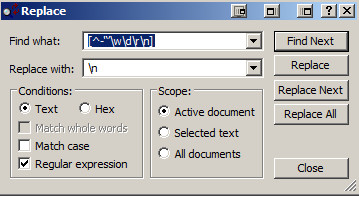
    Here’s what the search and replace box in Textpad looks like for this:
    Augmented Proofreading image001


    Notice that the “Regular expression” box is checked. And then you choose “Replace All”.

    The result is to turn this:

    Once upon a night we’ll wake to the carnival of life
    The beauty of this ride ahead such an incredible high
    It’s hard to light a candle, easy to curse the dark instead
    This moment the dawn of humanity
    The last ride of the day

    into this:

    Once
    upon
    a
    night
    we’ll
    wake
    to
    the
    carnival
    of
    life
    The
    beauty
    of
    this
    ride
    ahead
    such
    an
    incredible
    high
    It’s
    hard
    to
    light
    a
    candle

    easy
    to
    curse
    the
    dark
    instead
    This
    moment
    the
    dawn
    of
    humanity
    The
    last
    ride
    of
    the
    day


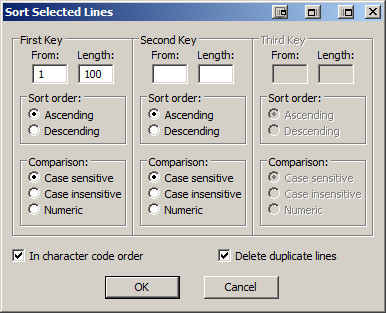
    For a book, this means what you have as a multi-thousand line long document and LOTS of repeated words. The next step is to lose the repetitions by sorting the list. For TextPad,  you’ll find Tools->Sort on the menu bar, and I generally set the sort up as the following:
    Augmented Proofreading image002

    This is a case-sensitive sort and “Delete duplicate lines”, of course, gets rid of all the duplications of words like “a”, “an”, and “the”.

    For the above text, you get:

    It’s
    Once
    The
    This
    a
    ahead
    an
    beauty
    candle
    carnival
    curse
    dark
    dawn
    day
    easy
    hard
    high
    humanity
    incredible
    instead
    last
    life
    light
    moment
    night
    of
    ride
    such
    the
    this
    to
    upon
    wake
    we’ll

    34 unique words.

    And here’s the payoff for all this funky text munging: Run a spelling checker over this, and it will find typos, of course, but it will also generally complain about most names, which aren’t generally kept in spelling checker dictionaries, and it will also show you words and their variants, nestled fairly closely together. Here’s an example from one of my projects:

    Swiss-born
    Take
    Talking
    Tallmadge
    Tallmadge’s
    Tarelton
    Tarleton
    Tarleton’s
    Tavern
    Tecumseh
    Tell
    Ten
    Thames

    The spelling checker landed on Tallmadge and its possessive form, but do you notice the “Tarelton” on the list? That’s the time for the Aha!, and you can fix the “Tarelton” form. The same thing applies to possessive variants and any other variant form you find.

    As with the last post, I’ll be peeking in on the comments and answering any questions that come up.

    Share
  • Indie Thoughts: Lessons from Heather Justesen

    From Heather Justesen, who writes clean romance.

    Two years ago I was working full-time for peanuts (seriously, it didn’t even cover the mortgage–and we didn’t live in a palace.) I quit to write full-time before I went completely insane. By December 2012 I had replaced my c-store income. By April 2013 I earned enough to pay ALL of our bills. Since then I’ve been the primary wage earner for our family, allowing my husband to close the business that was sucking all of the life out of him, and for us to move halfway across the country. He does bring in some money still, but even in my worst month we can pay all of the bills from my writing income. I’ve sold (real sales, not counting freebies) over 60K books in the past eighteen months. I’ve got audiobooks for most of my indie titles and I’m starting to see sales into bookstores. I would have to have one heck of an offer to even consider a traditional publisher’s contract. I’m very happy the way things are.

    * * * *

    Kevin, don’t lose hope. I have books that sell in the single digits every single month despite great reviews. And I have books in a different genre that sell really well every month (not blockbuster well, not top 100 well, but enough for us to get by on.) I didn’t do it with the first or second book, or the fourth book, I had nine books out before I started to make pay-the-bills money, and most of the money, even now that I have 18, comes from a single series. The others make very little [emphasis added]. Maybe give the genre a twist and try something a little different, but still in your general area of interest. Try a different genre that interests you, or just hang on and keep writing. Get feedback, learn more, and keep working at it. I wrote for nearly a decade before I had a book good enough to be in print (before Kindle really took off, or I had enough trust in myself to go it alone, so it was with a small press.) This is a craft, you can’t learn it overnight and success rarely comes overnight[emphasis added].

    Having three books out making six figures a month is crazy good, and definitely not the norm, and yeah those kinds of numbers can be discouraging, but a lot of the other stories here show that it can come. Most people who persevere eventually start to make decent money in indie publishing if they’re doing everything else right. Your covers are pretty good, so try changing up the descriptions and see if that helps. And keep writing.

    More on The Passive Voice.

    A series, lots of product, and an audience that has been under-served for years.

    Share
  • |

    The Little Secret that Propels So Many Blockbuster Plots

    I was invited to present a master class at the 2022 StoryMakers conference in Provo, Utah.

    We all want to develop plots that delight readers. Maybe we have ideas for the characters. Maybe we have ideas for the setting. Maybe we even have a couple of scenes.

    But a novel needs 40, 50, 60 or more scenes.

    How do you figure out what happens next, and do it in a way readers love?

    There’s one tool that can help.

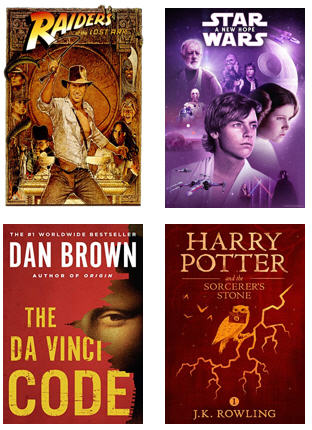
    Harry Potter, Lord of the Rings, and The Da Vinci Code all had it. So did Star Wars, Raider of the Lost Ark (1, 2, and 3), Taken, James Bond, The Wheel of Time, and thousands of other stories, TV episodes, and films.

    It’s what I call the wanted object, sometimes known as the MacGuffin.

    A good MacGuffin will not only make your plotting easier, it can also inject a wow factor into your story that readers love.

    In this session, the writers learned what a MacGuffin really is and how you can use it to propel the plot and keep readers turning the page.

    Here’s a PDF of the presentation.

    2022 john brown – the secret that propels so many blockbuster plots2

    And here’s the PDF of the handout.

    2022 john brown – the secret that propels so many blockbuster plots handout

    Enjoy!

    Share
  • “The Only Law of Literature” by James Maxey

    james-maxey

    You already know how I feel about writerly rules. So when I read James Maxey’s “The Only Law of Literature,” I had to share it.

    I want to quote the whole thing here. But I’ll resist and quote only the conclusion.

    [In response to critiquing stories that don’t work for you] All the literary analysis of writing techniques, of style, of world building, of creating characters–it all has it’s place, but it’s almost completely useless as a guide to writing a good book. You are never going to be able to think or study or analyze your way into writing a book that people love.

    There is only one law of good literature: Write what you’d love to read.

    Not what you have read and loved. What you love, but haven’t yet read.

    To quote myself from the Impish Idea thread:

    Every thing you write should be a love story. Not a romance. But a story written because you loved it.

    Follow your passion. Don’t worry about pleasing everyone. Fill your book with the stuff that makes your heart race and leave out the stuff that bores you. If you don’t make it into print, at least you’ll have a book you can look at with pride as being truly your own.

    Once you’ve learned this secret, everything else falls into place.

    Go read the whole post.

    It’s important to learn craft. You cannot get away from it. But craft is only useful as a tool to tell this cool, wonderful, poignant, amazing thing we’ve invented and discovered.

    Share

5 Comments

  1. That’s a great quote! I totally agree with thinking like a business and I’m looking forward to reading your posts about it.

    And well done on finishing another first draft! 😀

  2. Looking forward to this information – it looks to be helpful as I start various on-line businesses (web sites).

    And how about a new Progress Bar for the next step on Frank’s new story? (I know a guy who can help….)

  3. (grin)

    Yeah, I know that guy too. And it’s perfect timing. The 2 week manuscript rest ended today. Tomorrow I start the read-through.

  4. I like the quote.

    As someone who is an avid reader (I own all your books in Kindle format, and I was thrilled to see you on the Baen website), and is also self-employed – I’m in IT rather than being an author, I think this is good advice.

    Looking forward to getting the eArc of your new book, and then the finished version too. 🙂

    Mike

  5. eArc…

    Hum, Baen and I never talked about that. But that’s definitely something to explore. Thanks, Mike!

Comments are closed.