My wife and girls do not. Something about bruising and pain.
We could get pantywaist nerf guns. We do have some PVC marshmellow shooters. But a man wants something with a bit more kick.
I think I’ve found it. They’re called AirForce BlowGuns. Like PVC guns, you power them with your own breath. Unlike a lot of those guns, these seem to have some power.
The last few weeks I’ve been burning the candles at both ends with publication tasks. So no time for long reviews, but I still wanted to share.
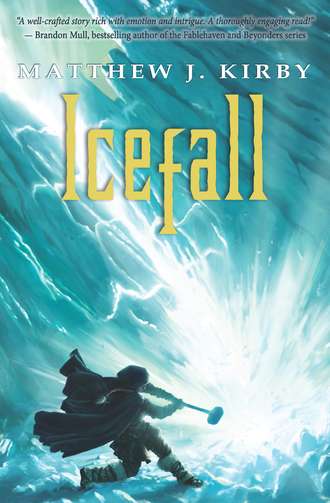
Icefall by Matthew Kirby
Wow. I loved this book. LOVED IT! It’s Norse historical fiction. A war is coming, and the king sends his children away to a remote fjord steading to keep them safe. He also sends a number of trusted warriors, a company of beserkers, a cook, a thrall, and a skald. But the fjord isn’t remote enough.
It’s a fine tale full suspense, wisdom, surprise, and two lovely character arcs. It’s told from the point-of-view of Solveig, the king’s plain daughter. And her voice and the details Kirby includes totally transported me to their world. A wonderful tale, wonderfully told.
Gravity
I don’t know if I like 3D very much, but Bullock and Clooney do a marvelous job. Do you remember Tom Hanks in the excellent Castaway where he’s marooned on a tiny island? This is Bullock’s Castaway, except the physics of space are deadly. A great film.
42
This film is about Jackie Robinson, the first Black man to play in the White leagues of American baseball, and recounts his first year. It stars Harrison Ford as the owner of the Brooklyn Dodgers, the guy who is determined to bring Blacks into the game he loves, as well as Chadwick Boseman who is new to me. I watched this with the whole family, and we were all enthralled. What a great story.
World War Z
I not a big zombie fan. So for me to recommend this means it had to be good. It was good. A delicious thriller with plenty of scare. I really liked the thriller feel to this. My wife and two youngest daughters sat on the couch holding each other’s hands. I sat in my La-Z-Boy throne heart pumping with the action.
Lynda.com
As I mentioned above, I’ve been working hard trying to get my books out the door. (Please, boys, just get out! It’s time for you to make your way in the world!) I’m using Adobe InDesign to format them for Kindle and EPUB, but I barely know the program. That caused some big problems. But then I subscribed to Lynda.com–a training website. I can’t tell you how happy I am that I did.
For $25 per month (and you can just subscribe for one month), you get access to hundreds of high-quality online classes recorded by experts. Each class is usually a few hours long, made up of videos that are usually each shorter than ten minutes. The site allows you to create playlists of various courses you want to take, makes recommendations, and lets you know which videos in a class you’ve watched. It also includes a verbatim transcript so you search for the part of the video that’s interesting to you.
The workhorse I’ve been using is “InDesign CS6 to EPUB, Kindle, and iPad” by Anne-Marie Concepcion. It’s 7.5 hours long. I’ve also been referring to parts of “InDesign CC Essential Training” by David Blatner and “Creating Long Documents with InDesign” by Mike Rankin. And I have 16 other courses in my playlist that I can’t wait to get to like “Designing a Book Cover” by Nigel French and others on graphic design, typography, and logos.
If you need training on some software product, go out to Lynda.com and see if they have a course for you.
It left me with this fine peace. With this feeling of goodness and light, in spite of, or probably because of, a number of poignant moments. It also surprised me.
To write a story like this, to give people this kind of gift…
What a wonderful, powerful thing.
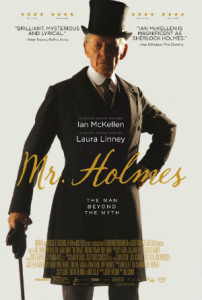
Now, it was not a thriller. It’s not an episode of Sherlock or Elementary. It’s not a murder mystery. It reminds me of Saving Mr. Banks most, but also of Miss Potter, maybe even The King’s English. It has that kind of tempo.
Basically, Sherlock Holmes is a much older man. He’s retired. And there’s a case he’s trying to solve. But, again, this isn’t a murder mystery. This story is about Sherlock himself and wisdom and the beauty of change whenever it occurs.
The story lingered with me, and I avoided reading or watching anything else for a few days to savor it. Give yourselves a treat. Watch this wonderful story.
Who are the brave men who tried to save the ambassador?
It was also a thrilling read in the tradition of Marcus Luttrell’s Lone Survivor. As such, it purposely avoids the political aspect of the incident. It’s not about what the officials of the United States government did, said, or knew, or the political firestorm that ensued.
It’s not a hit piece on Clinton and Obama, nor is it any kind of defense. Instead it simply documents the events on the ground in those last 13 hours, relying most heavily on what the five American security contractors who rushed to give aid said happened. Those men–two former Marines, two former SEALs, and a former Army Ranger—teamed up with Mitchell Zuckoff, the writer, to simply set the record straight.
I couldn’t put the book down. Not only because the book’s well-written and the characters and situation are compelling, but also because of the insight it shared into some key dynamics within Libya itself. For example, it helps you understand why the revolt against Muammar Gaddafi centered in Benghazi, not Tripoli. It also touches on some of the currents inside these Muslim-majority countries close to the epicenter of Sunni extremism—Egypt and Saudi Arabia–so volatile. And it shares details, large and small, as only those who experience such things first hand can.
If you want a fascinating account of really happened on the ground in Benghazi, get this book.
The Guardian just published a report of a survey taken of 34 American book publishers and found that 79% of staff are white and 78% female. Or as The Guardian put it “blindingly white and female” as if it’s some kind of horror show. The rest of the article bemoans the lack of diversity in publishing and our society in general and quotes the author of the study suggesting that these percentages should be monitored.
Is anyone up in arms about appropriate diversity percentages in the NBA or NFL?
Some might roll their eyes and ask me not to trot out that old chestnut. But it’s not a chestnut. It’s a point–nobody cares, me included. So why care about this? Many industries will be skewed toward one gender or race than another. As long as everyone has free opportunity to compete, who gives a flip?
Maybe that still doesn’t satisfy. Okay, how about this. According to Humanites Indicators, approximately 70% of degrees in English language and literature in America are awarded to…women. And about 82% are awarded to Whites. I’m assuming these percentages are probably pretty good indicators for the gender and race of folks interested in working at publishing companies.
If so, the survey results don’t reflect some white woman conspiracy at these publishing houses. They simply reflect the choices people make in college.
By the way, did you know the United States is still 72% White and European. So it’s not surprising to see roughly that many Whites in these jobs. The numbers might be a little high, but minorities seem to be pursuing other degrees in greater numbers (compare the overall percentages here versus those with ELL degrees).
This is not to say that we don’t want to welcome authors from all different background. We do. But if you want more men and more minorities, then maybe instead of monitoring publishers, you ought to start by seeing if you can attract more men and minorities to ELL degrees.
Or even better yet, how about reaching out to more boys and minorities at an earlier age and helping them learn the delights of reading and writing? Maybe if they like it, more of them will go into it as a career.
The best program I’ve seen for helping kids learn to love reading is the one Mary Leonhardt outlines in Keeping Kids Reading: How to Raise Avid Readers in the Video Age. It’s the culmination of the insights she gained over her thirty-five years teaching high school English and focusing on helping kids learn to LOVE reading. What an excellent book!
Oh, and one other idea. It might be effective to maybe just skip publishers altogether and help folks go directly to readers as indie writers. Amazon’s algorithms are pretty much race- and gender-blind.
The joy of music. Pure, unadulterated joy–this is what I recently stumbled across on YouTube.
I was watching the The Piano Guys and thought I saw something new from them. I clicked, but it wasn’t The Piano Guys. It was Simply Three doing a cover version of the popular “Wake Me Up” by Avicii.
For those unfamiliar with the term, a “cover” or “cover version” is a reworking, updating, or interpretation of an existing song. And this cover simply blew me away.
Simply Three is an electrifying trio made up of cellist Zack Clark, bassist Nicholas Villalobos, and violinist Glen McDaniel, although they have switched in other violinists, including Alex Weill and Olivia Lemmelin. But don’t let the instruments fool you–this isn’t some stuffy classical music gig. And it’s not muzak in the elevator. Not even close.
They are doing what Lindsey Stirling and The Piano Guys are doing: taking modern songs in wonderful new directions and, in the process, making these classical instruments cool again.
I went on to watch a number of their other covers, and then I had to purchase the songs because I simply had to be able to listen to their great beats and interpretations on the road.
Here’s their cover of “Wake Me Up.” The joy Zack Clark (the cellist) exhibits sells the whole thing for me.
Here is their cover of “Demons” by Imagine Dragons.
And finally their cover of “Counting Stars” by OneRepublic.
If you like them, you can get each of these on Amazon for less than a buck with these links:
Buying them not only supports the artists, but it lets them know there’s a demand for it and encourages them to make more. And I hope they make more.
***
By the way, “Counting Stars” has some interesting lyrics. Ryan Tedder, the songwriter, is a professed Christian. He grew up in a Charismatic household and graduated from Oral Roberts University.
However, you might look at some of the lyrics and think he’s given all that faith up.
I feel something so right
Doing the wrong thing
I feel something so wrong
Doing the right thing
I could lie, could lie, could lie
Everything that kills me makes me feel alive
But you need to look at the lyrics in context of the rest of the song and the artist’s statements about the song to see he’s singing about something totally different.
Some poets, and songwriters are poets (song is where poetry lives these days), think being obscure is cool. Tedder follows that more obscure approach in this song, which is unlike the immediate clarity he put into the lyrics of the fantastic “Halo,” performed by Beyonce, or his own OneRepublic’s “Apologize.”
Sometimes the artist writing gnomic lyrics doesn’t want to pin down a message for the listener—they think it’s cool for each person to make up their own message (I prefer clarity). Other times they do have a message, but they want the listener to work for it, and so they try to be subtle. Or sometimes they simply goof and don’t realize their lyrics are being so vague.
I have no idea which path Tedder was trying to take with these lyrics, but I do know that he’s made statements about the song. And these statements give us a guide.
In an interview with 5280, the Denver magazine (Denver is where Tedder lives) we get the first glimpse.
At 15, he began writing his own songs. “I obsessed over music and just loved it,” Tedder says. “But I never considered it as a career. Where I grew up you go to high school, you go to college, you find a wife in college, you get married, you have 2.3 kids, and if that hasn’t all happened by the time you’re 24, some people think there’s something wrong with you—or the assumption is that maybe you’re not into the opposite sex.”
But he couldn’t keep away.
Back in Oklahoma, at Oral Roberts University, the largest charismatic Christian university in the world, Tedder majored in public relations and advertising. At least that’s what his diploma says. Based on the time he put into sneaking into the Timko-Barton Performance Hall’s piano rooms, he probably could have been a double major. He spent hours on the piano and the guitar deconstructing his favorite albums—like Eric Clapton and B.B. King’s Riding with the King—figuring out the chords and then trying to write new songs using those same chords. He was skipping classes—even meals—to write songs.
No one knew. Not friends. Not his roommate. He sang in secret. He was in the school choir, but his friends always thought it was odd that a person who didn’t seem overly musically inclined would be taking a singing class. When he was in one of the piano rooms he would tape a piece of notebook paper over the small window in the door so that no one could see him.
Tedder says there were two reasons he hid his passion. The first was that he believed there were so many bad singers and bad songs in the world that he didn’t want to add to the noise. He wanted to be certain he would be successful before he revealed himself. The second reason was more deep-seated: Being raised in a religious home, Tedder had been taught that there was a purpose for his life, and that because God had ordained that purpose, he should live the life expected of him—one that was pious and humble. “Deciding you want to go into the music business is about the most narcissistic thing in the world,” Tedder says. “I had this constant battle—and to some degree I still do.”
So Tedder felt “wrong” about songwriting. But he eventually began to see it as his gift to share.
Billboard: Given “Counting Stars”‘ uplifting, faith-based message, it must be gratifying to be connecting with such a meaningful song.
Tedder: I think it’s our responsibility as a band, and what separates us from everyone else. I took that from being a fan of U2 for two decades now, since “Achtung Baby.” To this day, they might be the only band on that level who sings about things other than just boy-girl troubles or the kind of selfish, “I’m a badass” stuff. I’ve spoken with Bono about this when we toured with him, and he said the same thing. I felt a responsibility to actually write and sing about things that have a level of human gravity to them. If everybody else sings about sex and love and lust and money, then somebody’s gotta be singing about life and faith and hope and things of that nature.
So if “Counting Stars” isn’t about sex, lust, and money, what’s it about?
In another interview with Radio.com, he indicated that the whole counting stars bit was for anyone who loses sleep wondering how they’re going to be able to afford their rent or provide for their family. When he was first starting out, things were rough.
“A lot of time I just lay in bed awake, stressing out,” Tedder said. “Everybody does it. And I just thought, I can’t wait until I’m counting stars and not counting dollars anymore. Things will be so much better.”
To me, it’s clear that Tedder is singing about his story. And he’s singing for people like him who have a passion, but society says it’s not the practical thing to follow or dedicate your life to. Songwriting is what makes him feel alive. Furthermore, he had flashing signs indicating that if he sought, he would find—in other words, it was the thing God wanted him to do. And he just had to have hope, a four-letter word for those who are practical- and money-minded, and follow that passion.
We can argue the merits of that follow-your-passion message, but I think we’re all happy Tedder followed his.
***
And while we’re talking about the joy of music, how about this baritone saxophone and drum.
Smart Pop publishes smart, fresh, and engaging articles on the best of pop culture TV, books, and film, with a particular focus on science fiction and fantasy television and literature.
You want to hear what Scott Westerfield (Uglies, Pretties, etc.) has to say about Buffy? Go to Smart Pop.
What about Orson Card’s thoughts on Joss Whedon’s Firefly universe? Smart Pop.
What about the venerable Lawrence Block on Robert B. Parker’s Spenser series? Um, Smart Pop.
Strange. Do you see a pattern emerging?
Whether it’s Mad Men, House, Hunger Games, George Martin’s epic fantasies, Halo, True Blood, or Alias, Smart Pop gathers together New York Times bestselling authors, television writers, psychologists, philosophers, and others–folks who love of pop culture and have something worth sharing about it–and asks them to share their insights.
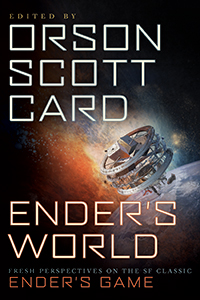
Recently, they’ve been putting together just such a collection on Ender’s Game. It’s called Ender’s World: Fresh Perspectives on the SF Classic Ender’s Game. It’s coming out February 2013. You can read more about it here.
I’m announcing this now because The Man was fortunate enough to be invited to contribute. I love Ender’s Game. LOVE IT. How cool is it that I get to write about it in an anthology edited by the folks at Smart Pop and Card himself? And then get to read what everyone else has to say, including military strategists Colonel Tom Ruby and Captain John Schmitt. As well as the little bits they’ll include on things like why the battle room is the shape it is and why they were recruiting kids.
But I’m also announcing this because in addition to the essays all we Ender-lovers get to write, Smart Pop is also going to include a series of Q&As with Scott Card, and they are currently soliciting the question from readers. FROM YOU. Right now.
From a writer’s pov, I have to tell you that the folks at Smart Pop have been nothing but enjoyable and insightful to work with. I’m looking forward to this book!
Have you ever gotten into the car to go to destination A and a few turns later realized you’re going to destination B and have to turn around?
If so, you’ve experienced the power of habit.
Have you ever told yourself you will NOT eat the cookies sitting out on the counter and two minutes later pick one up and eat it? Or perhaps it was the cigarette. Or the drink.
Habit.
Did you know that the genius behind the methods of Tony Dungy–the only coach in the NFL history to reach the play-offs ten years in a row and the one who turned a troubled Colts team around and three years later took them to win the Super Bowl in 2007–was to teach his players to be faster than everyone else. But they wouldn’t be faster because they would focus on increasing their physical speed. They would be faster because they would learn habits that would make their moves instinct. When his strategy worked, Dungy’s players could move with a speed that was impossible to overcome.
According to some research, more than 40% of the actions we perform each day are not actual decisions, but habits. And habits that we didn’t always consciously choose to start. We have sleeping habits, shopping habits, exercise habits, eating habits. Habits at work, at home, at school. Habits of the mind.
Companies have a huge interest in changing our shopping habits. Coaches have an interest in changing the habits we use when we play. Teachers have an interest in the habits of their classroom. Families and communities have habitual ways of interacting. We all have personal habits we’d like to adopt and others we’d like to give away. But unless you know what you’re doing, habits can be extremely intransigent and slippery things.
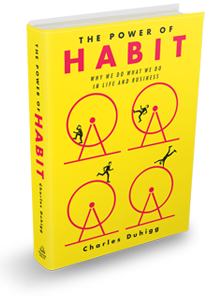
The good news is that a lot of research has been done in the last few decades, and we now know how habits work. When we arm ourselves with this knowledge, we’ll have a much better chance of changing. Luckily for us, we don’t have to track all that information down. In The Power of Habit: Why We Do What We Do In Life and Business, Charles Duhigg draws on hundreds of academic studies, interviews with more than three hundred scientists and executives, and research conducted at dozens of companies in his book and distills all this knowledge to its essence.
The title might sound boring, but Duhigg follows the style of Malcom Gladwell (Outliers, Blink, The Tipping Point), and the Heath brothers (Made to Stick), and has written a book that I couldn’t put down. For example, I couldn’t stop reading about coach Tony Dungy, or Target as it predicts who is pregnant and how far along they are, or the scientists who couldn’t figure out why Alcoholics Anonymous works, or how bad organizational habits led to thirty-one people being burned alive in London’s King’s Cross subway stop. I couldn’t stop reading about why Rosa Parks, not the first African American to refuse to give up her bus seat, could pivot the civil rights movement. I couldn’t stop reading the stories of individuals losing bad habits, others picking up good ones, and others who lost their minds but not their habits. Duhigg uses these and many other examples and studies to illustrate the key principles underlying how habits work. In the appendix, he gives us a guide for examining and forming our own habits.
I personally know the power of changing habits of the mind (which I’ve already written about). And teeth. A few years ago, I flossed once a week. It was such a pain. Now it’s a habit that I almost crave each night. I look back at how I made those changes and see it all laid out in Duhigg’s book. Can I actually change my habit of going to bed late? Stay tuned.
If you’re interested in forming the habits of a class, team, company, or family; if you want to change some of your own habits; if you’re interested in knowing why we do what we do and enjoy the style of Malcom Gladwell and Dan and Chip Heath, then I think you’ll love this book. Let me suggest you watch the video below. Then go to http://charlesduhigg.com/the-power-of-habit/ and click on the “Additional Resources” to watch and read more. Then just get the dang book.
2 Comments
Wow John, I wasn’t expecting much, but now I’m like, How many do I think I can talk my wife into letting me get?
I know. I think my family would have a total blast with these.

 The Guardian just published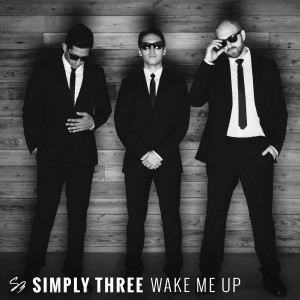
Wow John, I wasn’t expecting much, but now I’m like, How many do I think I can talk my wife into letting me get?
I know. I think my family would have a total blast with these.