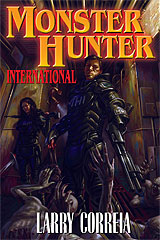
Monster Hunter International by Larry Correia

MonsterHunterInternational_LarryCorreiaThere’s a joke that all horror movies would be over in two minutes if you just made the hero smart and gave him a gun.

Well, Correia gives his likeable hero a gun, but not just any old thing. If you’re going to kill a vampire, why not use a rocket propelled grenade or a flame thrower? In fact, if there were enough monster outbreaks, you might have a government agency. You might also find that agency was willing to outsource some of the monster hunting to private contractors (ala Blackwater). And you can bet they won’t be hunting with pea shooters. They’ll be doing it right, with brains and firepower. Correia, someone who loves guns (used to own a gun shop and shoot competitively in rifle, shotgun, and pistol) and monsters, wrote a story that does just that.

The idea of Larry Correia’s Monster Hunter International might remind you a bit of X-Files or Men in Black, but it’s neither. However, it is as  good as or better than both. Correia tells the story of Owen Pitt, a big lug of an accountant, who, as he was working late one evening, gets called into the office of his boss. No big deal, right? Except the fat man is naked, transforming into a werewolf, and vows to eat Pitt’s heart. It’s not quite how you want to end your day tallying debits and credits. Pitt almost dies in the encounter, but manages to “live the American dream” and throw his incompetent jerk of a boss from the fourteenth-story window and splatter him on a double-parked Lincoln Navigator below.

Good work for a bean counter. When Pitt finally recovers, he gets an offer he can’t refuse (mostly because of the alluring agent that comes to recruit him), and he joins Monster Hunter International (MHI), the private contractor who sends out special force teams to use any means at their disposal to kill monsters. Unlucikly for Pitt, one of the baddest monsters around is just about to ruin the world forever, and Pitt finds himself in the middle of the fight.

Correia fills the book with enough action for any red-blooded male, a variety of bad mamba jamba monsters, and wonderful characters. There’s romance and heroism (I got a lump in my throat at one part toward the end), but his signature is his humor. I laughed again and again.

Part of that humor stems from the fact that Correia has an ear for good lines. Part stems from his delight in taking common tropes and stereotypes and twisting them. And this is another one of the things that I enjoyed immensely about the book. For example, the team of newbie hunters that Pitt joins is not made up of square-jawed males and females with Navy SEAL backgrounds, although some in the company do have that. Nope, Correia puts together an accountant, librarian, school teacher, and stripper (all people who faced some kind of monster and are ready for payback), and he makes them believable hunters. 

This tongue-in-cheek tweaking is everywhere. There are elves in this book unlike any you have ever seen. But he also makes it personal. Owen is not your typical accountant. Even a number of the minor characters get this treatment. For example, one of the people on the team is a Black guy with Rasta hair. But Correia doesn’t choose from what Correia calls one of the four Hollywood stereotypes. Nope, this guy plays against those types. He isn’t the comic relief, the gangsta, the sports dude, or scary male. He’s his own man, a shy virgin with a good heart. Correia also gives his characters interesting backstories. And one of the delights is discovering them.

I encountered a few minor flaws in the presentation, but these are easily overlooked. Easily. There’s also quite a bit of profanity (and so those who wish to avoid it are forewarned). However, when I turned the last page Friday night, I looked up at Larry who was lying on his bed in our La Quinta hotel room in Denver, his concealed .45 and 9mm guns on the floor beside him, and said, “Wow. WOW.” And then I think I said, “Dude, what a marvelous read” or maybe it was “Oh, great lord of zombie destruction tales do not smite me,” but I’m not sure because I was still thinking about the perfect last line of the perfect last scene of the last chapter.

Now, those exclamations of satisfaction and delight had nothing to do with the guns on the floor, that Larry’s a deadly shot, or that he’s a big 6’3″ Portugese. It has nothing to do with the fact that he and I were on a book tour together. I don’t read books that don’t grab me. End of story. I stopped doing that long ago. I don’t care who wrote them. And I don’t give false praise. False praise irks me to no end and does nobody any good, especially not the receiver. The truth is that Larry’s book was simply too good to put down. It pulled me in with the opening quote and kept delivering the goods until the end. And if you don’t believe me, you read the quote that both inspiried and opens the book and tell me you don’t want to turn the next page.

“You know what the difference between me and you really is? You look out there and see a horde of evil, brain-eating zombines. I look out there and see a target-rich environment.” ~Dillis D. Freeman Jr.

Yeah, it got ya, didn’t it. The ride is waiting folks. Just go on over to Amazon. Correia is going to be a writer to watch.

Share

Similar Posts

  • Two Jillian Workouts & Gottman’s Seven Marriage Principles

    Jillian Michaels is, in the words of my brother-in-law, “the woman who chases the fat people around.” And indeed, as one of the main trainers on the TV series Biggest Loser, she gets those folks moving. But I didn’t know anything about her or the show earlier this year when a friend recommended her 30-Day Shred DVD workout (thank you, Mr. Dayton).

    I’m a cave dweller. I sit in my little basement office and do my thing. And I have to make sure I get some type of exercise lest I turn into a great jelly. So I’m always on the lookout for a good workout. But it’s got to meet certain standards. I don’t want anything that’s Mickey Mouse. And I don’t want any froo-froo.

    So I asked this friend if these workouts featured a bunch of women dancing around in fruity outfits, because I can tell you right now, as open to new experiences as I am, I wasn’t going to buy a leotard and tip toe through the tulips with them. My friend assured me it was froo-froo free. And boy was he right.

    Jillian shows up with two other gals, gives you a two-minute warm up, and then proceeds to bust your hiney with three circuits of strength, aerobic calisthenics, and ab exercises. The strength exercises include things like push-ups and squats with dumbbell military presses or curls. The aerobic segments have you doing jumping jacks and jump rope. The ab portions run you through all manner of crunches and lower ab exercises. The three circuits take twenty minutes to complete. And there are three different levels of workouts on the DVD.

    I walk or hike three miles a day four days a week, and so I thought I was in reasonably okay condition. Jillian disabused me of that silly notion. I couldn’t keep up. Heck, the first dozen times through the workout I think I spent half the time either catching my breath or trying not to faint.

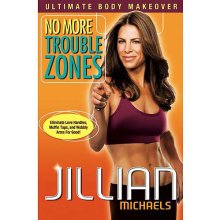
    But I kept with it and got stronger. And then I found Jillian’s No More Trouble Zones. This is a forty-minute workout. And I defy any of you he-men out there to try it and tell me you can keep up with this broad in this DVD. I still pant like a dog and have to take breaks when I do the workout. My only consolation is that Jillian and her two smiling evil pals work out with three-pound dumbbells while I work out with seven, fifteen, and twenty-five pounders.

    Like the shred workout, this forty-minute workout is comprised of circuits. But in the trouble zones workout there is no jumping about. It all double-whammy exercises that have you working both your upper and lower body at the same time or doing some killer ab maneuver. You’ll do pushups, squats, curls, a vicious plank circuit, and a dozen other exercises. You’ll work your triceps, biceps, shoulders, back, abs, and legs multiple times. This workout is no joke. 

    If you’re looking for an intense workout that doesn’t waste your time, I think you’ll enjoy either of these Jillian DVDs. All you need are a few dumbbells, a mat if you’re working on a hard surface, and prayer beads for those moments when you suspect you’re about to give up the ghost in a muscle-burning cardiac arrest.

    *

    Back in April of this year, Dr. Liz Hale, a licensed clinical psychologist, started her remarks to a local audience of more than 100 mental health professionals by saying, “Dear fellow colleagues, you are in danger of having an affair.”

    Her point was that every marriage, even those of the marriage gurus, is vulnerable to infidelity–be it sexual or emotional. Individuals have to actively curb all the subtle and often innocent beginnings that lead to unfaithfulness.

    “We make the mistake of thinking (marital) vows will keep us safe; and they don’t,” she said. She went on to say that couples cannot depend on love or similarities to keep their marriage intact. It’s not enough.

    Emotional or sexual infidelity isn’t as rare as we might think. But even if we don’t stray into some type of unfaithfulness, that doesn’t mean a marriage will stay together. Like anything worth having, a good relationship takes work.

    But what kind of work? What are the key principles for making a marriage last?

    For many years the prescriptions of marriage gurus were based on anecdotal evidence and rules of thumb—on opinion. Because the opinions weren’t tested, they led to all sorts of errors. For example, many yet believe that the road to marital bliss is through communication, specifically through successful conflict resolution. According to this idea, happy couples are those that have learned to resolve all their conflicts in a nice manner. The problem is that when conflict resolution was put to the test, the studies showed it didn’t work. Marriage therapies based on conflict resolution share a very low success rate—over the long haul they only work about 20% of the time.

    So what does work?

    John Gottman is a marriage counselor who took a different approach and started to collect rigorous scientific evidence on over 650 couples, tracking the fate of their marriages for up to fourteen years. The results of his work are startling.

    He uncovered a number of relationship myths, including the one about communication. He found that happy marriages were never perfect unions. These satisfied couples often had differences in temperament, interests, and family values. They argued over money, kids, and housekeeping, just like unhappy couples did. They had problems and faced issues. However, all these satisfied couples also practiced seven principles, even if they didn’t know it, which helped them navigate their way through all the difficulties and keep their marriages happy and stable.

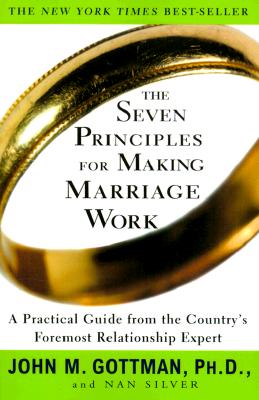
    And it’s not just opinion. The success rate for the type of marital therapy based on his research is 80%. He knows what makes marriages work and has written it up in a fabulous book called The Seven Principles For Making A Marriage Work.

    Every marriage is vulnerable to failure. It takes work to enjoy a satisfying relationship with a spouse. But it’s so much easier to improve and maintain a relationship when you’re working on the things that actually make a difference. If you want to improve your marriage, give Gottman’s book a read.

    Share
  • Navy SEALS Buds Class 234, Crackting the ACT, & Running the Green River

     Of the 1.4 million people in the armed forces, only 2,800 of them are Navy SEALS (acronym for “sea, air, and land”). That’s 1/5th of one percent. They are one of the most elite fighting forces in the world. However, less than 20% of those who attempt to become a SEAL ever succeed. To even try you must pass a physical screening test which requires you to swim 500 yards in ten minutes or less, perform seventy-nine push-ups in two minutes or less, and eleven pull-ups. You have to be able to run 1.5 miles in at least 10:20 minutes, and that’s while wearing boots and trousers.

    Some may think: well, that’s not too difficult. I could work up to that. However, the reality is that this level of physical fitness will not be enough. Because once you get into the initial training, you’re going to be doing far more than this every day.

    Can you knock out 500 push-ups in a day, along with a four mile run, hours of paddling out in a six-man raft into a ten foot wave that tumbles you again and again into chilling waters, hefting your share of a 160 pound log over your head until you can barely lift your arms, and running an obstacle course with obstacles three-stories high. You’ll do a lot of this while covered with sand, your thighs and armpits chafing. On some days you’ll have to swim a few miles in a cold sea. And then you’ve got to get up and do it all again the next day. No wimpy hour-long workouts on Monday, Wednesday, and Friday with rest days in between. Heck, on the third week, you’ll get only about four hours of sleep over four days.

    Can you do it?

    Maybe you can. But before you try, or assure yourself that you could have if you’d only had the chance, let me suggest you watch Discovery Channel’s Navy SEALS BUDS Class 234 to witness what it takes to become the best of the best. It’s a fascinating three-DVD set, just over five hours of programming, that follows class 234 through the initial six-month SEAL training called BUDS (basic underwater demolition/SEALS). You’ll see 114 men start the six-month course and only 17 finish it. In fact, less than thirty make it past the first three weeks, which include the most grueling and punishing training I’ve ever seen. Those initial weeks are designed specifically to weed out all but the most committed and able.

    The Discovery Channel does a great job with this six-part series. And it’s not just for guys. It only took about three minutes for each of my daughters to get hooked as well. And why wouldn’t they? It’s as fascinating as any American Idol or So You Think You Can Dance. In fact, in many ways it’s far more interesting. Heck, it was so good I think I’m going to watch it again. You can get it on Amazon, rent if from Netflix, or check it out from the Logan library.

    For more info on the SEALS, let me recommend you start with these two sites: http://www.seal.navy.mil/seal/ and http://en.wikipedia.org/wiki/United_States_Navy_SEALs

    *** 

    My high school age daughters took the ACT last year and got good scores. But we wanted to make sure that they had excellent scores. High enough to put them in the upper levels of those applying to their desired universities. But how would we prepare them?

    Back in the olden days when I was preparing to get my Masters of accounting degree, I knew I’d need some help to get a score on the GMAT that would be competitive. I looked at a number of study guides and ended up choosing the Princeton Review guide for the GMAT. I studied hard, got a great score, and became a believer. The guide made everything so easy. More importantly, everything the guide prepared me for was on the test. This is why, when I wanted to get a Masters of fine arts in creative writing, I used the Princeton Review for the GRE. Again, the study guide was easy to follow, and I got an equally good score on that test. Having had two great experiences, it’s no surprise I turned to Princeton Review again to help my two girls with their test. (BTW, some may see an attempt to get more than one graduate degree as smart, others as masochistic, and yet others as simple ivory tower bone-headery—I’ll let you decide which it might be in this case.)

    The Princeton Review guide for the ACT is called Cracking the ACT. A new edition is published every year and includes general ACT test-taking tips, everything you need to know in the specific content areas, and practice tests. It also includes access to the Princeton Review’s online resources which include another practice test. It’s a big guide (this year’s edition was 619 pages), but the size is deceptive. There’s plenty of white space for taking notes, and the text is written so clearly, and everything broken down in such an easy manner to follow, that you’ll start only to suddenly realize you’ve just read thirty pages. Besides, you don’t have to study it all. You can focus on specific content areas, if that’s all you want to do.

    This spring, both daughters worked through the book. We looked at their previous scores, identified areas for improvement, and set up a six-week schedule that required them to study about an hour per day, sometimes with help from Mom or Dad, but mostly on their own. One daughter studied hard, took the test in June, and improved her score by five points. The other daughter studied a little less diligently, took the same test, and improved her score by four points.

    When 36 is the highest possible score, such jumps become significant. However, they’re not the result of special DNA. While I tend to think my girls are everything and a bag of chips (especially when they give me back scratches), the truth is the ACT doesn’t test some mumbo-jumbo innate intelligence. It tests skills. Skills anyone can learn. What my girls supplied was consistent effort. All they needed was expert guidance in how to apply the effort. And Cracking the ACT provides boatloads of that.

    If you’re looking to improve your own score or help your children improve theirs, get this book. I have no doubt that anyone who supplies a bit of effort will be able see some nice results.

    ***

    Imagine emerald pools, steep red canyons, and a gentle breeze. Imagine water so clear you can see the plants and rocks sixteen feet down on the bottom. Imagine trout swimming only feet away. Imagine swimming with those trout and then getting back into your raft to ride some rapids. Imagine picnicking a the water’s edge or atop a flat, shaded rock forty feet up that gives you a grand view of the river. If you’re lucky, maybe you’ll see an osprey dive for a fish or watch a pair of river otters swim by. Imagine doing this with family or friends, all in a short twenty-four hour period.

    This experience is only about three hours away from Laketown, Utah. Well, everything except the swimming with the trout bit. The fish don’t really swim with you. They mostly just flee, but you get the idea. To enjoy it, all you need to do is raft the seven mile stretch of the Green River from the Flaming Gorge dam down to the Little Hole campground.

    My family and I just did this with some friends and had a grand time. Because the river is relatively slow and the rapids are relatively moderate and short, parents don’t have to worry every second that someone is going to fall in and drown in a man-eating surge. In fact, along many of the calm areas we actively helped the children into the sparkling cold water (grin), including one rafter who was only three years old. One of the most enjoyable moments was when we pulled the rafts up into the gentle backwash of a large rock in the middle of the river, climbed the rock, and took turns jumping into the current and letting it carry us downstream.

    The sun was shining, the weather warm. It was a wonderful trip. A total memory-maker. We put in just before noon and hauled the raft out just before 6 PM. But we could have taken much longer to play along the way.

    The experience was fairly cheap. It cost about $70 to rent an eight-man raft. Perfect for six people. But there are other smaller and larger raft sizes. You’ll need to arrange a way to get the raft to the river and back again. We simply tied our raft to the top of our minivan. You can pay the rental people to drive your car to the exit ramp at Little Hole after you put into the river, or bring two cars (or a bike) and drop one at the exit. Or you can pay for a shuttle service where they drive you to the River and pick you up.

    You’ll want to bring a small cooler with drinks, snacks, and sunscreen. You’ll also want to have good footwear. The river bed is rocky, and when you pull into shore, you don’t want to be ouching it the whole way in. I don’t recommend flip flops. They’re no better than bare feet. Old sneakers are fine, but they don’t dry quickly. And they waterlog and get heavy, which makes them less than ideal for swimming. Your best bet is to get real water shoes that are made to be light and drain quickly and yet still have a decent sole–a sandal or mesh covered shoe that uses Velcro to strap up. You can be fancy and spend a lot, or do what I did and get yours at Wal-Mart for less than ten bucks.  

    You could make it a long trip and drive to and from the gorge and run the river all in one day, but why push it? Just find a place to stay overnight. There are some motels in the area, but we elected to camp. The spots at the Firefighters Memorial campground were $27 per night. The campground was beautiful and tidy with restrooms and running water. One of the most surprising things about this particular campground was that I didn’t see one mosquito while I was there.

    I’m one of these types that attracts the villains. If there’s only one mosquito within a mile radius, it will smell me, pass up many other suitable victims (including my wife), and risk its life and limbs to sink its #@!* proboscis into my flesh. I think my blood must be some kind of mosquito crack. There’s probably some mosquito black market out there for it, run by some nasty mosquito cartel, which is led by a murderous, malaria-ridden mosquito boss making piles of evil mosquito money and spending it on opulent mosquito yachts and guns!

    Anyway, not one bite. We watched the sun set and then fell to sleep with the stars overhead and the wind gently soughing through the boughs of the pine trees.

    To make campsite reservations, go to www.utah.com to get a good map view of possible camping sites. Then go to www.recreation,gov to make the reservations online. Make sure your specific camping spot has everything you need. Our campground was very rocky and not all of the sites had tent pads. If you want to scope the lay of the land, the recreation.gov site will give you GPS coordinates of the campground. Enter those into Google maps then switch to satellite view and zoom in. You see exactly what you get. This way you can avoid accidently booking the site right next to the bathrooms or road or the one that features no trees.

    Finally, when you’re done, you might want to top it all off by stopping at the The Flaming Gorge Lodge restaurant, just a few miles south of the dam, and enjoying a monster-sized cup of hot chocolate with whipped cream and one of their fabulous desserts. The blackberry cobbler and ice cream was delicious.
    Share
  • Good Stuff! A Different Kind of Prom

    The first time I attended a high school prom in Rich County, I thought the Rich County people were from another planet.

    I was married. My wife Nellie had grown up in Rich County, and said that we had to go to her little brother’s prom.

    “Your brother’s prom?” I asked. Like, what?

    “Yes, my brother’s prom.”

    Weird, I thought. Because in the big city, older brothers and sisters who have graduated simply do not go to high school proms.

    But I’m always up for strange new experiences, and so we went.

    And I can report that it was indeed strange. In the big city, grandma and grandpa do not attend the prom, nor do mom and dad or little brothers and sisters. And they most assuredly do not sit in the stands and watch the junior class perform a dance.

    But that’s what they did in Rich County. And so I sat next to grandma and grandpa who were nigh unto eighty years old and watched an announcer present the junior class. There was a makeshift stage. And the announcer would announce the names of a young woman and a young man. On the stage, the young woman would take the arm of a young man, and then he would escort her out to the center of the floor to the applause of everyone in the gym. The couple would then perform a little action—he might twirl her, or she him, or she might jump in his arms, or he in hers, or she might lift her dress enough to show she was wearing cowboy boots that matched his, or dozens of other little creative things, and then they’d walk to the side to make room for the next couple.

    In Rich County, there are only forty or so kids in a class, so it didn’t take long. When the juniors were all announced, the whole junior class, in their tuxes and dresses, spread out and took their places on the floor. A song began to play, and then they performed a dance that had been choreographed specifically for the occasion.

    When it finished, the mother or father of each junior went out onto the floor and danced a slow dance with their son or daughter.

    They then presented the seniors in the same way, after which the parents of the seniors went out and danced with their sons and daughters.

    Only when that dance ended did the lights dim and the “normal” dancing begin. Nellie and I danced a few songs, and then she said it was time for us to get some refreshments and go.

    And that’s what we did, leaving the teens to their evening.

    I had never before seen anything like it. I laughed and wondered. Those funny hicks, I thought.

    I took a job in San Francisco for a few years, then another in Columbus, Ohio. And then, years after that hick prom, Nellie and I moved from the big city to Rich County. That was almost thirteen years ago.

    This last Friday I watched as my third daughter was announced and walked down from the makeshift stage. She was escorted by a young man, looking handsome in his tux. I watched him twirl her and another girl (he got to escort two). And when all the seniors had been presented, I got to dance with my girl at the prom.

    I cannot tell you how sweet that was to look in her eyes, to see my little girl grown up into this beautiful, strong woman. I thought about how she was soon going to leave us, and tears threatened to spring into this papa’s eyes, but she smiled and said, “Don’t you dare.”

    What’s a man to do? I obeyed. And instead of blubbering, we danced.

    When we finished, I gave her a hug and a kiss on the forehead and returned to the stands.

    I’ve danced six times with my girls at these Rich County proms—once when each was a junior and once when they were seniors. And I love this tradition.

    I love that a huge part of the community comes out to the dance. I love that we honor and applaud these great kids. I love watching the juniors in their gorgeous dresses and handsome tuxes perform these beautiful, formal dances that remind me of something you might find in Victorian England, something that seems to have stepped right out of Pride and Prejudice.

    DSCN5281
    Juniors performing dance
    DSCN5296
    Parents dancing with kids

    What an excellent evening.

    How lucky I am that places like Rich County exist, and that I get to live in one of them.

    Share
  • Good Stuff! Grandpa O’s Stories

    There are a boatload of characters that live in Rich County, Utah.

    One of them is Gary Ogilvie.

    If you were to see him at church or waiting in line for a raspberry shake at one of the fast food joints by Bear Lake, you’d just see a pleasant, mild-mannered gentleman.

    But Gary has quite the past.

    He’s been a police officer down on the Wasatch Front, a sheriff in Rich County, a Utah highway patrol officer, an internal affairs investigator for the Utah Department of Corrections, and an adult probation and parole supervisor. And a miner and many other things.

    And, boy, does he have some stories.

    Most with him wearing the badge, but others when he wasn’t wearing the badge. For example, Gary was himself hauled in by the cops when he was a teen.

    Gary wrote many of his stories down in a journal, and I had the privilege of reading them one day a year or two ago. They were fabulous. Some were funny, some shocking, some poignant.

    The good news for you is that Gary has recorded a number of them on YouTube. He did this for his  grandkids, but you and I get to benefit.

    If you enjoy real life cop stories, many with a humorous twist, and good-humored narrators, then you’re going to love listening to Grandpa O’s Stories over on YouTube.

    In fact, I don’t think you’ll be able to listen to just one.

    My bet is you’ll want to hear the next and the next.

    Share
  • Believe In Me, Cyber War

    A Man and a Team of Girls

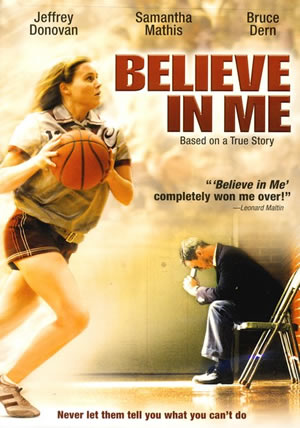
    Back in 1964, Jim Keith took a job at an Oklahoma high school to coach boy’s basketball.  But when he arrived, the administrators changed their minds and gave his job to someone else.  Keith’s contract didn’t specify which gender he’d coach, just that he’d coach.  So they switched him to the girls.  Keith was extremely disappointed.  Who wanted to coach girls when it was the boys who played real ball?  Especially when Keith was supposed to be head coach.  Keith tried to get the promised position back, except the girls he coached had other things in store for him.  Harold Keith, Jim’s brother, wrote a novel based on what happened.  That novel was made into a movie in 2006 called Believe In Me.  

    Now, we all know the plot line of sports movies: a losing underdog of a team rises up to win.  It’s predictable, right?  But we could say that of all crime shows as well—in this episode investigators discover a crime and figure out who did it!  Wow, what a shocker.  We could say it of all romantic comedies as well—in this movie a couple at odds gets together.  No way!  We could say it of lots of stories.  And yet we love these stories anyway.  Why?  

    Because the characters suck us in.  Because the story tellers do such a good job with the particular details we forget we’re watching a movie or reading a book.  We forget to think about the ending.  Furthermore, the stories are often about more than just winning games.  And so we worry about these people who have become real to us and focus on their immediate situation.  At least, that’s what happens when the story tellers do a good job.

    And Robert Collector, who both wrote and directed the film, did a great job with Believe In Me.  Now, I don’t know how accurate the film’s depiction of five-on-five play is; I believe the girl basketball teams of that era played six-on-six.  But that’s a niggling technical detail.  Besides, the movie isn’t about technique anyway.  It’s about a man and a group of country girls who have to face difficult obstacles, not so much on the court, but off it.  If you have girls or like sports at all, I think you’ll love this movie. 

    Cyber War

    I recently reviewed America The Vulnerable which explained how exposed we are as individuals, corporations, and a country to cyber crime, cyber espionage (both state and corporate), and cyber attacks.  Of all the cyber threats we face as individuals and a nation, the least likely is an all out cyber war.  But just because it’s less likely that doesn’t mean the threat isn’t real.  Especially since cyber warfare has been in use since the 1990’s.  We used cyber weapons openly in the gulf war in 2003, knocking out Iraqi air defenses.  Israel used them to own Syria’s air defenses when bombing their clandestine nuclear site in 2007.  Russia used them against Estonia in 2008 and Georgia in 2009 on a variety of targets, bringing many critical systems to a halt.  In 2010, somebody, most likely the US or Israel, developed the Stuxnet worm to sabotage the uranium enrichment facility at Natanz in Iran.  China has already conducted trial runs of cyber attacks on the US and has planted logic bombs and trap doors to activate in the future.

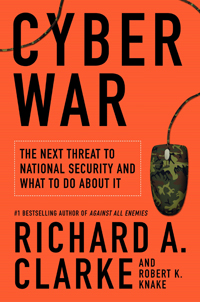
    In Cyber War, Richard Clarke shares his insights into what cyber war is, how cyber weapons work, and how vulnerable we are as a nation.  He discusses the cyber warriors (hackers) we now employ in the US military, and how a cyber war is like and unlike other wars.  In the second half of the book, he discusses the factors that have created our current vulnerability, how to set up a defense, and what we need to think about when conducting a cyber war. 

    And Clarke knows his stuff.  He worked for the State Department during the presidency of Ronald Reagan.  In 1992, President George H.W. Bush appointed him to chair the Counter-terrorism Security Group and to a seat on the United States National Security Council.  President Bill Clinton retained Clarke and in 1998 promoted him to be the national coordinator for security, infrastructure protection, and counterterrorism, the chief counterterrorism adviser on the National Security Council.  President George W. Bush kept him in the same position and later made him special adviser to the president on cyber security.    

    The thing I liked most about the book is that in addition to describing cool cyber war weapons, threats, and incidents, Clarke examines answers to many critical questions.  For example, how can we set up a defense without the government becoming a 1984 nightmare?  Would arms agreements work in cyber space?  (No.)  How do you prevent a cyber war from turning into a kinetic (guns and troops) war?  How do you attack your enemy when it’s sometimes hard to know who launched the attack in the first place?  He discusses these and many more questions.

    The book does have one fault.  Clarke has an obvious axe to grind with the Bush administration, and can’t help but make snide and irritating comments whenever he brings them up.  The good news is that those spots are few and far between.  If you want an excellent introduction into how cyber weapons are used and will likely be used in the future, you’ll want to read this book.

    Share
  • Some 101 for Congress and the President

    It’s not really rocket science.

    1. If you have loans outstanding and the payment is due, you owe the creditors a payment. Payables for Idiots 101.
    2. If you have received goods and services, then you owe your vendors a payment. Payables for Idiots 102.
    3. You pay your bills. End of story. That’s what grown ups do. If you have to float some debt for a few months, you do it. And you staple a note to your head to stop spending like a slot machine junkie. Payables for Idiots 103.

    The debts we have are for goods and services we’ve already received. So increase the debt limit and pay your damn bills. What about spending?

    1. You do not spend more than you take in year after year. If you do, that’s called running your business into the ground. In the case of the Congress (primarily Harry Reid’s Senate at this point, although many, but not all, of the Republicans were happy to go along with dumb spending earlier) and the President, it’s the country they’re running into the ground. Spending for Idiots 101.
    2. If you’ve got all sorts of cool things planned like Acorn subsidies for pimps and Antarctica Jell-O wrestling grants for scientists, but you can’t afford them—i.e. you have to go into debt to get them–you cancel those plans. Spending for Idiots 102.
    3. The problem is that Congress and the President buy all sorts of crap and expect to put it on a credit card when it comes due. And there’s nothing to prevent them from doing it.
    4. They’re like irresponsible teenagers. They need controls that won’t allow them to overspend. Kind of like putting limits on a teenager’s cell phone minutes. Or forcing them to use a debit card. When they’re out of cash, they get a card denied response from their vendors.
    5. So you set spending limits, debt limits, and force them to balance the budget each year, except in extreme emergencies like when space aliens try to wipe out humanity. Spending for Idiots 103.

    This means you pass Cut, Cap, and Balance and quit spending money you don’t have. Really difficult stuff. What about getting out of debt?

    1. You eat rice and beans until you’re debt is gone or down to a manageable level. That means you cancel crap you can’t pay for. Sorry earmarks, you’re gone. Sorry grants for nude artists in trees, you’re gone. Sorry subsidies for PBS, you’re gone.  Finances 200: How to Not Be A Money Moron.
    2. You figure out how to reduce your current cost structure. This means you figure out a way to reduce the costs of Medicare, Medicaid, Social Security, and every other service or product you provide, cutting those that aren’t essential. You hire someone like Mitt Romney who knows how to go through every line in a budget and turn a bloated ship around.  Finances 300: No, You Can’t Pay For Your Sister’s Hair Implants with My Money.
    3. You remind people this is the freaking U S of A. A place where a man or woman can make themselves. Not where the government changes your diapers and feeds you mush three times a day. Communism and socialism have failed. They were badly conceived utopias, much like multi-level soap and vitamin marketing schemes that are supposed to usher in the Second Coming.  Finances 400: The USA Buried the USSR for a Reason.
    4. You increase your revenues.
    5. However, if you raise taxes, you’re actually going to depress your revenues. Think about this. Which car company has bigger revenues–Lamborgini or Honda? Who is going to put out, if they’ve got Louie the Fingers and his buddy Jockstrap taking increasing amounts of their money in a protection racket? Don’t be a thug. Be an enabler.  Do what Wal-Mart does and go for volume.  Do what Ebay does–create the environment that entices tons of commerce, entices people to dramatically increase their transactions. Transactions go through the roof; you take only a tiny cut, and, shazam, you increase your revenues.  Finances 500: Um, Do You Want People to Work to Become Rich or Do You Want Them To Pick Up Torches and Burn the Houses of the Rich Down?

    Cut spending, reduce cost structure, and increase your revenues. That’s getting out of debt.

    Is this really that hard?

    EDIT: 8/1 Seems that “wacky” Ron Paul actually has a simple commonsense approach that doesn’t sound crazy. Why couldn’t we do this?

    Share