Moonlight, Lace and Mayhem interviews the Man
Carrie Hinkel-Gill at Moonlight, Lace and Mayhem has been interviewing me. It’s been thought-provoking and fun and is presented in four weekly installments. Check it out: http://mlmfantasy.blogspot.com/
Carrie Hinkel-Gill at Moonlight, Lace and Mayhem has been interviewing me. It’s been thought-provoking and fun and is presented in four weekly installments. Check it out: http://mlmfantasy.blogspot.com/
 A number of weeks ago life happened at my day job. I had just started a rewrite of the final battle of CURSE, but life put that on hold. Life got back to normal a few days ago. And a few days ago I began to work on that final battle sequence again. So you’ll notice that delivery targets have changed on the books page. I’m moving under a good head of steam now, and unless life happens again, we should meet those dates 🙂 More than anyone else, I want to get this book into your hands.
For those of you watching, I’m past the 65% point on Bad Penny. I’ve set the target at 90,000 words, but, of course, I don’t know if that’s exactly how long it will be. I have two big sequences left, one of which is the climax. My stats so far:
I’ve spent time thinking that I haven’t recorded–time on walks or driving. And time doing research. So this is understated, but it’s probably accurate enough. The good news is that I’m writing this draft slightly faster than I did the first draft of my last novel.
Now look at those numbers again. If I was doing this full time, it would have taken a week, maybe two do finish the pre-draft development. Then another two or three weeks to get to this point. Dang, how nice would that be! Once I finish, I’ll let it sit for a month. Then I’ll revise. Then I’ll give it to my expert beta readers. Then I’ll revise again and send it out for sale.
As for pen names, here’s what I selected out of a finalist list of about 200 names:
Which will it be?
National Geographic ran an article in the March issue titled “Wolf Wars.” It has a great interactive map. You’ll want to read the whole article, but I want you to look at something.
First, here’s a picture of a wolf in Yellowstone licking his or her chops over a recent elk kill. Looks real friendly, doesn’t it. Here, poochie, poochie, poochie.
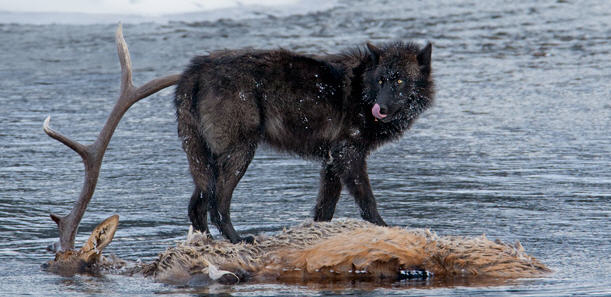
A few facts. Wolves can grow up to six feet long (tip of nose to tip of tail) and three feet tall. They weigh on average about 80 pounds but can be as heavy as 150-190 pounds. Wolves can reach 40 mph when chasing, but the use their stamina more than speed. Regardless of how they catch you, their jaws are strong enough to crush bones. You want more facts? Go to this wiki article on canis lupis. The point is that they are large, smart predators. At the top of the food chain. These aren’t little doggies. They’re killers. And they are mighty hard to socialize with humans (read the wiki article).
Of course, it can be done. Not far away in Heber City, Utah lives Doug and Lynne Seus (yes, that’s the name–gotta love it!) who train wild animals for movies. The company is called Rocky Mountain Wasatch Wildlife. I know you’ve seen one of their animal “actors,” Bart the bear, in many movies. The Seuses also happen to train wolves. A friend of mine grew up in Heber with the daughter of Doug and Lynne. She visits from time to time. Last summer she went down and saw the wolves. My friend was told that she had to carry any children she might bring.
Why?
Because the children are food. That’s why. And when she went out there, the wolves were tracking those children every minute with their eyes. Freaked her out. In fact, another friend got so freaked she took her kid back to the main house and didn’t come out again. Folks, these are wolves that work with humans ALL THE TIME.
I know the nature programs often make it seem like wolves are harmless, but they’re predators. Just like grizzlies, tigers, or crocodiles. Wolves are dangerous. A pack kills up to two elk a week. That’s a lot of eating. But they’re all up in Yellowstone, right?
Um, no.
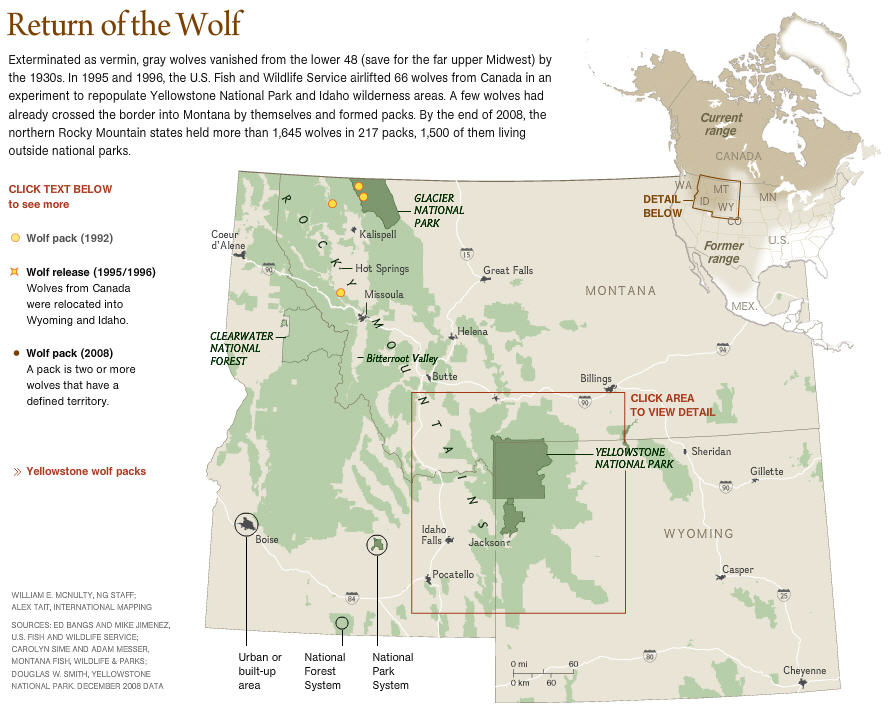
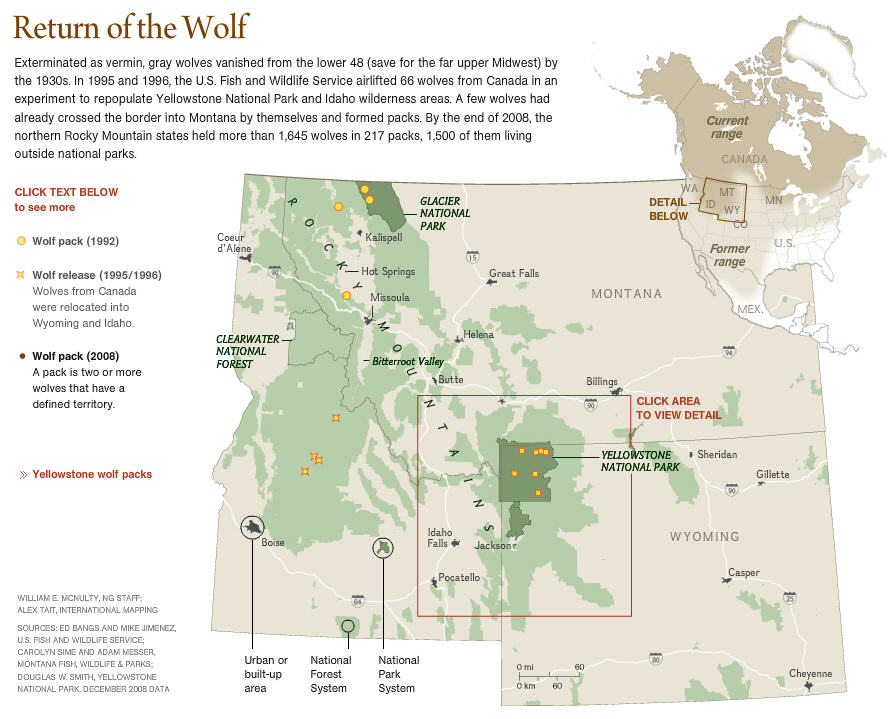

Holy schnitzel!
If you didn’t read it above, they’re estimating about 1,645 wolves in 217 packs. And that’s just the ones that have been officially documented. You know there are more out there that haven’t been seen. Look at the one all the way out by Casper, WY. Those bad boys can travel. In fact, the NG article says that wolves stake out a territory of about 200 to 500 square miles (a circle of that size has a radius of 8 to 13 miles). They travel on average (AVERAGE!) 60 miles from their pack when seeking a mate or new pack. Although one was recorded traveling 500 miles.
Okay, so given the maps and sightings above, how is the John Brown family doing down in Laketown?
The map below marks Laketown, UT with an A. I marked over that the packs shown in NG in red and others reported in pink. I also show orange rings 20 miles apart.
The “unofficial” sighting just inside the 80 mile ring was by my brother-in-law. The wolves were killing a bunch of his neighbor’s ewes he was taking care of. I didn’t say “eating” because they were killing far too many to eat. Wolves looked up at brother-in-law on four-wheeler. Assessed him. No whimpering, no cowering, no doggie wagging of tails. Just a frank assessment–human, danger or lunch? Said wolves sent a herd of the willies galloping up brother-in-law’s back. Freaked him out. He high-tailed it out of there and called the Feds who found that pack and killed them about fifteen miles away. But that sighting was before 2003. The sighting just outside the 100 mile mark was by some neighbors around 2007. The sighting down by Manila, UT was reported in a news report by KSL news in 2008, just two years ago.
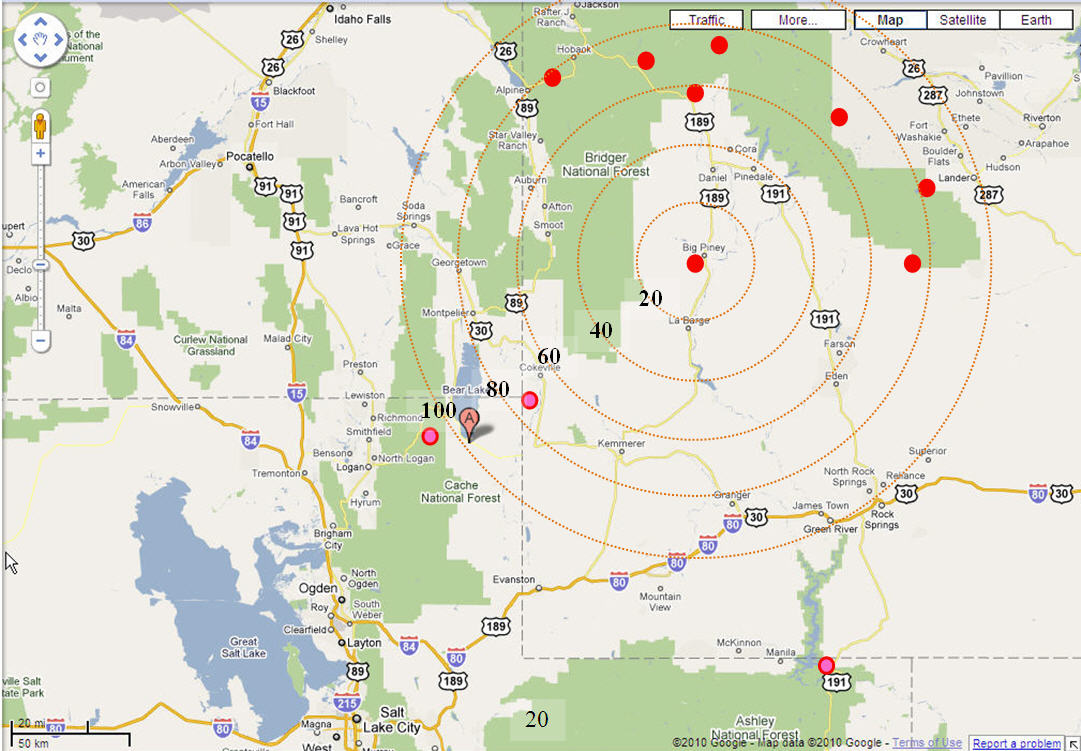
Okay, so I think it’s pretty safe to say that we probably have wolves in our backyard. And if we don’t, they’ll be here in a year or three.
Go read “Wolf Wars” in the the National Geographic. It’s free. Then tell me how you’d feel with a few packs in your backyard. Are you all warm and comfy? Here, little doggie . . .
So I’m thinking that when the girls or I go hiking, which we do all the time, we need to carry more than a walking stick. More than a paintball gun used to scare the deer out of our garden. I know that even with all the packs shown above, I haven’t heard about wolves attacking humans, but is it wise to assume they just freak out when they see humans and all run away–“that’s a eight-year-old human girl, she will make me wear the cone of shame. I do not like the cone of shame.”
Or will it be, “Hum, possible lunch over there, let’s check it out. Ooh, look at the fat one. I bet he’s tasty.”
What do you think?
I’ll be giving two presentations at LDStorymakers this year.
“Vivid and Clear” — Despite the often repeated 11th commandment for writers—show, don’t tell—writers NEVER show. They can’t. It’s all tell, tell, tell. The trick is to tell in a way that helps your readers imagine the situation (action, thought, dialogue, description, etc.) with such vividness and clarity it triggers an emotional response. In this hour we’ll explore a number of simple but powerful prose techniques that help you do just that.
“Story Turns” — Story turns–cliffhangers, rugpulls, plot twists, reversals, surprises, revelations (and more)–are a core part of an exciting plot, pacing control, and making a reader want to turn the page. In this workshop we’ll explore the main types of story turns and how they work so you can use them in your writing. (They’ve got me scheduled to give this one twice.)
More importantly, I get to attend some very interesting looking presentations from other writers when I’m not on stage. I had a blast last year.
Mette Harrison is the author of Mira, Mirror, The Princess and the Hound and The Princess and the Bear (Orson Scott Card simply loves her work.) So she’s a great writer, but she is also someone who does not blurb books if she doesn’t like them. Heck, she has a hard time doing PR for her OWN work. So I was so very happy to see this review of Servant of a Dark God.
John Brown’s book has all the great things about epic fantasy that I love. Full Review.
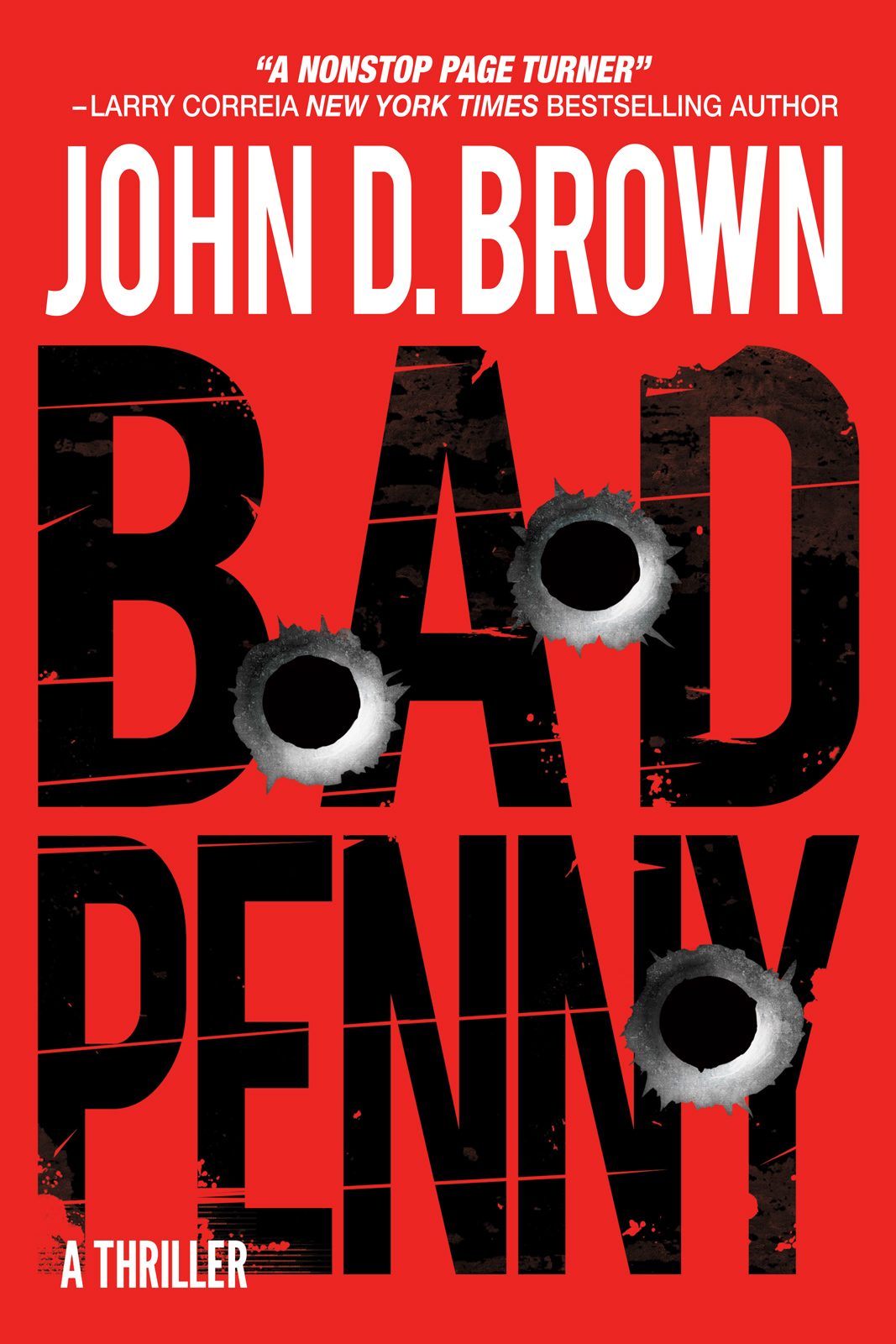 Boom, baby! Today is thriller day.
Frank’s an ex-con, trying to go straight. Then an old cell mate shows up and . . . let’s just say things go downhill from there. Throw in a Mormon, some drug lords, and a good helping of guns, and, man, was this book a blast to write!
You might be interested to know that this story was inspired by a fine old brother in my church in Ohio who was one of those salt-of-the-earth folks who also happened to have been at one time a bank robber.
When he got out of prison, he determined his life would change. He married a good Methodist girl he met at a church dance, went into the laundry business, and never looked back.
It was my privilege to record his life history. Not a single event or detail in the book is about him. But I can tell you that his story deserves a book. Hopefully, my character Frank ends up doing as well in life as he did.
The new release sale will run this week only. Same great prices as the last time. Get ’em now while they’re hot.
Bad Penny – Trade Paper (Amazon)
I’ve been working the last two weeks like a freaking elf from the North Pole trying to get these distribution channels set up, but the holidays seem to have stretched out the channel lead times.
So here’s what you do: email me right now (click on my face in the sidebar) and tell me which platform you’re interested in. When the book goes live on that platform (and that should be soon), I will set it at the new release price and email you with the news. It’s that easy.
See how good I am to you? (grin)
If you’re lying around on the 24th and don’t know what to do get the holiday spirit, please watch Merry Madagascar. It’s short, you’ll have a good time, and if you’re not already a King Julien fan, you will be.
Have an awesome Christmas!
Sincerely,
John
