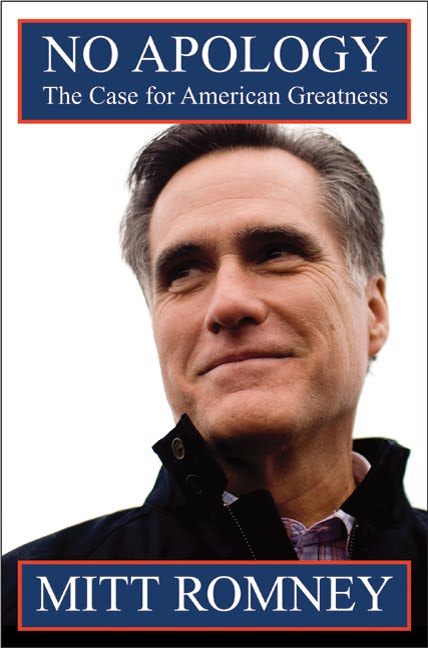
No Apology: Chapter 1 – The Pursuit of the Difficult

WE MUST FACE OUR CHALLENGES OR DIMINISH

Romney starts the chapter with a quote his dad used to recite to him: “the pursuit of the difficult makes men strong.” Romney states that over the years, he’s come to believe that this idea applies to more than individuals—it applies to businesses and nations as well.

He maintains that America has always faced great challenges. He cites a few examples from America’s history and states that there really hasn’t been a time when we were free of challenges. It seemed, after Reagan and Bush had presided over the fall of the Soviet Union, many thought “peace and prosperity were here to stay—without threat, without sacrifice.” Of course, that proved untrue.

America has faced great challenges in the past and faces huge challenges now. He believes we will “remain the leading nation in the world only if we face our challenges head on.” If we do not face and overcome them, we will become “the France—still a great country, but no longer the world’s leading nation.”

The question is: what’s so bad about that?

The answer is that some other nation or nations would fill the power vacuum. Romney poses the fundamental question: “what nation or nations would rise, and what would be the consequences for our safety, freedom, and prosperity?”

FOUR GLOBAL STRATEGIES FOR WORLD POWER

Romney suggests that there are a number of nations and groups who are “intent on replacing America as the world’s political, economic, and military leader.” He states that there are, in fact, “four major strategies currently being pursued to achieve world leadership.”

The first global strategy to achieve world power is the one represented by the United States. It is a strategy based on two fundamental principles: economic freedom and political freedom. Those nations that follow this strategy have become economic powerhouses and account for more than 60% of the world’s GDP. They are also the countries who have given humankind the most freedom.

The second global strategy is the one pursued by China. Its fundamental principles are free enterprise and authoritarian rule. He spends a couple of pages discussing how well Chinese enterprise is doing. Then he believes China is intent on becoming stronger than the United States.

The third main global strategy is the one pursued by Russia. It’s fundamental principles are authoritarian rule and controlling energy. “By controlling people and energy, Russia aims to reassert itself as a global superpower.” He then explains how this could be possible.

The fourth main strategy for global power is the one pursued by the violent jihadists, who count many foreign leaders in their numbers. Their strategy is based on conquest and compulsion through a variety of tactical means.

Of these four strategies in competition today only one is founded on freedom. Romney then suggests that we can be confident that our children and grandchildren will be free ONLY IF the economic and military strength of America and the West endure. He suggests that our superpower status is not inevitable. “Three other global strategies, each pursued by at least one state or major actor, are aggressively being pursued to surpass us, and in some cases, to suppress us. The proponents of each are convinced they will succeed. And world history offers us no encouragement.”

Because of this, he believes that “our primary objective as a nation must be to keep America strong. I am convinced that every policy, every political initiative, every new law or regulation should be evaluated in large measure by whether it makes us stronger or weaker” because “our freedom, security, and prosperity are at stake.”

OBAMA’S DRAMATIC SHIFT IN FOREIGN POLICY

Romney next maintains that president Obama has introduced a foreign policy that “is a rupture with some of the key assumptions that have undergirded more than six decades of American foreign policy.”

He states that when World War 2 ended, America executed a “dramatic and profoundly meaningful shift in our relationship with the rest of the world.” Previously we had guarded our own hemisphere and attempted to stay isolated from the affairs of Europe and Asia. But we found with WW1 and WW2 that “our vital interests could not be secure in the face of threats to the cause of freedom elsewhere. At the dawn of the nuclear age, a third world war was unthinkable; it would mean the destruction of humankind.” So the president and leaders of both parties “shifted America’s foreign policy. America took on the task of anticipating, containing, and eventually defeating threats to the progress of freedom in the belief that actively protecting others was the best way to protect ourselves.”

This new order had three main pillars:

1. “Active involvement and participation in world affairs”
2. “Active promotion of American and Western values including democracy, free enterprise, and human rights”
3. “A collective security umbrella for America and her allies”

He talks about how all the presidents, Democrat and Republican, followed this new strategy. But President Obama is engineering a dramatic shift away from it based on his own underlying attitudes.

Obama envisions an America that arbitrates disputes rather than advocate ideals. This is one of the reasons why he apologized to countries around the globe for American arrogance, trying to placate our enemies. This is also why it seems he has undercut many allies, including Israel, Poland, and Columbia. To be an arbitrator, you need to be equidistant from both sides. Not advocating for one or the other.

Another one of Obama’s assumptions is that “America is in a state of inevitable decline.” He, therefore, considers it futile to fight it; instead, it’s his job to help us manage our decline. Romney suggests Obama believes maintaining a dominant America is “a bad idea even if it were possible.”

Of course, Romney fundamentally disagrees with that assessment.

GETTING BACK ON TRACK

Romney suggests several things we can do to get back on track:

• Treat our allies like allies
• Strengthen the American economy
• Increase our defense spending
• Remind ourselves that the most attractive thing about us is our ideas—so we should “encourage democracy where we can, give aid and comfort to those who want it, and not undermine those who already have it”

Undergirding all of this, Romney suggests, “must be a certain conception of the goodness and greatness of America.” This “doesn’t mean America is a perfect country. We have made mistakes and committed grave offenses over the centuries.” But we should recognize that “No nation has shed more blood for more noble causes than the United States. Its beneficence and benevolence are unmatched by any nation on earth, and by any nation in history.”

Romney concludes by saying that he believes America is “destined to remain as it has been since the birth of the Republic—the brightest hope of the world” but only IF we face our challenges head on and work to keep America strong.

MY RANDOM COMMENTS

First, I don’t know if I’m going to have the time to capture each chapter in such detail. We’ll see.

Second, I found the discussion of the four strategies insightful. Particularly because it put in explained a number of questions I had about why Putin’s Russia does what it does. It also gave me insight into China, which I thought was still mostly economically socialistic.

I found the explanation of America’s shift in foreign policy in the 20th century interesting. As well as the shift Obama has made. I think I need to understand Obama better. Does he really think this? The actions and speeches Romney cites certainly are suggestive. Has anyone seen the movie 2016? It sounds similar.

It might appear the book will continue allocating space for attacking Obama, but I believe the six pages in this thirty-page chapter form probably the biggest appearance Obama makes in the book.

It’s clear that Romney’s business experience, especially as a consultant, has influenced how he sees things. The whole talk of strategy and challenges and competition reminds me of Michael Porter.

Porter is a Harvard professor and founder of Monitor, a strategy consulting firm that has been hired by corporations and countries. He is claimed to be the most cited author in business and economics. According to Wikipedia “He is generally recognized as the father of the modern strategy field, and his ideas are taught in virtually every business school in the world. His work has also re-defined thinking about competitiveness, economic development, economically distressed urban communities, environmental policy, and the role of corporations in society. . . his main academic objectives focus on how a firm or a region can build a competitive advantage and develop competitive strategy.”

The idea that America is competing with other nations is, of course, true. But I don’t think I’ve ever heard anyone running for president claim that their central goal, the goal any president should have, is to keep America strong because of the competitive threats we face. The talk is usually all focused on this issue or that without the broader picture I found here. I found Romney’s central tenet clarifying and refreshing. The rest of the book is going to be about how to keep our competitive advantages and strength.

Comments, observations, or issues from anyone who has read the chapter?

Share

Similar Posts

  • |

    All you need is a little beating and robbery

    Mrs. Brown, my wife, teaches language arts for the 7th and 8th grades as well as reading comprehension. She’s big on reading. She wants to provide every opportunity for kids to not only get good at it, but also learn to love it.

    And so her walls are lined with bookshelves full of awesome books teens love. She reads the first chapters of books to her classes to let them sample various stories. She features their book reports. She has them paste the covers of the books they’ve read on pages displayed around the classroom. And the school’s awesome librarian supports with her own programs.

    The 7th and 8th grade students at Rich Middle School are marinated in a big celebration of reading.

    In Mrs. Brown’s class, it’s fairly straight forward to get an A on reading, which is a huge part of your grade—all you’ve got to do is read.

    But how much reading do they need to do? How do you track it? And what books should they read?

    Check this out.

    First, she tests each student to see what his or her reading speed is.

    Next, she takes the number of hours they’re supposed to be reading each week for homework (I think it’s 2 or 2.5), then does the math to get a feasible reading word count for the trimester for each student. She may adjust it a bit, depending on the student’s ability.

    Third, she presents that number to the student, and the two of them set a word count goal for the trimester. Talk about an individualized goal.

    If you want to get an A in reading, all you have to do is reach that word count goal.

    How do you know how many words a book has?

    The Accelerated Reader program provides that information.

    But how does she know that they’ve read the books?

    She uses the Accelerated Reader tests. And if there isn’t one, the student can write a report.

    And what books do the students read?

    Any dang book they like.

    I love this. The kids get to select their own books and just read, read, read.

    Another part of this is that she pings each student once a week to ask them what book they’re reading, what page they’re on, and what they think of the book. This weekly check-in provides the more frequent accountability students of that age need.

    Yesterday, she received this report from one of her 8th grade boys who is reading Prey, the first book in The Drovers series.

    Oh, yeah.

    I’ll take that any day (grin).

    Rock on, budding reader.

    Share
  • |

    The book trade is a . . . trade

    James Dawson, YA author, feels it’s somehow wrong to hold back on cussing in his fiction. He wrote an article about this in the UK Guardian called “Why Teens in Books Can’t Swear.” He thinks it’s unrealistic. He thinks it’s about gate-keeper censorship. You know, parents wanting to steer their children towards certain experiences and away from others.  

    People.

    Dawson’s approach to the whole problem is wrong-headed. This isn’t about the virtues and vices of fiction. Or about gatekeepers, especially in today’s ebook world.  Or what experiences parents want to provide their children. And it’s not about art reflecting reality. Reality includes trips to the toilet, and yet we somehow fail to include realistic bum wiping in so many of our tales. Good heavens, have we betrayed our artistic integrity? No. We’ve just naturally chosen to include things that appeal to us and leave out others that don’t. Every book is an exercise in hundreds of such choices.

    The fact is that Dawson’s forgetting that a fundamental aspect of the book trade is the trade.  The buyer trades his or her money for a product (the book) that provides a service (the entertainment, thrills, chills, etc. of the reading experience) he or she values.  A customer preferring one kind of experience over another isn’t censorship (the horror, the horror).  It’s choice.  

    As an author, you make your offer. If folks like it, they buy it. If not, they don’t. Nobody owes you a purchase.

    This means that in any business, and selling fiction is a business, the most sensible way forward is to offer your intended buyers something they are likely to value.  Something they’re going to like.  Something they want.  If your buyer is thirsty and wants water, offer him a cold glass of water, not a waffle iron.  And if you can’t bear to develop anything but waffle irons, then, by all means, develop waffle irons.  Just make sure you offer them to the folks looking for . . . waffle irons. 

    This business of making offers also means that we package our products and services so that customers can easily tell what’s in the box. You don’t want someone to purchase your box thinking it contains breakfast cereal when in reality it’s a bunch of bolts.

    Yeah, writing is an art. But offering it in trade to others is also a basic economic act.

    Share
  • Presenting at the League’s Summer Symposium

    I’ll be presenting this Saturday, June 8, at the league’s summer writer symposium at USU. Here’s the description of my presentation.

    Make ‘Em Beg For More!
    How do you keep your readers begging for one more page? The answer is probably not what you think. Come to this session to learn the surprising secret—along with plenty of examples and how-tos. When you’re done, you’ll know exactly what you need to do to write stories that are devilishly hard for readers to put down.

    Check out the schedule below. Looks like there will be some great presentations. If you attend, please come and say hello.

    https://www.leagueofutahwriters.com/summersymposium

    Share
  • Good Stuff! Sergeant Nibley and Whole

    There are many good accounts of soldiers in World War 2, but I just finished one that is unlike any others I’ve read. It’s the delightful Sergeant Nibley PhD: Memories of an Unlikely Screaming Eagle by Hugh Nibley and Alex Nibley.

    It details the experiences of Hugh Nibley, the famous BYU scholar of ancient history, as a soldier in the war, starting from when Nibley was on his mission for The Church of Jesus Christ of Latter-day Saints and met Hitler coming out of a bathroom in Germany.

    This book made me laugh and wonder and sorrow. It includes insights, surprises, and anecdotes that I haven’t found anywhere else. The authors also include many pictures that help the whole thing come alive. If you like history or biographies or are a fan of Nibley’s works, I think you’ll love this book.

    *

    Some of the wonderful residents of Rich County, Utah where I live are not going to like this next one. But I have to share it because if what’s detailed in this next book is accurate, it could help so many.

    The book is Whole: Rethinking the Science of Nutrition by T. Colin Campbell who has been one on the forefront of nutrition research for over forty years.

    Campbell’s legacy, the China Study, is the most comprehensive study of health and nutrition ever conducted. He’s a renowned researcher at Cornell University. He has worked as a senior science adviser to the American Institute for Cancer Research, and sits on the advisory board of the Physicians Committee for Responsible Medicine.

    I share all that to simply suggest that he might have a little bit of expertise that’s worth listening to.

    Campbell grew up the son of a dairy farmer and went into the field of nutrition, believing animal protein, specifically dairy, could help solve nutrition problems in countries with starving populations.

    What he found shocked and surprised him. And at first, he didn’t believe it. But he and others ran study after study, and the science led to one conclusion: a diet high in animal products and processed foods increases the risk of many cancers, heart disease, diabetes, and a host of other maladies just as surely as tobacco increases the risk of lung cancer. What he found is that the healthiest populations ate a whole-food, plant-based diet.

    Now that goes against a lot of what we’ve been told. Milk is supposed to do a body good. And surely there’s nothing more healthy than lean cuts of meat. And aren’t there studies that prove this?

    In this book Campbell explains the science behind the evidence for what he and other scientists are seeing, the ways our current scientific paradigm ignores the fascinating complexity of the human body, and why, if we have such overwhelming evidence that everything we think we know about nutrition is wrong, our eating habits haven’t changed.

    I know this may seem like yet another whiplash science report. You know the kind—one report says red wine is bad for you and the other says red wine is good. But in this book, Campbell explains why we get such goofy and contradictory claims.

    If you or someone you love is dealing with heart disease, cancer, including breast cancer, obesity, or diabetes, you will want to hear him out. Whether what he has to say persuades you and what you will do about it, is up to you. But I think you’ll benefit from listening. If you’re interested in science, this book will give you surprising insights about its practice that you probably haven’t considered. Listening to Campbell has been eye-opening. I highly recommend this book. If, after hearing it, you want more information, I recommend his previous book called The China Study.

    Share
  • |

    Science Fiction and Fantasy beat Thrillers?!

    “More than 50% of all traditionally-published book sales of any format in the US now happen on Amazon.com.”

    That’s just amazing. But I found something even more amazing this week.

    Author Earnings released a report this week of their analysis of a million titles on Amazon. Data Guy, the tech guy behind the software gathering the information and crunching it, posted this graph in the comments.

    Do you see the amazing thing?

    AE-2016-06-genre-units

    Well of course you do, I gave it away in the title of the blog. Science fiction and fantasy sell MORE units than thrillers.

    More.

    What?!

    For, like, ever I thought SFF was a tiny portion of the market. Not so, my friends.


    Some may say, well, but this only represents Amazon. What about the channels traditional publishers sell through? Author Earnings explains a way to account for that in their report. Basically just double the size of the purple and red bars. If you do that I think thrillers might just edge SFF out. But it doesn’t dwarf it by any means.

    Furthermore, for an indie author, I don’t worry about those other channels because they’re not really a viable option for me. My world is selling online. And the online market for SFF is the SECOND BIGGEST MARKET after Queen Romance.

    Oh, BTW, next book in the queue is volume 1 of Lord of Bones. It’s going to start with something like this.

    The four men did not leave. Instead, they spread out just a bit in shallow semi-circle in front of Blaze.

    Four of them. One of him. There was definitely going to be blood.

    “You don’t want to do this,” Blaze said.

    The big one drew his sword and swung it a bit to loosen his shoulders.  “Oh, but we do. Because you’re not handing over the blackmeal. And we’re not leaving without it.”

    No, he was not going to hand that over. Couldn’t. Not if he valued the lives of his wife and boy.

    Two of the others drew their swords. The fourth brought his staff up and laid it on his shoulder in a two-handed grip.

    The big one would be the obvious target to take first. But Blaze knew that would be a mistake. The big one was there just to focus his attention. To fix Blaze in place. And then the silent one would slice him up the side.

    The man with the skinny face said, “Old man, the vultures will be picking your eyes out before lunch.”

    Blaze said, “Well, if you’re so determined, let’s not keep them waiting.” And then he rocked forward.

    I’ve not forgotten the Dark God series. I will finish it, but I need to get this smaller volume of Lord of Bones out.

    Share
  • Gun Runner submitted!

    Gun Runner, the action-packed, science fiction novel Larry Correia and I have been working on, has been delivered to Toni Weisskopf at Baen Books.

    It was a blast to write.

    This song was played, as was appropriate, in celebration.

    The seed came from Larry’s eleven-year-old son. When we sat down to develop an idea for a sci-fi con presentation a number of years ago, Larry asked: “Joe, what’s cool?”

    The answer: “Giant robots, bandits, and murderers.”

    We looked at each other and said, “That IS cool.”

    And thus was a story born.

    The current description Baen has goes like this.

    “Once, Jackson Rook was a war hero. Raised from boyhood to pilot an exosuit mech, he’d fought gallantly for the rebellion against the Collectivists. But that was a long time ago, on a world very far away.

    Now, Jackson Rook is a criminal, a smuggler on board the Multipurpose Supply Vehicle Tar Heel. His latest mission: steal a top-of-the-line mech called the Citadel and deliver it to the far-flung planet Swindle, a world so hostile even the air will kill you. The client: a man known only as the Warlord. Rook has been in the smuggling business long enough to know that it’s best to take the money and not ask questions. But Rook cannot stand by and watch as the Warlord runs roughshod over the citizens of Swindle, the way the Collectivists did on his homeworld. For all his mercenary ways, Rook is not a pirate. And deep within the smuggler, the heart of a warrior still beats.”

    The book should be available February, 2021.

    Share