Similar Posts
John guest posts about writing memorable fiction on ReidWrite
Luc Reid is the author of, among other things, Talk the Talk: The Slang of 65 American Subcultures. He is also the lizard king of Codex, which he started and of which I’m so happy to be a member. He’s always starting provocative threads on Codex, making us all think and reexamine the principles of story and the whole writing business. He recently posted some insights about what makes memorable stories. A lot of other fellow Codexians joined in the discussion. Happily, he asked me to share some of my thoughts on his site, ReidWrite. They begin as follows:
YOU’RE MINE, DEAR READER
Mwuhahaha.
Okay, maybe not. But you are wired to be mine. And you wouldn’t have it any other way.
Let’s back up. Luc wrote about writing memorable. I agree with the idea that the stories that produce a strong emotional reaction are the most memorable. In fact, I believe that triggering of emotion is THE reason why linear narrative that puts us into the trance has lasted so long in so many forms and makes so much money.
But can writers guide reader emotions? Or is it all just by accident?
Read the rest here: http://reidwrite.livejournal.com/8331.html.
BTW, when you’ve finished that, you might want to check out Luc’s new site, WillpowerEngine.com. It’s a place where he shares what he’s found in his research for his current book project, The Willpower Engine, on how self-motivation works. I think you’ll find a number of the posts there very interesting.
John guests on Writing Excuses season 3 episode 19
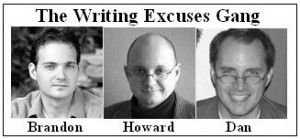
Here’s the third episode I recorded with the Writing Excuses guys.
In the first podcast we talked about putting and not putting ourselves in our writing and making characters who don’t all sound like the author. In the second, we talked about how to not repeat yourself as an author. In this one, I shared some basics about generating emotion in readers and dealing with negative emotions writers face when they encounter rejection, compare their career with others, hit writer’s block, or hear someone didn’t like their story.
As usual, the guys had some great insights. Check it out: Emotion in Fiction.
Is trying to improve your style a bad thing?
Ink and Quill by Stan Eales Another great podcast by the Writing Excuses team, this time on style and voice: http://www.writingexcuses.com/2008/10/06/writing-excuses-episode-35-voice-tone-and-style/
Quesion: is it dangerous as a writer to try to improve your style?
A lot of respected authors say it’s foolishness to focus on style. Because story is what people want. Story is the thing. Put all the lipstick you want on a pig, it’s never going to be anything but a pig.
I agree with them. Why fiddle with the words when the content oinks? If you have to focus on something, focus on delivering killer stories.
However, story content is not everything. There is a feeling that comes with how the story is written. You can serve prime rib on fine china in a $100 / plate restaurant, or you can serve it in a cardboard box out on the back lawn by the shed. Same beef, but not quite the same experience.
Orson Card is one of those who cautions against thinking about trying to improve your style. I want you to read this.
Question 5:
I would like to use the discussion in Lesson One as a springboard to my own inquiry. I understand that obsessively analyzing the style in which one writes can lead to bigger problems. However, my problem is not with an overall stylistic deficiency, but a very specific one. Through dialogue, the voices of the characters speak with one another. Are there any techniques you can offer which make the process of composing dialogue any easier? (I don’t expect a wonder formula, just some methods which would help me organize my thoughts a little better.)
— Submitted by Jennifer Dittrich
OSC Replies:
Composing Dialogue
The secret is not to think about dialogue as a separate task. You aren’t writing dialogue, you’re writing an encounter between characters. Part of the encounter is what they say, but part of it is how they react to each other, what they want from each other, what has happened between them in the past, who else is watching and the impression they want to make, and so on. When the characters speak, therefore, they aren’t “speaking dialogue,” they’re using words to do something to the other person — sometimes to try to get the other person to understand some information, but more often to get the other person to do something or feel something or reveal something. That’s what you concentrate on, and then come up with words you might use to accomplish that character’s purpose. Sometimes you’ll try many different opening lines as a conversation begins, and see where they go; sometimes you’ll erase long passages because they don’t feel right to you. But the solution to dialogue problems is rarely to “write better dialogue.” It’s almost always to clarify or change what the character wants or feels or thinks.
Most often, bad dialogue is bad because it’s “clunky.” The usual cause is that you’re trying to “write well,” and your idea of writing well comes from the horrible essays you were forced to write in high school and college. Forget all that! But don’t forget it just when you’re writing dialogue — that’s bad writing even in the essays and papers produced by those very same teachers! Good writing sounds like a person talking. Your narrative sections should be written in fluid language that can easily be read aloud. In other words, your narrative should sound like dialogue spoken by a good storyteller!
So if you worry about your writing style, especially your dialogue writing, chances are that the problem you have is that you are worrying about your writing style instead of worrying about what happens and why in the story! Bad style is almost invariably the result of trying for “good style,” because “good style” is invariably defined by writing teachers and the students who believe them as “writing like someone else who writes better than you.” But you can’t write like them, because you’re not them and their voice isn’t your voice. You can only write well when you write the way you talk, only more clearly and precisely. If you are laboriously constructing your sentences, searching in the thesaurus for “just the right word,” you are almost certainly writing unreadably; and, while you might only notice it in your dialogue, chances are you are writing badly all the time.
How do you cure this destructive habit? Let me give you a parallel example. When I was a child, I had a lyric boy-soprano voice, complete with vibrato. I sang high and sweetly, and that ability to sing was an important part of who I was. But when my voice changed, the “high” was gone and so was the sweet. Grimly determined to get my voice back, I forced a vibrato using very bad technique — a strained, rapid diaphragmatic vibrato rather than one that arises from a relaxed throat. It made my voice sound eccentric and unpleasant — and the tightness that resulted severely limited my range. I went through my college career with that voice, even though I knew it didn’t sound all that good, because I didn’t know how to do it better.
Then I went to Brazil as a missionary. Nobody there knew me as a performer. No one cared how I sang. I stripped away the old pretense and sang “straight,” with clear tone, no vibrato at all. I learned to relax my throat. I sounded like nothing; and then, to my surprise, a genuine, relaxed vibrato began to enter my voice on sustained notes. And my singing range increased, both higher and lower. When I came home, my singing voice was a far more versatile and powerful instrument than it had ever been before. During my forced-vibrato years, I couldn’t “do voices” — I could only sing the one way. Now I could take my relaxed voice and shape it to sound like an old man singing, or a child, or an untrained singer, or an operatic buffoon. I could sing conversationally; I could sing formally. I had my voice at last.
But I had to stop trying to force my voice and just relax, concentrating on the song and not the singer. Before I could sing well, I had to stop trying to sing well and concentrate on singing clearly, singing to the audience.
And if you don’t understand how this applies to writing style, I’m not a good enough writer to explain it to you any better.
You can read it on his site here: http://www.hatrack.com/writingclass/lessons/1998-08-14-5.shtml
Lots of great insights there. How many ways can you say, “Please, focus on the content of the story!”
But did you notice this line: ” Your narrative sections should be written in fluid language that can easily be read aloud. In other words, your narrative should sound like dialogue spoken by a good storyteller! ”
And this one: “You can only write well when you write the way you talk, only more clearly and precisely.”
Card is talking about improving your style to make it more clear and fluid and authentic to you. Even while warning this questioner as strongly as possible to avoid trying to improve your style, Card prescribes improving your style.
So style matters, even to Card. It just doesn’t matter nearly as much, in most cases, as content does. And I agree with him on his priorities.
However, I still think Card is throwing the baby out with the bath water. Maybe because he’s seen too many wretched stories that had great style. Nevertheless, there IS a way that each of us talks. We talk that way out of habit, but also because we like some of those turns of phrases. Because certain sounds, words, and rhythms appeal to us at some level. Because they feel right.
So what if you’re reading TC Boyle and love the rhythm of his prose? What if you figure out some of what drives that rhythm? What if you begin to use it in your writing? Is that bad?
Or what if you notice how David Farland always puts movement into descriptive passages? Or that you use “really” and “very” really a lot in very many places? What if you like how Dean Koontz stops to paint his characters? His use of metaphor to evoke an image of a person? What if you notice how some of Card’s prose works poetically?
What if your editor notices something you do that jars him so much it sets his teeth to rattling, and when he points it out you agree?
What if you pick up new stylistic elements and options and try them? Are you then going to write excrement?
No. You’re not. Because it’s natural to pick up words, phrases, manners of speaking. It’s natural to try them on. In fact, trying to AVOID this is what’s unnatural.
I used to work with a guy named Rick Jendro. He looks like a young Sylvester Stallone. One thing I loved about him was that he is a wonderful water cooler story teller. Rick used his hands and voice and face when telling his water cooler stories. He wasn’t Acting with a capital A, but he was acting. He was evoking the story. He reminded me of another friend, Jeff Cuthbert, who did the same thing.
I loved listening to both of them. LOVED IT. Partly because of this acting they did.
So I noticed what Rick was doing and Jeff had been doing. The next time I told a story I let myself be a bit more free with my hand motions and actions. I didn’t study movements or anything like that. Didn’t rehearse. I found they just came when I reminded myself to let them come. I tell a better story today than I did before because of this.
Was I wrong to delight in what they did and try it? I don’t think so. There’s nothing wrong with imitation. Good gravy, that’s how we learned language in the first place.
My advice, lowly writer that I am, is to read and imitate. Notice things. Notice every thing that sings. Every thing that clunks. From character to plot to punctuation to paragraphing to dialogue to whatever. Then try things on. Try on structures and plot twists and dilemmas. Try on paragraphing and poetical devices like simile and metaphor. Try on everything that strikes your fancy. Get a whole closet of outfits that feel wonderful on your bones.
And when you write, just write. Don’t worry about the style because all these new outfits you’ve got: the ones that feel most natural for the task at hand will present themselves to you when the time is right. I promise.
Plot Basics
In the comments to this week’s writing excuses on the 3 act structure, a writer asked if the try/fail cycle would really work with her chase story because her folks do not “fail to solve the problem” every time so much as “escape by the skin of their teeth”.
I thought this was a great question because we ARE often led to believe that the characters need to fail in each attempt. But if we look at a number of stories we’ll see that this isn’t the case. The hero is NOT always failing in his scene or sequence goal. In fact, much of the time he succeeds. So how does plot really work? Here’s my post.
[edited for clarity]
Jen, fwiw:
A few things finally opened up acts and plot to me. Maybe they’ll be helpful to you. I say this because a chase would work the same as anything else. I’ll just start at the beginning, although I’m sure you know a lot of this.
1) Story is about someone solving a problem. The problem is one of happiness (danger or lack on some level–physical, social, freedom, etc.) or mystery.
2) The reason why we tell stories about problems is because the solving of problems, if done a certain way, evokes suspense, surprise, and curiosity in the reader, and then a release of emotional tension. Why we humans like that ride, I don’t know. But we must keep this in mind when dealing with #1 because these effects are the main effects the bulk of people go to story for.
3) Plot is simply the actions the characters take, the results of their action, and what they decide to do next. Except this can’t be any old action and result. It has to be action and result that builds the anxiety of suspense, surprise, and the mystery or puzzle.
4) There are four possible answers to the question of “did the hero’s action solve the problem?”: yes, no, yes but, no furthermore.
For example. Yes, you killed the monster. No, you didn’t. Yes, you killed the monster, but it bit you and now you have the virus that’s going to turn YOU into a monster. No, you didn’t kill the monster furthermore you woke up its mumma.
Of those four possiblities, only the last two build suspense and curiosity. The first removes it totally. So it’s out. And a no answer leaves suspense unchanged. All you’re doing is delaying things with that. What you want to do is ratchet it up.
So if you want to build suspense then when a character takes an action, that action has to make things worse. They may escape by the skin of their teeth, but now the federal police know where they are (yes-but). Or not only did they not escape the police, but now the mafia, the real bad guys, know where they are (no-furthermore). These escalations and complications to the plot/problem continue until the hero’s plan is in total shambles and it appears he really is done for. That’s when they get one last shot at it.
If someone is trying to escape you don’t need a different plot structure. Their actions simply need to make it harder and harder and harder. Their plan needs to start to come apart. Things go wrong. Things they didn’t plan for make it worse. Someone double-crosses them or goes AWOL. We need to see them walking into dangers they didn’t plan for. If you go back and look at Prison Break season 1, you’ll see this all over the place in the last two episodes.
5) Acts are just a nifty way of breaking up the problem solving process into parts. In act 1 (the beginning), as stated, you introduce the problem and show that the character won’t or can’t walk away. Often a big reversal or reveal (a big yes-but or no-furthermore) marks the end of that act. But the key thing is that the hero MUST act. The stakes or too high or they simply can’t get away.
Now in act 2 (the middle) the hero says, aha, this is the real problem. Let’s try to solve it. Act 2 is a breeze to write IF you think about escalations and complications and nasty surprises–yes-buts and no-furthermores. He takes an intelligent action. BAM. It gets worse. And as these complications pile up we see that the hero comes to a point where his plans are in a shambles and the problem looks almost certain to squash him for good. In Star Wars, sure they saved the princess, but they led the empire to the secret base and the death star is going to blow them away (a grand yes-but).
In the last act, the hero straps on his guns and trys one more thing. Sometimes it helps to think of acts 1 and 2 as the hero reacting and act 3 as the hero finally getting the inititative, although it appears to be almost too late, and strapping on his guns. In Star Wars they do this. They’re running, running, running, and then they attack the death star. But the odds are slim. And they only have one little chance.
Remember: the odds are slim at this point and things get worse not because this is how problems are solved. Many get solved on the first try in real life. But because solving a problem in this way produces maximum suspense, surprise, and curiosity–the chief effects readers go to stories for. Any time you see a new plot structure or theory, you need to ask yourself what effect it has on the reader. If you can’t see any, junk it.
So you might have three acts, four, five, seven (all variations I’ve seen). It doesn’t matter. An act usually ends with a huge change in the nature of the problem. See Robert McKee’s STORY. But the number of acts isn’t the issue. It’s the effect on the reader. The acts are just means to an end. If we don’t keep the end in mind we’re likely to misuse the techniques.
6) The key for moving through the acts is to ask myself about actions, obstacles, and results. Here are some questions I’ve found productive.
Action. What are some intelligent actions the hero might take in this situation? What would I do? What are some logical steps that the reader might not think of?
Obstacles. What happens? What are some compelling obstacles the hero will face in this attempt? Are there points of conflict with himself, someone else on his side, the antagonist or his henchmen, someone in the background, with the setting? What does the antagonist do to foil the hero? What is a logical but maybe an unexpected and surprising obstacle to both the reader and hero? How does the hero’s plan begin to come apart?
Results. What happens? What are some possible results that pose a yes-but or no-furthermore? What would be unexpected, surprising to both the hero and the reader? How does the character’s action make it worse? How does the result reveal the problem is much worse than the hero and reader first thought? I’m thinking of complications and escalations–things that make the problem harder to solve or more important because more’s at stake.
In all of these, I choose the options that gives me the most zing and run with them. If they peter out, I try another (take 2, take 3, take 4), until I have one that works. Then I repeat it all over again and again until the hero is looking the gun in the face.
7) The “hero’s journey” is nothing more than a bunch of mystical names for common elements in this specific type of problem solving structure. Why does the hero have to leave home? Not because of some mystical archetype mumbo jumbo. No, because this forces them out into unfamiliar territory–adventure, risk. Things go wrong. The hero has to face the problem.
Why does the hero go to “the cave”? Again, not because of some mystical archetype mumbo jumbo. No, because turning and facing the monster, going onto ITS turf, poses the MOST RISK and hence most danger and hence most suspense for the reader.
Always keep the purpose of the story in mind. Suspense and curiosity DRIVE the structure of most stories. Yes, there are other effects we go to story for. But the reason stories are structured the way they are is because of those two reader effects. And all the rest of those Joseph Campbell terms are useless to writers unless they make the connection and see how they play into suspense and curiosity.
And even then I’ve found it’s wrong-headed to bind yourself to to a form just because. Or to think you need to slavishly follow it. The decision has to feel right for the story. It has to build anxiety and curiosity. And whatever does that well is right, regardless of whether it follows some formula. Although, I will say that certain story structures are used again and again because they deliver the goods to the reader better than other structures. Like biological evolution, they survive because of natural selection by readers.
So that ended up longer than I intended. Hopefully the ideas were as helpful to you as they were to me.
This writer’s question arises because of the common way of explaining the try/fail cycle sets us up to think there is only a no or no-furthermore option to each attempt by the hero. However, if we just look at a handful of stories, we’ll see the yes-but option is used all the time. What we want to avoid is the yes option, because that just stops the story. It stops the story because story is about solving a problem. And once the problem is solved, the story is over.
Other writers talk of formulas, however “pattern” has always been a more helpful way of looking at it than “formula.” I know, that’s semantic quibbling. But “formula” suggests to me THE way while “pattern” suggests to me something not so strict, something with some give to it and perhaps a great number of variations. Either way, pattern or formula, I found that unless I can understand the why of a part of the pattern, the effect it has on the reader’s experience, it’s not much use to me. It all comes down to plunging our hero into trouble or mystery, and then making the trouble or mystery worse SO THAT the reader feels increasing anxiety, curiosity, and surprise.
BTW, here’s a good explanation of the 3 act structure with some tips from Stephen J. Cannell, an old pro. I really like his tips on act 2 issues and complications. Because if we make the antagonist an active force, he or she will provide many wonderful yes-but and no-furthermore options.
You’ll find other excellent explanations of plot in TECHNIQUES OF THE SELLING WRITER by Dwight V. Swain, HOW TO WRITE BEST SELLING FICTION by Dean Koontz, and THE SECRETS OF ACTION SCREENWRITING by William C. Martell.
Some lessons from Tom Clancy’s first novel
 Tom Clancy is one of the biggest authors of our time. How did he break in? It’s an interesting story that Deborah Grosvenor, the editor who acquired The Hunt for Red October (Clancy’s first book), tells here.
And this early interview provides more insights.
So what conclusions can you draw from this? Here’s what I picked up.
1. Writing a good book is one thing. That book finding success is quite another.
2. Endorsements from the right people make a huge difference. More here in my blog Is Product Popularity Random?
3. Know what you write. And if you don’t know it, do the research. And then invent what you have to.
4. It’s not always a bad thing to start with a small press, especially if they’re going to put as much $$ into marketing and PR as this one did.
5. To finish your novel, you’re going to have to set aside time and get it done.
6. Finally, follow the zing. Clancy loved this stuff. Notice how his book was fed by the stories he heard and read.
Indie Thoughts: It’s a business
Complaining is not a business strategy ~ Jeff Bezos
I love that quote.
That doesn’t mean folks should never express dismay, fear, or frustration. It can sometimes be very helpful to voice it.
Name it.
Pin it to the wall.
And then move forward.
So Amazon changed how they approach paying authors with Kindle Unlimited (KU). I think the move is fantastic. It rewards value provided to the reader. If you’re in the business of selling value to the reader, that’s a no-brainer.
I also think this whole KU 2.0 thing illustrates why Author Earnings is so important.
It reminds us that we are NOT Amazon.
It reminds us that we are NOT the publishers.
It reminds us that we are NOT the agents.
We are a totally different group.
Amazon is simply a partner. A great partner right now, but they are NOT us.
Which means we’re responsible to make our own way. How do you do that? The only way I can imagine is to own the idea that you’re a business. And then think like a business.
How?
I haven’t run any better way than the lean startup approach. I’ll be sharing some posts over the next few weeks that explains just what that means.
Happy 4th of July! May God bless America and the disruptive freedom-loving form of government she introduced.