|

Literary reading rates on the rise

What great news!!!

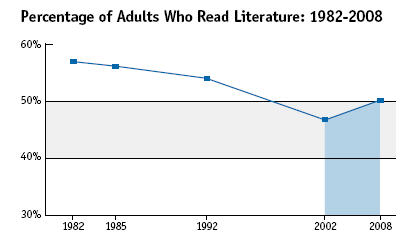
Washington, D.C. — For the first time in more than 25 years, American adults are reading more literature, according to a new study by the National Endowment for the Arts. Reading on the Rise documents a definitive increase in rates and numbers of American adults who read literature, with the biggest increases among young adults, ages 18-24. This new growth reverses two decades of downward trends cited previously in NEA reports such as Reading at Risk and To Read or Not To Read.

Adults up 3.5%, young adults (ages 18-24) up by 9%. Full article here. Full report here (with nifty graphs and tables).

They attribute it to reading programs. Perhaps. I’m sure JK Rowling phenomenon had something to do with it. Whatever the reason, it’s good to hear.

Share

Similar Posts

  • Indie Thoughts: Russell Blake’s Indie Author Myths

    This is from Russell Blake, a pseudonym for Craig Osso, a 52-year-old retired home developer who has sold close to 450,000 copies of the 25 books he published in the last 30 months. The man has made over a million bucks at this.

    1) Books Sell Themselves. No, sweetie, they don’t, at all, and never did. That’s why trad pubs spend massively on promotions. Because they know that visibility sells books, not invisible cosmic forces or author brilliance. It’s a highly competitive market with millions of choices, and it’s a retail market, and in retail, visibility is key. Which means constant promotion. Which most authors hate. But it’s reality, so get used to the idea. A companion to this aphorism is the next one…

    2) Just write the next one. Sure, if you want to have two undiscovered gems instead of one. Look, writing the next one’s important, but not if it’s used to justify not promoting the last one, which is often the case. You have to both market the last one AND write the next one. Sorry. You do.

    3) It’s all about luck. Well, perhaps some of it is. Maybe even much of it is. But so’s everything. You drive to the market, and 30 seconds after you pass the intersection some dumbass crashes into the car behind you. Luck. A hundred people start restaurants in town and two do well while the rest fail. Luck. A mugger attacks you after a movie. Luck. Sometimes good, sometimes bad. The book biz is no more or less random and chaotic than life, and yet some folks seem to consistently do better than others. I believe you need to work very hard, prepare, and be persistent, thereby creating some of your own luck. As an example, it’s possible you always wear your seat belt and the other driver didn’t today. In that case, bad luck becomes disastrous due to a simple lack of preparation. Or in the case of the restaurants, perhaps the ones that prospered had owners that worked 18 hour days and were talented chefs, and further, were savvy and inventive about getting people to try their cuisine. Preparation, persistence, hard work combine in that case to drag Lady Luck in their direction. With the mugger, maybe you have pepper spray or spent years on martial arts or have a concealed carry. Your preparation is the mugger’s bad luck.

    Luck may be a factor, but in my experience it’s only one factor, and that perspective of it all being all about luck breeds apathy.

    4) Do everything right and you’ll make it. Huh. If that were so, every book put out by big pubs would do well. The vast majority don’t. But that doesn’t mean you don’t have to do everything right, unless you want to worsen your already slim odds rather than improving them.

    . . . .

    10) Your muse cannot be forced to dance. Of course it can. If you were a writer on 24 or CSI or SNL you’d be expected to perform every week or you’d be out of a job. Most who work hard enough to get those gigs don’t want to lose ‘em, so they perform. Whether they feel like it or not. Whether they’re particularly inspired or not. The notion that you need to wait for your muse to decide to infuse you with story is fine if your books sell 10 million and you can afford to wait 4 or 5 years between each one. If that’s not you, you need to develop two things: a work ethic, and a system to inspire yourself.

    One technique I use is to ask myself how I can make this book, or this chapter, the best I’ve ever written. You get completely different answers depending upon what questions you ask yourself. “How can I consistently write 5K a day and enjoy it?” will get you a different answer than “How am I ever going to do this?” If you’re stuck, ask better questions.

    . . . .

    12) I’m too busy to read. Who’s got the time? This one kills me. How in the hell do you expect to be a good writer if you don’t read a lot of good books? Intuition? Divine guidance? Magic?

    . . . .

    1[6]) Write a good book and you will make decent money. Or write a lot of good books and you will make decent money. Would that it were so. Reality is that the overwhelming majority of good books, which is to say competently written-and-edited tomes, fail to sell much.

    . . . .

    My message is simple: working very hard and very smart can improve your terrible odds, but that’s all it can do. It’s not a magic pill, nor a recipe for success.

    . . . .

    I can tell you how to operate your writing and publishing company intelligently, but you need to recognize that most well-run publishing companies fail. Just as most well-run any-kind-of-companies fail. Most start-ups don’t last. They go belly up. Even those with the smartest people and shiniest wow products. That’s just how it works. Don’t start a company if you’re uncomfortable with that idea.

    . . . .

    I’m a big proponent of choosing a genre that can support you, which means one that’s popular, and sticking to it (with the caveat that if it doesn’t meet your expectations after a massive, concentrated effort, pay attention to the result you’re getting, and switch to something with better odds). I’m also big on publishing regularly, meaning every three or four months (more often if possible) if you intend to make this your living. I’m huge on pro editing and covers and proofreading. I consider your cover and your blurb essential to success. But those are the basics. Important basics, but still, building blocks.

    They will narrow your long odds because most authors simply don’t do what they should to make themselves successful. Understanding that is an advantage. It means you already know more than 90% of those who will publish on Amazon this year. If you do everything right, that will make you the 10% that has a chance.

    But still, it’s not a lock. By any stretch of the imagination. Get clear on that. In all businesses, this included, you can do everything absolutely, spectacularly right, and go nowhere. Because God hates you. Or because the world’s unfair. Or because you’re not good enough. Or were born under a dark star. Or didn’t get breast fed enough as a child. Pick your reason. It doesn’t matter what it is, as long as you recognize that in ALL industries, most businesses do not succeed.

    . . . .

    I wish I could tell you how to avoid being that person. I wish there were a formula. What I’ve come up with I share openly: Pick a genre you love and that’s large enough to support you, stick to it, write a lot of seriously good books, focus on improving your grasp of craft each time you sit down to write, make each book your best ever (meaning respect your reader above all else), package and quality control your books like the pros do, market intelligently, and spend massive amounts of time and energy working smarter than everyone else. And above all, be extremely realistic about everything. Some might say, cynical. I’d say pragmatic.

    . . . .

    Can you do this part time and make it? Sure you can. So can someone who starts any business part time. Just recognize that your odds of making it are lower than if you did it full time. Duh. Put in 80 hours a week, you might get better results than 10. Big surprise. Can you put in 10 or 20 and still do well? Sure. Again, anything’s possible. But you have to be unable to grasp basic business concepts if you think your odds will be the same. If they were, nobody would put in the 80. They’d all put in the 10, because their odds are identical.

    . . . .

    What’s my point? That self-publishing is both exciting in its possibilities and daunting in its requirements. And that very few businesses succeed, whether it’s a new shoe shop, or a convenience store, or a restaurant, or a software start-up…or a publishing company. But it’s more possible now to succeed than at any point in the past. I’m living proof.


    Link to the rest at Russell Blake’s Author Myths-1, Author Myths-2, and Author Myths -3.

    Blake has some of the most sensible advice I’ve read. If you want more, search for him over on KindleBoards.

    Share
  • |

    Do you want to meet authors and learn how to develop and write stories?

    Then you want to be in Provo, Utah this Thursday, Friday, and Saturday, February 11-13th, and attend Life, The Universe & Everything, the annual science fiction and fantasy writing conference. (I think students get in free.)

    If you live within a reasonable driving distance (I’m 2.5 hours away and consider that reasonable), then you should do everything you can to get down there. It’s going to be a blast. It and LDStorymakers are THE best conferences for writing that I know of in Utah, Nevada, Idaho, Wyoming, Colorado, and Arizona. And if you’re into SFF, then it’s the one. I mean, just check out the list of guests.

    I’ll be on the Role of Magic in Your Story and Distributing Your Novel panels. Look at the schedule and check out the guests who will be on those panels with me. Yeah. Awesome.

    And then I’ll be presenting Vivid and Clear by myself and Succeeding as a Writer with L.L. Muir, which is going to reveal some things that will surprise a lot of people.

    BTW, L.L. Muir is the best kept secret success story in Utah at the moment. She’s selling thousands of books, pleasing thousands of readers, and making, well, you’ll have to come to that presentation find out how much money she’s making. And what the secrets to her success are.

    Share
  • Is trying to improve your style a bad thing?

    By Stan Eales
    Ink and Quill by Stan Eales

    Another great podcast by the Writing Excuses team, this time on style and voice: http://www.writingexcuses.com/2008/10/06/writing-excuses-episode-35-voice-tone-and-style/

    Quesion: is it dangerous as a writer to try to improve your style?

    A lot of respected authors say it’s foolishness to focus on style. Because story is what people want. Story is the thing. Put all the lipstick you want on a pig, it’s never going to be anything but a pig.

    I agree with them. Why fiddle with the words when the content oinks? If you have to focus on something, focus on delivering killer stories.

    However, story content is not everything. There is a feeling that comes with how the story is written. You can serve prime rib on fine china in a $100 / plate restaurant, or you can serve it in a cardboard box out on the back lawn by the shed. Same beef, but not quite the same experience.

    Orson Card is one of those who cautions against thinking about trying to improve your style. I want you to read this.  

    Question 5:

    I would like to use the discussion in Lesson One as a springboard to my own inquiry. I understand that obsessively analyzing the style in which one writes can lead to bigger problems. However, my problem is not with an overall stylistic deficiency, but a very specific one. Through dialogue, the voices of the characters speak with one another. Are there any techniques you can offer which make the process of composing dialogue any easier? (I don’t expect a wonder formula, just some methods which would help me organize my thoughts a little better.)

    — Submitted by Jennifer Dittrich

    OSC Replies:

    Composing Dialogue

    The secret is not to think about dialogue as a separate task. You aren’t writing dialogue, you’re writing an encounter between characters. Part of the encounter is what they say, but part of it is how they react to each other, what they want from each other, what has happened between them in the past, who else is watching and the impression they want to make, and so on. When the characters speak, therefore, they aren’t “speaking dialogue,” they’re using words to do something to the other person — sometimes to try to get the other person to understand some information, but more often to get the other person to do something or feel something or reveal something. That’s what you concentrate on, and then come up with words you might use to accomplish that character’s purpose. Sometimes you’ll try many different opening lines as a conversation begins, and see where they go; sometimes you’ll erase long passages because they don’t feel right to you. But the solution to dialogue problems is rarely to “write better dialogue.” It’s almost always to clarify or change what the character wants or feels or thinks.

    Most often, bad dialogue is bad because it’s “clunky.” The usual cause is that you’re trying to “write well,” and your idea of writing well comes from the horrible essays you were forced to write in high school and college. Forget all that! But don’t forget it just when you’re writing dialogue — that’s bad writing even in the essays and papers produced by those very same teachers! Good writing sounds like a person talking. Your narrative sections should be written in fluid language that can easily be read aloud. In other words, your narrative should sound like dialogue spoken by a good storyteller!

    So if you worry about your writing style, especially your dialogue writing, chances are that the problem you have is that you are worrying about your writing style instead of worrying about what happens and why in the story! Bad style is almost invariably the result of trying for “good style,” because “good style” is invariably defined by writing teachers and the students who believe them as “writing like someone else who writes better than you.” But you can’t write like them, because you’re not them and their voice isn’t your voice. You can only write well when you write the way you talk, only more clearly and precisely. If you are laboriously constructing your sentences, searching in the thesaurus for “just the right word,” you are almost certainly writing unreadably; and, while you might only notice it in your dialogue, chances are you are writing badly all the time.

    How do you cure this destructive habit? Let me give you a parallel example. When I was a child, I had a lyric boy-soprano voice, complete with vibrato. I sang high and sweetly, and that ability to sing was an important part of who I was. But when my voice changed, the “high” was gone and so was the sweet. Grimly determined to get my voice back, I forced a vibrato using very bad technique — a strained, rapid diaphragmatic vibrato rather than one that arises from a relaxed throat. It made my voice sound eccentric and unpleasant — and the tightness that resulted severely limited my range. I went through my college career with that voice, even though I knew it didn’t sound all that good, because I didn’t know how to do it better.

    Then I went to Brazil as a missionary. Nobody there knew me as a performer. No one cared how I sang. I stripped away the old pretense and sang “straight,” with clear tone, no vibrato at all. I learned to relax my throat. I sounded like nothing; and then, to my surprise, a genuine, relaxed vibrato began to enter my voice on sustained notes. And my singing range increased, both higher and lower. When I came home, my singing voice was a far more versatile and powerful instrument than it had ever been before. During my forced-vibrato years, I couldn’t “do voices” — I could only sing the one way. Now I could take my relaxed voice and shape it to sound like an old man singing, or a child, or an untrained singer, or an operatic buffoon. I could sing conversationally; I could sing formally. I had my voice at last.

    But I had to stop trying to force my voice and just relax, concentrating on the song and not the singer. Before I could sing well, I had to stop trying to sing well and concentrate on singing clearly, singing to the audience.

    And if you don’t understand how this applies to writing style, I’m not a good enough writer to explain it to you any better.

    You can read it on his site here: http://www.hatrack.com/writingclass/lessons/1998-08-14-5.shtml

    Lots of great insights there. How many ways can you say, “Please, focus on the content of the story!”

    But did you notice this line: ” Your narrative sections should be written in fluid language that can easily be read aloud. In other words, your narrative should sound like dialogue spoken by a good storyteller! ”

    And this one: “You can only write well when you write the way you talk, only more clearly and precisely.”

    Card is talking about improving your style to make it more clear and fluid and authentic to you. Even while warning this questioner as strongly as possible to avoid trying to improve your style, Card prescribes improving your style.

    So style matters, even to Card. It just doesn’t matter nearly as much, in most cases, as content does. And I agree with him on his priorities.

    However, I still think Card is throwing the baby out with the bath water. Maybe because he’s seen too many wretched stories that had great style. Nevertheless, there IS a way that each of us talks. We talk that way out of habit, but also because we like some of those turns of phrases. Because certain sounds, words, and rhythms appeal to us at some level. Because they feel right.

    So what if you’re reading TC Boyle and love the rhythm of his prose? What if you figure out some of what drives that rhythm? What if you begin to use it in your writing? Is that bad?

    Or what if you notice how David Farland always puts movement into descriptive passages? Or that you use “really” and “very” really a lot in very many places? What if you like how Dean Koontz stops to paint his characters? His use of metaphor to evoke an image of a person? What if you notice how some of Card’s prose works poetically?

    What if your editor notices something you do that jars him so much it sets his teeth to rattling, and when he points it out you agree?

    What if you pick up new stylistic elements and options and try them? Are you then going to write excrement?

    No. You’re not. Because it’s natural to pick up words, phrases, manners of speaking. It’s natural to try them on. In fact, trying to AVOID this is what’s unnatural.

    I used to work with a guy named Rick Jendro. He looks like a young Sylvester Stallone. One thing I loved about him was that he is a wonderful water cooler story teller. Rick used his hands and voice and face when telling his water cooler stories. He wasn’t Acting with a capital A, but he was acting. He was evoking the story. He reminded me of another friend, Jeff Cuthbert, who did the same thing.

    I loved listening to both of them. LOVED IT. Partly because of this acting they did.

    So I noticed what Rick was doing and Jeff had been doing. The next time I told a story I let myself be a bit more free with my hand motions and actions. I didn’t study movements or anything like that. Didn’t rehearse. I found they just came when I reminded myself to let them come. I tell a better story today than I did before because of this.

    Was I wrong to delight in what they did and try it? I don’t think so. There’s nothing wrong with imitation. Good gravy, that’s how we learned language in the first place.

    My advice, lowly writer that I am, is to read and imitate. Notice things. Notice every thing that sings. Every thing that clunks. From character to plot to punctuation to paragraphing to dialogue to whatever. Then try things on. Try on structures and plot twists and dilemmas. Try on paragraphing and poetical devices like simile and metaphor. Try on everything that strikes your fancy. Get a whole closet of outfits that feel wonderful on your bones.

    And when you write, just write. Don’t worry about the style because all these new outfits you’ve got: the ones that feel most natural for the task at hand will present themselves to you when the time is right. I promise.

    Share
  • |

    What Separates the Gifted from the Schlubs and How Praise Can Backfire

    What makes someone gifted?

    Raw talent?

    Sure. An apptitutde for something always helps. But it appears it’s not enough. True expertise takes work. And those trying to help (i.e. parents, teachers, coaches) can hinder if they give the wrong kind of praise.

    I wanted to share three articles reporting the results of a number of interesing studies on expertise which often appears as a skill level that seems unobtainable by normal, motivated individuals.

    The Meadow Mount School of Music

    This music school in the Adirondacks has “trained such luminaries as Pinchas Zukerman, Itzhak Perlman, Joshua Bell, Lynn Harrell, and Yo-Yo Ma.” A number of researchers wanted to see what the difference was between the students who seemed most skilled and those who weren’t. They divided students “into three skill levels, including one the faculty had identified as having the best chance of becoming world-class soloists.” Then they looked at the differences.

    According to the report, “the results were clear-cut, with little room for any sort of inscrutable God-given talent. The elite musicians had simply practiced far more than the others…Psychologists found a second attribute in elite players that is less obvious than sheer hours of practice. While most of us think of practice as the repetition of tough spots (and this is how many young people do practice), elite musicians, they found, took a different approach.”  Read full article.

    The majority of childhood prodigies never fulfill their early promise

    Why? According to these researchers it’s because so many early-bloomers get warped by their experience and fail to develop perseverance. More here.

    Praise that Undermines Achievement

    It appears that how we praise achievement affects performance. Sometimes in large and startling ways.

    You may think that it’s good to praise your child for being “smart” or “good” in some subject. But there’s growing evidence that giving kids such labels doesn’t improve or motivate performance, but actually reduces it.

    Psychologist Carol Dweck and her team have studied the effect of praise on students in a variety of settings. “Repeating her experiments, Dweck found this effect of praise on performance held true for students of every socioeconomic class. It hit both boys and girls—the very brightest girls especially (they collapsed the most following failure). Even preschoolers weren’t immune to the inverse power of praise.” So what type of praise actually works? Read here.

    When does genius bloom?

    We often think genius must be tied to being precocity. After all, Motzart was doing musical flips when he was still a kid.  For writers, however, it appears this isn’t the case. More here.

    Share
  • How author Rachel Aaron wrote a novel in 12 days

    Well, not quite. It was 15.

    First read her essay “How I Went From Writing 2,000 Words a Day to 10,000 Words a Day”.  Now read about her 12 day triumph in “12 Days of Glory”.

    Amen on the pre-writing! I’d be lost without it. LOST. Sketching out scenes beforehand makes them SO MUCH EASIER to write. I can focus on the delivery, characters, dialogue, etc. instead of the events. It frees my creativity to focus on other things. Sketching out a novel beforehand does the same for the whole book. I have a simple sketch of the scene I’m going to write today. There’s no dithering about what to write. I KNOW what I need to write. So I do another more detailed sketch, the pre-writing for the scene before I jump into the day’s work. When I get the scene in my mind, the draft comes so much more quickly.

    Amen on time! I’ve found my mind is like a furnace: it takes time to get hot, and if I only dedicatetake small chunks of time, I’m forever warming it up. When I get 3-4 hours a day, I far more productive on a per hour basis than when I only get one.

    Amen on enthusiasm! There’s nothing worse than trying to write something that bores me. I can’t do it. And her little method for reviewing scenes is very similar to what I do.

    Great posts, Rachel! Now I just need to get back into my dedicated time groove.

    Share
  • The Key Conditions for Reader Suspense Part 1: Problem

    Sometimes it feels like there are a thousand things to remember when writing a story. New writers who make lists of these things soon begin to drown in them. But I’ve come to realize that many of these “rules” don’t matter.

    They don’t matter because many ignore the function of story. This makes it impossible to know how and when to apply them, or if they’re even something you should apply in the first place. Furthermore, a good number that do tie back to function often have little impact.

    In fact, the more I write, the more I believe the Pareto Principle applies to writing–a few vital factors make up most of the effect. The key is to focus on a limited number of fundamentals. To focus on these things that matter most. The things that produce the biggest bang for the buck.

    So what really matters when you’re writing a story?

    That all depends on what you’re trying to do. Form follows function.

    So what is the function, the objective?

    First of all, it’s something that happens in the reader. Readers buy stories because they provide a service, they do something to the reader, guide them into an experience. In this series, I take a look at what I think is one of the core elements of the story experience and identify the Pareto factors for delivering it to the reader.

    That story core, or at least a huge part of it, is suspense.

    Man goes out and turns on his sprinklers. They hiss to life. He scratches his bum, looks at the rising sun, goes back inside, and nothing more happens.

    You want to pay me money for that one? Want to make it into a movie? It’s a story.

    Yeah, it’s a story alright, you may say, but who cares?

    Okay, so maybe while he’s scratching his bum, a guy with a gun slips in the back. The intruder points the gun at the man’s daughter who is standing by the toaster buttering her bread. She’s a teenager, dressed in cutoffs and hiking boots. The intruder says, “Your father is going to be coming back through that door any time now. You’re going to call him into the kitchen. We’re going to have a chat. You two didn’t finish the business we talked about.”

    The girl only has a butter knife, but she grips it tighter, considers that only 13% of shots fired by cops in gunfights hit home. This was drilled into her by her firearms instructor. The guys who are trained only hit 13% of the time. It’s that low even though most gunfights start with the opponents standing only six feet away from each other–the distance between her and Gideon with his gun. That’s what happens when the adrenaline takes over. But Gideon doesn’t look like he’s full of adrenaline. He looks like a man going to a BBQ. So maybe he has a 40% chance with each bullet. That still gives her 60. 

    The front door opens. It distracts Gideon for just a moment. The barrel of his gun moves slightly to the left.

    It’s not a story yet, but it’s more interesting. And it’s more interesting because that second version generated something the first one never could. What it generated, dear Reader, was a little rise of hope, fear, and curiosity–a little suspense.

    After finishing draft 3 of CURSE OF A DARK GOD, I needed a break. So I reviewed my notes of DARK GOD’S GLORY, debriefed the many things I learned this last year about novels and story (and, oh boy, was it a year for learning), wrote up my “Ideal Novel” document, and then began to study structure and suspense. It’s been a wonderful and fruitful month.

    I think I’ve found some clarity and solidified a number of Pareto factors for suspense. Let me share my current thoughts on the subject. (Interestingly enough, the Writing Excuses guys just did a podcast on this subject: 5.4: Creating Suspense. You might want to check it out.)

    Because form follows function, let’s start with the end in mind.

    In the stories we love, the stories we stay up late at night for, the ones for which we pay $25.99 in hardback, the ones we willingly spend hours of our life on, those stories very frequently put the reader into a state of hoping and fearing for a character. This starts as curiosity and quickly moves to sympathy. Very often it builds to an edge-of-your-seat worry that continues up to the end of the novel. At that point the reader experiences a cathartic release.

    When we talk about suspense, this is what I believe we’re talking about. And a key thing to remember is that the tension we’re after is not something that’s in the text. It’s something the text builds IN the reader. So you may have massive explosions, deaths, chases, escapes, villains, and all the hordes of hell combine in your story, in the text, but that does not mean the story has dramatic tension. Because dramatic tension is a READER concept. You may have a relatively quite scene where a child is doing nothing more than swinging at a park, but because the reader knows the child molester has just arrived and the park is empty, the scene creates dramatic tension. The girl feels no tension. She’s just swinging away. But the reader’s tension goes through the roof. It’s all about what happens in the READER.

    So the question is what key factors of a story guide the reader into this dramatic tension?

    Well, we first need to understand what’s involved with this tension. What’s it made of? I came across a lovely *discussion of this last month in David Howard’s How to Build a Great Screenplay and have adapted it to my use. In emotional terms, we HOPE and FEAR for a character. “We don’t know what WILL happen, but we know [or suspect] what MIGHT happen, and therefore feel tension about those possibilities” (p52).

    Notice the key ideas:

    • Hope
    • Fear
    • Character
    • Uncertainty

    So what makes us hope or fear for someone? What makes us uncertain of an outcome?

    I see vital ingredients, key conditions in three of the four parts of story—problem, character, and plot. In this blog I’ll discuss the Pareto factors for suspense I see working in problem. In following posts, I’ll identify those I see in character and plot.

    The Nature of the Problem

    Form follows function, so what types of problems lead to us hoping and fearing for a character?

    When I look back at the stories I love that produce this effect in me, I see three main types of problems. I’ve talked about these before.

    Problem Type 1: Danger/Threat

    In this type of problem, there’s a danger or threat to some aspect of the character’s happiness that is significant enough that the READER can sympathize.

    With these problems we HOPE the character avoids or eliminates the danger, but we FEAR they may not. There are many aspects of happiness that might be threatened or in danger. I’ve listed below those that raise my FEAR and would raise my fear for someone else. I’ve stated them in first person, but you can think about them in third.

    1. Life

    In these situations my life is in danger or threatened.  People are out to kill me (HUNGER GAMES); I’m going to starve or freeze to death (“TO BUILD A FIRE”); there’s a shark in the water who would like a taste (JAWS).

    2. Security & well-being

    My security and physical well-being is in danger or threatened. These include all sorts of situations where bullies threaten me with violence or where I might be maimed in some way. Or I begin to lose some vital function—sight, hearing, speech, my ability to think, etc.

    3. Relationships

    In these situations my inclusion in a group is threatened. My love, friendship, relationship, feeling of belonging or of being valued are endangered. For example, I’m ostracized by a group, shunned, discriminated against. Or maybe my girlfriend begins to look at other men and I fear losing her, or my son and I become estranged and I fear losing him. This can even be a physical separation like in TAKEN (daughter kidnapped for the slave trade) or NOT WITHOUT MY DAUGHTER (daughter kidnapped by husband).

    4. Meaningfulness

    In these situations my sense of fulfillment of doing something worthwhile is in danger. I’m threatened with a life of drudgery. You can see this at work in the beginning of THE INCREDIBLES where Bob, Mr. Incredible, has to work in a deadening insurance office. But it might be someone whose future or ability to do things that are meaningful to them is being threatened. For example, a boy who desperately wants to play the piano has his piano and is forced to do something else.

    5. Freedom

    Anything threatening our freedom. It might be slavery or blackmail or government control or a number of other things.

    6. Ownership

    In these situations my ability to retain and use my possessions is threatened. Any time something precious is stolen from me, my happiness is affected.

    7. Other aspects?

    These are the main aspects of happiness I’ve identified that seem significant enough to raise fears. If you think you know another, please post a comment.

    Problem Type 2: Lack/Opportunity

    In this type of problem, a character has a lack of and opportunity for some aspect of happiness that is significant enough that the READER can sympathize. These are often about characters in some kind of hardship. The lacks, hardships, and opportunities all have to do with the same aspects of happiness as listed above. In these situations we HOPE the character is able to fill the lack; we HOPE they will be able to grasp this opportunity for happiness. But we also FEAR they will fail.

    If you think about love stories, these are all stories of lack/opportunity. She’s alone, without a lover, or a satisfying and loving relationship, and she meets someone. Suddenly, she has an opportunity for happiness. As readers we immediately began to hope she will find that relationship wonderfulness and fear she might not.

    In the movie OCTOBER SKY a young boy lives in a coal mining community. But it’s not his thing. He suddenly gets an opportunity at school to do something with science. This is his ticket to doing something meaningful. We HOPE he doesn’t miss it, but we FEAR he might.

    Problem Type 3: Mystery

    A character encounters a mystery that is significant enough that the READER can sympathize or feel curiosity about it.

    The first two types of problems center on happiness. They raise suspense and sympathy and worry in the reader. This last type of problem centers more on raising curiosity in the reader. We HOPE the character solves the mystery because we want to know the answer as well, but we FEAR they might not.

    Very often these types of problem are paired with some aspect of happiness. The vast majority of murder mysteries, cop stories, and courtroom dramas do this. In fact, many happiness problems are paired with mysteries and puzzles.

    Problems that are HARD to Solve

    Let’s go back up to the objective. We want to HOPE and FEAR for the character. We don’t know what WILL happen but suspect or know what MIGHT and we worry and feel tension about the possibilities. We want to worry, and we want that worry to build to a pitch. We then want to experience a cathartic release.

    How will we FEAR if the problem is so easy anybody could fix it? How will we WORRY if the lead has all the odds stacked in his or her favor?  How will we feel UNCERTAIN if we know exactly what’s going to occur?

    I can’t worry for Frodo, for example, if all he has to do is cast the naughty ring into the pit of doom that lies on the other side of his street. I can’t worry about a guy finding a girl to love and who will love him, and have that worry build to a sharp edge-of-your-seat point, if all he has to do is proclaim his feelings and the girl immediately rushes to him forever.

    The facts are that we won’t feel fear, worry, or uncertainty unless the problem is HARD to solve. I’ll discuss the Pareto factors for making problems hard when I talk about plot.

    Problem Intensifiers

    Besides being hard, problems need to be urgent. I’ve identified four factors that seem to intensify the nature of the problem: probability, immediacy, significance, and specificity.

    1. Probable

    It’s one thing to face the one-in-a-gazillion chance that I might be trampled by a herd of elephants when I walk out of the door. It’s quite another to know that the last seven people who walked out of the door were killed by the madman with the AK-47 sitting at the end of the hall.

    The higher the probability of the threat or loss of opportunity, the more intense the problem becomes because it’s more likely I’ll lose. No probability and I have nothing to FEAR.

    2. Immediate

    It’s one thing to know an asteroid will hit the earth and kill us all in 7,000 years. It’s quite another to know it will hit in three days.

    The more immediate the problem, the less likely I’ll be able to solve it. The less likely my chances are, the more I’ll WORRY. Give us 2,000 years, and I’m sure we’ll figure out the asteroid thing. Give us three days, and that’s probably cutting it too close. This is why setting up a time limit, a ticking clock or ticking time-bomb, can ratchet up the audience’s tension.  Of course, it has to be a short time limit. You can’t start the bomb ticking, and give the lead 45 years to disarm it.

    3. Significant

    We talked about this before. It’s one thing to face the kidnapping of my pet spider. It’s quite another to face the kidnapping of my child. Significance increases when more is put at risk.

    The more significant the threat or opportunity, the more invested I become. The more I FEAR to lose.

    4. Specific

    It’s one thing to say that something bad is going to happen. It’s quite another to know that kidnappers are going to cut your finger off with a pair of wire dikes. It’s one thing to have someone say something good will happen (Chinese fortune cookie) and quite another to say your uncle just died and left you a million dollars, but you have to fight your three cousins for it.

    The more specific the problem, the easier it is for us to see the specific possibilities and react to them with HOPE and FEAR. Generalities don’t trigger emotions.  Striking snakes do, though. As do garbage disposals that are turned on just when you reach in to get the baby’s pacifier.

    Another part of this is to make the threat specific to the hero. It’s one thing to say a lot of people in the United States or Russia or India are going to die. It’s another to say the hero will lose his own child or wife in the event. In fact, the loss of one child can make the problem more intense that the loss of thousands.

    This is not to say you can’t write about threats to large groups of people. That’s one of the ways to broaden the scope of the problem and make it more significant. It’s just that problems become more intense the closer they comes to home. Things that threaten us personally, or those we love, raise more fears than those that threaten people we don’t know. A flood raging in the next county is different than the one coming down our street. So in story, the more personal you make the threat to the person we’ve invested in, the more intense the threat will be.

    Uncertainty

    Supporting all of this hope, fear, and worry is the fact that the reader is uncertain of the outcome. The character must have a chance to solve the problem up until the end, but for no extended period of time can it look like winning or losing is assured, because the moment the reader can predict the ending and the major turns along the way, that’s the moment they will lose interest.

    Think about this. It’s the first quarter of a football game, and the score is 64 to 0. Anybody sticking around for that one to play out?

    No, you can predict the ending. Why watch? Predictability kills hope, fear, and worry. It kills interest.

    So how do we make sure the reader is uncertain of the outcome?

    First, as stated before, we make the problem hard to solve. We’ll get into more specifics during the post on plot, but we make the problem harder to solve by giving our characters limitations, putting them into ongoing and continuing troubles, and making them face conflict with their own competing desires, other people in the story, and the setting.

    But there’s another ingredient. The second thing we do is introduce surprise. Surprise is one of the vital elements in story making precisely because it makes things unpredictable. It makes hope, fear, worry, and curiosity possible.

    There are two forms the surprise takes. The first is surprising or new limitations, troubles, and conflicts. New twists to the problem.

    Maybe we’ve seen lots of stories about assassins who need to go behind enemy lines. But what if we add a surprising conflict. What if our character is asked to sneak in and kill his sister? Or his mother? Or his best friend? Or the teacher he loves?

    What if our lead is not a highly-skilled CIA operative, but a child who has been trained for this, and not as a suicide bomber? Or a grandmother with no training at all who is forced into the situation?  What if the person she is supposed to kill isn’t in enemy territory but a religious leader or someone in our own government?

    Do you see? You simply twist the elements of the problem in new ways. While the situation may be similar, it’s not the exact same thing they’ve seen before, and so it prevents them from predicting how things will unfold. While they suspect what MIGHT happen, then don’t know what WILL happen.

    The next type of surprise is to simply introduce a turn into the story the reader cannot foresee. Again, this relies on reader expectation. So the sidekick we’ve lead the reader to trust turns out to be a traitor. The tactic that the reader has seen work so many times in other stories fails right off the bat in your book. In fact, maybe the whole plan fails. The villain finds out about the child assassin in the beginning and when he shows up, they’re waiting.

    Surprises give the story vital jolts of life. Set up a problem that has a new twist to it and give us some unexpected twists along the way during the plot.

    Developing a Story Problem

    Story problems are the engines that make stories go. They define where a story starts and when it ends. They do so because they generate hope, fear, worry, and curiosity. You might have great characters and a fabulous setting, but if your characters don’t face gnarly problems, readers will be unable to hope and fear for them. They will not worry. And they’ll soon tire of waiting for something to happen.

    When I’m developing the central problem of my stories, I find the most exciting possibilities when I think of possible threats/dangers, lacks/opportunities, and mysteries. My ideas start to really crackle when I think of ways to make those problems harder, more urgent, and the outcome more uncertain. When I do this, I find I never have to worry about knowing what to write next. The problems beg for scenes.

    It’s true that some delightful stories do not promise or deliver suspense and curiosity as their major delights. For example, in many mysteries, readers are not hoping and fearing as much as they are enjoying the character interactions or the humor. But even in those stories, hope, fear, and curiosity play a significant role. They often structure the novel.

    The bottom line is that suspense over a character’s fate (hope, fear, and worry) or the answer to an involving question (curiosity) is one of the key things readers come to our stories for. And all that suspense starts with problem. However, it can’t end there because readers won’t worry for just anybody. You have to have characters they can get behind. In the next post in the series, I’ll write about a number of Pareto factors that naturally invest a reader in a character’s fate.

    Notes

    *These notes might expand. For right now I just want to share the full Howard quote.

    “As we’ve seen, what the audience hopes for and what the characters hope for need not be the same thing. The same is true of our fears versus their fears. But how do hope and fear fit into the scheme of storytelling? Hope and fear are about the future. They derive from uncertaintly about future events in the story, future decisions the characters might make, future discoveries or revelations that might be unearthed, future outside forces and how they will influence the journey of the characters. When we discuss hope verusus fear in dramaturgical terms, this uncertainty is a function solely of the audience and its experience [my emphasis]. This is dramatic tension. We hope the man with the cobra in the shoe box won’t open the box; we fear he might and get himself or someone else bitten. We don’t know what will happen, but we know what might happen and therefore feel tension about those possibilities” (How to Build a Great Screenplay, 52).

    Parts in the The Key Conditions for Reader Suspense Series

    1. Scene  (coming soon)
    2. Development Tips
    Share