Is trying to improve your style a bad thing?

By Stan Eales
Ink and Quill by Stan Eales

Another great podcast by the Writing Excuses team, this time on style and voice: http://www.writingexcuses.com/2008/10/06/writing-excuses-episode-35-voice-tone-and-style/

Quesion: is it dangerous as a writer to try to improve your style?

A lot of respected authors say it’s foolishness to focus on style. Because story is what people want. Story is the thing. Put all the lipstick you want on a pig, it’s never going to be anything but a pig.

I agree with them. Why fiddle with the words when the content oinks? If you have to focus on something, focus on delivering killer stories.

However, story content is not everything. There is a feeling that comes with how the story is written. You can serve prime rib on fine china in a $100 / plate restaurant, or you can serve it in a cardboard box out on the back lawn by the shed. Same beef, but not quite the same experience.

Orson Card is one of those who cautions against thinking about trying to improve your style. I want you to read this.  

Question 5:

I would like to use the discussion in Lesson One as a springboard to my own inquiry. I understand that obsessively analyzing the style in which one writes can lead to bigger problems. However, my problem is not with an overall stylistic deficiency, but a very specific one. Through dialogue, the voices of the characters speak with one another. Are there any techniques you can offer which make the process of composing dialogue any easier? (I don’t expect a wonder formula, just some methods which would help me organize my thoughts a little better.)

— Submitted by Jennifer Dittrich

OSC Replies:

Composing Dialogue

The secret is not to think about dialogue as a separate task. You aren’t writing dialogue, you’re writing an encounter between characters. Part of the encounter is what they say, but part of it is how they react to each other, what they want from each other, what has happened between them in the past, who else is watching and the impression they want to make, and so on. When the characters speak, therefore, they aren’t “speaking dialogue,” they’re using words to do something to the other person — sometimes to try to get the other person to understand some information, but more often to get the other person to do something or feel something or reveal something. That’s what you concentrate on, and then come up with words you might use to accomplish that character’s purpose. Sometimes you’ll try many different opening lines as a conversation begins, and see where they go; sometimes you’ll erase long passages because they don’t feel right to you. But the solution to dialogue problems is rarely to “write better dialogue.” It’s almost always to clarify or change what the character wants or feels or thinks.

Most often, bad dialogue is bad because it’s “clunky.” The usual cause is that you’re trying to “write well,” and your idea of writing well comes from the horrible essays you were forced to write in high school and college. Forget all that! But don’t forget it just when you’re writing dialogue — that’s bad writing even in the essays and papers produced by those very same teachers! Good writing sounds like a person talking. Your narrative sections should be written in fluid language that can easily be read aloud. In other words, your narrative should sound like dialogue spoken by a good storyteller!

So if you worry about your writing style, especially your dialogue writing, chances are that the problem you have is that you are worrying about your writing style instead of worrying about what happens and why in the story! Bad style is almost invariably the result of trying for “good style,” because “good style” is invariably defined by writing teachers and the students who believe them as “writing like someone else who writes better than you.” But you can’t write like them, because you’re not them and their voice isn’t your voice. You can only write well when you write the way you talk, only more clearly and precisely. If you are laboriously constructing your sentences, searching in the thesaurus for “just the right word,” you are almost certainly writing unreadably; and, while you might only notice it in your dialogue, chances are you are writing badly all the time.

How do you cure this destructive habit? Let me give you a parallel example. When I was a child, I had a lyric boy-soprano voice, complete with vibrato. I sang high and sweetly, and that ability to sing was an important part of who I was. But when my voice changed, the “high” was gone and so was the sweet. Grimly determined to get my voice back, I forced a vibrato using very bad technique — a strained, rapid diaphragmatic vibrato rather than one that arises from a relaxed throat. It made my voice sound eccentric and unpleasant — and the tightness that resulted severely limited my range. I went through my college career with that voice, even though I knew it didn’t sound all that good, because I didn’t know how to do it better.

Then I went to Brazil as a missionary. Nobody there knew me as a performer. No one cared how I sang. I stripped away the old pretense and sang “straight,” with clear tone, no vibrato at all. I learned to relax my throat. I sounded like nothing; and then, to my surprise, a genuine, relaxed vibrato began to enter my voice on sustained notes. And my singing range increased, both higher and lower. When I came home, my singing voice was a far more versatile and powerful instrument than it had ever been before. During my forced-vibrato years, I couldn’t “do voices” — I could only sing the one way. Now I could take my relaxed voice and shape it to sound like an old man singing, or a child, or an untrained singer, or an operatic buffoon. I could sing conversationally; I could sing formally. I had my voice at last.

But I had to stop trying to force my voice and just relax, concentrating on the song and not the singer. Before I could sing well, I had to stop trying to sing well and concentrate on singing clearly, singing to the audience.

And if you don’t understand how this applies to writing style, I’m not a good enough writer to explain it to you any better.

You can read it on his site here: http://www.hatrack.com/writingclass/lessons/1998-08-14-5.shtml

Lots of great insights there. How many ways can you say, “Please, focus on the content of the story!”

But did you notice this line: ” Your narrative sections should be written in fluid language that can easily be read aloud. In other words, your narrative should sound like dialogue spoken by a good storyteller! ”

And this one: “You can only write well when you write the way you talk, only more clearly and precisely.”

Card is talking about improving your style to make it more clear and fluid and authentic to you. Even while warning this questioner as strongly as possible to avoid trying to improve your style, Card prescribes improving your style.

So style matters, even to Card. It just doesn’t matter nearly as much, in most cases, as content does. And I agree with him on his priorities.

However, I still think Card is throwing the baby out with the bath water. Maybe because he’s seen too many wretched stories that had great style. Nevertheless, there IS a way that each of us talks. We talk that way out of habit, but also because we like some of those turns of phrases. Because certain sounds, words, and rhythms appeal to us at some level. Because they feel right.

So what if you’re reading TC Boyle and love the rhythm of his prose? What if you figure out some of what drives that rhythm? What if you begin to use it in your writing? Is that bad?

Or what if you notice how David Farland always puts movement into descriptive passages? Or that you use “really” and “very” really a lot in very many places? What if you like how Dean Koontz stops to paint his characters? His use of metaphor to evoke an image of a person? What if you notice how some of Card’s prose works poetically?

What if your editor notices something you do that jars him so much it sets his teeth to rattling, and when he points it out you agree?

What if you pick up new stylistic elements and options and try them? Are you then going to write excrement?

No. You’re not. Because it’s natural to pick up words, phrases, manners of speaking. It’s natural to try them on. In fact, trying to AVOID this is what’s unnatural.

I used to work with a guy named Rick Jendro. He looks like a young Sylvester Stallone. One thing I loved about him was that he is a wonderful water cooler story teller. Rick used his hands and voice and face when telling his water cooler stories. He wasn’t Acting with a capital A, but he was acting. He was evoking the story. He reminded me of another friend, Jeff Cuthbert, who did the same thing.

I loved listening to both of them. LOVED IT. Partly because of this acting they did.

So I noticed what Rick was doing and Jeff had been doing. The next time I told a story I let myself be a bit more free with my hand motions and actions. I didn’t study movements or anything like that. Didn’t rehearse. I found they just came when I reminded myself to let them come. I tell a better story today than I did before because of this.

Was I wrong to delight in what they did and try it? I don’t think so. There’s nothing wrong with imitation. Good gravy, that’s how we learned language in the first place.

My advice, lowly writer that I am, is to read and imitate. Notice things. Notice every thing that sings. Every thing that clunks. From character to plot to punctuation to paragraphing to dialogue to whatever. Then try things on. Try on structures and plot twists and dilemmas. Try on paragraphing and poetical devices like simile and metaphor. Try on everything that strikes your fancy. Get a whole closet of outfits that feel wonderful on your bones.

And when you write, just write. Don’t worry about the style because all these new outfits you’ve got: the ones that feel most natural for the task at hand will present themselves to you when the time is right. I promise.

Share

Similar Posts

  • How much does author Jim C. Hines make?

    Dear But-All-Writers-Are-Rich,

    Jim C. Hines is a hard working midlist author with a couple of fun series out. Hines reveals what he makes in his post 2011 Writing Income. More importantly he reveals what he’s been making for a few years. For more information on advances etc., please peruse my page on Writing Business Facts & Figures.

    Sincerely,

    The Man

    Share
  • |

    The 3 Things You Must Learn to Write Killer Stories: Feb 20 @ BYU

    Mark your calendars!!

    The free, 2009 Life, the Universe, and Everything symposium at BYU will run Thursday – Saturday, February 19 – 21.

    The speical guests are Tracy & Laura Hickman (Dragonlance authors) and James C. Christensen (yes, the amazing fantasy artist). But there will be more than a dozen other authors there, including: L.E. Modesitt, Brandon Mull, James Dashner, Brandon Sanderson, David Farland, Mette Ivie Harrison, Eric James Stone, Howard Tayler, and a number of others.
     
    Here’s what I’ll be doing:

    1. Panel: The Principles of Suspense. Fri, Feb 20, 1:00 PM – 2:00 PM
    2. Workshop: The 3 Things You Must Learn to Write Killer Stories. Fri, Feb 20, 6:00 PM – 8:00 PM
    3. Panel: Myth and Mythology in SF&F. Sat, Feb 21, 1:00 PM – 2:00 PM
    4. Reading: from the forthcoming novel and a few of my other published works, Sat, Feb 21, 3:00 PM – 4:00 PM

    If you want to write fiction, you’ll want to attend the workshop. And if you’ve attended the workshop before, know that I’ve made some significant updates to the workshop content for 2009. I’m always learning, and so each time I teach this I’m able to provide more insight.

    You’ll also want to carefully review the whole schedule. There are tons of panels with professional authors on them that are going to be both useful and interesting to writers.

    My workshop focuses on three incredibly important things.  In the beginning, I didn’t know these key things, and that ignorance stymied all my writing efforts for years. Once I learned them, the way was opened. There was still a lot of work involved. But these principles increased my output of quality material 1000% (literally). The principles allowed me to write the story that got me my current three-book contract from Tor.

    I’ve taught it now more than a dozen times to all sorts of fiction writers and they’re telling me they’re finding it very useful. You’re going to love this stuff, and I always enjoy sharing what I’ve learned with other writers. The three things are:

    1. What a story really is. We’re not talking narrative taxonomy, although that’s included. It’s focused on the story effect upon the reader. And why this is one of the most important things you need to understand when writing fiction.
    2. Parts & principles. Key principles of character, problem, plot, setting, and text as they relate to #1.
    3. The creative process. The simple but powerful principles of how to get ideas. How to develop them into story. Why writer’s block is a gift and how to use it to produce MORE. Plus a number of other creative principles I wished I’d known.

    It’s a highly interactive workshop. Again, the whole symposium, including the workshop, is free. I don’t know another place where you can learn from so many professionals for such a great price.

    Hope to see you there!!

    Share
  • |

    American Idol Story Elements

    I don’t have time to watch, but I found myself getting sucked in this week. And here’s something I realized as I watched Simon, Paula, Randy, Ryan, & the contenstants–the show is using story principles.

    Idol

    Duh, I know: of course, it is. But it does it so well. It reminds me of a research article I read about sportscasters and audience enjoyment of sports competitions. They found that if they could inject story elements–suspense, rivalry, etc.–people enjoyed the games more. Next time you watch a college football game, notice what the color commentators say to make it a contest. It’s not just about reporting what #45 did out in the flat.

    Anyway, back to Idol. Look at these elements.

    What draws us to characters?

    Beauty, threats, quirkiness, larger-than-life situation or skills, source of viewer wish-fulfillment.

    Humm, let’s look at the cast of performers. Don’t we see all of that? How many of us wouldn’t love to be able to sing like they do? Have a shot at becoming a recording artist? Or just goggle at someone getting this chance?

    What factors generate suspense?

    Threats to characters we like or marvelous opportunities for them, turns in the situation, a prolonged resolution.

    Humm. Our sympathy is engaged because these folks are normal folks, many of them underdogs. Many viewers identify strongly with one or two because of the contestant’s various social groups and because, heck, the auditions are for people like you and me. It could be us up there in front of the world! You’ve got the threat of peformance fright, but also the overriding opportunity to make a dream real. You’ve got a wonderful career, if not millions of dollars, on the line. You’ve got Simon who is honest, but also plays his part. Isn’t that the moment of most suspense with each performance? You’ve even got a little subplot going on between Simon and Seacrest. There’s no villain here. But there are plenty of obstacles. Weekly threats.

    What does Idol give us that Survivor never could?

    It’s all REAL, even if the producers let their selection of performers be influenced by things other than vocal talent. And because it’s real, we believe it. Which means we can more easily feel sympathy and root for the various performers.

    It’s a simple but brilliant concept. And I just wasted 4 hours watching it. And I’m likely to do it again.

    Zing, Baby. Zing!

    Share
  • Generating Story 11: Creative Q&A with Author Janci Patterson

    I was introduced to Janci Patterson at a local convention by author Sandra Tayler (some may know Sandra because of her husband Howard who does the online Schlock Mercenary comic).  Janci told me she’d just signed with a YA publisher. That was exciting. I asked her what her novel was about. She told me, and I immediately hated her because it sounded like such a fun idea, and I wanted to not only read it, but also write the story myself. Luckily I have a few scruples and did not pay the local Klingons to off her and drop her body in the Great Salt Lake for the brine shrimp to feast upon.

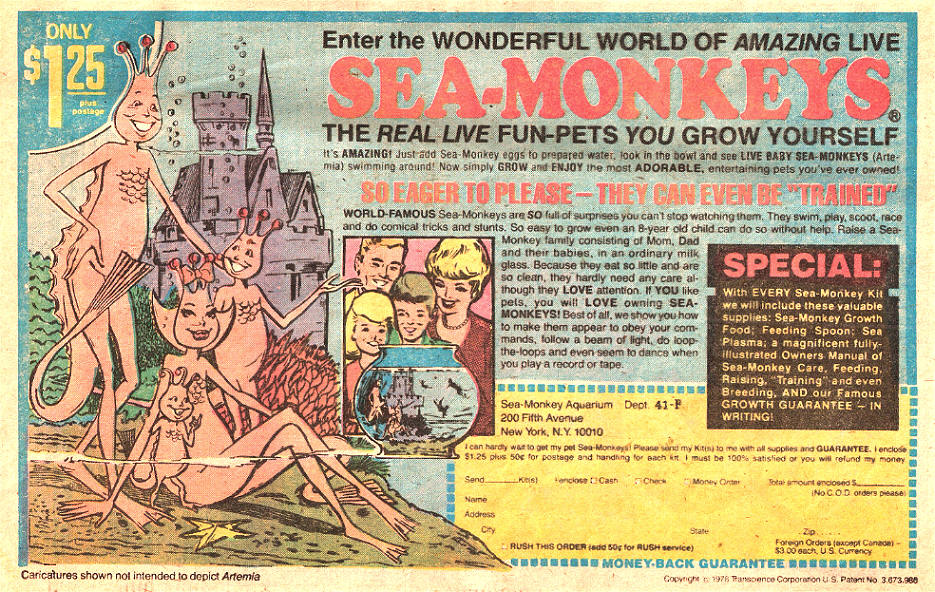
    BTW, did you know that back in the day hucksters placed this ad in Boy’s Life magazine?

    Look at that cute sea-monkey family. Look at the picture of the human family watching the sea-monkey family swim around a castle in a bowl. Click on it. See it large.

    As a young lad, I, as every good Boy Scout should, subscribed to the magazine. I saw that ad over and over.  Who wouldn’t want a sea-monkey? So I saved up my money, earned by watering plants and trees at a nursery in the hot Utah summer sun, and ordered me a family to put on my own shelf.

    The aquarium came. It was not a bowl and did not have a castle. But, hey, there were real live sea-monkey eggs right there in the packet. They weren’t just fantasy creatures! I mixed in the water and salt and dropped the eggs in. I can’t tell you how excited I was. Days later the eggs hatched. And what did I have?

    Brine shrimp.

    BRINE SHRIMP!

    I could have had my mom drive me to the lake where I could have scooped up a million of them. For free. That was, I believe, my first great disillusionment. The first great step from child to adult.

    Alas, sea-monkeys . . .

    Anyway, back to story. Janci was one of those Codex Writers who shared how she used Q&A to develop her killer story idea. She agreed to share it with you. Here’s Janci.

    ***

    The idea for CHASING THE SKIP started with a game of existential questions.  That’s like Twenty Questions, only with no question limit and much more confusing subject matter–like the Pythagorean theorem, or gas prices.  My husband and I like to play the game on long road trips, since a really good round can take two or three hours to play out. 

    On this occasion, I chose a bounty hunter.  It took Drew about five minutes to guess that one–not my finest subject ever.  But after he guessed it, we started talking.  I knew that bounty hunters still existed, but I had no idea how chasing down a fugitive could be a part of our contemporary justice system.  Just what is it that bounty hunters did, anyway?  How did it all work?

    After our road trip, that question stuck with me, so I began to do some research.  What I discovered fascinated me.  A bounty hunter could legally chase down his mark because of the bail bond process.  In order to be released from jail before a pending trial, an arrestee had to put up bail money as collateral, to ensure they returned for their trial.  Since most people can’t afford to post the full bail amount, a bondsman will post it for them, in exchange for a smaller fee.  When the arrestee skips bail, the bondsman is out the money–unless he can get bring the arrestee back.  In fact, he’ll have that person sign away their constitutional rights to privacy in addition to paying the fee.  He’s allowed to go find them if they don’t show up in court.  He can even break and enter to do so–dragging them out against their will.  But the bondsman is a busy man, so he signs those rights over to a bounty hunter, and off the bounty hunter goes, chasing down the skip.  If a person is good at it, bounty hunter can be a legitimate career.

    As I researched, I knew I had the beginnings of a story.  This had all the elements–reality with a touch of danger, crime with a touch of justice.  I wanted to make it work. 

    But I write YA novels, and no bondsman would sign on a teenager to go after his skips.  That would have all kinds of negative legal ramifications, and even if it didn’t, no reader would believe it. Enter my Creative Q&A, the question I always ask when I’m doing idea development for a novel: where can I put a teenager in this?

    Answer: she couldn’t be the bounty hunter, but she could be the bounty hunter’s daughter.

    That posed its own problems, of course.  No dad in his right mind is going to haul his daughter along on the road with him as he tracks down skips.  (Or, in question form, what would make a dad in his right mind bring his daughter into such a dangerous situation?)  I needed a crisis, so he had to bring her along, had to track down the skip, had to keep going with all of it, even when things got rough.  And if I could work in some interpersonal drama, all the better.

    And so it was that Ricki became abandoned by her mother, forced to ride along with her bounty hunter father, a man she barely knows, as he chases down a skip who is more dangerous than his usual mark.  Why would he take this particular job with Ricki along? 

    Ricki would like to know that, too.

    ***

    John Sez: ins’t that a great idea?  I hate Janci.

    While we’re hating her, did you notice that she got some random bit of zing playing 20 questions with her hubby? She followed it up by doing some research.  After doing that, she had a lot more zing. She also knew she had a general topic for a story.  She knew she had the beginnings of a story because her zing meter was going wild. 

    But she didn’t have a story yet.  She had a vocation, which is nothing more than a bit of setting.

    To have a story you need character, problem, plot, AND setting.  So she whipped out her Creative Q&A tool to help her find a character.  And the question she asked was one she’s found is very productive for her. It’s a basic question. But it’s an excellent question. And from that Q&A she started to develop the rest of the story parts.

    The take away isn’t that playing 20 questions on road trips is the key to story ideas.

    It isn’t that one question Janci asked, as fundamental and productive as it is.

    It’s that the principles we’ve been discussing in these posts work. Develop the 6 Core Parts. Think about objectives. Start anywhere. Hunt zing. Generate your own zing. Use Creative Q&A. Work on the various parts using whatever tools you have until you have developed enough that the story comes alive in your mind.

    I hope she sells a million.

    For more in this series, see How to Get and Develop Story Ideas

    Share