
Similar Posts
The secret of Mormonism
If you want to understand the secret to Mormonism, something 99.9% of the world does not know, even though many think they do, read on.
This last Tuesday I was at dinner with a number of wonderful coworkers. We were talking about religion and listening to the guy who helps set up our training environments talk about the interesting hunting ministry he’s involved with (it’s very cool—12,000 acres of woodland in Alabama all dedicated to hunting, outdoor survival, and God).
At one point in the conversation, a delightful fellow trainer, who shared with us the night before the definition of diplomacy as being able to tell someone to go to hell and have them look forward to the trip, asked me, “Does your church believe in Christ. Or, no, is it some other fellow?”
It’s a great question, and I realized that many people are confused. And so I wanted to take time to clear it up.
So what the heck is a Mormon?
It’s not what you think.
And for those of you who think you know, nope, it’s not about that book.
Let me explain. You’ll come away knowing more about us than anyone in any of your circles, and you can lord your superior knowledge over them at dinner parties, when playing games that require vast stores of smarts, or at random moments, just because you can.
Here’s the deal. The first part of the name of the church is “The Church of Jesus Christ.” So, yes, we believe in Christ, that he died for us, was resurrected, is our Lord and god, etc.
The last part of the name is “of latter-day saints.” We don’t use “saint” to mean super-holy people like the Catholic church does, but more as followers or disciples. So you could translate the last part of the name of our church as “of latter-day followers.”
So the whole name would be The Church of Jesus Christ of Latter-day People who Follow Him.
Okay, then what’s the deal with the name “Mormon”?
Well, here’s where we get to the nub of it and the thing that 99.9% of the world doesn’t know. The key difference between the Mormon church and other Christian churches is that we believe that Jesus has called apostles again in our day, just like he did back in the good old days. And when I say apostles, I mean guys like Peter, James, John, Paul, etc.
You might be wondering what an apostle is. What made those guys special?
It wasn’t that they had great faith in Jesus. Lots of people had great faith. It was that they were called to bear special witness of him. And that special witness was not merely that they believed, but that they knew Jesus was the Messiah because they had seen and heard him after his resurrection.
Peter himself said it best when he wrote in his letter, “For we have not followed cunningly devised fables, when we made known unto you the power and coming of our Lord Jesus Christ, but were eyewitnesses of his majesty.”
When the apostles had to choose someone to replace Judas, Peter said, “Wherefore of these men which have accompanied us all the time that the Lord Jesus went in and out among us, beginning from the baptism of John unto that same day that he was taken up from us, one must be ordained to be a witness with us of his resurrection.”
These guys didn’t simply believe. They knew. They were eyewitnesses to the fact that Jesus wasn’t just some preacher—he was the son of God and was resurrected.
So Mormons believe that Jesus has called apostles again today who bear witness of an absolute certain knowledge of the reality of Jesus the Christ. We believe their purpose is also to be the Lord’s spokesmen when He wants to make general announcements or give general instructions. Finally, we also believe they’ve received the authority to offer the covenants the Lord wants to make with all of us.
We believe the first apostle called in these latter days was a fellow by the name of Joseph Smith. We don’t worship Smith. He was just an apostle. Just like Matthew or John of old were. But we do believe the Lord called him to be an apostle and restore some truths that had gotten lost or confused over the years.
We also believe the Lord asked him to bring forth other scriptures in addition to those in the Bible. One of these new scriptures was a translation of an ancient record called The Book of Mormon. It’s called that because Mormon is the name of the guy who wrote it. And Mormon was another apostle—one called by Jesus in ancient America.
And guess what the purpose of The Book of Mormon is? It’s to testify of Jesus Christ and explain his gospel.
So the name of the Mormon church is really The Church of Jesus Christ of Latter-day Saints. Mormons believe that Jesus has called and commissioned apostles in our times, right up to today, to bear special witness of him. And in addition to that, those apostles have brought forth additional scriptures that witness of the divinity and mission of Jesus Christ.
For Mormons, it’s all about Jesus Christ.
So when someone asks, what’s a Mormon? You can say, let me tell you the real answer. It’s not about an additional book of scripture. Yes, folks gave them the nickname of Mormons because of that book, but the key difference is that Mormons believe that Jesus has called apostles like Peter and Paul again in our day to be his spokesmen, and bear a certain witness of him and his good news, and help folks receive all the blessings the Lord wants to pour out on them.
And, O, what a wonderful message we Mormons believe that is.
If you liked those videos, you can see more here.
Please feel free now to randomly lord your superior knowledge over your family and friends.
No Apology
The Book
Political TV ads can be fun. And annoying.
Debates can be fun. And maddening.
You can indeed learn things about the candidates from watching the ads and debates. But fifteen and thirty second snippets of information really don’t give you the full picture. And sometimes they actually hide the facts, producing nothing more than informational smog.
Recently, I decided I wanted to really know what Mitt Romney thought. What he was about. What he hopes to accomplish if he wins the presidency. If Mitt was someone in my neighborhood, I’d go visit the man, and we’d have a chat.
I’d ask him about his ideas and past. I’d ask him to give me examples. Because of the nature of the issues at stake and the number of them, I imagine our chat would probably last a few hours. It might stretch over a number of evenings.
Of course, I’d want time to consider our chat and determine where I did and didn’t agree with him. I’d want to hear what others thought. And I’d want to look into his history, his successes and failures.
But the first step would be to go to the man himself and hear him out.
I hate it when people put words in my mouth. I’m sure Romney, or anyone else running, hates that same thing. If I were running, I’d would hope folks would take the time to hear me out. They may ultimately disagree with me on many or a few things. But I’d hope, as they are gathering information, that they would take the time to actually go to the source and listen to what I myself had to say.
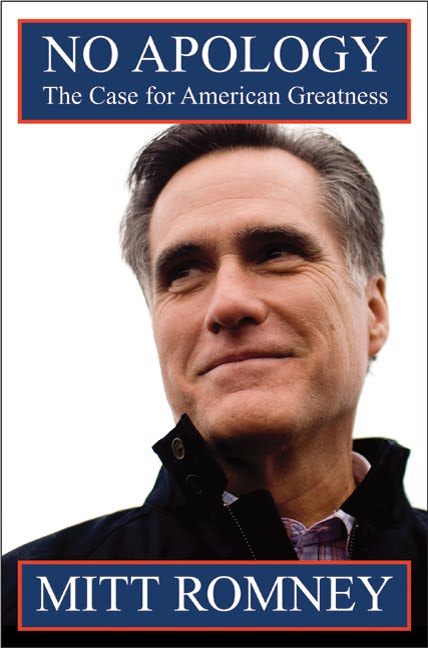
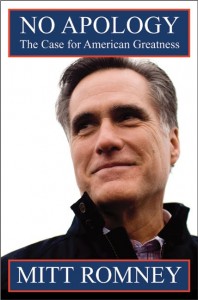 Unfortunately, I can’t walk around the corner and knock on Mitt’s door. But he did write a book that was published in 2010, and it’s probably the next best thing to talking to Romney at his kitchen table. The book is called No Apology: The Case for American Greatness.
I’ll admit I thought it was going to be a dry guide book explaining his position on every hot political issue. It’s not a guide book. In fact, he leaves a number of topics out. Nor was it dry.
I also suspected it might be a scathing attack piece on the Obama administration. It’s not that either. Not even close. He does criticize some things where he and Obama differ, but he also commends him on a few things. Either way, Obama is a very small part of the book.
So what IS this book?
Romney states its purpose in the introduction: it’s “about what I believe should be our primary national objective: to keep America strong and to preserve its place as the world’s leading nation” and “the course I believe we must take to strengthen the nation in order to remain prosperous, secure, and free” (2). It’s about his ideas on how to make sure America does not falter as so many nations have, but remains wealthy, happy, and productive.
I finished the book yesterday. I found it interesting, personable, sometimes surprising, and insightful.
I found Mitt Romney to be a man self-deprecating humor. He’s also a thinking man, one who likes to look at data to see what it shows. It’s clear he’s a man who does NOT think he knows everything or has a monopoly on every good idea, but he’s also a man who demands evidence. I also saw a man who is kind. He doesn’t talk much about his 14 years of service as a lay minister in his church in this book, but you can see how those years changed him as he discusses helping the unemployed, out-of-wedlock births, and single-parent families. Finally, I saw a man who loves, LOVES, America and is convinced she can remain the hope of the earth, but only if we do things that foster our strength.
This book outlines what he thinks those things are.
The book is written in a conversational and easy style with many examples from his personal experience, studies, and history. Romney’s record of accomplishments demonstrates his skills and hard work ethic. This book explains to what end he would apply that skill and work.
If you’re planning on voting this November for the president of the United States, I think you’ll find this book very useful. You may end up agreeing with many things he says. You may end up disagreeing with him on many points. But before you can do either, you need to understand what Romney’s position actually is. And the first step in doing so is to fully hear the man out, in his own words, from his own lips.
As a result, whether you end up deciding he’s your candidate or not, you WILL come away with important insights into the issues discussed.
What’s Next
I want you to know that I do not worship George, Ben, Tom, Adam or any of the other guys who formed our constitution and started this nation.
They put their lives and fortunes on the line for what they believed in. And I am immensely grateful for what they did. I enjoy tremendous freedoms because of their courage, determination, and sacrifice. Those guys, by-and-large, rock!
But I do NOT believe that their words are scripture nor that their ideas are sacrosanct—merely to be accepted and not to be considered and questioned and disagreed with.
Even so, these guys were gutsy and brilliant. They attempted something everyone thought would fail. Something that HAD failed every time it had been attempted in their recorded history. But they pulled it off and changed the world.
These guys believed in the common man. They believed that the educated common man was the best person to hold the reins of government. Thomas Jefferson thought up a rhyme to make the idea easy to remember. He said, “If a nation expects to be ignorant and free in a state of civilization, it expects what never was and never will be.”
I can’t argue with that.
Of course, we’re not going to become experts on every policy issue. But we certainly can become informed on the broad principles and issues. And we can certainly become informed about the candidates.
Because I found No Apology so useful, over the next few days I’m going to summarize Romney’s main points, chapter by chapter, here. I’ll also point out interesting ideas and facts he shares as well as share any questions, quibbles, or disagreements I have.
I hope you find it useful. More importantly, I hope you read the book and join in the conversation.
30 books you should read before you die
An avid reader friend of mine began reading through the books in a list called “100 books you must read before you die.”
She got to Jack Kerouac’s On The Road and went to Facebook and posted the following: “I don’t get the appeal. It’s about a group of boys/men who are irresponsible, drunks, whoring around taking advantage of others and being enabled by their women. Why is this a classic and why should I have wasted my time on it? Can some of my literary friends explain? I hated a brave new world and the handmaid’s tale too.”
Is the book a classic?
Should she read it before she dies?
Is it really that important?
Let me share an edited version of my response and then provide my list of 30 books you should read before you die.
*
Annette, the unfortunate truth is that these lists of “classics” are a sham because there is no objective criteria for determining literary excellence.
Or maybe I should say that measuring quality in the arts isn’t like measuring the unambiguous, objective score of a baseball game. After books exhibit a certain level of proficiency, it becomes increasingly difficult to distinguish the quality of one book from another, especially because much of this depends on a reader’s interests and subjective experience of the story.
When it becomes hard to rank performances, people rely on other measures. One of the most powerful is social networks.
So if two readers find two different books that blow them away, one of the books might get all the attention because the one book gets picked up by a news service (The New York Times) or a platform (the Oprah Book Club effect) or some other social network of influence. A lot of the so-called literary classics only appear on various lists because they tapped into the academic network, which kept them alive far longer than they would have lasted otherwise.
On The Road is simply a book that made a stir among some circles in the 1950s. That’s it.
Was it more important or of higher quality than Exodus? The Chronicles of Narnia? Lord of the Rings? A Town Like Alice? All published in the 1950s as well.
It depends.
If you’re wanting to understand the 1950s beat culture, it would be an important book.
But if you’re wanting to understand fantasy writing of the time, it wouldn’t.
If you’re wanting to read a book that’s had a huge impact on popular culture, well, LOTR beats On The Road like a dog.
Some people have the feeling that the so-called classics have some inherent medicinal value because someone put them on a list and called them classics.
Nope. They’re just stories. Some of which can shed light on the issues and interests of a part of the culture in a given period. But if you’re not interested in that specific sub-culture, who cares?
And if you’re reading to be entertained, moved, uplifted, or educated—which ones do that best for Annette is for you to decide.
So all that to say I wouldn’t devalue your reaction to the book

*
I’m now going to give you my list.
But it’s not going to be a list of titles. Nor will it focus on a book’s impact on some sub-culture of a given period.
It’s going to be a real list. One that focuses on what so many of us go to stories for.
- The one that makes you weep.
- The one that makes you giggle and snort.
- The one that reminds you of what it’s like to fall in love.
- The one that gives you hope.
- The one that you begin to read more and more slowly because you don’t want it to end.
- The one that scares the soup out of you.
- The one that you can’t put down, even though you need to wake up early in the morning.
- The one that makes you wish you lived there.
- The one that’s so good that when you close it, you immediately start to read it a second time.
- The one that gives you and your child hours of pleasure together.
- The one that gives you a sacred, spiritual experience.
- The one that makes you reread some of the lines because the turns of phrase are just so delicious.
- The one that gives you courage.
- The one that takes you on an awesome adventure.
- The one that makes you want to be a better person.
- The one that bores you to tears (just so know you how good the others are).
- The one that introduces you to a different culture that delights you.
- The one that makes you think.
- The one that lingers with you for days.
- The one that gives you lovely insights.
- The one that inspires you to love your spouse more.
- The one that introduces you to the sorts of people you normally don’t like and makes you actually like them.
- The one that delights you with its characters.
- The one that whisks you away to a different historical period.
- The one that inspires you to give your children a hug.
- The one that gets your adrenaline pumping.
- The one that sparks all sorts of ideas in your head.
- The one that makes you wonder and start imagining what it would be like to be there.
- The one that blows your freaking mind.
- The one that makes you stand up in your living room and cheer.
We could do more than 30, couldn’t we?
Like the one that makes you think people from a different time period are just like us. And the one that makes you think people from that same period are completely alien.
But I think we’ll stop. That there above is a list.
Those are 30 books I think everyone will want to read before they die.
Indie Thoughts: Publishers know profit, but haven’t tapped best seller lists
In The Business Rusch: Generational Divide Kris Rusch points out that the new on-demand and long-tail market for books has changed the duration of the opportunity a book has to be successful, but that it seems the industry still isn’t recognizing this in how they measure success.
The problems come from the fact that those of us who run things—people in our forties, fifties, and sixties—use metrics that were developed by our parents for their world, that tightly controlled Mad Men world where everyone was expected to be the same, not just in what they wore or bought but in what they listened to or watched or read as well.
The bestseller list?
It measures velocity. (A good essay on this topic, “The Meaningless Metrics of Fame,” came from Mike Briggs, husband of Patricia Briggs, earlier this week. I’ve also dealt with it.)
Reviews?
They only want new books, and then only at the time of release.
Brick and mortar bookstores?
They only have room for the latest releases, and then only the ones that are the most popular with their customers (whoever those folks might be).
Books have come late to this fight. Books have been available on demand for only about four years now, in the U.S. In other countries, there’s been even less time.
And we’re all still fighting over meaningless metrics, to use Mike Briggs’ term, because those metrics only measure things that were important around the water cooler, not things which are important now.
What’s important now?
She goes on to say:
The publishing industry isn’t even talking about new metrics. That idea hasn’t occurred to traditional publishing, and indie (or self) published writers are constantly seeking validation from the old system—trying to figure out ways to game the bestseller lists or to get a fantastic review from somewhere that has old-world prestige . . . But at some point, traditional publishers are going to have to develop new ways to figure out which products sell well and which ones don’t. All of their systems—from sales figures (which measure books shipped not books sold) to bestseller lists to critical acclaim—are based on the old models.
Kris is a very experienced with publishing, but her last point conflates internal accounting with marketing. Publishers DO know which products sell.
The primary measure of success in a financial enterprise s not new. It’s been around for 100’s of years. And on demand and long-tail markets don’t change it.
The measure is how much a product or service contributes in profit to the bottom line. You take revenues, minus expenses, and that’s the contribution that product (a book in this instance) makes to your total profit. Or to covering your fixed costs.
Booksellers have measured the success of their books with actual or estimated profits for quite some time. Publishers already know which books sell well and which don’t. No accountant in the world is going to report books shipped as the measure of success. And they don’t. The very fact that publishers have a profit and loss statement and show returns on royalty statements demonstrate that. They look very closely at actual and estimated profits. And to they do this by channel, which is reflected in a small way when they break out ebooks on royalty reports. This is all basic accounting.
Here’s an example. Until Ender’s Game the movie, Ender’s Game the book hadn’t appeared on any best seller list since it was first released. And its release was 30 years ago! Yet over the years Tom Doherty touted its sales numbers many times. Tom knew that book was gold. Of course, he did. Because he doesn’t use best seller lists to tell him what’s selling well. He knows those lists are marketing devices. He has the real data in house. Why would he need a list to tell him anything?
And Tom isn’t going to use books shipped either. Tor may report those numbers to Publishers Weekly for marketing purposes, but he will always multiply that number by an expected return rate to estimate sales. He wants to do that. Because books shipped is meaningless to the bottom line and everyone knows it, including the auditors.
Publishers are well aware of the long tail. They see it with books that have been rotated out of the brick and mortar channels but are still selling in the online ones. They report it in their annual statements. They know the online channels work differently from the brick & mortar ones.
The measure of success is still the same as it ever was—how much profit is this property contributing to our bottom line?
Marketing, however, is a whole other ball of wax.
What the long tail and on-demand allow are marketing campaigns that are impossible in the brick & mortar channel. In brick & mortar you have a limited time to advertise (roughly 8-15 weeks). After that period, most books are rotated out of the store. This means that any marketing for those brick & mortar buyers MUST coincide with the period when the books are in the stores.
But the online channels open up all sorts of other opportunities. You can market forever. And the contribution margin is always positive. The online and POD costs are easily recouped with each sale. (Publishers are well aware of this profit potential; this is why we have so many making grabs for backlists.)
And I see publishers taking advantage of these new marketing methods. This last week I saw publisher books not currently stocked by brick & mortar retailers on BookBub, BargainBooksy, and Book Sends. And the industry isn’t totally focused on new books for reviews. I just had a large newspaper agree to look at my book that was published four months ago. Still, Rusch is right when she says that the publishers haven’t adapted one of their biggest marketing tools to take advantage of the new opportunities–they haven’t done anything with the best seller lists.
Amazon has lead the way in creating new ways of marketing books to different types of readers with their best seller lists. These lists create the excitement of discovery.
But every one else is still reporting weekly sales on the big lists.
If I were a publisher, I’d be asking USA Today to provide more than just the weekly view of the top 150 books. And USA Today is THE list to watch because their numbers are not based on units shipped to a sample of stores, but actual sales. Here are some lists that readers would be interested in.
- Most anticipated this week: based on pre-order totals
- Most anticipated this month: based on pre-order totals
- Hot new releases: based on weekly numbers
- Hot new releases for the month: based on monthly numbers
- Books with legs: last 3 months; I know it needs a different name (grin)
- Best sellers of the last 12 months: annual total of units sold
- Best sellers of the last 18 months: total units
- Contenders: for each of the lists above show the next 150 books (I always want to see the next 100 books after the top 100 on Amazon’s lists; why not show readers the top 300?)
- Movers: for each of the lists above show those that have the biggest rise in percentage sales and meet some unit minimum (you don’t want to feature books with 2,000% increase because they went from selling 1 unit to 20), even if they don’t break the best seller lists
- Genre: allow all of this to be sliced by genre.
Let the reader select the view they want to see!
Avid readers will gravitate towards the shorter time periods. Those that read fewer books will gravitate towards the longer periods. Everyone who wants to discover something new will go to the contender and mover lists.
This is about marketing. Not publishers measuring success.
And then armed with those numbers guess what the publishers will do? They will go back to the brick & mortar venues and pitch to have some of these same books carried in the stores for the first time (some publisher books are printed digital first) or carried again.
What’s driving the rise in school shootings?
Homicide rates are down in America, but school shootings are up. What’s going on? What’s driving this?
Some say it’s guns.
I have an hunch that I think deserves some study.
Back in the 1970s we had 30 school shootings with a population of about 216 million.
Today we have a population of 320 million. If we had the same ratio of shootings to population today, we’d have 44 shootings total in the decade between 2010 and 2020. But from 2000 – 2010, we had 60. And since 2010 (if my data is correct, and it appears that’s a big if–see Edit 2 at bottom) we’ve had 146. That’s a 300% increase!
If we want to solve the school shooting problem in the long term, we need to figure out what’s fueling it. One way to get at this is to ask what’s changed since the 1970s and 80s when the rates were lower.
Are we killing at a higher rate in general? Is that what’s changed?
No. FiveThirtyEight reports homicide rates have dropped. Here’s their chart.
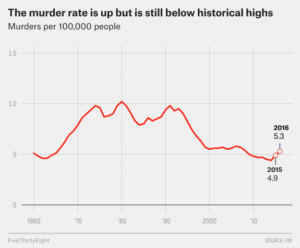
We’re down.
But school shootings are up. Way up!
Clearly, what’s driving school shootings doesn’t seem to be the same thing that’s driving general homicide rates. Otherwise, the rates would be moving in the same direction, but they’re not.
Is it gun ownership rates?
According to the Washington Post, ownership rates are at their lowest in quite some time. Here’s their chart.
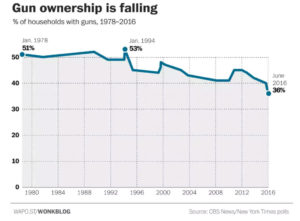
This means that if general gun ownership rates were a major factor, then we’d be seeing school shooting rates fall. We’re not.
Furthermore, some of the US states with the highest gun ownership rates have the lowest murder and school shooting rates. (For those wanting to know more about guns, magazines, the definition of an assault rifle, gun control, etc. see Larry Correia’s informational post below.)
Now, it could be that while overall gun ownership rates have fallen, ownership in certain population segments has risen. That’s something to look at. But when looking at the overall ownership rate, we don’t find an answer.
Is there anything else to study? Anything else that might be different now?
Here’s my hunch–it’s the internet. My hunch is that an unintended consequence of social media and the ease of finding certain types of content have facilitated the development of the mindset and ability of certain youth to commit these crimes.
We do things when we are prompted to take a specific action and we have both the ability and desire necessary to take that action. So action requires three things:
- A prompt
- The ability
- The desire
If the rates are going up, then one or more of those things have changed. Either more kids are being prompted to take this specific action, we’ve made it easier for them to do it, or we’ve increased their desire to do it. Or some combination of those three.
Let’s see if the internet might be a factor.
First, from what I’ve read, it seems a lot of these kids feel like outcasts and seem to be seeking some kind of revenge. Does social media foster and facilitate more bullying and isolation and, therefore, more resentment? Has it increased the desire to conduct such attacks?
Second, it is dramatically easier for kids to learn how to do all sorts of stuff now. Back in the 70s and 80s, it was hard to learn about the methods and tactics of crime, firearms, etc. Now, if you want to learn how to shoot, scope a place out, plan an attack, do all sorts of things, you can watch YouTube videos on it. Has the easy accessibility of how-to instruction facilitated the ability to plan and carry out these attacks?
Third, back in the 70s and 80s you had limited programming. Gilligan’s Island, Brady Bunch, The Love Boat, The Donny and Marie Show, Lawrence Welk, etc. They all fostered good-citizen values. Today, kids have easy access to all sorts of crap. Violent rape porn. Evil games like Blue Whale that give challenges to the player, and the last is to kill yourself. Are there certain types of programming on the internet that foster a violent mindset? That prompt these very actions and makes them seem like a good alternative?
Fourth, look at how well political conversations go on Facebook. Chat rooms, blogs, etc.–we all know they foster more incivility than when you talk in person. Does our social media, by its very structure, anonymity, etc. foster a more anger-filled approach to disagreements? Has it prompted, even trained, more kids to behave this way?
Is one of the unintended consequences of the internet and social media a rise in school shootings?
I’m not saying it’s the only part of the puzzle. But I do think it’s worth studying. We need a long-term solution.
At the same time, we need something now while that long-term solution is being researched and implemented. One of the best ideas I’ve seen so far to stop the killings is the one mentioned here.
Such people are screened, trained, and on-site. They can respond immediately. Plus it’s voluntary. If you’re a teacher that doesn’t want to do this, you don’t have to. Plus this doesn’t add security guards to schools. Nothing changes at the school until the shooter shows up, and suddenly there are half a dozen, dozen, two dozen deputies immediately there.
I think at our tiny 1A middle school, there are probably 6-8 people who would do this, including my wife. The teachers know the kids, know where other teachers are likely to be, know the place like the back of their hands. We know security deters threats. I can’t see anything but positives.
I don’t like the fact that we have to contemplate this. I want to go back to my youth in Bountiful, Utah where this never happened. Maybe we can get back to that type of a society. Until then we need an immediate, practical, and effective solution. This seems like a good part of a multi-approach solution.
But what’s the long-term solution?
I wonder if has to do with the internet.
Is any organization seriously studying this?
Do you see anything else that might have increased the prompts for this specific action, the ability to plan and conduct attacks, or the motivation to do so?
Edit 1 – gun retention
On Facebook today, a former deputy sheriff I know and respect was asked “Should teachers carry guns?” His answer: “No. Weapon retention is never even considered when politicians and others come up with that. Imagine some big, unfriendly student disarming a teacher during some classroom issue. Instant problem.”
This is a good point to raise.
I didn’t think of it. It’s clear none of the teacher defense plans are complete without it.
But is it a show stopper?
First of all, how big a risk is this? How many student-teacher scuffles do we have in grades 1-6 where the teacher is overpowered by a third-grader? How about in middle school? I’m sure the risk is higher in high school.
But just because there’s a risk doesn’t always mean you shouldn’t do something. Male and female agents and officers are trained in retention. My question is whether such retention training is ineffective? Should officers not carry guns because of this?
If it is effective, then it seems to me that if you’re trained, you’re trained. A big senior boy has just as much chance to disarm a trained cop as a trained non-cop of the same size and strength.
This is another reason I like the suggestion of the sheriff above. It’s not just any teacher that would do this. They need to be screened and trained. They’re deputized. I could see them doing training on a frequent basis. Something goes down at at school, and you immediately have 6-8 trained deputies on site. Maybe a dozen or more. Is that not a game changer?
It’s good to identify risks. But what would reduce the risks identified? Could we reduce them to acceptable levels? It’s a question that needs answering.
Edit 2 – is the “rise” due to bad data?
Just saw this. Is the “rise in school shootings” even real? Or is it bad data? Here’s an opinion on USA Today, suggesting it might not be as bad as we think. One of the things that’s maddening about all of this is what seems to be a lack of good data!Sources
- FiveThirtyEight reports on homicide rates
- The Washington Post on gun ownership rates
- The Atlantic on how hard it is to get good stats on these things (frustrating!)
- The Washington Post on the variety we see in mass shootings.
- Wikipedia on school shootings
- Wikipedia on murder rates by state in the USA
- Wikipedia on murder rates by country–however, it appears how the data is reported by country and what’s counted, even between countries like the UK and USA, make is almost impossible to get apples to apples.
- B.J. Fogg’s model of what’s required for a behavior to occur
- Larry Correia’s informational post on guns and gun control
Indie Thoughts: When an author should self-publish and how that might change
From publishing consultant Mike Shatzkin:
For a number of reasons, the belief here is that most of the time for most authors who can get a deal with an established and competent house, their best choice is to take it.
Sounds reasonable, but then we get to the money quotes.
The strength of the traditional publishers and the traditional deals is directly related to the amount of the market that is served by inventory in stores. When that proportion was “nearly all”, the power allocation was “nearly all” to the traditional publishers.
***
Self-publishing and new-style digital-first publishing can grow more to the extent that the book-in-store share of the market shrinks more. But while that’s happening, the big publishers are also adding to their capabilities: building their databases and understanding of individual consumers (something that all the big houses are doing and which the upstarts seem not to believe is happening, or at least not happening effectively), distributing and marketing with increasing effectiveness in offshore markets, and controlling more and more of the global delivery in all languages of the books in which they invest.
It will compound the pressure on the alternative players if Amazon continues to grow its global market share for ebooks. The bigger the percentage of the market that can be reached by self-publishers with one stop at Amazon, the less interest they’ll have in picking up smaller chunks of the market with additional deals and the more powerful will be any incentives Amazon cares to offer for making the title exclusive to them.
Link to the rest at The Shatzkin Files, and thanks to Passive Guy for the original link.
Shatzkin’s discussion of the amount of the market served by inventory in stores is right on. But his “best choice” conclusion doesn’t follow.
Why?
Because the question for each author has to be which stores will I be in, what kind of floor space will I have, and how long will I be there? And in many cases the answers to those questions do not compete well with indie options.
For example, a lot of in-store sales come from the drug store, grocery store, airport, Walmart, Costco type venues. But it’s rare than an author getting an average deal will see the light of day in those places. Those are reserved for bigger sellers. And not very many of those. So unless you’re getting a big deal, you can’t count that floor space.
Poof. Tens of thousands of venues are now no longer part of the equation.
So you are now left with whatever number of stores the publisher can get you into at Barnes&Noble (a max of 675 stores), Books-a-Million (max of 200 stores), Hastings (max of 149 stores), non-chain stores, etc. I think the total number of book stores in the USA is around 10,000 or so. But publishers won’t get you into all of them. Some don’t carry your type of book: they’re used books stores, or kids book stores, or Christian book stores. And even if it’s a store like Barnes&Noble, you probably won’t get into all their stores. So how many stores will you actually be in?
Next, you have to wonder where you’ll appear in the stores you do get into. Will you be face-out somewhere prominent? Or will you have two copies spine-out in the back? If you’re spine-out, that’s just reduced the value of the floor space publishers offer you yet again.
Finally, how long will you be there? If you sell your two copies in a store, are you done at that store? Will your books be there longer than 12 weeks? Will they be there even 8 weeks?
James Patterson can sell millions of books because he has multiple copies in tens of thousands of stores with great display. And he’s usually there for more than just a handful of weeks. If you have two books spine-out in each of 500 stores for eight weeks, how well are you going to do?
Here’s some math on author revenue and units sold. Is selling 1,000 books with the royalties and contract terms offered really worth it? What about 4,000 books? 7,000? Are you going to be in enough stores with a decent placement to get those numbers?
If you’re going to be in thousands and thousands of stores with good placement, and the terms of the contract are reasonable, then, good golly, working with a publisher looks great. But if you’ve got a book that’s good enough to make an editor somewhere want to buy rights to it and the publisher is offering to put you spine-out in a little over a thousand stores with all sorts of contract crap, then Shatzkin’s “best choice” is really a poor one. In those situations my money is on going indie.
EDIT: It seems there are about 12,700 book stores in the USA. But that includes big-box stores, which I think are the Walmarts and Costcos.
2 Comments
Comments are closed.
I just bought it! Can’t wait to start!
Awesome. I hope you enjoy the tale.