Good Stuff! Three Days in Moscow
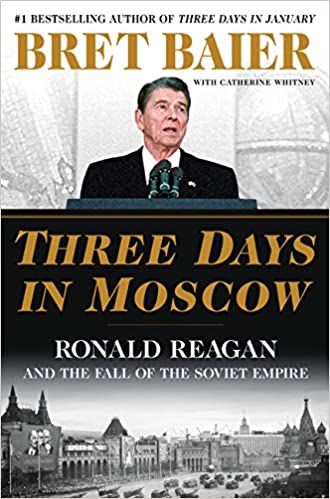
Book cover, Three Days in Moscow

I just finished Three Days in Moscow: Ronald Reagan and the Fall of the Soviet Empire by Bret Baier. It’s a New York Times bestseller that takes you into the world of Ronald Reagan, his rise to power in politics, and his role in ending the Cold War. And it does in a personable way with gentle humor throughout.

I enjoyed the fascinating behind-the-scene insights about the personalities involved and the clarity about what really happened. And how the book brings Reagan to life, as if he’s almost there. Along the way you’ll also get insight into Mikhail Gorbachev, the assassination attempt on Reagan, and more.

Baier is the chief political anchor for Fox News. In 2001, he became the station’s chief Pentagon correspondent and ended up traveling to Afghanistan 11 times and Iraq 13 times. In 2007, he became the station’s chief correspondent to the White House. More importantly, Baier seems to be one of the few journalists these days who is simply trying to get and report facts instead of spin. And that’s exactly what he’s done here.

If you like biographies or history, if you want to know how the U.S.A. and the U.S.S.R. stepped back from decades of mutually assured destruction, if you want to get a view into how diplomacy is done, then I think you’ll love this book. And you’ll probably love it even more if you can listen to the audio book version, read by Baier himself, which also includes a recording of Reagan’s speech to the students at Moscow State University. I listened to it via the Overdrive account my public library provides. Baier’s reading was terrific.  

Share

Similar Posts

  • LTUE 2026 Presentations

    I always enjoy presenting at the Life, the Universe and Everything writers conference. This year they asked me to present the following.

    The 3 Little Secrets that Make Plotting So Much Easier

    No, the secrets don’t have anything to do with the hero’s journey; 3, 7, 8, or 9 acts; Lester Dent; or cat-saving beats. An average novel has around 40 to 70 scenes. If you’re like me, those abstract plot structures spark an idea or three, then dump you in front of a blank wall. So where in the heck do all the other scenes come from? Well, a whole heap of them stand up and present themselves when you use these 3 little secrets. If you struggle with plotting, this is your chance to put that behind you for good and start generating fun and exciting plots with ease. Come learn the 3 little secrets that make plotting so much easier. 

    Here’s the handout.

    Vivid And Clear

    Despite the oft-repeated 11th commandment for writers—show, don’t tell—writers never show. They can’t. It’s all tell, tell, tell. The trick is to tell in a way that helps your readers imagine with such vividness and clarity that your story triggers an emotional response.  In this session learn the five critical prose techniques that help you do just that. 

    Here are the presentation slides.

    Share
  • |

    The book trade is a . . . trade

    James Dawson, YA author, feels it’s somehow wrong to hold back on cussing in his fiction. He wrote an article about this in the UK Guardian called “Why Teens in Books Can’t Swear.” He thinks it’s unrealistic. He thinks it’s about gate-keeper censorship. You know, parents wanting to steer their children towards certain experiences and away from others.  

    People.

    Dawson’s approach to the whole problem is wrong-headed. This isn’t about the virtues and vices of fiction. Or about gatekeepers, especially in today’s ebook world.  Or what experiences parents want to provide their children. And it’s not about art reflecting reality. Reality includes trips to the toilet, and yet we somehow fail to include realistic bum wiping in so many of our tales. Good heavens, have we betrayed our artistic integrity? No. We’ve just naturally chosen to include things that appeal to us and leave out others that don’t. Every book is an exercise in hundreds of such choices.

    The fact is that Dawson’s forgetting that a fundamental aspect of the book trade is the trade.  The buyer trades his or her money for a product (the book) that provides a service (the entertainment, thrills, chills, etc. of the reading experience) he or she values.  A customer preferring one kind of experience over another isn’t censorship (the horror, the horror).  It’s choice.  

    As an author, you make your offer. If folks like it, they buy it. If not, they don’t. Nobody owes you a purchase.

    This means that in any business, and selling fiction is a business, the most sensible way forward is to offer your intended buyers something they are likely to value.  Something they’re going to like.  Something they want.  If your buyer is thirsty and wants water, offer him a cold glass of water, not a waffle iron.  And if you can’t bear to develop anything but waffle irons, then, by all means, develop waffle irons.  Just make sure you offer them to the folks looking for . . . waffle irons. 

    This business of making offers also means that we package our products and services so that customers can easily tell what’s in the box. You don’t want someone to purchase your box thinking it contains breakfast cereal when in reality it’s a bunch of bolts.

    Yeah, writing is an art. But offering it in trade to others is also a basic economic act.

    Share
  • If you want to work with publishers, you need this. Right now.

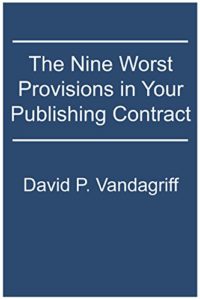
    thenineworstprovisionsinyourpublishingcontract-by-vandagriffWriters who want to deal with publishers need this book: The Nine Worse Provisions in Your Publishing Contract by David P. Vandagriff. And it’s currently free!
    Vandagriff is a lawyer whose business involves high-stakes intellectual property litigation. He has negotiated major contracts with a wide range of opposing parties, some of which include Apple, Hewlett-Packard, Microsoft, Intel, Morgan Stanley, Merrill Lynch, Fidelity Investments, AOL, Disney, Hallmark, plus other large publishers, agents and etailers.

    He’s also publishes The Passive Voice, a news blog on the publishing business that includes many posts from his lawyer perspective.

    Don’t fall for contract terms that turn you into a slave.

    Share
  • Gun Runner is out today!

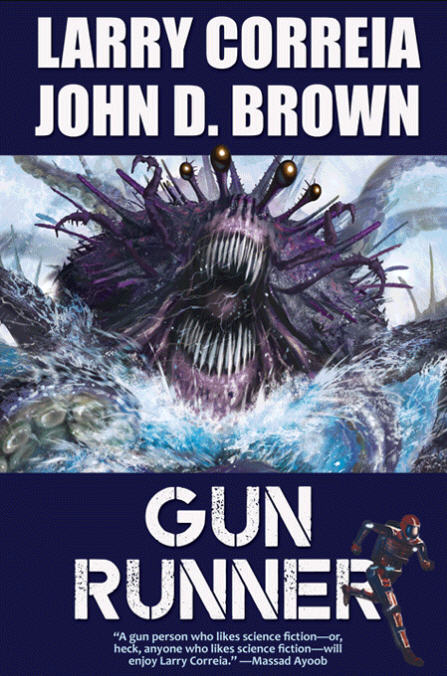
    Gun Runner on Amazon! Order here!
    Autographed copies available from Uncle Hugo’s here!
    Podcast discussion with the authors here!

    The is 100% Brown and Correia, which means it’s action-packed, full of fun characters, and none of that navel gazing business.

    It’s about a guy named Jackson Rook who works on a crew that smuggles weapons. They’re active in a righteous cause, helping the oppressed peoples of various planets stand up for themselves against the whoresons with the money and power.

    But then Jackson learns something about the current job that turns his gut. And he begins to think they might just be working for the wrong team.

    Will he be able to set things right when just about everybody and everything on the godforsaken planet called Swindle wants to kill him or turn him back into the monster he once was?

    Read to find out.

    If you like action and science fiction, I think you’re going to love this book.

    Share