|

Story zing method: fiddling with knobs

One of the most basic way of coming up with story ideas is to take a familiar story or thing, list out what’s commonly associated with it, then start changing some of those elements.

For example, you list out all the normal things for vampires–the coffins, black, bats, sucking blood, etc.–then you begin to twist. What if the vampire wears, instead of black, some styling plaid? What if it isn’t a person but a rabbit (whoops, that one’s been done)? What if instead of gothic places like catherals you find him in a trailer park? What if instead of being dangerously suave, he’s a drunk?

Do you see? You can do this with anything.

In this interview, Matthew Sturges talks about how he did just that with the movie The Dirty Dozen and ended up with with Midwinter, a novel about prisoners given another chance. According to Sturges, “In the case of Midwinter, the beginning of the story was, ‘What is prison like in Faery?'”

Read the whole interview. I think you’ll find it enlightening.

Share

Similar Posts

  • |

    Dewitt Jones and Clear Vision

    Not many people understand creativity. Dewitt Jones, a National Geographic photographer, does. And this video on the creative process, HOLY COW, it’s so good I had to buy it so I could watch it whenever the yearning took me.

    Clear Vision

    But this isn’t just for artists. The principles of creativity apply to any creative endeavor–from writing and drawing to building microchips and parenting. 

    Go here. Watch the brief clip. Then watch the whole Clear Vision video. Tell me what  you think.  

    Capture the zing!

    Share
  • |

    Black Chokecherry Syrup

    When you live where we do, you cannot hope to landscape likes folks in a warm suburb. First of all, at 6,000 feet with a min temp of -30 Fahrenheit you can’t grow a lot of warmer climate plants. Second, the deer seem to eat everything else you do grow. So we’ve been looking and I think I’ve found a tree to add.

    I actually found it earlier when I was biking around the beautiful Round Valley and had to stop and go back to revel in the delicious fragrance. But I didn’t know what it was at the time. I do now. 

    It’s the black chokecherry.

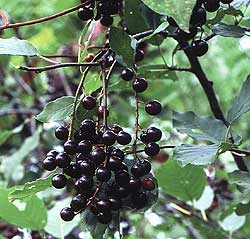
    It grows naturally up here. Has beautiful fragrant blossoms in the spring. And it produces fruit that can be made into a delicious syrup. Oh, the raccoons like it as well.

    Now when you eat the raw berry, unless you eat it late in the fall, you’re in for an astringent, alum after-punch. But we picked the berries up a canyon behind our town after the first frosts. In fact, many of our berries were wrinkled. They just fine raw. Even Lilia, my pickiest eater, enjoyed them.

    We picked about 1.25 gallon ice cream buckets of the stuff. Then we followed this recepie and made about 4 quarts of syrup.

    • 3 cups chokecherry juice (see first step)
    • 3 cups apple juice (not from a store, but cooked from apples)
    • 6 1/2 cups sugar
    • (I’ve heard some folks add 1/4 teaspoon almond extract for a stronger cherry taste)
    1. Wash chokecherries, place in a large kettle, barely cover with water and cook, covered, for about 30 minutes till the cherries are soft. Mash gently and strain the chokecherry juice through a sieve or cheesecloth.
    2. Do the same with the apples.
    3. Pour the juice into a large kettle; stir in the sugar.
    4. Cook on high, stirring constantly.
    5. Boil hard for 1 minute.
    6. Remove from heat and skim foam.
    7. To can: Pour hot syrup into sterilized hot jars to within 1/8th inch from top.

    It’s absolutely delicious on pancakes. 


    Share
  • Media and Teenage Sexuality

    I don’t know how it’s possible to aruge that media does not influence our decisions. The evidience is simply overwhelming. Here’s another report of a study linking media sexuality to teenage decisions about sexuality.

    “CHICAGO — Groundbreaking research suggests that pregnancy rates are much higher among teens who watch a lot of TV with sexual dialogue and behavior than among those who have tamer viewing tastes.” Full article here.

    The study shows that while teenage pregnancies have dropped overall, those teens watching racey shows had, not just a small incremental risk, but TWICE the risk of getting pregnant.

    Now, I know this article by the Guttmacher Institute focuses on the 1990’s, but it still is enlightening. It discusses the reasons for the dropping teenage pregnancy rates during those years. It’s conclusion is that both abstinence and usage of more effective contraception are the main factors for the drop in teenage pregnancies.

    When I put the two articles together, it makes me wonder if the racey shows are encouraging more sex among the teens who watch them or the use of less-effective contraception or both. My guess is that the shows are influencing a decision for more sexuality.

    Either way, what does this mean for a writer?

    To me, it means that while I’m never responsible for someone’s actions nor in 100% control of what people take from my writing, I AM responsible for those things I know are highly likely to influence folks one way or another. I hope my works provide a wonderfully entertaining experience, but also avoid influencing people into decisions that will lead them down paths that will limit their happiness.

    Share
  • |

    Monks in Mormonland (and their honey)

    We just visted the Abbey of our Lady of the Holy Trinity this week with my family. It’s nestled on over 1,800 acres of some the most beautiful country in Utah.

    I think almost every religion demonstrates virtues we can all learn from. The dedication of these good men to their beliefs and vows to God is one such example.  As is their decision to live simply. And their creamed honey blends, which you can order from their website, are delicious! So far the maple honey is my favorite. Here’s a 2 minute National Geographic video about this abbey.

    Share
  • |

    “How It All Came Crashing Down” by Peter B. Gardner

    Everybody knows that we got into this recession because banks began lending money to people who had terrible credit ratings, right? People who didn’t have to prove they even had a job. I mean, how long are you going to stay in business when you keep handing out dough to people you never hear from again?

    But is that all there is to it? And was it really just the fault of congress because they told Freddie Mac and Fannie May (the organizations that purchased loans) that they had to start purchasing these highly risky things? Or was it all those greedy Wall Streeters?

    In this must-read article, “How it All Came Crashing Down,” BYU econ professors explain how we got into this mess—and what we can learn from it.

    But that’s not the end of the story. Ira Glass and the folks at This American Life uncover deeper causes of the problem in their must-listen show “The Watchmen” (no, not the movie). I mean, come on, we were told these high-risk loans were as dangerous as milkshakes. Shouldn’t SOMEBODY have seen it?

    President Obama keeps saying that the root of the problem was that there wasn’t enough government oversight. Sounds good, doesn’t it?  We’ll get disinterested Uncle Sam to protect us from all these investment bullies. But if we dig a bit deeper, it appears that Uncle Sam was one of the major players at the root of the mess.

    Ouch.

    Read. Listen. They are two fabulous pieces.

    Share