To allow my inner Swedish svelteness to manifest itself I’ve been doing some hiking and biking. I do my own Elmer Fudd biathalon in which I bike for a mighty 3 miles. Hike a hill interval style that I swear rises up at 90 degrees. Then go back to the bike and bike up another hill of the same size. And so I face the normal obstacles–inertia, rocks, mosquitoes, dump truck drivers who flirt with the idea of running me over. That sort of thing. But now I’ve got one more.
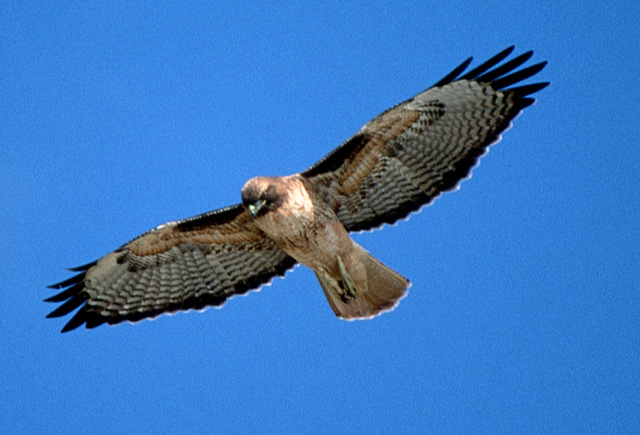
You know I’ve been trying to attract some crows and ravens. No luck yet. I’ve gone to plan Q which is probably what most people would do for plan A–just put up a bird feeder with cat food in it. Except I haven’t gotten around to erecting the whole apparatus. So no crows or ravens yet. But I have been able to attract the attention of a pair of hawks.
At first I thought they were protecting their nest. A pair of doughty parents. But I’ve looked about and can’t find any nest. Furthermore, they don’t always pull their stunt in the same area. And so I’m beginning to suspect they’re toying with me.
Here’s what happens. I go on my hike and while I’m walking in place at the beginning of a new interval, looking out over the magnificent mountain vistas and contemplating important things like cheese, one of these hooligans will sneak dive bomb me from behind. At the last moment the bird will pull up making a huge WAAAHOOOF sound with its wings that sends my heart racing even faster than it already is. It’s like someone taking a huge broom and swinging it at speed three inches from the back of your head.
Yesterday, I saw them off to the right at about 100 yards, calling out, making that piercing cry. I thought—ha! they’re over there. But THEY weren’t. It was only one of them. The other guy was between me and the sun. And so I’m hiking along minding my own business and WHAAAHOOOF! I just about had a heart attack.
I’ve caught one diving at me once. It’s an amazing thing to see a bird of that size hurtling from the sky straight at your head. And I would welcome such an experience again. But they just won’t perform. No, they’ve got to blindside me.
This week I’m going to get a picture of the low-budget criminals and post it here.
Here, watch this book trailer for Scott Westerfield’s Leviathan.
Yeah, I know you want to–go ahead, watch it again.
Miller looks at book trailers, sees that the vast majority of them are lame, lame, lame (actually, this is the FIRST I’ve seen that’s any good). Sees that they reach no markets and then concludes that all trailers are silly. It’s true: lame trailers ARE a waste of time and money. But ANY advertisement (print, video, audio, whatever) that’s lame is a waste of time and money. Making killer trailers that nobody sees is an even bigger waste of time and money. But that’s true of ANY killer advertisement that nobody sees.
Look. I’ve never read Westerfield. Don’t know much about him or his books. But I saw that clip and now want to read that book. Hum, trailer worked for me. I AM a reptoid mutant, but I suspect there are others out there like me. I mean, come on. Good gravy, woman–“Do you oil your war machines? Or do you feed them?” Killer!
Movie trailers, book trailers–any advertisement–isn’t about delivering what the person is going to experience on the spot. If that were the case, then you’d never show a print ad of a meal at Olive Garden because it doesn’t deliver the goods right there on page 10 of Woman’s Day. Nope, all you’d do is go around giving out samples in places with Italian mood.
Miller’s error is not understanding the difference between making an offer and delivering on one. What an ad is supposed to do is make the offer. Let you know this thing is available. Because you’re not delivering the actual experience, you can make the offer via all sorts of media. Now, if you can give them a taste, that’s great. But you don’t need to deliver the full deal right there.
So what do you need in an offer? You need the offer to say, “Hey, I’ll deliver this type of experience.” It needs to call to some action, either directly or by implication–“buy this” or “be here.” You also need it to say, “You can trust this will be worth it” and make the consumer believe that’s likely to be true. It communicates this last bit by being a quality piece of work.
Making an offer is exactly what book covers do–they make the offer and give the consumer a little taste. And book covers matter. This has been proven over and over. Just like most people, when I see a cool cover, I pick up the book and check it out. When I see a lame one, or one that offers something I’m not interested in, you’re going to have to threaten me to pick that book up. Or it better dang well have some righteous word of mouth. It’s that simple. We all judge books by their covers because the cover is making an offer. And lame offers don’t get very many takers.
Book trailers are nothing more than deluxe book covers. The cool thing about them is the cool thing about movie trailers–you can make the offer by providing a little taste. You do that by giving the audience the story situation, the pitch. You do it by communicating the feel of the experience and raising curiosity. You do it by making it a pro job. The good ones make you laugh, say cool!, or raise curiosity and expectation.
And that Westerfield trailer does that.
Dang, “Do you oil your machines? Or do you feed them?”
Run that on TV. Run it on the radio. Put it up on sites where people are likely to see and click. Confirm it in print. Make the offer to real people. Get it infront of young readers. I’ll stake my eyebrows that ad can sell as many books as a good movie trailer can sell movie tickets.
Very effective advertising for the book. I think the content of the book is crap, but that trailer made me pick it up just to see what it was all about.
Do you notice that this one and the Westerfield one combine extreme professionalism AND they make the pitch in a clear and grabbing way? The pitch for both was what the book was about. For fiction it’s the concept. For non-fiction how to it’s the promise.
So many of the book trailers lack one or more of those things. For example, look at the book award finalist for THE FALLEN: http://www.youtube.com/watch?v=vsLE6bNaIrk. I don’t know what the heck the book is even about after a long 2 minutes. They’re trying to make a movie.
Something else. On both of these you have a voice over PITCHING the book to you just as someone might do it in person or to an editor. It’s a powerful method, I think.
Notice also how short the Westerfield one is. Just over a minute. Westerfield’s really is like a query pitch or cover copy–in just a few lines tell me what your story is about. We get genre, setting, character, and the story problem or concept.
We all know about the placebo effect. Well, here’s its ugly brother.
nocebo (no-SEE-bo) noun: A substance producing harmful effects in someone because it is believed to be harmful, but which in reality is harmless. [From Latin nocebo (I will harm), from nocere (to harm). Modeled after placebo (I will please).]
Both groups who received nocebos showed elevated levels of the stress hormone cortisol in their blood.” James Morgan; Is Your Pain a Trick of the Mind? The Herald (Glasgow, UK); Jan 12, 2007.
An article with many interesting examples of nocebo effect.
I got my masters degree in accounting and information systems. While going to school I started an investment club and learned about a man named Warren Buffett.
Warren Buffett is humble, full of folksy humor, and trades places with Bill Gates as the richest man in the world, depending on the year you’re counting. His annual letters to his shareholders are a delight to read. This year’s is full of wisdom about the current financial crisis. Moreover, within a few minutes of reading you will be able to get some key insights that can help as you evaluate the plans being hatched in Washington and how to prevent this particular type of crisis from happening again.
If you’re not that into finance, I recommend reading:
The introduction starting on page 2 and ending on page 3
The “Finance and Financial Products” section starting on page 10 and running through page 12
Once you’ve read those, if you want to laugh and see Buffet’s humor, skip to page 21 where Buffett talks about the annual meeting of shareholders. Tell me you wouldn’t want to attend.