In writing, profanity is a tool, but not the only tool

In this week’s Writing Excuses comments, a poster named Sam asked:

How do you, as writers, get past your own inhibitions concerning the use of profanity in order to write a character who does use it?

Why get past them?

Any given audience has values (as do you as a writer). Stomp on the values too much and you will make the readers so uncomfortable or angry that their discomfort will outweigh the draw of the story. They will put you down and never read you again. For one audience it’s gore. Another it’s explicit sex or vulgarity. For another it’s the bashing of a political stance or a particular demographic.

If you or your audience is uncomfortable with profanity then say “he swore” OR find another way to convey the information the profanity does.

Writing works by evoking types in the reader’s mind (as well as type resistors for surprise, curiosity, humor, etc.). Trigger a type and all the data associated with that type comes with it. Profanity is one way to trigger a type (or work against type) in the reader’s mind. But there are many other ways to evoke that same type, many ways to produce the same effect. Language, especially profanity, is a powerful and efficient method, but it’s not the only one.

You want a mean cruel man? You can have him call his wife a “cu**” all the time. OR you can just show him doing something cruel to her or slapping her, e.g. he grabs her by the neck and makes her look at the food on his plate up close like some pet owners do to dogs when they crap where they shouldn’t–”Does that look like beef stroganoff to you? Stupid whore.”

Look at Prison Break. Teddy needed to be scary. Profanity could have helped trigger his character. After all, cons use a lot of profanity. But Prison Break was prime time so the writers used other things to evoke the types they needed. Teddy worked for the purposes of that story. All of the cons did. They were believable. And all that without a deluge of profanity.

Stay away from replacement profanity that evokes a different type. For example, if you had Teddy using “darn it” all the time, unless it was part of some particular character attribute, it would have not been believable because it evokes the wrong type, e.g. Ned Flanders.

So if you don’t want to use profanity, don’t. Think about your objective and find another type trigger.

Share

Similar Posts

  • More Great Questions for Story Development: Governments

    Part of my model of the creative process is that it’s driven by questions. We come up with creative solutions in response to a problem. The problem triggers the process.

    Let me give an example. Let’s say I have a character named Bill who lives out in space salvaging parts of space ships and other things. Or maybe he’s on some planet.

    I don’t have a story yet. I’ve just got a dude in a general situation. I lack all the necessary parts. That lack is a problem to me as a writer. To develop the story, I state the problem as a question and begin generating options.

    So I might ask, what are the threats Bill faces on a physical and social level? Are there mysteries he encounters? Who else is there? In order to answer those questions I might need to ask what’s the planet like?

    At some point in time, I’ll feel I have generated enough answers for the key questions that it’s time to draft. When I begin to draft, I have other tasks or problems to solve. I might ask things like what’s the goal of this scene? What’s an interesting way to start and end it? What’s something surprising and bad that might happen as a result of the character’s action?

    It’s all question and answer.

    Towards the end of this week’s Writing Excuses on World Building Governments the guys share some great questions you might find fruitful when thinking about your world’s government.

    Share
  • Media and Teenage Sexuality

    I don’t know how it’s possible to aruge that media does not influence our decisions. The evidience is simply overwhelming. Here’s another report of a study linking media sexuality to teenage decisions about sexuality.

    “CHICAGO — Groundbreaking research suggests that pregnancy rates are much higher among teens who watch a lot of TV with sexual dialogue and behavior than among those who have tamer viewing tastes.” Full article here.

    The study shows that while teenage pregnancies have dropped overall, those teens watching racey shows had, not just a small incremental risk, but TWICE the risk of getting pregnant.

    Now, I know this article by the Guttmacher Institute focuses on the 1990’s, but it still is enlightening. It discusses the reasons for the dropping teenage pregnancy rates during those years. It’s conclusion is that both abstinence and usage of more effective contraception are the main factors for the drop in teenage pregnancies.

    When I put the two articles together, it makes me wonder if the racey shows are encouraging more sex among the teens who watch them or the use of less-effective contraception or both. My guess is that the shows are influencing a decision for more sexuality.

    Either way, what does this mean for a writer?

    To me, it means that while I’m never responsible for someone’s actions nor in 100% control of what people take from my writing, I AM responsible for those things I know are highly likely to influence folks one way or another. I hope my works provide a wonderfully entertaining experience, but also avoid influencing people into decisions that will lead them down paths that will limit their happiness.

    Share
  • “Would I be more excited about this book if I…”

    As new writers we want to do our best but because we haven’t yet internalized all the principles, we often want to create checklists of rules. We want to list out all the the aspects of a golden story and make sure we include them.  And these lists can help.

    Everything I’ve learned about building expertise suggests that experts have internalized guidelines, patterns, and concepts. But in the beginning we don’t have those internal constructs. And so we often are benefited by exetrnal support in the form of diagrams, lists, etc. Sooner or later we internalize. And what used to be conscious becomes automatic.

    Case in point: Dean Koontz. In his book on how to write best sellers he states in so many words that you’d be in idiot not to have an outline. That was back in the late 1970’s. In an interview almost 30 years later about his Odd Thomas books, he says he never outlines. I suspect he’s so familiar with the form outlines are redundant for him now.

    So lists can be good. But lists can also hinder us if we’re not careful.

    For example, James Maxey, a great author, likes characters with dark secrets. He states: “One of my tricks for making my characters interesting is that the primary characters are usually motivated by a dark secret. Vendevorex in Bitterwood desperately does not want Jandra to learn that he killed her parents. Rail Blade in Nobody Gets the Girl doesn’t want anyone to know that she killed her brother with her superpowers in a moment of anger when she was still young. The key revelation for me is that the thing that the world most wants to know about a person is often the thing that a person least wants anyone to know.”

    Dark secrets are kind of cool, right?

    But if we then said, okay, a great story must have a character with a dark secret, and we put that on our list, that’s when we start to work against ourselves. The “must” is the problem.

    Not because we don’t have tests and guidelines. Tests assume objectives. And I, for one, certainly do have objectives for my books as a whole an in their various parts. For example, I sure as heck want to make sure my opening chapter starts with a strong draw. I sure as heck want an ending that leaves me feeling some poignancy, cosolation, and a telescoping of possibilities. I most definitely want characters that intrigue me. I have some definite musts.

    But any one of the techniques or elements we might list (dark secrets, 3 acts, 7 acts, the players in Campbell’s “Hero’s Journey,” characters with an internal problem, etc. and ad infinitum) are nothing more than options that might or might not serve any given objective. They’re not necessary (of course, monkeys may be necessary). And I don’t mean that in an anomaly way.

    I’m not suggesting it’s counterproductive to say, well, I love characters [fill in the blank] or plots that [fill in the blank] and I want one in this novel. I’m saying if we begin to think that all (or most) good novels must have these elements, then I think we’ll end up limiting ourselves.

    So when you find something that works, when you hear about a technique, or some writerly rule, put it on your list of option prompts. Not on your list of must haves. And then ask this creative question, which I got from another great author, Luc Reid: “Would I be more excited about this book if I…”

    Another version might be: “Would I care about and believe in this story/character/scene/etc. more if I…”

    Would I care about and believe in this story more if had a character with this [insert option]? Would I care more if this plot line had [insert option]? Would I believe the story more if there were monkeys hiding in the attic?

    If the answer is yes, then add it. If the answer is no or maybe, then put it aside. That option can go back on the shelf for another time.

    Share
  • Indie Thoughts: What drives book sales?

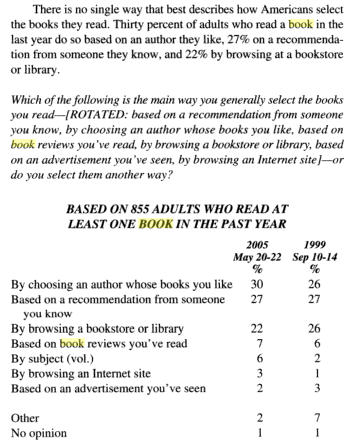
    gallup-poll-how-readers-select-booksWhat are the biggest factors influencing which book a person will read next?

    Many surveys have been conducted over the years to answer just that question. I’ve pasted one on the right and summarize the results of others here. One factor sits at the top of almost all of those surveys. Did you look at those other surveys? According to these surveys, folks tend to buy books by authors they already like.

    This phenomenon is called a lot of things. One of the most common is “brand loyalty.” Some might be wondering how you define a brand and what could be branded in publishing. KKR has a great piece here that answers those questions.

    So brand loyalty. How does it develop? Well, any time you please readers, their loyalty grows and inches them toward the loyal fan end of the spectrum. Your brand may not have the power of a Dean Koontz because you don’t have near the number of loyal customers as Koontz, but you still have a brand. And people who like your stuff are going to be loyal to some degree, but not the same degree.

    I think that last point is important to remember: readers that know and like your brand won’t all have the same degree of loyalty.

    You have hard-core fans who are totally dedicated to you and make an effort to know what’s happening. You’ve pleased them so much, your brand is gold to them.

    You have others who will buy your book the minute they hear it’s out, but don’t make an active effort to keep up to date on things.

    There are others who will mark it to be read when they hear about it, but don’t make a big effort to get it unless it’s convenient.

    You have others who like your stuff but are still in that period where they like but haven’t yet committed to being a fan. That sometimes may take a few books.

    That’s how it was with me and Lee Child. I read the first and liked it. Some time later I saw another and was predisposed to like it. I read that one and liked it too. I wasn’t a Child fan yet. But then I read the third. And that’s when I became a true fan. I’m not hard-core. But I now read everything he puts out within a few months of the release.

    From what I can see, branding and brand loyalty matter no less in publishing than they do in any business where you’re relying on repeat customers.

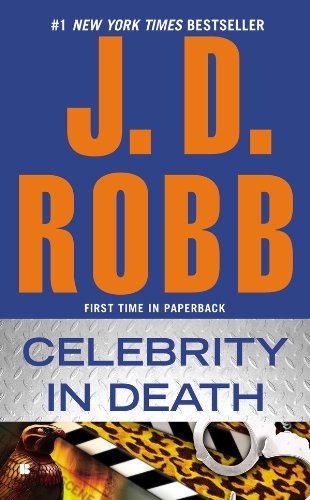
    JD Robb Celebrity in DeathI see the effect of brand loyalty all over. It was the force behind the dramatic explosion of sales when it was revealed that Robert Galbraith, the author of The Cuckoo’s Calling, was J.K. Rowling. It was the force behind the midnight book store events when Stephanie Meyer would release a Twilight book (and the Twilight balls). And other similar events with many other authors. It’s the reason why publishers make the names of a lot of authors so prominent on the cover. Good grief, sometimes that’s all you need. Look at some of the Nora Roberts or JD Robb covers. On many of those the name, the brand, takes up 75% of the cover. You can see customer loyalty blossoming in reviews on GoodReads and Amazon and elsewhere where readers say in essence, “I loved this author and I will be looking for the next book.”

    Building a base of loyal customers is they goal in businesses that rely on repeat sales. Because not only do those folks come back for more, but the also tell other folks about the product.

    Go back an look at those surveys. What was usually the number two reason someone selected a book?

    Word of mouth.

    Word of mouth comes in many forms. Recommendations from folks you know. Recommendations from other influencers–folks like Rush Limbaugh or review sites you frequent. Recommendations from some other type of social influence mechanism like a bestseller list on Amazon.

    The key takeaway for me is that top two factors driving book sales all stem from a loyal customer base. Which means building that base should be one of my main goals as a writer.

    So how do you do that?

    The same way everyone else in a repeat customer business does it. At a general level, you:

    1. Create a product (a book in this case) that’s likely to delight a certain set of consumers (readers).
    2. Let those consumers (readers) know about it.
    3. Make it enticing for them to give it a try.
    4. Make it easy for those who liked it to know when they can get another.
    5. Get more product (another book that’s similar to the last) out the door so your repeat customers can come back for more.

    I’ll be sharing more of my ideas about aspects of those five steps in upcoming posts. And I’ll be wanting to hear what you’ve found that works. Because ultimately we’re all testing various strategies. And the more we share with each other, the more we’ll each benefit.

    While you’re waiting, you might want to look at an awesome book on customer loyalty called The Loyalty Effect by Frederick F. Reichheld.

    Share