Indie Thoughts: What drives book sales?

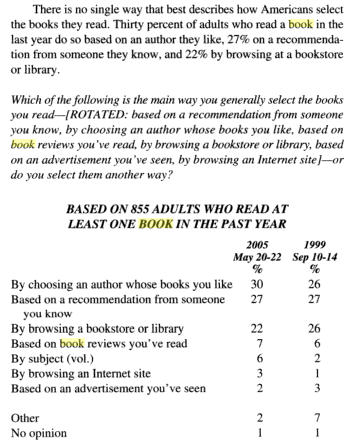
gallup-poll-how-readers-select-booksWhat are the biggest factors influencing which book a person will read next?

Many surveys have been conducted over the years to answer just that question. I’ve pasted one on the right and summarize the results of others here. One factor sits at the top of almost all of those surveys. Did you look at those other surveys? According to these surveys, folks tend to buy books by authors they already like.

This phenomenon is called a lot of things. One of the most common is “brand loyalty.” Some might be wondering how you define a brand and what could be branded in publishing. KKR has a great piece here that answers those questions.

So brand loyalty. How does it develop? Well, any time you please readers, their loyalty grows and inches them toward the loyal fan end of the spectrum. Your brand may not have the power of a Dean Koontz because you don’t have near the number of loyal customers as Koontz, but you still have a brand. And people who like your stuff are going to be loyal to some degree, but not the same degree.

I think that last point is important to remember: readers that know and like your brand won’t all have the same degree of loyalty.

You have hard-core fans who are totally dedicated to you and make an effort to know what’s happening. You’ve pleased them so much, your brand is gold to them.

You have others who will buy your book the minute they hear it’s out, but don’t make an active effort to keep up to date on things.

There are others who will mark it to be read when they hear about it, but don’t make a big effort to get it unless it’s convenient.

You have others who like your stuff but are still in that period where they like but haven’t yet committed to being a fan. That sometimes may take a few books.

That’s how it was with me and Lee Child. I read the first and liked it. Some time later I saw another and was predisposed to like it. I read that one and liked it too. I wasn’t a Child fan yet. But then I read the third. And that’s when I became a true fan. I’m not hard-core. But I now read everything he puts out within a few months of the release.

From what I can see, branding and brand loyalty matter no less in publishing than they do in any business where you’re relying on repeat customers.

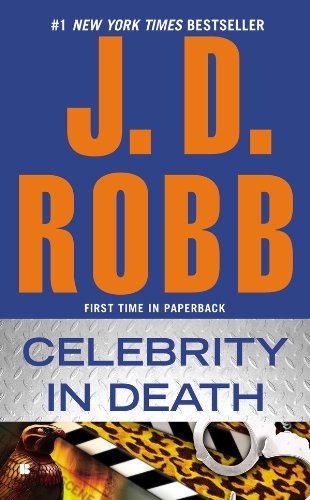
JD Robb Celebrity in DeathI see the effect of brand loyalty all over. It was the force behind the dramatic explosion of sales when it was revealed that Robert Galbraith, the author of The Cuckoo’s Calling, was J.K. Rowling. It was the force behind the midnight book store events when Stephanie Meyer would release a Twilight book (and the Twilight balls). And other similar events with many other authors. It’s the reason why publishers make the names of a lot of authors so prominent on the cover. Good grief, sometimes that’s all you need. Look at some of the Nora Roberts or JD Robb covers. On many of those the name, the brand, takes up 75% of the cover. You can see customer loyalty blossoming in reviews on GoodReads and Amazon and elsewhere where readers say in essence, “I loved this author and I will be looking for the next book.”

Building a base of loyal customers is they goal in businesses that rely on repeat sales. Because not only do those folks come back for more, but the also tell other folks about the product.

Go back an look at those surveys. What was usually the number two reason someone selected a book?

Word of mouth.

Word of mouth comes in many forms. Recommendations from folks you know. Recommendations from other influencers–folks like Rush Limbaugh or review sites you frequent. Recommendations from some other type of social influence mechanism like a bestseller list on Amazon.

The key takeaway for me is that top two factors driving book sales all stem from a loyal customer base. Which means building that base should be one of my main goals as a writer.

So how do you do that?

The same way everyone else in a repeat customer business does it. At a general level, you:

  1. Create a product (a book in this case) that’s likely to delight a certain set of consumers (readers).
  2. Let those consumers (readers) know about it.
  3. Make it enticing for them to give it a try.
  4. Make it easy for those who liked it to know when they can get another.
  5. Get more product (another book that’s similar to the last) out the door so your repeat customers can come back for more.

I’ll be sharing more of my ideas about aspects of those five steps in upcoming posts. And I’ll be wanting to hear what you’ve found that works. Because ultimately we’re all testing various strategies. And the more we share with each other, the more we’ll each benefit.

While you’re waiting, you might want to look at an awesome book on customer loyalty called The Loyalty Effect by Frederick F. Reichheld.

Share

Similar Posts

  • |

    Indie Thoughts: Publishers know profit, but haven’t tapped best seller lists

    In The Business Rusch: Generational Divide Kris Rusch points out that the new on-demand and long-tail market for books has changed the duration of the opportunity a book has to be successful, but that it seems the industry still isn’t recognizing this in how they measure success.

    The problems come from the fact that those of us who run things—people in our forties, fifties, and sixties—use metrics that were developed by our parents for their world, that tightly controlled Mad Men world where everyone was expected to be the same, not just in what they wore or bought but in what they listened to or watched or read as well.

    The bestseller list?

    It measures velocity. (A good essay on this topic, “The Meaningless Metrics of Fame,”  came from Mike Briggs, husband of Patricia Briggs, earlier this week. I’ve also dealt with it.)

    Reviews?

    They only want new books, and then only at the time of release.

    Brick and mortar bookstores?

    They only have room for the latest releases, and then only the ones that are the most popular with their customers (whoever those folks might be).

    Books have come late to this fight. Books have been available on demand for only about four years now, in the U.S. In other countries, there’s been even less time.

    And we’re all still fighting over meaningless metrics, to use Mike Briggs’ term, because those metrics only measure things that were important around the water cooler, not things which are important now.

    What’s important now?

    She goes on to say:

    The publishing industry isn’t even talking about new metrics. That idea hasn’t occurred to traditional publishing, and indie (or self) published writers are constantly seeking validation from the old system—trying to figure out ways to game the bestseller lists or to get a fantastic review from somewhere that has old-world prestige . . . But at some point, traditional publishers are going to have to develop new ways to figure out which products sell well and which ones don’t. All of their systems—from sales figures (which measure books shipped not books sold) to bestseller lists to critical acclaim—are based on the old models.

    Kris is a very experienced with publishing, but her last point conflates internal accounting with marketing. Publishers DO know which products sell.

    The primary measure of success in a financial enterprise s not new. It’s been around for 100’s of years. And on demand and long-tail markets don’t change it.

    The measure is how much a product or service contributes in profit to the bottom line. You take revenues, minus expenses, and that’s the contribution that product (a book in this instance) makes to your total profit. Or to covering your fixed costs.

    Booksellers have measured the success of their books with actual or estimated profits for quite some time. Publishers already know which books sell well and which don’t. No accountant in the world is going to report books shipped as the measure of success. And they don’t. The very fact that publishers have a profit and loss statement and show returns on royalty statements demonstrate that. They look very closely at actual and estimated profits. And to they do this by channel, which is reflected in a small way when they break out ebooks on royalty reports. This is all basic accounting.

    Here’s an example. Until Ender’s Game the movie, Ender’s Game the book hadn’t appeared on any best seller list since it was first released. And its release was 30 years ago! Yet over the years Tom Doherty touted its sales numbers many times. Tom knew that book was gold. Of course, he did. Because he doesn’t use best seller lists to tell him what’s selling well. He knows those lists are marketing devices. He has the real data in house. Why would he need a list to tell him anything?

    And Tom isn’t going to use books shipped either. Tor may report those numbers to Publishers Weekly for marketing purposes, but he will always multiply that number by an expected return rate to estimate sales. He wants to do that. Because books shipped is meaningless to the bottom line and everyone knows it, including the auditors.

    Publishers are well aware of the long tail. They see it with books that have been rotated out of the brick and mortar channels but are still selling in the online ones. They report it in their annual statements. They know the online channels work differently from the brick & mortar ones.

    The measure of success is still the same as it ever was—how much profit is this property contributing to our bottom line?

    Marketing, however, is a whole other ball of wax.

    What the long tail and on-demand allow are marketing campaigns that are impossible in the brick & mortar channel. In brick & mortar you have a limited time to advertise (roughly 8-15 weeks). After that period, most books are rotated out of the store. This means that any marketing for those brick & mortar buyers MUST coincide with the period when the books are in the stores.

    But the online channels open up all sorts of other opportunities. You can market forever. And the contribution margin is always positive. The online and POD costs are easily recouped with each sale. (Publishers are well aware of this profit potential; this is why we have so many making grabs for backlists.)

    And I see publishers taking advantage of these new marketing methods. This last week I saw publisher books not currently stocked by brick & mortar retailers on BookBub, BargainBooksy, and Book Sends. And the industry isn’t totally focused on new books for reviews. I just had a large newspaper agree to look at my book that was published four months ago. Still, Rusch is right when she says that the publishers haven’t adapted one of their biggest marketing tools to take advantage of the new opportunities–they haven’t done anything with the best seller lists.

    Amazon has lead the way in creating new ways of marketing books to different types of readers with their best seller lists. These lists create the excitement of discovery.

    But every one else is still reporting weekly sales on the big lists.

    If I were a publisher, I’d be asking USA Today to provide more than just the weekly view of the top 150 books. And USA Today is THE list to watch because their numbers are not based on units shipped to a sample of stores, but actual sales. Here are some lists that readers would be interested in.

    1. Most anticipated this week: based on pre-order totals
    2. Most anticipated this month: based on pre-order totals
    3. Hot new releases: based on weekly numbers
    4. Hot new releases for the month: based on monthly numbers
    5. Books with legs: last 3 months; I know it needs a different name (grin)
    6. Best sellers of the last 12 months: annual total of units sold
    7. Best sellers of the last 18 months: total units
    8. Contenders: for each of the lists above show the next 150 books (I always want to see the next 100 books after the top 100 on Amazon’s lists; why not show readers the top 300?)
    9. Movers: for each of the lists above show those that have the biggest rise in percentage sales and meet some unit minimum (you don’t want to feature books with 2,000% increase because they went from selling 1 unit to 20), even if they don’t break the best seller lists
    10. Genre: allow all of this to be sliced by genre.

    Let the reader select the view they want to see!

    Avid readers will gravitate towards the shorter time periods. Those that read fewer books will gravitate towards the longer periods. Everyone who wants to discover something new will go to the contender and mover lists.

    This is about marketing. Not publishers measuring success.

    And then armed with those numbers guess what the publishers will do? They will go back to the brick & mortar venues and pitch to have some of these same books carried in the stores for the first time (some publisher books are printed digital first) or carried again.

    Share
  • Washington Irving, Family, & Writing

    How do writers juggle writing and family?

    One of my heroes is Mary Higgins Clark who, as a single mom, started a career. She got up very early, wrote for 1-2 hours in the morning, and became a mega-seller.

    I have four girls. And a full-time job. When the first two were little my wife was working and I was Mr. Mom going to school. Then we switched.

    Here’s my experience. While I love writing, my stories do not run to me and give me wonderful strangling hugs after school like my youngest. While I laugh at the humor I come up with in my stories and enjoy it, it cannot replace the uncontrollable giggling I experience when I go on dates with my second. While writing lifts me, it does not fill my office with notes and wallpapers of love like my oldest. And writing never drags me out to play ghosts in the graveyard or hide and seek–daughter #3. Nor will my stories and novels be there for me when I’m old.

    While writing is incredibly fulfilling, my wife, kids, and other relationships are a joy it cannot replace.

    What all this means is that I try to recognize that I can’t let family and writing compete. They can’t be equal priorities. Family comes first. But this doesn’t mean I don’t write. I block out times to write. These are my writing times. I get up early to make time for this. I don’t watch a lot of TV. I don’t read a million blogs, nor, alas, can I read fiction at the level I used to. I make time. But I also make blocks when I just forget writing (even though it can be hard).

    Specifically, here’s my average work week.

    5:00 AM rise, wake and get centered for the day
    6:00 AM work (“work” is my day job and writing)
    6:30 AM family and breakfast
    7:30 AM go to work (at home). Try to get in 7-8 hours at day job and 2 hours writing. When I did commute I wrote for 1 hour during lunch and 1 hour in the morning before I went to work. Then I’d take a 2 hour block on Thursdays.
    5:30 PM family etc.
    9:30 PM bed

    On Saturdays I get a few more hours writing. Sunday I forget everything but family.

    With the new book contract I have to become a bit more creative. But if it ever comes down to sacrifice the last 2 years of my oldest being at home and writing, well, the books will go.

    When my writing plans meet reality, I try to adjust and find other slots for writing. It wasn’t easy in the beginning, but it’s become much easier. And I don’t worry about what I might have accomplished in writing if I’d just had the extra time. Such what-if’s, I’ve found, are almost always poisonous. And who the heck cares? Because while I want to write wonderful stories, I think the greatest loss I think I might experience at the end of my life (believing in an after life or not) is looking back and seeing that I traded the opportunity for wonderful relationships for a rapidly mouldering spot on the shelves.

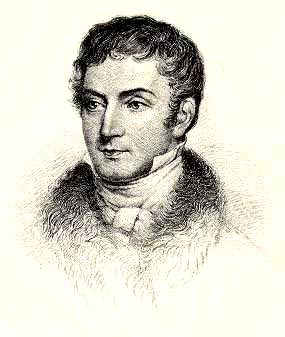
    Washington Irving wrote a funny and wonderful piece on this mouldering in his “The Mutability of Literature” in THE SKETCHBOOK OF GEOFFERY CRAYON. I recommend every writer read this to put life and writing into perspective.

    Share
  • The main thing about villains

    The main role of villains and antagonists in stories is to generate suspense, anxiety, and fear in the reader. They make it possible for us to worry that the hero will not be able to avoid a significant threat or remove a lack. There are other effects–mystery, poignancy (about the human situation like in Les Mis). But those are secondary.

    For the main things to happen the villain has to be a credible, significant, and immediate threat…all the way through the book until he or she is smushed or wins.

    If he’s not credible, the reader realizes there is no real threat. If the threat is not significant, who cares? If it’s not immediate, again, who cares?

    So how do we make a villain like that? We make him or her smart, powerful, a few steps ahead of the hero, and dedicated to doing something we root against (because it’s just plain wrong or because we love our hero and want the best for him and the villain is pitted against him). He has to be able to put the hero on his heels most of the way through the book, and our poor hero is scrambling to adjust.

    You can have all sorts of villains–liked by many or few, kooky or calculating, eccentric or plain, noble or sadistic–just as long as they remain significant, immediate, and credible threats. The minute they lose threat status, the game’s over because at that point fear, anxiety, and suspense in the reader vanish.

    Share
  • Who Will Play in The eBook Supply Chain?

    I was reading this Konrath post by Barry Eisler on the “Attack of the self-publishing memes” in which he argues that there isn’t an inherent conflict of interest for agents to also help authors epub their books. This got me thinking about the steps (tasks) in the current supply chain, who was going to provide them, and where the biggest value lay.

    Here’s the process right now as I understand it from manuscript to reader. The numbers are only task identifiers and don’t represent sequential order in every case, although I did try to sort them that way.

    PAPER CHANNEL TASKS THROUGH BRICK & MORTAR OUTLETS

    SELL MANUSCRIPT TO PUBLISHER
    1. Promote manuscript to editor at publisher
    2. Negotiate contract with publisher

    EDIT MANUSCRIPT
    3. Story edit manuscript
    4. Revise for story edits
    5. Copy edit manuscript
    6. Revise for copy edits

    PREPARE BOOK
    7. Create cover design and art (a marketing/advertising function)
    8. Obtain ISBN
    9. Typeset book
    10. Print book

    MARKET BOOK TO WHOLESALERS, RETAILERS, AND LIBRARIES
    11. Establish book selling hierarchy (lead book, second lead, etc.)
    12. Obtain reviews from trade publications, newspapers, websites, authors, etc.
    13. Create sales catalog and other sales documents
    14. Contact book buyers and promote books (calls, visits, conferences, etc.)
    15. Take orders

    DISTRIBUTE BOOK
    16. Ship to retail outlets and wholesalers
    17. Warehouse book
    18. Process reader purchases & returns

    PROMOTE BOOK TO TARGET AUDIENCE
    19. Publicity, including free copies
    20. Advertising
    21. Co-op display purchases

    SELF-PUB EBOOK AND POD PAPER CHANNEL TASKS

    EDIT MANUSCRIPT
    1. Story edit manuscript
    2. Revise for story edits
    3. Copy edit manuscript
    4. Revise for copy edits

    PREPARE BOOK
    5. Create cover design and art (which you could lump under marketing)
    6. Obtain ISBN
    7. Format book for ereaders and POD services (CreateSpace etc.)

    DISTRIBUTE BOOK
    8. Upload book to retail and library outlets
    9. Warehouse the bytes
    10. Process reader purchases & returns

    MARKET BOOK TO LIBRARIES AND TARGET AUDIENCE
    11. Obtaining reviews from trade publications, newspapers, websites, authors, etc.
    12. Publicity, including free copies
    13. Advertising, including website display etc.

    AUDIO BOOK CHANNEL TASKS
    There are actually two channels here–physical audio books (CDs) and downloads (Audible, etc.).

    I would assume the physical audio would follow the marketing, distributing, and promoting aspects of the paper channel tasks and add in the audio production tasks. Downloadable audio would follow the marketing of the ebooks and add in the audio production tasks.

    THOUGHTS
    I’m sure I’m missing some key steps somewhere. Somebody please supply them if you see gaps.

    As for the future, here’s what I see. The paper channel tasks aren’t going to change much. Nor do I think the people performing the various tasks will either. For example, I just don’t think POD machines are going to catch on in stores and wipe out distributors. They may take out printers (#10) of trade and mass market paperbacks. But I haven’t seen a POD machine that can do hardbacks. Maybe the PODs will move to the retail outlets. But I don’t think so. Somebody disabuse me of the notion.

    However, I do think there will be some interesting developments in the ebook/POD channel.

    Right now a lot of authors are spending time performing tasks 6, 7, and 8. Some literary agencies are wanting to charge 15% forever for those steps with maybe a little cover design. But tasks 6-8 are the tasks that require the least amount of skill and will soon be automated.

    Formatting for ebooks now is like coding html was for webpages 10 years ago–people in the code spending hours tweaking crap. Right now it takes you about a day to learn how to format a novel for the various ebook readers. Once you know how to do it, you’ll spend a day, maybe two, formatting your novel and uploading it. Or you can pay someone else to do it–any responsible teenager will do.

    But within the next year I predict an application coming (if it’s not already here) that will hook into Word and other programs that will make the labor obsolete. Creating a Kindle document will be like creating a PDF document in Word today—you just click Save.

    Uploading could be automated as well across various sites with some application. But it’s fairly easy now.

    So for which tasks are these ebook distributors wanting to charge 15% forever? Obtaining an ISBN?

    I don’t even think they even do that.

    Amazon and the other ebook retailers have a lock on 9 & 10. It would be incredibly hard to dislodge those gorillas. So I think the place where literary agencies and others who want to play in the indie ebook/POD supply chain are going to flourish is in the other tasks that require the most skills–editing, cover art, and marketing, which I’ve marked in blue.

    Authors interested in the indie ebook/POD channel are going to want service providers who can deliver great editing, cover art, and marketing. They’re going to want folks who can help them sell into traditional domestic and foreign paper distribution channels. They’re going to want folks who can help them sell rights to other buyers–audio, film, etc.  And they’re going to want help with their contracts.

    If I were an agency, graphic artist, editor, intellectual rights lawyer, or some other entrepreneur trying to serve indie ebook/POD authors, that’s where I’d spend my time.

    Dystel & Goodrich literary agency recently announced they would do something like this . . . almost.

    Over the past months and years we’ve come to the realization that e-publishing is yet another area in which we can be of service to our clients as literary agents. From authors who want to have their work available once the physical edition has gone out of print and the rights have reverted, to those whose books we believe in and feel passionately about but couldn’t sell—oftentimes, after approaching 20 or more houses—we realized that part of our job as agents in this new publishing milieu is to facilitate these works being made available as e-books and through POD and other editions.

    Right now, you’re thinking, oh, DGLM is going to be another of those agencies that has decided to become an e-publisher and charge clients whose books they can’t sell 50% of their income for the privilege of uploading their work. Some of you may be mumbling, “Uh…that’s a conflict of interest.” We get it and we understand how that can be the perception. However, we have no intention of becoming e-publishers. As we said above, we have too much respect for the work that publishers do and too much respect for the work we ourselves do to muddy the waters in such a way.

    Again, what we are going to do is to facilitate e-publishing for those of our clients who decide that they want to go this route, after consultation and strategizing about whether they should try traditional publishing first or perhaps simply set aside the current book and move on to the next. We will charge a 15% commission for our services in helping them project manage everything from choosing a cover artist to working with a copyeditor to uploading their work. We will continue to negotiate all agreements that may ensue as a result of e-publishing, try to place subsidiary rights where applicable, collect monies and review statements to make sure the author is being paid. In short, we will continue to be agents and do the myriad things that agents do.

    Our intention is to keep on trying to find books we think we can sell to traditional publishing houses, to negotiate the best deal (always), and to give our authors as many options as we can. Because we will continue to be commission-based, we will not be automatically pushing authors into e-publishing. Again, we want to give our authors options and empower them to do what they set out to do all along: have their work read by the largest possible audience

    However, from what I understand they’re not offering to perform the necessary tasks for 15% forever, only the project management of the tasks. Which means the author will still be paying for the editing and cover art and marketing.

    15% forever for project management (a list of to-do’s in this case) and a service provider contact list? Where the author still pays for the editing, cover design and art, and marketing?

    Ummmmm, no.

    Others like D&G will pop up. But the ones that indie authors will eventually go to will be those that deliver on the high-skill tasks for reasonable rates.  Those will be the ones playing in the ebook supply chain of the future.

    Many authors will contract the tasks separately themselves.  But a lot of authors won’t want to do that. They’ll want a one-stop-shop. Or one that does most of it. Some of those one-stop-shops will charge an upfront fee and will probably accept anyone who can pay. Others will make most of their money on a % of the sales to readers and libraries, footing the initial costs of the tasks, and will only work with clients they think will pay out, which if you think about it isn’t really an idie (self-pub) model at all. That’s the space traditional publishers play in right now.

    But in the ebook/POD world distribution is no longer a key barrier to entry for new competitors. And so I expect to see a whole bunch of new publishers coming to play in that space. Those that select, edit, and market well will flourish.

    Meanwhile, I don’t think most of us authors care which road we take and who we play with. Well, as long as they play nice and don’t poop in the sandbox. We just want to get our stories in to the hands of massive numbers of delighted readers.
    Share
  • Edward Bear Shares His Proofreading Secrets

    One of the things I enjoy about being an author are the emails I receive from readers. A few months ago I received one from Mr. Edward Bear. He’d purchased Servant and, as he was reading, found an unclosed dialogue quote.

    Mr. Bear could have simply noted it and read on. But he did not. Mr. Bear is a proofreader. And so he practiced a bit of wizardry, found that I had a handful of quote goofs, and emailed them to me.

    Many of them ended up being weird smart quote issues Word introduced into the text when I broke a line of dialogue with an action like this: “You will not”–he scratched his nose angrily–“share another pair of my panty hose with that woman!”

    You’d think that would be enough for a doughty reader. But Mr. Bear didn’t just notify me of the errors. Oh, no. He also included the page from his proofreader’s grimoire that allowed him to find those quote issues in a matter of minutes in the first place.

    As soon as I had the time, I tested the spell on Bad Penny, and, voila, in a matter of a few minutes found a couple of issues in that text. I was delighted.

    But Mr. Bear wasn’t satisfied with mere delight. He then sent me another page from that grimoire to help with spelling. We luvs wizardly readers, Precious.

    Copy editing and proofreading require patience, painstaking reading, and a knowledge of what to look for. You have to know not only the mechanics of the written word (capitalization, spelling grammar, syntax, punctuation, abbreviations, usage, etc.) but also, if you’re reading for a printed edition, interior formatting (widows, orphans, word or hyphen stacks, headers, and so forth). There’s a lot to it. And anything that speeds up the process and minimizes errors is welcome.

    If you’re contracting your proofreading out, a cleaner copy can also translate into lower rates. Knowing that many of you who visit this website are writers, and because your host’s generosity knows no bounds, I asked Mr. Bear if he might be willing to share his wizardry with you. The wizard responded with a yes.

    Augmented Proofreading 1

    By Edward Bear I’m Ed Bear. I work, both professionally and otherwise, as a proofreader. I’ve gone over books for my publisher and I’ve done scan/OCR/check against paper books for republication, both electronic and back-to-treeware. When I mentioned some of the “ancillary tools” I have for aiding the work, John offered me this guest post slot in his blog. Feel free to pass this stuff around. I’ve found these techniques invaluable in getting the job done faster, and with better quality.

    First, though, I need to tell you about the tools themselves. The biggest component is the software for electronic text editing. However, I’m NOT talking Word or anything like that. I’m talking about an editing program which can a: work with plain text and b: handle Regular Expressions. (What are those, some of you ask? I’ll get to that.)

    Since I’m a windows user, I have two such programs available. My favorite is a program called TextPad (www.textpad.com).  I’ve used it for years and it’s become invaluable to my work. They currently charge $28 for a single user license, but IMO, the program’s so useful that, even though upgrades are free, I buy another license every time they bring out a new major release. The other program is free. It’s called NotePad++ (http://notepad-plus-plus.org/) I’ve tested it and it can handle the methods I use, but I haven’t used it much, since TextPad and I are long-time buddies. If anybody out there knows a program for the Macintosh which will do these jobs, please mention it in the comments.

    Regular Expressions

    You don’t have to be a wizard to use them. The tutorial over at http://www.regular-expressions.info/tutorial.html describes them elegantly:  “Basically, a regular expression is a pattern describing a certain amount of text.”  They are also called a regexp or regex, and I’ll be including the regexes I use in this post.

    I have a small library of regexes, and two of them are critical to aiding the proofreading process. One of them allows checking dialogue quotemarks, to insure that speech is properly closed off, and the other makes it possible to generate a word list of each unique word in the  book. I’ll be walking through the usage, including screenshots.

    Quote Checking

    One of the challenges of checking dialogue passages is that, with one exception, every opening quote (“) needs to have its matching closing quote (”). The exception, of course, is when the same character is speaking in the next paragraph. This can lead to a heavy false positive load if the characters are loquacious.

    The first time I tried this stunt, I found  73 paragraphs with unbalanced quotes. Only 6 of them were errors. But being able to find them quickly so they could be fixed in minutes instead of hours? That paid for the effort.

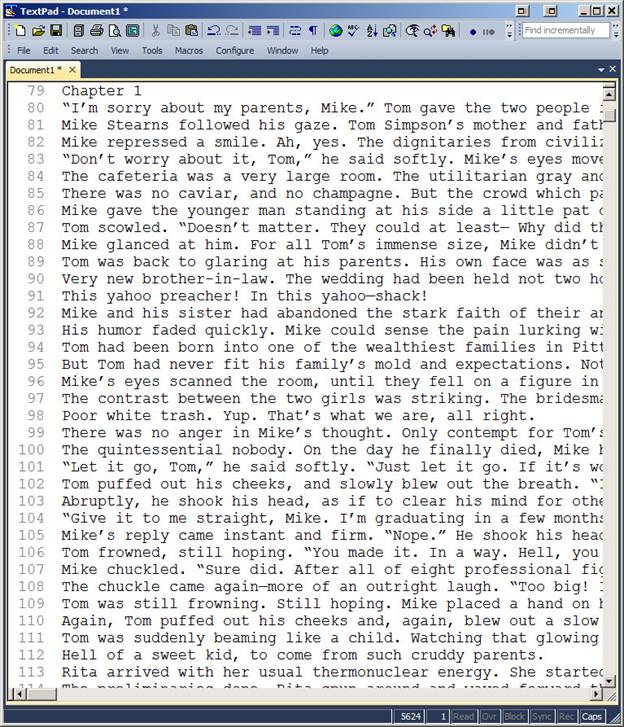
    The process itself is simple: You take the document and convert it to plain text. If it’s an RTF or Word document, you simply select ALL, hit copy, and paste it into Textpad.  The result will look something like this:

    image001

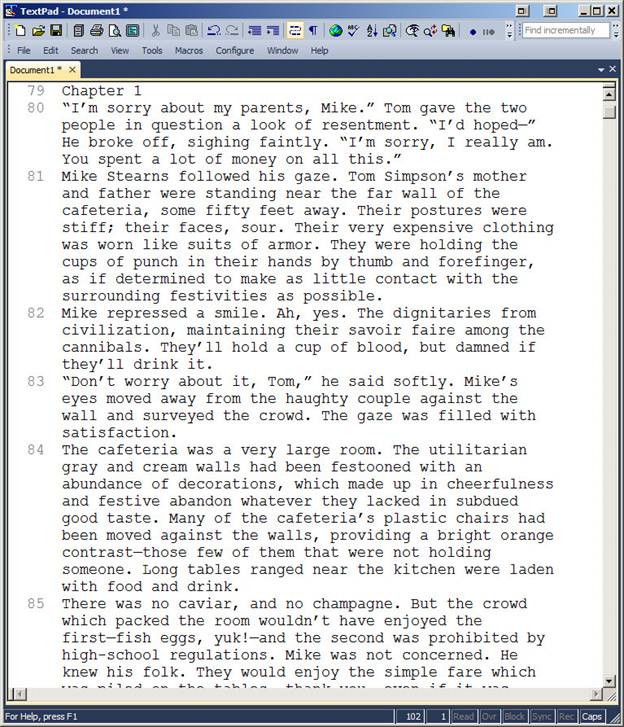
    What I normally do is turn on word wrap, so I can see the whole paragraphs as I go. So it looks like this:

    image002

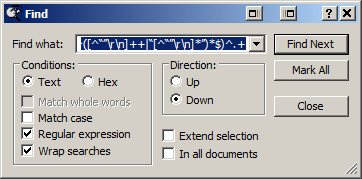
    Now, we go hunting. The next step is to set up the search pattern using a regex. The one I use for this is the following: (?!^([^“”\r\n]++|“[^“”\r\n]*”)*$)^.+ Complicated little brute, isn’t it. I didn’t write it, but I knew who to ask if he could write one, and the above is the result. FYI, there’s also one for straight quotes: (?!^([^”\r\n]++|”[^”\r\n]*”)*$)^.+ You use it the same way. So go into find, and put the regex into the “Find what:” box:

    image003

    Notice that the “Regular expression” box is checked. I also “Wrap searches” just in case I miss something and want to loop around. Click “Find Next” and:

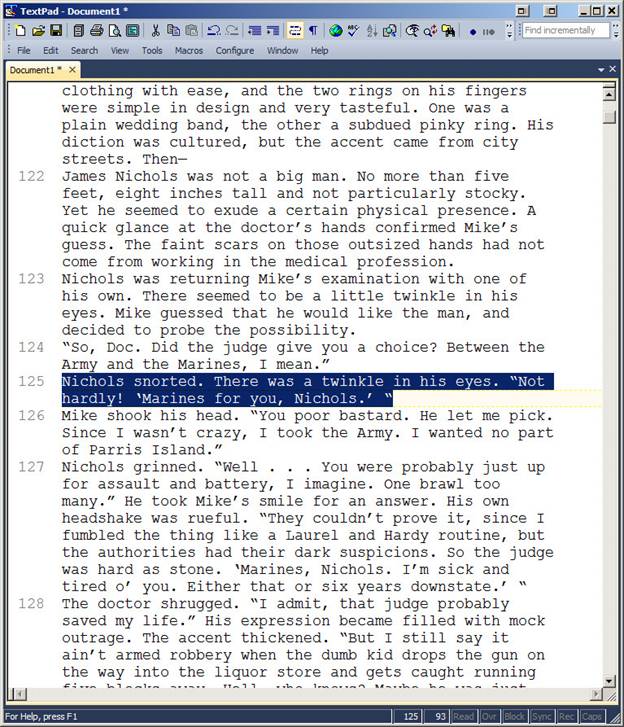
    image004

    The paragraph highlighted has two opening quotes, one at the beginning and one at the end. Word assumes that a quote preceded by a space is an opening quote, so you need to correct it in your RTF/DOC. Wash, rinse, repeat. You keep doing “find next” all the way through, checking for situations like the following:

    image005

    As I said, same speaker, next paragraph, so this one is good. This post is getting a little long for a blog entry, what with illustrations, so I’ll break off here. Stay tuned for part two: checking spelling and spelling consistency. In the meantime, here are the RegEx tool commands plus a few bonus goodies: RegExToolCommands.

    Share
  • LTUE 2016 presentation materials

    I promised you I’d post my materials. Here they are.

    Succeeding as a Storyteller 2016-02-13 HANDOUT

    Vivid and Clear 2016-02-11

    What Comes Next 2016-02-12 PRINT

    Also, at the end of my and LL Muir’s presentation of Succeeding as a Writer, I offered some of my books, the ones I authored, for free in the back. I would like to ask whoever accidentally got caught up in the mad rush (it was like Black Friday) and took my copy of Cheree Alsop’s Daybreak: Girl from the Stars Book 1 to please mail it to me. It looks like this:

    Daybreak-Amazon-Kindle-196x300

    It is dedicated to “Mrs. Brown’s Class” and was a present for her. You may mail it to John D. Brown, PO Box 157, Laketown, UT 84038.

    Share

4 Comments

  1. I agree with this totally.

    My “fan-ship” with author Terry Goodkind was actually the inverse of what you mentioned with Lee Child. I read Goodkind’s first “Sword of Truth” book, loved it, rabidly read through the published books in the series, and then bought further books immediately when they came out. As the series petered out though, I became less enthusiastic.

    By the time he officially ended the Sword of Truth series, I followed him to one book in a different (but related) world, but haven’t read any of the things he put out since.

    In his case, I feel like he lost my readership because he failed to stick with the true distinctives of his brand (or at least the ones that I resonated with). I wanted to read a fantasy adventure with a magic system that had a mystery element to it that had to be figured out. And I wanted the story to encapsulate a philosophical theme. However, he started minimizing the fantasy adventure/magical mystery elements in favor of the philosophical ones, and lost me.

    I don’t hate his work. I’d pick up a book of his if I saw one on the shelf or it was cheap. But I’d be looking for the “old Goodkind,” what brought me to him in the first place.

    I wonder if he thought he’d just continue his series because that’s what people had responded to, when really it was the structure and feel of his stories. I would’ve rather he ended “Sword of Truth” earlier and start another series in a completely different world but with the same feel, I think.

  2. I like how you called them the “true distinctives of his brand” that resonated with you. I think this is why series do so much better than stand-alones–folks want more of the same type of story. I loved Bradley Denton’s BUDDY HOLLY IS ALIVE AND WELL ON GANYMEDE and thought I would like the rest of his books, but they were all different, and I failed to become a loyal customer because of it. He’s a great author, but I think it shows that a lot of time when we go back for repeat business we’re wanting a repeat of the same general experience.

  3. J Adams:

    Have you looked at the latest books in the Sword of Truth series? “The Omen Machine” and “The Third Kingdom”? Goodkind left out a lot of the “philosophy”, as you call it. But I did not think they were very compelling stories, although that had little to do with the “philosophy”, or lack thereof. Mostly, the characters and plot were weak.

  4. I haven’t. I only made it halfway through the first of his books. I know a lot of folks who love them, but they just didn’t speak to me.

Comments are closed.